

Bathroom Flooring NZ: Tile vs Vinyl vs Timber (2026)
Last updated:
Bathroom Flooring NZ: Tile vs Vinyl vs Engineered Timber in Auckland’s Humidity
Free cost calculator
How much will your bathroom renovation cost?
Get an instant Auckland price range for your project — no details required to see it.
Quick answer: For most Auckland bathrooms, porcelain tile is the long-term answer and luxury vinyl plank (LVP) is the best mid-budget alternative. Engineered timber doesn’t belong in a bathroom — Auckland’s 82% average humidity will eventually cup, gap or delaminate it, regardless of what the brochure says.
We’ve removed engineered timber from Auckland bathrooms three years after install. The “water-resistant” laminate that swelled at every joint? Stripped that out too. And we’ve lifted porcelain tiles laid in the early 2000s that were still flat, sealed and good for another 15 years on the floor.
After more than 1,000 Auckland renovations, the bathroom flooring decision usually comes down to two real options. The third — engineered timber — is much narrower than the flooring retailers will tell you, and we’ll explain why honestly below.
This guide is for Auckland homeowners choosing between tile, vinyl and timber for a full bathroom or ensuite renovation. We’ll walk through what each material actually does in our humidity, what it costs installed, what it looks like 5 and 10 years on, and where each one fits in the NZ Building Code’s E3 internal moisture rules.

What Auckland’s Humidity Actually Does to Bathroom Floors
Most flooring articles talk about “water resistance”. That’s the wrong frame for Auckland.
The real enemy isn’t a one-off splash from the shower. It’s the daily humidity cycle. According to NIWA’s Mean Relative Humidity climate normals (1991–2020), Auckland sits at roughly 82% relative humidity year-round, climbing to around 89% in June and rarely dropping below about 77%, even in November. Bathrooms then add their own load on top — relative humidity inside the room can spike past 90% during a hot shower and stay above 70% for hours afterwards if the extract fan is undersized or the door’s left shut.
Per NZS 4303:1990, reported by BRANZ, indoor relative humidity should stay no higher than 60% in habitable spaces to control moisture damage and mould. In a typical Auckland bathroom, that target is exceeded every single day. Multiply that by 365 days a year and the flooring is being asked to handle an environment well outside the spec sheet of most timber and laminate products.
Three failure modes we see most often
After more than a decade of bathroom renovations across Mt Eden, Henderson, Albany, Titirangi and the rest of Auckland, the failures we strip out fall into three categories:
1. Joint swelling on water-resistant laminate. The wear layer holds up. The MDF or HDF core does not. Once moisture wicks through the joint — typically at the threshold or around the toilet — the core swells, the surface lifts, and there’s no fix short of replacement.
2. Cupping and gapping on engineered timber. The veneer is real wood. Real wood absorbs moisture from humid air, expands across the grain, and pushes against its neighbour. When the air dries out overnight, it contracts. Repeat that cycle for two years and the boards cup at the edges. Three years and gaps open up. We’ve seen it in homes with good ventilation.
3. Mould between large-format tile grout. This isn’t a tile problem — it’s a grout problem. Cement-based grout is porous. In a poorly ventilated villa bathroom in Grey Lynn or Ponsonby, mould colonises the grout lines within 18 months. Epoxy grout solves it, but most installers don’t quote for it unless you ask.
💡 Quick tip: If your bathroom doesn’t have a window AND a vented extract fan rated for the room size, fix the ventilation before you choose the floor. The best flooring in the world will fail in an unventilated Auckland bathroom.
Subfloor matters as much as the surface
The other thing every retail flooring article skips: what’s underneath. Auckland housing stock varies enormously, and the right floor depends on the subfloor as much as the topcoat.
Pre-1940s villas and bungalows (Grey Lynn, Mt Eden, Ponsonby, Devonport) usually have timber joist subfloors. Underfloor ventilation is often poor, especially after years of additions. A heavy tiled bathroom needs a fibre-cement underlay or plywood overlay rated for wet areas — and the joists may need bracing.
Leaky-era homes (mid-1990s to mid-2000s) across Auckland sometimes have framing that’s already compromised. Before any flooring decision, the framing has to be inspected and remediated where needed.
1970s–80s brick-and-tile in Manurewa, Henderson and Glen Eden often has concrete-slab bathrooms. Slabs are great for tiles, but cold underfoot — underfloor heating becomes worth the investment.
New builds in Hobsonville, Flat Bush and Millwater are typically slab-on-grade with current H1 insulation. Most flooring options work, but check what the developer specified — some have already been damaged by trade traffic before you move in.
Our bathroom renovation team assesses the subfloor before quoting any flooring — it’s the difference between a floor that lasts 10 years and one that fails in three.
Option 1: Porcelain and Ceramic Tile — Still the Auckland Default
Tiles have been the default bathroom floor in Auckland for 40 years. There are reasons that haven’t changed.
Porcelain tile has a water absorption rate below 0.5%. Ceramic tile sits between 3% and 6%. The NZ Building Code’s Acceptable Solution E3/AS1 requires a maximum 6% water absorption for tiles in wet areas, plus glazed edges on glazed tiles and a waterproof membrane laid underneath in accordance with AS/NZS 4858:2004. Porcelain meets the spec by a wide margin. That’s why it’s specified on the vast majority of bathroom projects coming out of our Wairau Valley showroom.
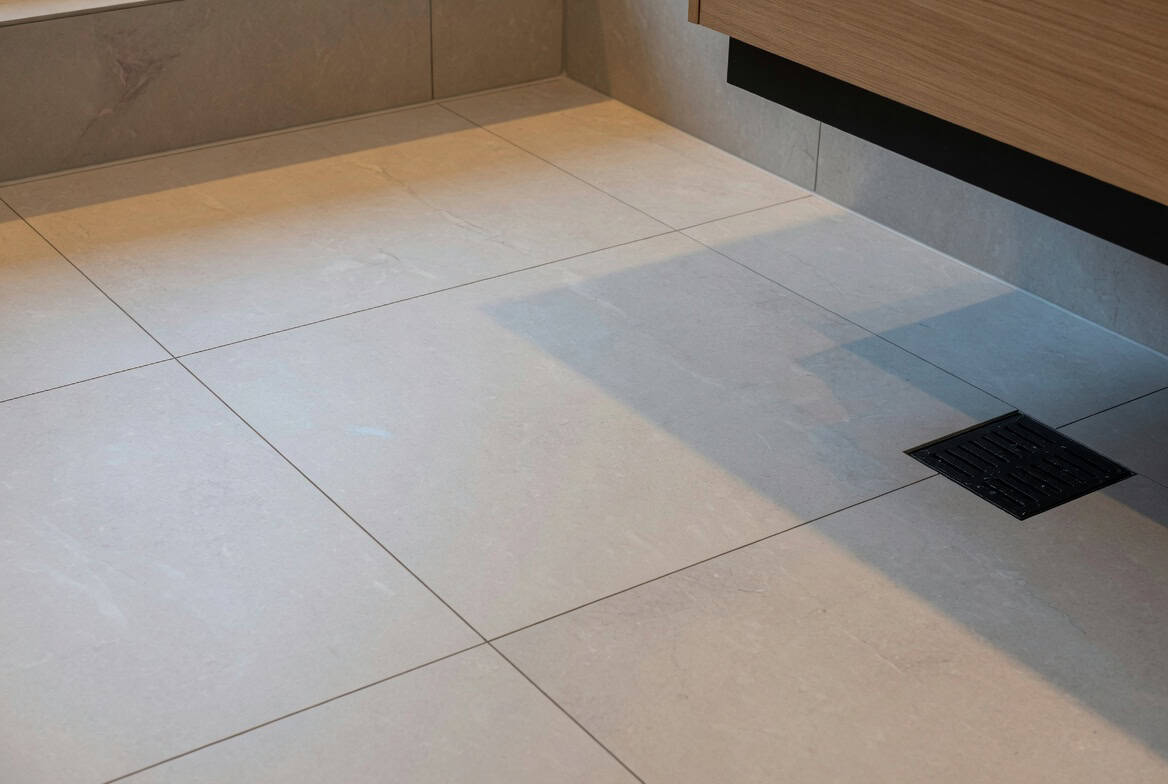
Porcelain vs ceramic vs natural stone — what we actually specify
Porcelain is what we recommend for almost every Auckland bathroom. Dense, dimensionally stable, near-zero absorption, available in large formats (600×600, 600×1200) that minimise grout lines. Through-body porcelain hides chips because the colour runs through the tile, not just the glaze.
Ceramic is fine for walls and acceptable on bathroom floors when budget is tight. The trade-off is durability — ceramic chips and cracks more easily and absorbs more moisture. We see ceramic floor tiles fail at the threshold (where the bathroom door catches them) and around floor wastes more often than porcelain.
Natural stone — travertine, marble, limestone — is beautiful and high-maintenance. Stone needs sealing every 12–24 months in an Auckland bathroom, and an unsealed acid spill (vinegar, citrus cleaner, even some shampoos) etches the surface permanently. Stone gets specified on premium projects in Remuera, Herne Bay and Parnell where the homeowner is committed to the upkeep. For everyone else, porcelain that looks like stone is a better answer.
We work with The Tile Depot on most of our bathroom tile selections — the range covers everything from $40/m² builder-grade porcelain to $200+/m² Italian feature tiles.
The grout question — and why it matters more than the tile
Most tile failures we strip out aren’t tile failures. They’re grout failures.
Standard cement-based grout is porous. In a humid bathroom, water and shampoo residue soak into the grout, mould colonises it, and within two years the grout lines look grey, patchy and tired. Epoxy grout costs more upfront — typically an extra $40–$80/m² on the labour bill — but it’s stain-resistant, mould-resistant and effectively maintenance-free. On any bathroom we expect to last 15+ years, we specify epoxy in the wet zones.
“The mistake we see most often is people choosing the tile carefully and then leaving the grout decision to whoever’s installing. Grout is half the floor visually, and almost all the maintenance burden. Spec it as carefully as you spec the tile — especially the colour. A dark grout with a light tile looks great for a year, then the contrast just shows every flaw.”
— Cici Zuo, Head of Sales (NZ Dip. Interior Design), Superior Renovations
The cold-underfoot problem (and how to solve it)
The honest weakness of tile is temperature. Tile sits at room temperature, and Auckland room temperatures in winter can drop below 14°C inside a poorly heated bathroom. Stepping out of a hot shower onto a 14°C tile floor is unpleasant.
Underfloor heating fixes it permanently. Electric underfloor heating mats run $80–$150/m² supplied and around $2/day to operate on a thermostat-controlled timer. For a 6m² Auckland bathroom, that’s roughly $1,500–$2,500 supplied and installed — a small percentage of the total renovation cost and the single upgrade that clients tell us they’d never skip again.
💡 Quick tip: Slip resistance matters as much as look. Ask for the R-rating of any tile before you sign off — R10 is the minimum for a residential bathroom floor, R11 is better for the shower zone. Polished porcelain looks beautiful and is dangerous wet.
Tile cost — what to budget for an Auckland bathroom
For a typical 6m² Auckland bathroom floor:
| Tile type | Supply ($/m²) | Installed total ($/m²) | Realistic 6m² floor cost |
|---|---|---|---|
| Builder-grade porcelain | $40–$60 | $120–$160 | $720–$960 |
| Mid-range porcelain | $70–$120 | $160–$220 | $960–$1,320 |
| Premium porcelain / stone-look | $120–$200+ | $220–$320+ | $1,320–$1,920+ |
| Natural stone | $150–$300+ | $280–$450+ | $1,680–$2,700+ |
| Add: waterproof membrane + substrate prep | — | $80–$150 | $480–$900 |
For a sense of where flooring sits in a full bathroom budget, our bathroom renovation cost calculator gives a tailored estimate for your project.
Option 2: Luxury Vinyl Plank (LVP/SPC) — The Category That Changed
Five years ago, we wouldn’t have written this section. Vinyl in a bathroom meant sheet vinyl glued to particleboard, and it looked like rental kitchen flooring.
The category has changed completely. Modern luxury vinyl plank (LVP) and stone polymer composite (SPC) flooring is genuinely waterproof — not water-resistant, waterproof — with a wear layer that holds up to family-bathroom use, click-lock or glue-down installation, and a finish that mimics timber convincingly. We now specify it on roughly 30% of our bathroom renovations, particularly ensuites, low-traffic family bathrooms and rentals.

LVP vs SPC vs sheet vinyl — what’s the difference
The category has three main subtypes, and the distinction matters.
LVP (Luxury Vinyl Plank) — typically 4–7mm thick, flexible PVC core, click-lock or glue-down install, timber-look or stone-look surface. Suitable for bathrooms when fully waterproof and installed correctly.
SPC (Stone Polymer Composite) — rigid core made from limestone powder and PVC, typically 4–6mm thick. More dimensionally stable than LVP, denser, harder underfoot. Our preferred subtype for full bathrooms because the rigid core handles temperature and humidity cycling without flexing at joints.
Sheet vinyl — old-school continuous roll, heat-welded at the seams. Cheap, fast to install, genuinely seamless when done right. Looks dated to most modern eyes, but in rental properties and laundry-bathrooms where budget is the priority, it’s still a defensible choice.
What to look for on the spec sheet
Most LVP/SPC failures we see come down to two specifications buyers don’t check: wear layer thickness and joint type.
Wear layer. This is the transparent top layer that protects the printed design from scratches and scuffs. For a bathroom, 0.4mm is the absolute minimum and 0.5mm is what we specify on family bathrooms. Anything below 0.3mm is sold as residential-grade but won’t last in a bathroom under daily use.
Joint type. Click-lock LVP is faster to install and works well in dry rooms. In a bathroom, we install glue-down LVP — the adhesive forms a continuous moisture barrier and the joints can’t lift if standing water sits on the floor for any length of time. The cost difference is small. The reliability difference is significant.
“The trade-off most people don’t understand is install time. A tiled bathroom needs the substrate, then waterproofing, then the membrane to cure, then tiling, then grouting, then sealing. That’s eight to ten working days for the floor alone. Glue-down LVP is two days. On a tight reno timeline — say a Henderson family with one bathroom and two kids — that’s a real difference.”
— Alison Yu, Designer, Superior Renovations
Where LVP/SPC works — and where it doesn’t
We specify LVP on:
- Ensuites and master bathrooms with low water exposure (separate enclosed shower)
- Second bathrooms in family homes — kids’ bathrooms, guest bathrooms
- Combined laundry-bathrooms where the floor needs to handle washing machine overflow risk
- Rental properties and investment renovations where install speed and 10-year durability beat 25-year longevity
We don’t specify LVP on:
- Wet rooms with no shower enclosure — large quantities of standing water can still find joints
- Heritage villa bathrooms where the look needs to be authentic stone, ceramic or tile
- High-end resale renovations in premium suburbs (Remuera, Herne Bay) where buyers expect tile
💡 Quick tip: Ask for a sample piece and feel the weight. SPC and quality LVP feel substantial in your hand. If a sample feels light or flexes easily, the core is thin or low-density — it won’t perform in a wet area, regardless of the marketing.
LVP cost — what to budget
For a 6m² Auckland bathroom floor in glue-down LVP or SPC:
| Product tier | Wear layer | Installed ($/m²) | Realistic 6m² floor cost |
|---|---|---|---|
| Entry LVP | 0.3mm | $50–$70 | $300–$420 |
| Mid-range LVP/SPC | 0.4mm | $70–$100 | $420–$600 |
| Premium SPC (recommended) | 0.5mm+ | $100–$140 | $600–$840 |
| Add: substrate levelling (if needed) | — | $30–$60 | $180–$360 |
LVP comes in roughly half the installed cost of mid-range tile. Over a 10-year horizon, the running maintenance cost is also lower — no grout to scrub, no sealing to redo. The trade-off is replacement: where porcelain tile lasts 20–30 years, quality LVP lasts 10–15. For most Auckland homeowners, that trade-off is worth it.
Option 3: Engineered Timber — Why We Don’t Install It in Auckland Bathrooms
This is where we’ll be more direct than most flooring articles.
We don’t install engineered timber in bathrooms. Not in ensuites, not in family bathrooms, and we’d push back on it even in a powder room. The reasons are physical, not commercial — engineered timber is a beautiful product, and we install plenty of it in living areas, hallways and bedrooms. It just doesn’t belong on a bathroom floor in Auckland’s climate.
The retail flooring articles you’ll read are mostly written by businesses that sell timber. They have a reason to find a “yes, but only in a powder room with perfect ventilation” angle. We don’t sell flooring — we install it as part of full bathroom renovations and stand behind the work. Different incentive, different answer.
What engineered timber actually is
Engineered timber boards are typically constructed with a real timber veneer (1–6mm thick depending on the product) bonded to a plywood or HDF core. Those boards are made to sit in the humidity range of a normal living space, and that is what their warranties assume. NZS 4303:1990, cited by Level, recommends relative humidity no greater than 60% in habitable spaces.
The problem is in the spec itself. Auckland’s outdoor relative humidity averages 82% and bathroom relative humidity routinely exceeds 90% during showering. The product is being asked to hold its shape in conditions outside the manufacturer’s stated tolerance, every single day, for years.
What we see when we strip it out
When we open up an Auckland bathroom that has engineered timber on the floor — usually we’re called in for a “the floor’s lifting” job after 3–5 years — we see one or more of:
Cupping at the board edges. The veneer absorbs moisture from below (where ventilation is worst), expands more than the core, and the edges curl upward. Once cupping starts, it’s permanent.
Gapping along the joints. Seasonal humidity cycling pushes boards apart. By winter the gaps close. By summer they open again. The finish at the edges cracks, water ingress accelerates, the cycle worsens.
Finish degradation around the toilet and shower. Even where the boards themselves haven’t moved, the surface finish breaks down where it’s hit repeatedly with moisture. The wood underneath darkens, mould can establish under the finish, and there’s no cosmetic fix.
Subfloor damage in older homes. If water has been passing through joints for years undetected, the timber subfloor or the building paper underneath may need remediation. We’ve seen this in a couple of Glen Eden and Henderson villas where the engineered floor was hiding a much bigger problem.
“Most clients who ask about engineered timber for a bathroom have seen it on Pinterest or in a European design magazine. The look is beautiful — warm, soft, considered. The honest answer is: that look is achievable in a powder room with no shower if you’re prepared to replace the floor in five to seven years. For anyone who wants a bathroom floor that lasts, it’s not the right product.”
— Cici Zuo, Head of Sales (NZ Dip. Interior Design), Superior Renovations
The “powder room exception” — why we still hesitate
Some flooring retailers will tell you engineered timber is fine in a powder room (a half-bathroom with a toilet and basin, no shower or bath). The reasoning: less direct water exposure, lower humidity load.
There’s some logic to it. But we still hesitate, and here’s why: most engineered timber warranties explicitly exclude wet areas. Read the fine print. If the floor cups or gaps in three years, there is no warranty claim. You’ve spent $80–$140/m² on a floor with no manufacturer backing in the room you put it in.
If a client really wants timber-look in a powder room, we’ll specify a high-end timber-look porcelain tile or a premium SPC plank. They look like timber. They behave like a bathroom floor should.
⚠️ Important note: If you have an existing engineered timber floor that runs from a hallway into a bathroom or ensuite, the right move during a renovation is to terminate the timber at the threshold and transition to tile or LVP inside the bathroom. We do this regularly — with a flush threshold strip, the visual line is clean and the bathroom floor lasts.
Brief takes on three other options we get asked about
Laminate (including “water-resistant” laminate). Even the products certified as waterproof rely on the seal at the joints holding for the life of the floor. Once a joint fails — usually around the toilet or threshold — the MDF core swells and lifts. We don’t recommend laminate in any Auckland bathroom.
Hybrid flooring. “Hybrid” usually means rigid-core LVP/SPC — the same product we covered in Option 2, often marketed under a different name. If the spec sheet shows a stone polymer or rigid core with 0.4mm+ wear layer, it’s a sound choice. The marketing label matters less than the spec.
Polished concrete. Works beautifully in the right Auckland home — usually new-builds with slab-on-grade designed in from day one. As a retrofit in an existing villa or bungalow, the engineering complexity (slab thickness, slope to drain, sealing, transition to other rooms) usually makes tile or LVP a better answer.
Decision Matrix: What to Choose Based on Your Auckland Bathroom
The “best” bathroom flooring isn’t a single answer. It depends on the bathroom type, the housing stock, the budget and how long you plan to live in the home. Here’s how we’d advise across the most common Auckland scenarios.
Match the floor to the bathroom
| Bathroom type | Best floor | Acceptable alternative | Avoid |
|---|---|---|---|
| Master ensuite (long-term home) | Porcelain tile + underfloor heating | Premium SPC (0.5mm wear) | Engineered timber, laminate |
| Family bathroom | Porcelain tile + epoxy grout | Premium SPC | Engineered timber, ceramic |
| Powder room (no shower) | Timber-look porcelain | Mid-range LVP | Engineered timber, laminate |
| Combined laundry-bathroom | SPC (overflow tolerance) | Porcelain with floor waste | Any timber product |
| Rental property bathroom | Mid-range LVP (fast install) | Builder-grade porcelain | Premium tile (over-spec) |
| Wet room (open shower) | Porcelain tile, R11 slip rating | — (not LVP) | All timber, all laminate, LVP |
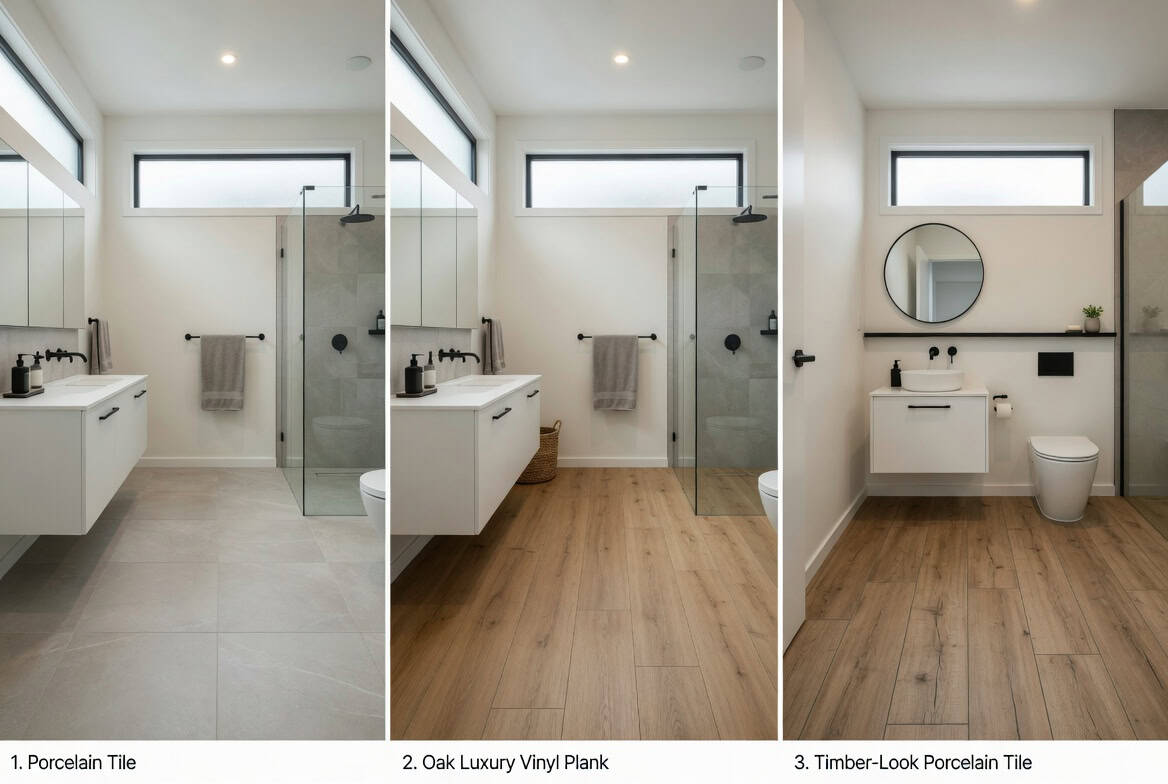
Render generated using Sketch Up to show clients the difference.
Match the floor to the house
The Auckland housing stock layer changes the calculus too. A few examples:
1920s villa in Grey Lynn or Mt Eden: Timber subfloor, often poor underfloor ventilation. Heavy tile is achievable but the joists may need sistering and a fibre-cement underlay is essential. SPC can be a faster, lighter alternative if the heritage look isn’t a priority.
1970s brick-and-tile in Henderson or Glen Eden: Concrete slab, cold underfoot. Tile with electric underfloor heating is the sweet spot. SPC also works well here and warmer than tile without heating.
Leaky-era home (1995–2005, scattered across Auckland): Don’t choose the floor first. Get the framing inspected. Once any weathertightness issues are remediated, the floor decision is the same as any other home — usually porcelain tile.
New build in Hobsonville, Flat Bush or Millwater: Slab-on-grade with current H1 insulation. Both tile and SPC work; choice usually comes down to design preference and budget.
Our in-house design team walks every client through this decision in a free consultation — including a visit to our Wairau Valley showroom where you can see and step on porcelain, SPC, ceramic, stone-look LVP and timber-look tile side by side. The difference between a sample held in your hand and the same material laid out across 6m² is significant.
💡 Quick tip: If you’re comparing tile and LVP samples in a showroom, ask to see them on the actual floor display, not just in your hand. Floor materials look completely different at floor level under bathroom lighting compared to held under fluorescent showroom lights.
NZ Building Code, Waterproofing and What’s Actually Compliant
This is the part most retail flooring articles skip — and the part Auckland Council care about most when consent is involved.
The E3 Internal Moisture clause
The NZ Building Code clause E3 (Internal Moisture) requires that finished floors in wet areas — bathrooms, ensuites, laundries, kitchens with floor wastes — must be impervious. The Acceptable Solution E3/AS1 gives three approved finishes:
- Waterproof sheet material (such as PVC sheet vinyl) with sealed joints, sealed or coved at edges
- Ceramic or stone tiles with maximum 6% water absorption and waterproof grouted joints, laid over a waterproof membrane
- Concrete slab-on-grade with steel-trowelled or polished finish, sealed at splash zones (typically used in laundries and garage bathrooms only)
LVP and SPC sit outside the explicit Acceptable Solution but can be used as an alternative solution provided the product manufacturer’s wet-area certification is documented and the installation method is compliant — typically meaning glue-down with sealed perimeter and full-coverage adhesive. Most quality LVP/SPC manufacturers supply this documentation.
The waterproof membrane requirement
Whatever the finished floor, a waterproof membrane laid in accordance with AS/NZS 4858:2004 is required throughout shower zones and recommended under all tiled bathroom floors — and in practice, Auckland Council inspections typically expect it across the full wet-area floor. The membrane is what stops water reaching the framing and substrate — the tile is just the visible finish.
For tiled bathrooms, the membrane is laid over a properly prepared substrate (usually 6mm fibre-cement underlay over plywood, or directly onto a primed concrete slab), the joints and corners are coved, and the membrane is taken up the walls of the shower zone to a minimum specified height. A PS3 (Producer Statement — Construction Review) is typically issued by the licensed waterproofer, and Auckland Council inspects waterproofing during the consent process for any bathroom that requires consent.
Who can do this work legally
Bathroom waterproofing is restricted building work. It must be carried out by a Licensed Building Practitioner (LBP) with a relevant licence class, or by someone supervised by one. Most insurance and warranty claims for bathroom failures hinge on whether this paperwork is complete — if waterproofing was done by an unlicensed person, the homeowner is exposed.
Our bathroom renovations include all consent management, LBP-supervised waterproofing and PS3 certification as standard. The paperwork matters as much as the tilework.
⚠️ Important note: If you’ve had a previous bathroom renovation and don’t have the PS3 waterproofing certificate, that’s a problem at resale time. A LIM report flagging missing documentation can affect both the sale price and the buyer’s insurance. If you’re renovating now, file the certificate carefully — your future self will thank you.
Summary: How to Decide
Three questions will get you to the right floor in five minutes:
1. How long do you plan to live in the home? If it’s 10+ years and the bathroom is going to be heavily used, porcelain tile pays for itself. If it’s a 5–8 year horizon or a rental, premium SPC is genuinely competitive.
2. What’s the bathroom doing? Wet room or family bathroom with kids — tile, R11 slip rating, epoxy grout. Ensuite with separate enclosed shower — tile or premium SPC, your call. Powder room with no shower — porcelain that looks like timber, not actual timber.
3. What’s the housing stock? Heritage villa where the look matters — tile. New build or post-1970s with slab — both options work, choose on warmth and budget. Leaky-era home — fix the framing first.
For most Auckland homeowners renovating a single bathroom for the long term, the answer remains the boring one: porcelain tile, epoxy grout in the wet zones, electric underfloor heating, and a properly certified waterproof membrane underneath. It’s been the right answer for 40 years. It’s still the right answer for most of the bathrooms we hand back to clients across the city. Across all of our completed Auckland bathroom projects, porcelain tile has consistently outperformed every alternative on lifespan, low maintenance and resale value.
For ensuites, low-traffic family bathrooms and rentals, premium SPC is the modern alternative — and a fair one. For engineered timber, the honest answer in our climate is no.
If you’d like a designer to walk through your specific bathroom — the housing stock, the layout, the realistic budget, the floor that fits — book a free in-home consultation with us. Our team handles the design, materials, consent, waterproofing and installation under one roof, and we stand behind every floor we install.
➡ Book your free in-home consultation with Superior Renovations
➡ Use our bathroom renovation cost calculator
➡ Request a free feasibility report for your project
What is the best bathroom flooring for NZ humidity?
For most Auckland bathrooms, porcelain tile is the best long-term option — it has under 0.5% water absorption, meets NZ Building Code E3/AS1 requirements, and lasts 20–30 years. Premium SPC (stone polymer composite) flooring is the strongest alternative for ensuites and family bathrooms, with 10–15 year durability and faster installation. Both handle Auckland's 82% average humidity reliably when installed correctly with a waterproof membrane underneath.
How much does bathroom flooring cost in Auckland?
For a typical 6m² Auckland bathroom: builder-grade porcelain tile runs $720–$960 installed, mid-range porcelain $960–$1,320, and premium porcelain or stone-look $1,320–$1,920+. Add $480–$900 for substrate prep and waterproof membrane. Premium SPC flooring sits at $600–$840 installed for the same 6m² area. Within a full bathroom renovation — typically $26,000–$35,000 in Auckland for a mid-range project — the floor is usually 6–12% of total cost.
Can I install engineered timber in a bathroom in NZ?
We don't recommend it. Engineered timber is made for normal living-space humidity — NZS 4303:1990 recommends no greater than 60% in habitable spaces — but Auckland averages 82% and bathrooms regularly exceed 90% during showers. Within 3–5 years we typically see cupping, gapping or finish degradation. Most engineered timber warranties explicitly exclude wet areas, leaving you without manufacturer backing if it fails. For a timber look in a bathroom, specify a high-end timber-look porcelain tile or premium SPC instead.
Is vinyl plank waterproof in bathrooms?
Quality LVP and SPC flooring is genuinely waterproof — not water-resistant — when correctly installed with the glue-down method. Look for a wear layer of at least 0.4mm (0.5mm+ for family bathrooms) and a rigid stone polymer core. Click-lock LVP can let moisture wick through joints over time, so for bathrooms we always specify glue-down installation with a sealed perimeter. With the right product and installation, expect 10–15 years of reliable performance.
Do I need a waterproof membrane under bathroom tiles in NZ?
Yes, it is mandatory under the NZ Building Code. Clause E3 Internal Moisture and Acceptable Solution E3/AS1 require a waterproof membrane laid to AS/NZS 4858:2004 standard under all tiled bathroom floors, with extra coverage in shower zones. A PS3 (Producer Statement — Construction Review) certificate from the licensed waterproofer is typically required and is inspected by Auckland Council during the consent process. Without compliant waterproofing, both your build consent and your insurance can be compromised.
What thickness of LVP flooring should I use in a bathroom?
For an Auckland bathroom, the wear layer matters more than the total thickness. A wear layer of 0.4mm is the absolute minimum and 0.5mm or above is what we specify for family bathrooms. Total thickness is typically 4–6mm for SPC and 4–7mm for LVP, but a 6mm board with a 0.3mm wear layer will fail before a 4mm board with a 0.5mm wear layer. Always check the wear layer specification on the product datasheet before buying.
Is porcelain tile better than ceramic for bathroom floors?
Yes, for almost every Auckland bathroom. Porcelain has under 0.5% water absorption while ceramic sits between 3% and 6% — both meet the NZ Building Code E3/AS1 maximum of 6%, but porcelain has a much wider safety margin. Porcelain is also denser, more chip-resistant, and through-body porcelain hides chips because the colour runs through the tile. Ceramic floor tiles fail more often at thresholds and around floor wastes. The price difference is marginal compared to the durability difference.
How long does bathroom flooring last in Auckland?
With proper waterproofing and ventilation, porcelain tile lasts 20–30 years and is often still serviceable when the bathroom is replaced for design reasons rather than failure. Quality SPC and LVP flooring lasts 10–15 years in a bathroom. Engineered timber typically fails within 3–5 years in an Auckland bathroom regardless of brand. Water-resistant laminate fails when the first joint lets moisture through, often within 2–4 years. Lifespan also depends heavily on bathroom ventilation — a bathroom without an extract fan will reduce every floor type's lifespan.
Should I get underfloor heating with bathroom tiles?
For most Auckland homes, yes. Tile sits at room temperature and Auckland room temperatures in winter can drop below 14°C in poorly heated bathrooms — uncomfortable underfoot after a hot shower. Electric underfloor heating mats run $80–$150 per square metre supplied and add roughly $1,500–$2,500 to a typical 6m² bathroom installed. Run on a thermostat-controlled timer, the operating cost is around $2 per day. Of all the bathroom upgrades clients tell us they would never skip again, underfloor heating is the most common.
What does the NZ Building Code require for bathroom floors?
NZ Building Code clause E3 (Internal Moisture) requires bathroom floors to be impervious. Acceptable Solution E3/AS1 lists three approved finishes: waterproof sheet material with sealed joints, ceramic or stone tiles with maximum 6% water absorption laid over a waterproof membrane, and slab-on-grade concrete with appropriate sealing. A waterproof membrane to AS/NZS 4858:2004 is mandatory under tiled floors. Waterproofing is restricted building work and must be done by or supervised by a Licensed Building Practitioner (LBP), with PS3 certification typically required.
Can I install bathroom flooring myself?
The flooring itself can be DIY in some cases — sheet vinyl, click-lock LVP in dry areas — but bathroom waterproofing is restricted building work under NZ legislation and must be carried out or supervised by a Licensed Building Practitioner with a relevant licence class. Without LBP-certified waterproofing, the work will not pass council inspection if the bathroom requires consent, and your home insurance may not cover failures. For most Auckland bathroom renovations, the saving on DIY flooring is small relative to the risk if waterproofing isn't compliant.
Do dark or light bathroom floor tiles show water marks more?
Dark tiles show water marks, soap scum and limescale more visibly than light tiles, especially in polished or semi-gloss finishes. For Auckland's hard water — particularly common in suburbs supplied from older infrastructure — matte or satin-finish tiles in mid-tone neutral colours are easiest to keep looking clean. Light grey, taupe and warm beige porcelain tiles in matte finish are popular choices because they hide both water marks and minor scuffs. If you want a dark floor, accept that it will need more frequent cleaning to stay looking sharp.
Further Resources for your bathroom renovation
- Featured projects and Client stories to see specifications on some of the projects.
- Our full guide to timber, engineered and laminate flooring
- Real client stories from Auckland
- Browse our bathroom design gallery for inspiration across tile, vinyl and stone-look floors
- Visit our Wairau Valley showroom at 16B Link Drive to see all flooring options side by side
Need more information?
Take advantage of our FREE Complete Home Renovation Guide (48 pages), whether you’re already renovating or in the process of deciding to renovate, it’s not an easy process, this guide which includes a free 100+ point check list – will help you avoid costly mistakes.
Download Free Renovation Guide (PDF)
Have you been putting off getting renovations done?
We have partnered with Q Mastercard ® to provide you an 18 Month Interest-Free Payment Option, you can enjoy your new home now and stress less.
Learn More about Interest-Free Payment Options*
*Lending criteria, fees, terms and conditions apply. Mastercard is a registered trademark and the circles design is a trademark of Mastercard International Incorporated.
Still have questions unanswered?
Book a no-obligation consultation with the team at Superior Renovations,
we’d love to meet you to discuss your renovation ideas!