

Pergola NZ Guide 2026: Costs, Roof Options and Screens
Updated July 2026 with the latest consent rules, Auckland wind zone guidance, and real project cost ranges.
Quick Answer: What You Need to Know About Pergolas in NZ
Free cost calculator
How much will a new pergola cost?
Get an instant Auckland price range for your project — no details required to see it.
An unroofed pergola of any size is exempt from building consent in New Zealand under Schedule 1 of the Building Act 2004. The moment you add a solid roof, it becomes a veranda, and that has a 30m² ground-floor exemption. A pergola in Auckland typically costs $1,500–$3,500 for a DIY kitset and $8,000–$35,000 for a custom build, with louvre and retractable roof systems sitting at the top of that range. (Price a louvre roof with our calculator.) Materials matter: aluminium handles coastal salt, timber suits character homes, and steel earns its keep in high-wind zones like Piha or Westmere.
Looking for a quick cost estimate for your custom pergola?
Try our calculator below (results in 2 minutes):
Most Auckland homeowners we speak to assume they need a consent for a pergola. Most don’t. Most also assume a pergola and a veranda are the same thing legally, they’re not, and the difference is the single biggest cause of unnecessary consent applications and surprise costs we see.
This guide covers what a pergola actually is under NZ law, which materials handle our weather, what realistic Auckland prices look like in 2026, and how to decide between a $2,500 kitset from Mitre 10 and a $20,000 custom build. We’ve designed and built pergolas across the North Shore, Eastern Bays, Central Auckland and West Auckland, the cost ranges and project notes here come from real jobs, not industry averages.
Pergola or Veranda? The Difference That Decides Whether You Need Consent
This is the part most NZ pergola guides get wrong, and it’s the part that costs homeowners the most money.
Under Schedule 1 of the Building Act 2004, a pergola is defined as a simple-framed, unroofed structure. It’s exempt from building consent with no size limit, as long as it doesn’t have a solid roof. The moment you add a fixed roof (polycarbonate, steel sheeting, even a permanent louvre system in some interpretations), it stops being a pergola in the eyes of the Act. It becomes a veranda or carport, and a different exemption applies.
The veranda exemption allows up to 30m² on the ground floor without consent, provided the structure is built using lightweight materials and follows accepted construction standards. Anything bigger, or attached in a way that affects the host building’s weathertightness or structure, will need a consent.
For full official guidance see the MBIE Schedule 1 exempt building work guidance.
What About Auckland Unitary Plan Rules?
Being exempt from a building consent doesn’t mean you can ignore Auckland Council district plan rules. The Auckland Unitary Plan still controls:
- Yard setbacks, typically 1.5–3m from boundaries, depending on your zone
- Height in relation to boundary, daylight planes in residential zones
- Maximum height, usually 8m in residential zones, but local overlays can be stricter
- Heritage and special character overlays — Ponsonby, Grey Lynn, Devonport and parts of Parnell have additional restrictions even on exempt structures
“Boundary rules catch a lot of owners out. We measure twice before posts go in the ground, a 25m² pergola that’s compliant under the Building Act but breaches a setback in the District Plan is still going to cost you a resource consent or a removal order.” — Dorothy Li, Design Manager, Superior Renovations
If you’re planning anything within 1m of a boundary, in a heritage zone, or attached to your house, the safe move is a quick call to Auckland Council’s duty planner before you commit. It’s free, it takes ten minutes, and it stops you finding out the hard way.
💡 Quick tip: Call 0800 BEFORE YOU DIG before any post goes in. Pergola posts go 600–900mm deep, that’s right into the zone where underground power, gas, fibre and water services sit. A free service-locate call now beats a $4,000 repair bill later.
Best Pergola Materials for Auckland Conditions
Auckland’s not a single climate. The North Shore has salt-laden sea breeze. Central suburbs get humid summers and damp winters. West Auckland and exposed bays cop genuine wind. The right material depends less on aesthetics and more on what your site throws at it.
Aluminium — The Default for Coastal Auckland
Powder-coated aluminium is the most popular pergola material we install, and for good reason. It doesn’t rust, it doesn’t rot, and a matte black or off-white finish holds its colour for 15–20 years before a recoat is even worth thinking about.
Best for: Coastal suburbs like Takapuna, Devonport, Mission Bay, Browns Bay, Piha, and any property within 1km of the coast where salt corrosion is a real factor.
Watch out for: Cheap imported aluminium with thin powder-coat. Marine-grade or architectural-grade (minimum 80-micron coating) is the spec to look for if you’re near the water.
Cost range: $12,000–$30,000 fully installed for a typical 4m × 4m custom design.
Timber — Character Homes, Inland Suburbs
A timber pergola in Western Red Cedar, macrocarpa or treated pine still has a place, especially on character villas and bungalows in Mt Eden, Grey Lynn, Remuera, Epsom and Sandringham where aluminium can look out of place against the original architecture.
Best for: Inland suburbs, character homes, owners who want to stain or paint to match an existing colour scheme.
Watch out for: Untreated or H3.1-treated timber close to the ground. For posts in or near soil, H4 or H5 treatment is the minimum, anything less will rot inside 8–10 years in Auckland’s wet winters. Resene Woodsman or a similar UV-stable oil-based stain needs reapplying every 2–3 years.
Cost range: $8,000–$22,000 fully installed for a 4m × 4m custom build.
Steel — High-Wind Sites, Larger Spans
Steel is the right call when wind exposure or span length is the controlling factor. A steel pergola can clear-span 6m+ without intermediate posts, which timber and aluminium struggle to do affordably.
Best for: Exposed properties in Westmere, Herne Bay, Bucklands Beach, lifestyle blocks west of Auckland, anywhere classified high or very high wind zone under NZS 3604.
Watch out for: Hot-dip galvanised or marine-grade powder coat is essential. Painted steel will rust at every fixing point within 5 years on a coastal site.
Cost range: $14,000–$35,000 fully installed.
What’s a “Wind Zone” and Why Does It Matter?
Most Auckland suburbs fall in the medium wind zone under NZS 3604, but coastal Takapuna, Piha, Karekare, Westmere and the exposed Eastern Bays can hit high or very high. The wind zone dictates post size, footing depth, and bracing requirements.
For a medium wind zone, 100×100mm timber or 75×75mm steel posts with 600mm footings is typical. For high/very high, that goes up to 150×150mm timber or 100×100mm steel with 900mm footings and diagonal bracing. A pergola spec’d for the wrong wind zone is the single most common failure mode we see in DIY builds across Auckland.
Pergola Designs That Work in NZ, and What They Cost
The pergola category has changed in the last five years. Five years ago “pergola” meant timber posts and rafters. Today it covers everything from a $1,500 freestanding kitset to a $40,000 louvre roof system with motorised LED lighting and rain sensors. Here’s what the actual options look like in 2026, with honest cost ranges from real Auckland jobs.
1. Open-Slat Pergola (Traditional)
A classic frame with timber or aluminium slats overhead. Provides dappled shade and visual structure without blocking light. Best paired with climbing plants, jasmine, clematis, or NZ natives like clematis paniculata or muehlenbeckia for a softer look.
Cost: $1,500–$3,500 kitset / $8,000–$15,000 custom
Best for: Character homes, gardens, BBQ areas where rain shelter isn’t critical
2. Polycarbonate or Tinted Glass Roof
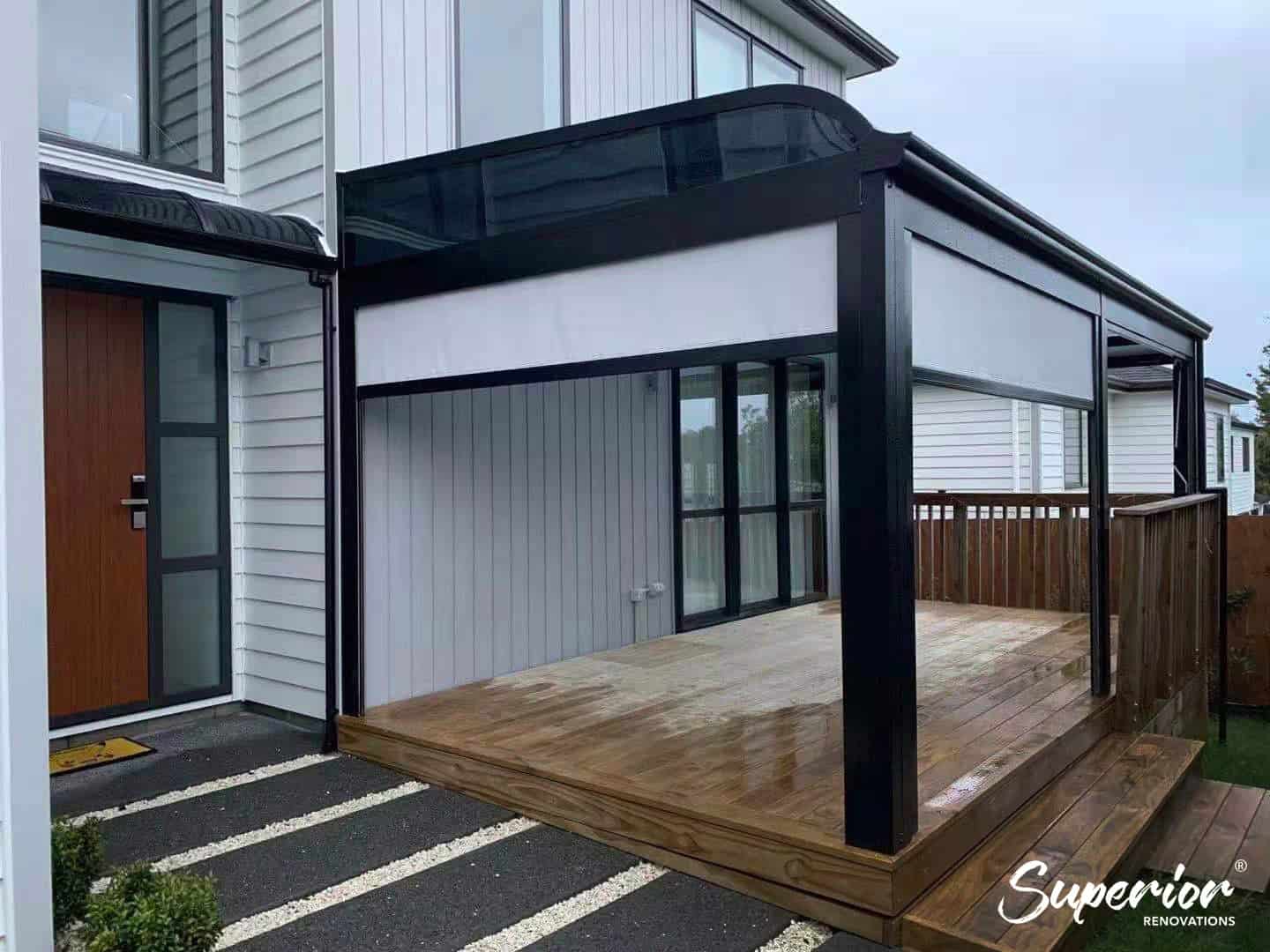
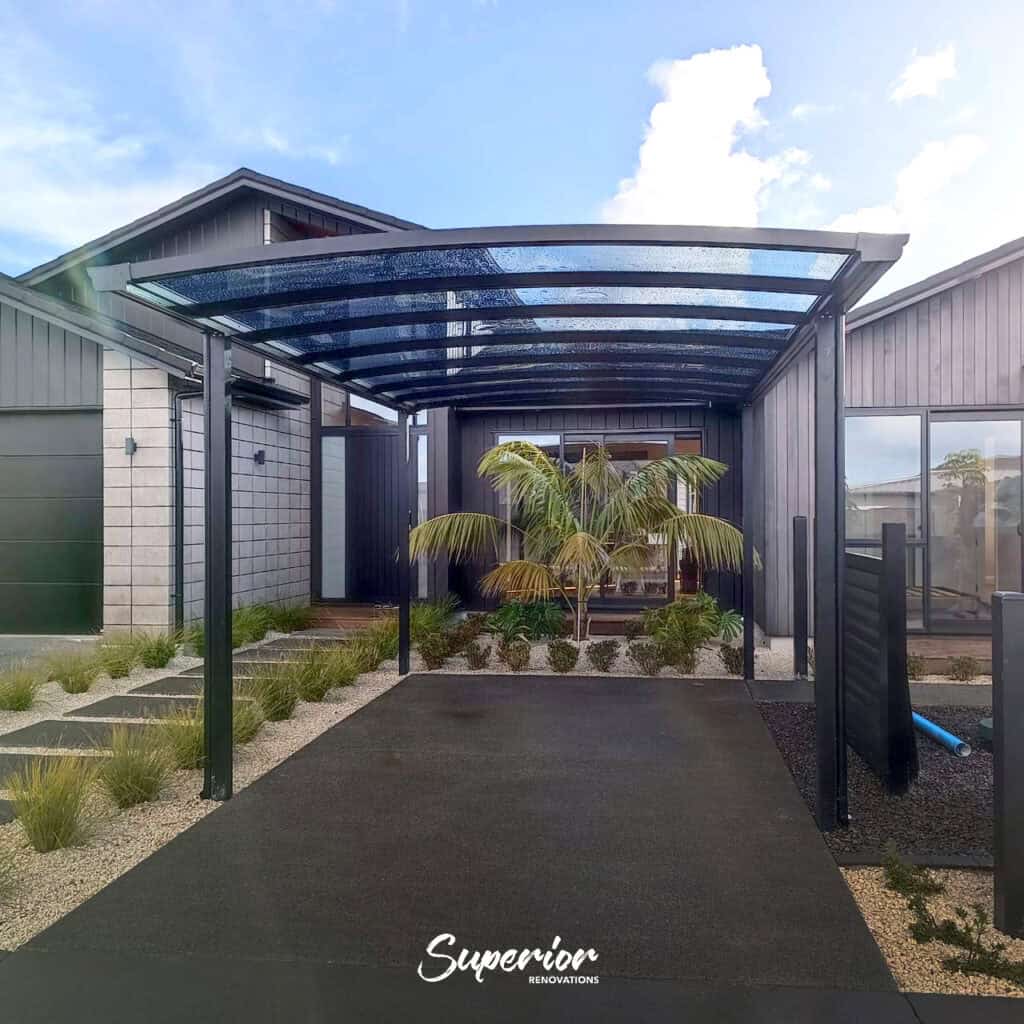
A pergola frame with a fixed transparent or tinted roof. Gives you actual rain shelter and UV reduction while keeping the open feel. Polycarbonate is the more common choice; tinted laminated glass is the architectural upgrade.
Cost: $12,000–$22,000 fully installed
Best for: Decks and outdoor dining areas you want to use year-round
Note: This is technically a veranda under the Building Act, exempt up to 30m² on ground floor with the right construction.

3. Retractable Canopy / Fabric Roof
An aluminium frame with a motorised or manual retractable fabric canopy. Open for sun, closed for rain or harsh midday sun. UV-stable PVC-coated polyester is the standard fabric; expect 10–15 years before replacement.
Cost: $15,000–$28,000 fully installed
Best for: Auckland’s variable weather, full sun in winter, shade in summer
Watch out for: Wind ratings. A canopy without a wind sensor can shred in a southerly. Auto-retract sensors are worth the $400 add-on.
4. Louvre Roof (Opening Roof) System
Adjustable aluminium blades that rotate from fully open to fully closed. Motorised, often with rain and wind sensors. This is the premium end of the market and what most “modern pergola” Instagram photos actually show.
Cost: $15,000–$40,000+ fully installed. A small single-bay unit starts around $15,000; a typical 4m × 4m motorised system with rain and wind sensors lands at $20,000–$40,000+
Best for: Owners wanting a true four-season outdoor room, north-facing decks where sun control is the main driver

5. Attached vs Freestanding
Attached pergolas connect to the house at the fascia, eaves or a structural wall. They’re more economical (one less wall of posts) and visually integrate the outdoor and indoor spaces. Freestanding sits independently, which is easier from a consent and weathertightness perspective.
The trade-off: Attached structures can compromise weathertightness if the flashings aren’t done properly. We’ve inspected post-DIY attached pergolas where water has been tracking back into the wall cavity for years. If you’re attaching to the house, this is the part that absolutely needs a qualified builder, not a weekend project.
Cost difference: Attached is typically 10–15% cheaper to build but adds the flashing work the saving disappears into.
Cost Comparison Summary (2026 Auckland)
| Pergola Type | DIY Kitset | Custom Build (Installed) | Best Use Case |
|---|---|---|---|
| Open-slat (timber) | $1,500–$3,500 | $8,000–$15,000 | Gardens, shade, character homes |
| Open-slat (aluminium) | $2,500–$5,500 | $10,000–$18,000 | Coastal, low maintenance |
| Polycarbonate roof | $3,500–$7,000 | $12,000–$22,000 | Year-round dining, deck cover |
| Retractable canopy | $6,000–$10,000 | $15,000–$28,000 | Auckland variable weather |
| Louvre roof system | n/a (specialist install) | $15,000–$40,000+ | Premium, four-season use |
Pergola With a Roof, or a Deck Roof? What Actually Keeps the Rain Off
These two get searched as though they are the same product. They are not, and the difference changes both the price and the consent question.
An open-slat pergola is a shade structure. Slats set on an angle cut the midday sun, but rain goes straight through. If the brief is “I want to sit outside when it is raining”, an open-slat pergola will not deliver that at any budget.
A roofed structure over a deck is a different build. Once there is a solid roof it stops being an unroofed pergola in consent terms and becomes a veranda or a roofed deck, which changes the exemption you are relying on. How an opening louvre roof works, and what one costs in NZ covers the adjustable version of this in detail.
The Four Roof Options, and Who Each One Suits
| Roof type | Keeps rain off | Light | The honest drawback |
|---|---|---|---|
| Open slats | No | Dappled | Shade only. Cheapest, and the simplest on consent. |
| Polycarbonate sheet | Yes | High, diffused | Loud in heavy rain, and it traps heat underneath unless there is airflow at the high side. |
| Toughened or laminated glass | Yes | Highest | The dearest option, and it shows every leaf and bird mess from underneath. Needs real cleaning access designed in. |
| Adjustable louvre blades | Yes, when closed | Controllable | Premium cost and a motor to maintain, but the only option that gives you sun and shelter from one structure. |
The Detail Everyone Forgets: Where the Water Goes
A 4m by 4m roof sheds about 16 square metres of rainfall, and in a heavy Auckland downpour that is a real volume arriving at one edge. An open-slat pergola needs no spouting at all. The moment you roof it you need a fall, a gutter, and somewhere for the downpipe to discharge that is not the middle of the lawn or, worse, hard against the house foundation.
This is the most common defect we see on retrofitted roofs: cover added to an existing frame with no fall designed in, so water ponds in the middle of the sheet and the discharge runs straight against the pile line. If the deck sits over an existing stormwater run, settle the connection point at design stage rather than on the last day of the build.
Roofing a Deck That Is Already There
Two things decide the cost. First, whether the existing piles and bearers can carry the extra roof load and uplift, or whether new posts have to go down past the deck to their own footings, which is the more common answer. Second, whether the roof ties into the house, because that means flashing into existing cladding and it is the detail that turns a tidy job into a leak. What a new deck costs to build in NZ is worth reading alongside this if the deck itself is near the end of its life, because doing both together avoids paying twice for access.
One compliance point that catches people on the larger builds: once residential building work costs $30,000 or more including GST, a written contract is mandatory. A roofed outdoor room with blinds and lighting clears that threshold without much effort. The $30,000 rule, and what has to be in the contract sets out what that means in practice.
Kitset vs Custom Build — Which Is Right for You?
This is the single most common question we get on enquiry calls, and the honest answer depends on three things: your site, your finish standard, and whether you actually want to spend a weekend (or three) building it yourself.
When a Kitset Makes Sense
Kitsets from Mitre 10, Bunnings or Placemakers work well when:
- Your site is flat, well-drained, and in a medium wind zone
- You want a standard rectangular footprint under about 4m × 4m
- You’re genuinely handy, you’ve built a deck, hung doors, dug post holes
- You’re prepared to spend 20–40 hours across 2–3 weekends
- The pergola is going in an area where minor imperfections won’t bother you (rear garden, not the main entertaining deck)
What a Pergola Kitset Price Does Not Include
The sticker price on a kit is the timber or the aluminium extrusion. It is rarely the cost of a finished pergola, and the gap catches people out. Budget separately for:
- Footings and concrete. Post holes, bags of concrete, and the hire of a post-hole borer if the ground is clay, which across much of Auckland it is.
- Fixings rated for your wind zone. Kits are generally supplied to a standard specification. If your site sits in a high or very high wind zone, the brackets and bolts that came in the box may not be the ones the structure needs, and upgrading them is not optional.
- Stain, oil or paint. A timber kit arrives raw or roughly treated. Two coats of a decent exterior finish over a 4m by 4m frame is a real line item and a real weekend.
- Anything that attaches it to the house. If the kit is designed to be freestanding and you want it attached, you are into flashing work, which is where kitset projects most often go wrong.
- Your own time. Twenty to forty hours is the realistic range for a first-timer on a standard rectangular kit, and it is worth pricing that honestly against a quote before deciding.
A useful test: if the finished result has to sit in your main line of sight from the kitchen, the tolerance you will accept is higher than a kit build usually delivers, and the saving stops feeling like a saving by about year three.
When Custom Is Worth the Extra Spend
A custom build earns its premium when:
- You’re in a high or very high wind zone, overspec’d posts and bracing matter
- You’re on a coastal site needing marine-grade fixings throughout
- The pergola is attached to the house, flashings are not a DIY job
- You want non-standard dimensions, integrated lighting, or a louvre/retractable system
- You’re building it to support a renovation, getting it wrong now creates a problem when you eventually sell
If the honest answer is that you want the space usable in every month of the year, the next structure up is an enclosed one. What a sunroom or conservatory costs in NZ sets out where that crossover sits on price.
Longevity Comparison
| Build Type | Expected Lifespan (Auckland) | Main Failure Mode |
|---|---|---|
| Budget timber kitset (untreated/H3) | 8–12 years | Rot at post bases, joint failure |
| Quality timber kitset (H4/H5, sealed) | 15–20 years | UV degradation of finish, fixing rust |
| Standard aluminium kitset | 15–20 years | Powder-coat chipping, cheap fixings |
| Custom engineered build | 25–30+ years | Component replacement (canopy, motor) rather than structural |
The longevity gap is the part that doesn’t show up in the kitset price tag. A $2,500 kitset replaced at year 10 plus a second replacement at year 20 costs more across 30 years than a $15,000 custom build done once.
“On coastal sites in Takapuna or Mission Bay, we overspec posts and use marine-grade fixings throughout. It adds maybe 8% to the build cost and triples the structural lifespan, that’s the trade-off we wish every kitset buyer understood before they ordered.”, Jeff Zhang, LBP & Site Manager, Superior Renovations
Screens, Covers and Side Protection: the Part That Decides Whether You Use It
A roof handles sun from overhead. It does nothing about the low western sun at 5pm in February, the neighbouring deck eight metres away, or a southerly driving rain in sideways under the structure. Most Auckland pergolas that end up unused failed on the sides, not the top.
There are three separate jobs here, and it is worth being clear about which one you are solving.
Privacy Screening
On a typical Auckland section the neighbouring windows are the constraint. Options, roughly in order of cost:
- Vertical timber battens fixed between the posts, 40mm to 60mm stock with a 20mm to 30mm gap. The cheapest genuine screen, it keeps airflow, and on a character home it reads as part of the architecture rather than a fence stuck on the side.
- Fixed aluminium louvre blades, angled so you see sky and the neighbours see nothing. Dearer than timber but there is no maintenance, and the angle can be set to block one specific sightline while keeping the view in another direction.
- Planting. Slower, but a griselinia or pittosporum hedge behind an open screen does the job permanently for a fraction of the joinery cost. The catch is that it needs two to three growing seasons, so it only helps if it goes in at the same time as the build.
Weather Screening: Outdoor Blinds and Cafe Blinds
This is the highest-value add-on on an Auckland pergola, and the one most often left to “next year” and never done. Dropping two sides turns a shaded platform into a space you can still sit in during drizzle.
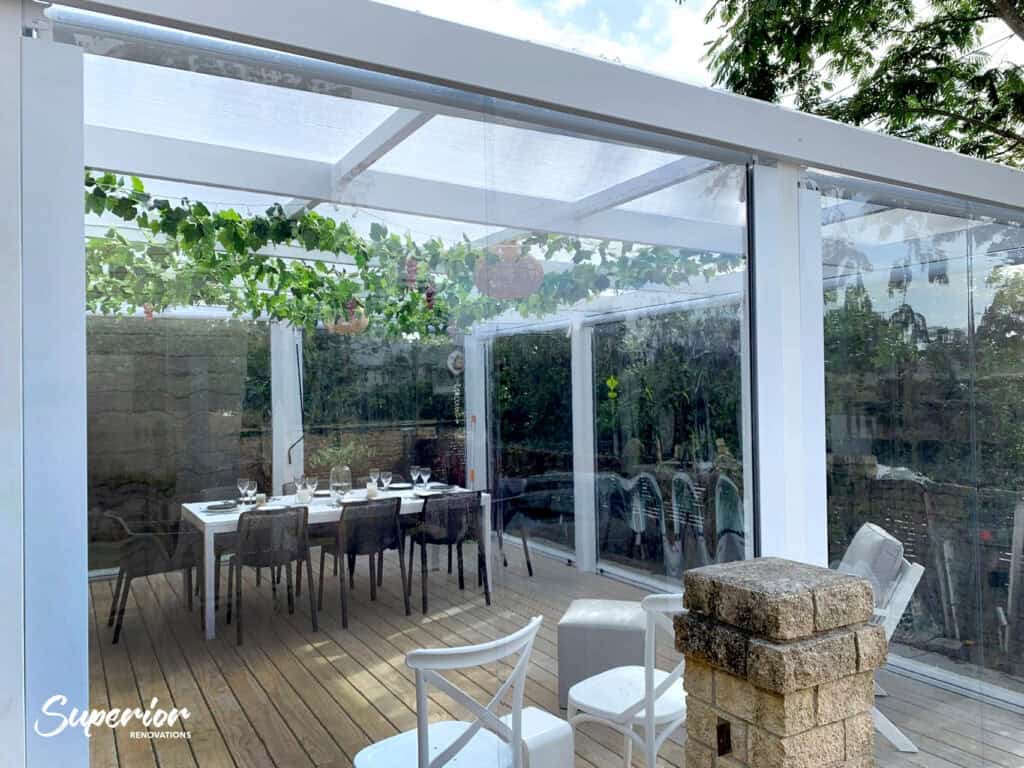
- Clear PVC cafe blinds block wind and rain and keep the view. They also trap heat, so on a north or west face you want them retractable rather than fixed.
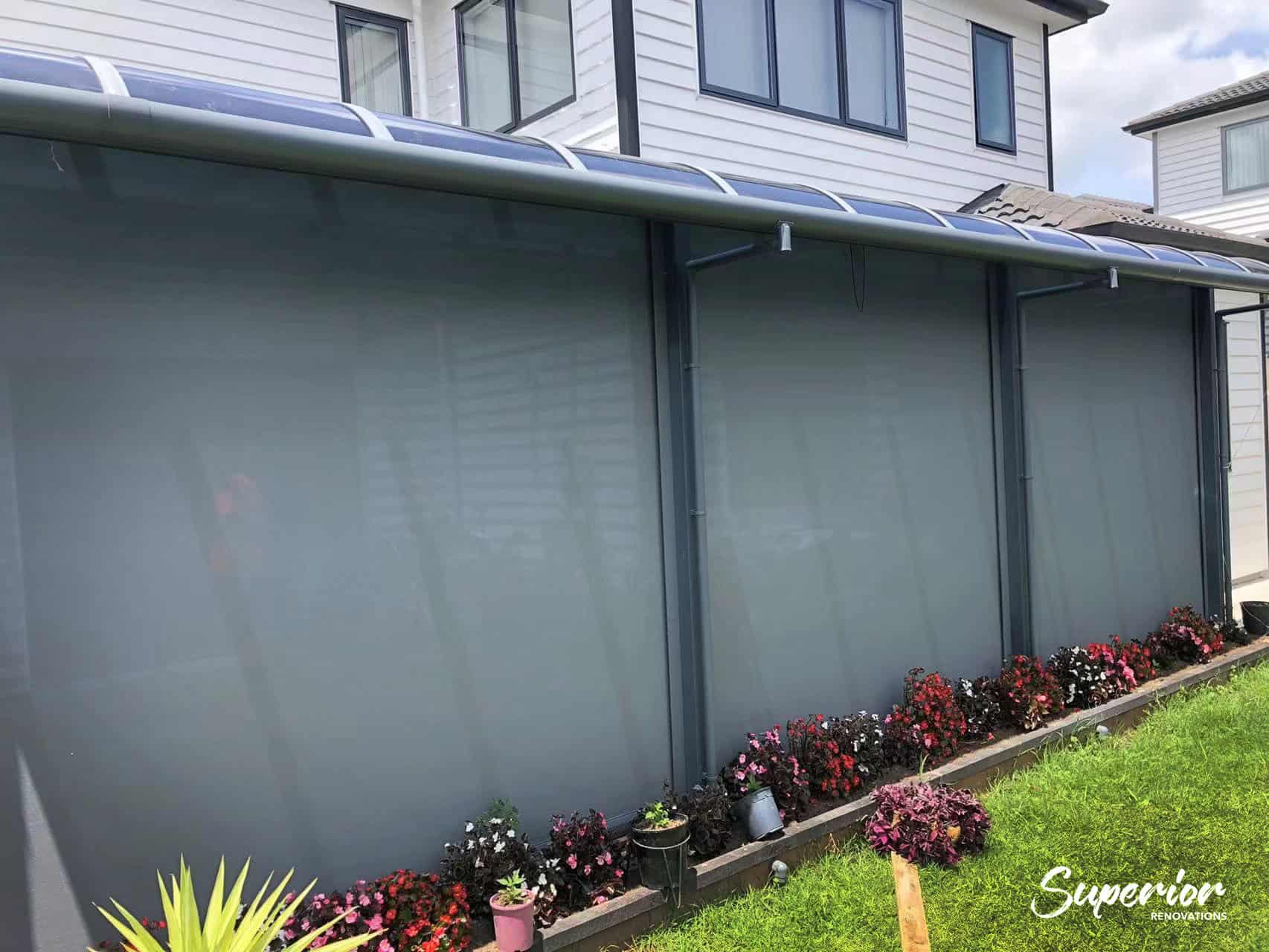
- Mesh or shadecloth blinds cut glare and let air through, which is the better answer on a west-facing deck where the problem is afternoon sun rather than rain.
- Zip-track systems run the blind edge in a side channel so it cannot flap or lift. On an exposed Auckland site this is the difference between a blind that lasts a decade and one that tears in its second winter, and on anything above a low wind zone it is the version we specify.
Adding a Cover to a Frame You Already Have
If the frame is already up and you want cover added, the decision is structural before it is aesthetic. A frame built for an open slat roof was designed for wind passing through it, not pushing on it. Adding a solid or fabric cover raises uplift substantially, and the fixings and post footings were sized for the original load case.
Get the existing frame checked before you buy a cover. It is the kind of call our outdoor team makes before anything gets bolted to an existing structure. Retrofitting cover onto an undersized frame is the most common reason we get called out to a pergola that has moved, and the fix is usually new footings, which costs more than building it right the first time.
Maintenance and Longevity — What to Expect From Each Material
A pergola in Auckland is a 15-to-30-year asset depending on the material and how well it’s looked after. The maintenance load is genuinely low if you know what to do, and the wrong “maintenance” (pressure washing timber, painting over rust) actually shortens the lifespan.
Timber Pergolas
- Wash: Soft brush and mild soapy water every 6–12 months. Skip the pressure washer, it raises the grain and breaks down the surface seal
- Re-stain: UV-protective oil-based stain every 2–3 years. Resene Woodsman or Cabot’s Aquadeck are the standard NZ specs
- Inspect: Post bases annually for any movement, soft spots, or insect activity (borer in older treated timber)
- Coastal note: Salt rinse every 3–4 months if you’re within 500m of the water
Aluminium and Steel Pergolas
- Wash: Hose down every 6 months. Mild detergent for sap or bird droppings
- Inspect: Fixings yearly, particularly any stainless or galvanised bolts that may show surface rust. A spray of CRC Soft Seal at fixing points prevents 90% of the failure modes we see
- Touch up: Powder-coat chips happen. Matching touch-up paint from the original supplier seals the metal before rust starts. Don’t ignore them on coastal sites, once rust gets under powder coat, it spreads fast
Canopies, Blinds and Add-Ons
- Retractable canopies: Retract during storms. Spot-clean with mild soap. Replacement fabric every 10–15 years
- Outdoor blinds and curtains: Annual machine wash if removable, otherwise hose-clean. Check tracks and rollers for corrosion
- Climbing plants: Prune in spring. Watch the weight, mature jasmine and kiwifruit vines are heavier than the pergola was rated for, especially after rain
Three Typical Auckland Pergola Builds, and What Drives the Price
The three specifications below are the shapes an Auckland pergola brief usually takes: a coastal deck cover, a character-home timber frame, and a four-season louvre room. The specs and the build sequence are how we scope this work, and the figures are typical installed costs for that specification in 2026 rather than a quote for any one job. Your own number moves with wind zone, site access, the condition of the existing deck, and how much of the structure has to tie back into the house.
Specification 1: Coastal Aluminium Pergola Over an Existing Deck
The common coastal brief: extend the entertaining season and get weather cover over an existing deck of roughly 24m², on a site close enough to the water for full salt exposure.
Our spec: 4m × 4m powder-coated aluminium frame in matte black, marine-grade 80-micron coating, retractable PVC-coated polyester canopy with wind sensor, integrated LED downlights.
Typical installed cost: around $22,000 for this specification
Typical programme: about 4 days on site, after a 3-week lead time on the canopy system
Why this spec works: the wind sensor usually pays for itself in the first hard southerly, and a motorised canopy turns a deck into a year-round dining space without the visual weight of a fixed polycarbonate roof.

Specification 2: Heritage-Sensitive Timber Pergola on a Character Bungalow
The character-home brief: a pergola that looks like it has always been there. Owners in the older bungalow suburbs regularly rule out aluminium at quote stage because the modern lines fight 1920s architecture.
Our spec: 4.5m × 3.5m Western Red Cedar frame, traditional rafter detailing, stained in a warm walnut Resene Woodsman finish, climbing jasmine trained along stainless wires.
Typical installed cost: around $15,000 for this specification
Typical programme: about 6 days on site, with cedar machining the step most likely to run long
Why this spec works: cedar weathers in sympathy with a bungalow’s existing eaves, and trained jasmine gives full dappled shade within about two summers without any added cover.
Specification 3: Louvre Roof Outdoor Room on an East-Facing Deck
An east-facing deck where the brief was a true outdoor room, usable in any weather, from harsh summer midday sun to winter rain. The owners ran a home-based business and wanted the space to function as an informal meeting area.
Our spec: 5m × 4m aluminium frame with motorised opening louvre roof, rain and wind sensors, integrated LED strip lighting on a smart-home dimmer, drop-down outdoor blinds on two sides.
Typical installed cost: around $35,000 for this specification
Typical programme: about 8 days on site, with a 6-week lead time on the louvre system
Why this spec works: a rain sensor closes the roof in seconds, which is the difference between a space you use and one you only look at. Drop-down blinds on the east and north sides handle the low morning sun that a roof alone cannot.

Frequently Asked Questions About Pergolas in NZ
Do I need a building consent for a pergola in NZ?
No, if the pergola is unroofed. Under Schedule 1 of the Building Act 2004, an unroofed pergola is exempt from building consent regardless of size. The moment you add a solid roof, it becomes a veranda, and the veranda exemption (up to 30m² on ground floor) applies. Auckland Unitary Plan rules around setbacks, boundary heights and heritage overlays still apply even when no building consent is required.
What are the rules for building a pergola in NZ?
The structure must comply with the Building Code even if exempt from consent. Posts must be founded to handle local wind loads (NZS 3604), boundary setbacks must respect the district plan, and attached pergolas must not compromise the host building's weathertightness. Auckland Council can require a resource consent if you're in a special character zone or breaching setback rules.
How much does a pergola cost in Auckland?
DIY kitsets run $1,500–$3,500 for a basic 3m × 3m timber pergola from Mitre 10, Bunnings or Placemakers. Custom builds range $8,000 to $35,000 depending on material and roof type. A polycarbonate-covered aluminium pergola installed runs $12,000–$22,000. A motorised louvre roof system is $20,000–$40,000+. Coastal sites add 8–10% for marine-grade fixings.
Is it cheaper to build a pergola or buy a kitset?
A kitset is cheaper upfront, typically $1,500–$3,500 versus $8,000+ for a custom build. But kitsets last 8–15 years versus 25–30+ for custom, and the longevity gap closes the cost gap over time. For coastal sites, high wind zones, or pergolas attached to the house, the custom build pays for itself in not needing replacement.
How much does a timber pergola cost in NZ?
A treated pine kitset starts around $1,500. A quality cedar or macrocarpa kitset is $2,500–$4,000. Custom-built timber pergolas in Auckland range $8,000–$22,000 fully installed depending on size, timber grade and finish. Western Red Cedar adds about 25–30% to the material cost over treated pine but lasts substantially longer without staining.
Can I attach a pergola to my house in NZ?
Yes. An attached unroofed pergola is still exempt from building consent under Schedule 1. The critical issue is weathertightness, the flashing at the attachment point must prevent water tracking into the wall cavity. This is not a safe DIY job for attached structures; we recommend a qualified builder handle the connection detail regardless of who builds the rest.
What's better than a pergola for Auckland weather?
If full weather cover is the goal, a roofed veranda or a louvre roof system outperforms a traditional pergola. A motorised louvre opens for sun in winter and closes against rain in summer, effectively a four-season outdoor room. Retractable canopy systems give similar flexibility at a lower cost. A traditional open-slat pergola is still the right call when you want shade without enclosure and don't need rain shelter.
What's the best pergola material for coastal Auckland?
Powder-coated aluminium with a marine-grade 80-micron coating is the standard for coastal Auckland. It doesn't rust, doesn't need staining, and holds its finish for 15–20 years even within 500m of the water. Steel is acceptable if hot-dip galvanised and powder-coated, but standard painted steel will rust at every fixing point inside 5 years on a coastal site.
How long does a pergola last in Auckland?
Budget timber kitsets last 8–12 years before post-base rot becomes critical. Quality H4/H5 treated or naturally durable timbers like cedar or macrocarpa, properly sealed, last 15–20 years. Standard aluminium kitsets run 15–20 years. Custom engineered pergolas with marine-grade fixings and proper detailing last 25–30+ years, with only the canopy or motor needing replacement during that span.
Do I need an architect or designer for a pergola?
Not for a standard freestanding pergola. For an attached pergola, a custom design integrated with existing architecture, or anything above $20,000 in build cost, professional design pays for itself in avoiding costly site mistakes. Most reputable renovation companies include 3D design as part of the quote process, we offer this free for pergola projects we're invited to quote on.
What roofing options can you add to a pergola in NZ?
Four main options. Open slats or battens give dappled shade with no rain cover. A fixed polycarbonate or tinted-glass roof turns the space into a year-round veranda, exempt to 30 square metres on the ground floor. A retractable fabric canopy opens for sun and closes for rain. At the premium end, a motorised louvre roof with rotating aluminium blades and rain sensors gives full four-season control. Costs run from around $8,000 for a slatted build to $40,000 or more for a motorised louvre system, installed.
Planning a Pergola? Talk to Us First
A pergola sits in the awkward zone where it’s small enough to feel like a DIY job but big enough that getting it wrong is expensive. The cost-to-replace on a failed coastal pergola, a wrongly-flashed attached structure, or a kitset that doesn’t survive its first southerly is significantly higher than what good upfront advice costs.
We’ve designed and built pergolas across Auckland for over a decade. As the crew that builds decks, pergolas and outdoor rooms right across Auckland, we know what your site needs. A free in-home consultation gets you the right material recommendation for your site, an honest cost range, a 3D design visualisation, and confirmation of where you sit on consent rules, before you commit a cent.
Book a free in-home consultation or call 0800 199 888.
Or run the numbers yourself with our pergola cost calculator, results in 2 minutes.
Want to See More Outdoor Renovation Inspiration?
Outdoor renovations and landscaping services
Full cost guide to outdoor renovations in NZ
Kwila decking: costs, care and why it suits Auckland decks
Free 48-page Complete Home Renovation Guide
Have you been putting off getting renovations done?
We have partnered with Q Mastercard ® to provide you an 18 Month Interest-Free Payment Option, you can enjoy your new home now and stress less.
Learn More about Interest-Free Payment Options*
*Lending criteria, fees, terms and conditions apply. Mastercard is a registered trademark and the circles design is a trademark of Mastercard International Incorporated.
Still have questions unanswered?
Book a no-obligation consultation with the team at Superior Renovations,
we’d love to meet you to discuss your renovation ideas!


