


Kitchen Renovation Cost Calculator Tool (NZ)
Last updated:
Quick answer: Our free kitchen renovation cost calculator NZ asks 12 questions about your finishes and scope, then emails you an indicative Auckland price. A mid-range Auckland kitchen costs $26,000–$35,000 + GST; use the calculator figure to set a budget, then compare real quotes line by line.
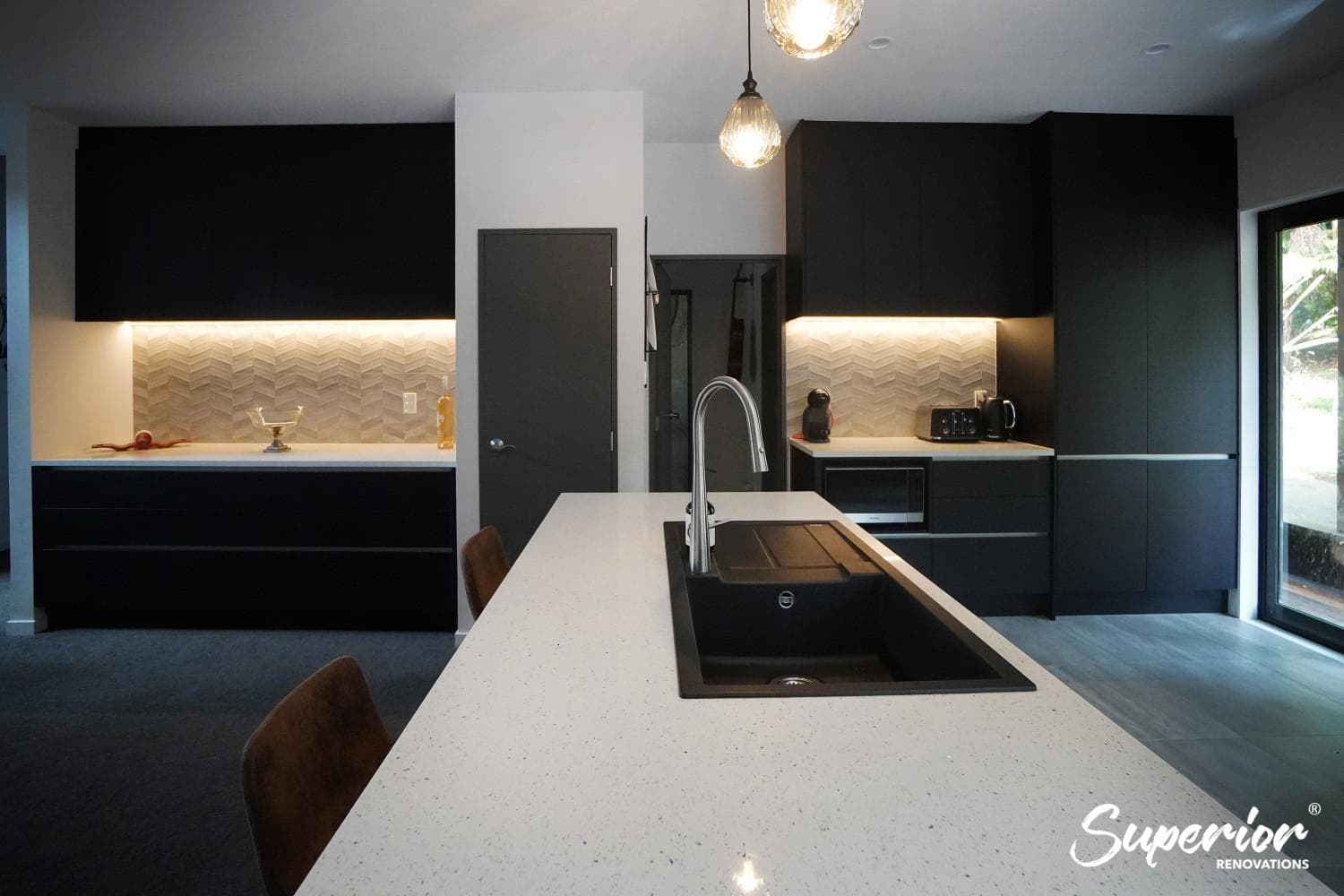
Planning Your Kitchen Renovation in Auckland
If you’re thinking about renovating your kitchen in Auckland, the first question is almost always the same: what’s it going to cost? At Superior Renovations, we know that every home is different, and so is every budget. This page is about the part that comes before a quote: getting a realistic number, turning it into a budget you can defend, and then working out why two quotes for the same kitchen can sit thousands of dollars apart. If you want every line item priced by tier, our full kitchen renovation cost guide for Auckland covers the detail; this page is the planning and quote-checking companion to it.
We’ll cover the stages of a full renovation, the hidden costs that catch people out, what drives a quote for kitchen cabinets, and how to read a quote once it lands. Our Kitchen Cost Calculator NZ is here too, so you can run your own numbers before anyone measures up.
Get started with the calculator
Free cost calculator
How much will your kitchen renovation cost?
Answer a few questions and we’ll email you an Auckland price range.
Takes less than 60 seconds, results sent straight to your inbox.
Open Kitchen Renovation Cost Calculator
What Goes Into a Full Kitchen Renovation?
A full kitchen renovation isn’t just swapping out cabinets. It’s a multi-stage process, and each stage affects your budget. Whether you’re in Ponsonby or Papakura, here’s what a complete kitchen overhaul actually involves.
Every stage has to fit the next one or the whole job suffers. Based on our own kitchen work at Superior Renovations, here’s what you’re looking at, and how each stage affects your overall cost. Treat the stage ranges below as indicative planning figures, not quotes; the published totals in the cost section further down are what to budget against.
-
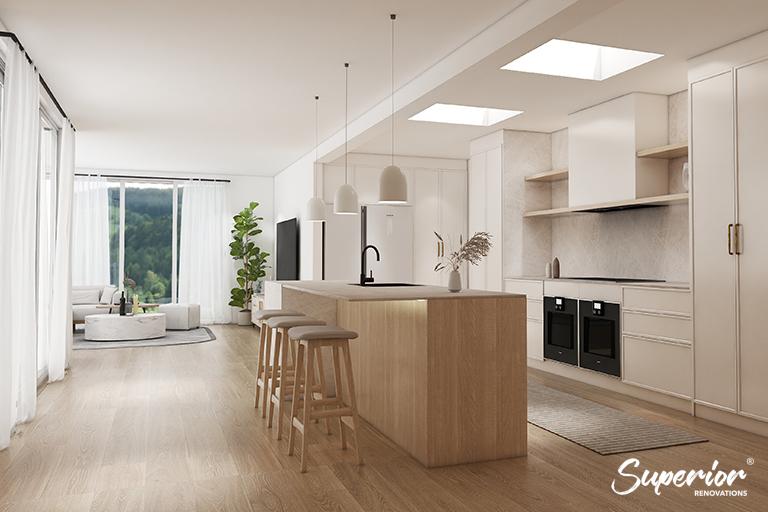
- Planning and Design: This is where your vision becomes a workable plan. You’ll work with a designer, like our Head of Design Dorothy Li, to map out the layout, workflow, and aesthetic. A 3D render helps you see the space before anything is ordered. Expect $2,000–$5,000 for professional design services in Auckland, depending on complexity. As Dorothy puts it: a well-planned kitchen saves time, money, and stress during the build. For layout and finish starting points, browse our gallery of kitchen design inspiration.
-
- Demolition and Removal: Old cabinets, benchtops, and appliances come out. In older Auckland homes, you’ll sometimes find surprises, outdated wiring being the most common. Demolition typically costs $1,500–$3,000 depending on kitchen size and condition.
- Structural Changes: If you want open-plan, walls may need to come down. Load-bearing walls need engineering sign-off and a building consent, so council fees and engineering costs land before any work starts. Check your pathway with Auckland Council early.
- Plumbing and Electrical: Moving a sink or adding new lighting is standard in a kitchen reno, but it needs licensed professionals. Budget $2,000–$6,000. Auckland Council’s guidance is that plumbing and drainage work only qualifies for a consent exemption when an authorised person does it. Cut corners here and you’ll regret it.
- Flooring and Wall Finishes: From tiles to timber, flooring sets the tone for the whole kitchen. In Auckland, quality materials like ceramic or hardwood run $50–$150 per m². Wall finishes and splashback tiles add another $1,000–$3,000. Our designer Alison Yu makes the point well: choosing durable flooring matters in a busy Auckland kitchen, you’ll thank yourself later.
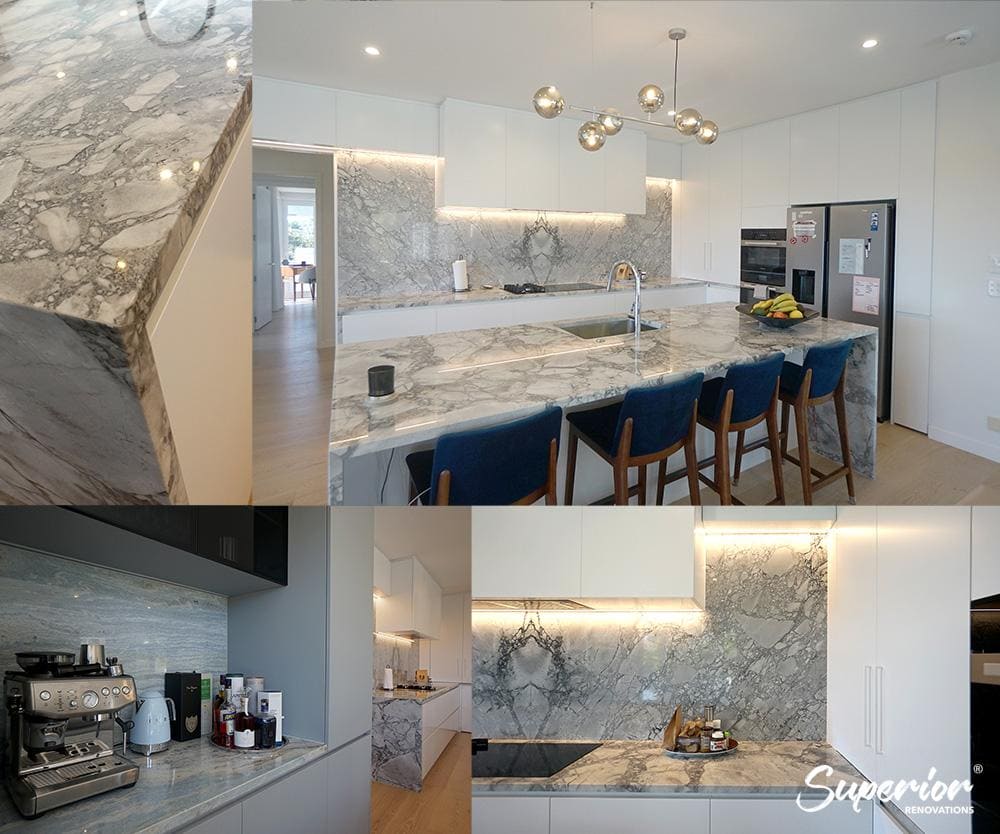
- Cabinets and Benchtops: Cabinets are the backbone of the kitchen, $5,000–$25,000 depending on materials (laminate through to solid timber). Benchtops in granite or engineered stone range from $2,000 to $10,000.
- Appliances: A full suite, oven, fridge, dishwasher, runs $3,000–$15,000. Energy-efficient options cost more upfront but save money over time. Consumer NZ’s kitchen appliance reliability data is worth reading before you choose brands.
- Finishing Touches: Lighting, handles, and the details that pull it all together. Budget $1,000–$3,000. These are the things people notice, or notice are missing.
Timeline: a standard kitchen renovation takes 5 to 6 weeks from the day demolition starts, as long as the design is finalised and the cabinetry is already being made. Cabinetry manufacturing takes 4 to 6 weeks, so it gets ordered early, and a job that needs consent adds 4 to 8 weeks for Auckland Council processing (figures from our renovation FAQ).
Here’s a summary of the phases and their cost ranges:
| Phase | Estimated Cost | Key Considerations |
|---|---|---|
| Planning and Design | $2,000–$5,000 | Work with a designer for a layout that actually works |
| Demolition | $1,500–$3,000 | Watch for hidden issues in older homes |
| Structural Changes | $3,000–$10,000 | May require Building Consent |
| Plumbing/Electrical | $2,000–$6,000 | Licensed professionals only |
| Flooring/Walls | $2,000–$6,000 | Choose durable, easy-to-clean materials |
| Cabinets/Benchtops | $7,000–$35,000 | Balance quality and budget |
| Appliances | $3,000–$15,000 | Factor in energy efficiency |
| Finishing Touches | $1,000–$3,000 | The details that make it look finished |
Our Kitchen Cost Calculator lets you model these costs for your specific project in under a minute.
Get started
Takes less than 60 seconds, results sent straight to your inbox.
Open Kitchen Renovation Cost Calculator
Hidden Costs That Can Derail Your Kitchen Renovation Budget
You’re halfway through a kitchen renovation in your Mount Eden villa, the new island is taking shape, when the builder finds dodgy wiring behind the walls. Budget blown. If that sounds familiar, you’re not alone. Unexpected costs catch Auckland homeowners out more often than you’d think. Here’s what to watch for.
Drawing on our own jobs, plus Consumer NZ’s home renovation guide for the wider checklist:
-
- Structural surprises: Knocking down a load-bearing wall can add $3,000–$10,000 for structural reinforcement on a typical job, before consent. Jeff Zhang, our LBP and Site Manager, is blunt about this one: get a structural engineer’s report before anything touches a wall. Fixing a sagging ceiling costs a lot more than the report did.

-
- What’s behind the walls: Older homes in Grey Lynn or Remuera regularly turn up asbestos, outdated plumbing, or old wiring. These add $1,000–$5,000 once discovered. A pre-renovation inspection ($500–$1,000) is worth it. Build a 10–20% contingency into your budget from the start, the range on our Auckland renovation cost guide, and plan nearer the top of it on a pre-1940s villa or bungalow.
- Cabinet costs: Budget cabinets warp and wear. Quality options run $5,000–$25,000 depending on materials. Our view is blunt: put the money into cabinets that last. You open them dozens of times a day, and a sagging door or a failed drawer runner is the first thing that makes a new kitchen feel old.
- Appliances: A full package, induction cooktop, integrated fridge, dishwasher, can hit $3,000–$15,000, not including installation. EECA’s appliance guidance is to compare the Energy Rating Label: the stars for efficiency, and the kWh-per-year figure for running cost.
- Professional fees and consents: Design fees, contractor costs, and architect fees add $2,000–$10,000. Building Consents for structural changes add $500–$2,000. Don’t try to avoid these: work that needed a consent and didn’t get one becomes your problem, and the next owner’s, when the house is sold.
Start with a realistic plan. Our Kitchen Cost Calculator NZ asks whether demolition, electrical and plumbing work, and building consent fees are in your scope, so those lines are in the number from the start rather than added later.
| Hidden Cost | Estimated Cost (NZD) | How to Manage It |
|---|---|---|
| Structural Changes | $3,000–$10,000 | Engineer’s report before touching walls |
| Hidden Issues (wiring, plumbing) | $1,000–$5,000 | Pre-renovation inspection |
| Quality Cabinets | $5,000–$25,000 | Choose durable materials |
| Appliances | $3,000–$15,000 | Energy-efficient models reduce running costs |
| Professional Fees and Consents | $2,000–$10,000 plus council fees | Consent fees follow Auckland Council’s fee schedule |
How Much Does a Kitchen Renovation Cost in Auckland?
For a full kitchen renovation in Auckland, new cabinets, benchtops, flooring, and plumbing and electrical work, a mid-range project costs between $26,000 and $35,000 + GST for a 10–12m² kitchen, which works out to roughly $2,300 per square metre. Basic refreshes start from $15,000, and larger kitchens (18m²+) or premium builds with custom joinery, stone and integrated appliances run $62,000 to $138,000 or more. Those are the figures published on our own renovation cost FAQ and Auckland renovation cost guide for 2026. Here is how they break down by tier:
-
- Basic refresh or small kitchen ($15,000–$25,000): New laminate benchtops, standard cabinets, basic appliances, existing layout kept. Suitable for rental properties or straightforward refreshes on a tight budget.
- Mid-range ($26,000–$35,000 + GST): A 10–12m² kitchen with custom cabinets, stone benchtops and quality appliances, covering design, cabinetry, benchtop, splashback, appliances and installation. This is where most Auckland homeowners land. Our designer Cici Zuo puts it well: mid-range kitchens balance style and practicality, you get a good result without overcapitalising.

- Large or premium ($62,000–$138,000+): Kitchens of 18m² and over, or premium builds with custom joinery, stone benchtops and integrated appliances. Layout changes, specialist stone and solid timber or lacquered cabinetry push a job toward the top of this band.
What drives these costs? The choices you make. Vinyl flooring over hardwood saves thousands. Moving plumbing for an island adds $2,000–$5,000. Auckland Council is explicit that you are unlikely to need a building consent to remodel an existing kitchen within the same space with the sink left where it is, which is also the cheapest way to build.
For cabinetry, benchtop, flooring and appliance prices by tier, the full cost guide linked at the top of this page goes line by line. Where the money goes is usually a choice, not a surprise. The most common pattern we see on Auckland kitchens is a mid-range budget with one deliberate upgrade, most often the benchtop, paid for by keeping the layout and the flooring exactly where they are.
| Renovation Type | Estimated Cost (NZD) | What You Get |
|---|---|---|
| Basic refresh / small kitchen | $15,000–$25,000 | Laminate benchtops, standard cabinets, basic appliances, existing layout |
| Mid-range (10–12m²) | $26,000–$35,000 + GST | Custom cabinets, stone benchtops, quality appliances, roughly $2,300/m² |
| Large (18m²+) or premium | $62,000–$138,000+ | Custom joinery, stone benchtops, integrated appliances |
Get started
Takes less than 60 seconds, results sent straight to your inbox.
Open Kitchen Renovation Cost Calculator
Auckland-specific factors: Auckland runs above the national average on labour rates, $120–$150 an hour for qualified trades, and on compliance costs (per our FAQ). Older homes, Devonport villas, Grey Lynn bungalows, often need additional work for outdated wiring or plumbing once the old cabinets come out.
How to keep costs down: Think about how you actually use your kitchen. If you cook seriously, an island might be worth it. If the kitchen is mostly for quick meals, focus on functional storage upgrades rather than premium finishes. Our designer Alison Yu puts it simply: think about your kitchen daily, that’s what should guide your budget decisions.
What a Small Kitchen Renovation Costs
A small kitchen does not cost proportionally less than a large one, and that catches people out. A small kitchen renovation in Auckland starts from around $15,000 to $25,000, which is the same budget-refresh band as a larger kitchen kept simple. The reason is that a kitchen is mostly fixed costs: the same trades attend, the same appliances go in, the same plumbing and electrical work is done, and the same design and project-management time is spent whether there are eight cabinets or eighteen.
What genuinely scales with size is cabinetry and benchtop area. On a compact galley or L-shaped kitchen that is a smaller share of the total than most people assume, so the honest advice on a small kitchen is to spend the saving on the things you touch every day, the drawer runners, the tapware, the benchtop, rather than assuming the whole job will come in cheap.
If your kitchen is genuinely tight, layout does more for you than budget. Our guide to design ideas for small kitchens and our kitchen planning measurements reference cover the clearances that make a small space work.
How Much Do Kitchen Designers Charge in NZ?
Professional kitchen design in Auckland typically runs $2,000 to $5,000, depending on complexity and how much documentation the build needs. That normally buys a measured survey, a layout worked through in plan, cabinetry and appliance specification, finishes selection, a 3D render so you can see it before anything is ordered, and drawings the installer can build from.
Charging models vary. Some designers work to a fixed fee for a defined package, some charge hourly, and some charge a percentage of the project value. The one to ask about directly is whether the fee is credited back if you proceed with the same company for the build, because that changes the real number considerably.
At Superior Renovations the design sits in our own design department rather than being contracted out, and the designer who draws your kitchen stays involved through the build. Practically, that means the person who chose the cabinetry is the person answering the question when a site measurement comes back 15mm off. You can see the range of work in our Auckland design studio.
Do You Need a Building Consent for a Kitchen Renovation?
Usually not. Auckland Council states you are unlikely to require a building consent to remodel an existing kitchen within the same space, leaving the kitchen sink in the same position. Swapping cabinets, benchtops, flooring and appliances in a like-for-like layout is normally exempt work.
Consent enters the picture when the job stops being a swap: removing a load-bearing wall to open the kitchen to the living area, adding a new sanitary fixture or moving drainage rather than reconnecting an existing one, or altering the structure of the house. Those are the changes that also carry the biggest cost, which is why the consent question and the budget question tend to arrive together.
Treat that as general guidance rather than a ruling on your own kitchen. Confirm your specific pathway with Auckland Council or a Licensed Building Practitioner before you commit to a layout change, and be aware that any restricted building work has to be carried out or supervised by an LBP. If you’re weighing up doing part of the job yourself, our guide to which kitchen work NZ law lets a homeowner do sets out where the line sits.
Factors That Drive Kitchen Renovation Costs in NZ
Two kitchens in Auckland can have wildly different price tags. Here’s what actually drives the difference.
Think of your kitchen renovation like ordering coffee in Ponsonby, a flat white or a double oat milk latte with all the trimmings. Every choice adds up. Here’s what matters most:
-
- Kitchen size and layout: A small 8m² kitchen in Papakura sits at the bottom of the refresh band. A 20m² open-plan kitchen in St Heliers is a mid-range project or beyond. Relocating a sink or adding an island adds $2,000–$5,000 in plumbing and electrical work. Dorothy Li’s advice: stick to your existing layout wherever possible. It’s the single most effective way to control cost.
-
- Materials: Laminate benchtops cost $1,000–$3,000. Quartz or granite runs $5,000–$10,000. Vinyl flooring sits at $50–$80/m², hardwood or tiles at $100–$150. The benchtop is the line with the widest spread for the smallest area, so it’s the first place to look when a quote comes in high.
- Appliances: A basic package costs around $3,000. High-end smart appliances can push that to $15,000. Our rule of thumb: choose appliances that suit how you cook, not how you’d like to cook. Check the Consumer NZ reliability results before you commit.
- Structural changes: Load-bearing wall removal costs $3,000–$10,000 plus engineering and consent fees. Skip a consent you needed and you’ll face problems at sale time.
- Labour and professional fees: Qualified Auckland trades charge $120–$150 an hour. Across a kitchen, expect $2,000–$10,000 for skilled trades, design and project management on top of materials.
- What’s behind the walls: Older Auckland homes regularly turn up plumbing or wiring that needs replacing. A pre-renovation inspection ($500) is cheap insurance against finding out mid-build.
How to prioritise: If you host regularly, invest in the island. If you’re a low-key cook, focus on durable basics and smart storage. Our Kitchen Cost Calculator NZ lets you adjust these variables and see how they affect the total in real time.
| Factor | Estimated Cost Impact (NZD) | How to Manage It |
|---|---|---|
| Kitchen Size and Layout | $2,000–$10,000 | Keep existing layout to save on plumbing and electrical |
| Materials (Benchtops and Flooring) | $2,000–$15,000 | Mid-range materials offer the best durability-to-cost ratio |
| Appliances | $3,000–$15,000 | Energy-efficient models reduce running costs |
| Structural Changes | $3,000–$10,000 | Structural engineer’s report before any wall comes down |
| Labour and Professional Fees | $2,000–$10,000 | Licensed professionals avoid rework costs |
| Hidden Issues | $1,000–$5,000 | 10–20% contingency from the start |

Custom Cabinetry vs Flat-Pack: What the Difference Actually Costs
Cabinetry is the single largest line in almost every kitchen quote, so it is the line where the price gap between two quotes usually opens up. Understanding the three options is the fastest way to work out why.
Flat-pack uses standard carcass sizes off a shelf. It is the cheapest route and it is genuinely fine in a rectangular room with no obstacles. The cost lands where the room stops cooperating: a chimney breast, a window in the wrong place, a wall that is 40mm out of square over three metres, and you end up with filler panels doing the work that cabinetry should be doing.
Modular with modifications sits in the middle. Standard boxes, non-standard doors, fronts and fillers made to suit. Most mid-range Auckland kitchens are built this way and the result is good.
Fully custom means every cabinet is made to the millimetre for your room. You pay for it in the cabinetry line, and you get it back in usable space: drawers that run the full width instead of stopping short, a pantry that fills its recess, a run that finishes flush against the wall rather than with a 60mm filler.
What Drives a Quote for Kitchen Cabinets
A kitchen cabinet quote is priced on four things: how many units there are, what they’re made of, what’s inside them, and who installs them. Two quotes for the “same” kitchen usually differ on at least one of those, and it’s rarely the one you’d guess.
- Unit count and type. A bank of drawers costs more than a cupboard of the same width, because each drawer carries its own box and runner set. Tall pantry and oven towers, corner units and an island with panels on all four sides add up quickly.
- Door and panel finish. Our calculator prices six cabinetry finishes: melamine, fibre board, plywood, thermoformed, acrylic and lacquer or paint finish. Melamine sits at the practical end; a painted or lacquered door carries extra finishing work, and is priced that way.
- Hardware and internals. Soft-close hinges and drawer runners, pull-out bins, corner mechanisms and internal organisers. Ask for the hardware brand by name, because this is the line that decides how the kitchen feels in ten years.
- Exposed ends and fillers. End panels, kickboards, scribe strips and filler pieces. On an out-of-square wall in an older Auckland home these can be a real number.
- Installation. Supply-only and supply-and-install quotes are not comparable. Installation also decides who is responsible when a door won’t line up.
Questions to Ask Before You Compare Cabinet Quotes
- Is the benchtop in this price, or quoted separately? What about the splashback?
- What board are the carcasses made from, and what edging is used on them?
- Which hinge and runner hardware is specified, and is it soft-close throughout?
- Does the price include removal of the old kitchen, delivery and installation?
- Are plumbing and electrical disconnection and reconnection included, or left to you to arrange?
- Is the figure including or excluding GST?
If a quote can’t answer those six, it isn’t finished yet. Our guide to choosing custom kitchen cabinets goes further into finishes and storage.
💡 Quick tip: Ask for the cabinetry drawing with the quote, not just a price. A unit-by-unit plan is the only way to check two quotes are pricing the same number of drawers.
Where Our Cabinetry Is Made
This is one of the few parts of a kitchen quote where it is worth asking who actually builds it. Ours is made in-house. In January 2023 Little Giant Interiors moved into a 700m² factory in Rosedale on the North Shore, more than four times the 150m² Henderson unit it replaced, sitting alongside the group’s head office.
The floor runs a Format-4 CNC machining centre for cutting and drilling panels repeatably, a Homag edgebander applying laser edge banding, and a Micronair extraction system pulling dust away at the source. The reason that matters to your budget is not the machinery itself, it is that custom sizing stops being an expensive exception when the factory is set up to cut to a measurement rather than to a catalogue. If a cabinet has to be 812mm wide, it is 812mm wide.
It also removes a handover. When the cabinetmaker, the designer and the project manager are the same organisation, a site measurement that comes back different does not turn into a three-week negotiation between suppliers. For an idea of what that looks like finished, see our kitchen designs and styles and the kitchen design gallery, or open the drawers yourself on the kitchen displays at our Wairau Valley showroom at 16B Link Drive.
💡 Quick tip: If the cabinetry carcasses are sound and only the fronts are dated, replacing doors and drawer fronts is a fraction of a full rebuild. Our guide to the cost of replacing kitchen cupboard doors covers when that is the smarter call.
How Our Kitchen Renovation Cost Calculator Works
Planning a kitchen renovation in Auckland without a cost picture is guesswork. How do you know whether you’ve budgeted enough for that benchtop, or whether the plumbing is about to catch you out? That’s what our Kitchen Cost Calculator NZ is for. It’s free, it’s built around how Auckland kitchens are actually priced, and it sends an indicative figure to your inbox.
We built it because renovation pricing is opaque, and nobody should commit to a conversation, let alone a contract, without a realistic idea of the number.
What the Calculator Asks You
Twelve questions, all about scope and finish. This is the full list, so you can have your answers ready:
| Question | Your options |
|---|---|
| Type of kitchen renovation | Mid-range or high-end |
| Cabinetry material | Melamine, fibre board, plywood, thermoformed, acrylic, lacquer/paint finish |
| Benchtop material | Engineered stone, laminate, polished concrete, marble, granite, or don’t know yet |
| Splashback | Tiled, toughened glass, mirrored glass, acrylic, stainless steel, or none |
| Quality of fittings | Low-end, mid-range or high-end |
| Scope switches (yes/no) | Flooring, demolition, LED lighting, electrical and plumbing work, building consent fees |
| Location | Whether the project is in Auckland |
| Anything else | A free-text note on your kitchen |
The result is sent to the email address you give at the end, along with your name and phone number, so the figure arrives in writing and one of our team can follow it up if you want them to.
What It Doesn’t Price
Be clear on the gaps, because they’re where a calculator figure and a real quote part company:
- Appliances. There’s no appliance question, because a $900 oven and a $9,000 one both fit the same hole. Budget for them separately.
- Room size and layout moves. The calculator doesn’t measure your kitchen. A larger room, or moving the sink, hob or drainage, is something only a site measure prices properly.
- What’s behind the walls. Old wiring, galvanised pipes and soft framing only show up once the old kitchen is out. That’s what the contingency is for.
How to Get a More Useful Number
Run it twice. Once at mid-range with the finishes you’d accept, and once at high-end with the finishes you actually want. The gap between the two figures is the size of the decisions still in front of you, and it’s more useful than either number on its own.
Answer “don’t know yet” on the benchtop rather than guessing, and switch on demolition, electrical and plumbing for any full renovation; a like-for-like swap with none of those is a refresh, not a renovation. As Dorothy Li, our Head of Design, puts it: the calculator is a roadmap rather than a quote, and it shows you where the money goes before you commit to anything.
How accurate is it? It’s an indicative figure, not a quote, and it’s only as good as your answers. It won’t replace a measured quote for one of the kitchens we design, make and install across Auckland, but it gets you into the right band before you talk to anyone.
💡 Quick tip: Write down the two calculator figures before your first consultation. A designer can tell you very quickly which of your choices moved the number, and that’s the conversation that saves money.
Turning a Calculator Estimate Into a Kitchen Budget
A calculator number is a starting point. A budget is that number plus everything the calculator was never going to know. Here is the order we’d build it in.
- Start with your calculator range. Use the mid-range and high-end runs as the floor and the ceiling.
- Check it against the published bands. A mid-range 10–12m² Auckland kitchen is $26,000–$35,000 + GST. If your number sits well outside that, one of your answers is doing a lot of work, and it’s worth knowing which.
- Add appliances as their own line. EECA suggests comparing the kWh-per-year figure on the Energy Rating Label: its worked example is an appliance using 180kWh a year at 30c per kWh, which costs about $54 a year to run. Retailers are legally required to display the label on regulated appliances.
- Confirm the GST basis. Some figures you’ll see are + GST, some include it. At 15%, that’s $3,900 on a $26,000 kitchen, so put every number on the same footing.
- Add a 10–20% contingency. Plan nearer 20% on a pre-1940s villa or bungalow, where old wiring and plumbing turn up once the kitchen comes out.
- Map the timing. Cabinetry takes 4 to 6 weeks to make, the on-site work 5 to 6 weeks from demolition, and consent adds 4 to 8 weeks if your layout needs one. Payments follow those stages.
| Budget line | Where the number comes from |
|---|---|
| Kitchen build (cabinetry, benchtop, splashback, trades, install) | Calculator range, checked against the published bands |
| Appliances | Your own shortlist, compared on the Energy Rating Label |
| GST | 15% on any figure quoted + GST |
| Contingency | 10–20% of the build, nearer 20% on older homes |
| Consent and engineering (layout or structural change only) | Confirmed at design stage with Auckland Council or an LBP |
If the total is more than you want to spend, the levers are, in order: keep the layout, step the benchtop down a material, then simplify the cabinetry finish. Cutting the contingency is not a lever.
How to Compare Kitchen Renovation Quotes
Two quotes for the same kitchen can sit thousands apart and both be honest. Usually they’re pricing different things. Put them side by side and check each of these before you compare totals.
| Check | What to look for |
|---|---|
| Fixed price or estimate | A fixed price only moves through written variations; an estimate can move with time and materials |
| Allowances | Prime cost (PC) sums for items not yet chosen and provisional sums for work not yet scoped. Low allowances make a quote look cheap and get topped up later |
| Design | Whether a measured design, 3D render and drawings are included or charged separately |
| Cabinetry | Unit count, carcass board, door finish, hardware brand, supply and install |
| Benchtop and splashback | Material, thickness, edge detail, and whether they are in the price at all |
| Trades | Demolition and rubbish removal, plumbing, electrical, painting and flooring, each named |
| Appliances | Supplied and installed, installed only, or excluded |
| Consent | Who obtains it, and whether fees are included |
| GST and payments | Including or excluding GST, and how many payment stages |
What the Law Says a Kitchen Contract Must Include
A mid-range Auckland kitchen at $26,000–$35,000 + GST is $29,900–$40,250 once GST is added, which puts most full renovations at or over the $30,000 line. MBIE’s Building Performance guidance says residential building work costing $30,000 or more, including GST, must have a written contract, and your contractor must give you a disclosure statement and a consumer protection checklist before you sign. The contract has to cover, among other things, the price or how it will be calculated, a description of the work including materials and products, who obtains any building consents, the payment process, how defects will be fixed, and how variations are agreed before work continues. There is also a 12-month defect repair period under the implied warranties, whether or not you have a written contract.
Our guides to when a written building contract becomes compulsory and what to get in writing before you sign a renovation contract cover the detail.
How We Quote a Kitchen
Every Superior Renovations kitchen is quoted as a fixed price, with in-house design and 3D renders, demolition, plumbing and electrical, cabinetry, benchtop and splashback, appliance installation and painting under the one contract and one dedicated project manager. The only additions to a fixed price are variations you’ve approved in writing, either changes you ask for or conditions nobody could see until the old kitchen came out. Having completed more than 1,000 Auckland renovations, we’d rather tell you the full number at the start than explain a new one halfway through.
💡 Quick tip: If one quote is far cheaper than the rest, read its exclusions list first. The difference is usually there, not in the workmanship.
Ready to Get Started?
Whether you’re hosting in Botany or cooking quick weeknight meals in Mt Eden, the kitchen is where your household actually runs, and it’s the room where a vague budget costs the most. You now have the order to work in: run the calculator, build the budget around it, then make every quote show its working.
Our Kitchen Cost Calculator is the first step, a personalised, indicative figure based on Auckland pricing, sent to your inbox once you’ve answered twelve questions. After that, the team that designs and builds Auckland kitchens end to end is here to talk through the detail, from the first layout to the final handle.
Get started
Takes less than 60 seconds, results sent straight to your inbox.
Open Kitchen Renovation Cost Calculator
➡ Book your free in-home consultation with Superior Renovations
➡ Run your numbers through the kitchen renovation cost calculator
➡ Request a free feasibility report for your project
Kitchen Renovation Cost Calculator FAQs
How much does a kitchen renovation cost in Auckland?
A mid-range kitchen renovation in Auckland costs $26,000 to $35,000 + GST for a 10 to 12 square metre kitchen with custom cabinets, stone benchtops and quality appliances, roughly $2,300 per square metre. Basic refreshes start from $15,000, and larger (18 square metres plus) or premium kitchens run $62,000 to $138,000 or more. Our Kitchen Cost Calculator NZ gives you a figure for your own finishes and scope.
Is the kitchen renovation cost calculator free?
Yes. It asks 12 questions about your renovation type, cabinetry material, benchtop, splashback, fittings and scope, including flooring, demolition, lighting, electrical and plumbing, and consent fees. The indicative figure is emailed to you once you add your name, phone number and email. It does not price appliances or measure your room, so treat a measured site visit as the next step.
How much does a small kitchen renovation cost?
A small kitchen renovation in Auckland starts from around $15,000 to $25,000. It is not proportionally cheaper than a large kitchen, because most of the cost is fixed: the same trades attend, the same appliances go in, and the same design and project-management time is spent. Only the cabinetry and benchtop area scale down with the room.
What affects a quote for kitchen cabinets?
Four things: how many units there are (drawers cost more than cupboards of the same width), what they are made of (from melamine through to lacquer or paint finishes), the hardware and internal fittings, and whether installation is included. Exposed end panels and fillers add more on out-of-square walls. Always check whether the benchtop and splashback are in the cabinet quote or priced separately.
How do I compare two kitchen renovation quotes?
Check whether each is a fixed price or an estimate, then compare what is included rather than the totals: design, cabinetry specification, benchtop and splashback, demolition, plumbing, electrical, painting, appliances, consent and GST. Look closely at prime cost and provisional sums, because low allowances make a quote look cheaper than the job will be. Ask for the cabinetry drawing so both quotes price the same units.
Do I need a written contract for a kitchen renovation?
If the work costs $30,000 or more including GST, yes. MBIE's Building Performance guidance says residential building work at that level must have a written contract, and the contractor must give you a disclosure statement and consumer protection checklist before you sign. Below that threshold a written contract is still the sensible choice, and implied warranties apply either way.
How much do kitchen designers charge in NZ?
Professional kitchen design in Auckland typically runs $2,000 to $5,000 depending on complexity. That usually covers a measured survey, the layout, cabinetry and appliance specification, finishes selection, a 3D render and drawings the installer can build from. Ask whether the design fee is credited back if you proceed with the same company for the build, because that changes the real cost.
Do I need a building consent for a kitchen renovation?
Usually not. Auckland Council states you are unlikely to require a building consent to remodel an existing kitchen within the same space with the sink left in the same position. Consent is needed once you remove a load-bearing wall, add a new sanitary fixture or alter drainage or structure. Confirm your own pathway with Auckland Council or a Licensed Building Practitioner.
What are the biggest cost drivers in a kitchen renovation?
Kitchen size, cabinetry type, benchtop material, appliances, and whether the layout moves. Relocating a sink or adding an island adds $2,000 to $5,000 in plumbing and electrical work alone. Hidden issues such as outdated wiring or old plumbing can add $1,000 to $5,000, so build a 10 to 20 percent contingency into your budget from the start, nearer 20 percent on older homes.
Is custom cabinetry worth the extra cost over flat-pack?
It depends on the room. Flat-pack works well in a rectangular kitchen with no obstacles. Once there is a chimney breast, an awkward window or walls that are out of square, standard carcasses need filler panels and you lose usable space. Custom cabinetry is made to the millimetre for the room, so drawers run full width and runs finish flush. That is what you are paying for.
How long does a kitchen renovation take?
A standard kitchen renovation takes 5 to 6 weeks from the day demolition begins, provided the design is finalised and cabinetry is already being made. Cabinetry manufacturing takes 4 to 6 weeks, so it is ordered early, and custom splashbacks are installed on a separate visit. If consent is required, allow an extra 4 to 8 weeks for Auckland Council processing.
How can I keep kitchen renovation costs down without cutting quality?
Keep the layout. Moving the sink, hob or drainage is the single most expensive decision in a kitchen, and it also triggers the consent question. After that, spend on the things you touch daily, the drawer runners, tapware and benchtop, and save on the things you do not, such as internal cabinet finishes and specialty appliances you will rarely use.
Further Resources for your kitchen renovation
- Featured projects and Client stories to see specifications on some of the projects.
- Real client stories from Auckland
- Kitchen renovation cost in Auckland – the full cost guide, line item by line item
- How long a kitchen renovation takes
Need more information?
Take advantage of our FREE Complete Home Renovation Guide (48 pages), whether you’re already renovating or in the process of deciding to renovate, it’s not an easy process, this guide which includes a free 100+ point check list – will help you avoid costly mistakes.
Download Free Renovation Guide (PDF)
Have you been putting off getting renovations done?
We have partnered with Q Mastercard ® to provide you an 18 Month Interest-Free Payment Option, you can enjoy your new home now and stress less.
Learn More about Interest-Free Payment Options*
*Lending criteria, fees, terms and conditions apply. Mastercard is a registered trademark and the circles design is a trademark of Mastercard International Incorporated.
Still have questions unanswered?
Book a no-obligation consultation with the team at Superior Renovations, we’d love to meet you to discuss your renovation ideas!
References
- Auckland Council – Kitchen and bathroom home renovations (consent requirements)
- MBIE Building Performance – Contracts for your building project
- EECA – Choose good appliances (Energy Rating Labels)
- Consumer NZ – Most reliable kitchen appliances
- Consumer NZ – Home renovation guide
- Superior Renovations – Renovation cost FAQ (2026 figures)
- Superior Renovations – Renovation costs Auckland (per-m² rates and contingency)
Please note: Whilst all information is considered to be true and correct at the date of publication, changes in circumstances after the time of publication may impact on the accuracy of the information. The information may change without notice and Superior Renovations is not in any way liable for the accuracy of any information printed and stored or in any way interpreted and used by a user.


