


Cost of Building a Deck in Auckland 2026 | Superior Renovations
Last updated:
Cost of Building a Deck in Auckland: A 2026 Guide
Walk into any Auckland backyard mid-summer and the deck is doing the work — Sunday lunches that turn into dinner, kids tracking water from the pool, the boss’s barbecue you said yes to before you remembered the lawn was patchy. It’s the room that pulls the rest of the house outdoors.
The question we get asked first, every single time: what does it actually cost?
The honest answer is wider than most online calculators suggest. A small treated-pine deck on a flat section starts around $5,000. A 40m² hardwood deck with a louvered pergola, screening blinds, and integrated lighting can push past $50,000. The variables that drive that spread — material, height, foundations, finishing, the suburb you’re in — are what the rest of this guide unpacks.
After 1,000+ completed renovation projects across Auckland, we’ve built decks on coastal sites where salt air dictates the timber, on Titirangi hillsides where foundation work outweighs the deck itself, and on the back of Mt Eden villas where character architecture rules the design. The figures below reflect that work — not generic industry averages or AUD prices someone forgot to convert.

2026 Auckland Deck Costs: The Quick Reference
Free cost calculator
How much will your renovation cost?
Get an instant Auckland price range for your project — no details required to see it.
For a professionally built deck in Auckland, expect to invest:
- Small pine deck (10–20m², flat site): $5,000–$15,000
- Medium kwila or vitex deck (20–40m²): $15,000–$35,000
- Large hardwood or composite deck (40–80m²): $30,000–$70,000+
- Add a pergola, screens, lighting, or in-built seating: $10,000–$30,000 on top
All figures GST-inclusive, fully built (materials, labour, foundations, balustrades where required, finishing). They exclude consent fees ($2,000–$5,000 if your build requires consent) and major earthworks on difficult sites.
DIY pine decks are technically possible. The cost saving is usually smaller than people expect once you factor in consent, engineering, hire costs, and the warranty you don’t get from doing it yourself. The real saving comes from getting material and structural choices right at design stage — not from skipping a professional install. More on that throughout the guide, including a section on how the choices play out across different Auckland suburbs.
What Actually Drives the Cost
Skip the spreadsheet detail for a moment. The cost variance on Auckland decks comes from a handful of decisions you’ll make in the first design meeting. Get them right and the rest is execution.
Material choice — the single biggest variable
The timber or composite you specify can shift the per-square-metre cost by a factor of three. Treated pine professionally installed sits around $250–$400/m² (GST-incl). A premium composite or aluminium deck can hit $700–$900/m². Same footprint, very different invoice. Full material breakdown in the next section.
Deck height and foundation engineering
Ground-level decks on flat sections are the simplest builds. Push above 1.5 metres or onto a sloping site and the engineering cost climbs fast. Sloping sites in Titirangi, Glendowie, parts of Mt Eden, and the eastern bays often need concrete piles, structural posts, and engineered bracing. The foundation cost on a hillside deck can match or exceed the deck timber. If your section drops away from the house, get a geotech assessment built into the quote.
Balustrades, stairs, and screening
Flat ground-level decks don’t need a railing. Under New Zealand Building Code clause F4 (Safety from Falling), a barrier is required wherever you could fall 1 metre or more — including off the edge of a deck. Glass balustrades run $400–$700 per linear metre installed. Powder-coated aluminium balustrades run $250–$450 per linear metre. Stairs add $1,500–$4,000 per flight depending on width and material.
Pergolas, screens, and add-ons
Most decks we build at Superior Renovations include some form of cover. A timber pergola sits at $5,000–$12,000. A motorised louvered roof — weather-responsive, opens and closes from your phone — runs $15,000–$35,000. Screening blinds for wind and privacy add $3,000–$8,000. Detailed numbers on this side sit in our pergola cost calculator.
Site access and ground conditions
A back deck reached by a wide concrete drive is one job. A back deck behind a 1930s Grey Lynn villa with a 60cm side passage is a different one entirely. Subsoil and material have to come in and out by wheelbarrow, and labour absorbs that cost. Ground conditions matter too — Auckland’s clay and volcanic soil mix means geotech expectations vary suburb by suburb. Pre-purchase site assessments are worth their weight in saved variations.
Material Comparison: What Actually Works in Auckland’s Climate
Auckland’s humidity, UV intensity, salt air on the coastal fringe, and rainfall mean material choice matters more here than in drier parts of New Zealand. A deck specified for Christchurch will underperform in Mission Bay. The realistic options:
Treated Pine (H3.2 or H4)
The budget option, and for many homeowners the right call. Pressure-treated pine costs $250–$400/m² installed. Built and maintained properly — stained or oiled every 12–18 months — a pine deck will last 15–20 years before significant boards need replacing.
Pine’s weaknesses: it’s soft, dents under heavy outdoor furniture, and the treatment colour shifts as it ages. Without regular maintenance it greys and roughens quickly. Pine also can’t carry the same load over the same span as hardwood, so structural framing requirements are slightly heavier — a quiet cost you don’t always see in the headline timber price. Radiata pine for exterior decking must be treated to at least H3.2, one of the species options set out in NZS 3602:2003 for decking timber.
Kwila (Merbau)
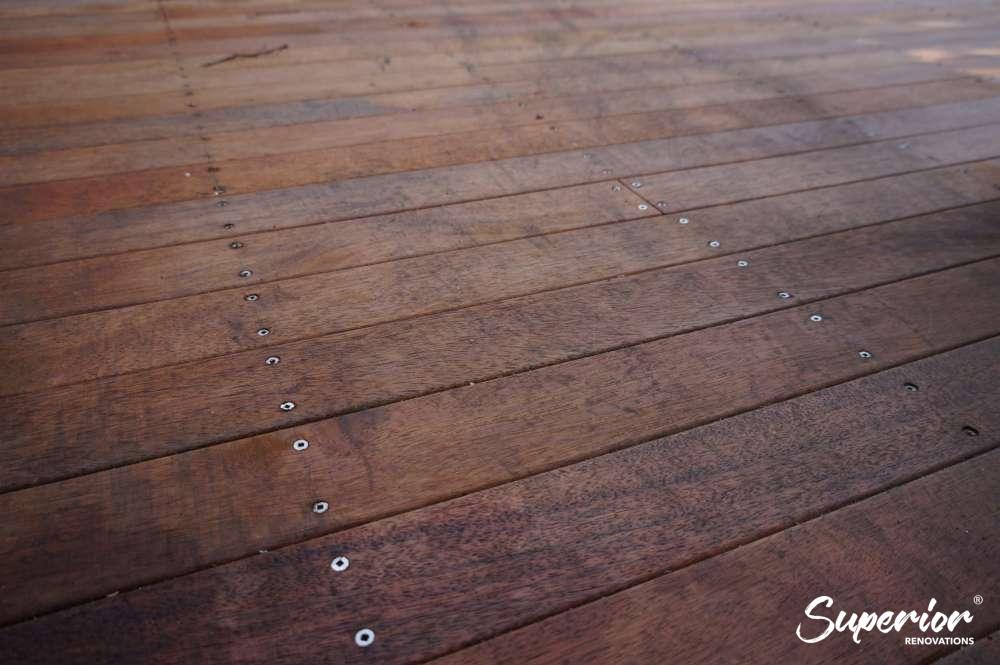
Auckland’s traditional hardwood favourite. Kwila is dense, naturally oily, naturally insect-resistant, and rated for 25+ year decks with light annual oiling. Installed cost: $450–$650/m² (GST-incl). The rich red-brown colour fades to a soft silver-grey if left unoiled.
Two catches. Kwila is a tropical hardwood, almost entirely imported — sourcing from FSC-certified suppliers matters if sustainability is part of your brief. And it leaches red tannin in its first year, which can stain concrete, paving, painted weatherboards, or anything underneath. Worth knowing before specifying it next to a freshly painted exterior.
Vitex
The quiet contender, and the option more Auckland homeowners choose once they’ve actually seen both kwila and vitex side by side. Vitex is a dense Pacific hardwood — typically sourced from the Solomon Islands or Vanuatu — that combines long deck life with a paler honey tone that ages to silver-grey without the tannin issue kwila has. Installed cost sits around $450–$650/m², similar to kwila.
What makes vitex genuinely suited to Auckland decks:
- No tannin leaching. Safe to install next to light-coloured paving, painted weatherboard, and tiled outdoor areas. The number one practical reason designers specify it over kwila on character home renovations.
- Strong dimensional stability. Vitex moves comparatively little in Auckland’s seasonal humidity swings, meaning fewer cupped or twisted boards by year three or four.
- Lighter, more contemporary aesthetic. The honey-blond tone suits modern architectural homes, painted villas, and contemporary extensions. Where kwila reads traditional, vitex reads current.
- Naturally durable without chemical treatment. Vitex carries a Class 2 natural durability rating (durable above ground), giving a 25+ year deck life with normal maintenance. It is one of the decking species recognised in NZS 3602.
- Sustainability profile. Commonly supplied from community-based operations in the Solomon Islands under forestry oversight.
The kwila-vs-vitex call usually comes down to colour preference and what’s underneath the deck. If white concrete, light paving, or painted weatherboard is in the picture, vitex is the safer specification. If the deck floats over soil or dark paving and you want the classic Kiwi hardwood look, kwila still works. Kwila carries a Class 1 (very durable) rating to vitex’s Class 2 — but both will outlast a pine deck by years with normal maintenance, and the tannin difference matters more to most Auckland sites than the durability gap does.
Garapa
A South American hardwood — paler than kwila, denser than pine. Installed cost $400–$600/m². Garapa carries a Class 2 natural durability rating, similar to vitex, with a deck life around 20–25 years. Good option when vitex isn’t readily available and the brief calls for a paler timber.
Iroko
A premium West African hardwood at $500–$700/m² installed. Less common in Auckland than kwila or vitex; often specified by designers for high-end character home extensions where matching original timber tones matters. Highly durable, with a 30+ year life.
Composite Decking (Trex, Outdure, Millboard)
The fastest-growing category in Auckland’s premium deck market. Composite boards combine recycled timber fibre with polymer — no oiling, no splintering, minimal fading, no warping. Installed cost: $500–$900/m² depending on brand and grade.
The trade-off: composite reads as a product more than as timber. Some clients love that — barefoot-safe, no maintenance, kids and dogs proof. Others prefer the patina of real wood. Composite is also harder to repair locally if a board is damaged — replacement boards come from the original supplier, which can mean lead times.
Aluminium Decking
The newest category, gaining traction on coastal Auckland sites. Aluminium boards are non-combustible (helpful near boundaries), don’t rust, don’t fade, don’t warp. Installed cost: $600–$900/m². Best fit: coastal homes in Mission Bay, Takapuna, St Heliers, Devonport, where salt air degrades traditional timber finishes within years.
The drawbacks: aluminium runs hot in summer sun (uncomfortable barefoot), dents under impact, and visually reads more commercial than residential. Most Auckland homes still specify timber.
Consent, LBP, and the Rules That Actually Apply
Deck consent rules in New Zealand sit under Schedule 1 of the Building Act 2004. The thresholds for residential decks:
Building consent is NOT required if:
- It is not possible to fall more than 1.5 metres from the deck, even if the structure collapses
- The deck doesn’t structurally affect the existing house’s load-bearing structure
Building consent IS required if:
- Any point of the deck allows a fall of more than 1.5 metres
- The deck attaches structurally to the house in a way that affects load-bearing walls
- A pergola, roof, or covered structure triggers separate building work rules
This is Exemption 24 of Schedule 1, as set out by Building Performance (MBIE). On a sloping section the fall height has to be measured at the worst-case point — over a slope or retaining wall, the drop may be greater than at the front edge.
Resource consent is a separate question. Even a low ground-level deck can trigger resource consent if it breaches site coverage limits, encroaches on yard setbacks under the Auckland Unitary Plan, or affects a heritage overlay (relevant for Ponsonby, Grey Lynn, Mt Eden, Devonport, and other character areas).
Consent advice is site-specific. The thresholds above are general guidance — always confirm your own project with Auckland Council or a Licensed Building Practitioner before you start.
The LBP requirement that catches people out
Decks that require building consent almost always involve Restricted Building Work — structural work, weathertightness work, or design that affects the building envelope. RBW must be carried out or supervised by a Licensed Building Practitioner (LBP), and the LBP must provide a Record of Work for council.
If you’re hiring a builder direct, ask for their LBP number and the licence class before you sign anything. If the build is consent-required and your builder isn’t LBP-licensed for that class of work, the consent application will stall — and you’ll be the one paying for the variation. At Superior Renovations, LBP coverage is built into our team across every consent-required project.
The handrail rule
Separate from consent: any deck where you could fall 1 metre or more must have a barrier or handrail, under New Zealand Building Code clause F4. This applies whether or not the deck needed consent to build. Barrier height and the spacing between balustrades are specified in F4 and its Acceptable Solutions — worth confirming at design stage rather than fixing at compliance inspection.
For official source detail, see the Auckland Council deck consent guidance and the Building Performance (MBIE) guidance on Exemption 24 for decks.
The Real Question: What Does a Cheap Deck Actually Cost?
Three quotes, three numbers, lowest one wins. We’ve watched this go wrong enough times to know how it usually ends.
The cheapest quote isn’t always lying. Sometimes the spec is genuinely lighter — undersized framing, missing balustrade detail, pine where the brief said kwila, no provision for the slope, no consent budget. The price is real. So is the deck. It just isn’t the deck you thought you were buying.
The hidden costs of the cheap quote typically land in year two or three:
- Variations during the build. The original quote excluded foundation engineering. Once piles are in the ground and quoted separately, the cheap deck isn’t cheap.
- Re-work on consent. The cheap quote assumed no consent was needed. Council inspector says otherwise. You pay to retrofit the structure to comply.
- Premature failure. Pine specified without H4 treatment rots underneath at the bearer level. Hardwood without proper fixings cups within two years.
- No LBP, no Record of Work, no resale paper trail. The cheap deck is on your house but not on your file. The buyer’s lawyer finds it during due diligence.
A properly built deck at the right material specification with a written Action Plan, fixed price, and consent management built in costs more upfront. It costs less over ten years. Most of our deck clients have either lived through a cheap-quote regret on a previous job, or watched a neighbour live through it. They know the real maths.
If you’re at the quote-comparison stage right now, book a free in-home consultation and we’ll walk through where the variations risk sits in your specific brief — even if you end up going with a competitor.
How We Build Decks: The Action Plan Process
What sets a Superior Renovations deck apart from a quote-and-build contractor isn’t only the workmanship. It’s the written Action Plan behind the quote. Every deck project follows the same six-stage process:
1. Free in-home consultation. A senior designer visits your home, sees the site, takes measurements, and listens to how you actually want to use the space. No template forms. No checkbox briefs.
2. Design Studio collaboration. You visit our Wairau Valley Design Studio, where material samples, balustrade options, lighting, and pergola configurations can be seen, touched, and selected before any commitment is signed.
3. Detailed Action Plan document. Before any work begins, you receive a written Action Plan covering scope, specifications, materials by brand, timeline, variations process, and fixed price. No vague “we’ll work it out as we go” estimates.
4. Consent management. If your deck requires building or resource consent, our team handles the application, engineer’s drawings, LBP documentation, and council liaison. You don’t deal with Auckland Council directly.
5. Project management on site. A dedicated project manager runs the build, coordinates trades, and provides regular progress updates. The person you spoke to at the start of the project is the same person there at handover.
6. Warranty and post-build support. All work is covered under our standard renovation warranty, plus material-specific manufacturer warranties for composite, aluminium, and hardware components.
This is the same Design-to-Build process behind 1,000+ completed Auckland renovation projects and our 190+ Google reviews.
Auckland Suburb Considerations
A few suburb-specific patterns shape what works and what doesn’t:
Coastal suburbs — Mission Bay, St Heliers, Takapuna, Devonport, Browns Bay
Salt air shortens the life of pine and softens hardwood finishes faster than further inland. Vitex, composite, or aluminium are the practical specifications on coastal properties. Annual oiling on a kwila deck becomes maintenance you genuinely have to do rather than skip. Stainless steel fixings are non-negotiable — galvanised will rust within years on a salt-exposed site. Use 316-grade stainless decking screws for coastal builds.
Hillside suburbs — Titirangi, Glendowie, Mt Eden, Mt Albert, Onehunga
Foundation engineering is the biggest cost variable here. A deck cantilevered off a sloping section needs piles, structural posts, and engineered bracing — sometimes adding $8,000–$25,000 to the build before any timber goes on. Geotech assessment at design stage is genuinely worth the spend. Building Code requirements for fall protection on elevated decks also bite hard on hillside sites — any deck with a 1m-plus fall needs barriers, which adds another $3,000–$8,000 to the spec.
Character and heritage suburbs — Ponsonby, Grey Lynn, Herne Bay, Devonport
Heritage and character overlay rules in the Auckland Unitary Plan affect what’s permitted — particularly for visible decks at the front or sides of a property. Allow extra time for resource consent review and design adjustments. Recent villa renovations we’ve worked on have needed deck designs that step down from the original floor level rather than extending out, to keep character compliance intact.
Modern build suburbs — Hobsonville Point, Long Bay, Millwater, Karaka
Covenants and design controls in master-planned subdivisions often dictate material and colour choices. Check your covenant document before specifying material — some restrict composite or aluminium for visual consistency, others mandate specific timber tones or balustrade styles. The covenant is enforceable; “but the council said it was fine” doesn’t help if your neighbour escalates.

Frequently Asked Questions
Do I need consent to build a deck in Auckland?
Building consent is not required where it is not possible to fall more than 1.5 metres from the deck, even if the structure collapses — this is Exemption 24 of Schedule 1 of the Building Act 2004. Any deck with a potential fall of more than 1.5 metres, or any deck attached to the house in a way that affects load-bearing structure, requires building consent. Resource consent is a separate question — even low decks can trigger it if site coverage, yard setbacks, or heritage overlay rules apply under the Auckland Unitary Plan. Always confirm your specific site with Auckland Council.
How much does it cost to build a deck in Auckland in 2026?
Most Auckland decks fall in the $250 to $650 per square metre range fully built (GST-inclusive). Small treated-pine decks start around $5,000. Larger hardwood decks with pergolas and lighting reach $50,000 to $70,000 or more. The biggest variables are material choice, deck height, and site conditions. Sloping sites and coastal locations cost more than flat inland builds.
Vitex or kwila — which is better for an Auckland deck?
Both are durable Pacific hardwoods suited to 25-plus year decks. The practical difference is tannin. Kwila leaches red tannin in its first year, which can stain light paving and painted exteriors. Vitex doesn't. Kwila carries a higher natural durability class (Class 1 to vitex's Class 2 under NZS 3602), but for most Auckland sites the tannin difference matters more than the durability gap. Vitex also reads more contemporary in colour. Cost is similar — around $450 to $650 per square metre installed for either. If your deck sits next to white concrete or painted weatherboard, vitex is the safer specification.
How long does it take to build a deck in Auckland?
A typical deck build takes 1 to 4 weeks on site after consent is sorted. Add 4 to 8 weeks for building consent applications if your deck triggers consent — most decks with a fall of more than 1.5 metres do. Sloping sites with engineered foundations can add another 1 to 2 weeks for piles to set. Plan the timeline around consent, not just the build.
Can I extend my existing deck without consent?
If the extension keeps the potential fall under 1.5 metres and doesn't structurally attach to the house in a load-bearing way, no building consent is needed. If the extension takes the fall above 1.5 metres, attaches structurally to the dwelling, or breaches site coverage rules under the Auckland Unitary Plan, consent will be required. Penalties for unconsented work can be significant — get a qualified designer or your council to check first.
What is the cheapest decking material in NZ?
Treated pine is the cheapest professionally installed deck material in New Zealand, at around $250 to $400 per square metre fully built. For exterior decking it must be treated to at least H3.2. It needs staining or oiling every 12 to 18 months and lasts 15 to 20 years before significant boards need replacing. The trade-off is that pine dents under furniture, greys quickly without maintenance, and isn't as load-bearing as hardwood.
Do I need an LBP for a deck in Auckland?
If your deck requires building consent, it almost always involves Restricted Building Work (RBW). RBW must be carried out or supervised by a Licensed Building Practitioner (LBP), and the LBP must provide a Record of Work for Auckland Council. If you're hiring a builder direct, ask for their LBP number and the licence class before you sign anything.
How long does a hardwood deck last in Auckland?
A well-built kwila or vitex deck lasts 25-plus years in Auckland conditions with light annual oiling. Coastal sites in Mission Bay, Takapuna, St Heliers or Devonport may see shorter life on hardwoods due to salt air. Composite and aluminium decks are warrantied for 25 to 30 years and don't require oiling. Whatever the material, ventilation under the deck and stainless fixings make a real difference to how long it lasts.
Do I need a handrail on my deck?
Any deck where you could fall 1 metre or more must have a barrier or handrail, under New Zealand Building Code clause F4 (Safety from Falling). This applies whether or not the deck needed building consent. Glass balustrades run $400 to $700 per linear metre installed. Powder-coated aluminium balustrades run $250 to $450 per linear metre. Barrier height and balustrade spacing are specified in F4 and its Acceptable Solutions.
Is composite decking worth it in Auckland?
Composite is worth it if low maintenance matters more than the look of real timber. The upfront cost ($500 to $900 per square metre) is higher than pine and similar to or above kwila and vitex. The trade-off is no oiling, no splintering, minimal fading, no warping, and 25 to 30 year warranties. Coastal Auckland sites in particular favour composite or aluminium because salt air shortens timber life.
Get a Real Quote for Your Auckland Deck
The figures in this guide are accurate for typical Auckland projects in 2026. Every site is different. The only way to get a true cost for your specific home is a free in-home consultation with our design team. We’ll assess the site, walk through material options, and produce a written Action Plan with a fixed price.
➡ Book your free in-home consultation with Superior Renovations
➡ Estimate your pergola or deck cover cost
➡ Request a free feasibility report for your project
Please note: Whilst all information is considered to be true and correct at the date of publication, changes in circumstances after the time of publication may impact on the accuracy of the information. The information may change without notice and Superior Renovations is not in any way liable for the accuracy of any information printed and stored or in any way interpreted and used by a user.
Further Resources for your deck and outdoor renovation
- Featured projects and Client stories to see specifications on some of the projects.
- Real client stories from Auckland
Need more information?
Take advantage of our FREE Complete Home Renovation Guide (48 pages), whether you’re already renovating or in the process of deciding to renovate, it’s not an easy process, this guide which includes a free 100+ point check list – will help you avoid costly mistakes.
Download Free Renovation Guide (PDF)
Have you been putting off getting renovations done?
We have partnered with Q Mastercard ® to provide you an 18 Month Interest-Free Payment Option, you can enjoy your new home now and stress less.
Learn More about Interest-Free Payment Options*
*Lending criteria, fees, terms and conditions apply. Mastercard is a registered trademark and the circles design is a trademark of Mastercard International Incorporated.
Still have questions unanswered?
Book a no-obligation consultation with the team at Superior Renovations, we’d love to meet you to discuss your renovation ideas!


