


Guide to Kwila Decking in Auckland: Tips, Suppliers & Maintenance
If you’re an Auckland homeowner thinking about a kwila deck — whether that’s a spot for summer barbies in Botany Downs or somewhere to sit and watch the bush in Titirangi — this guide covers what you need to know. Kwila (also known as Merbau) is a dense tropical hardwood that handles Auckland’s humidity, coastal salt air, and UV without much fuss. The reddish-brown tones are hard to beat, and with a bit of maintenance, a good kwila deck will last 15–25 years or more.
Why’s Kwila Decking Such a Good Choice for Auckland Backyards?
It suits our conditions well. Kwila is naturally oily and dense — it shrugs off moisture, insects, and decay in exposed spots like Takapuna and Devonport where the salt spray is real. The Janka hardness rating means it won’t dent under heavy furniture, and FSC-certified options mean you’re not compromising on environmental credentials. Compared to pine, the long-term maintenance burden is lower. We’ve seen Herne Bay decks going strong past 15 years with regular oiling. The main downsides: initial tannin bleeding (a reddish runoff that washes out over time) and a higher upfront cost — but pre-coating the boards before installation deals with most of the tannin issue in our wet climate.
How Much Will a Kwila Deck Set You Back in NZ Right Now?
For materials alone, budget $90–$120 per m² for quality 140x19mm boards — pricier than treated pine but cheaper than most composite options. Full installation including substructure runs $200–$350 per m². A typical 20m² deck comes in somewhere between $3,800 and $7,500 all up, plus $500–$2,000 if your project needs Auckland Council consent (required for decks over 1.5m high or 25m²). Clay soils in areas like Remuera can add to site prep costs. Always spec stainless steel fixings for coastal sites — it’s not a place to cut corners. PlaceMakers and South Pacific Timber both carry FSC-certified kwila in the $90–$110 range.
What’s the Best Way to Maintain Kwila So It Lasts in Our Weather?
Keep it simple and stay consistent. Clean every six months with something like Wet & Forget — particularly important in shady spots like Titirangi where mildew gets a hold quickly. Oil every 12–18 months using Resene Kwila Stain or Dryden OilStain. New decks need a tannin wash-down every couple of weeks for the first few months. Allow good airflow — 450mm clearance underneath as a minimum — and you’re looking at 25 years without drama. Skip the maintenance schedule and you’ll see cracking and fading sooner than you’d like. Whether you want to keep that warm reddish colour or let it silver naturally, both are valid — just decide early so you’re using the right products from the start.
Thinking about a kwila deck for your place? Get in touch with Superior Renovations for a free chat — we’re happy to talk through your options without the sales pitch.
Guide to Kwila Decking for Auckland Homeowners
Kwila (also known as Merbau) is one of the most popular decking timbers in Auckland for good reason. It handles the humidity, the coastal salt, and the UV load that comes with living in this part of the world — and it does it while looking genuinely good. Rich reddish-brown tones, a lifespan of 15–25+ years with proper care, and a density that takes high-traffic use in its stride. This guide is for Auckland homeowners who want a straight answer on every part of the kwila decking decision — costs, materials, maintenance, alternatives, suppliers, and what to watch out for. Auckland’s conditions are specific: intense UV, salty air in coastal suburbs, and clay soils that complicate substructures. We’ve tailored the advice accordingly.
If you’re looking for specific cost estimates, try our Renovation Cost Calculator Tools
- Bathroom Renovation Cost Calculator
- Kitchen Renovation Cost Calculator
- Reroofing Cost Calculator
- Double Glazing Cost Calculator
- House Extension Cost Calculator
- Custom Kitchen Cabinetry Cost Calculator
- New Laundry Cost Calculator
- New Pergola Cost Calculator
How Much Does Kwila Decking Cost in Auckland?
Kwila is a premium hardwood and the price reflects that — but “premium” doesn’t mean overpriced when you factor in what it costs to own over 20 years. This section breaks down materials, installation, and the hidden costs that catch people out, so you can put together a realistic budget before you start talking to suppliers or contractors.
Understanding Kwila Decking Costs: Supply and Installation
The cost of a kwila deck isn’t just the timber. There’s installation, site preparation, fixings, and ongoing maintenance to account for. Auckland’s conditions add a few specifics — clay soils, coastal exposure, and UV load all influence what a good job actually requires.
Materials alone typically run $90–$120 per square metre for kwila decking in New Zealand. Add professional installation and you’re looking at $200–$350 per m² total, depending on site complexity and design. Here’s what drives those numbers.
Material Costs for Kwila Decking
Kwila board prices vary depending on grade, size, and whether the timber is FSC-certified. Standard sizes in Auckland are typically 140x19mm or 90x19mm. Here’s a quick snapshot of what the main suppliers are charging:
| Supplier | Product | Size | Price (per m², incl. GST) |
|---|---|---|---|
| South Pacific Timber | Kwila Decking | 140x19mm | ~$89 |
| PlaceMakers | Kwila Griptread Decking FSC | 150x25mm (140x19mm finished) | ~$90–$100 |
| BBS Timbers | Kwila Hardwood Decking | 140x19mm | ~$90–$110 |
FSC certification matters — it confirms sustainable sourcing and is worth asking about at any supplier. It can affect price slightly, but it’s the right call for timber that comes from managed forests.
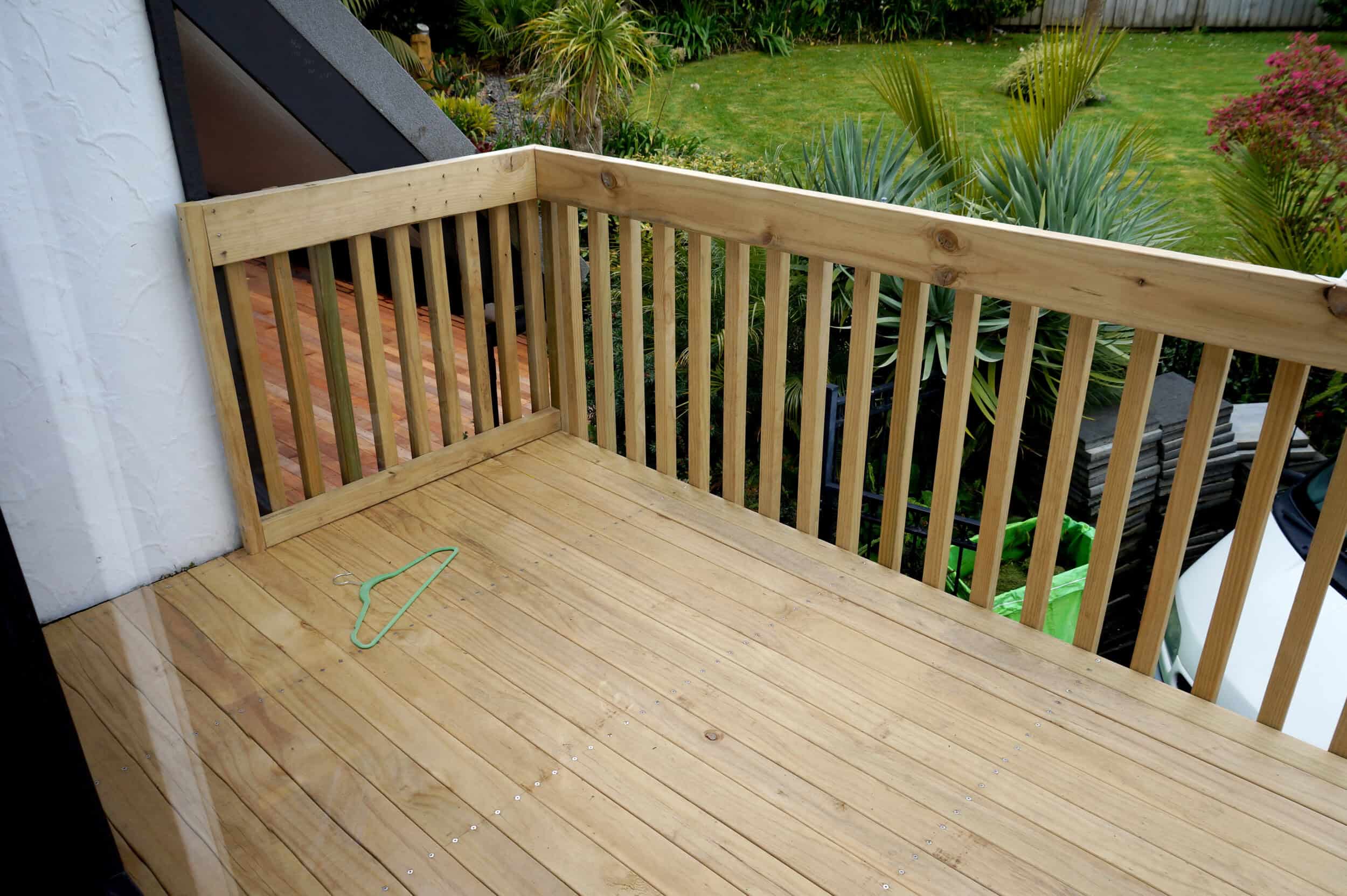
Kwila decking by Superior Renovations
Prices shift with demand and availability. Big-box retailers like Bunnings and Mitre 10 are convenient and often competitive on price. Specialist suppliers like JSC Timber tend to offer better grade selection and more specific advice. Auckland’s proximity to port means freight costs are lower than in more remote parts of the country, which helps.
Installation Costs in Auckland
This is where costs start to climb. Professional installation for kwila in Auckland typically runs $180–$280 per m². The range reflects several variables:
- Site preparation: Uneven ground, old deck removal, or drainage work in suburbs like Remuera or Ponsonby adds $20–$50 per m² on top of the basic install.
- Design complexity: A single-level deck in Flat Bush costs less to build than a multi-level deck with integrated seating in Herne Bay. The more complex the design, the higher the labour cost.
- Access: Auckland’s hilly suburbs — Mt Eden, Titirangi, parts of the North Shore — can make getting materials in and working on-site genuinely difficult. That time shows up in the quote.
- Fixings and pre-coating: Stainless steel screws (T316 grade for coastal sites) and pre-coating boards before installation add $10–$20 per m², but both are worth it. PlaceMakers recommends 10g 65mm T316 stainless fixings — budget around $0.50–$1 each.
Get at least three quotes from Auckland-based contractors. Local knowledge — Auckland clay soils, coastal exposure requirements — makes a real difference to how the job gets specified and priced.
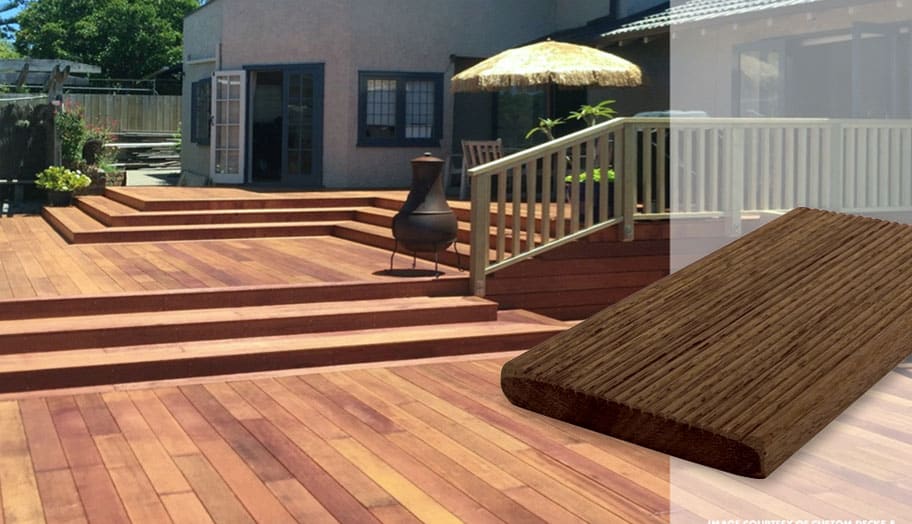
https://www.placemakers.co.nz/online/timber-plywood/decking/hardwood-decking/c/RAK03I1
Additional Costs to Factor In
A few things that don’t always show up in the initial quote:
- Staining or oiling: Plan for around $20 per m² for materials to protect the timber and maintain colour. More on this in the maintenance section.
- Substructure: The joists, bearers, and posts — usually treated pine — add $30–$50 per m² depending on deck size and height above ground.
- Council consent: Decks over 1.5m high or beyond a certain footprint require Auckland Council Building Consent. Budget $500–$2,000 for the consent itself, and allow time for processing.
- Maintenance kit: A decent brush, deck cleaner, and oil applicator will cost $50–$100 upfront but will pay for itself quickly.
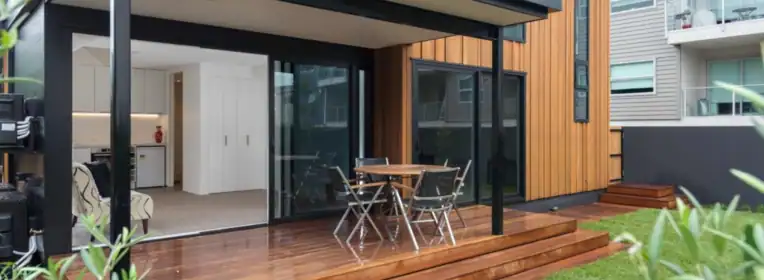
https://jsc.co.nz/product-categories/decking
How Auckland’s Environment Affects Costs
Auckland’s humidity and coastal exposure aren’t just talking points — they have a direct bearing on how a kwila deck should be built. Kwila handles moisture and decay well naturally, but the installation still needs to be done right for it to deliver on that promise. Adequate under-deck ventilation (minimum 450mm clearance, as PlaceMakers recommends) prevents moisture from sitting beneath the boards — something that matters especially in suburbs like Takapuna or Devonport where the air is salty and damp. Getting this right might mean spending a bit more on substructure or site prep, but it’s money well spent.
In coastal Auckland suburbs, pre-coating kwila boards on all four sides before installation is standard practice — it significantly reduces moisture damage risk and saves on repair costs down the track.
Is Kwila Worth the Price?
Pine is cheaper upfront. Composite decking is lower maintenance. But kwila sits in a practical middle ground — a well-maintained kwila deck realistically lasts 15–25 years in Auckland conditions, and its visual quality is hard to replicate with synthetic alternatives. Compared to composite (which can run $300–$400 per m² installed), kwila often represents better value for homeowners who don’t mind doing a bit of maintenance every year or two. In suburbs like Parnell or Titirangi, a good kwila deck also adds genuine kerb appeal that shows up in a valuation.
How to Keep Costs Down Without Cutting Corners
- Get multiple quotes: Prices between suppliers like Lumberbank, Bunnings, and Mitre 10 vary more than you’d expect. Shop around before committing.
- DIY what makes sense: Site prep and staining are manageable for handy homeowners. Structural work is not — leave that to licensed tradespeople to stay compliant with Auckland building code.
- Invest in sealant upfront: A quality product like Dryden OilStain at the start reduces how often you’ll need to redo the job. Available at Mitre 10 and suited to NZ conditions.
- Keep the design simple where you can: A single-level deck costs meaningfully less than one with multiple tiers or complex integrated features.

https://bbstimbers.co.nz/kwila
Kwila decking at $200–$350 per m² installed is a meaningful spend. But when you factor in its 15–25+ year lifespan, its low maintenance relative to pine, and the visual return it delivers, the numbers hold up for most Auckland homeowners who are planning to stay in their property and use the outdoor space properly.
Pros and Cons of Kwila Decking: Is It the Right Choice for Your Auckland Home?
Kwila has a strong reputation in the Auckland market — well-earned, for the most part. But it’s not the right answer for everyone. Here’s an honest look at what you’re getting and what you’re signing up for, so you can make the call with clear expectations.
Why Auckland Homeowners Choose Kwila
1. It handles Auckland’s conditions well
Kwila’s high oil content gives it natural resistance to moisture, insects, and decay — the three things that shorten a deck’s life in Auckland’s climate. Whether you’re in Takapuna copping salt spray off the harbour or in Mt Eden dealing with heavy winter rain, kwila is built for it. According to PlaceMakers, those natural oils are what make kwila a reliable performer in NZ’s variable weather.
For maximum durability, ensure your deck has proper ventilation — at least 450mm clearance underneath — to prevent moisture from sitting in the substructure. This is especially relevant in Auckland’s clay-heavy soils.
2. The aesthetic is hard to argue with
Kwila’s warm reddish-brown tones — shifting toward golden hues as the timber ages — add character that composite alternatives rarely replicate convincingly. It works on modern builds in Grey Lynn and on classic bungalows in Henderson. If you leave it untreated, it weathers to a clean silver-grey patina — a look that suits beachside properties in places like Devonport or Waiheke without requiring any maintenance effort to maintain the colour.
3. Less maintenance than pine
This is a relative claim, but it’s a meaningful one. A clean and an oil every 12–18 months is the maintenance commitment for kwila. Pine needs attention every six to twelve months to stay in reasonable shape. Products like Dryden OilStain or Resene Kwila Timber Stain from Mitre 10 are straightforward to apply and widely available.
Apply a quality decking oil to all four sides of the boards before installation — not just the top face. It adds a step to the build, but significantly reduces moisture ingress from below.
4. FSC-certified options are available
Kwila’s sustainability record has historically been patchy — some supply chains have raised legitimate concerns about logging practices in the source regions. FSC-certified kwila from suppliers like South Pacific Timber addresses that directly. If environmental provenance matters to you, ask for the certification and verify it — don’t just take the supplier’s word for it.
5. Built for heavy use
Kwila’s Janka hardness rating of around 1,800 lbf means it takes heavy furniture, foot traffic, and the general wear of family life without denting or marking easily. For a deck that’s going to be used hard — regular entertaining in Botany Downs, kids in Albany — it’s a more practical choice than softer timbers.
The Downsides Worth Knowing About
1. Tannin bleeding
Kwila bleeds tannins — a reddish-brown sap that runs off the timber after rain and can stain concrete, pavers, or a neighbour’s fence. In a tight Remuera backyard, this is worth planning for. The bleeding is most pronounced in the first few months and settles down, but if you’re not across it beforehand it can be an unpleasant surprise.
Hose down the deck regularly after installation — every couple of weeks for the first three to six months. Lay down drop cloths during the build to protect surrounding surfaces. Pre-coating boards before installation also reduces the bleed significantly.
2. Higher upfront cost than pine
At $90–$120 per m² for materials and $200–$350 per m² installed, kwila is a step up from pine ($50–$80 per m² materials) but generally cheaper than composite ($300–$400 per m²). For a budget-conscious homeowner in Manurewa who needs a functional deck rather than a premium one, pine is a reasonable call. For anyone planning to stay in the property and use the space properly, kwila usually wins the ten-year cost comparison.
A smaller, well-built kwila deck often outperforms a larger pine deck over time — both in appearance and in what it costs to maintain. Consider scaling down the design before switching materials.
3. It still needs maintenance
Low maintenance is not no maintenance. Without annual oiling, kwila will fade toward a silver-grey patina — fine if that’s what you want, but it can also dry out and crack in Auckland’s UV-heavy summers if left completely unprotected. Set a reminder and stick to it. The job takes an afternoon, not a weekend.
Set a calendar reminder for cleaning and oiling annually. It’s a fraction of the time pine requires, but it still needs to happen.
4. Sourcing ethics vary
Not all kwila on the NZ market is FSC-certified. Without certification, you can’t verify the logging practices behind the timber — a real concern given kwila’s source regions. Always ask for documentation. If a supplier can’t produce it, that’s your answer.
5. It’s not a DIY-friendly install
Kwila’s density makes it harder to work with than pine. It needs proper fixings, correct board spacing (4–6mm), and experienced hands to avoid splitting or cupping — both of which are more common in Auckland’s humid climate if installation isn’t done well. Get a contractor with hardwood decking experience, not just general carpentry.
Ask any contractor you’re considering for photos or references from past kwila projects specifically. General carpentry experience doesn’t automatically translate to hardwood decking.
Pros and Cons at a Glance
| Advantages | Disadvantages |
|---|---|
| Handles Auckland’s weather conditions well | Initial tannin bleeding can stain surrounding surfaces |
| Rich reddish-brown aesthetic that ages well | Higher upfront cost than pine |
| Lower maintenance than softwoods | Still needs oiling annually to hold colour |
| FSC-certified options available | Sourcing ethics vary without certification |
| High density suits heavy use | Needs experienced installers to avoid cupping or splitting |
Is Kwila Right for Your Auckland Home?
If you’re after durability, a good-looking result, and you’re prepared to do a bit of maintenance every year or two, kwila is a strong choice. It suits coastal suburbs like Devonport where its weather resistance matters, and high-traffic family homes in Howick where its hardness earns its keep. If you need the cheapest possible option, or want something genuinely maintenance-free, the alternatives section below is worth reading first.
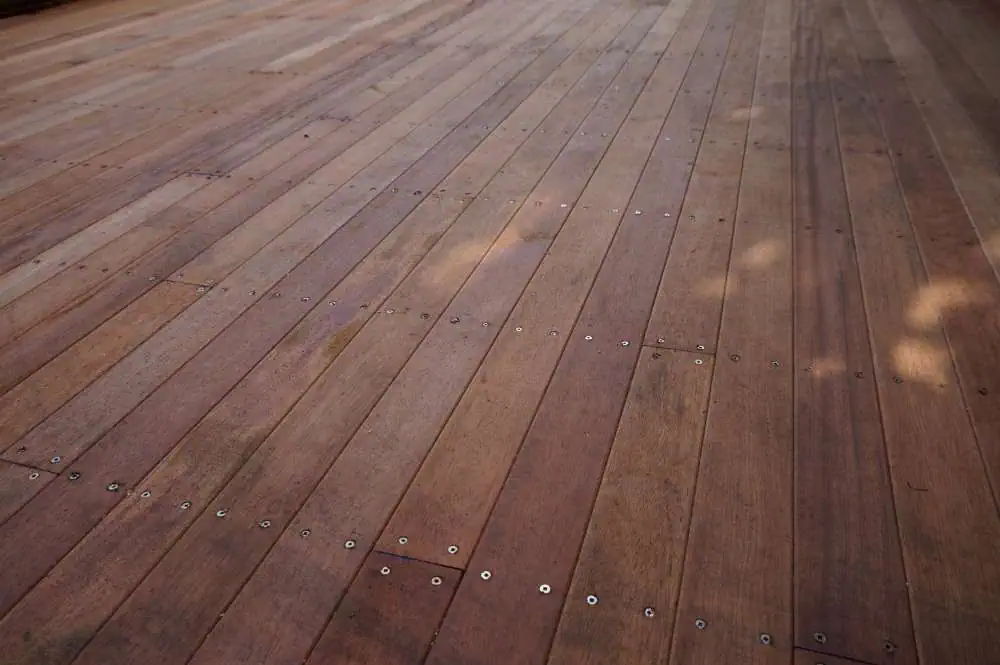
Making Kwila Work for Your Property
- Verify FSC certification: Ask for it in writing from suppliers like South Pacific Timber. Don’t take it on trust.
- Plan for tannin management from day one: Protect surrounding surfaces during installation, wash regularly in the first few months, and pre-coat before installation.
- Use experienced installers: Hardwood decking is a different discipline. Ask for references from similar kwila projects in Auckland.
- Decide on your finish preference early: Whether you’re maintaining the reddish colour with regular oiling or letting it silver naturally, the products you use from the start affect how it ages.
- Spec the right fixings: T316 stainless steel as a minimum — non-negotiable for anything within a couple of kilometres of the coast, as PlaceMakers will tell you.
Kwila is a genuinely good decking timber for Auckland — well-suited to the climate, good looking, and durable when properly installed. The main things that shorten its life are poor installation and neglected maintenance, neither of which is hard to avoid with the right preparation.
Alternatives to Kwila Decking for Your Auckland Home
Kwila isn’t the only answer. Depending on your budget, maintenance appetite, and what the deck needs to do, one of the alternatives below might be a better fit. Here’s an honest comparison.
Why It’s Worth Considering Alternatives
Kwila is a strong all-rounder, but there are situations where it’s not the obvious call. Pine is substantially cheaper upfront. Composite is genuinely low-maintenance. Vitex offers a lighter aesthetic at a similar durability level. Bamboo suits the eco-conscious end of the market. Your choice comes down to budget, how you’ll use the deck, and how much maintenance you’re realistically going to do.
1. Treated Pine Decking
Treated pine is the most common decking material in New Zealand for a reason: it’s significantly cheaper than kwila at $50–$80 per m² for materials and $150–$250 per m² installed. Available at Bunnings and Mitre 10, H3.2-treated pine is pressure-treated to handle the outdoor conditions Auckland throws at it.
Pros:
- Lower cost: Makes a big deck in Papakura viable on a tighter budget.
- Easy to work with: Lighter and softer than kwila, which reduces installation time and labour cost.
- Paintable and stainable: Can be finished to mimic the look of harder timbers if that’s what you’re after.
Cons:
- Shorter life: Realistically 10–15 years against kwila’s 15–25+.
- More maintenance: Needs staining or sealing every six to twelve months in Auckland’s conditions, or it deteriorates quickly.
- Softer timber: Dents and marks more easily under heavy use — not ideal for high-traffic family decks.
Specify H3.2 treatment for any outdoor use. Ensure adequate ventilation under the deck — pine is more susceptible to moisture damage than kwila, and Auckland’s clay soils don’t help.
2. Composite Decking
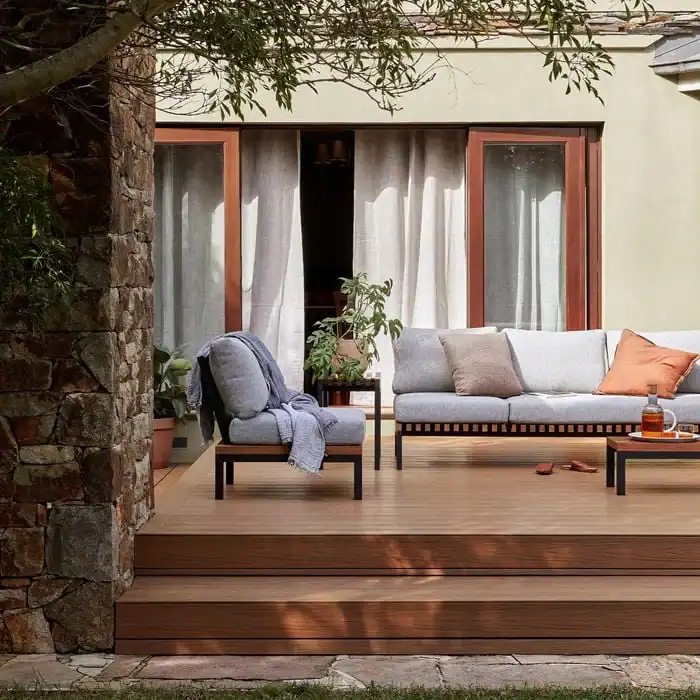
Composite — wood fibre and recycled plastic blended together — is gaining ground in Auckland for one reason: it barely needs maintaining. Brands like Trex and Millboard, available through JSC Timber, cost $100–$200 per m² for materials and $300–$400 per m² installed.
Pros:
- Very low maintenance: No oiling, no staining. A hose-down periodically is about it — suits busy Aucklanders in Parnell who want the deck, not the upkeep.
- Weather resistant: Handles fading, rot, and moisture well — useful in coastal spots like Devonport.
- Eco-friendly options: Often made from recycled content, which matters to a growing number of buyers.
Cons:
- Higher upfront cost: More expensive than kwila installed, which strains budgets for larger decks.
- It doesn’t look like timber: Getting closer, but still not there. Some Kiwi homeowners find the aesthetic unconvincing.
- Gets hot: Darker composite boards in Auckland’s summer sun get genuinely uncomfortable underfoot — worth checking before you commit to a colour.
If you’re near water or have a pool deck, choose a composite with a textured surface for grip. Smooth composites get slippery wet.
https://www.bunnings.co.nz/ekodeck-designer-series-137-x-23mm-5-4m-backbeach-leatherwood-composite-decking_p0457238
3. Vitex Decking
Vitex is a tropical hardwood that doesn’t get as much attention as kwila, but it should. From suppliers like South Pacific Timber, vitex costs $80–$100 per m² for materials and $180–$300 per m² installed — a slightly softer price point with comparable durability.
Pros:
- Similar durability to kwila: Handles Auckland’s moisture and salt air well.
- Lighter aesthetic: The golden-brown tones suit coastal properties in Mission Bay or Waiake where kwila’s deeper red can feel heavy.
- Sustainability credentials: Often FSC-certified.
Cons:
- Also bleeds tannins: Same precautions apply as kwila — plan for it from the start.
- Harder to source: Fewer Auckland suppliers carry it, which limits your options and can affect price.
- Still needs oiling: Maintenance requirements are broadly similar to kwila.
A clear oil rather than a tinted stain lets vitex’s natural grain work for you without pushing it toward a colour it doesn’t naturally have.

https://southpacifictimber.co.nz/products/decking/vitex-decking/
4. Bamboo Decking
Bamboo decking is getting more traction in NZ as a sustainable alternative. Available at Bunnings, bamboo costs $90–$150 per m² for materials and $200–$350 per m² installed.
Pros:
- Renewable resource: A genuinely sustainable option for eco-conscious builds in suburbs like Grey Lynn.
- Distinctive look: Doesn’t try to look like timber and is better for it — suits modern, minimal aesthetics.
- Good durability when properly treated: High-density, thermally treated bamboo resists moisture and pests reasonably well.
Cons:
- Quality varies significantly: Lower-grade bamboo can warp or crack in Auckland’s humidity. You get what you pay for here more than most materials.
- Needs regular sealing: More maintenance than composite, less than pine.
- Can be pricier than pine or kwila: Depending on product and brand, bamboo at the quality end sits alongside kwila on price.
Specify high-density, thermally treated bamboo for Auckland conditions. Ask for certification details on quality — this market has a wider range than most.
How the Options Compare
| Material | Cost (Materials, per m²) | Cost (Installed, per m²) | Durability | Maintenance | Aesthetic | Best For |
|---|---|---|---|---|---|---|
| Kwila | $90–$120 | $200–$350 | 15–25+ years | Low (oil every 12–18 months) | Rich reddish-brown | Coastal homes, high-traffic decks |
| Treated Pine | $50–$80 | $150–$250 | 10–15 years | High (stain every 6–12 months) | Light, customisable | Budget-conscious homeowners |
| Composite | $100–$200 | $300–$400 | 20–30 years | Very low (cleaning only) | Modern, uniform | Low-maintenance priority |
| Vitex | $80–$100 | $180–$300 | 15–20 years | Low (oil every 12–18 months) | Golden-brown | Coastal, aesthetic-focused homes |
| Bamboo | $90–$150 | $200–$350 | 10–20 years | Moderate (seal every 12 months) | Modern, distinctive | Eco-conscious homeowners |
Which Material Suits Your Situation?
Kwila holds up well against all of these alternatives for most Auckland situations. But here’s the short version on when to consider something else:
- Budget is the primary constraint: Treated pine in Manurewa — just be across the higher maintenance commitment.
- Maintenance-free is non-negotiable: Composite in Parnell — pay more upfront, get years of no-fuss use.
- You want a lighter coastal look: Vitex in Mission Bay — similar durability to kwila with a different aesthetic character.
- Sustainability is the deciding factor: High-quality bamboo in Grey Lynn — just specify carefully and don’t buy cheap.
Practical Tips for Choosing
- Work out the ten-year cost, not just the install cost: Kwila and vitex often win on that number even when pine looks cheaper upfront.
- Prioritise moisture and UV resistance for coastal sites: Kwila, vitex, and composite are the safe calls for Devonport or Takapuna.
- Check FSC or equivalent certification for any timber: This applies to kwila, vitex, and bamboo equally.
- See samples in person: Visit suppliers like Lumberbank or BBS Timbers and look at the materials in natural light before deciding.
- Talk to an Auckland contractor before finalising the material: They’ll have a view on what performs well in your specific suburb and soil type.
Kwila is the right call for most Auckland homeowners who want durability, aesthetics, and a maintenance commitment they can realistically stick to. But the alternatives are worth understanding properly before you commit.
How Long Does Kwila Decking Last? Life Expectancy for Auckland Homes
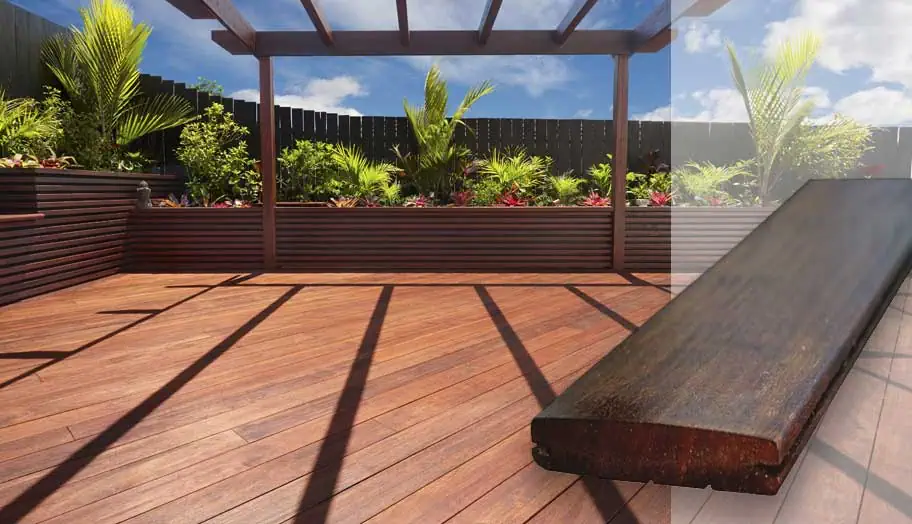
The headline number is 15–25+ years. That’s the realistic lifespan of a well-installed, properly maintained kwila deck in Auckland’s conditions. But that range covers a lot of ground, and the difference between 15 years and 25+ years comes down to a few factors that are worth understanding before you start.
What Determines How Long Your Kwila Deck Lasts?
Kwila’s natural oil content and density give it a head start over softwoods. PlaceMakers cite those properties as the reason it performs reliably in NZ’s variable coastal weather — particularly in suburbs like Devonport and Takapuna. But the timber alone doesn’t determine lifespan. Here’s what does:
- Timber grade: FSC-certified, high-grade kwila from suppliers like South Pacific Timber is denser and more consistent than lower-grade stock. Knots and imperfections are where moisture gets in and problems start.
- Installation quality: Board spacing of 4–6mm, stainless steel fixings, and adequate substructure ventilation are the three things that most separate a 25-year deck from a 12-year deck. Poor installation in Auckland’s humidity accelerates every weakness in the timber.
- Maintenance routine: Cleaning and oiling every 12–18 months protects against UV and moisture damage. Neglect it and you’ll see cracking and fading — sometimes within a few seasons in high-UV areas like Parnell.
- Coastal exposure: Mission Bay, Waiake, St Heliers — salt air accelerates corrosion in fixings and puts more pressure on the timber’s surface. Proper material specification matters more in these spots.
- Usage: A high-traffic entertainment deck in Howick lives a harder life than a quiet sitting area in Titirangi. That’s not a reason to avoid kwila — it’s built for it — but it’s honest.
What Auckland’s Climate Does to Kwila
Auckland’s combination of rain, UV, and salt air is demanding — but kwila was designed for tropical conditions, so it’s not out of its depth. Three things to watch for specifically:
- Moisture: Auckland rain and humidity cause untreated kwila to absorb water and swell. Pre-coating all four sides of each board before installation, as PlaceMakers recommend, is the most effective preventive step.
- UV exposure: The Kiwi sun is harsh. Without regular oiling, kwila fades toward silver-grey — which some homeowners actively want, but the UV still degrades the surface over time even if the colour change suits you.
- Salt air: The real risk here is to your fixings, not the timber. Standard steel screws corrode and fail long before the kwila does. T316 stainless steel, available at Mitre 10, is the specification for anything near the coast.
For coastal suburbs, 450mm minimum clearance under the deck for ventilation is non-negotiable — particularly on Auckland’s clay-heavy soils where drainage is slower.
How to Get the Most Out of Your Kwila Deck
- Hire installers who know hardwood: Auckland contractors with kwila experience will spec and install it correctly. Ask specifically for examples of past hardwood decking projects.
- Pre-coat before installation: Resene Kwila Timber Stain from Bunnings applied to all four sides before the boards go down is one of the highest-value steps in the whole process.
- Clean every six months, oil every 12–18: The maintenance regime isn’t complicated — it just needs to happen consistently.
- Spec T316 stainless fixings: As PlaceMakers recommend — not just for coastal areas, for any Auckland build.
- Manage tannins in year one: Regular wash-downs in the first few months protect both the deck’s surface and anything around it.
Set a calendar reminder for annual maintenance. A few hours once a year is a fraction of the cost of repair or replacement.
How Kwila Compares on Lifespan
| Material | Life Expectancy | Key Factors for Longevity |
|---|---|---|
| Kwila | 15–25+ years | Regular oiling, quality installation, FSC-certified timber |
| Treated Pine | 10–15 years | Frequent staining, H3.2 treatment, good ventilation |
| Composite | 20–30 years | Minimal maintenance, UV-resistant brands, proper installation |
| Vitex | 15–20 years | Similar to kwila — oiling, quality fixings, ventilation |
| Bamboo | 10–20 years | High-density treatment, regular sealing, quality sourcing |
Kwila sits in a strong position on the lifespan table — better than pine and bamboo, comparable to vitex, and while composite edges it out, composite costs more upfront and lacks kwila’s natural character. For most Auckland homeowners, that’s the right trade-off.
What to Watch For
These are the signs your kwila deck needs attention:
- Colour fading to grey: Time to reapply oil if you want to maintain the reddish tone.
- Small cracks or splits: The timber is drying out. Sand lightly and oil promptly before they worsen.
- Loose boards or fixings: Auckland’s humidity cycles cause movement. Check annually and retighten what needs it.
- Mould or mildew patches: Common in shady spots like Titirangi. Clean with a deck cleaner before it gets established.
Inspect your deck twice a year — after winter and after summer. Catching issues early is significantly cheaper than fixing them once they’ve progressed.
A kwila deck is a 15–25+ year investment for Auckland homeowners who install it properly and maintain it consistently. The timber itself is up to the challenge — Auckland’s conditions are demanding but well within what kwila was designed to handle.
https://www.placemakers.co.nz/online/timber-plywood/decking/hardwood-decking/c/RAK03I1
Maintaining Your Kwila Deck: A Practical Guide for Auckland Homeowners
Kwila is low-maintenance compared to pine. It is not no-maintenance. Auckland’s humidity, UV intensity, and coastal salt air will work on an untreated deck regardless of the timber species — the question is whether you stay ahead of it or respond to the damage after it’s done. Staying ahead is cheaper and less work. Here’s how.
Why Maintenance Matters
Kwila’s natural oils give it inherent resistance, but those oils deplete over time — faster in high-UV areas like Parnell, faster again in coastal suburbs where salt air adds to the load. Regular maintenance replenishes that protection and catches small issues — a loose fixing, a patch of mildew — before they become expensive ones. According to PlaceMakers, a consistent routine extends kwila’s useful life significantly. It also keeps the deck looking the way it should.
Set calendar reminders for biannual cleaning and annual oiling. It won’t take more than an afternoon — and it’s the difference between a 15-year deck and a 25-year one.
The Three Core Maintenance Tasks
1. Cleaning
Clean every six months — spring and autumn. In shady Auckland suburbs like Titirangi, mildew establishes quickly and is harder to shift once it’s embedded in the grain. A mild deck cleaner like Wet & Forget and a stiff brush handles most situations. For coastal properties, the post-winter clean is particularly important — salt buildup combined with moisture creates the conditions for surface deterioration that’s easy to prevent and annoying to remediate.
Clean every six months, especially after Auckland’s wet winters. Focus on shaded areas first — that’s where mildew gets established.
2. Managing Tannin Leaching
Kwila bleeds tannins — a reddish-brown sap that runs off in rain and stains concrete and pavers. In the first three to six months after installation, this is the main thing to stay on top of.
- Regular wash-downs: Hose or low-pressure wash every two to three weeks in the early months to flush tannins before they set on surrounding surfaces.
- Protect nearby surfaces at installation: Drop cloths during the build catch runoff before it stains. Particularly relevant in tight Auckland backyards like Ponsonby or Grey Lynn where pavers are close to the deck edge.
- Pre-coat before installation: Applying sealant or oil to all four sides of each board, as South Pacific Timber recommend, significantly reduces tannin bleed from the outset.
If tannin stains reach nearby pavers or concrete, diluted oxalic acid cleaner from Bunnings removes them without damaging the deck surface.
3. Oiling or Staining
Oil or stain every 12–18 months to protect against UV and moisture. Without it, the deck will fade toward silver-grey — which is a legitimate aesthetic choice, but the UV still degrades unprotected timber even if the patina suits you. For homeowners who want to maintain the reddish colour, a quality decking oil is the straightforward answer.
- Product selection: Dryden OilStain and Resene Kwila Timber Stain from Mitre 10 are both well-suited to NZ conditions. Both penetrate the timber and provide UV protection rather than sitting on the surface where they can peel.
- Application process:
- Clean the deck thoroughly and allow it to dry completely.
- Lightly sand with 120–180 grit sandpaper if the surface is rough or the previous coat is weathered.
- Apply oil or stain with a brush or cloth, working with the grain for even coverage.
- Allow 24–48 hours drying time. Check Auckland’s forecast — applying before rain is a wasted job.
- Frequency: Every 12 months in high-UV or coastal areas like Mission Bay. Every 18 months in more sheltered locations is generally sufficient.
Apply in early morning or late afternoon — Auckland’s midday sun dries the oil unevenly and can leave lap marks.
Maintenance Schedule for Auckland Conditions
| Task | Frequency | Best Time | Notes |
|---|---|---|---|
| Initial Tannin Wash-Down | Every 2–3 weeks for first 3–6 months | After installation | Hose or low-pressure wash; protect nearby surfaces. |
| General Cleaning | Every 6 months | Spring and autumn | Mild deck cleaner; focus on shaded areas for mould prevention. |
| Oiling or Staining | Every 12–18 months | Spring or early summer | UV-resistant products; apply in cooler part of the day. |
| Inspection | Every 6 months | After winter and after summer | Check fixings, cracks, mildew — especially in coastal suburbs. |
After Auckland’s wet winters, check under pergolas and in any shaded sections of the deck first — that’s where mildew gets established without much warning.
What You’ll Need
Available at Bunnings or Mitre 10:
- Deck cleaner: Wet & Forget or similar mild biodegradable cleaner for general maintenance.
- Decking oil or stain: Resene Kwila Timber Stain or Dryden OilStain for UV and moisture protection.
- Oxalic acid cleaner: For tannin stains on surrounding surfaces.
- Tools: Stiff-bristled brush, low-pressure hose or washer, sandpaper (120–180 grit), brush or cloth applicator.
- Protective gear: Gloves and drop cloths.
Mistakes Worth Avoiding
- Not pre-coating before installation: Leaving the undersides and ends of boards unsealed invites moisture ingress from below — one of the more avoidable causes of premature deck failure in Auckland’s climate.
- Using cheap oils or stains: They don’t penetrate properly and won’t hold up to Auckland’s UV. Pay for a quality product — you’re applying it to an expensive deck.
- Ignoring tannin management in year one: Tannin stains on concrete or light-coloured pavers in tight Auckland backyards are difficult to fully remove once they set.
- High-pressure washing: Damages kwila’s surface grain and drives moisture into the boards. Low pressure or a good stiff brush is all you need.
- Skipping inspections: A loose screw caught early is a ten-second fix. Found after a winter of movement, it can mean board replacement.
Auckland-Specific Considerations
- Coastal suburbs: T316 stainless fixings as standard — Devonport, Takapuna, St Heliers. PlaceMakers recommend these for all coastal installations.
- High-UV areas: In Parnell or Botany Downs, oil every 12 months rather than 18 — the sun exposure warrants it.
- Clay soils: 450mm under-deck clearance for ventilation in areas like Remuera. Clay drains slowly and moisture sits longer than it does on sandy soils.
- Shaded areas: In leafy suburbs like Titirangi, check for mildew at every six-month clean. It establishes fast where the deck doesn’t dry out properly between rains.
Maintain it consistently and your kwila deck will look good and perform well for 20+ years. The maintenance burden is modest — a few hours twice a year and an oiling session annually. For a deck that adds value to your property and gets genuine use, that’s a reasonable trade.
Painting or Staining Your Kwila Deck
How you finish a kwila deck shapes how it looks and how much work it takes to maintain over its life. Three options: stain to preserve the natural colour, paint for a completely different look, or leave it to weather naturally. Each is a legitimate choice — they just come with different commitments.
Staining vs. Painting: What’s Actually Different?
Staining works with the timber — it penetrates the grain, enhances kwila’s natural tones, and protects from within. Painting sits on top of the grain and covers it completely. Both shield the deck from Auckland’s UV and moisture, but they suit different priorities. Most Auckland homeowners with kwila choose to stain. It’s less work to maintain and better suited to a timber this visually distinctive.
Staining Kwila Decking
Staining is the default choice for kwila in Auckland because it lets the timber do the work. Oil-based products like Resene Kwila Timber Stain or Dryden OilStain penetrate the boards and protect from within — they don’t peel or bubble the way a surface coating can in Auckland’s humidity. According to PlaceMakers, these are the products to reach for in NZ’s variable weather.
Pros:
- Enhances the natural character: Maintains kwila’s warm tones, or deepens them — either way it works with the grain rather than hiding it.
- Protects against UV and moisture: Critical for coastal suburbs like Mission Bay and anywhere facing north.
- Straightforward to reapply: Light sand, clean, new coat every 12–18 months. It’s an afternoon, not a project.
- Range of tones available: Clear through to deep brown — enough flexibility without moving away from the timber’s natural character.
Cons:
- Needs reapplication every 12–18 months: More often in high-UV spots like Botany Downs facing full north sun.
- Limited colour range: If you want something that doesn’t look like timber, stain won’t get you there.
- Tannins can affect the finish: Pre-treat the deck properly before staining to get an even result.
Choose a stain with UV protection built in — Resene Kwila Timber Stain from Mitre 10 is formulated for Auckland’s sun intensity.
Painting Kwila Decking
Paint gives you an opaque finish — bold colour options, the grain disappears. It’s less common for kwila because covering that natural character feels like a waste to most homeowners. That said, it works for specific aesthetics — a dark charcoal deck in Ponsonby, a clean white against a coastal-style home in Herne Bay.
Pros:
- Wider colour range: If the design brief calls for something that doesn’t read as “timber deck,” paint gets you there.
- Solid weather barrier: Thicker coverage provides good protection against moisture in coastal spots like Takapuna.
- Useful for older decks: Covers knots, minor surface damage, or weathering that stain would highlight rather than hide.
Cons:
- Hides the grain: For many homeowners, that’s the main reason they chose kwila in the first place.
- Higher maintenance burden: Paint can chip and peel in Auckland’s humidity — plan for touch-ups every two to three years.
- More prep work: Thorough sanding and priming before application adds time and cost.
If you’re painting, use a high-quality exterior paint with UV and mildew resistance — Dulux Weathershield from Bunnings is a solid choice for Auckland’s conditions.
Letting Kwila Weather Naturally
Left untreated, kwila weathers to a silver-grey patina. It’s a genuine aesthetic, not a failure mode — popular in coastal Auckland suburbs like Waiheke where the weathered look suits the environment. The trade-off: without protective oils, the timber surface degrades faster under UV, and the patina can be uneven in shaded areas.
Pros:
- No colour maintenance: You’re not committed to oiling schedules to maintain a particular look.
- Suits coastal settings: The silver-grey patina reads naturally in beachside suburbs like Devonport or Mission Bay.
Cons:
- UV still degrades unprotected timber: Even if the colour change suits you, untreated kwila dries out and is more susceptible to cracking in Auckland’s summer sun.
- Patina can be patchy: In shaded areas like leafy Titirangi sections, weathering is uneven — some boards silver faster than others.
If natural weathering is the goal, apply a clear sealant initially to protect against moisture while the patina develops. It slows the process slightly but protects the structure underneath.
How to Apply Stain or Paint: Step by Step
- Clean the deck: Remove dirt, mould, and any old coatings with a mild cleaner like Wet & Forget from Bunnings. Scrub with a stiff brush and rinse well.
- Sand the surface: 120–180 grit to smooth rough areas or remove weathered coating. Essential for paint adhesion; still worthwhile for staining.
- Prime (painting only): Apply a hardwood-compatible primer if painting, as PlaceMakers recommend. Skip this for staining.
- Apply stain or paint: Work with the grain using a brush, roller, or cloth. One to two coats, with 24–48 hours between them.
- Protect the surrounds: Drop cloths on pavers, pots, and adjacent surfaces — particularly in tight Auckland yards where there’s not much margin.
- Check the forecast: Don’t apply before rain and avoid Auckland’s midday heat — both cause uneven drying.
Early morning or late afternoon is the right window for staining in Auckland. Midday sun drives oil out of the grain before it can penetrate properly.
Products Worth Using in Auckland’s Climate
| Product | Type | Best For | Price (Approx.) |
|---|---|---|---|
| Resene Kwila Timber Stain | Oil-Based Stain | Maintaining kwila’s natural colour; UV protection | $50–$80 per 4L |
| Dryden OilStain | Oil-Based Stain | Deep penetration; good for coastal conditions | $60–$90 per 4L |
| Dulux Weathershield | Exterior Paint | Bold colour; strong weather protection | $70–$100 per 4L |
| Wattyl Deck & Timber Clear | Clear Sealant | Natural weathering with moisture protection | $50–$70 per 4L |
Test any stain or paint on a spare board first — kwila’s grain and natural oils affect how colour takes. What looks right in the tin isn’t always what ends up on the deck.
Auckland-Specific Finishing Considerations
- Coastal suburbs: High UV and salt — choose stains or paints with both UV and mildew resistance. Takapuna and Mission Bay need products that can handle both.
- North-facing decks in Parnell or Botany Downs: Darker stains absorb more UV and may need reapplication every 12 months rather than 18.
- Shaded Titirangi sections: Clean thoroughly before staining — mildew in the grain prevents even penetration.
- Pre-wash for tannins: Particularly important before staining — tannin residue on the surface causes uneven finish and colour variation.
What It Costs to Stain or Paint
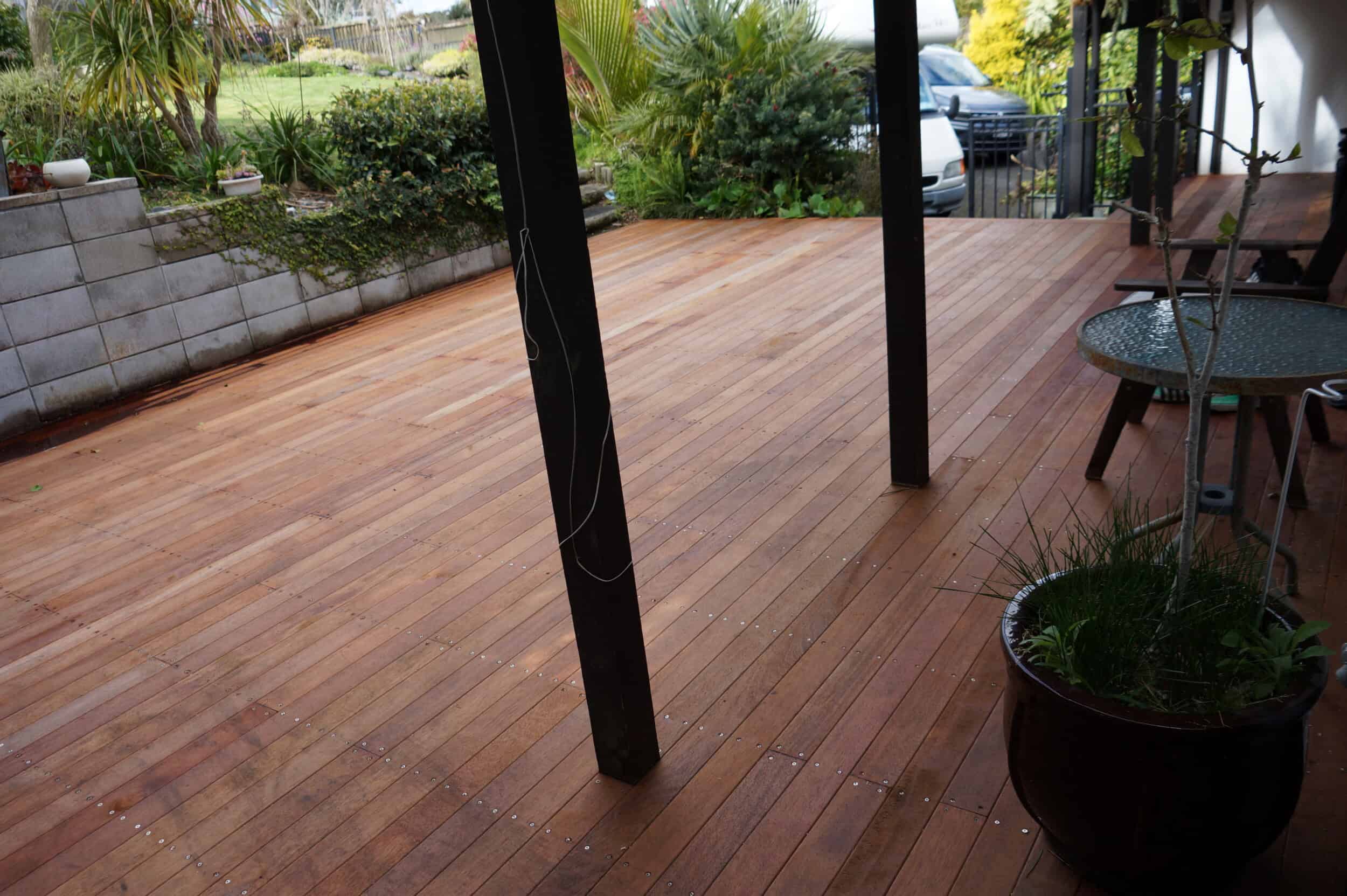
Materials run $10–$20 per m². Professional application adds $30–$50 per m² — worth it for large or complex decks where even coverage matters. DIY is straightforward for most homeowners on a standard rectangular deck:
- Materials: Stain or paint ($50–$100 for 4L covering approximately 20–40 m²), sandpaper ($10–$20), brushes or rollers ($10–$30).
- Professional application: $500–$1,500 for a 20–30 m² deck in Auckland, depending on prep requirements.
- Frequency: Staining every 12–18 months; painting every two to three years given Auckland’s humidity.
For a large or complex deck in Herne Bay or similar, professional application is worth the cost — particularly for painting, where prep quality determines how long the finish holds.
Getting the Finish Right
- Surface prep is everything: A clean, lightly sanded surface is the difference between a finish that lasts and one that lifts within a season.
- Use quality products: Resene and Dulux are the right brands for Auckland’s conditions. Cheaper alternatives underperform in UV and humidity.
- Manage tannins first: Wash down the deck in the first few months before applying any finish — tannin residue disrupts stain penetration.
- Match the finish to the house: A dark charcoal deck suits some properties; a natural oiled kwila suits others. Look at the whole picture before committing.
Staining suits most Auckland kwila decks — it’s the lowest-maintenance path that still protects the investment. If you want a bold colour, painting is viable with higher upkeep expectations. And if you genuinely want the weathered look, a clear sealant in year one gives the patina somewhere to go without leaving the timber unprotected.
Best Brands and Suppliers for Kwila Decking in Auckland
Kwila quality varies between suppliers — grade, sourcing, and the advice you get alongside the timber all make a difference to how your deck performs. Here’s an honest rundown of the main options in Auckland, what they’re good for, and what to ask before you buy.
Why It Matters Where You Buy From
The timber grade, FSC certification status, and the supplier’s familiarity with Auckland’s coastal conditions all affect your deck’s long-term performance. A reputable supplier will tell you which product to use for your specific site — coastal vs. inland, high UV vs. sheltered — and will stock the accessories (correct fixings, suitable oils) alongside the boards. As PlaceMakers note, that local knowledge matters for a 15–25+ year result.
Always ask for FSC certification documentation when purchasing kwila — sustainable sourcing matters, and a supplier who can’t produce the paperwork is telling you something.
Auckland’s Main Kwila Suppliers
1. PlaceMakers
Overview: One of NZ’s largest building supply chains with multiple Auckland locations including Mt Wellington and Albany. Often stocks FSC-certified kwila and carries a full range of accessories including fixings and stains.
Why them: Wide availability, solid Auckland-specific advice through their Hardwood Decking Guide, and the infrastructure to supply large projects consistently.
Price range: $90–$120 per m² for kwila materials.
Best for: Homeowners in Howick or Remuera who want a reliable, well-supported supplier with multiple locations.
Contact: placemakers.co.nz or visit a local store for a quote.
Ask specifically about T316 stainless fixings — they’ll have them, and they’re the right call for any Auckland coastal installation.
2. Mitre 10
Overview: Good coverage across Auckland with stores at Wairau Park, Henderson, and elsewhere. Stocks kwila alongside the maintenance products you’ll need — including Resene Kwila Timber Stain.
Why them: Competitive pricing, regular specials, and knowledgeable staff on maintenance questions including tannin management.
Price range: $85–$115 per m² for kwila; stains typically $50–$80 per 4L.
Best for: Budget-conscious homeowners in Papakura or Manurewa, and DIYers who want to source materials and maintenance products in one place.
Contact: mitre10.co.nz or local store.
Check for spring specials on kwila — timing a purchase around deck-building season can save a meaningful amount on materials.
3. Bunnings
Overview: Stores in Botany Downs and Westgate, with Auckland-wide delivery. Carries kwila alongside related products including Dryden OilStain and oxalic acid cleaners.
Why them: Affordable end of the market, and genuinely useful as a one-stop shop for timber, fixings, tools, and maintenance products.
Price range: $80–$110 per m² for kwila; accessories from $10–$100.
Best for: DIY builds in Flat Bush or Albany where cost and convenience are the priorities.
Contact: bunnings.co.nz or local store.
Use their online stock checker before driving in — kwila availability at specific Auckland stores can vary.
4. South Pacific Timber
Overview: Auckland-based specialist timber supplier with a focus on sustainable sourcing. FSC-certified kwila is a core part of their offering — see their Kwila Decking page for details.
Why them: If environmental provenance is important to you, this is the place to start. The certification is real and the quality reflects a supplier who takes the material seriously.
Price range: $95–$125 per m² for FSC-certified kwila.
Best for: Eco-conscious homeowners in Grey Lynn or Waiheke for whom sustainable sourcing is part of the brief.
Contact: southpacifictimber.co.nz or their Penrose yard.
Request a sample before committing to a volume order — it’s worth seeing the grade in person.
5. BBS Timbers
Overview: Auckland-based hardwood specialist with a strong track record in decking. Their Kwila Decking page gives a clear sense of the grade options available.
Why them: Genuine expertise in hardwood — they understand how kwila behaves in Auckland’s coastal conditions and can advise on specification accordingly.
Price range: $90–$120 per m².
Best for: Homeowners in St Heliers or Mission Bay who need coastal-specific advice alongside the timber.
Contact: bbstimbers.co.nz or their Mt Roskill yard.
Ask them directly about stainless steel fixing specifications for your suburb — they’ll give you a straight answer.
6. JSC Timber
Overview: Auckland-based with a broad timber and composite range. Their Decking page includes installation guidance suited to Auckland conditions.
Why them: Good selection and the ability to custom mill — useful if your design calls for non-standard board sizes.
Price range: $90–$115 per m².
Best for: Homeowners in Parnell or Herne Bay with specific design requirements or non-standard sizing.
Contact: jsc.co.nz or their East Tamaki yard.
Ask about custom milling options if your design has unusual dimensions — it’s a capability most suppliers don’t offer.
Supplier Comparison
| Supplier | Price (per m²) | FSC-Certified Option | Key Strengths | Best For |
|---|---|---|---|---|
| PlaceMakers | $90–$120 | Yes | Wide availability, solid advice | Reliable supply for larger projects |
| Mitre 10 | $85–$115 | Sometimes | Competitive pricing, DIY supplies | Budget-conscious buyers |
| Bunnings | $80–$110 | Sometimes | Affordable, convenient one-stop | DIY builds |
| South Pacific Timber | $95–$125 | Yes | Sustainable, high-grade kwila | Eco-conscious homeowners |
| BBS Timbers | $90–$120 | Yes | Hardwood expertise, coastal focus | Coastal site specifications |
| JSC Timber | $90–$115 | Yes | Broad range, custom milling | Non-standard design requirements |
What to Check Before Buying
- Timber grade: Ask for Select or Standard Grade as a minimum. Fewer knots, more consistent density, better long-term performance.
- FSC certification: Get it in writing. South Pacific Timber, BBS Timbers, and JSC Timber are reliable here.
- Fixings availability: Confirm they stock T316 stainless steel fixings or can point you to a source. Not all suppliers carry them as standard.
- Delivery to your site: Confirm lead times and delivery costs, especially for Waiheke or North Shore properties where logistics add cost.
- Reputation: Ask your contractor who they’ve worked with and trust. Their experience with a supplier’s grade consistency is worth hearing.
Budget Considerations
Materials will run $80–$125 per m². Installation adds $100–$225 per m² depending on site and design complexity. A few practical notes:
- Compare quotes from at least two suppliers before committing. Prices for the same grade can vary more than you’d expect.
- Budget for accessories separately: T316 stainless fixings ($20–$50 per box), quality oil ($50–$90 per 4L), and deck cleaner ($10–$30).
- Order 5–10% more than your calculated area to account for cuts, waste, and any defects in the boards.
- Spring and early summer are the busiest period for Auckland deck builds — order early to avoid supply delays.
Auckland has a good range of kwila suppliers across different price points and specialisations. For budget and convenience, Bunnings or Mitre 10. For sustainability, South Pacific Timber. For hardwood expertise and coastal specification, BBS Timbers or JSC Timber. For the broadest coverage and established track record, PlaceMakers. Any of these, specified correctly and installed well, will give you a deck that performs for 15–25+ years.
Your Kwila Decking Project: Final Advice for Auckland Homeowners
Kwila is a well-suited decking material for Auckland. It handles the conditions — coastal salt, high UV, humid winters — and it looks genuinely good doing it. With proper installation and consistent maintenance, 20+ years is a realistic expectation. Here’s the summary of what matters most.
Key Things to Get Right
- Lifespan and durability: Kwila’s 15–25+ year lifespan is achievable — but only with correct installation and consistent maintenance. FSC-certified timber from suppliers like South Pacific Timber gives you the best starting point on material quality.
- Maintenance is not optional: Clean every six months, oil every 12–18 months, inspect twice a year. It’s not onerous, but it needs to happen.
- Staining vs. painting vs. natural weathering: Staining is the default — low maintenance, suits the material well, protects effectively. Painting is an option for specific aesthetics but carries a higher upkeep commitment. Natural weathering is legitimate if you like the patina and apply a clear sealant initially to protect the structure. Resene Kwila Timber Stain from Mitre 10 is the product most Auckland homeowners land on for ongoing colour maintenance.
- Supplier matters: Source from someone who stocks FSC-certified timber and can advise on Auckland-specific requirements. Bunnings ($80–$110 per m²), PlaceMakers ($90–$120 per m²), and BBS Timbers are all solid options at different price points.
- Spec for your site: T316 stainless fixings for anything coastal. Minimum 450mm under-deck ventilation on Auckland’s clay soils. Pre-coat boards on all four sides before installation. These are the steps that separate a deck that lasts from one that needs remediation in year eight.
Budget Summary for a 20m² Deck
| Item | Cost Range | Notes |
|---|---|---|
| Kwila Decking Materials | $1,600–$2,500 | $80–$125 per m² from suppliers like Bunnings or South Pacific Timber. |
| Installation | $2,000–$4,500 | $100–$225 per m², depending on design and site complexity. |
| Fixings and Accessories | $200–$500 | T316 stainless steel screws, oils, cleaners. |
| Maintenance (Annual) | $200–$400 | Cleaning and oiling — $10–$20 per m² for materials. |
| Total (Initial Build) | $3,800–$7,500 | 20m² deck, excluding council consent if required. |
Build in a 5–10% contingency for site surprises — clay soils in suburbs like Remuera or Howick sometimes require more substructure work than the initial quote anticipates.
Final Tips for Auckland Homeowners
- Plan for the climate from day one: UV-resistant stains, proper ventilation, marine-grade fixings for coastal sites. These aren’t extras — they’re the difference between a deck that holds up and one that doesn’t.
- Buy quality timber: PlaceMakers and JSC Timber both carry grade options worth asking about. Don’t just buy on price.
- Set up a maintenance schedule and stick to it: Calendar reminders, spring and autumn. The cumulative cost of maintenance is a fraction of replacing a deck prematurely.
- Deal with tannins in year one: Wash down every few weeks in the first three to six months. It’s the easiest time to manage it and the hardest time to neglect.
- Use people who know the material: Experienced hardwood installers, suppliers familiar with Auckland’s building requirements. That expertise shows up in how the deck performs ten years later.
Check Mitre 10 and Bunnings in spring — that’s when the best deals on kwila decking and maintenance products tend to appear.
Getting Started
A well-built kwila deck is one of the better outdoor improvements you can make to an Auckland property. The material suits the climate, holds its value, and — used properly — delivers decades of genuine enjoyment from the outdoor space. Whether you stain to maintain the colour, let it silver naturally, or opt for a bold painted finish, the decisions are yours to make. What matters is getting the foundations right — good timber, proper installation, the right maintenance routine. Talk to a supplier or get in touch with the Superior Renovations team to start working through what makes sense for your property and budget.
Kwila's natural oil content and density make it well-suited to Auckland's coastal conditions — moisture, salt air, and UV. A well-installed deck lasts 15–25+ years, handles high traffic without denting, and looks genuinely good doing it. FSC-certified options from suppliers like South Pacific Timber address sustainability concerns. Ask for the certification documentation when you buy. For a 20m² deck, budget $3,800–$7,500 including: Materials ($1,600–$2,500 at $80–$125 per m²), installation ($2,000–$4,500 at $100–$225 per m²), accessories including T316 fixings and oils ($200–$500), and annual maintenance ($200–$400). Council Building Consent adds $500–$2,000 if your deck exceeds 1.5m in height or 25m². Build in a 5–10% contingency for site-specific surprises, particularly in clay-heavy suburbs like Remuera. Compare quotes from at least two suppliers before committing. Clean every six months — spring and autumn. Oil or stain every 12–18 months using products like Resene Kwila Timber Stain from Mitre 10. In the first three to six months after installation, wash down every two to three weeks to manage tannin leaching. Set calendar reminders — the maintenance burden is low but it needs to be consistent. Staining is the most practical choice for most Auckland homeowners — it protects the timber, maintains the natural colour, and requires reapplication every 12–18 months. Painting offers more colour options but peels more readily in Auckland's humidity and needs attention every two to three years. Natural weathering produces a silver-grey patina — suitable for coastal properties in Waiheke or Devonport, but apply a clear sealant initially to protect against UV degradation. Test any stain on a spare board first — kwila takes colour differently than pine. Hose down the deck every two to three weeks for the first three to six months. Pre-coat all four sides of boards before installation — this significantly reduces bleed from the outset. Use drop cloths during the build to protect pavers and concrete in tight Auckland backyards. If staining reaches concrete, diluted oxalic acid cleaner from Bunnings removes it without damaging surrounding surfaces. Salt air in coastal suburbs (Takapuna, Devonport, St Heliers) — specify T316 stainless fixings, no exceptions. High UV in north-facing sites (Parnell, Botany Downs) — oil annually rather than every 18 months. Mildew in shaded leafy suburbs (Titirangi) — clean every six months and don't let it establish. Clay soils (Remuera, Howick) — minimum 450mm under-deck clearance for ventilation, and budget for substructure work if needed. Main options: Bunnings ($80–$110 per m²) for affordable DIY supply. PlaceMakers ($90–$120 per m²) for reliable grade and Auckland coverage. South Pacific Timber ($95–$125 per m²) for FSC-certified sustainable kwila. BBS Timbers ($90–$120 per m²) for hardwood expertise and coastal specification advice. Mitre 10 ($85–$115 per m²) for competitive pricing and DIY maintenance supplies. Visit in person and ask for grade samples before ordering volume. Building Consent is required if your deck exceeds 1.5m above ground level, covers more than 25m², or affects drainage or neighbouring properties. Check with Auckland Council or your contractor before starting — consent costs run $500–$2,000 and processing takes time. Factor both into your project timeline rather than treating consent as an afterthought. Why Choose Kwila for My Auckland Deck?
How Much Does a Kwila Deck Cost in Auckland?
How Often Should I Maintain My Kwila Deck?
Should I Stain, Paint, or Let My Kwila Deck Weather Naturally?
How Do I Manage Tannin Leaching on My Kwila Deck?
What Auckland-Specific Challenges Should I Consider?
Where Can I Buy Quality Kwila Decking in Auckland?
Do I Need Auckland Council Consent for My Deck?
Need more information?
Take advantage of our FREE Complete Home Renovation Guide (48 pages), whether you’re already renovating or in the process of deciding to renovate, it’s not an easy process — this guide, which includes a free 100+ point checklist, will help you avoid costly mistakes.
- Download Free Renovation Guide (PDF)
- Or try our free House Extension Cost Calculator
Still have questions?
Book a no-obligation consultation with the team at Superior Renovations — we’d love to talk through your project.
Or call us on 0800 199 888
Putting off that renovation?
We’ve partnered with Q Mastercard® to offer an 18-month interest-free payment option. Get the outdoor space sorted now and spread the cost.
Learn more about Interest-Free Payment Options*
*Lending criteria, fees, terms and conditions apply. Mastercard is a registered trademark and the circles design is a trademark of Mastercard International Incorporated.


