

Engineered Stone vs Granite vs Marble Benchtops NZ
Last updated:
Engineered Stone vs Granite vs Marble Benchtops NZ: How to Choose
Free cost calculator
How much will your kitchen renovation cost?
Get an instant Auckland price range for your project — no details required to see it.
Quick answer: For most Auckland kitchens, engineered stone is the practical pick (low maintenance, around $520–$1,200/m² installed), granite is the durable natural option, and marble is the beauty that asks for the most care. The right benchtop depends on how you cook, your budget, and how long you’ll live there.
Here’s a conversation we have in our Wairau Valley showroom most weeks. One partner wants marble — the bright, veined look off every design feed. The other has read that marble stains if you so much as look at it with a glass of red. Both are partly right, and the answer usually isn’t either extreme.
The benchtop question got more interesting in the last couple of years, too. Australia banned engineered stone outright in July 2024 over a serious workplace health issue, and New Zealand spent 2025 deciding what to do about the same material. So on top of “which looks best”, a lot of Auckland homeowners are now asking whether engineered stone is even a safe choice. We’ll answer that plainly further down — the short version may surprise you.
This is the renovation company’s take, not a stone supplier’s. We install all three of these materials across Auckland kitchens, we see what holds up after five years of family life, and we cost them as part of the whole job — not as a slab in isolation. By the end you’ll know what each material actually costs in New Zealand, how it behaves day to day, where the silica question really sits, and a sensible way to land on the right one.

The Three Benchtop Materials at a Glance
Before cost or care, it helps to know what you’re actually buying. The three materials look similar polished up on a showroom plinth, but they’re chemically and structurally different — and those differences drive everything else.
Engineered stone (often called quartz)
Engineered stone is a manmade surface: crushed natural quartz bound together with resin and pigment. That manufacturing is exactly why it’s so popular — colour and pattern are consistent slab to slab, it’s non-porous so it doesn’t need sealing, and it shrugs off everyday stains. If you want a white benchtop that looks the same in five years as it does on install day, this is the material that delivers it. Brand names you’ll hear in Auckland kitchens include Caesarstone and Smartstone, among others.
The catch sits in two places: heat and the manufacturing dust (more on that in the silica section). The resin that makes engineered stone so consistent is also what makes it vulnerable to a hot pan straight off the element.
💡 Quick tip: Watch the words. “Quartz” usually means engineered stone (manmade), while “quartzite” is a natural stone — harder than granite. They get confused constantly, so ask your supplier which one you’re actually looking at.
Granite — the natural workhorse
Granite is a genuinely natural stone, quarried and cut into slabs, so every piece is unique. It’s one of the hardest, most heat-tolerant surfaces you can put in a kitchen — sitting around 6–7 on the Mohs hardness scale — and once it’s sealed, it handles stains well. The trade-off is that natural variation: you’re choosing a specific slab, not a colour code, so two kitchens are never identical. For some people that’s the whole appeal. For others it’s a headache when they wanted a precise match.
Marble — beautiful, and high-maintenance
Marble is calcium carbonate. In plain terms, it’s a soft stone — roughly 3 on the Mohs scale — and it’s sensitive to acid. A splash of lemon juice, wine or vinegar left sitting will etch the surface, leaving a dull mark even where there’s no stain. That’s not a flaw you can seal away entirely; it’s the nature of the material. Calacatta and Statuario — the bright whites with bold grey veining — are the ones everyone pins, and they sit at the very top of the price range.

“People fall for polished marble in the showroom and forget it’s basically a soft, reactive stone. If a client is set on the marble look, I’ll often steer them to a honed finish — it hides etching far better than a high polish — or to a marble-look engineered stone for the main working zone. You get the look without resealing every six months and panicking over a lemon.”
— Cici Zuo, Head of Sales (NZ Dip. Interior Design), Superior Renovations
💡 Quick tip: Ask to take material samples home and live with them for a week. Showroom lighting flatters everything. A marble-look slab that sang under spotlights can read flat next to a south-facing Grey Lynn window.
| Material | What it is | Hardness (Mohs) | Needs sealing? |
|---|---|---|---|
| Engineered stone (quartz) | Crushed quartz + resin (manmade) | ~7 (resin lowers it slightly) | No — non-porous |
| Granite | Natural quarried stone | ~6–7 | Yes — periodically |
| Marble | Natural stone (calcium carbonate) | ~3 (soft, acid-sensitive) | Yes — regularly |
If you take one thing from this section: engineered stone is the low-fuss all-rounder, granite is the tough natural option, and marble is the showpiece you have to look after. Everything that follows is really about which of those trade-offs suits your kitchen. If you want to see how the benchtop sits within the bigger picture, here’s how we plan and build a full kitchen renovation from layout through to the final surface.
What Each Benchtop Costs in New Zealand
This is where most comparison articles go vague, or quietly quote Australian prices. Here are real New Zealand figures, supplied, fabricated and installed.
Per-square-metre price ranges
According to Houzz NZ’s benchtop cost guide, a new quartz (engineered stone) benchtop runs roughly $520 to $1,200 per square metre installed, and granite sits between about $700 and $1,700 per square metre. Marble steps up again — typically from around $900 and climbing well past $2,000–$2,500 per square metre for premium Italian slabs like Calacatta. The headline pattern: engineered stone is usually the most affordable, granite overlaps with it at the lower grades, and marble is the consistent premium.
A couple of extras are easy to forget. Houzz NZ notes an under-mount sink cut-out adds around $250, and routed drainer grooves another $350 or so. Small numbers next to a slab, but they’re real line items on the quote.
💡 Quick tip: Slab thickness changes both the look and the price. A 20mm top is the standard; a 40mm or mitred edge reads more solid and high-end but adds real fabrication labour. Decide the edge before you compare quotes.
💡 Quick tip: Benchtops are often quoted per lineal metre rather than per square metre, because they’re long runs. When you compare quotes, check which unit each fabricator is using — otherwise you’re comparing apples with feijoas.
The Auckland costs nobody warns you about
The slab price is only part of it, and this is the part the supplier-written guides skip. Stone is heavy. In older Auckland homes, the existing cabinetry often can’t carry it without reinforcement. Our group’s interior specialists at Little Giant Interiors find that around a third of pre-2000 homes need cabinet bases strengthened before stone or thick porcelain goes on — particularly the chunkier 30mm and 40mm slabs.
Then there’s the templating. Villas and bungalows in Grey Lynn, Ponsonby and Mt Eden are charming and rarely square. Walls that lean or bow mean re-templates, and that can add 15–30% to fabrication. And if you’re shifting the sink position as part of the reno, budget $900–$2,200 for the plumbing alone. None of that is the stone’s fault — it’s the reality of putting a precise, heavy surface into a house built when Michael Joseph Savage was in office.
Where the benchtop sits in your total kitchen budget
Here’s the framing that actually matters. A mid-range kitchen renovation in Auckland runs roughly $26,000 to $35,000 with us, working out to around $2,300 per square metre of kitchen. In that kind of budget, the benchtop is typically a $3,000–$8,000 slice — meaningful, but not the thing that makes or breaks the job. Stretching from engineered stone to granite might add a thousand or two. Going to full marble can add several. Knowing that ratio stops the benchtop decision from swallowing the whole conversation.
Want to sanity-check your own numbers before you talk to anyone? Run them through our kitchen renovation cost calculator — it’ll give you a realistic Auckland range to plan around. For a deeper breakdown of where the money goes across a whole kitchen, our guide to planning a kitchen layout covers how surface choice ties into the rest of the design.

| Material | Installed cost (per m²) | Best for |
|---|---|---|
| Engineered stone | ~$520–$1,200 | Busy family kitchens, low maintenance, consistent colour |
| Granite | ~$700–$1,700 | Durability, heat tolerance, one-of-a-kind natural look |
| Marble | ~$900–$2,500+ | Statement islands, owners happy to maintain it |
| Benchtop as % of mid-range kitchen | ~$3,000–$8,000 total | Of a $26,000–$35,000 reno |
Living With Each Surface: Heat, Stains and Sealing
Cost gets the attention. Daily life is what you actually have to live with. So how does each one behave once the kitchen is done and you’re cooking in it five nights a week?
Heat resistance
This is engineered stone’s real weakness, and it’s the one most people don’t hear about until it’s too late. The resin binder can scorch or discolour under a pot straight off the hob. We’ve seen perfectly good quartz benchtops with a dull burn mark where someone parked a hot cast-iron pan “just for a second”. Granite and marble, being natural stone, handle heat far better — though even then a trivet is sensible. If you’re the kind of cook who pulls a roasting dish out and wants somewhere to put it down without thinking, that’s a genuine mark in favour of natural stone.
Stains and etching
Engineered stone’s non-porous surface is the easiest to live with — wine, oil, turmeric, kids’ felt-tips, it mostly wipes away. Granite, once sealed, resists stains well; its busy natural pattern also hides the odd mark. Marble is the difficult one: it stains because it’s porous and it etches because it’s acid-sensitive — two separate problems. Sealing helps with staining but does little for etching. That dull ring under a wine glass is the marble reacting, not a stain you missed.
“The honest version I give clients: engineered stone forgives you, granite asks for a seal now and then, marble wants a relationship. None of that is wrong — it’s just a question of how much daily attention you want to give a surface. Most Henderson and Flat Bush family kitchens we do end up in engineered stone for exactly that reason. The marble dream usually moves to the island, where it’s seen more than it’s used.”
— Alison Yu, Designer, Superior Renovations
Sealing and upkeep over time
Engineered stone needs no sealing — that’s a real long-term saving in both money and hassle. Granite should be resealed periodically (how often depends on the slab and how hard the kitchen works). Marble needs the most frequent attention and the most careful day-to-day habits: wipe acidic spills straight away, use boards and trivets, accept that it’ll develop a patina over the years. Some people genuinely love that lived-in marble look. Others are quietly furious about the first etch mark within a fortnight. Knowing which person you are is half the decision.
💡 Quick tip: If you want the natural-stone look but cook like your kitchen’s a commercial line, look hard at granite before marble. It gives you the genuine-stone character and heat tolerance without marble’s acid sensitivity.
The Silica Question: Is Engineered Stone Safe in NZ?
This is the part of the benchtop conversation that’s changed, and it deserves a straight answer rather than either hype or hand-waving.
What actually happened in Australia
On 1 July 2024, Australia became the first country in the world to ban the manufacture, supply and use of engineered stone. The reason is a workplace health crisis: engineered stone has traditionally contained very high levels of crystalline silica — up to around 90–95%, compared with roughly 2–50% in natural stones. When the material is cut, ground or polished, it releases fine silica dust, and inhaling that dust over time causes silicosis — an incurable, sometimes fatal lung disease. Per WorkSafe NZ’s accelerated silicosis safety alert, the accelerated form can develop in as little as one to ten years of high exposure.
Where New Zealand landed
New Zealand looked closely at the same question. MBIE ran a formal consultation that closed in March 2025, weighing options from tighter workplace controls through to a full Australian-style ban. Workplace Relations and Safety Minister Brooke van Velden signalled she didn’t see the evidence for a total ban here, favouring an evidence-based approach focused on controlling exposure. As things stand, engineered stone is still legal to buy and install in New Zealand — but the direction of travel is clearly toward stricter fabrication controls and possible licensing. The scale of the issue is real: MBIE estimated around 270,000 New Zealand workers may be exposed to respirable crystalline silica, with roughly 80,000 at high levels.
What this means for you as a homeowner
Here’s the reassuring bit, and it’s the bit that gets lost in the headlines. The risk is occupational — it falls on the people cutting and polishing the stone, not on the family living with the finished benchtop. As MBIE puts it, in its solid, installed form engineered stone doesn’t have hazardous properties; the danger is the dust generated during fabrication. An installed, sealed engineered stone benchtop in your kitchen poses no silica risk to you or your kids.
So the responsible homeowner question isn’t “should I avoid engineered stone?” It’s “is my fabricator doing this safely?” Choose a fabricator that wet-cuts (water suppresses the dust), uses proper ventilation and respiratory protection, and ideally holds the voluntary industry RCS accreditation. That single question protects workers and signals a serious operator. If you’d rather sidestep the material entirely, there are good alternatives — our group has a full rundown of engineered stone alternatives for NZ kitchens, from porcelain to natural stone to lower-silica products.
💡 Quick tip: Ask your fabricator directly: do you wet-cut on site, and do you hold RCS (respirable crystalline silica) accreditation? A straight, confident answer is a good sign. A vague one tells you something too.
Important note: The engineered stone regulatory position in New Zealand is still moving. Before you commit, ask your renovation company what the current rules require of fabricators — a good one will know exactly where things stand.
How to Choose — and the Mix Most People Miss
Comparison done. Now the decision. After years of fitting these surfaces into Auckland kitchens, our designers tend to land clients in roughly the same place — and it’s often not a single material at all.
Match the material to how you actually live
Five honest questions sort most of it out. How do you cook — cast iron straight onto the bench, or always a board and trivet? How long will you stay — five years and selling, or fifteen and settling? What’s the cabinetry like — solid, or pre-2000 and possibly needing reinforcement? What’s your tolerance for upkeep? And what’s the look you can’t let go of? If you cook hard, hate maintenance and want a white benchtop that stays white, engineered stone wins almost every time. If you want genuine natural stone and you’ll seal it occasionally, granite. If you’re chasing a specific marble look and you’ll care for it, marble — eyes open.
The hybrid that quietly solves the argument
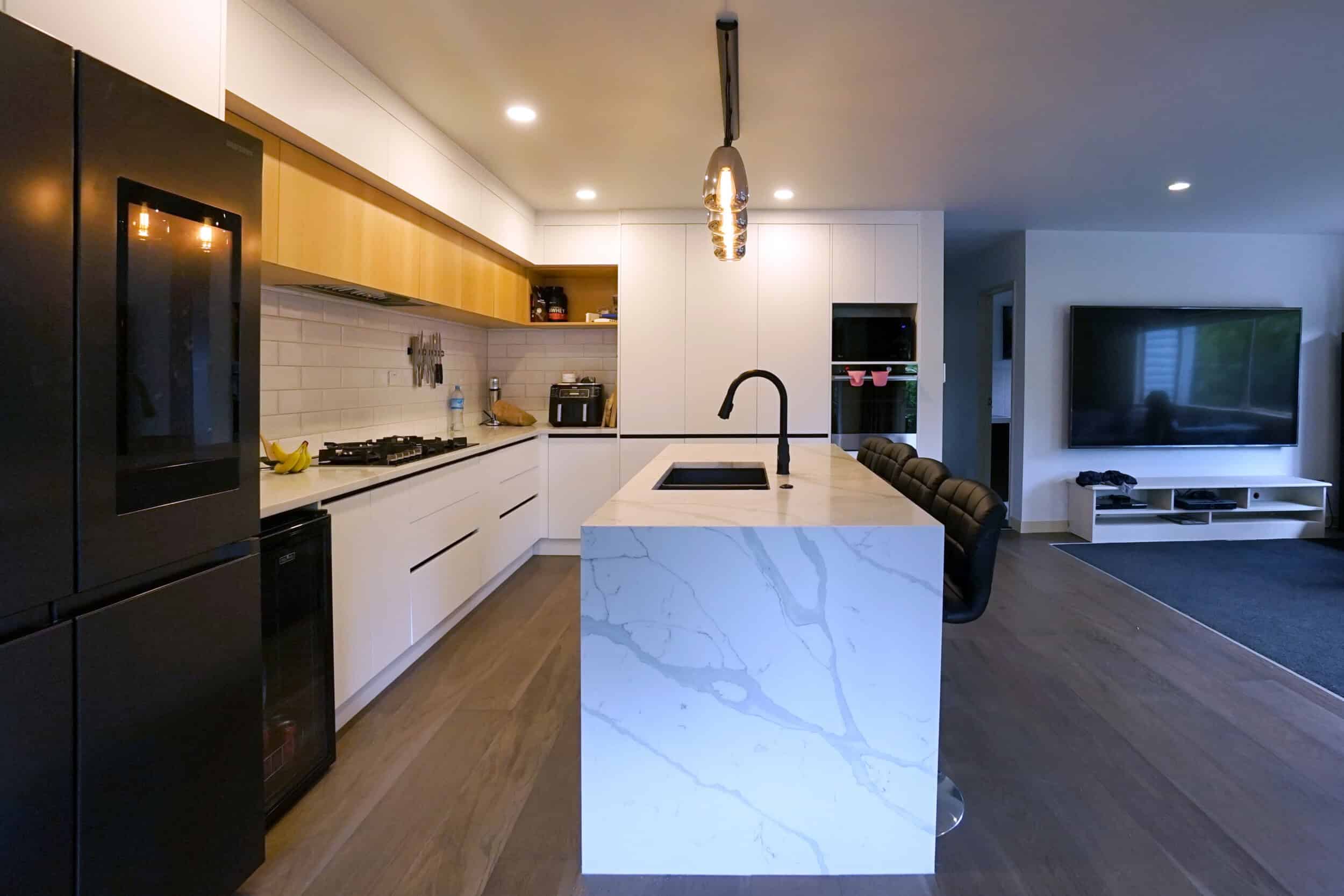
Here’s the move most competitor articles never mention. You don’t have to pick one material for the whole kitchen. The approach our design team recommends most often is a marble or marble-look slab on the island — the showpiece everyone sees — paired with hard-wearing engineered stone on the perimeter where the real cooking, chopping and hot-pan action happens. You get the statement look in the spot that gets photographed, and a bulletproof working surface everywhere else. See how the pairing looks in our kitchen design gallery. It’s frequently the answer to that “I want marble” / “marble will stain” standoff we started with.
“The biggest mistake I see is treating the benchtop as a separate decision made at the showroom counter. It’s part of the whole design — it has to work with the cabinetry, the splashback, the lighting and the budget. When we plan it together from the start, the hybrid approach almost designs itself, and people stop feeling they have to choose between beautiful and practical.”
— Dorothy Li, Design Manager, Superior Renovations
What to ask your fabricator before you sign
Three questions tell you a lot. First, the safety one above — how do you control silica dust? Second: are you quoting per lineal or per square metre, and what’s included (cut-outs, edge profile, drainer grooves)? Third: have you allowed for templating an older Auckland home, where walls are rarely true? A fabricator who answers all three clearly is one you can trust with the most-used surface in your house.
💡 Quick tip: Get the edge profile, cut-outs and any drainer grooves itemised on the quote in writing. “Stone benchtop, supplied and installed” hides a lot of variation in both price and finish.
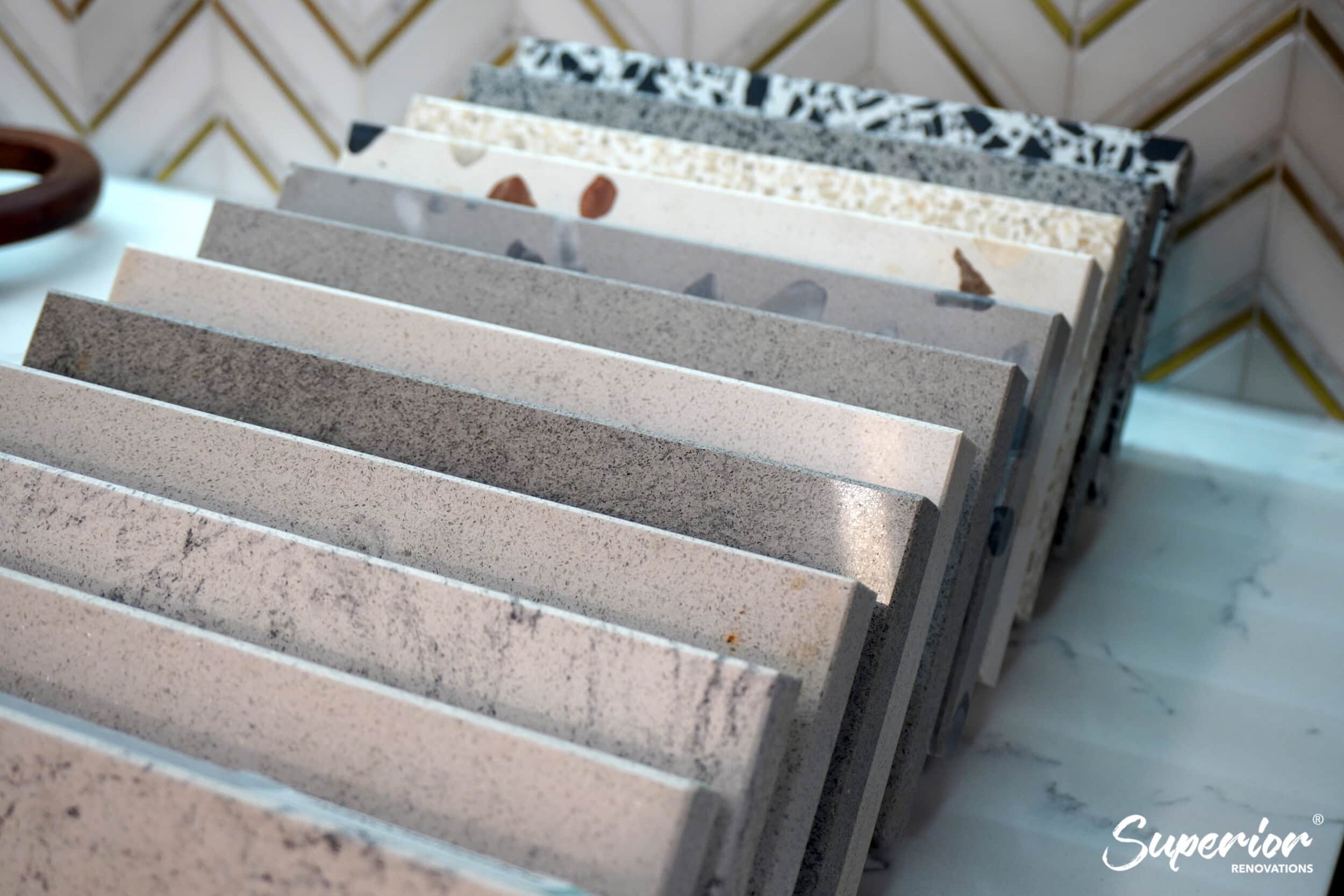
If you’d like to see and feel the materials side by side rather than judging off a phone screen, that’s exactly what our Auckland design studio is for — benchtop selection is part of the design process, not an afterthought. And if you’re weighing up cabinetry materials at the same time, our take on MDF versus solid wood pairs well with this one.
Choosing a benchtop comes down to three honest trade-offs: how much maintenance you’ll accept, how much you’ll spend, and how long you’ll live with it. Engineered stone keeps it easy, granite gives you tough natural stone, marble gives you the look if you’ll look after it — and a smart mix often beats picking just one. Sort that out early and the rest of the kitchen falls into place.
➡ Book your free in-home consultation with Superior Renovations
➡ Estimate your kitchen renovation cost with our NZ calculator
➡ Request a free feasibility report for your project
Which benchtop is best for a kitchen in NZ — engineered stone, granite or marble?
For most Auckland family kitchens, engineered stone is the best all-rounder — it's non-porous, needs no sealing, and keeps a consistent colour, at roughly $520–$1,200 per square metre installed. Granite suits people who want genuine natural stone with high heat tolerance and will reseal it occasionally. Marble is best kept for statement islands where its beauty is on show but it isn't taking the daily cooking punishment. There's no single right answer — it depends on how you cook, your budget, and how long you'll stay in the home.
How much does a stone benchtop cost in NZ?
Per Houzz NZ, engineered stone (quartz) runs about $520–$1,200 per square metre installed, granite about $700–$1,700, and marble from around $900 up past $2,500 for premium slabs. Add roughly $250 for an under-mount sink cut-out and $350 for drainer grooves. In a typical $26,000–$35,000 mid-range Auckland kitchen renovation, the benchtop is usually a $3,000–$8,000 line item. Older homes may also need cabinet reinforcement and extra templating, which adds to the figure.
Will a marble benchtop stain?
Marble can both stain and etch, and they're two different problems. It's porous, so it absorbs spills like wine, oil and coffee unless sealed and wiped quickly. It's also acid-sensitive, so lemon juice, vinegar or wine will etch the surface — leaving a dull mark even where there's no colour stain. Sealing reduces staining but does little for etching. A honed (matte) finish hides etch marks better than a high polish, which is why our designers often suggest it if a client is set on marble.
Can you put hot pans on engineered stone?
Not safely. Engineered stone is bound with resin, which can scorch, discolour or crack under direct high heat — a pot straight off the element can leave a permanent dull mark. Always use a trivet. If you're a cook who regularly pulls hot cast iron or roasting dishes straight onto the bench, granite handles heat far better, as it's natural stone with no resin binder. This heat weakness is the single most common complaint we hear about engineered stone after install.
What is the difference between engineered stone and granite?
Engineered stone is manmade — crushed quartz bound with resin and pigment — so it's non-porous, consistent in colour, and needs no sealing, but it's vulnerable to heat. Granite is a natural quarried stone, so every slab is unique, it tolerates heat well, and it sits around 6–7 on the Mohs hardness scale, but it needs periodic sealing and you're choosing a specific slab rather than a colour code. Granite is also natural stone with lower silica content, whereas engineered stone has traditionally been very high in silica.
Is engineered stone banned in New Zealand?
No. As of 2025–2026, engineered stone is still legal to buy and install in New Zealand. Australia banned it outright from 1 July 2024 over silicosis risk to workers. New Zealand ran an MBIE consultation that closed in March 2025; the Minister indicated she didn't see evidence for a full ban here and favoured stronger workplace controls instead. The regulation is tightening — expect a move toward stricter fabrication rules and possible licensing rather than an outright ban.
Is engineered stone safe to have in my home?
Yes. The silica risk from engineered stone is occupational — it affects the workers who cut, grind and polish the slabs and breathe the dust, not the people living with the finished benchtop. As MBIE notes, in its solid, installed form engineered stone has no hazardous properties. The responsible step is choosing a fabricator who controls dust properly — wet-cutting, ventilation, respiratory protection and ideally RCS industry accreditation. That protects the people doing the work, which is where the real risk sits.
Do granite and marble benchtops need sealing?
Yes, both do, because they're natural porous stones. Granite should be resealed periodically — how often depends on the slab and how hard the kitchen works, but it's a straightforward job. Marble needs more frequent sealing plus careful daily habits: wipe acidic spills immediately and use boards and trivets. Engineered stone, by contrast, is non-porous and never needs sealing, which is one of its biggest practical advantages over both natural stones for a busy household.
Can I mix benchtop materials in one kitchen?
Absolutely, and it's an approach our design team recommends often. The most popular mix is a marble or marble-look slab on the island — the visible showpiece — paired with hard-wearing engineered stone on the perimeter where the cooking and chopping happens. You get the statement look where it's seen and a tough, low-maintenance surface where it's used. It's frequently the best solution when one person wants marble and the other is worried about maintenance.
How much does a benchtop add to a full kitchen renovation cost in Auckland?
In a mid-range Auckland kitchen renovation of roughly $26,000–$35,000, the benchtop is typically a $3,000–$8,000 portion of the total. Moving from engineered stone to granite might add a thousand or two; going to full marble can add several thousand. Older homes can carry extra costs the slab price hides — cabinet reinforcement to carry the weight, extra templating for out-of-square walls, and plumbing if the sink moves. Use our kitchen renovation cost calculator to get a realistic range for your own project.
Further Resources for your kitchen renovation
- Featured projects and Client stories to see specifications on some of the projects.
- Real client stories from Auckland
Need more information?
Take advantage of our FREE Complete Home Renovation Guide (48 pages), whether you’re already renovating or in the process of deciding to renovate, it’s not an easy process, this guide which includes a free 100+ point check list – will help you avoid costly mistakes.
Download Free Renovation Guide (PDF)

Have you been putting off getting renovations done?
We have partnered with Q Mastercard ® to provide you an 18 Month Interest-Free Payment Option, you can enjoy your new home now and stress less.
Learn More about Interest-Free Payment Options*
*Lending criteria, fees, terms and conditions apply. Mastercard is a registered trademark and the circles design is a trademark of Mastercard International Incorporated.
Still have questions unanswered?
Book a no-obligation consultation with the team at Superior Renovations, we’d love to meet you to discuss your renovation ideas!