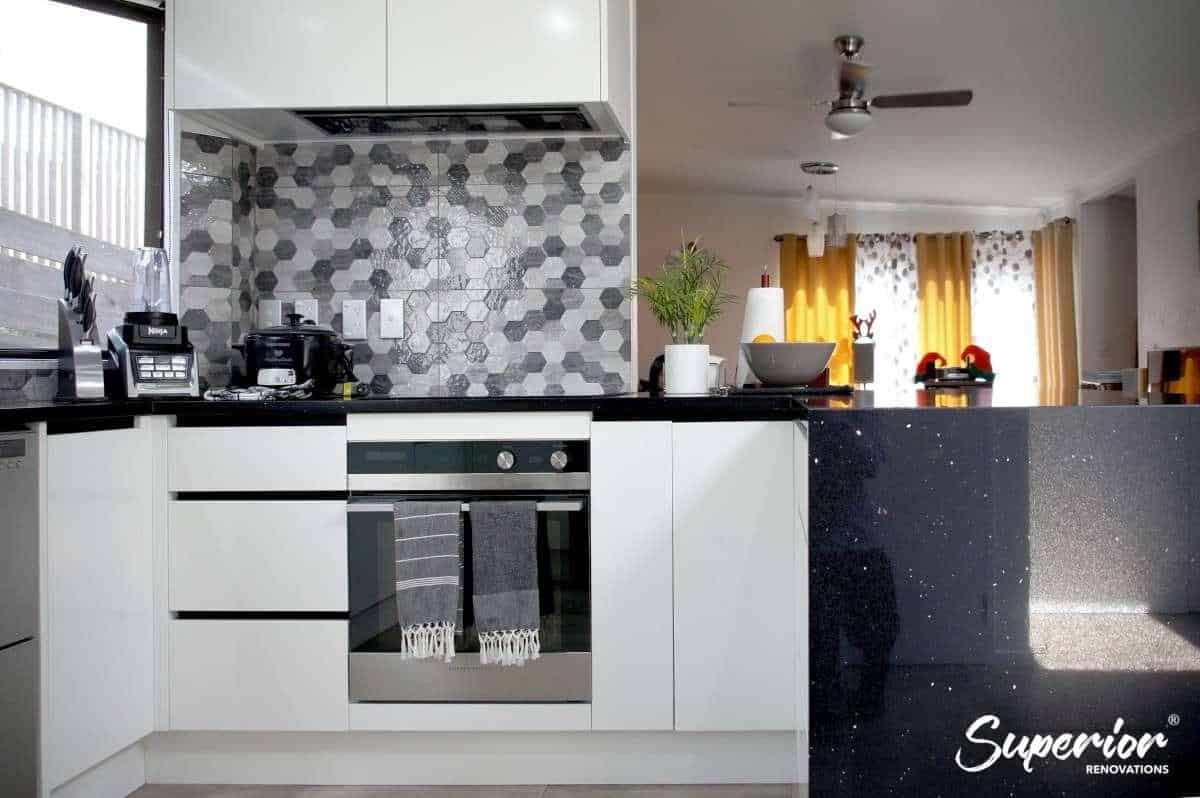

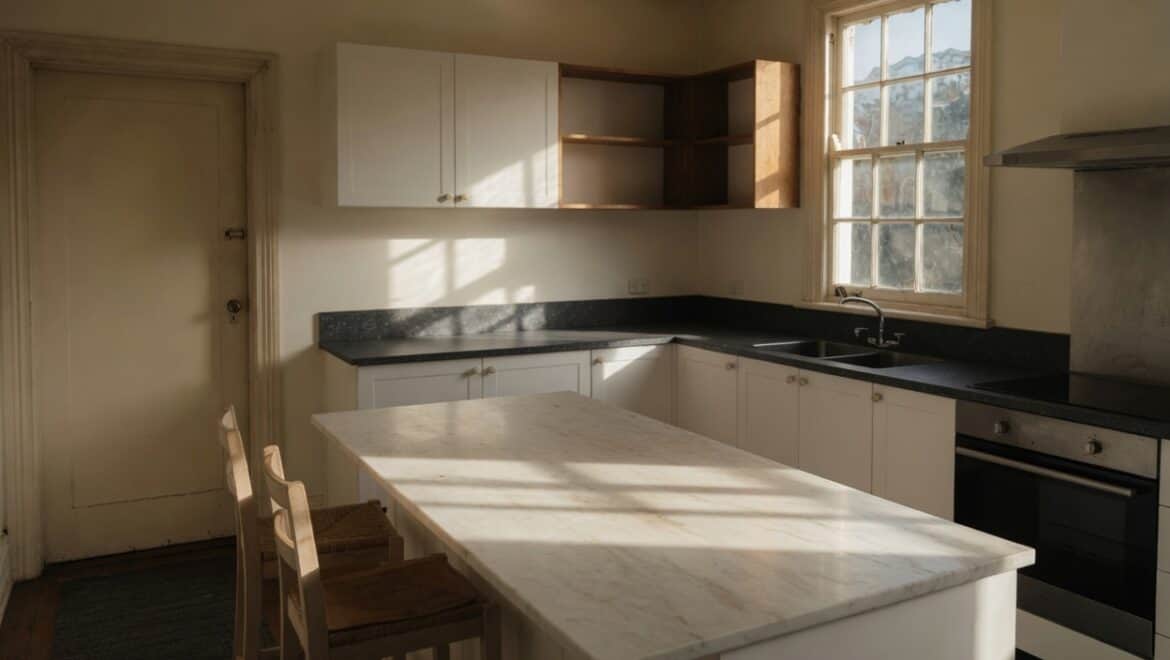
Kitchen Renovation

kitchen auckland 1 - Superior Renovations
Kitchen Renovation

How Long Does a Kitchen Renovation Take in Auckland?

How Long Does a Kitchen Renovation Take in Auckland?

Quick answer: A full kitchen renovation in Auckland takes 6–12 weeks from start to finish, depending on the scope, complexity, whether consent is involved, and whether cabinetry is made in-house or by a third party. Around 5–6 of those weeks are the on-site build.

If you’ve started ringing around for quotes, you’ve probably had three different companies give you three different timeframes. One says four weeks. Another says three months. So which is it?

Here’s the honest version. We’ve run more than 1,000 kitchen renovations across Auckland since 2017 — from tight little galley kitchens in Grey Lynn villas to full open-plan rebuilds in Flat Bush new-builds — and the time it takes comes down to a handful of decisions you make early. Get those right and a standard kitchen lands in the 6–12 week window. Drag your feet on material selections, or open a wall and find rot, and the clock keeps ticking.

This guide is about time, not cost. If you want the full step-by-step of what physically happens on site, we’ve covered that separately in the stage-by-stage breakdown of a kitchen renovation. Here, we’re answering one question: how long will the whole thing actually take, and where does the time go?


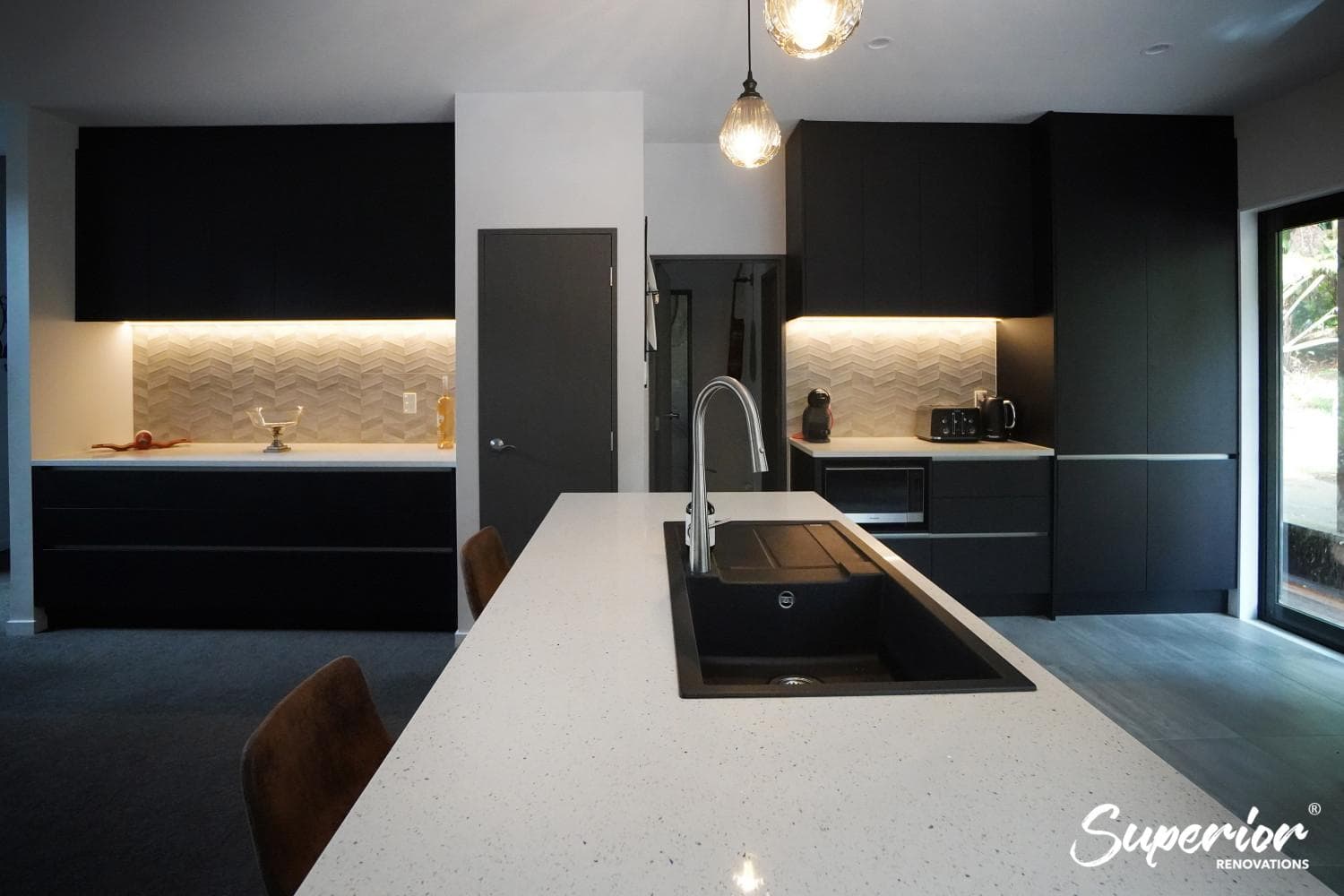
KIT 05 01 - Superior Renovations

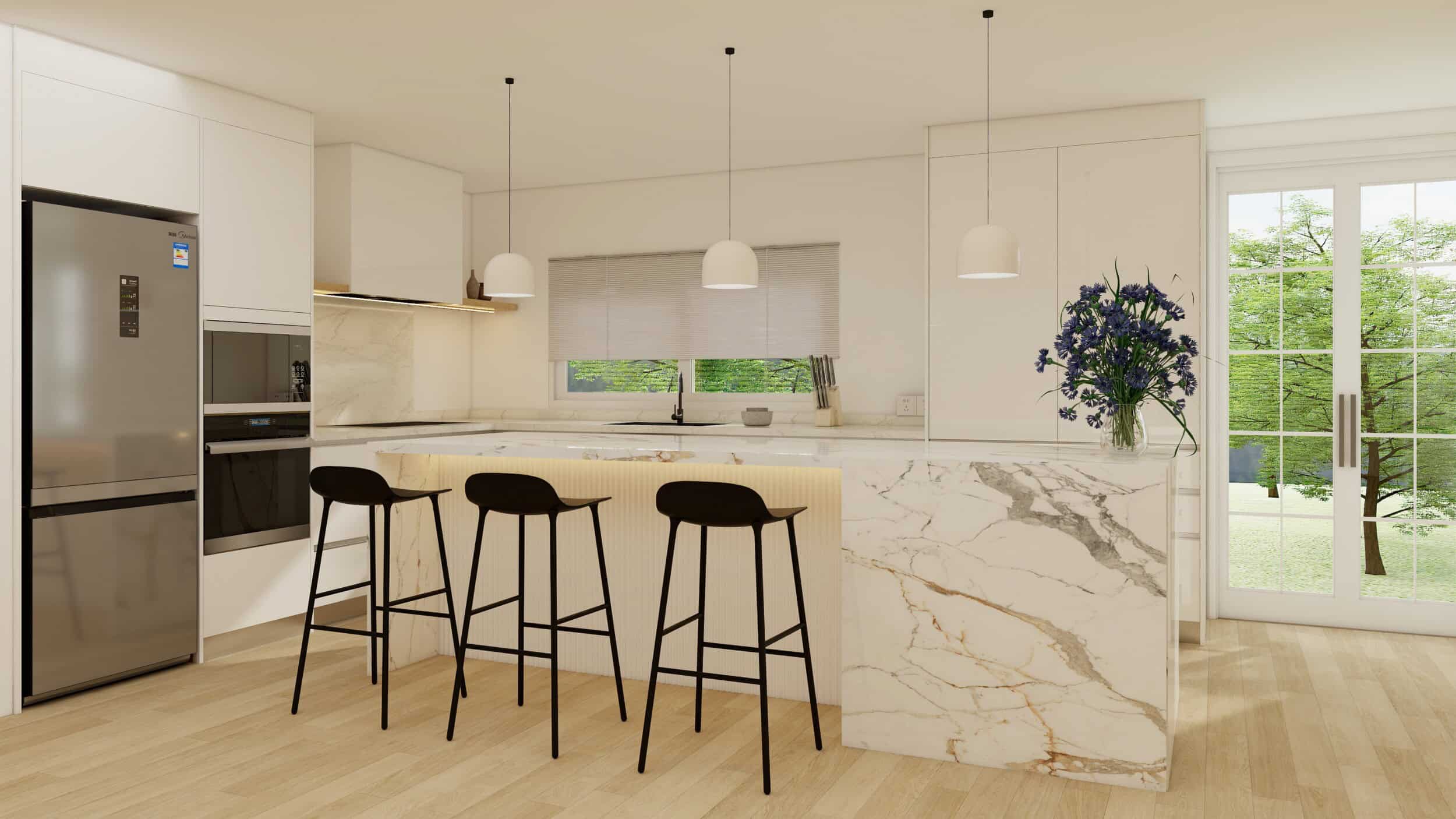
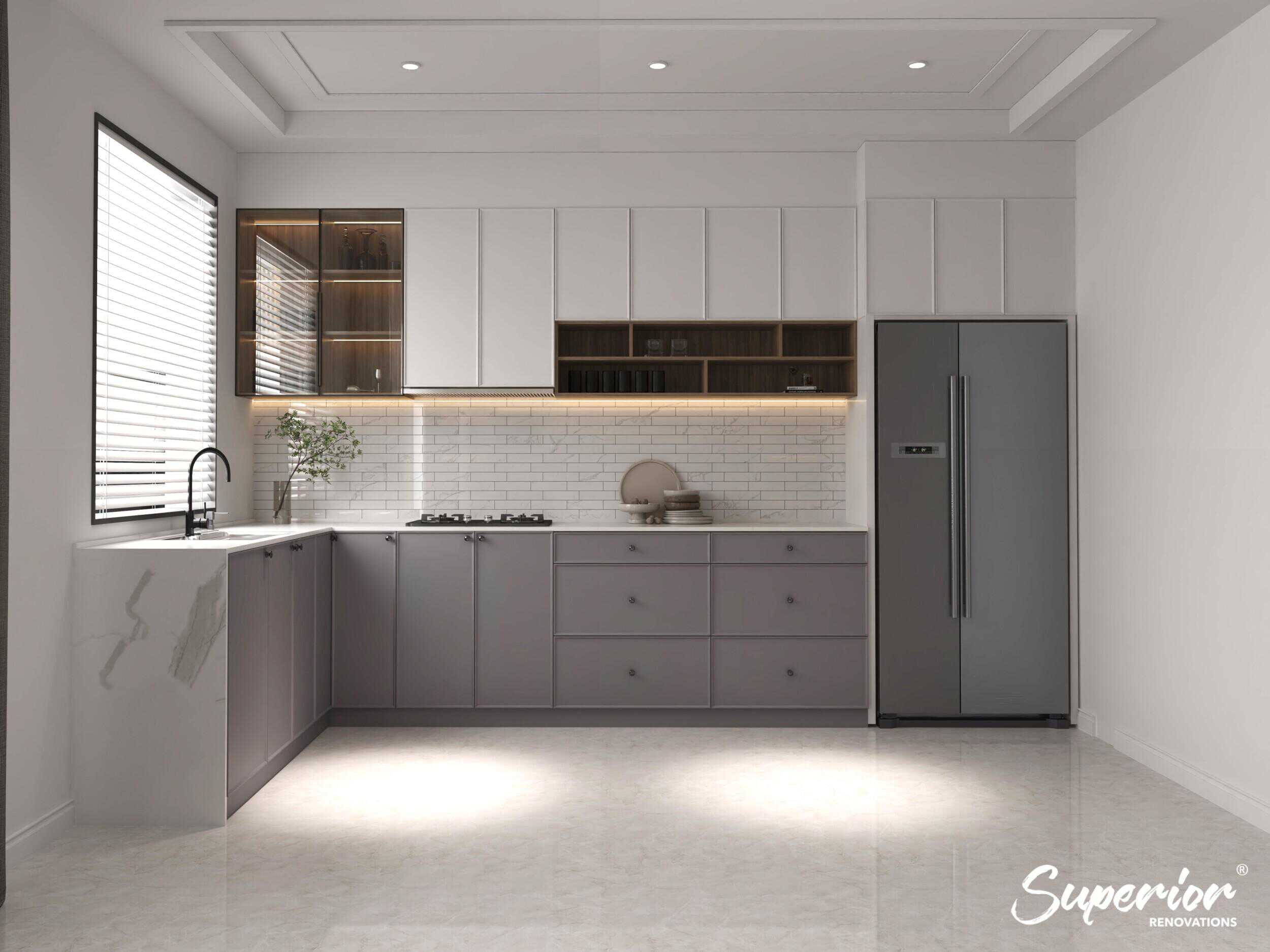
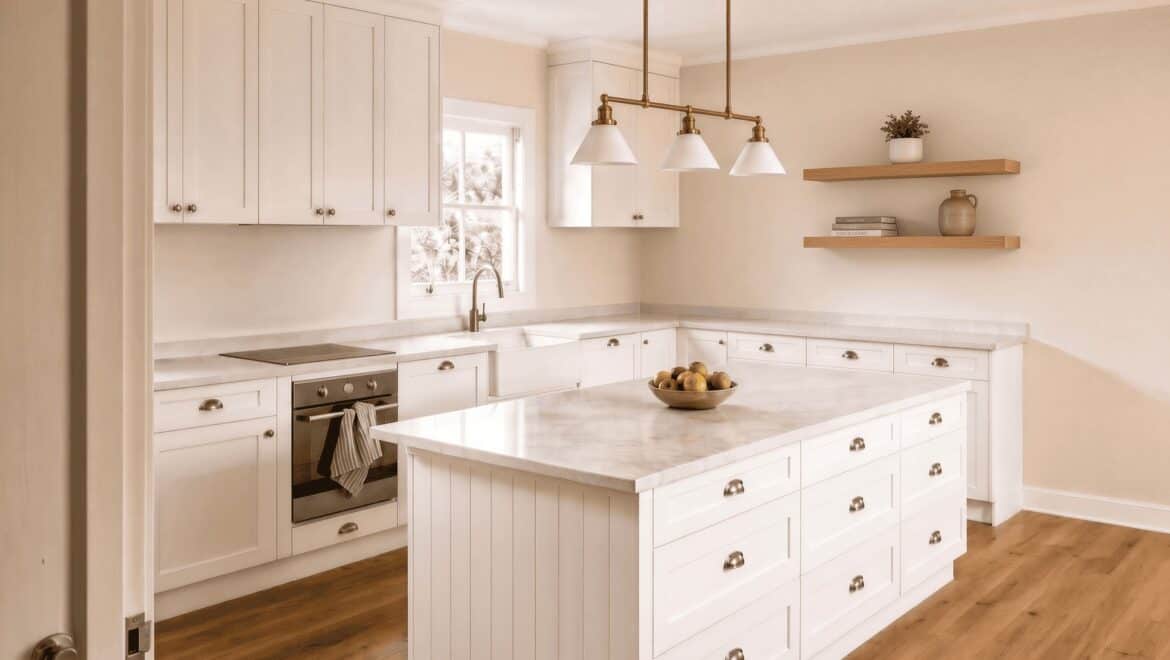
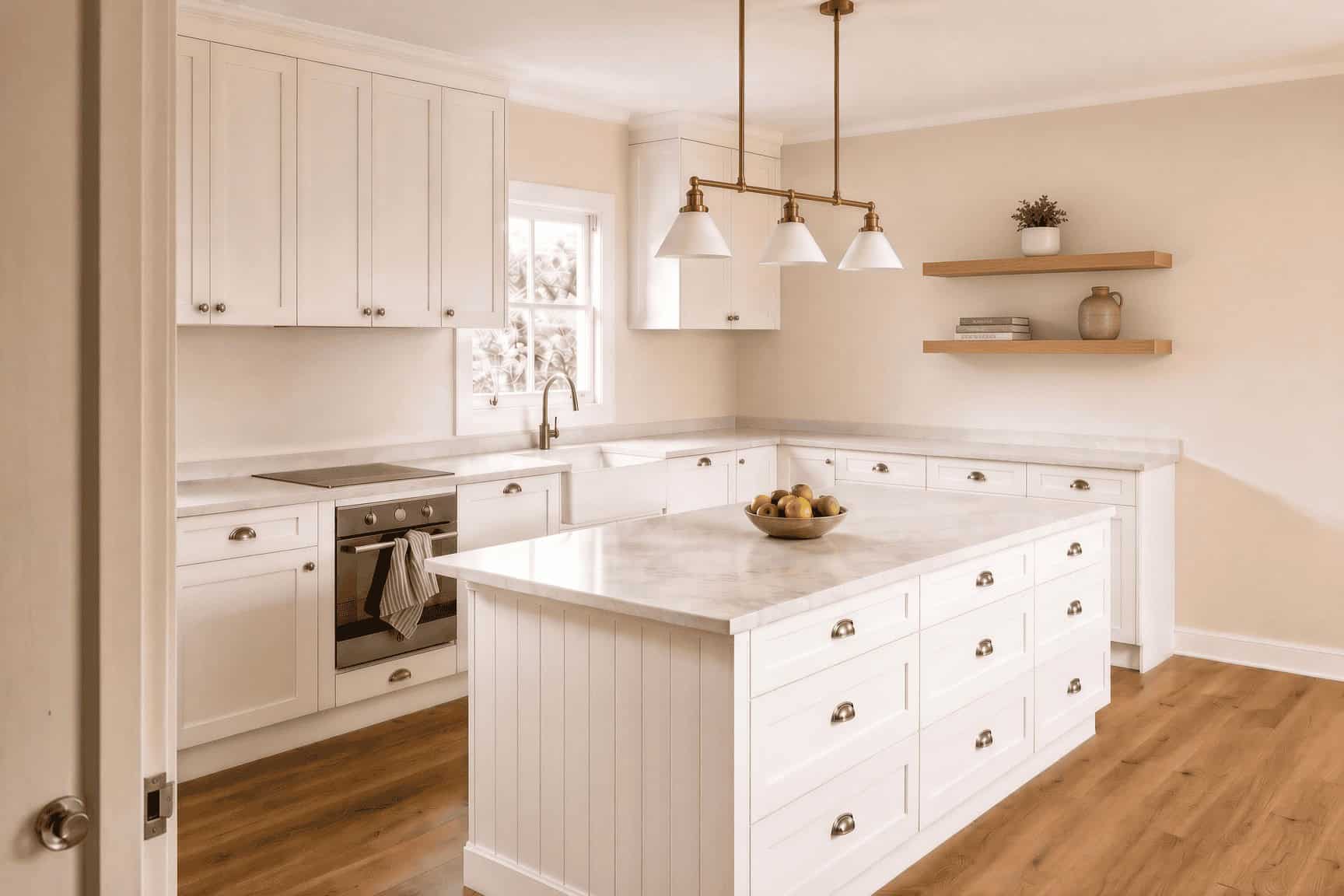
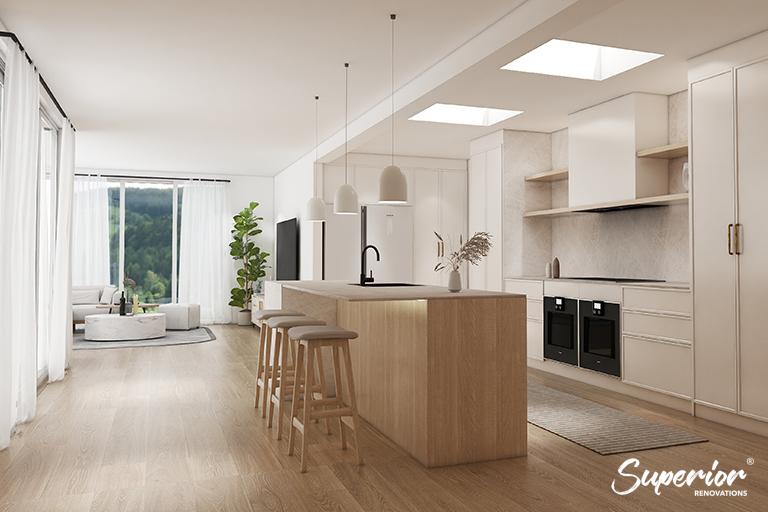
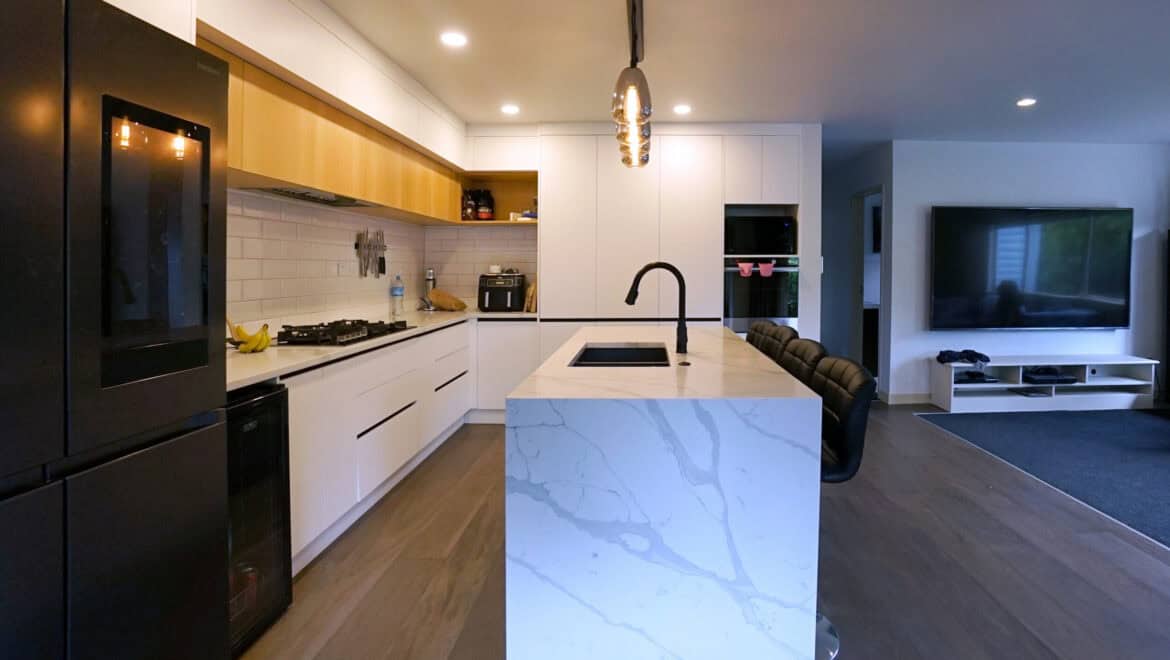
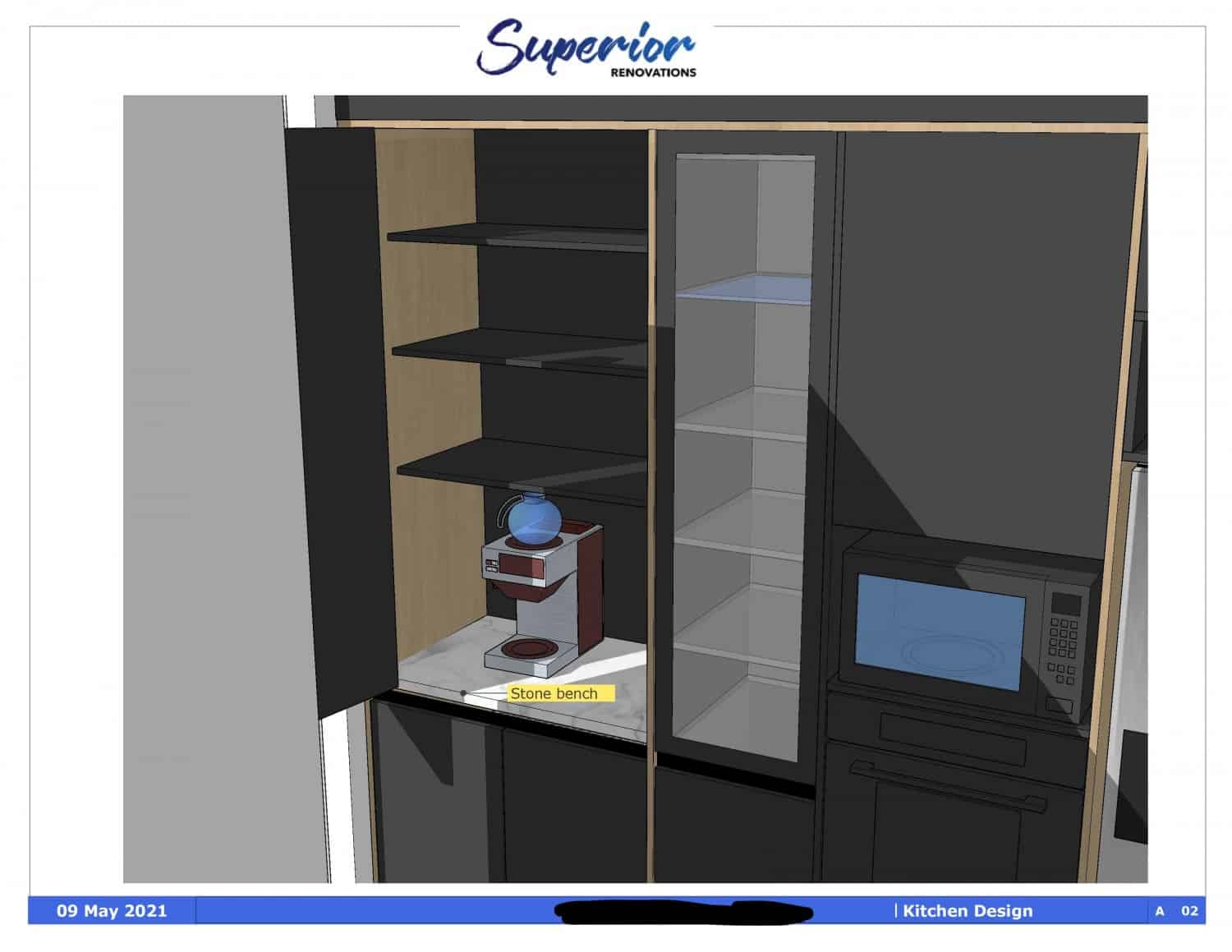
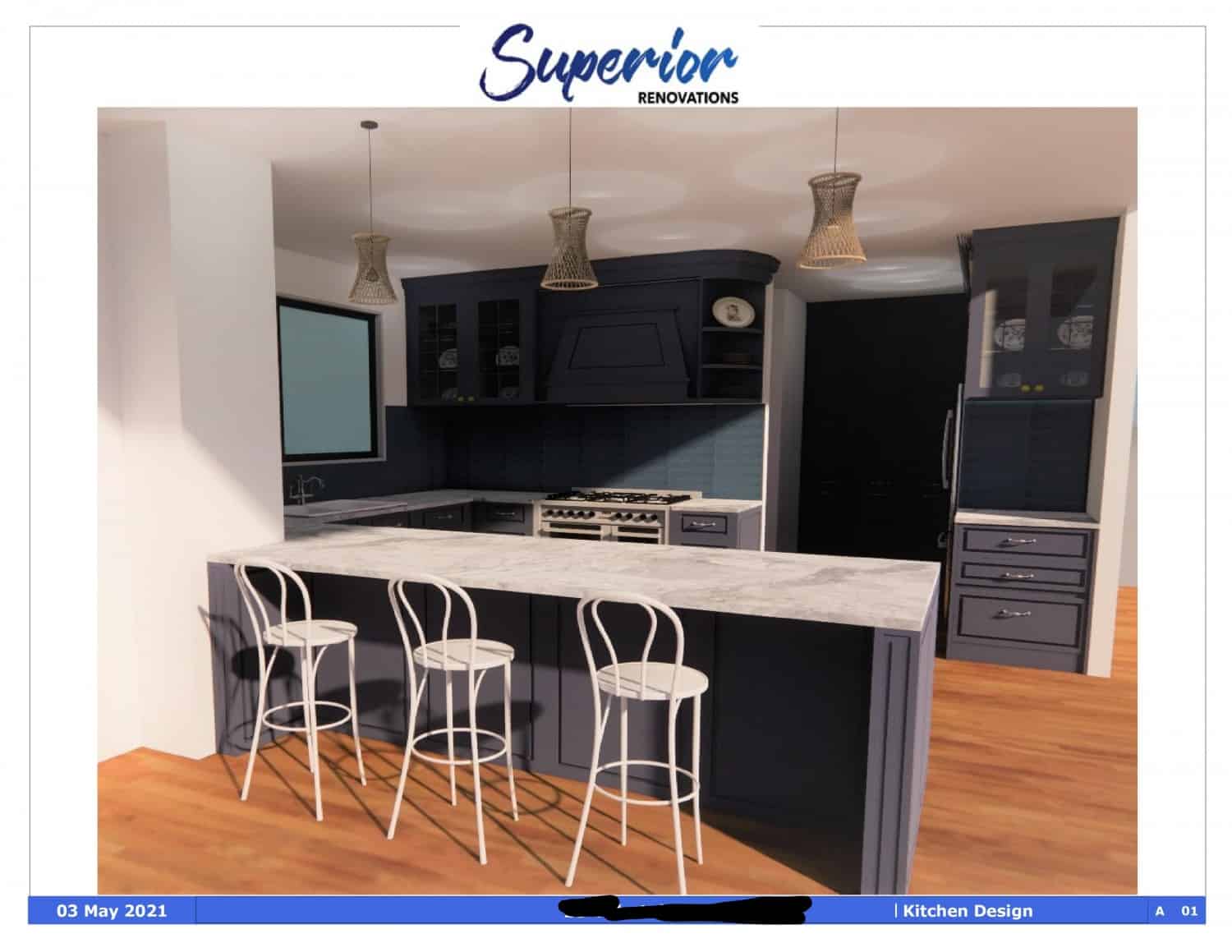
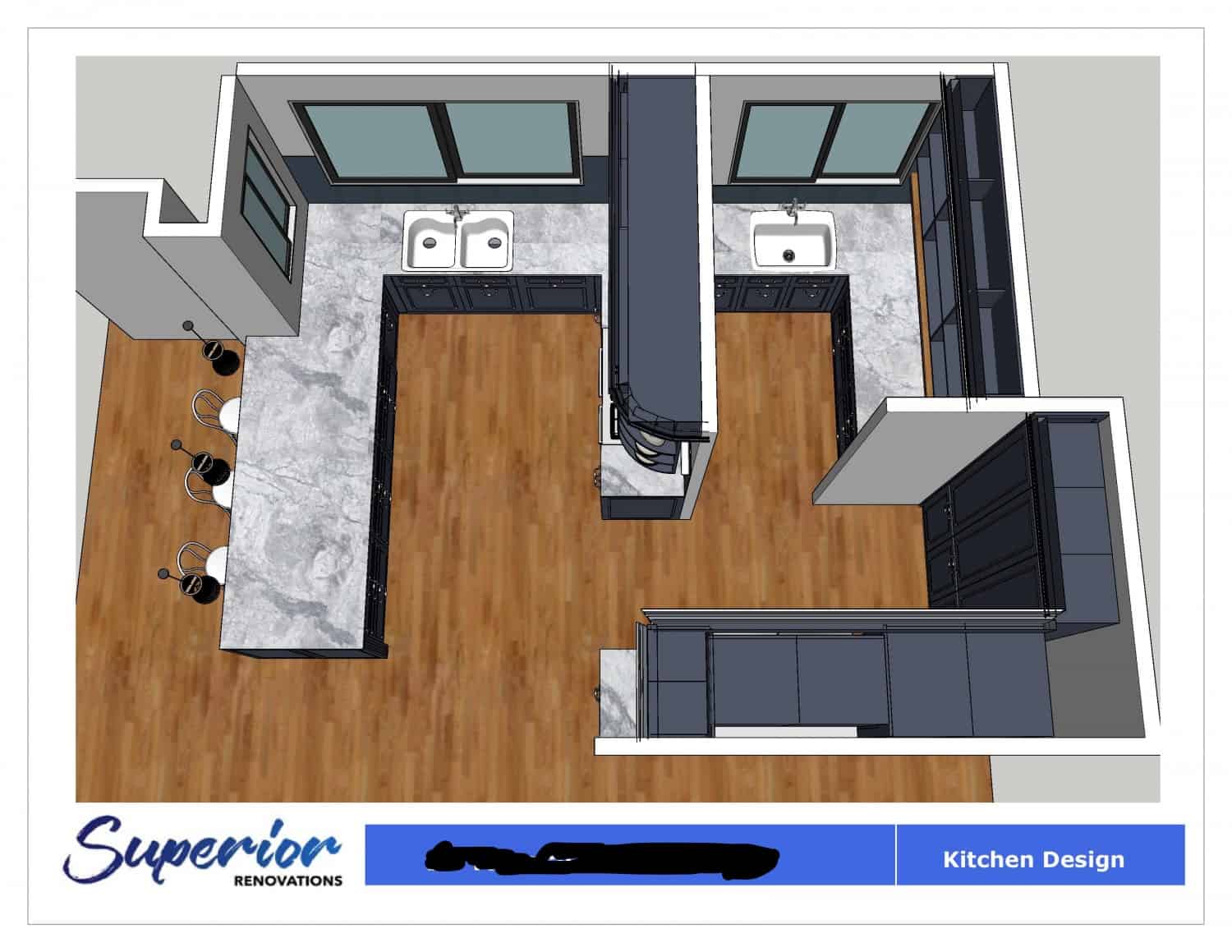
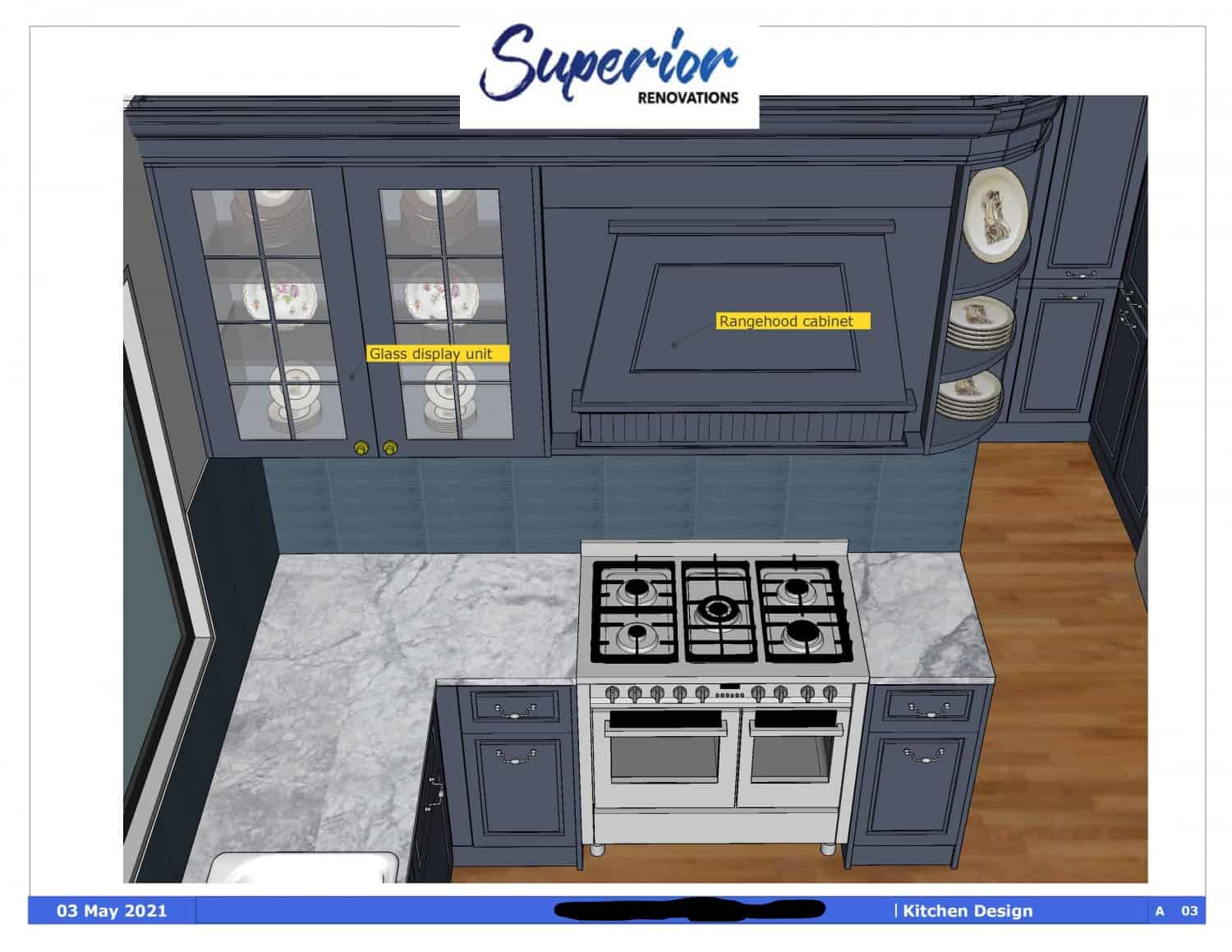
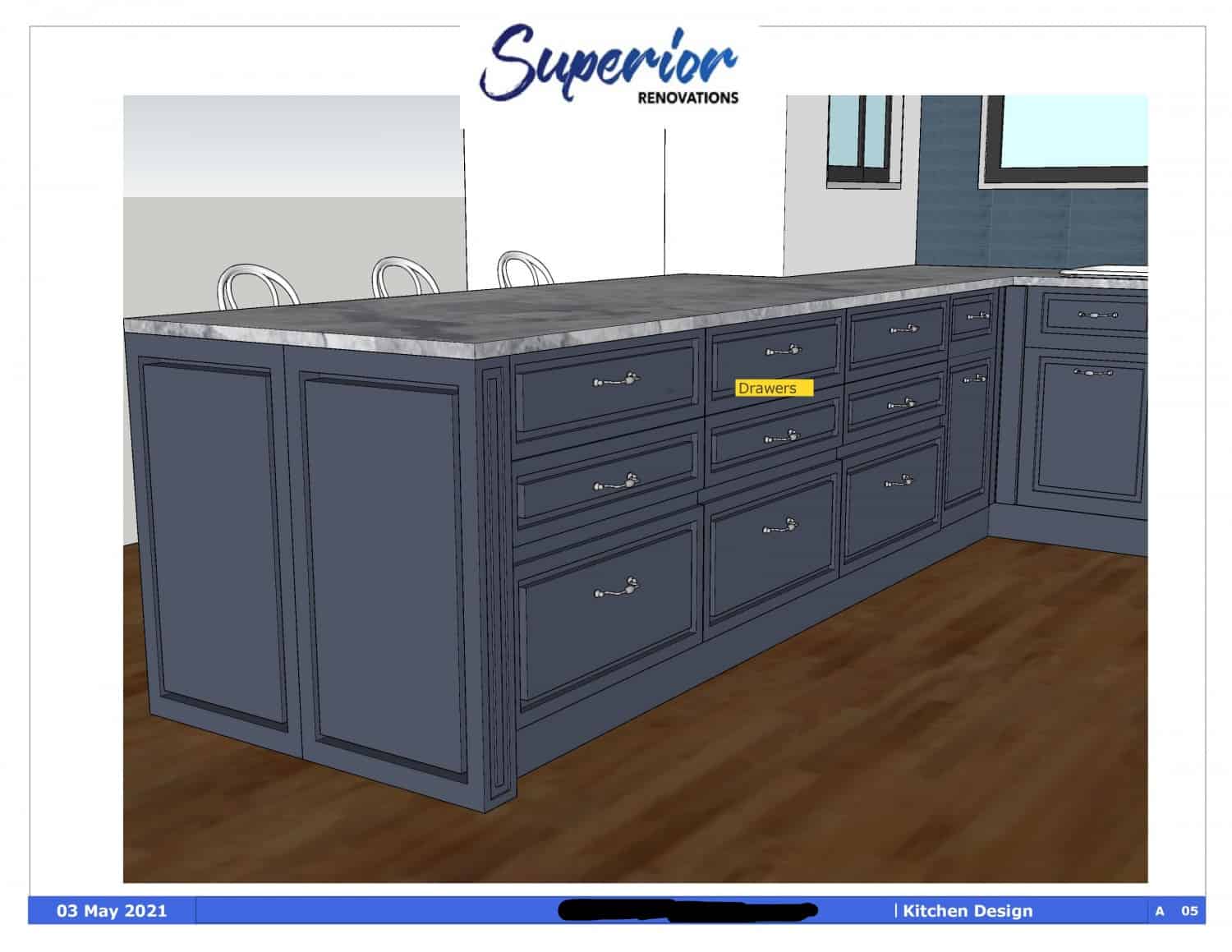
Kitchen Render by Sachi Amarasekara


The Honest Answer: 6 to 12 Weeks, Start to Finish

When we say a kitchen renovation takes 6–12 weeks, people often assume that’s all on-site work — tradies in the house for three months. It isn’t. The number splits into two parts that overlap: the planning and manufacturing lead time, and the on-site build.

Where the Weeks Actually Go

The on-site build — demolition through to final fit-off — is usually the shorter half. For a standard Auckland kitchen, that’s around 5–6 weeks with the trades on the tools. The longer, quieter half happens before anyone swings a hammer: design sign-off, ordering, and waiting for your cabinetry and benchtop to be manufactured. That’s typically another 4–8 weeks running in the background.

So how long does a kitchen renovation take in Auckland, all in? For most jobs, count on 6 to 12 weeks from the day you lock the design to the day you cook your first dinner. The spread depends almost entirely on scope.

Phase Typical timeframe What’s happening
Design & selections 2–4 weeks 3D design, layout sign-off, choosing finishes
Manufacturing lead time 3–4 weeks Cabinetry built, benchtop and splashback ordered (runs alongside design)
Demolition 2–4 days Old kitchen out, services capped
Build & installation 4–5 weeks Wiring, plumbing, GIB, cabinetry, benchtop, splashback, flooring
Total, end to end 6–12 weeks Standard Auckland kitchen; structural work pushes beyond

💡 Quick tip: The manufacturing clock starts the day you sign off the design — not demo day. The faster you lock your layout and finishes, the sooner your cabinetry goes into production and the shorter your overall timeline.

“People think the build is the long part. It isn’t — the build runs to a schedule. What blows timelines out is indecision in the design phase. If you’ve signed off your layout and chosen your finishes before we order, the whole thing runs like clockwork. If you’re still changing your benchtop colour the week before installation, that’s where the weeks disappear.”
— Dorothy Li, Design Manager, Superior Renovations


What Actually Moves the Number

Six things decide whether your kitchen lands at the six-week end or the twelve-week end. Some you control. Some you don’t.

1. Scope and Layout Changes

Swapping cabinetry, benchtops and appliances in the same footprint is the fastest kind of job. The moment you move the sink, relocate the cooktop, or knock the kitchen through into the dining room, you’ve added plumbing reroutes, electrical changes and often a structural element — and that adds weeks. A like-for-like refit is quick; a layout redesign is not.

2. Whether You Need Building Consent

Most cosmetic kitchen renovations in Auckland don’t need building consent. The trigger is structural or significant plumbing and drainage work — removing a load-bearing wall, for example, or relocating waste pipes. Per Building Performance (building.govt.nz), once a complete application is lodged, the council has 20 working days to process it.

Here’s the part most guides get wrong. The statutory limit is 20 working days, but it’s rarely the full bottleneck. MBIE’s consent monitoring shows the national median processing time in the fourth quarter of 2025 was just 10 working days, with 95.4% of applications cleared inside the statutory window. The real delays come from Requests for Information — an incomplete application stops the clock dead until you supply what’s missing. If your kitchen needs consent, removing a load-bearing wall is genuinely structural territory for our architectural team at Sonder Architecture, and getting the documentation right the first time is what keeps the timeline tight.

Important note: A consent application that triggers one Request for Information can add two to four weeks on its own. The fix is a complete, accurate application up front — not chasing the council afterward.

3. In-House vs Third-Party Manufacturing

This is the one nobody tells you about, and it’s often the single biggest variable. If your renovation company outsources its cabinetry to a third-party joinery shop, you’re sitting in someone else’s queue. Their production schedule, their delays, their lead times. We build a lot of our cabinetry through our in-house joinery team at Little Giant Interiors, which means we control the manufacturing slot rather than waiting on an external supplier. On a job where a third-party shop quotes a six-week cabinetry lead time, controlling it in-house can claw back two to three of those weeks.

4. Material and Benchtop Lead Times

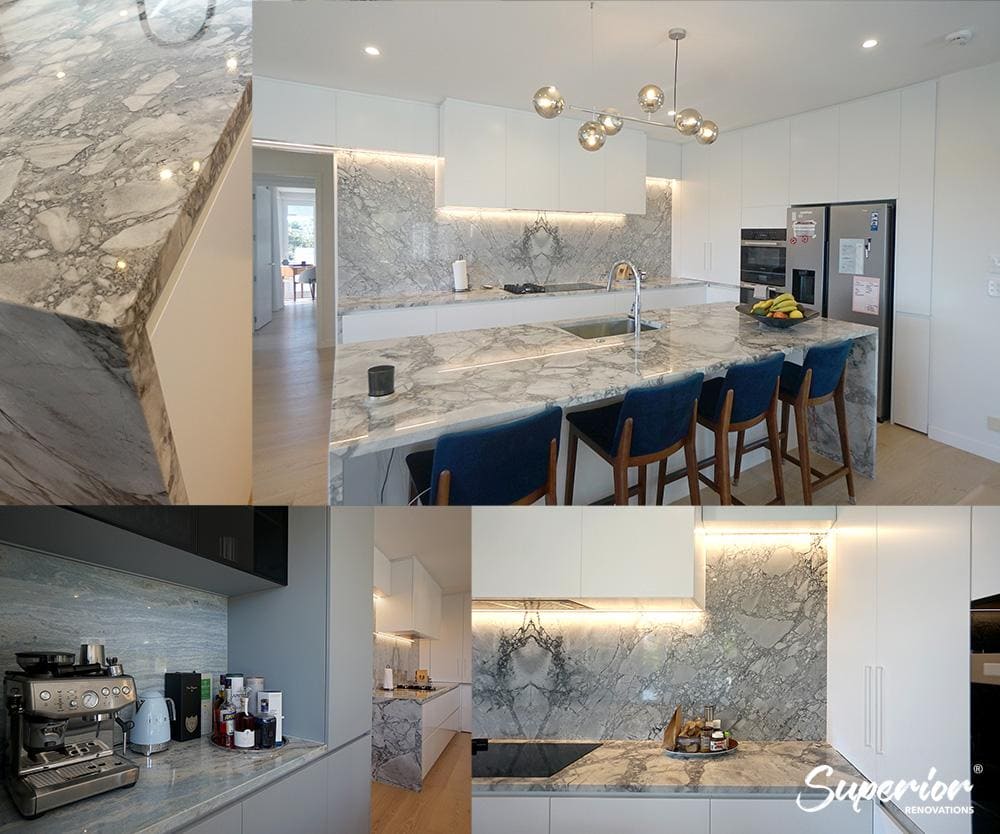
Your finishes carry their own clocks, and they run whether you’ve decided or not. Engineered stone benchtops need templating after the cabinets are in, then fabrication — usually two to three weeks before they’re installed. Custom cabinetry runs three to four weeks in production. Glass and acrylic splashbacks have a manufacturing lead time too, which is why they get ordered early in the process. Laminate surfaces from a supplier like Laminex are quicker off the shelf than a slab of engineered stone — a real consideration if your timeline is tight.

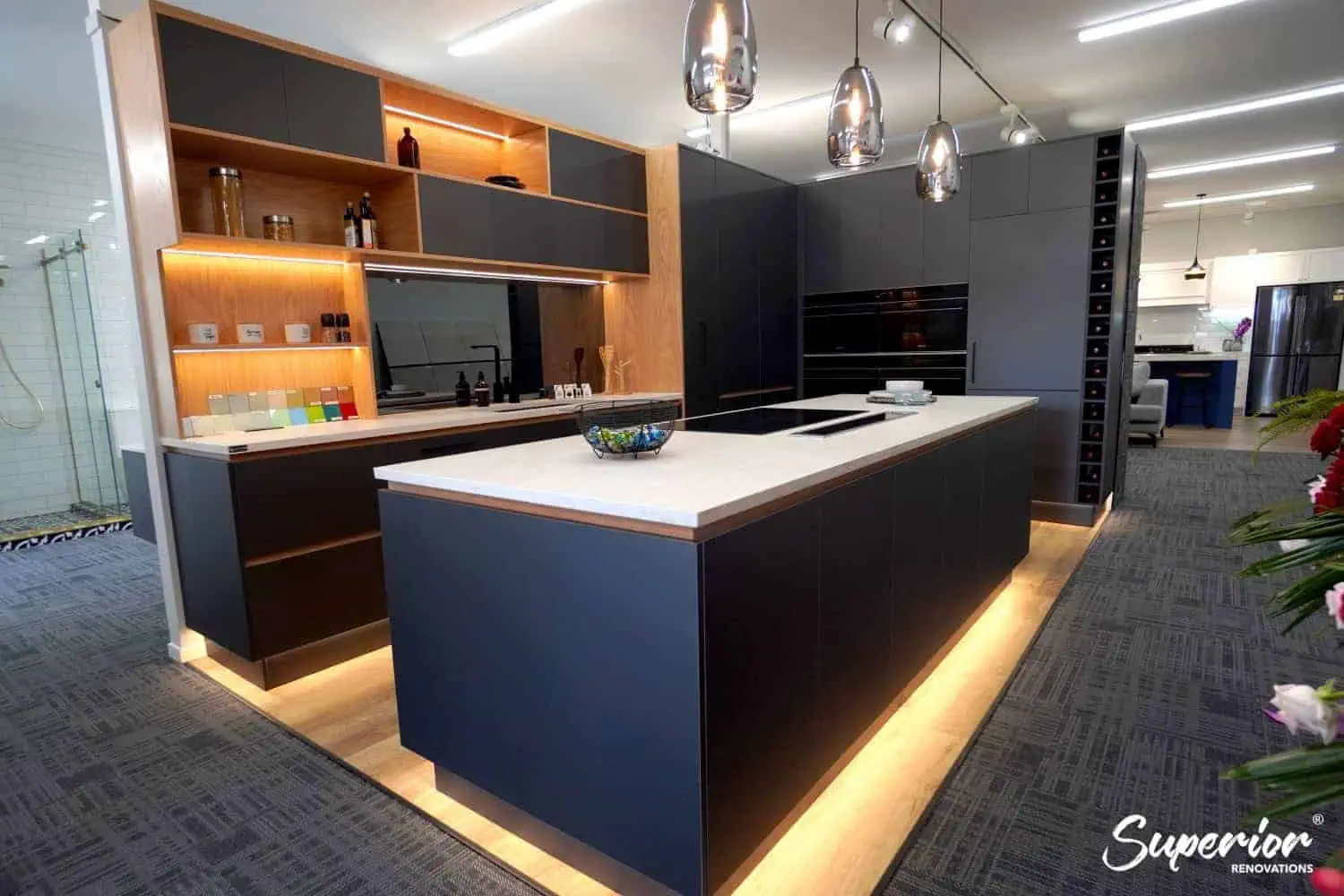
Superior Renovations Showroom 15 - Superior Renovations

5. The Age and Condition of Your Home

Auckland’s housing stock has surprises baked in. Pull the cabinets off the wall in a 1920s Mt Eden villa and you might find single-skin walls, old wiring, or borer-chewed framing that needs sorting before the new kitchen goes in. The 1970s brick-and-tile places in Manukau and the leaky-era homes from the early 2000s each have their own quirks. Older homes carry a higher chance of hidden work, which is why we build a contingency buffer into the timeline rather than promising a date we can’t hold.

6. Season and Trade Availability

Kitchens can be done year-round in Auckland because the work is indoors. But summer is the busy season. If you want a January or February start, the trades and manufacturing slots fill up fast. Autumn and late winter tend to have shorter wait times — which, given it’s currently winter, makes right now a smart time to lock in a slot for spring.

Factor Effect on timeline
Like-for-like refit (no layout change) Fastest — toward the 6-week end
Layout redesign / moving services Adds 1–3 weeks
Building consent required Adds 2–4+ weeks (longer with an RFI)
Third-party cabinetry vs in-house Can add 2–3 weeks of queue time
Engineered stone vs laminate benchtop Adds ~2–3 weeks fabrication
Hidden damage in older homes Variable — buffer 1–2 weeks

“The trick with lead times is that they run in parallel, not one after another. If a client decides on their stone and cabinetry early, the manufacturing clock is already ticking while we sort the rest. Leave those decisions late and suddenly everything’s queued end to end. Deciding early is the cheapest way to save weeks.”
— Alison Yu, Designer, Superior Renovations


How Long Will You Be Without a Kitchen?

This is the question people actually mean when they ask about timelines. Not “how long is the project” — but “how long am I cooking dinner on a camp stove in the garage?”

The No-Sink Stretch

For a standard build, the genuinely disruptive period — no sink, no cooktop, no usable bench — runs around 3 to 4 weeks in the middle of the on-site phase. Demolition and the early services work are the start of it; the kitchen comes back to life once the cabinetry is installed, the benchtop is in, and the plumber returns for the final fit-off.

Setting Up a Temporary Kitchen

Most of our clients set up a temporary kitchen in the garage, laundry or dining room — a fridge, microwave, a kettle and a single induction hob get you a long way. If you’ve got a laundry tub, that becomes your sink. We had a family in Titirangi run their whole household out of the laundry for a month and barely blink. It’s a few weeks of mild inconvenience, not the end of the world.

💡 Quick tip: Box up the kitchen gear you actually use day to day — kettle, toaster, a few plates, the good knife — and keep it separate. Living out of a temporary kitchen is far easier when the essentials aren’t buried in a packing box in the garage.

Do You Need to Move Out?

For a kitchen-only renovation, almost never. The work is contained to one room, and you can live around it. Moving out only really comes into play on larger whole-home projects where multiple rooms are offline at once. For the way we run a full kitchen renovation, you stay put — and we keep the dust and disruption walled off as much as the job allows.

DSC03003 - Superior Renovations


Can You Speed It Up? And What Causes the Delays

Some of the timeline is fixed — stone takes as long as stone takes. But a good chunk of it is in your hands.

What Actually Speeds a Kitchen Reno Up

Decide early, decide once. The single fastest move you can make is signing off your layout and locking your finishes before manufacturing starts. Order long-lead items — stone, custom cabinetry, glass splashbacks — at the front of the process so their clocks run in parallel. And work with a single point of contact who coordinates the trades, rather than juggling separate plumbers, sparkies and tilers yourself. A coordinated trade schedule is the difference between a 6-week build and a 10-week one.

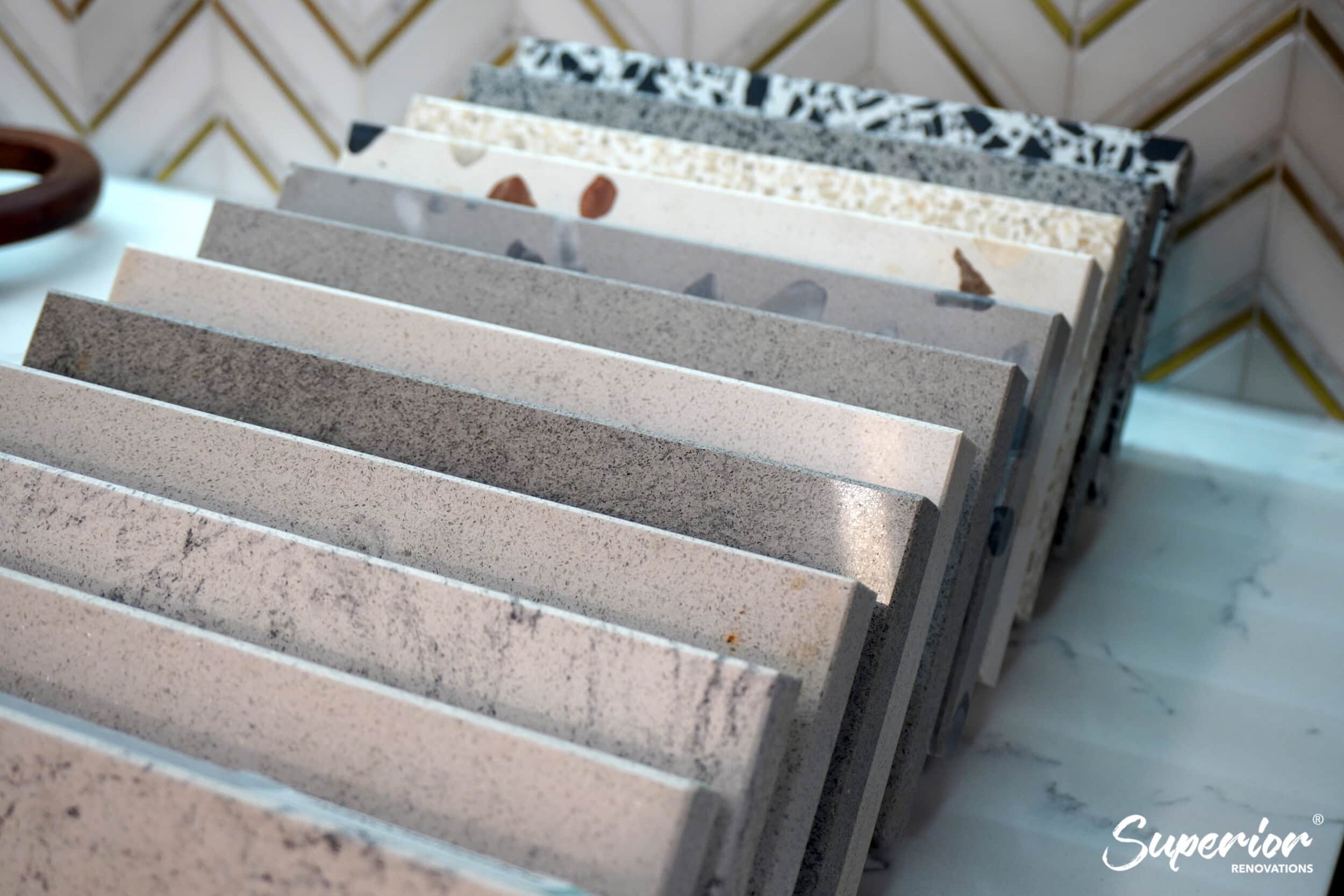
Selections are where most people stall, so it pays to see materials in person rather than second-guessing them off a screen. You can run your finishes past our design team at the Superior Renovations showroom at 16B Link Drive, Wairau Valley — touching the benchtop samples and seeing the cabinetry colours next to each other tends to settle decisions in an afternoon that would otherwise drag on for a fortnight.

The Usual Suspects Behind Delays

Late material selections are the number one cause — every week you spend deciding on a benchtop is a week the manufacturing clock isn’t running. After that: consent RFIs, a client supplying their own appliances that turn up late, and hidden damage uncovered at demolition. We’ve had jobs held up because an oven was sitting in a courier depot in Hamilton waiting on a delivery slot. If you’re supplying your own appliances, get them on site before fit-off week.

Why DIY Almost Always Takes Longer

People assume doing it themselves saves time. It usually does the opposite. Without a coordinated schedule, trades turn up in the wrong order, materials arrive late, and the job stretches across months of weekends. A managed renovation compresses the timeline precisely because someone is sequencing every trade to the day. Worth weighing up before you commit to the do-up yourself.

Cost and timeline are linked — a tighter, well-planned scope is both faster and easier to budget. If you want a rough number to plan around, our kitchen renovation cost calculator gives you an estimate in under a minute, and our kitchen renovation checklist walks you through what to pin down before you start. A mid-range Auckland kitchen typically runs $26,000–$35,000 — but this guide is about the weeks, not the dollars.


When to Book Your Auckland Kitchen Renovation

If you’re working toward a deadline — a new baby, family coming for Christmas, a house going on the market — work backwards from it.

Working Back From Your Deadline

For a standard kitchen, allow the full 6–12 weeks, then add the booking lead time on top. In the busy summer run, our calendar fills weeks ahead. If you want a job finished before Christmas, the conversation needs to start in winter or early spring — not in November. Leave it too late and you’re not waiting on the build; you’re waiting on a start date.

Why Winter Is the Smart Time to Plan

It feels counterintuitive, but the quieter, cooler months are the best time to get your design and consent sorted. Trades have more availability, manufacturing slots are easier to secure, and you walk into spring ready to build rather than starting from scratch. Sort the planning now and you skip the summer queue entirely.


A kitchen renovation in Auckland takes 6–12 weeks because that’s how long it takes to do it properly — design it, build the cabinetry, and install it without cutting corners. The companies promising four weeks are either skipping the design phase or sitting you in a third-party queue you’ll feel later. Lock your decisions early, work with one team that controls its own manufacturing, and the timeline looks after itself.

Book your free in-home consultation with Superior Renovations
Estimate your kitchen renovation cost in under a minute
Request a free feasibility report for your project


How long does a kitchen renovation take in Auckland?

A full kitchen renovation in Auckland takes 6–12 weeks from start to finish. Around 5–6 weeks is the on-site build (demolition through to final fit-off), with another 4–8 weeks of design and manufacturing lead time beforehand that often overlaps. Structural changes, building consent, or third-party cabinetry queues push the timeline toward — or beyond — the upper end.

How long will I be without a kitchen during the renovation?

The genuinely disruptive stretch — no sink, no cooktop, no usable bench — runs around 3 to 4 weeks in the middle of the on-site phase. Most homeowners set up a temporary kitchen in the garage or laundry with a fridge, microwave and a single induction hob to get through it. The kitchen comes back online once cabinetry, benchtop and plumbing fit-off are done.

Why do some companies quote four weeks for a kitchen renovation?

A four-week quote usually refers only to the on-site build, not the design and manufacturing lead time before it. It can also mean cabinetry is outsourced to a third-party joinery shop, where you sit in their production queue. A realistic end-to-end figure for a standard Auckland kitchen is 6–12 weeks once design, manufacturing and installation are all counted.

Do I need building consent for a kitchen renovation?

Most cosmetic kitchen renovations don't need building consent in Auckland. Consent is triggered by structural work, such as removing a load-bearing wall, or significant plumbing and drainage changes. Per Building Performance, councils have 20 working days to process a complete application. MBIE's monitoring showed a national median of 10 working days in late 2025, though Requests for Information can stop the clock and add weeks.

What's the longest part of a kitchen renovation?

It's not the build — it's the lead time before it. Design sign-off, cabinetry manufacture (3–4 weeks), and benchtop fabrication (2–3 weeks for engineered stone) make up the quiet half of the timeline. Indecision in the design phase is the single biggest cause of delays, because the manufacturing clock only starts once you've locked your layout and finishes.

Can I live in my house during a kitchen renovation?

Yes. For a kitchen-only renovation, you almost never need to move out — the work is contained to one room and you can live around it. Set up a temporary kitchen with the essentials and keep daily-use items separate from packed boxes. Moving out only becomes a consideration on larger whole-home projects where several rooms are offline at once.

How can I make my kitchen renovation faster?

Decide early and decide once. Sign off your layout and finishes before manufacturing starts, and order long-lead items — engineered stone, custom cabinetry, glass splashbacks — at the front of the process so their lead times run in parallel. Working with a single team that coordinates the trades, and ideally controls its own cabinetry manufacture, is the difference between a 6-week build and a 10-week one.

Does an engineered stone benchtop add time to the project?

Yes. Engineered stone is templated after the cabinets are installed, then fabricated off-site — usually 2–3 weeks before it's fitted. Laminate surfaces are quicker because they're not custom-fabricated the same way. If your timeline is tight, your benchtop choice is one of the few levers that genuinely moves the date, so factor it into your decision early.

When should I book a kitchen renovation to be finished by Christmas?

Work backwards: allow the full 6–12 weeks, then add booking lead time on top. Summer is the busy season in Auckland, so calendars fill weeks ahead. To be finished before Christmas, the conversation should start in winter or early spring. Planning over the cooler months means trades and manufacturing slots are easier to secure and you skip the summer queue.


Further Resources for your kitchen renovation

  1. Featured projects and Client stories to see specifications on some of the projects.
  2. Real client stories from Auckland

Need more information?

Take advantage of our FREE Complete Home Renovation Guide (48 pages), whether you’re already renovating or in the process of deciding to renovate, it’s not an easy process, this guide which includes a free 100+ point check list – will help you avoid costly mistakes.

Download Free Renovation Guide (PDF)


finance - Superior Renovations

Have you been putting off getting renovations done?

We have partnered with Q Mastercard ® to provide you an 18 Month Interest-Free Payment Option, you can enjoy your new home now and stress less.

Learn More about Interest-Free Payment Options*

*Lending criteria, fees, terms and conditions apply. Mastercard is a registered trademark and the circles design is a trademark of Mastercard International Incorporated.


Still have questions unanswered?

Book a no-obligation consultation with the team at Superior Renovations, we’d love to meet you to discuss your renovation ideas!

    Services

    Home RenovationKitchen RenovationBathroom RenovationOutdoor RenovationHouse ExtensionCommercialDesign ServicesOther

    By submitting this form, you agree to receive communications from us via email or text regarding our services, you can unsubscribe at any time.

    This site is protected by reCAPTCHA and the Google

    Privacy Policy and Terms of Service apply.


    References

    1. Building Performance (MBIE) — The building consent process
    2. MBIE — Building Consent System Performance Monitoring (Q4 2025)
    KIT 06 02 - Superior Renovations
    Kitchen Renovation

    Kitchen Layout Guide NZ: 6 Layouts & the Work Triangle

    Kitchen Layout Guide NZ: 6 Layouts & the Work Triangle

    Quick answer: The best kitchen layout is the one that keeps your sink, stove and fridge close enough to move between easily — the “work triangle” — while leaving clear walkways and enough bench space for how your household actually cooks. For most Auckland homes that’s an L-shaped or galley layout in tighter spaces, and a U-shaped or island layout where there’s room to spread out.

    Planning a kitchen layout is the part of a renovation that quietly decides everything else. Get it right and the room works for fifteen years without you thinking about it. Get it wrong and you spend every dinner walking around an island that’s 200mm too close to the oven. Whether you’re reworking a tight galley in a Ponsonby villa or opening up a family kitchen in Albany, the layout is the foundation — so this guide covers the six main kitchen layouts, the work triangle, the measurements that matter, and the design moves our team uses to make Auckland kitchens flow.


    What Is the Best Kitchen Layout? The Six Main Types

    There’s no single best kitchen layout — there’s the right one for your space and how you cook. The six layouts below cover almost every Auckland kitchen, from a single-wall apartment to a double-island entertainer.

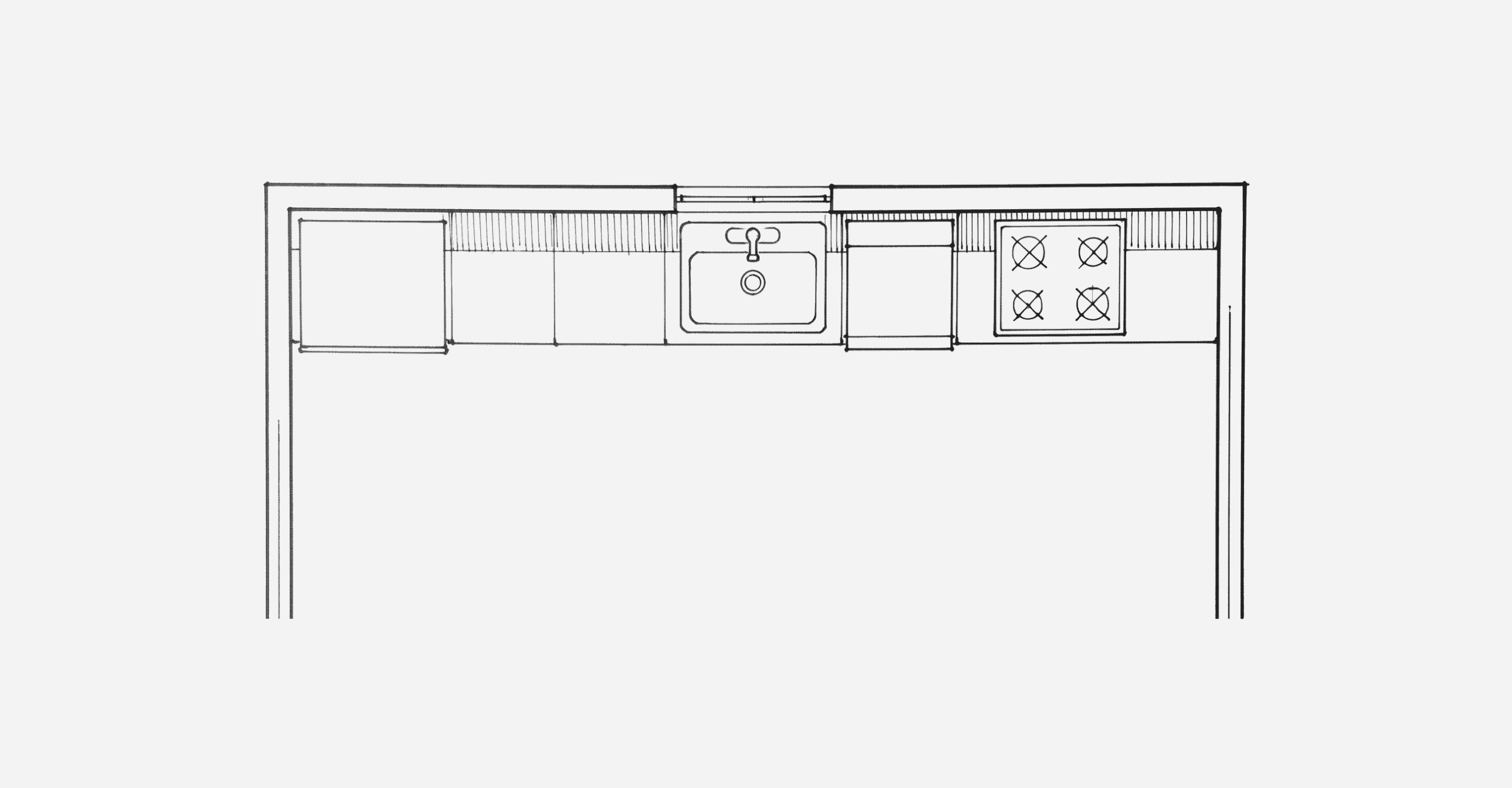
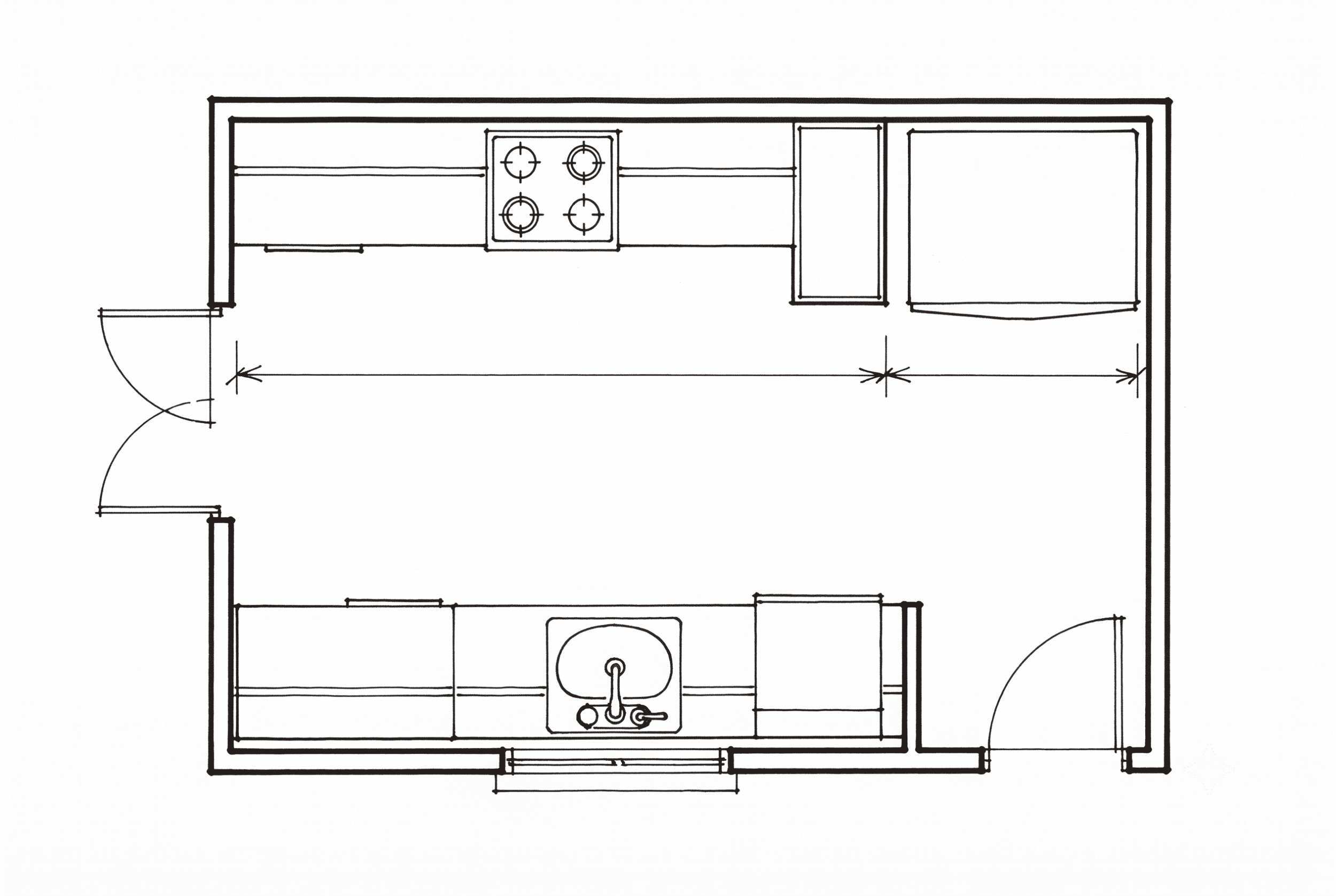
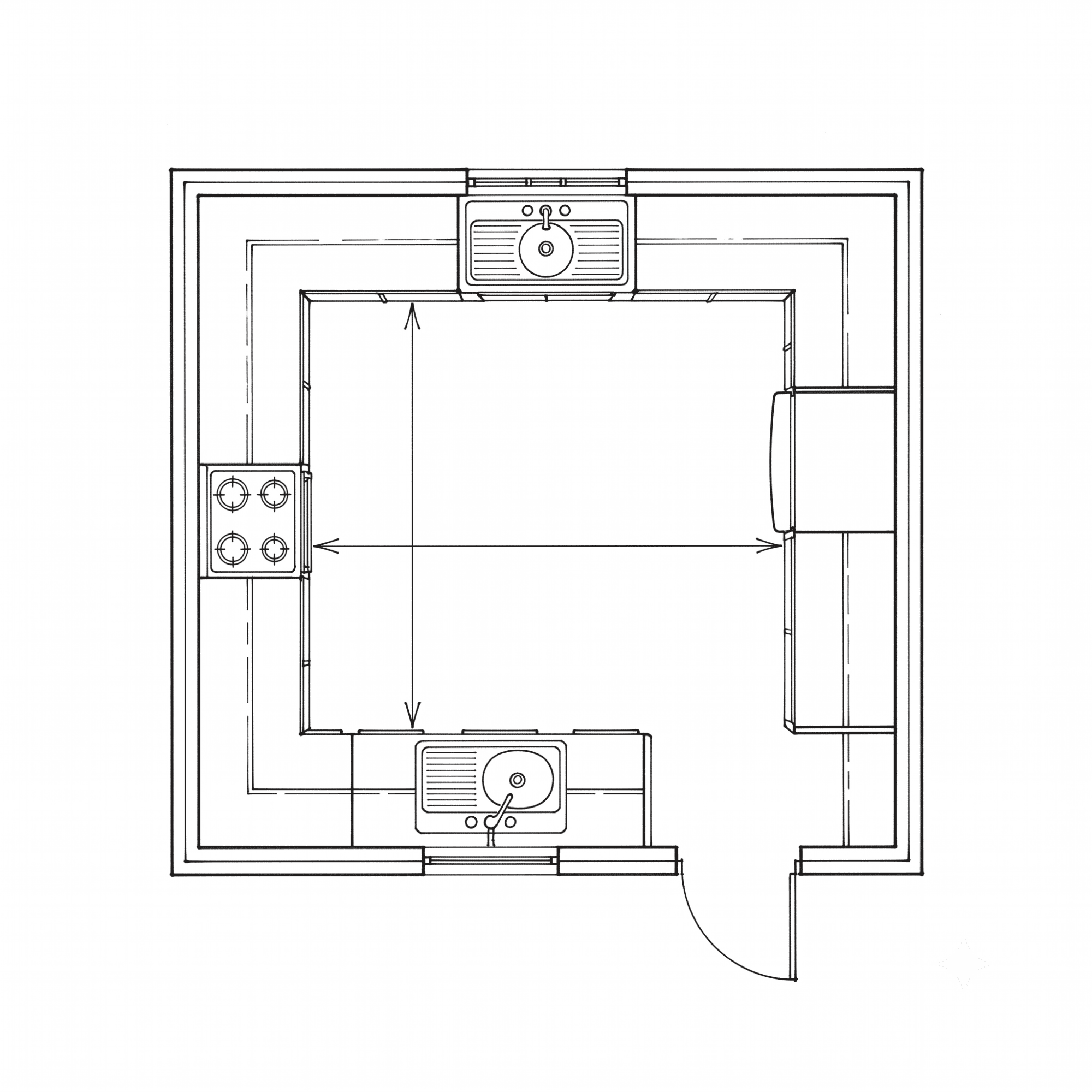
    • Galley — two parallel runs of cabinetry with a walkway between. Best for narrow rooms and one main cook.
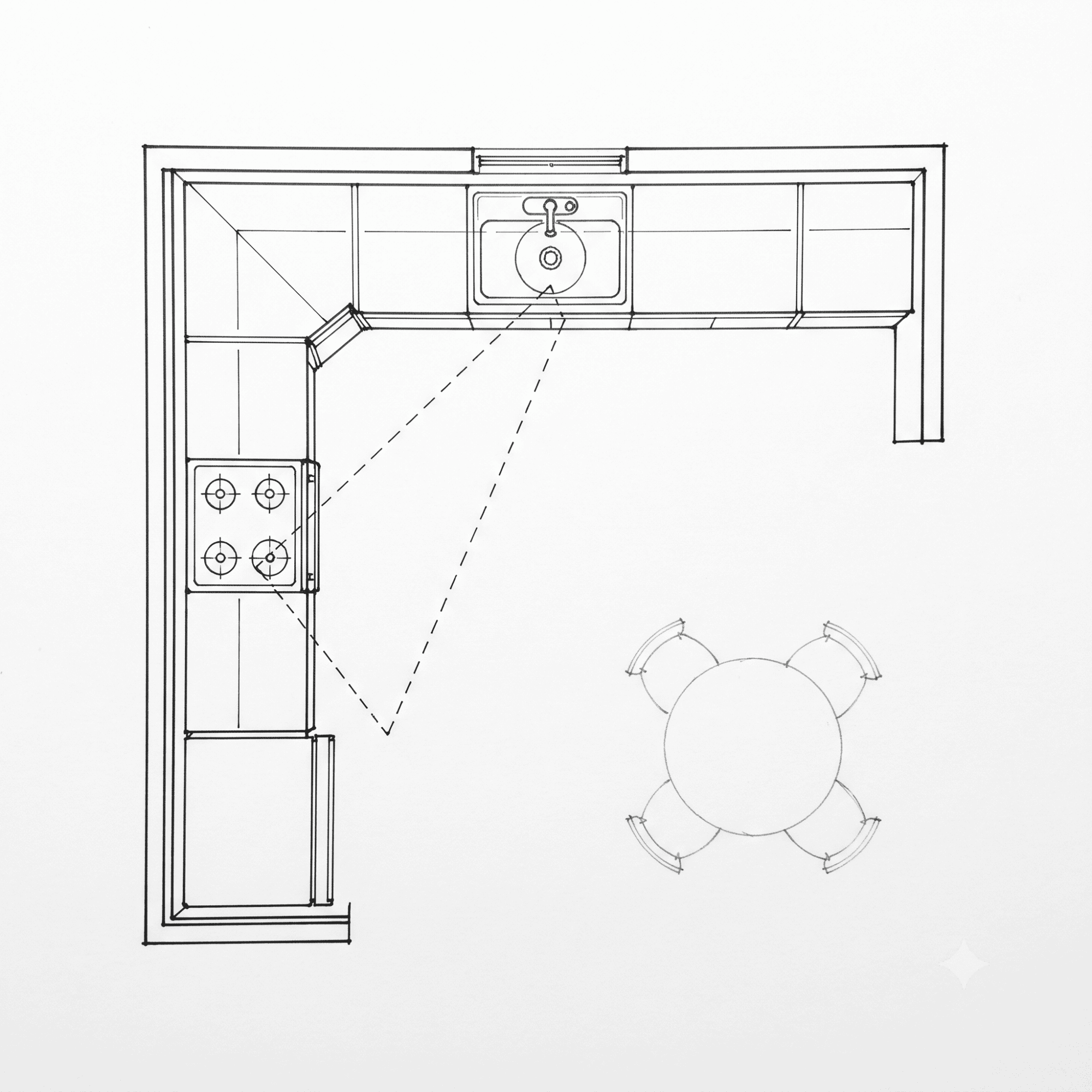
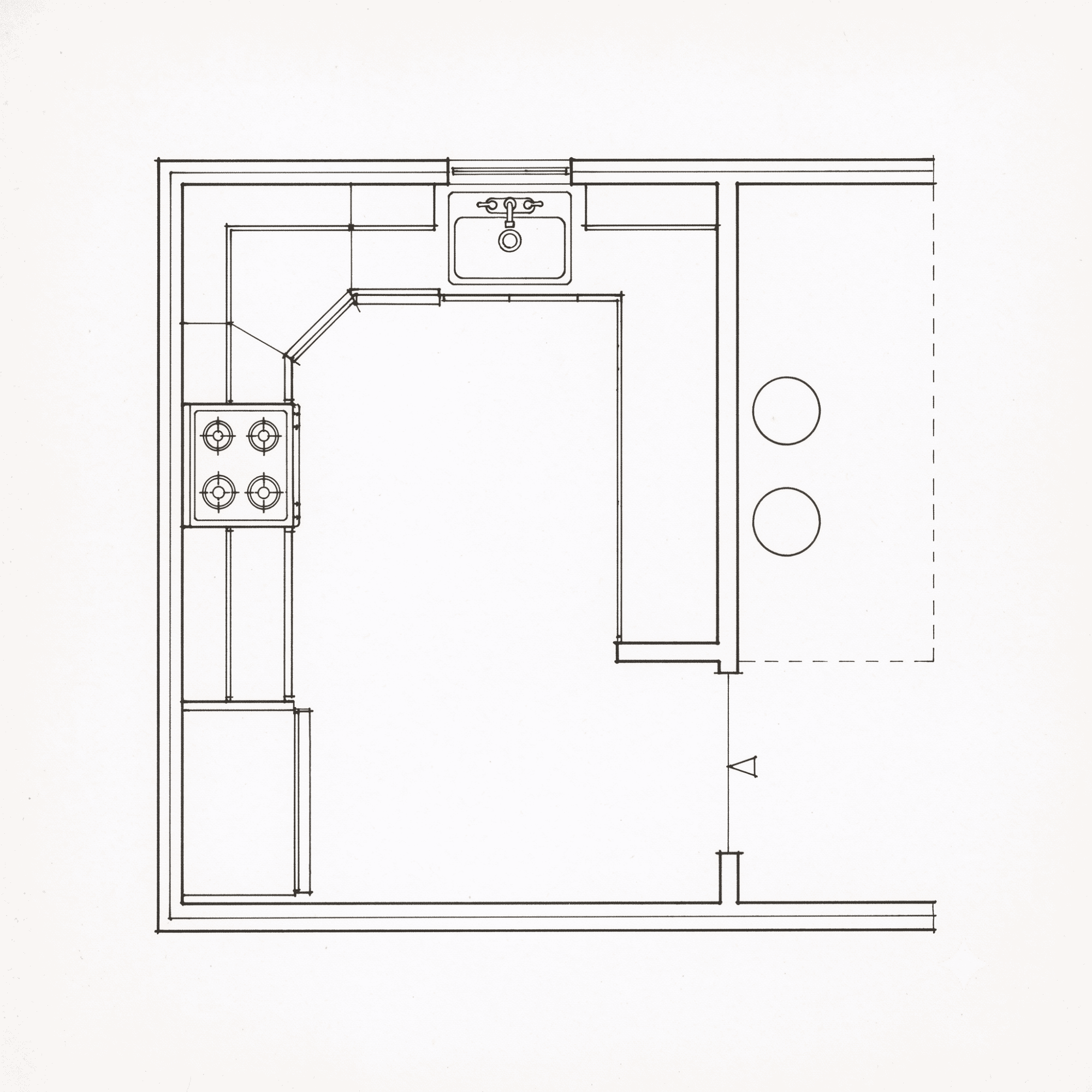
    • L-shaped — cabinetry along two adjoining walls. The most versatile layout; suits small-to-medium kitchens and open-plan corners.
    • U-shaped — cabinetry on three walls. Maximum bench and storage; needs a larger room.
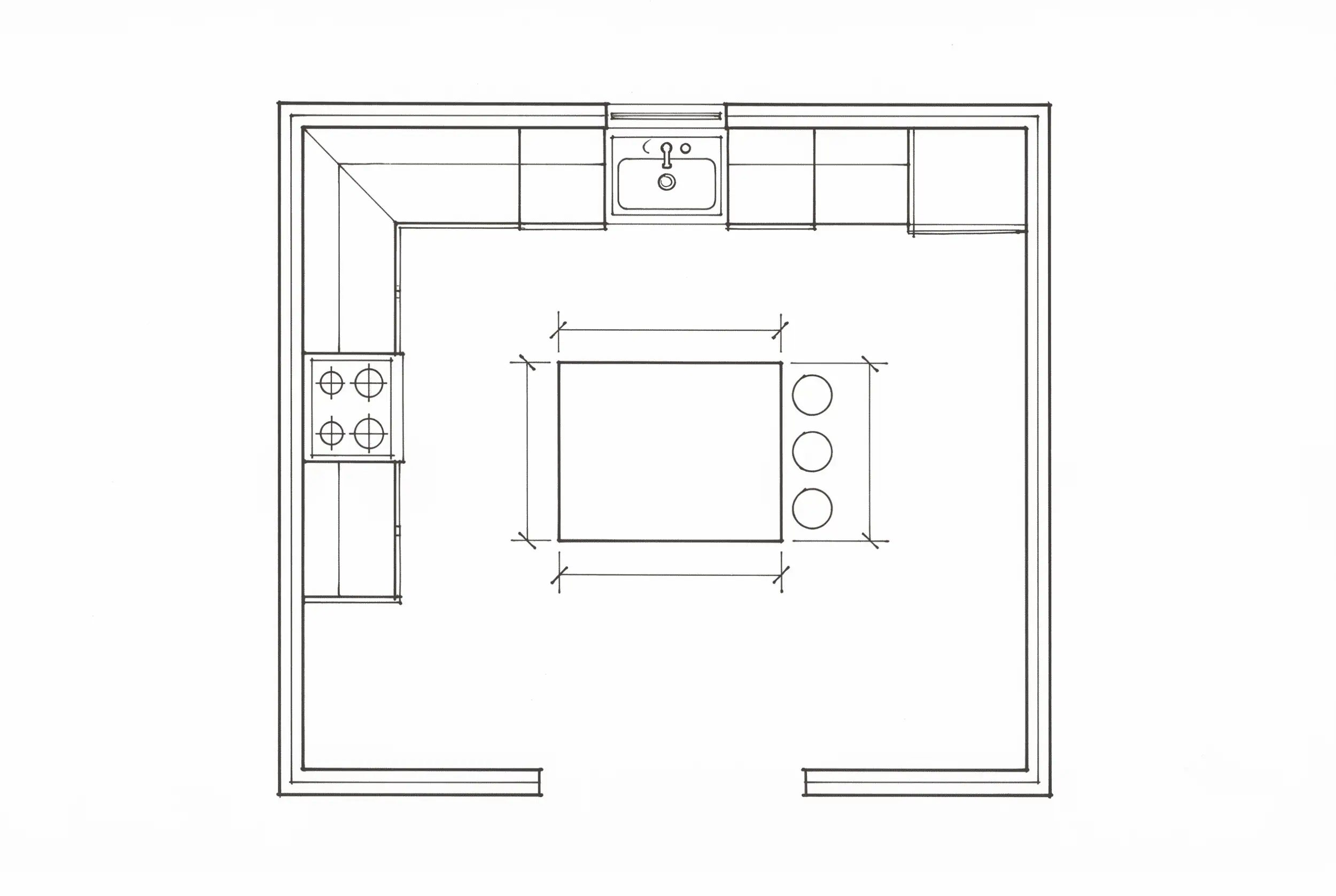
    • Island — a freestanding bench in the centre, added to an L, U or open-plan layout for prep, storage and seating.
    • Peninsula — an island connected at one end, giving the same benefit where there isn’t room for a standalone island.
    • Single-wall — everything on one wall. The footprint-saver for apartments and very small spaces.

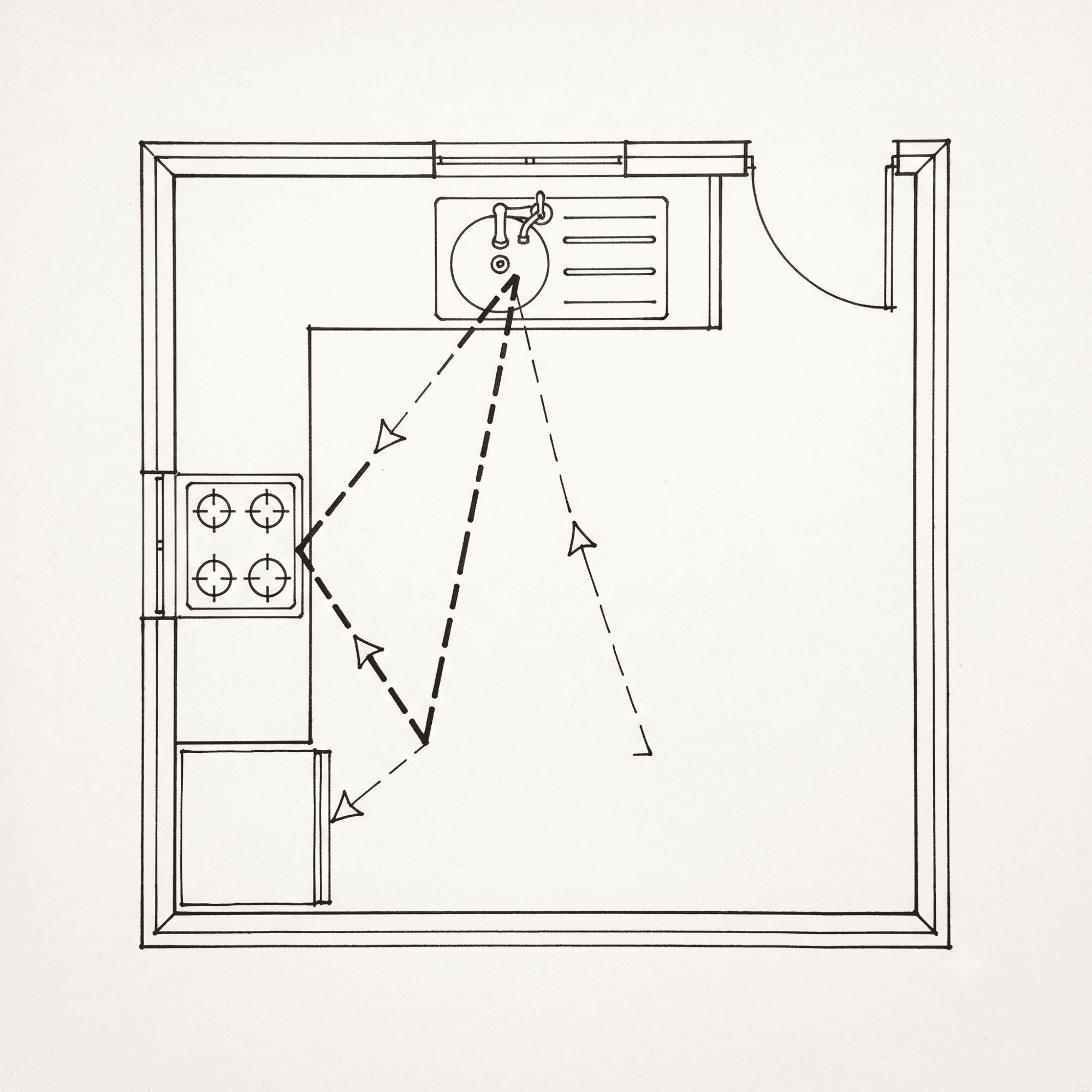
    At the centre of all six is the work triangle: the path between your sink, stove and fridge. Keep the three legs adding up to roughly 4–8 metres with no through-traffic crossing the middle, and the kitchen will feel efficient no matter which layout you choose. Everything else — storage, lighting, finishes — is built on top of getting that triangle right.


    Kitchen Ergonomics and the Work Triangle

    Ergonomics is the study of designing a space around the people using it, rather than making people adapt to the space. In a kitchen, that mostly comes down to the work triangle — and it’s the single most useful planning idea we give clients.

    The work triangle connects the three spots where the actual work happens: the stove (cooking), the sink (cleaning and prep), and the fridge (storage). The rule is simple. Those three points should sit close enough to move between in a few steps, and nothing — no island, no dining table, no walkway — should cut through the middle of the triangle.

    “The work triangle is old, but it still holds. What’s changed is that modern open-plan kitchens run on zones as much as the triangle — a prep zone, a cooking zone, a cleaning zone, a storage zone. In a busy Auckland family kitchen with two people cooking, zoning is what stops everyone colliding at the same bench.”
    — Dorothy Li, Design Manager, Superior Renovations

    💡 Quick tip: if two people cook in your house regularly, plan for it. Allow 90–120cm of walkway so two people can pass, and give the second cook their own bit of bench away from the main triangle.


    7 Essentials to Plan Before You Choose a Kitchen Layout

    Whatever shape your kitchen ends up, it has to be livable first. You need to move around it without bumping into things, and open every cabinet and appliance door without it hitting something else. That’s why space planning comes before shape. Here are the seven things our designers work through before locking in any layout.

    1. Foot Traffic and Designated Storage Zones

    Your first job is a clear primary pathway through the kitchen that doesn’t get blocked when the oven or dishwasher door is open. Kitchens are high-traffic — usually the busiest room in the house. Map where everything lives before you design: big appliances, cutlery, everyday utensils, the washing zone, the cooking zone. Give each a designated home. The drawing below shows how the zones should fall.

    Kitchen layout zones for circulation, preparation and cooking

    Clear zones for circulation, meal prep and cooking (Image courtesy RoomSketcher)

    2. Distance Between Your Fixtures

    A cramped kitchen looks fine on a plan and fails in real life. Think about the gap between your cooking zone and your sink, and don’t let the fridge sit so far from the stove that you’re walking laps mid-cook. Your dishwasher wants to be right by the sink so you can rinse and load in one move. The plan can hide these problems; the daily cooking won’t.

    3. Distance Between Your Island and the Cooking Area

    If you’ve got an island, the gap between it and the cooktop matters more than almost anything else. Too far and your prep-to-cook flow falls apart. Too close and only one person can work in the space, and the island’s own cabinet doors start colliding with the run behind them. Aim for 100–120cm of clearance around an island.

    L-shaped kitchen island, Blockhouse Bay renovation

    This island from our Blockhouse Bay renovation sits a clear distance from the counters

    L-shaped kitchen with large island and bar stools, Stanmore Bay

    L-shaped kitchen from our Stanmore Bay renovation — large island with bar stools and a hob

    4. Place the Sink and Cooktop First

    A good rule: figure out where the sink, cooktop and dishwasher go before anything else. That’s where most of the action happens, so designers lock those in before designating prep and storage zones. Leave plenty of room around both the sink and cooktop. If you’ve got a large island with surface area to spare, putting the sink on it can give you a generous work zone.

    5. Be Smart About the Cooktop

    Ventilation matters more in Auckland than people think — our humid summers and the steam off a good fry-up will leave moisture sitting in the room, and over time that means mould on the walls and ruined cabinetry, especially in an open-plan setting. It’s not just a comfort issue: Building Performance (MBIE) notes that a rangehood over the cooktop is the mechanical extraction that clears cooking moisture before it settles on cold surfaces — and that very airtight homes may need a window cracked on the opposite side of the house for the extractor to actually pull air. You can put a cooktop on an island, but a proper island extraction system is expensive and you lose the splashback that catches the splatters. We usually steer clients toward a cooktop on an exterior wall, where ventilation is simpler to run and you get a splashback for free.

    6. Keep Vertical Storage in Mind

    Storage makes or breaks a kitchen. A beautiful kitchen with nowhere to put things is a bad kitchen. Not everyone has a big footprint to work with — but a small kitchen doesn’t have to mean no storage. Go up. Wall-mounted vertical storage reached by a kitchen ladder, tall cabinetry, hooks and open shelves all claw back space the floor plan can’t give you. For more on squeezing storage out of a tight footprint, our small kitchen design ideas guide goes deeper.

    7. Create a Floor Plan and Visualise It in 3D

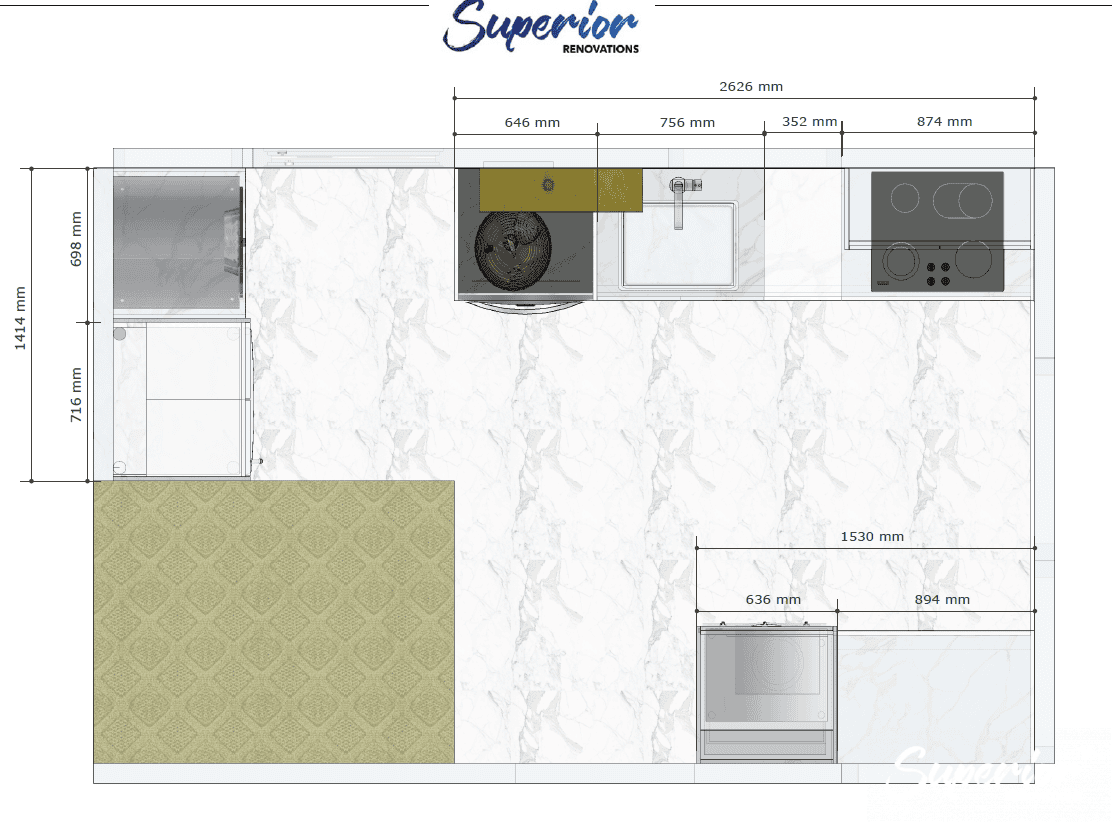
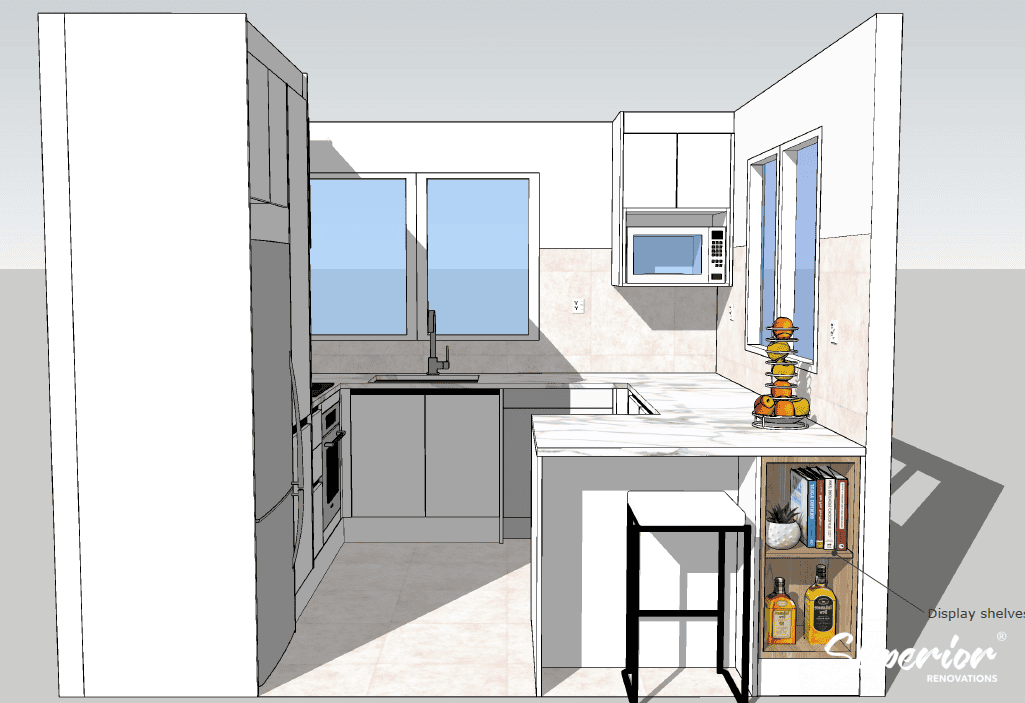
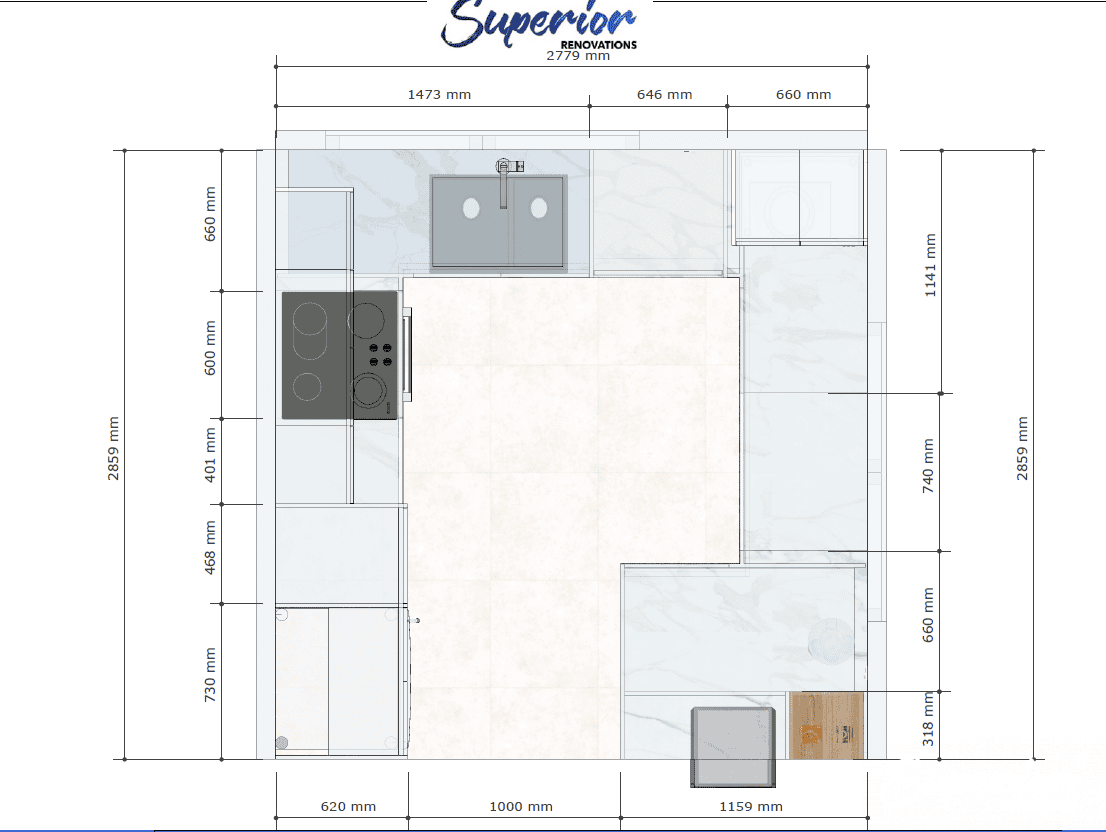
    Once materials, dimensions and the look are settled, get the kitchen drawn in 3D before anything is built. Most renovation companies — us included — give clients 3D drawings so they can see the kitchen before manufacturing and installation start. Even on a DIY project, a 3D drawing from an app or a designer is worth the effort. It’s far cheaper to move a cabinet on screen than after it’s installed.


    Key Kitchen Measurements That Make a Layout Work

    The difference between a kitchen that feels right and one that fights you is usually a few centimetres. These are the numbers our designers plan to.

    • Bench height: 900mm standard, 600mm deep.
    • Clearance in front of appliances: at least 120cm for easy loading and unloading.
    • Island clearance: 100–120cm all the way around for traffic flow.
    • Seating overhang: 30–45cm of bench overhang for comfortable bar-stool seating.
    • Two-cook walkway: 90–120cm so two people can pass without a shuffle.

    Then layer your lighting — pendants over an island, LED strips under the cabinets for the bench — and choose a benchtop that shrugs off spills and Auckland humidity. Quartz and quality laminate both hold up well.

    💡 Quick tip: if anyone in the house is left-handed, plan their landing space on the right of the stove, not the left. Small thing, noticed every single day.

    If you’re working out what your project will cost alongside the layout, our kitchen renovation cost calculator gives you a ballpark by scope before you commit.


    7 Kitchen Layout Ideas to Keep It Functional

    Once the layout’s locked, these are the moves that keep it working day to day — small kitchen layout ideas and full-size ones alike.

    1. Vertical Wall Storage

    Storage is the backbone of a functional kitchen. Build organisation into the walls — magnetic strips, hooks, rails. Vertical wall storage works in any size kitchen and comes in endless configurations, so it’s the first place to look when bench and cabinet space runs short.

    2. Make Room for an Island

    Where there’s space, plan for an island. It’s where everyone gathers, it adds storage, and it makes the whole kitchen more usable. Even a compact island earns its footprint as prep space and casual seating.

    Kitchen island in an Auckland renovation

    3. Hide It in the Corner

    Dead corner cabinets are wasted space. A two-tiered carousel or a magic-corner pull-out turns that black hole into proper storage you can actually reach — somewhere to stash both the everyday gear and the things you use twice a year.

    Two-tiered carousel corner storage in a kitchen layout

    Magic-corner pull-out

    4. Clean-Lined Cooktop

    If counter space is tight, a flat glass ceramic cooktop keeps the bench reading as one continuous surface. It suits any kitchen style and doesn’t break up the line of the bench the way a raised cooktop can.

    5. Sort the Spices

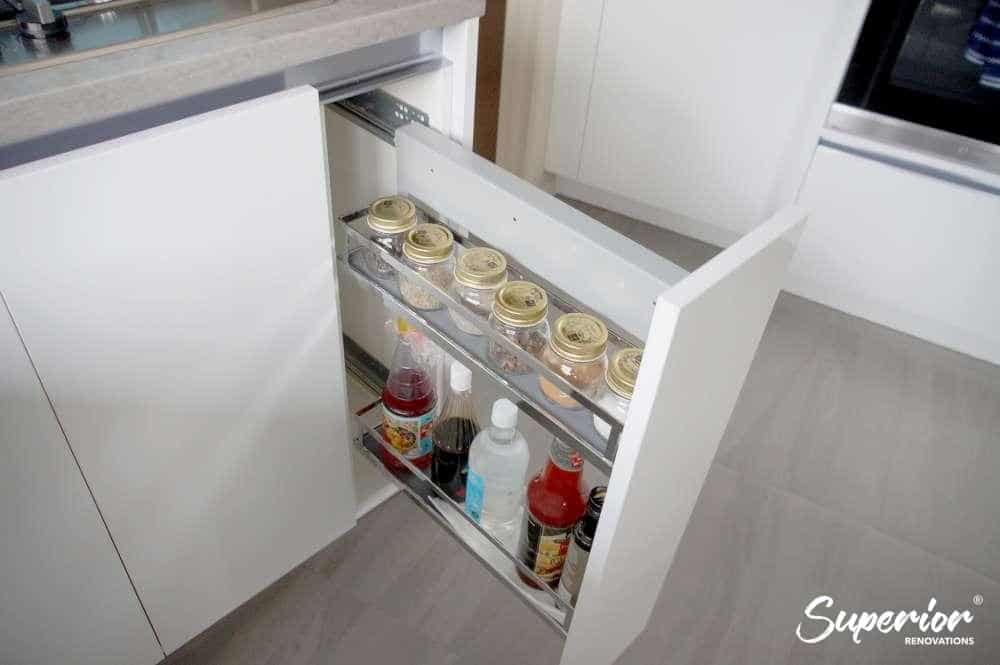
    A functional kitchen is won in the details. A dedicated spice drawer with small containers — rather than a cupboard where everything migrates to the back — is the kind of small organisational win you notice every time you cook.

    Organised pull-out kitchen drawers

    Pantry with pull-out drawers

    6. Keep Continuity

    You don’t need a big budget for a resolved look. Integrated appliance doors that match your cabinetry give a unified, finished kitchen without the cost of a full custom fit-out — the eye reads one clean run instead of a row of different appliance fronts.

    7. Light the Dark Spots

    Nobody enjoys hunting through a dark drawer. Plug-in LED strips with motion sensors inside drawers and cabinets are cheap and genuinely useful, and good task lighting over the bench is non-negotiable in a working kitchen.

    Kitchen splashback lighting in a functional kitchen layout

    Lighting on the splashback


    The 6 Most Popular Kitchen Layouts — Which Suits Your Space?

    Now the dimensions are sorted, here are the six layouts in detail. The right one comes down to your room’s shape and how your household actually uses the kitchen.

    1. U-Shaped Kitchen

    U-shaped kitchens run cabinetry along three walls, forming a U. They give you ample room to cook, store and entertain, and a larger U can take an island in the middle for extra bench space. You’ll usually find them in a standalone room or the corner of a large open space. The modern version has evolved — an L-shaped run plus a disconnected island that completes the U — which fits the open-plan living most Auckland homeowners want now.

    Project specs + photosGuru and Neeta’s modern U-shaped kitchen

    Got a small kitchen but love the U? Go for the modern take — an L-shaped run with a narrow island that doubles as a breakfast bar.

    Project specs + photosAmber and Craig’s U-shaped kitchen in Hillsborough

    5 Ideas for a U-Shaped Kitchen

    Central dining table: if there’s room, an island adds storage and a gathering point — but in a genuinely large kitchen, a dining table can be more comfortable than crowding around an island.
    Add depth with paint: a U-shape can read boxy. A single dark feature wall, or dark paint on the base of an island, creates a focal point and adds depth.
    Pendant lighting: a large kitchen needs to be well lit. Pendants over the middle of the room or a dining area define the space and make it more welcoming.
    Open shelving: swapping some upper cabinets for floating shelves opens the room up. Style them simply and keep them tidy.
    An entertaining space: if you host, leave room to talk with guests while you cook — the kitchen has always been where everyone ends up anyway.

    2. L-Shaped Kitchen

    An L-shaped kitchen suits smaller spaces — apartments, units, kitchens for couples or singles. It has one less wall of cabinetry than a U, so less storage and bench, but it’s a cleaner fit for a compact room. Build storage vertically to make up the difference. It’s also the layout of choice for an unused corner, and in an open-plan living/dining space you can add a small island that doubles as a dining spot, freeing you from a separate table you never use.

    Project specs + photosL-shaped kitchen with large island, Blockhouse Bay

    5 Ideas to Maximise an L-Shaped Kitchen

    Link with materials: matching the surface, cabinetry colour and hardware across both runs gives a cohesive look and makes the room feel larger.
    Balance your storage: paint upper cabinets the same colour as the walls so they recede, and go a touch lighter on the lowers. You keep the storage without the bulk.
    Create a practical workspace: keep the work triangle tight so everything flows.
    Balance the L with a window: position one run under a window where you can — it balances the layout and floods the room with light.
    Store vertically: floor-to-ceiling cabinetry on one wall uses the full height, and a magnetic rail keeps knives off the bench.

    3. Galley Kitchen

    Galley kitchens run two parallel walls with a walkway between, often in a room of their own. They’re common in older Auckland homes, and increasingly people knock out one wall to fold the galley into an open-plan living space. If you’re removing a wall with cabinetry against it, turn that run into a long island so you keep the storage and bench. Another option is a large open servery window in the wall instead of demolishing it entirely. If you’re weighing up opening the room right up, our open plan kitchen guide covers what’s involved.

    Open-style galley kitchen with island, Auckland renovation

    This client wanted her galley kitchen folded into the living space but kept the storage — so we added a servery window and extended the counter into an island for casual dining.

    Photos and project specsOpen-style galley kitchen in Epsom

    5 Galley Kitchen Ideas

    Add lighting: natural light is ideal, but where you can’t get it, worktop spots and well-placed pendants do the job. Shiny tile, metal and glass bounce light and make the room feel bigger.
    Keep it simple: handle-free doors, a monochromatic light-neutral palette, and one statement piece — a rug or a high-end tap — keep a galley feeling airy.
    Open it up: the easiest way to add function is an island for prep, storage and casual seating.
    Hanging storage: rails for pots and pans, or floating shelves, free up cabinet and counter space.
    Clear the bench: a microwave drawer and tall storage keep the countertops clear, which makes a narrow galley feel calmer.

    4. Island Kitchen

    Islands have come and gone over the decades. Today’s island isn’t just a prep bench — it’s storage on every side, extra surface, and a casual breakfast spot. It won’t fit every room, but there are sleeker, smaller versions now, and you can add one to an L, U or galley as long as there’s clearance to move around it. For more design direction on islands and finishes, see our kitchen ideas guide.

    5 Island Kitchen Ideas

    Squeeze in a moveable island: tight on space? A portable island gives you extra surface and seating you can roll out of the way.
    A splash of colour: in a neutral kitchen, painting the island a contrast colour is a quick lift without a full renovation.
    Extra storage at one end: shelves on the end of the island beat blank panels — a 10cm-deep gap makes a handy spot for oils and condiments.
    Position appliances away from the entertaining side: face the cooking onto the social area but keep the working appliances on the inside of the island.
    Light it well: the island becomes the focal point and a prep zone, so it needs proper lighting overhead.

    5. Peninsula Kitchen

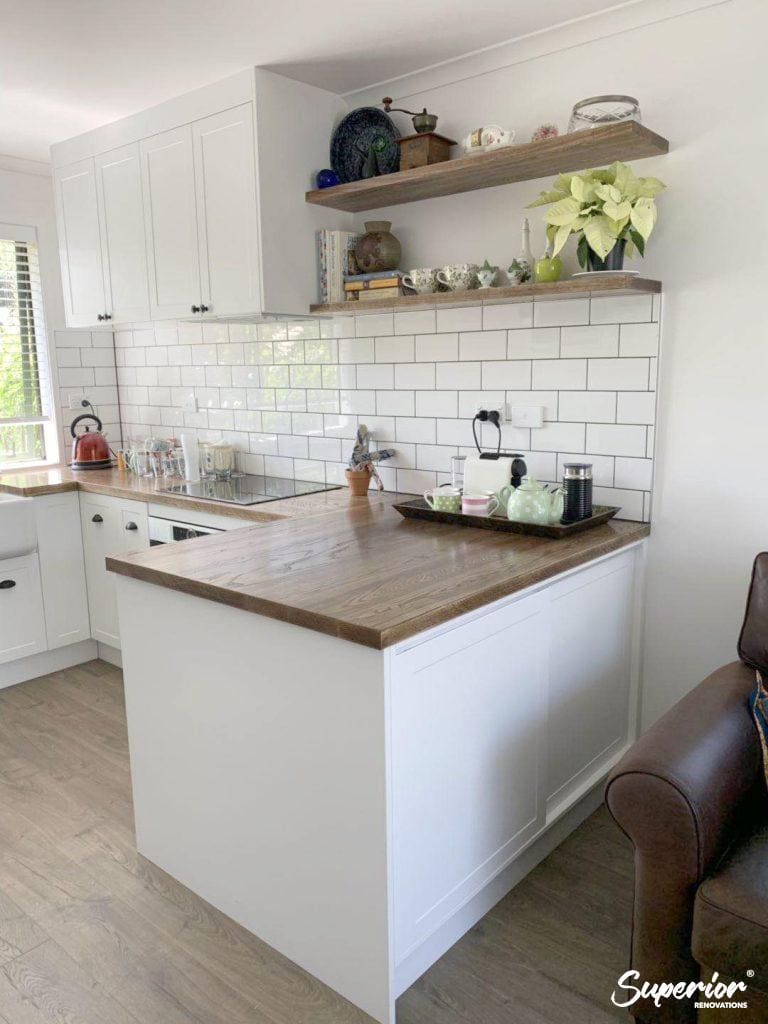
    A peninsula is an island connected at one end. It gives you the extra bench or dining area an island would, in a room that can’t take a standalone one. It works especially well with an L-shaped kitchen. Lynette’s family wanted a breakfast nook but didn’t have room for a central island — so we built a peninsula that gave them the nook without crowding the space.

    Peninsula kitchen with breakfast nook, Bucklands Beach renovation

    A custom peninsula in this Bucklands Beach renovation added bench space and a breakfast nook.

    Project specs for the kitchen above

    3 Peninsula Kitchen Ideas

    Banquette seating on the back: if there’s room, built-in banquette seating fits more people around the table and turns the peninsula into a social spot.
    Open shelving: open shelves keep everyday gear within reach and let more light into the room.
    Light fixtures: pendants over the peninsula brighten the workspace and add visual appeal.

    6. Two-Island Kitchen

    Only an option in a genuinely large kitchen — two islands in the middle with a walkway between. Use one for prep and put a cooktop in the other to make it your cooking zone. Two smaller islands beat one enormous one: more accessible, easier to walk around, better flow overall.


    Featured Kitchen Renovation Projects

    Urban Luxury Kitchen, Parnell — Open-Plan U-Shaped

    This Parnell townhouse had a tiny kitchen with no counter space. We changed the whole layout, moving the kitchen from the left of the room to the right, then added cabinetry in the dining area as extended storage — shelves with internal lights that open when needed. See the before and afters.

    Open-plan U-shaped kitchen renovation, Parnell Parnell kitchen renovation Parnell kitchen renovation

    Entertainer’s Dream, Massey — Modern U-Shaped Open-Plan

    Guru and Neeta had a closed-off kitchen that shut them out of open-plan living. They wanted luxury and an entertaining space. We opened it up and extended the counter toward the lounge to work as a bar. See more.

    Modern U-shaped open-plan kitchen, Massey Massey kitchen renovation Massey kitchen renovation

    Cottage Kitchen, Mangere Bridge — Peninsula

    This one was about natural elements that reflected the client’s country surroundings. A dated kitchen became a chic country-style space — treated real-wood benchtops, a butler’s sink, floating shelves, and cabinetry wrapped in Dezignatek Thermoform with a ‘Ronda’ pattern for a vintage look. See more.

    Cottage-style peninsula kitchen, Mangere Bridge Mangere Bridge kitchen renovation Mangere Bridge kitchen renovation

    Open-Plan Galley, Epsom

    We renovated this historic Epsom bungalow for a young family — durable, easy-clean materials and an open-style galley that lets everyone share one space. See the full project.

    Open-plan galley kitchen, Epsom bungalow Epsom kitchen renovation Epsom kitchen renovation

    Ready to Plan Your Kitchen Layout?

    The layout is the foundation of the whole renovation — worth getting right before a single cabinet is ordered. If you’d like our designers to work through your space, your work triangle and the right layout for how your household cooks, we’d love to help.

    Book your free in-home consultation with Superior Renovations
    Use our kitchen renovation cost calculator to estimate your project
    Request a free feasibility report for your project


    Kitchen Layout FAQ

    What is the best kitchen layout?

    There's no single best kitchen layout — it depends on your room and how you cook. The key is the work triangle: keep your sink, stove and fridge close enough to move between in a few steps, with no through-traffic crossing the middle. For tighter Auckland spaces an L-shaped or galley layout works best; where there's more room, a U-shaped or island layout gives more bench and storage. Plan the layout around your work triangle first, then choose the shape that fits your space.

    What is the kitchen work triangle?

    The work triangle is the path between the three busiest points in a kitchen — the sink, the stove and the fridge. The three legs should total roughly 4 to 8 metres, and nothing (no island, table or main walkway) should cut through the middle. It's the oldest kitchen-planning rule and still the most useful. In modern open-plan kitchens it's often paired with zoning — separate prep, cooking, cleaning and storage areas — to handle more than one cook at once.

    Which kitchen layout is best for a small kitchen?

    For a small Auckland kitchen — an apartment, a unit, or a tight villa space — a galley or L-shaped layout usually works best. A galley uses two parallel walls efficiently for one main cook; an L-shape frees up a corner and pairs well with a small island or peninsula that doubles as dining. Single-wall layouts suit the very smallest footprints. In all of them, build storage vertically with tall cabinetry and wall storage to make up for the smaller footprint.

    What are the standard kitchen measurements?

    Standard bench height is 900mm with a 600mm depth. Allow at least 120cm of clearance in front of appliances for loading, and 100 to 120cm around an island for traffic. Bar-stool seating needs a 30 to 45cm bench overhang, and a kitchen used by two cooks wants 90 to 120cm walkways so people can pass. Getting these few numbers right is usually the difference between a kitchen that flows and one that feels cramped.

    How many kitchen layouts are there?

    There are six main kitchen layouts: galley (two parallel runs), L-shaped (two adjoining walls), U-shaped (three walls), island (a freestanding central bench), peninsula (an island connected at one end), and single-wall (everything on one wall). Most Auckland kitchens are a version of one of these, often combined — for example an L-shaped run with an island, which is the modern take on the U-shaped kitchen.

    Should I put my cooktop on the island?

    You can, but we usually advise against it. A cooktop on an island needs an expensive extraction system to handle steam and smoke, and you lose the splashback that catches splatters — which matters in humid Auckland kitchens where poor ventilation leads to mould. Putting the cooktop on an exterior wall makes ventilation simpler to run and gives you a splashback for free. If you do want it on the island, budget properly for the extraction.

    How much space do you need around a kitchen island?

    Allow 100 to 120cm of clearance on all sides of a kitchen island. Less than that and only one person can work comfortably, and the island's own cabinet doors start colliding with the run behind them. More than 120cm and you're walking too far between zones. If your room can't give you at least a metre around a standalone island, a peninsula — connected at one end — is usually the better call.

    Do you provide a kitchen designer and 3D plans?

    Yes. We have in-house kitchen designers who develop your layout and provide 3D drawings as part of the proposal, so you can see the kitchen before anything is manufactured or installed. We provide a full renovation service — design, demolition, sourcing materials from local supplier showrooms, custom cabinetry, installation, project management, and all trades including electricians, plumbers, tilers, builders and grouters. You don't need to arrange your own tradespeople.

    What's the most popular kitchen layout in NZ?

    The L-shaped kitchen is the most versatile and widely used in New Zealand homes, because it suits small-to-medium spaces and adapts easily to open-plan living when paired with an island. In larger Auckland homes the U-shape and island layouts are popular for the bench space and storage they offer. The strongest current trend is an L-shaped run plus a disconnected island — a modern version of the U-shape that fits the open-plan living most homeowners now want.


    Further Resources for your kitchen renovation

    1. Featured projects and Client stories to see specifications on some of the projects.
    2. Real client stories from Auckland.

    Need more information?

    Take advantage of our FREE Complete Home Renovation Guide (48 pages), whether you’re already renovating or in the process of deciding to renovate, it’s not an easy process, this guide which includes a free 100+ point check list – will help you avoid costly mistakes.

    Download Free Renovation Guide (PDF)


    finance - Superior Renovations

    Have you been putting off getting renovations done?

    We have partnered with Q Mastercard ® to provide you an 18 Month Interest-Free Payment Option, you can enjoy your new home now and stress less.

    Learn More about Interest-Free Payment Options*

    *Lending criteria, fees, terms and conditions apply. Mastercard is a registered trademark and the circles design is a trademark of Mastercard International Incorporated.


    Still have questions unanswered?

    Book a no-obligation consultation with the team at Superior Renovations, we’d love to meet you to discuss your renovation ideas!

      Services

      Home RenovationKitchen RenovationBathroom RenovationOutdoor RenovationHouse ExtensionCommercialDesign ServicesOther

      By submitting this form, you agree to receive communications from us via email or text regarding our services, you can unsubscribe at any time.

      This site is protected by reCAPTCHA and the Google

      Privacy Policy and Terms of Service apply.


      References

      1. Building Performance (MBIE) — Active ventilation
      Screenshot 2024 11 01 155903 - Superior Renovations
      House Renovation, Kitchen Renovation

      Kitchen Planning Measurements NZ | Auckland Designer Guide

      Standard Kitchen Planning Measurements: An Auckland Designer’s Guide to NZ Standards

      Quick answer: Standard NZ kitchen planning measurements start with a 900mm benchtop height, 600mm benchtop depth, 1000–1200mm walkways, and AS/NZS 4386 compliant cabinetry. Get these right before cabinetry is ordered and the kitchen will work for the next 20 years — get them wrong and no amount of stone or tile will fix it.


      kitchen renovation design auckland 2 - Superior Renovations

      Plan a kitchen reno well and you’ll forget the measurements exist. Plan it badly and you’ll be reminded every morning — the dishwasher door clipping the island, the bench just slightly too low for your back, two people trying to pass each other in front of the fridge. Standard kitchen planning measurements aren’t a constraint. They’re what stops the small mistakes that turn an expensive renovation into a daily frustration.

      The trouble with most measurement guides online: they default to American inches, Australian sizing, or generic global standards that don’t quite line up with how kitchens are actually built in New Zealand. We’ve designed and built over 1,000 Auckland kitchens through our Wairau Valley Design Studio, and the dimensions below are what we use as the baseline — anchored to the AS/NZS 4386 cabinetry standard and MBIE Building Code guidance, then adjusted for the housing stock we work in.


      Why Standard Kitchen Measurements Actually Matter

      Standard measurements exist because they work for most people, most of the time. They’re built on ergonomic research, decades of cabinetry industry practice, and the dimensions of every common appliance you might want to install. The Australian/New Zealand cabinetry standard AS/NZS 4386 defines the construction and dimensional baseline most NZ kitchen manufacturers build to.

      Standards do two jobs. They make sure your kitchen plays nicely with off-the-shelf appliances — a 600mm dishwasher slots into a 600mm cabinet without modification. And they make sure the kitchen is comfortable to use for the broadest range of body types and cooking habits.

      Where standards stop being useful is the moment your kitchen is unusual — a 1920s Grey Lynn villa with a 2.4m wide room, a Hobsonville townhouse with an island that needs to anchor an open-plan space, or a homeowner who’s 1.9m tall and tired of leaning over a low bench. That’s when the standards become a starting point and a designer earns their fee.

      💡 Quick tip: Before any cabinet is ordered, stand at your existing bench (or the bench at your friend’s place) and check how it feels for 10 minutes of food prep. If you’re bending or reaching, the standard isn’t your standard — flag it with your designer early.


      Standard Benchtop Height and Depth in NZ Kitchens

      The NZ standard kitchen benchtop height is 900mm from the finished floor. Common range sits between 850mm and 950mm depending on the cook. Most Auckland kitchens default to 900mm because it lines up with off-the-shelf base cabinets, appliance heights, and the assumption of an average-height user.

      Benchtop depth is typically 600mm front-to-back. That gives you a usable prep zone without the bench eating into the walkway behind you. Add a 20–30mm overhang on the front edge and the bench is comfortable to lean against without your toes hitting the cabinet.

      Diagram showing standard NZ kitchen benchtop height of 900mm and depth of 600mm

      The 900mm benchtop height is the NZ default — but it isn’t right for every cook.

      “The 900mm bench is the default, not the answer. We measure our clients during the design consult — taller cooks usually go to 920 or 950mm, and a couple of our clients with back issues have asked for 880mm because they prefer to brace their arms when chopping. The cost difference is nothing. The comfort difference is daily.”
      — Alison Yu, Designer, Superior Renovations

      When to deviate from 900mm

      Two situations call for a non-standard bench height. The first is body type — if you or your partner is taller than 1.85m or shorter than 1.6m, the standard will feel wrong every time you use it. The second is task — a baking-heavy kitchen often benefits from a slightly lower zone (around 850mm) so kneading and rolling doesn’t strain shoulders, while a coffee or cocktail bench can sit higher to keep the work surface at hand height.

      If you’re planning to age in place, BRANZ’s Universal Design guidance recommends a height-adjustable bench in the 620–900mm range — worth a conversation with your designer if accessibility is on the horizon.

      💡 Quick tip: Bench height should be measured from the finished floor — not the subfloor. New flooring (tile, engineered timber, vinyl plank) all add 8–20mm of height, which is why villa renovations in Mt Eden and Ponsonby sometimes end up with a 920mm bench when the spec said 900mm. Get the flooring spec locked before cabinet manufacture.


      Base Cabinet Dimensions and Modular Widths

      Base cabinets carry the weight of the kitchen — drawers, pots, the appliances that sit underneath, and the benchtop above. Their dimensions decide what fits where, and they’re built to a standardised module so the cabinetry industry can manufacture efficiently.

      • Cabinet height (without bench): 870mm typical (with 100–150mm kickboard underneath)
      • Cabinet depth: 560–570mm carcass plus the benchtop overhang gives the 600mm total
      • Common cabinet widths (NZ modular): 300mm, 400mm, 450mm, 600mm, 800mm, 900mm, 1000mm, 1200mm
      • Kickboard (toe-kick) height: 90–150mm — most NZ builders use 100mm

      The 600mm module is doing the most work in your kitchen. It fits the standard dishwasher, the standard under-bench oven, most freestanding cookers, and the most common drawer bank size. When a designer is laying out your kitchen, the 600mm anchor points usually go in first — sink, dishwasher, cooker — and everything else stretches between them.

      💡 Quick tip: NZ-made cabinetry typically allows for 18mm panel thickness on carcasses. If you’re ordering imported flat-pack, double-check — some import lines run at 16mm which can mess with how doors and drawers align against an NZ-spec benchtop edge.


      Upper Cabinets, Wall Storage and Reach Limits

      Upper cabinets do storage without taking floor space — useful in the smaller kitchens you’ll find in older Ponsonby villas, character bungalows in Mt Eden, and apartment kitchens across the city.

      • Height from bench to underside of upper cabinet: 600mm is the working standard (per Bunnings NZ guidance and most NZ cabinetmakers)
      • Upper cabinet depth: 300–350mm — deeper than that and you start ducking when using the bench
      • Top of upper cabinets: typically 2100mm from floor for standard 720mm tall uppers, or run to the ceiling (2400mm+) for extra storage

      The reach limit matters more than the storage volume. Anything above 2000mm needs a step ladder for most people — fine for the Christmas platters, useless for daily use. Plan the contents of each upper cabinet before you finalise the height; the top shelf is for things you touch twice a year, not your everyday glassware.


      Walkway and Clearance Space — The NZ Standard

      This is where most poorly-planned kitchens fall apart. The layout reads fine on a 2D plan. Then the appliances and the people go in, and suddenly the oven door blocks the fridge and you’re sidestepping every time someone wants the kettle.

      • Single-cook walkway: 1000–1100mm minimum between bench and wall, bench and island, or bench and bench
      • Two-cook / busy household walkway: 1200mm minimum — non-negotiable if you regularly cook with another person in the kitchen
      • Accessible kitchen (MBIE G3/AS1): the NZ Building Code accessibility guidance requires a 1500mm manoeuvring space for wheelchair use
      • Appliance door clearance: always check the open dimension, not just the closed cabinet width — a 600mm dishwasher needs 600mm of cabinet plus the door projection in front (around 530mm when open)

      “In open-plan Auckland kitchens — and most of the ones we design now are open-plan — the walkway numbers matter even more than usual. The kitchen isn’t just a kitchen, it’s the corridor between the front door and the lounge. We plan around the traffic flow on a normal Sunday, not a deserted weekday. 1200mm is the minimum we’d set for a family kitchen.”
      — Eunice Qin, Designer, Superior Renovations

      💡 Quick tip: Stand in your existing kitchen and have someone open the dishwasher, the oven, and the fridge all at once. If anyone can’t get past, that’s the walkway problem your new design needs to solve. We’ve taken video on consults — it’s the single fastest way to spot a flow issue.


      Kitchen Island Dimensions for Auckland Homes

      An island is the best feature in a modern kitchen, or the worst — the difference is almost entirely in the dimensions. Get them right and the island anchors the room. Get them wrong and it’s a 1.5m obstacle eating your floor space.

      • Minimum island width: 600mm (the smallest a working island can be)
      • Comfortable working island width: 900–1100mm
      • Island length: 1800–3000mm depending on room size — anything under 1500mm starts to feel pointless
      • Bench overhang for stool seating: 300–400mm from the cabinet face (per Houzz NZ’s kitchen island measurement guidance)
      • Bar stool seat height for a 900mm bench: 600–650mm
      • Bar stool seat height for a raised 1050–1100mm bench: 750–800mm
      • Clearance around the island: 1000–1200mm on every side
      3D kitchen island design showing standard island proportions and overhang for seating

      Island depth, overhang, and surrounding clearances all need to land together — and the room size dictates which one bends first.

      How Auckland housing stock affects island sizing

      The “comfortable” island depends entirely on the room. We’ve worked on Grey Lynn villas with 3m wide kitchens where the right answer was no island at all — a peninsula instead, because the 1200mm clearance just wasn’t possible. We’ve also done Hobsonville townhouses with open-plan ground floors that easily took a 1100 × 2400mm island with seating along one side and a sink along the other. Same family, same budget — completely different island.

      💡 Quick tip: If you want stools on the island, decide whether you want elbows up or down. A flat 900mm island works for breakfast bowls and laptops. A raised 1050–1100mm section works better for drinks, casual chat, and hiding the working bench from the lounge view. Pick before the cabinetry quote — adding a raised section after the fact gets ugly.

      For inspiration on how these proportions play out in completed Auckland projects, browse our Kitchen Design Gallery.


      Appliance Placement and Space Requirements

      Every appliance has its own measurement rules. Get them wrong and you’ll either block the workflow, hit a ventilation problem, or — most painfully — find out at install that the brand-new range doesn’t quite fit the cabinet you’ve already paid for.

      Kitchen appliance placement and clearance diagram for fridge, oven, dishwasher and rangehood

      Appliance clearances stack on top of each other — the fridge door, the oven swing, the dishwasher drop-down all need their own space.

      Fridge

      • Standard freestanding fridge width: 600mm (slim), 700mm (mid), 800–900mm (French door / side-by-side)
      • Cabinet alcove width: add 25–50mm to the fridge width for ventilation
      • Clearance above the fridge: 50mm minimum for heat dissipation
      • Door swing clearance in front: 900mm minimum to open and unload

      Oven and cooktop

      • Standard oven widths: 600mm (most common), 750mm, 900mm
      • Bench either side of the cooktop: 300mm minimum, 450mm preferred — for landing hot pans and prep
      • Cooktop to range hood clearance (electric / induction): 600mm minimum
      • Cooktop to range hood clearance (gas): 650–750mm depending on the hood manufacturer’s spec

      Dishwasher

      • Standard dishwasher width: 600mm (most homes), 450mm (slim/apartment)
      • Distance from sink: within 900mm — keeps the plumbing run sensible and stops dripping plates being walked across the room
      • Door-down clearance in front: 530mm projection — needs walkway space accounted for

      💡 Quick tip: Pick your appliances before the cabinet drawings are finalised, not after. Even within “600mm dishwasher” there’s variation — a Bosch and a Miele can differ by 5mm in height once installed, and that’s enough to leave a visible gap under the benchtop. Send actual model numbers to your designer.


      Sink and Tapware Measurements

      The sink area is the busiest square metre of the kitchen. Position and sizing decide whether the kitchen works for one person rinsing wine glasses or two people prepping dinner.

      • Single bowl sink: 500–600mm wide × 400–500mm deep is the NZ standard
      • Double bowl / 1.5 bowl sink: 800mm wide × 480mm deep is typical
      • Sink depth (bowl): 180–220mm — deeper bowls handle pots without splashing
      • Bench clearance on prep side: 600mm minimum, 900mm preferred
      • Bench clearance on landing side: 450mm minimum
      • Mixer tap spout height above the bench: 250–350mm depending on the tap and your sink depth — taller mixers suit pot filling, shorter ones look cleaner against a window

      If your sink sits in front of a window — and a lot of Auckland kitchens do, especially in character homes facing the back garden — check the mixer doesn’t hit the window frame when the spout swivels. We’ve measured this on consults and found a few clients’ existing taps already bashing the architrave.


      Lighting Heights — Pendants, Downlights, Under-Cabinet

      Bad kitchen lighting is one of those things you don’t notice until you’re trying to chop something at 6pm in winter and squinting at the bench. Three lighting layers do the work in a properly designed kitchen — overhead general light, task light on the working surfaces, and feature pendants over the island or dining bench.

      • Pendant lights over an island: 750–900mm above the bench surface — high enough not to block the view across the kitchen, low enough to cast usable light on the bench
      • Recessed ceiling downlights: 800–1000mm apart, 600mm from any wall, positioned over the front of the bench (not behind it — otherwise you cast a shadow over your own hands while working)
      • Under-cabinet LED strip: mounted at the front edge of the underside of the upper cabinet, aimed across the bench
      • Pendant cord length over a fixed dining bench: 700–800mm above the bench
      Modern kitchen with layered lighting including recessed downlights and under-cabinet LED strip

      Layered lighting — recessed downlights for general light, under-cabinet LED for the bench, and pendant lights as features.

      Kitchen island with pendant lighting hung at standard 750mm above the benchtop

      Pendant lights positioned low over the island — both functional task lighting and a design feature in their own right.

      For more on getting kitchen lighting right, our previous guide on the importance of lighting in achieving a beautiful kitchen design goes deeper.


      Splashback Heights and Wall Coverings

      The splashback is the wall between the bench and the upper cabinets. Two jobs — protect the wall from water, steam, and oil, and add a finish that suits the rest of the kitchen.

      • Standard splashback height: 600mm — matches the standard bench-to-upper-cabinet gap
      • Behind the cooktop: the splashback should extend the full bench-to-rangehood height with no joins — usually 700–900mm depending on hood placement
      • Full-height splashbacks (bench to ceiling): increasingly common in Auckland renos, particularly with engineered stone or large-format tile — easier to clean, fewer grout lines, more contemporary
      • Window-as-splashback: a feature in a lot of villa kitchens — the bench abuts the windowsill, no splashback, which works as long as the trim is waterproof-finished

      Adjusting Standards for Auckland Housing Stock

      The standards above are the starting point. Auckland’s housing mix means most kitchens need at least one adjustment off-standard, and the older the home, the bigger the gap between “what the textbook says” and “what fits”. Here’s what we see across the suburbs.

      Pre-1940s villas (Grey Lynn, Ponsonby, Mt Eden, Herne Bay)

      Original kitchens were often the smallest room in the house — sometimes 2.5 × 3m with a chimney intruding into one wall. Walkway standards still apply, but island ambitions usually need to give way to a peninsula. Ceiling heights are generous (often 3m+), which lets you run tall pantry cabinets up to 2700mm without the room feeling crammed.

      Leaky-era plaster homes (mid-1990s to mid-2000s, widespread)

      Standard sizing usually applies, but recladding work in adjacent walls can change the kitchen footprint mid-project. We’ve had situations where new framing post-reclad shifted the wall position by 40mm and forced a recut on the benchtop. Worth factoring in if you’re combining a kitchen reno with weathertightness work.

      1970s–80s brick-and-tile (South and West Auckland, North Shore)

      Generally a kind house for kitchen renos — generous floor footprints, square rooms, easy access for delivery and trades. Standard measurements apply cleanly. The constraint is usually ceiling height (2.4m) which limits how tall the uppers can run.

      Hobsonville, Flat Bush, Millwater townhouses (post-2010)

      Open-plan ground floors, often with an L-shape kitchen running into a dining-living combined space. Walkway and island standards matter even more here because the kitchen is a circulation space, not just a cooking room. Most of these homes were built with 900mm benches and modular cabinetry already in place — refresh kitchens (replacing doors, benchtop, splashback while keeping the carcasses) often make more financial sense than a full tear-out.

      Apartments (CBD, Takapuna, Newmarket)

      Galley kitchens with 800–900mm walkways are the norm, and body corporate rules often prevent moving plumbing or extraction. Compact appliances (450mm dishwashers, 600mm cooktops) get used heavily here. Pay particular attention to ventilation — many apartment kitchens vent through a shared duct that may need consent before any change.


      How a Designer Catches Measurement Errors Before They Cost You

      Standard measurements give you the language. Catching the errors specific to your house is where a designer earns their keep. We use a three-stage check on every kitchen renovation through the Design Studio — and most of the errors get caught well before any cabinetry is ordered.

      • Site measure: we measure the existing room in person, not just from your drawings. Wall lines in older Auckland homes are rarely square, and a 20mm taper across a 3m run will show up in the finished cabinetry unless it’s planned around.
      • 3D rendered walk-through: a 3D kitchen render lets you see the proportions before manufacture. Walking the camera around the rendered space catches sightline issues (the rangehood looming over the dining table, the pendant lights in the way of the window view) that 2D plans hide.
      • Shop drawings sign-off: the final cabinetmaker drawings list every dimension to the millimetre, every appliance model number, every hinge type. This is the last stop before anything is cut.

      “Measurements are the boring part of design, which is exactly why they’re where renovations go wrong. We’ve inherited kitchens where the previous designer signed off on drawings that listed a 600mm dishwasher cabinet next to a 650mm appliance. By the time it’s at install, you’re spending money to fix what should have been caught at drawings stage. The check is half an hour. The fix is thousands.”
      — Dorothy Li, Design Manager, Superior Renovations

      If you’d like a sense of what the design process looks like end-to-end, our Design Studio page walks through it — or check out our previous guide on top kitchen design ideas for a small kitchen renovation for layout examples that put these measurements to work.

      The measurements above are the baseline most Auckland kitchens are built to, but they’re the start of the conversation — not the end. A 900mm bench is right for most people. A 1200mm walkway works for most households. Where the standards stop being useful is also where the design work properly begins.

      Book your free in-home consultation with Superior Renovations
      Use our kitchen renovation cost calculator
      Request a free feasibility report for your project


      What is the standard kitchen bench height in NZ?

      The NZ standard kitchen bench height is 900mm from the finished floor, with a common range of 850-950mm depending on the cook's height. The AS/NZS 4386 cabinetry standard is built around this 900mm baseline. Taller cooks (over 1.85m) often go to 920-950mm for back comfort, and homeowners planning for accessibility can spec a height-adjustable bench in the 620-900mm range per BRANZ Universal Design guidance.

      How much walkway clearance do I need in an Auckland kitchen?

      Single-cook kitchens need a minimum walkway clearance of 1000-1100mm between bench and wall, bench and island, or bench and bench. Two-cook or family kitchens need 1200mm minimum. Accessible kitchens require 1500mm manoeuvring space per the NZ Building Code G3/AS1 guidance from MBIE. In open-plan Auckland homes where the kitchen is also a corridor, 1200mm is the practical minimum.

      What is the standard benchtop depth in a NZ kitchen?

      The standard NZ kitchen benchtop depth is 600mm front-to-back. This is made up of a 560-570mm cabinet carcass plus a 20-30mm overhang on the front edge. The 600mm depth comfortably fits a standard 600mm appliance like a dishwasher or under-bench oven while leaving a usable prep zone on top. Islands often run deeper at 900-1100mm to accommodate seating overhangs.

      How big should a kitchen island be in a typical Auckland home?

      A working kitchen island should be at least 600mm wide and 1500mm long, with 1800-3000mm length being more common in Auckland homes. For seating overhangs, plan 300-400mm of overhang from the cabinet face and 600-650mm seat height stools for a 900mm island. Allow 1000-1200mm of clearance on every side of the island for walkway flow.

      What is the minimum distance between cooktop and range hood in NZ?

      For electric and induction cooktops, the minimum cooktop-to-rangehood clearance is 600mm. For gas cooktops, the clearance increases to 650-750mm depending on the rangehood manufacturer's specifications. Always check the appliance manual — some high-output gas cooktops require larger clearances, and some sealed gas/induction hybrids have their own specific requirements.

      How high should upper kitchen cabinets be installed above the bench?

      The standard NZ height from benchtop to the underside of upper cabinets is 600mm. This gives enough clearance for benchtop appliances (kettles, mixers, coffee machines) while keeping the upper cabinet contents within reach. Upper cabinets typically run from 1500mm height up to 2100mm for standard 720mm tall units, or up to ceiling height (2400-2700mm) for full-height storage.

      What kitchen cabinet widths are standard in New Zealand?

      Common NZ kitchen cabinet widths follow a modular system: 300mm, 400mm, 450mm, 600mm, 800mm, 900mm, 1000mm and 1200mm. The 600mm module is the most common because it fits standard NZ appliances — dishwashers, single ovens, freestanding cookers. Most NZ-made cabinetry uses 18mm panel thickness on carcasses, which affects how doors and drawers align in the final installation.

      What clearance does a fridge need in an Auckland kitchen?

      A freestanding fridge needs 25-50mm of width clearance in its cabinet alcove for ventilation, 50mm minimum above for heat dissipation, and 900mm of clear floor space in front for the door to swing open and allow loading. French door and side-by-side fridges (800-900mm wide) need extra planning because the doors swing wider than standard hinged fridge doors.

      What is the standard kitchen sink size in NZ?

      NZ standard kitchen sink sizes are 500-600mm wide x 400-500mm deep for a single bowl, or 800mm wide x 480mm deep for a double or 1.5 bowl sink. Bowl depth is typically 180-220mm. Plan for 600mm minimum (900mm preferred) of bench clearance on the prep side of the sink, and 450mm minimum on the landing side. Mixer tap spouts typically project 250-350mm above the bench.

      How high should pendant lights hang above a kitchen island?

      Pendant lights above a kitchen island should hang 750-900mm above the bench surface. This gives enough room not to block sightlines across the kitchen, while casting useful task light onto the bench. For pendants over a fixed dining bench or raised breakfast bar, hang slightly higher at 700-800mm above the bench. The cord or rod can usually be shortened on site to fine-tune the final hang height.

      Do I need to follow the AS/NZS 4386 standard for my kitchen?

      AS/NZS 4386 is the Australian/New Zealand standard for domestic kitchen assemblies and is the baseline most NZ kitchen manufacturers build to. While it isn't a legally enforced building code requirement for a residential kitchen renovation, building to this standard means your kitchen will be compatible with off-the-shelf appliances, will use sensible ergonomic dimensions, and will be easier to repair or refresh in future. Any reputable NZ cabinetmaker will be building to this standard by default.

      Can a designer change the standard measurements to suit my body type?

      Yes — and they should. Standard NZ kitchen measurements are designed for average body types, but a good designer will measure you during the consult and adjust bench heights, cabinet positions, and reach distances to suit. Common adjustments include 920-950mm benches for taller cooks, 850-880mm zones for baking-heavy use, lower upper cabinets for shorter cooks, and full Universal Design specs for ageing-in-place planning. Adjustments are easy at design stage and expensive after manufacture.


      Further Resources for Your Kitchen Renovation

      1. Featured projects and Client stories to see specifications on some of the projects.
      2. Real client stories from Auckland

      Need more information?

      Take advantage of our FREE Complete Home Renovation Guide (48 pages), whether you’re already renovating or in the process of deciding to renovate, it’s not an easy process, this guide which includes a free 100+ point check list – will help you avoid costly mistakes.

      Download Free Renovation Guide (PDF)


      finance - Superior Renovations

      Have you been putting off getting renovations done?

      We have partnered with Q Mastercard ® to provide you an 18 Month Interest-Free Payment Option, you can enjoy your new home now and stress less.

      Learn More about Interest-Free Payment Options*

      *Lending criteria, fees, terms and conditions apply. Mastercard is a registered trademark and the circles design is a trademark of Mastercard International Incorporated.


      Still have questions unanswered?

      Book a no-obligation consultation with the team at Superior Renovations,
      we’d love to meet you to discuss your renovation ideas!

        Services

        Home RenovationKitchen RenovationBathroom RenovationOutdoor RenovationHouse ExtensionCommercialDesign ServicesOther

        By submitting this form, you agree to receive communications from us via email or text regarding our services, you can unsubscribe at any time.

        This site is protected by reCAPTCHA and the Google

        Privacy Policy and Terms of Service apply.


        References

        1. Standards New Zealand — AS/NZS 4386.1:1996 Domestic kitchen assemblies (Kitchen units)
        2. Building Performance (MBIE) — Building Code accessibility guidance: Kitchens
        3. BRANZ Build Magazine — Universal Design Supplement: Kitchens (Issue 168)
        4. Bunnings New Zealand — How to measure up for a new kitchen
        5. Houzz New Zealand — Key measurements for designing the perfect kitchen island
        DSC04095 - Superior Renovations
        Kitchen Renovation

        Open Plan Kitchen NZ: Design, Consent & Cost Guide

        Open Plan Kitchen Ideas, Costs & Consent: The Auckland Guide

        Quick answer: An open plan kitchen joins the kitchen, dining and living into one space. Opening up a closed Auckland kitchen usually means removing a wall, and if it’s load-bearing that triggers a building consent, an engineer’s design and LBP-supervised work, which is where most of the cost and timeline sits.

        The most requested kitchen change we get in Auckland isn’t a fancy benchtop or a smart tap. It’s “can we get rid of this wall?” People want the light in, the cook back in the room, and the boxed-off kitchen gone.

        Fair enough. But here’s the part most open plan kitchen articles skip entirely: whether that wall comes out cleanly or turns into a structural job with an engineer, a consent and a steel beam. That single question decides your cost, your timeline, and whether the project even gets off the ground. So this guide leans into it harder than a lifestyle piece would, alongside the design side, the open-versus-closed comparison, and what it all costs in 2026. It’s put together with our in-house kitchen designers, Cici Zou and Dorothy Li, working from our Design Studio at 16B Link Drive, Wairau Valley.

        KIT 05 01 - Superior Renovations

        Design render by Sachi Amarasekara – Open Kitchen


        What is an Open Plan Kitchen?

        An open plan kitchen combines the kitchen, dining and lounge into one connected space, with no full-height walls dividing the cooking zone from the rest of the room. It’s the layout most new Auckland builds use by default, and the one most renovation clients ask us to create out of an older, closed-off kitchen.

        The appeal is simple. Knock out the wall and a dim back-of-house kitchen borrows light and space from the rooms around it. A villa kitchen in Grey Lynn that felt like a corridor becomes part of the living area. A 1970s brick-and-tile in Manurewa with a separate dining room suddenly reads as one generous space. And because it’s what buyers now expect, the layout tends to support resale value rather than work against it.

        Why the Island Does So Much Heavy Lifting

        Open up a kitchen and you create a problem at the same time: where does the storage and bench that used to live on the missing wall now go? The answer is almost always an island.

        An island claws back the counter and cabinetry you lose when the wall comes out, and it does it in the middle of the room where it’s most reachable. It can carry a sink or a cooktop, double as a breakfast bar, and act as the natural gathering point when people drift into the kitchen. The one rule our designers hold firm on: leave enough clearance around all sides so the island doesn’t choke the traffic between the stove, sink and fridge.

        💡 Quick tip: Keep at least 1000–1100mm of walkway around a single-cook island, and 1200mm if two people cook at once. Tight clearances are the most common regret we hear after the fact. For the full set of numbers, see our kitchen planning measurements guide.

        “When a wall comes out, people fixate on the open space and forget where the storage went. The island has to earn its keep, so I design it to carry the drawers and the prep zone the old wall used to hold, not just look good in the middle of the room.”
        — Dorothy Li, Design Manager, Superior Renovations


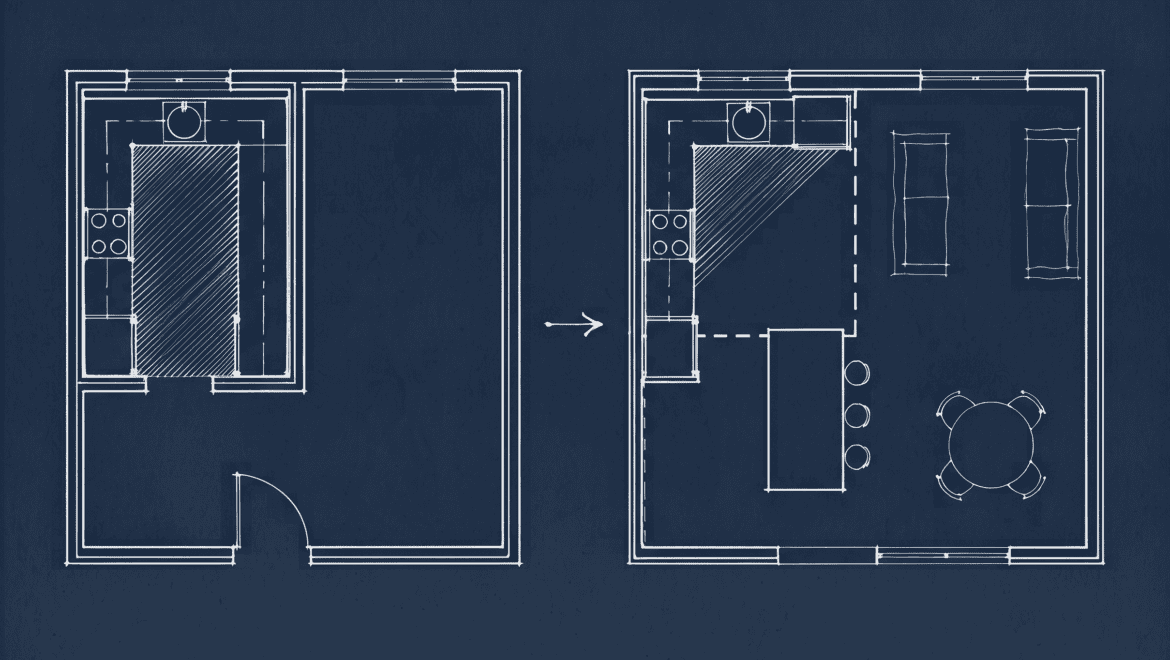
        How to Convert a Closed Kitchen into an Open Plan One

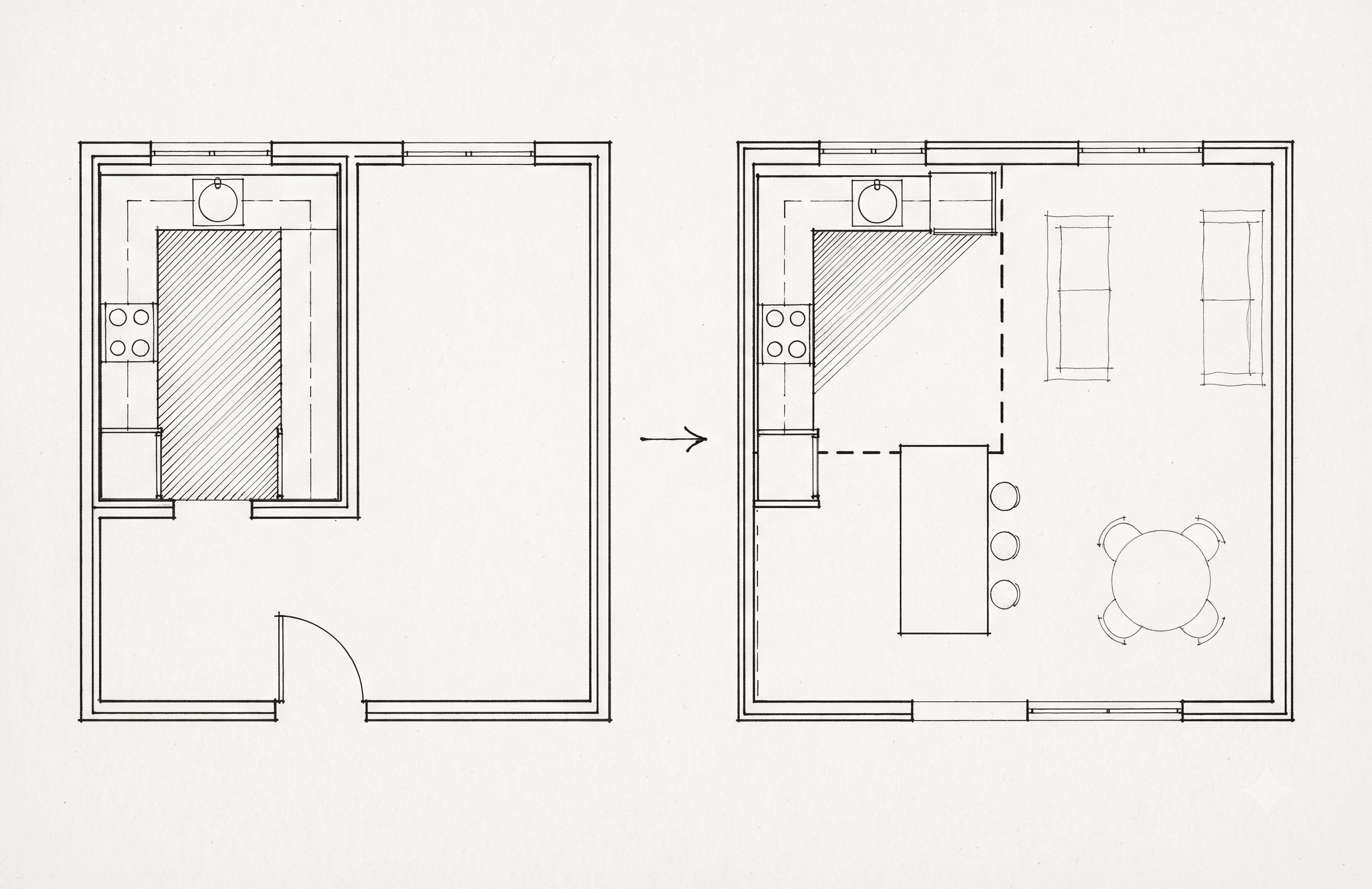
        This is where open plan kitchen projects are won or lost. When someone asks us to open up their kitchen, the very first thing we work out is whether the change is cosmetic or structural, because the two are worlds apart on cost, consent and timeline.

        • Kitchen is already open plan: No structural work. It’s a cabinetry-and-finishes renovation, same as any other kitchen.
        • Kitchen is currently closed off: A wall has to go, which is where engineering, consent and trade coordination come in.

        If a wall is coming out, we ask for the whole-house floor plan first. That tells us which of two very different walls we’re dealing with.

        Partial Walls (Non-Load-Bearing)

        A partial wall carries no structural load. It’s there as a divider, or to frame a doorway. These come out fairly cleanly: the builders remove the wall, then make good the GIB, plaster and paint where it met the floor, ceiling and adjoining walls.

        A non-load-bearing wall can usually be removed without a building consent. The exception worth knowing: consent is still needed if removing it affects fire separation or weathertightness, which can happen in some attached or multi-level homes.

        Structural Walls (Load-Bearing)

        A load-bearing wall carries weight from the structure above, the roof, a second storey, or both. You can’t just take it out. The load has to be picked up by a beam, typically steel or engineered timber, sized by an engineer for the span and the weight above it.

        Removing a load-bearing wall is Restricted Building Work under the Building Act 2004. Before anyone swings a hammer, the job needs a structural engineer’s design, a building consent from Auckland Council, and Licensed Building Practitioner supervision. The MBIE Building Performance rules are clear on this, and the Auckland Council consent process applies whether you like it or not.

        Here’s the quick check we run to tell whether a wall is load-bearing:

        1. Check the whole-house floor plan.
        2. Look for extra support, doubled studs, posts or a thickened section.
        3. See whether the wall runs through more than one level.
        4. Check the joists and beams in the subfloor and roof space, and which way they run.

        None of this is guesswork you should be doing yourself, especially in an older home with no original plans, where the framing is anyone’s guess until the GIB comes off. We talk through trial GIB removal and inspections with clients before committing to a structural approach.

        Important note: If your home has no floor plan on record, budget time and a small cost for investigation before the design is locked. What’s behind the lining changes the engineering, and it’s better found in week one than mid-build.

        Who Carries the Consent Risk

        This is the real difference between hiring a cabinetmaker and hiring a full renovation company to open up your kitchen. We run the consent process for you: our LBP designer produces the consent drawings, we lodge the building consent with Auckland Council, the engineer’s producer statement goes in, and the Records of Work are filed at sign-off. A cabinetmaker isn’t taking on any of that structural or compliance risk, and they’re not meant to. That’s the work behind a clean open plan conversion, and it’s why a closed-to-open job sits in a different bracket to a like-for-like kitchen swap. You can see how we handle the whole sequence on our design-and-build kitchen renovation service.

        “The honest version most people don’t hear: removing a load-bearing wall isn’t the expensive bit, the beam and the engineering are manageable. It’s the consent and the coordination that catch people out when they try to project-manage it themselves. That’s the part we take off your plate.”
        — Cici Zou, Designer (NZ Dip. Interior Design, Certified Designer), Superior Renovations


        What Does It Cost to Open Up a Kitchen in Auckland?

        The cabinetry and finishes of an open plan kitchen sit in the same bands as any kitchen renovation. In Auckland in 2026, a mid-range kitchen renovation runs $28,000–$35,000, a full mid-range build with custom cabinetry and stone tops typically $30,000–$50,000, and luxury or custom kitchens with islands and premium materials $90,000–$138,000+. Auckland labour sits around $120–$150 per hour, which is why prices here run 10–20% above the national average.

        The line that varies most is the wall. As a rough Auckland guide for 2026:

        Wall type What’s involved Typical added cost
        Non-load-bearing (partial) Remove wall, make good GIB, plaster and paint. Usually no consent. $2,000–$6,000
        Load-bearing (structural) Engineer’s design, steel or engineered timber beam, building consent, LBP-supervised install. $8,000–$25,000

        The load-bearing range is wide on purpose. It swings on the span of the opening, the weight sitting above it, and whether you’re under a single storey or a two-storey home, which needs a bigger beam and more temporary propping during the build. To see where your overall project lands, run the numbers through our kitchen renovation cost calculator.

        💡 Quick tip: On timeline, a like-for-like kitchen runs 5–6 weeks, but an open-plan conversion with structural work typically pushes to 6–12 weeks, and if consent is needed, add 4–8 weeks of Auckland Council processing before the build even starts. Factor that into your move-out or living-around-it plan.


        Before and After: A GreenlaneWall Removal

        One simple move, removing a wall, can completely change a kitchen. A good example is a full kitchen transformation we did in Greenlane, Auckland.

        Before

        DSC05804 - Superior Renovations

        After

        renovated kitchen space

        Before the work, the kitchen was congested, dim and short on storage. The core of the renovation was breaking the two partial walls dividing the kitchen from the living space, and removing the counter that had acted as a divider, which freed up room for a proper island. The atmosphere shift after opening it up was significant. Read the full Blockhouse Bay kitchen project.


        Open Plan vs Closed Plan Kitchen: How They Compare

        kitchen renovation design auckland 2 - Superior Renovations

        Design render by Sachi Amarasekara – Open Kitchen

        kitchen renovation design auckland 3 - Superior Renovations

        Design render by Sachi Amarasekara – Open Kitchen


        Not every Auckland home suits an open plan kitchen, and not every homeowner wants one. A closed plan kitchen is shut off from the rest of the house by a wall or a doorway or two. It’s the traditional layout, most common in older properties, though plenty of newer homes still use it.

        Closed plan suits people who want cooking mess and clean-up out of sight, who like privacy while they cook, or who cook daily and elaborately and want a focused, contained space. It’s also the cheaper renovation, because it skips the structural work that opening up a kitchen demands.

        Factor Open plan Closed plan
        Light & sense of space More natural light, feels larger Can feel darker and smaller
        Family & entertaining Cook stays connected to the room Isolated from the action
        Storage Less wall, fewer cabinets More cabinetry and pantry wall
        Noise & cooking smells Travel through the home Contained
        Resale appeal What most buyers now expect Less in demand, suits some buyers
        Renovation cost Higher (wall removal) Lower (no structural work)

        If you’re leaning closed plan but want it lighter, our designers suggest glass-panelled doors to keep light moving between rooms, two-toned cabinetry so the space doesn’t read flat, and a banquette in a corner for a breakfast nook. You don’t have to knock out a wall to make a closed kitchen feel good. For ideas on making a compact closed kitchen work harder, our small kitchen design ideas are worth a read.

        “Closed plan gets written off too quickly. For a busy family that cooks every night and hates a kitchen on permanent display, it’s the better call, and it costs less to renovate. The trick is light: glass doors and a lighter palette stop it feeling boxed in.”
        — Eunice Qin, Designer, Superior Renovations


        The Verdict: Which Layout Do Our Designers Recommend?

        DSC07267 - Superior Renovations


        There’s no universally right answer, and this guide isn’t built to make the choice for you. But for most Auckland homeowners renovating today, the open plan kitchen is what they’re after, and for good reason: light, space, connection, and the layout buyers expect.

        We asked Cici and Dorothy which they’d choose for themselves.

        Cici: “Open plan, for me. I cook a lot and I want to be talking to family while I do it. When I design my own space I think about the future, friends over, kids around, conversations flowing. A big island in an open room does all of that.”

        Dorothy: “Open plan, from a design point of view. It gives you far more to work with, the finishes carry through from the living area, and you get that one big connected space that feels like the heart of the home.”

        If you’re weighing it up for your own home, the fastest way to get clarity is to have a designer look at your actual floor plan and walls. Our team does that in a free in-home consultation, and we’ll tell you straight whether your wall is load-bearing before you fall in love with a layout you can’t easily afford. You can also browse our in-house Design Studio to see how the design-to-build process works.

        Book your free in-home consultation with Superior Renovations
        Estimate your kitchen renovation cost
        Request a free feasibility report for your project


        Is an open plan kitchen worth it in NZ?

        For most Auckland homeowners renovating today, yes. An open plan kitchen brings in natural light, makes a small home feel larger, keeps the cook connected to family and guests, and supports resale value because it's what buyers expect in a modern home. The trade-offs are less storage wall, more visible mess, and the cost of removing a wall, especially if it's load-bearing. It's worth it when you value light and connection and your home suits the change. A closed plan kitchen can be the smarter call if you cook elaborately, want privacy, or are on a tighter budget.

        Do I need building consent to open up my kitchen in Auckland?

        It depends on the wall. Removing a non-load-bearing (partial) wall usually doesn't need consent, though consent is still required if the removal affects fire separation or weathertightness. Removing a load-bearing wall always needs a building consent from Auckland Council, a structural engineer's design, and Licensed Building Practitioner supervision, because it's Restricted Building Work under the Building Act 2004. At Superior Renovations we manage the engineer, the consent application and the LBP sign-off as part of the project, so you don't lodge anything yourself.

        How much does it cost to remove a wall for an open plan kitchen?

        As a rough 2026 Auckland guide, removing a non-load-bearing wall and making good (plaster and paint) typically adds $2,000 to $6,000 to a kitchen renovation. Removing a load-bearing wall, including the structural engineer, a steel or engineered timber beam, the building consent, and LBP-supervised installation, typically adds $8,000 to $25,000 depending on the span, the load carried above, and whether the home is single or double storey. This is on top of the cabinetry, benchtop, appliance and finishing cost of the kitchen itself.

        How much does an open plan kitchen renovation cost in Auckland?

        In Auckland in 2026, a mid-range kitchen renovation runs $28,000 to $35,000. A full mid-range build with custom cabinetry and stone benchtops typically runs $30,000 to $50,000, and luxury or custom kitchens with islands and premium materials range from $90,000 to $138,000 and up. An open plan conversion adds the cost of removing the wall on top of these figures. Auckland labour sits around $120 to $150 per hour, which is why local pricing runs 10 to 20% above the national average.

        Open plan vs closed plan kitchen, which is better?

        Neither is universally better; it depends on your lifestyle. Open plan wins on natural light, sense of space, family connection and resale value, and gives more freedom for islands and seating, but offers less storage wall, less privacy, and costs more because it usually involves removing a wall. Closed plan wins on privacy, cabinetry and storage, contained noise and cooking smells, and a lower renovation cost, but can feel darker and more isolated. Open plan suits entertainers and connected families; closed plan suits keen cooks who want a private space or are renovating on a budget.

        How long does an open plan kitchen conversion take in Auckland?

        A like-for-like kitchen renovation takes about 5 to 6 weeks from the start of demolition. An open plan conversion with structural changes typically runs 6 to 12 weeks, because the beam, propping and engineer-supervised work add stages. If the job needs Auckland Council consent, for example removing a load-bearing wall, add 4 to 8 weeks of consent processing before the build can start. Splashbacks also need separate manufacturing lead time and are installed as a later visit.

        Do you need an extractor fan in an open plan kitchen?

        Yes, we strongly recommend one. With no walls to contain them, cooking smells and steam travel straight into your living and dining areas and linger. A good rangehood or ventilation system, ducted externally where possible rather than recirculating, makes a real difference to how the whole space feels and smells. It's a small line item that clients are always glad they didn't skip.

        Can I put an island in a closed or small kitchen?

        Sometimes, but not always. An island needs clear walkways on all sides, at least 1000 to 1100mm for a single cook, so a narrow closed kitchen usually can't take one without feeling cramped. In a larger closed kitchen it can work well. If the room is too tight, a peninsula attached to one run of cabinetry often gives you the bench and storage benefits of an island without the clearance problem. Our designers can tell you quickly from your floor plan.

        How do I know if my kitchen wall is load-bearing?

        The reliable signs are: the wall runs through more than one level, it sits at right angles to the floor or ceiling joists, or it has extra support like doubled studs or a thickened section. Walls running parallel to the joists are more often non-load-bearing, but this isn't a safe DIY call, especially in older Auckland homes with no original plans. The only certain way is an assessment by a builder or engineer, sometimes after a small section of GIB is removed to see the framing. We check this for clients before any design is locked in.


        Further Resources for your kitchen renovation

        1. Featured projects and Client stories to see specifications on some of the projects.
        2. Real client stories from Auckland

        Need more information?

        Take advantage of our FREE Complete Home Renovation Guide (48 pages), whether you’re already renovating or in the process of deciding to renovate, it’s not an easy process, this guide which includes a free 100+ point check list – will help you avoid costly mistakes.

        Download Free Renovation Guide (PDF)


        finance - Superior Renovations

        Have you been putting off getting renovations done?

        We have partnered with Q Mastercard ® to provide you an 18 Month Interest-Free Payment Option, you can enjoy your new home now and stress less.

        Learn More about Interest-Free Payment Options*

        *Lending criteria, fees, terms and conditions apply. Mastercard is a registered trademark and the circles design is a trademark of Mastercard International Incorporated.


        Still have questions unanswered?

        Book a no-obligation consultation with the team at Superior Renovations, we’d love to meet you to discuss your renovation ideas!

          Services

          Home RenovationKitchen RenovationBathroom RenovationOutdoor RenovationHouse ExtensionCommercialDesign ServicesOther

          By submitting this form, you agree to receive communications from us via email or text regarding our services, you can unsubscribe at any time.

          This site is protected by reCAPTCHA and the Google

          Privacy Policy and Terms of Service apply.

          kitchen renovation design auckland
          Kitchen Renovation

          Stages of a Kitchen Renovation in Auckland (2026)

          Stages of a Kitchen Renovation: What Actually Happens From Start to Finish

          Quick answer: A kitchen renovation in Auckland follows six main stages — consultation, design, pre-construction (including consent if needed), demolition, construction and installation, and final handover. The full process takes 5–6 weeks on site, plus 4–8 weeks of design and manufacturing lead time beforehand.

          Most Auckland homeowners who contact us about a kitchen reno have the same question: “What’s the actual process?” Not the pretty Instagram version. The real one — the part where your house smells like plaster dust, there’s no running water at the sink for three days, and you’re cooking dinner on a camp stove in the garage.

          We’ve renovated hundreds of kitchens across Auckland since 2017, from villas in Grey Lynn with original 1920s sculleries to 1990s brick-and-tile places in Pakuranga where the melamine cabinets have finally given up. Every kitchen project is different in scope, but the stages are remarkably consistent. Knowing what happens at each one — and roughly when — takes most of the stress out of the experience.

          This is the process we follow at Superior Renovations for every kitchen we take on. We’ll walk through each stage in order: what happens, how long it takes, what it costs, and what you should be doing at each point. No fluff. Just the stuff you’ll wish you’d known before demo day.

          One thing worth flagging upfront: we focus on full kitchen renovations — gut-and-rebuild jobs, open-plan conversions, complete layout redesigns. If you’re just swapping a benchtop or putting in a new rangehood, this guide will still be useful for understanding the broader process, but that’s not what our team does day to day.

          Image 20240914141754 - Superior Renovations


          Stage 1 — Consultation and Scope: Getting Clear on What You Want

          This is where everything starts, and it’s the stage most people underestimate. You might think the consultation is just a meet-and-greet. It’s not. A good initial consultation sets the scope, budget range, and feasibility for the entire project — get it wrong here and you’ll pay for it later.

          What Happens During the In-Home Consultation

          At Superior Renovations, the first step is a free in-home consultation. One of our team visits your property, walks through the existing kitchen with you, and talks about what you’re after. We’re looking at a few things:

          The current layout — where’s the sink, the cooktop, the fridge? Is the workflow functional, or are you walking 4 metres every time you need to drain pasta? We’re also looking at structural clues. Older Auckland homes — particularly pre-1960s villas and bungalows in areas like Mt Eden, Kingsland, or Devonport — often have kitchens tucked away at the back of the house with load-bearing walls between the kitchen and living area. That matters because removing a load-bearing wall adds structural engineering, consent, and a steel beam to the project.

          We’ll talk about your wish list, your must-haves, and your budget. Being upfront about budget is the single most useful thing you can do at this stage. If you’ve got $30,000 to spend, we can design a great kitchen. If you’ve got $90,000, we can design a different great kitchen. But we need to know the number to make it work properly.

          💡 Quick tip: Before your consultation, take ten minutes to photograph your current kitchen from each corner. Note down what frustrates you most — it might be lack of bench space, poor lighting, or a layout that blocks traffic flow. These details save time for your designer.

          Setting a Realistic Kitchen Renovation Budget in Auckland

          Based on completed projects in Auckland, here’s where the numbers sit in 2026:

          Renovation Level Typical Cost (NZD + GST) What’s Included
          Budget refresh $15,000–$25,000 Pre-made cabinets, laminate benchtops, no layout changes
          Mid-range full renovation $30,000–$50,000 Custom cabinets, stone benchtops, appliance upgrade, minor layout tweaks
          Luxury / custom $90,000–$138,000+ Premium materials, island bench, smart features, full layout redesign

          Auckland prices typically run 10–20% above the national average, driven by higher labour rates ($120–$150/hour) and compliance costs. Always factor in a 10–15% contingency — especially if your home was built before 1980. You’d be surprised how often we open up a wall in a Pt Chevalier bungalow and find something that wasn’t in the plans.

          For a personalised estimate, try our kitchen renovation cost calculator. It takes less than 60 seconds.

          “The biggest mistake I see is homeowners locking in their heart on a specific look before understanding their budget. If we know the number early, we can steer material choices so the design actually delivers — instead of having to strip things back halfway through.”
          — Alison Yu, Designer, Superior Renovations

          What to Prepare Before Your First Meeting

          Come with a rough budget range, a few photos of kitchens you like (Pinterest, Houzz, Instagram — wherever), and a list of what isn’t working in your current kitchen. If you’ve had any previous building work done on the property, dig out the plans or LIM report. That information speeds up the scoping process significantly.

          After the consultation, we’ll follow up with a written project brief and an indicative cost range. This isn’t a binding quote — it’s a realistic picture of what your project will cost so you can decide whether to move forward into the design stage. No surprises.


          proposal - Superior Renovations


          Stage 2 — Kitchen Design and Material Selection

          This is where your kitchen starts to exist — on screen, at least. The design stage is where every decision gets made that will affect how your kitchen looks, functions, and costs. Changes here are free. Changes once the builders are on site are not.

          Working With a Designer at the Showroom

          Once you’ve committed to moving forward, you’ll work with one of our designers at the Superior Renovations showroom in Wairau Valley (16B Link Drive). This is a hands-on session — you’re looking at actual materials, touching benchtop samples, opening cabinet drawers, and seeing how different handle profiles feel in your hand.

          The designer develops a full kitchen layout based on your consultation brief. This includes cabinet placement, appliance positions, electrical and plumbing points, lighting, storage, and workflow. We generate 3D renders so you can see exactly what the finished kitchen will look like — not a rough sketch, but a realistic visualisation with your chosen colours, materials, and fittings.

          Why does this matter? Because a $2,500 design investment can save you $10,000+ in construction changes. Moving a sink 600mm during the design phase costs nothing. Moving it after the plumber has already roughed-in the pipes costs real money.

          💡 Quick tip: Ask your designer to walk you through the “work triangle” — the path between your sink, cooktop, and fridge. If that triangle is too stretched or too cramped, you’ll feel it every time you cook. A well-designed kitchen makes the 6pm dinner rush feel manageable, not chaotic.

          Choosing Materials That Work for Auckland Conditions

          Material selection sounds straightforward until you’re standing in front of 40 benchtop samples. Here’s the shortcut: think about how your family actually uses the kitchen.

          Benchtops — Engineered stone (brands like Caesarstone or Smartstone) is the most popular choice for mid-range Auckland kitchens. It handles heat, stains, and daily abuse. Laminate (Laminex or Melteca) is the budget-friendly option and looks far better than it did ten years ago.

          Superior Renovations Showroom 8 - Superior RenovationsSuperior Renovations Showroom 15 - Superior RenovationsSuperior Renovations Showroom 16 - Superior Renovations

          Cabinetry — This is the single largest cost item, typically 35–45% of the total budget. Custom cabinets give you control over dimensions, internal fittings, and finish. Pre-made flat-pack options from Mitre 10 or Bunnings work for budget projects but won’t fit irregular wall lines — common in older Auckland homes.

          Splashbacks — Tiled, glass, or acrylic. Tiled splashbacks from suppliers like The Tile Depot offer the widest range of looks. Glass and acrylic require manufacturing lead time (usually 2–3 weeks) and are installed after the main build.

          Appliances and fixtures — Sink, tap, rangehood, oven, cooktop, dishwasher. These need to be selected and ordered during the design stage because their exact dimensions affect the cabinet design. A 900mm rangehood needs a different cabinet opening than a 600mm one. Get this wrong and you’re re-manufacturing cabinetry.

          How Long Does the Design Stage Take?

          Allow 2–4 weeks for design and material selection. Faster if you’re decisive about finishes. Slower if you want to explore multiple layout options or if your project involves structural changes that need architectural input — in which case, we’ll bring in Sonder Architecture for the structural design and consent drawings.

          At the end of this stage, you’ll have a finalised design, a full materials list, and a detailed fixed-price quote with a payment schedule and construction timeline. This is the point where you sign the contract.

          “I always tell clients — spend the time here. Every hour in the design stage saves three hours on site. Once we’ve got the 3D render locked in and the materials ordered, the build phase runs like clockwork.”
          — Dorothy Li, Design Manager, Superior Renovations


          Stage 3 — Pre-Construction: Consent, Manufacturing, and Preparation

          This is the behind-the-scenes stage. You won’t see tradies on site yet, but a lot is happening. The pre-construction phase is where your design gets turned into physical components — and where any council consent gets processed.

          Do You Need a Building Consent for a Kitchen Renovation in Auckland?

          Short answer: probably not — but it depends on your scope.

          Most kitchen renovations that keep the existing layout don’t require Auckland Council building consent. Replacing cabinetry, benchtops, appliances, flooring, and finishes in the same positions falls under exempt work. You’re free to go ahead without a consent application.

          Consent is required if your project involves:

          Removing or altering a load-bearing wall — this is the most common consent trigger in Auckland kitchen renovations, especially open-plan conversions where the kitchen wall comes down to connect with the living/dining area. Relocating plumbing to a new position — moving the sink to an island bench, for example, typically requires consent because it alters the drainage layout. Adding new electrical circuits beyond standard replacements — additional wiring for an induction cooktop or dedicated appliance circuits may trigger consent depending on scope.

          According to Auckland Council’s guidance on kitchen renovations, you can remodel an existing kitchen within the same space without consent — provided you’re leaving the sink in the same position and using authorised tradespeople for plumbing and electrical work.

          If consent is required, our team handles the full application — drawings, structural engineering (via Sonder Architecture), council submission, and follow-up. Auckland Council consent processing currently takes 20 working days for straightforward residential applications, though complex projects can take longer.

          💡 Quick tip: If your project needs consent, don’t wait until the consent is granted to start ordering materials. Your designer can run the material ordering and consent application in parallel — so by the time consent comes through, your cabinetry is already in the manufacturing queue. That saves weeks.

          Cabinet Manufacturing and Material Ordering

          Once the design is signed off and the contract is in place, the project moves to manufacturing. Your cabinetry is booked into the manufacturing schedule, and all materials, hardware, fixtures, and fittings are ordered from suppliers.

          Cabinet manufacturing typically takes 4–6 weeks depending on complexity and the manufacturer’s schedule. Stone benchtops need to be templated after cabinets are installed (they’re cut to fit the actual installed dimensions, not the design drawings), so they arrive separately — usually 1–2 weeks after cabinet installation.

          During this period, your project manager will confirm the construction start date, finalise the build sequence, and coordinate all trades — plumber, electrician, tiler, builder, painter, installer. Everything gets scheduled so each trade arrives at the right time, in the right order.

          Preparing Your Home for the Kitchen Build

          A week or two before demolition, you’ll need to set up a temporary kitchen. This sounds minor, but it makes a real difference to how tolerable the next 5–6 weeks are. Most of our Auckland clients set up a trestle table with a microwave, electric jug, and a portable induction cooktop in the garage, spare room, or dining area.

          Clear the existing kitchen completely before demo day. Everything out of the cabinets, off the shelves, out of the drawers. Appliances disconnected. The demo team works fast — they don’t want to be carefully packing away your grandmother’s china while they’re pulling out cabinetry.


          Stage 4 — Demolition and Site Preparation

          Demo day. This is when the old kitchen comes out. It’s loud, it’s dusty, and it happens fast.

          What Gets Removed During Kitchen Demolition

          Old cabinets, benchtops, splashback, flooring, and appliances are stripped out completely. In a full kitchen renovation, we’re taking everything back to bare walls and floor — sometimes further. If we’re opening up into an adjacent room, the dividing wall comes down at this stage too (with structural support already in place if it’s load-bearing).

          Demolition for a standard kitchen takes 1–2 days. If structural work is involved — steel beams, header installation, foundation adjustments — add another 2–3 days. The demo crew will protect adjacent rooms with dust barriers and floor protection, but fair warning: renovation dust finds its way everywhere. Close bedroom doors and cover furniture in adjacent rooms.

          What Happens After the Old Kitchen is Out

          This is the stage most homeowners don’t think about, and it’s where hidden issues surface. Once the old kitchen is gone, the walls and floor are exposed. In older Auckland homes — particularly anything built before 1970 — we commonly find water damage behind the sink, inadequate electrical wiring, outdated plumbing, or framing that doesn’t meet current code.

          A client in Hillsborough had us renovate their 1960s kitchen last year. Behind the old wall-mounted cabinets, we found the GIB had been nailed directly to the framing with no moisture barrier — the bottom plate was damp and soft. That framing needed replacing before the new kitchen could go in. It added $3,500 and four days to the project. That’s what your contingency budget is for.

          Once the space is cleared and any remedial work is complete:

          Rough-in plumbing — the plumber installs pipework for the new sink position, dishwasher, and any other water connections. All plumbing must be done by an authorised tradesperson under Schedule 1 of the Building Act 2004. Rough-in electrical — the electrician wires new circuits, power points, and lighting positions according to the design plan. If you’re upgrading to an induction cooktop, you’ll need a dedicated circuit. Wall and floor preparation — GIB repair or replacement, plastering, levelling, waterproofing where required.

          💡 Quick tip: If you’re living in the house during the renovation, arrange to be out on demo day and the day after. The noise, dust, and disruption are at their worst during this stage. After that, it settles into a steady build rhythm.


          Stage 5 — Construction, Installation, and Finishing

          This is the main event. The stage where your kitchen gets built.

          Cabinet Installation

          Once the site is prepped and all rough-in work is signed off, cabinet installation begins. Delivery is timed to line up with the installation date — we don’t want cabinetry sitting in your hallway for two weeks getting scratched.

          Installation typically takes 2–3 days for a standard kitchen. The cabinets go in first — base units, wall units, pantry, island bench carcass. Everything is levelled, shimmed, and secured. This has to be precise because the benchtop, splashback, and appliances all reference off the cabinet positions. A cabinet that’s 5mm out will show once the stone benchtop goes on.

          Benchtop Templating and Installation

          If you’ve chosen engineered stone or natural stone, the benchtop supplier comes in after cabinet installation to template. They’ll laser-measure the exact dimensions of your installed cabinets — including sink cutout, cooktop cutout, and any joins. The stone is then cut and polished off-site, which takes 5–10 working days.

          Laminate benchtops are typically manufactured before installation and delivered ready to fit. They go in faster — usually same day as cabinet install or the day after.

          Plumbing, Electrical, and Appliance Fit-Off

          Once the benchtop is in, the final connections happen. The plumber fits the sink and tap, connects the dishwasher, and tests all water connections. The electrician connects the oven, cooktop, rangehood, and any under-cabinet or pendant lighting. This fit-off stage typically takes 1–2 days.

          Appliances need to be on site before the fit-off date. If you’re supplying your own appliances, make sure they’re delivered to your home at least a week before the scheduled fit-off — don’t assume courier timelines will cooperate. We’ve had jobs delayed because a client’s oven was sitting in a warehouse in Hamilton waiting for a delivery slot.

          Splashback, Tiling, Flooring, and Paint

          Splashbacks go in after the benchtop is installed — they sit on top of the bench surface and run up to the wall cabinets. Glass and acrylic splashbacks require manufacturing lead time (ordered earlier in the process) and are installed as a single panel. Tiled splashbacks are laid by a tiler on site — this takes 1–2 days including grouting and drying time.

          Flooring is typically laid after cabinet installation — it runs up to the cabinet bases, and kickboards are fitted last to cover the join. Luxury vinyl plank (LVP) is the most popular flooring choice in Auckland kitchen renovations right now — it’s warm underfoot, water-resistant, and handles heavy traffic. Tiles are the other common option, especially for open-plan spaces where the kitchen floor continues into the living area.

          Painting is the last step inside the kitchen — walls and ceiling get a final coat after all trades have finished. Your painter works around the installed cabinetry, benchtop, and splashback.

          “The order of trades matters more than most people realise. Plumber before cabinets. Cabinets before benchtop. Benchtop before splashback. Painter last. When that sequence gets disrupted — because materials are late, or a trade doesn’t show up on the right day — the whole schedule shifts. That’s why we use a dedicated project manager on every kitchen.”
          — Cici Zou, Designer (NZ Dip. Interior Design, Certified Designer), Superior Renovations

          💡 Quick tip: Don’t choose paint colours until the benchtop and cabinetry are installed. Colours look different against real surfaces than they do on a screen. Grab a few Resene test pots and paint A4-sized swatches on the wall next to your new cabinets — check them in morning light and evening light before committing.


          Stage 6 — Handover, Inspection, and Aftercare

          The finish line. But not quite the way most people picture it.

          The Final Walk-Through

          Before we hand over the kitchen, your project manager walks through the completed space with you. Every element is checked — cabinet doors and drawers (do they open, close, and align properly?), benchtop finish, appliance operation, plumbing (run every tap, flush every connection), electrical (every power point and light switch), splashback joins, flooring, paint.

          This is a detailed inspection, not a casual look. If anything needs attention — a drawer runner that’s slightly stiff, a paint touch-up behind the oven, a silicone bead that isn’t clean — it goes on a snag list and gets sorted before the final sign-off.

          What a Typical Kitchen Renovation Timeline Looks Like

          Here’s the full timeline from first contact to handover, based on a mid-range Auckland kitchen renovation without consent:

          Stage Duration Notes
          Consultation 1–2 weeks In-home visit, project brief, indicative cost range
          Design and material selection 2–4 weeks Showroom sessions, 3D renders, final quote
          Manufacturing and ordering 4–6 weeks Cabinetry manufacture, materials ordered
          Demolition and site prep 3–5 days Strip-out, rough-in plumbing and electrical
          Construction and installation 3–4 weeks Cabinets, benchtop, splashback, flooring, paint
          Handover and inspection 1–2 days Walk-through, snag list, sign-off
          Total (no consent) ~12–16 weeks Add 4–8 weeks if consent required

          Warranties and Aftercare

          Your kitchen renovation is covered by a workmanship guarantee from Superior Renovations, plus individual manufacturer warranties on products, appliances, and fixtures. The cabinetry, benchtop, and splashback all have separate manufacturer warranties — your project manager will hand these over at completion along with care and maintenance instructions.

          If anything comes up after handover — a soft-close hinge that needs adjusting six months later, a question about cleaning stone benchtops — our aftercare team is available. That’s part of the service. We’ve built kitchens across Auckland for years and we want them to stay in great condition.

          For details on how we manage the full renovation experience — from design through to aftercare — see our Our Promise page or read what our clients have to say in their own words.


          How to Get Through a Kitchen Renovation Without Losing Your Mind

          We’ve watched hundreds of Auckland families go through this process. The ones who have the best experience tend to do a few things the same way.

          Accept that the first week is the worst. Demo day is loud and messy. The house feels chaotic. Your temporary kitchen setup is annoying. That’s normal. By week two, the build has a rhythm and you’ll barely notice the crew is there.

          Stay in regular contact with your project manager — not with the tradies directly. The project manager is the single point of communication for a reason: they coordinate everyone, track the schedule, and flag any issues before they become problems. At Superior Renovations, your PM keeps you updated throughout, so you always know what’s happening and what’s next.

          Don’t make design changes once construction starts. Seriously. Moving a power point after the electrician has already wired it adds cost and delays. The design stage exists for exactly this reason — make every decision there, and the build stage runs smoothly.

          And finally — it’s worth it. Every client we’ve worked with says the same thing about three weeks after handover: “I should have done this years ago.”

          Book your free in-home consultation with Superior Renovations
          Try our free kitchen renovation cost calculator
          Request a free feasibility report for your project


          What are the main stages of a kitchen renovation?

          A kitchen renovation follows six main stages: consultation and scoping, design and material selection, pre-construction (consent, manufacturing, ordering), demolition and site preparation, construction and installation, and final handover and inspection. The full process takes approximately 12–16 weeks from first consultation to completion for a standard Auckland kitchen renovation without consent.

          How long does a kitchen renovation take in Auckland?

          A standard kitchen renovation takes 5–6 weeks from demolition day, assuming the design is finalised and cabinetry has been manufactured beforehand. Including the design stage (2–4 weeks) and manufacturing lead time (4–6 weeks), the total process from first consultation to handover is typically 12–16 weeks. If consent is required, add 4–8 weeks for Auckland Council processing.

          How much does a kitchen renovation cost in Auckland in 2026?

          In Auckland in 2026, a budget kitchen refresh starts from $15,000–$25,000. A mid-range full renovation with custom cabinets and stone benchtops runs $30,000–$50,000. Luxury and custom kitchens with premium materials and full layout redesigns range from $90,000 to $138,000+. Auckland prices are typically 10–20% above the national average due to higher labour rates ($120–$150/hour).

          Do I need a building consent for a kitchen renovation in NZ?

          Most kitchen renovations that keep the existing layout do not require Auckland Council building consent. Consent is required if you are removing a load-bearing wall, relocating plumbing to a new position, or making significant electrical changes. According to Auckland Council, you can remodel a kitchen within the same space without consent if the sink stays in the same position and authorised tradespeople do the plumbing and electrical work.

          What is the most expensive part of a kitchen renovation?

          Cabinetry is typically the most expensive component, accounting for 35–45% of the total budget. In a mid-range Auckland kitchen, expect to spend $10,000–$20,000 on cabinetry alone. Other significant costs include stone benchtops ($3,000–$8,000), appliances ($3,000–$10,000+), and labour for plumbing, electrical, and installation trades.

          Can I live in my house during a kitchen renovation?

          Yes — most Auckland homeowners stay in their home during a kitchen renovation. Set up a temporary kitchen with a microwave, electric jug, and portable induction cooktop in the garage, spare room, or dining area. The main disruption is during the first week (demolition). After that, the construction phase is quieter and follows a predictable daily rhythm.

          How do I prepare my kitchen for renovation?

          Empty all cabinets, drawers, and shelves completely before demolition day. Disconnect and remove portable appliances. Set up a temporary kitchen in another room. Close doors to adjacent rooms to limit dust spread. If you have a LIM report or previous building plans for the property, have these available for your project manager.

          What happens if you find problems during demolition?

          It is common to discover hidden issues in older Auckland homes once walls and floors are exposed — water damage, outdated wiring, substandard framing, or asbestos-containing materials. Your renovation company should assess and quote any remedial work before proceeding. This is why a 10–15% contingency budget is recommended for every kitchen renovation.

          Should I use a designer for my kitchen renovation?

          For mid-range to luxury renovations ($30,000+), a professional designer is a worthwhile investment. They optimise layout and storage, create 3D visualisations so you can see the result before construction, recommend materials suited to NZ conditions, and help avoid costly design mistakes. Design fees in Auckland typically run $552–$4,830+ depending on scope.

          How are kitchen renovation payments structured in NZ?

          Most NZ renovation companies use staged payments — a deposit on contract signing, progress payments at key milestones (e.g. after demolition, after cabinet install), and a final payment on handover. At Superior Renovations, your written quote includes a payment schedule and construction timeline so you know exactly what is due and when. Avoid any company asking for more than 30% upfront.

          What is the best time of year to renovate a kitchen in Auckland?

          Kitchen renovations can be done year-round in Auckland since most work is indoors. Autumn (March–May) and late winter (August–September) tend to have shorter wait times for trades and manufacturing slots. Summer is the busiest period — if you want to start in January or February, book your consultation 3–4 months ahead to secure your preferred dates.


          Further Resources for your kitchen renovation

          1. Featured projects and Client stories to see specifications on some of the projects.
          2. Real client stories from Auckland
          3. Browse our kitchen design gallery for completed Auckland projects
          4. Explore our kitchen renovation cost calculator for an instant estimate

          Need more information?

          Take advantage of our FREE Complete Home Renovation Guide (48 pages), whether you’re already renovating or in the process of deciding to renovate, it’s not an easy process, this guide which includes a free 100+ point check list – will help you avoid costly mistakes.

          Download Free Renovation Guide (PDF)


          finance - Superior Renovations

          Have you been putting off getting renovations done?

          We have partnered with Q Mastercard ® to provide you an 18 Month Interest-Free Payment Option, you can enjoy your new home now and stress less.

          Learn More about Interest-Free Payment Options*

          *Lending criteria, fees, terms and conditions apply. Mastercard is a registered trademark and the circles design is a trademark of Mastercard International Incorporated.


          Still have questions unanswered?

          Book a no-obligation consultation with the team at Superior Renovations,
          we’d love to meet you to discuss your renovation ideas!

            Services

            Home RenovationKitchen RenovationBathroom RenovationOutdoor RenovationHouse ExtensionCommercialDesign ServicesOther

            By submitting this form, you agree to receive communications from us via email or text regarding our services, you can unsubscribe at any time.

            This site is protected by reCAPTCHA and the Google

            Privacy Policy and Terms of Service apply.

            DSC07267 - Superior Renovations
            Kitchen Renovation

            Is $10,000 Enough to Renovate a Kitchen in NZ?

            Is $10,000 Enough to Renovate a Kitchen in NZ? (What About $20,000?)

            Quick answer: $10,000 won’t cover a full kitchen renovation in New Zealand — but it can fund a surprisingly effective cosmetic refresh. For a proper renovation with new cabinets, benchtops, and appliances, you’ll need at least $15,000–$25,000. In Auckland, most mid-range kitchen renovations land between $30,000 and $50,000.

            It’s one of the most Googled renovation questions in New Zealand, and the answer isn’t what most people want to hear.

            Ten grand sounds like real money. And it is. But in the world of kitchen renovations — where cabinets alone can eat $5,000–$15,000 and a plumber charges $120–$150 an hour in Auckland — it doesn’t stretch as far as you’d think. A cosmetic kitchen refresh (new paint, handles, tap, and maybe a splashback) can come in under $10,000. A full renovation? That’s a different story.

            We’ve had this conversation with hundreds of Auckland homeowners at our Wairau Valley showroom. Someone walks in with a $10,000 budget, expecting new cabinets and stone benchtops. We’d rather be upfront about what’s realistic than let you burn through your savings on half a job.

            This guide breaks down three budget tiers — $10,000, $20,000, and $30,000+ — so you can see exactly what each one delivers. No fluff. Just real numbers from real Auckland projects.


            DSC07267 - Superior Renovations


            What $10,000 Actually Gets You in a Kitchen Renovation

            Let’s be direct. $10,000 is not enough for a full kitchen renovation in New Zealand. New cabinets, benchtop, appliances, flooring, a plumber, an electrician, and a builder? That runs $15,000 minimum for a small kitchen on basic materials with zero layout changes. In Auckland, $20,000 is more realistic.

            But $10,000 can do a lot if you know where to spend it.

            The $10,000 Cosmetic Refresh — Item by Item

            A cosmetic refresh keeps the existing layout, keeps the existing cabinets (or most of them), and focuses on the surfaces and finishes that make the biggest visual impact. Here’s a realistic Auckland breakdown:

            Item DIY / Budget Option Estimated Cost
            Cabinet painting (professionally sprayed) Spray-coat existing doors $2,000–$4,000
            New handles and hardware Modern pulls from Mitre 10 or Bunnings $150–$500
            New laminate benchtop Laminex range, standard L-shape $1,500–$3,000
            Tile splashback Subway or metro tiles, professionally laid $800–$2,000
            New mixer tap and sink Mid-range from Reece or Bunnings $400–$1,000
            Plumber (tap and sink swap, same position) Licensed plumber, 2–3 hours $300–$500
            New light fixture Under-cabinet LED strip + pendant $300–$800
            Wall paint DIY with Resene or Dulux $150–$400
            Total $5,600–$12,200

            On the lean end — painting cabinets yourself, fitting your own handles, and keeping the splashback simple — you can land under $6,000. Get a professional spray-coat and a decent laminate benchtop from Laminex, and you’re closer to $8,000–$10,000.


            designer kitchen auckland 10 1 - Superior Renovations

            Designer Kitchen By Superior Renovations

            💡 Quick tip: The single biggest visual change you can make under $10,000 is professionally painting or spray-coating your existing cabinets. A dated pine or melamine kitchen from the 1990s can look genuinely modern with a matte charcoal or white spray finish — and it costs a fraction of new cabinetry.

            What a $10,000 Budget Cannot Do

            There are hard limits at this price point. $10,000 won’t cover new cabinetry, new appliances, or any layout changes. Specifically:

            You won’t be replacing cabinets. Even flat-pack cabinets from Mitre 10 for a standard kitchen run $3,000–$7,000 — and that’s before installation, benchtop, and trades. Add a plumber, electrician, and builder, and you’ve already blown past $10,000 before buying a single appliance.

            You won’t be moving the sink, the oven, or the dishwasher. Relocating plumbing in an Auckland home adds $2,000–$10,000 to the job. Moving electrical adds more. At this budget, everything stays where it is.

            You also won’t be replacing appliances — not as part of the renovation, anyway. If your oven is on its last legs, that’s a separate purchase. A decent oven and cooktop package runs $2,000–$5,000 from brands like Fisher & Paykel, Bosch, or Westinghouse.

            “A $10,000 refresh works best when the bones of the kitchen are still solid — structurally sound cabinets, decent layout, no plumbing issues. We’re changing the skin, not the skeleton. That’s where the value sits at this price.”
            — Alison Yu, Designer, Superior Renovations

            When a $10,000 Refresh Makes Sense

            This budget suits a few specific scenarios. If you’re preparing a house for sale and the kitchen is dated but functional, a cosmetic refresh offers the best return without overcapitalising. A $10,000 refresh on a $700,000 home in Hillsborough or Henderson is smart money — a $40,000 renovation on the same property probably isn’t.

            It also works if you’re renovating a rental property, doing a quick pre-tenancy spruce-up, or staging a phase-one upgrade before a larger renovation down the line.

            Where it doesn’t make sense: if the cabinets are water-damaged, the layout is genuinely broken, or you’re dealing with an older Auckland home where the plumbing needs replacing anyway. In that case, spending $10,000 on cosmetics is putting lipstick on a problem.


            What $20,000 Gets You — The Entry Point for a Real Kitchen Renovation

            $20,000 is the realistic starting point for a genuine kitchen renovation in New Zealand — new cabinets, new benchtop, and basic new appliances, provided you keep the existing layout. In Auckland, you’ll need to be disciplined about materials and smart about where you save.

            At this budget, you’re no longer just refreshing surfaces. You’re stripping out the old kitchen and installing something new. But the rules are strict: no layout changes, no structural work, no premium materials.

            The $20,000 Kitchen — What’s Included

            Item Specification Estimated Cost
            Flat-pack or pre-made cabinets Standard sizes, MDF or acrylic panel doors $4,000–$8,000
            Laminate benchtop 30mm laminate, standard L-shape or galley $1,500–$3,000
            Entry-level appliances Oven, cooktop, rangehood (Westinghouse/Bosch) $2,000–$4,000
            Sink and tapware Stainless steel sink, mid-range mixer tap $400–$800
            Tile splashback Ceramic or subway tiles from The Tile Depot $800–$2,000
            Vinyl plank or laminate flooring Budget-friendly, durable for kitchens $500–$1,500
            Plumber Disconnect and reconnect (same positions) $800–$1,500
            Electrician Disconnect, reconnect, new under-cabinet lighting $800–$1,500
            Builder / installer labour Demo, install cabinets, benchtop, finishing $2,000–$4,000
            Paint and finishing Walls and ceiling $300–$600
            Total $13,100–$26,900

            Notice the range. At the lean end — a small galley kitchen in a Papakura townhouse, flat-pack cabinets, basic appliances — you might squeeze in under $15,000. A standard kitchen in a three-bedroom Massey home with better materials? Closer to $22,000–$25,000. In Auckland specifically, $20,000 is the entry point for a basic full renovation — not a generous one.

            DSC02914 - Superior RenovationsHigh End Kitchen Design

            We completed a small kitchen renovation in Greenlane for around $22,000 — smart storage, neutral tones, laminate benchtop, and a tight layout that didn’t need any plumbing changes. It came up well. But the homeowner was realistic about what that budget delivered: clean, modern, and functional — not magazine-feature material.

            💡 Quick tip: The single biggest cost-saver at this budget level is keeping the existing layout. The moment you move a sink or oven, you’re adding $2,000–$10,000 in plumbing and electrical work — and that’s budget you can’t afford to lose when you’re working with $20,000.

            Where to Save (and Where Not To)

            Save on cabinets. Flat-pack from Mitre 10 or Bunnings is genuinely good now — melamine or acrylic panel doors in white or neutral tones look sharp and hold up well. The difference between a $5,000 flat-pack kitchen and a $15,000 custom job is quality and longevity, but at this budget, flat-pack is the right call.

            Save on benchtops. Laminate has come a long way. The Laminex range includes stone-look and timber-look finishes that are genuinely convincing. At $170–$300 per square metre, it’s a fraction of engineered stone ($500–$800/m²).

            Don’t save on trades. In New Zealand, all plumbing and electrical work must be done by licensed professionals — that’s the law, per building.govt.nz. Cutting corners here to save $1,000 can cost you $5,000+ in rework, plus your insurance may not cover unlicensed work. Auckland Council is strict on this.

            Don’t save on the rangehood. It sounds minor, but a cheap recirculating rangehood in an Auckland kitchen — where humidity is already an issue — leads to moisture damage, peeling paint, and mould behind cabinets. Spend the extra $200–$400 on a ducted model if at all possible.

            “I always tell clients at the $20,000 mark — pick two things to do really well and accept basic everywhere else. If the benchtop and handles are beautiful, the whole kitchen lifts. If you try to upgrade everything, you end up with a kitchen where nothing quite feels right.”
            — Cici Zou, Designer (NZ Dip. Interior Design), Superior Renovations

            The $20,000 Trap: When It’s Not Enough

            Here’s where homeowners get caught. They budget $20,000, start the renovation, and discover the framing behind the old cabinets is damp. Or the electrician finds wiring that doesn’t meet current standards. Or the floor underneath is uneven and needs levelling before new vinyl goes down.

            Older Auckland homes — especially 1970s–80s brick-and-tile in suburbs like Mt Roskill, Mangere, and Manurewa — are particularly prone to hidden surprises. Pre-1940s villas in Grey Lynn or Ponsonby can throw up issues too: outdated plumbing, single-skin walls, asbestos in textured ceilings.

            The standard advice is to add a 10–15% contingency to your budget. On $20,000, that’s $2,000–$3,000 set aside for the unexpected. If nothing goes wrong, you keep it. If something does, you’re not scrambling for a personal loan mid-build.

            Important note: If your Auckland home was built before 2000, consider budgeting for a pre-renovation inspection ($500–$1,000). It can flag asbestos, outdated wiring, or hidden moisture before you commit to a build — and potentially save you thousands.

            Want to see how your specific kitchen stacks up? Try our free kitchen renovation cost calculator — it gives you a tailored estimate based on your kitchen size, materials, and scope.


            The Real Cost of a Mid-Range Kitchen Renovation in Auckland

            So if $10,000 gets you a refresh and $20,000 gets you a basic renovation, what does a proper mid-range kitchen renovation actually cost?

            In Auckland in 2026, a mid-range kitchen renovation — custom cabinets, stone or engineered benchtops, good appliances, minor layout tweaks — runs between $30,000 and $50,000 + GST. The national average sits lower, around $28,000–$35,000, but Auckland’s labour rates ($120–$150/hour) and material demand push costs 10–20% higher than the rest of the country.

            That figure comes from completed projects, not guesswork. We’ve renovated kitchens across Auckland from Avondale ($95,000 for a large modern build) to Greenlane ($22,000 for a compact refresh) — and the most common spend for a standard three-bedroom home lands between $30,000 and $45,000.

            What You Get at $30,000–$50,000

            This is the budget where a kitchen starts to feel designed, not just assembled. At this level, you’re typically getting:

            Component Mid-Range Specification
            Cabinets Custom-made to fit your space, soft-close hinges, quality MDF or acrylic panel doors
            Benchtop Engineered stone (e.g., caesarstone or equivalent) — $3,000–$6,000
            Appliances Mid-tier brands — Fisher & Paykel, SMEG, Bosch — $4,000–$8,000
            Splashback Porcelain tiles or glass — from The Tile Depot or similar
            Flooring Quality vinyl plank or porcelain tiles ($100–$200/m²)
            Layout changes Minor — repositioning an appliance or adding a breakfast bar
            Design Professional 3D design, material selection, project management
            All trades Builder, plumber, electrician, tiler — all licensed and managed

            This is the sweet spot for most Auckland homeowners. You’re getting a kitchen that looks and functions well, uses materials that’ll last 15–20 years, and is built by professionals who handle everything from design to handover. It’s also the tier where renovation companies like us add the most value — managing the build, coordinating trades, and catching problems before they become expensive.

            west harbour kitchen design


            For inspiration on what this budget delivers in practice, have a look at our kitchen design gallery — it includes projects at various price points from across Auckland.

            Why the Jump from $20,000 to $30,000 Is Worth It

            The gap between a $20,000 kitchen and a $30,000 kitchen is bigger than the numbers suggest.

            At $20,000, you’re typically assembling flat-pack cabinets, accepting laminate surfaces, and coordinating trades yourself. At $30,000+, you’re getting custom cabinetry built to your exact dimensions, professional design input, a project manager keeping everything on track, and materials that genuinely last.

            A well-renovated kitchen can recoup 50–80% of its cost in added property value — and mid-range renovations tend to deliver the best return without overcapitalising. For a $1 million home in a suburb like Meadowbank or Westmere, a $35,000–$45,000 kitchen renovation is well within the 5–10% of property value guideline that most property experts recommend.

            We work with our in-house design team to make sure every dollar in a mid-range budget pulls its weight. Dorothy Li, our Design Manager, will tell you that 80% of the impact in a kitchen comes from the cabinets and benchtop — get those right, and the rest follows.

            💡 Quick tip: If you’re torn between a $20,000 DIY-managed renovation and a $30,000 professionally managed one, consider the time cost. Managing trades, ordering materials, and troubleshooting problems yourself can take 40–80 hours of your time. If you value your time at even $50/hour, the “saving” disappears fast.

            How to Decide Which Budget Is Right for You

            Here’s a simple framework we use with our clients:

            Your Situation Recommended Budget Approach
            Selling soon, kitchen is dated but functional $5,000–$10,000 Cosmetic refresh — paint, handles, benchtop, splashback
            Rental property spruce-up $8,000–$15,000 Basic renovation with durable, low-maintenance materials
            First home, tight budget, kitchen is unusable $18,000–$25,000 Full basic renovation, same layout, pre-made cabinets
            Family home, want it done properly $30,000–$50,000 Mid-range renovation with professional design and build
            Forever home, premium result $50,000–$100,000+ Custom design, premium materials, layout changes

            The honest answer? Most Auckland homeowners who come to us end up in the $30,000–$45,000 range. That’s where the balance between cost, quality, and longevity sits. If you’ve only got $10,000–$20,000 right now, a cosmetic refresh or phased approach might make more sense than trying to stretch a tight budget across a full renovation.


            Smart Strategies for Stretching a Tight Kitchen Budget

            If you’re working with $10,000 or $20,000 and determined to make the most of it, here are the strategies that actually work — not the generic “shop around” advice you’ll find everywhere else.

            Phase Your Renovation

            The smartest move for a tight budget is staging the work over two phases. Phase one (now): cosmetic refresh for $8,000–$10,000 — spray-coat the cabinets, new benchtop, new handles, fresh splashback. Phase two (12–18 months later): replace appliances, upgrade lighting, add better storage solutions.

            This way, you get an immediate visual transformation and spread the cost over time. We’ve seen homeowners in Takapuna and Albany do this effectively — phase one makes the kitchen liveable and attractive, phase two finishes the job when the budget allows.

            Do the Right Things Yourself (and Nothing Else)

            DIY saves money only on the tasks where your mistakes won’t cost more to fix than the professional would have charged. Safe DIY territory: painting walls, installing handles, removing old splashback tiles (carefully), and laying vinyl plank flooring if you’ve done it before.

            Leave the plumbing, electrical, and cabinet installation to licensed professionals. In New Zealand, unlicensed plumbing and electrical work is illegal — and in Auckland, the council takes compliance seriously. A botched plumbing job can void your insurance and create moisture problems that cost far more than the $800 you saved.

            Buy Smart, Not Cheap

            There’s a difference. Cheap is a $1,200 rangehood that breaks in 18 months. Smart is buying a mid-range Fisher & Paykel model during a seasonal sale at Bunnings or Noel Leeming and saving 20–30% without sacrificing quality.

            Watch for end-of-line appliance sales, ex-display kitchen packages from Mitre 10, and clearance benchtop offcuts from suppliers. The Tile Depot often has run-out stock at significant discounts — perfect for a splashback when you’re not fussy about having this season’s trend tile.

            modern kitchen design

            Consider Finance to Bridge the Gap

            If you’ve got $20,000 saved but the kitchen really needs a $30,000 renovation, stretching the budget with finance can make sense — provided the terms work for you. We’ve partnered with Q Mastercard to offer 18 months interest-free on renovation projects. That means the difference between a $20,000 basic job and a $30,000 mid-range result could be as little as $550 a month interest-free.

            Not everyone wants to take on debt for a kitchen, and that’s fair. But if the alternative is spending $20,000 on a kitchen you’re not happy with — and then spending another $20,000 to redo it in five years — the maths works out better doing it once, properly.

            💡 Quick tip: Before committing to any budget, get a free quote from a renovation company. The number in your head and the number on the quote are often different — sometimes higher, sometimes lower. We offer free in-home consultations specifically so you can make decisions based on real figures, not guesswork.


            The Bottom Line on Budget Kitchen Renovations in New Zealand

            $10,000 is not enough for a kitchen renovation. It is enough for a kitchen transformation — if you focus on the right things and accept the limits of a cosmetic refresh.

            $20,000 gets you into genuine renovation territory: new cabinets, benchtop, and appliances in a small-to-medium kitchen with no layout changes. It’s tight in Auckland, but doable.

            $30,000–$50,000 is where most Auckland homeowners end up — and where the value proposition is strongest. You get professional design, quality materials, managed trades, and a result that lasts 15–20 years.

            The worst thing you can do is start a renovation you can’t finish. If $10,000 is your budget right now, do a smart cosmetic refresh and plan phase two for later. If $20,000 is your ceiling, be disciplined about keeping the layout and choosing materials wisely. And if you can stretch to $30,000+, you’ll get a kitchen that genuinely changes how you live in your home.

            Whatever your budget, we’re happy to talk it through. No pressure, no obligation — just straight answers about what your money will deliver.

            Book your free in-home consultation with Superior Renovations
            Get an instant kitchen renovation cost estimate with our free calculator
            Request a free feasibility report for your project


            Is $10,000 enough to renovate a kitchen in New Zealand?

            Not for a full renovation — but it's enough for a cosmetic refresh. For $10,000 you can professionally paint or spray-coat existing cabinets, replace the benchtop with laminate, install new handles, add a tile splashback, and update the mixer tap. You'll need to keep the existing layout and cabinets. A full kitchen renovation with new cabinets and appliances starts from $15,000–$25,000 in NZ.

            Can I renovate my kitchen for $20,000 in Auckland?

            Yes, but it's the entry-level for a genuine renovation. $20,000 covers new flat-pack cabinets, a laminate benchtop, entry-level appliances, basic flooring, and trade labour — provided you keep the existing layout. In Auckland, labour costs run $120–$150/hour, so this budget is tighter than in regional NZ. Add 10–15% contingency for unexpected issues, especially in older homes.

            What is the cheapest way to update a kitchen in NZ?

            The cheapest effective update is a cosmetic refresh for $5,000–$10,000: spray-paint existing cabinets ($2,000–$4,000), install new handles ($150–$500), replace the benchtop with laminate ($1,500–$3,000), and add a fresh splashback ($800–$2,000). Painting walls yourself saves another $300–$500 in labour. Keep everything in the same position to avoid plumbing and electrical costs.

            How much does a mid-range kitchen renovation cost in Auckland?

            In Auckland in 2026, a mid-range kitchen renovation costs between $30,000 and $50,000 + GST. This includes custom cabinets, engineered stone benchtops, mid-tier appliances (Fisher & Paykel, SMEG, Bosch), professional design, and all trades managed. Auckland averages 10–20% higher than the national average of $28,000–$35,000 due to higher labour rates and material demand.

            Do I need a building consent for a kitchen renovation in Auckland?

            Most kitchen renovations don't require consent — replacing cabinets, benchtop, appliances, and finishes in the same layout is typically exempt. Consent is required if you're removing load-bearing walls, relocating plumbing to a new position, or making structural changes. If you're unsure, Auckland Council or your renovation company can assess your specific situation during a consultation.

            How long does a kitchen renovation take in Auckland?

            A standard kitchen renovation takes 5–6 weeks from demolition to handover, assuming the design is finalised and materials are on-site before work starts. A basic cosmetic refresh can be done in 1–2 weeks. More complex projects with structural changes or open-plan conversions take 6–12 weeks. If consent is required, add 4–8 weeks for Auckland Council processing.

            Should I renovate my kitchen before selling my house?

            It depends on the scope. A cosmetic refresh ($5,000–$10,000) almost always pays for itself in buyer appeal — a dated kitchen is one of the top reasons Auckland homes sell below expectations. A full renovation makes sense only if the kitchen is genuinely broken or the property value supports it. As a rule, keep renovation spend under 10–15% of your property's value to avoid overcapitalising.

            Can I do a kitchen renovation in stages to save money?

            Yes — phasing is one of the smartest strategies for tight budgets. Phase one ($8,000–$10,000): cosmetic refresh with painted cabinets, new benchtop and splashback. Phase two (12–18 months later): new appliances, lighting, and storage upgrades. This gives you an immediate visual improvement while spreading costs. Many Auckland homeowners use this approach successfully.

            What are the hidden costs of a kitchen renovation in NZ?

            Common hidden costs include: asbestos removal ($1,000–$5,000 in pre-2000 homes), outdated plumbing or wiring that needs upgrading ($1,000–$3,000), floor levelling before new flooring ($500–$1,500), and Auckland Council consent fees if structural work is involved ($500–$2,000). Budget a 10–15% contingency to cover surprises — especially in older Auckland villas and brick-and-tile homes.

            Is it cheaper to renovate or replace a kitchen in NZ?

            A cosmetic renovation (repainting cabinets, new benchtop, new handles) costs $5,000–$10,000 versus $15,000–$25,000+ for a full replacement with new cabinets. Renovation makes sense if cabinets are structurally sound. Replacement is better if cabinets are water-damaged, warped, or the layout genuinely doesn't work. A renovation company can assess which approach gives you the best value.

            How much does it cost to paint kitchen cabinets in NZ?

            Professional spray-coating of existing kitchen cabinet doors in NZ costs between $2,000 and $4,000 for a standard kitchen, depending on the number of doors and finish quality. DIY painting is cheaper ($200–$500 in materials) but rarely achieves the same factory-smooth finish. Spray-coating is one of the highest-impact, lowest-cost kitchen upgrades available.

            What is the average kitchen renovation cost per square metre in NZ?

            Kitchen renovation costs in NZ range from approximately $1,500 to $4,200 per square metre depending on materials and scope. In Auckland specifically, expect $2,500–$4,000/m² for a mid-range renovation. A standard 10–12m² kitchen at mid-range specification would cost $30,000–$50,000. Smaller kitchens (8–9m²) can come in at $20,000–$30,000 with basic materials.


            Further Resources for your kitchen renovation

            1. Featured projects and Client stories to see specifications on some of the projects.
            2. Real client stories from Auckland

            Need more information?

            Take advantage of our FREE Complete Home Renovation Guide (48 pages), whether you’re already renovating or in the process of deciding to renovate, it’s not an easy process, this guide which includes a free 100+ point check list – will help you avoid costly mistakes.

            Download Free Renovation Guide (PDF)


            finance - Superior Renovations

            Have you been putting off getting renovations done?

            We have partnered with Q Mastercard ® to provide you an 18 Month Interest-Free Payment Option, you can enjoy your new home now and stress less.

            Learn More about Interest-Free Payment Options*

            *Lending criteria, fees, terms and conditions apply. Mastercard is a registered trademark and the circles design is a trademark of Mastercard International Incorporated.


            Still have questions unanswered?

            Book a no-obligation consultation with the team at Superior Renovations,
            we’d love to meet you to discuss your renovation ideas!

              Services

              Home RenovationKitchen RenovationBathroom RenovationOutdoor RenovationHouse ExtensionCommercialDesign ServicesOther

              By submitting this form, you agree to receive communications from us via email or text regarding our services, you can unsubscribe at any time.

              This site is protected by reCAPTCHA and the Google

              Privacy Policy and Terms of Service apply.

              KIT 02 VIEW 1 - Superior Renovations
              Kitchen Renovation

              Kitchen Renovation Cost NZ 2026 — Real Auckland Prices

              How Much Does a Kitchen Renovation Cost in NZ in 2026?

              Quick answer: A mid-range kitchen renovation in New Zealand costs between $26,000 and $35,000 + GST in 2026. In Auckland, that figure runs 10–20% higher — expect $30,000–$50,000 for a 10–12m² kitchen with custom cabinets, stone benchtops, and quality appliances. Basic refreshes start from $15,000; luxury custom builds reach $138,000+.

              Construction costs across New Zealand are climbing again. The Cotality Cordell Construction Cost Index for Q1 2026 recorded a 1.0% quarterly increase — the strongest in two and a half years — with annual growth hitting 3.0%. Structural timber is up 5.2%, cladding 5.0%, and concrete 4.5%. For Auckland homeowners thinking about a kitchen renovation, the message is straightforward: prices aren’t dropping, and the sector is getting busier.

              That doesn’t mean you need to rush. But it does mean the numbers in this guide are real, current, and based on completed Auckland projects — not estimates pulled from a national average that doesn’t reflect what happens on the ground in Grey Lynn, Henderson, or Remuera.

              We’ve renovated kitchens across Auckland since 2017. A compact Greenlane kitchen for $22,000. A rustic Stanmore Bay build at $85,000. A full modern overhaul in Avondale for $95,000. The range is wide because every kitchen is different — size, layout, materials, and whether you’re touching the plumbing all shift the final number significantly.

              This guide breaks down every cost component: cabinets, benchtops, flooring, splashbacks, appliances, labour, consents, and design fees. We’ve included real per-square-metre figures, Auckland-specific pricing, and actual project examples so you can see what your budget will deliver — not what a brochure promises.

              If you want a quick ballpark before reading further, try our Kitchen Renovation Cost Calculator — takes under 60 seconds.

              Modern kitchen renovation in Auckland by Superior Renovations — stone benchtops with custom cabinetry


              1. Average Kitchen Renovation Cost in NZ in 2026

              The average cost of a kitchen renovation in New Zealand sits at approximately $28,908 + GST — but that figure hides more than it reveals. It blends basic cabinet refreshes with full custom rebuilds, small galley kitchens with open-plan entertainer’s spaces. What matters is where your project sits on the spectrum.

              Kitchen Renovation Cost Snapshot: 2026

              Cost Category Minimum Average Maximum
              NZ National Range $16,832 + GST $28,908 + GST $173,880 + GST
              Typical Budget Range $25,664 – $31,256 + GST
              Auckland Mid-Range $30,000 $40,000 $50,000+
              Per Square Metre (Auckland) $2,500 – $4,000

              Why is Auckland more expensive? Two reasons. Labour rates run $120–$150/hour here versus $80–$120 elsewhere in NZ. And Auckland Council consent processing, when required, adds both cost ($2,500–$6,500) and time (1–5 months) that homeowners in smaller centres often avoid.

              💡 Quick tip: Your reason for renovating shapes the right budget. Renovating to sell? Stick to mid-range materials with broad appeal. Renovating to stay? Spend on quality products that will hold up and remain enjoyable for years — not just look good in listing photos.

              Auckland vs Regional NZ: What the Same Kitchen Costs

              The same 10m² kitchen with custom cabinets and a stone benchtop:

              Location Specification Cost
              Auckland Custom cabinets, stone benchtop, $120/hr labour $35,000
              Christchurch Same spec, $90/hr labour, local materials $28,000
              Rural NZ Pre-made cabinets, laminate, lower labour rates $25,000

              Setting a budget without accounting for your location is one of the most common planning mistakes Auckland homeowners make. A quote from a Christchurch-based website won’t reflect what you’ll pay in Ponsonby or Albany.


              2. What Drives Kitchen Renovation Costs in NZ

              Understanding where the money actually goes is the first step to controlling it. On a typical kitchen renovation budget of $28,908 + GST, here’s how the spend breaks down:

              Budget Breakdown by Category

              Item Budget % Average Cost (NZD + GST)
              Cabinetry 28% $9,039
              Installation & Labour 18% $5,695
              Appliances 15% $4,678
              Benchtops & Splashback 11% $3,381
              Flooring 7% $2,271
              Lighting 5% $1,449
              Painting 5% $1,587
              Windows & Doors 4% $1,408
              Designer Fees 3% $994
              Plumbing 3% $1,007
              Other (permits, misc) 1% $428

              Costs are approximate and exclude GST. Prices run higher in Auckland.

              The Five Biggest Cost Levers

              Cabinetry takes 28% of the budget — it’s the single biggest line item and the one with the widest price range. Pre-made cabinets from a supplier like Mitre 10 or Bunnings run $3,000–$7,000. Custom joinery in solid timber or matte lacquer finishes from a manufacturer like Little Giant Interiors starts from $10,000 and can reach $20,000+ for a full kitchen.

              Layout changes are the second biggest variable. Keeping the existing plumbing and electrical positions saves $2,000–$10,000. That’s not a small number. In older Auckland homes — the 1920s villas in Mt Eden, the 1960s brick-and-tile in Papatoetoe — opening up walls or relocating a sink often means dealing with outdated wiring, galvanised pipes, or framing that needs attention once exposed. The plumber doesn’t just move a pipe; they fix what they find behind the wall.

              Benchtop material creates a dramatic cost difference on a relatively small surface area. Laminate runs $200–$500 per square metre. Engineered stone or granite runs $500–$1,200/m². On a 3m² benchtop, that’s the difference between $600 and $3,600. Both look good. One lasts longer.

              Appliances swing from $2,000 for a basic oven, hob, and rangehood package to $20,000+ for integrated smart appliances. Most Auckland homeowners land somewhere in the $5,000–$10,000 range for a quality mid-range set.

              Labour rates in Auckland sit at $120–$150/hour. A full renovation typically requires 50–100 hours across multiple trades — that’s $4,000–$15,000 in labour before materials are factored in.

              “The biggest budget blowouts we see aren’t from expensive taste — they’re from homeowners who didn’t plan their layout decisions properly upfront. Moving a sink two metres in a Remuera villa can cost more than the benchtop itself.”
              — Alison Yu, Designer, Superior Renovations

              💡 Quick tip: If your budget is tight, keep the existing layout and spend the savings on better materials. A kitchen with quality benchtops and smart storage in the same footprint will outperform a cheap kitchen in a new layout every time.


              3. Kitchen Renovation Cost per Square Metre in NZ

              Per-square-metre pricing gives you the quickest way to ballpark your renovation cost against your kitchen’s actual size. Auckland homeowners spend an average of $2,300 per square metre on kitchen renovations in 2026, but that figure shifts with scope — from $1,533/m² for a basic refresh to $4,167/m² for a high-end custom build.

              Cost per Square Metre by Tier

              Tier Cost per m² 10m² Kitchen 15m² Kitchen
              Basic $1,533–$2,000 $15,330–$20,000 $23,000–$30,000
              Mid-Range $2,000–$3,000 $20,000–$30,000 $30,000–$45,000
              Luxury $3,000–$4,167+ $30,000–$41,670+ $45,000–$62,500+

              Costs exclude GST and vary by region — Auckland runs higher due to labour rates.

              What Pushes the Per-Square-Metre Cost Up

              Minor updates — a new splashback, fresh paint, retained layout — sit around $1,500/m². Full demolition and custom rebuild pushes toward $3,000–$4,000/m². The biggest variable within the per-metre figure is materials: laminate benchtops at $200/m² versus engineered stone at $800–$1,200/m², vinyl flooring at $50/m² versus hardwood at $200/m², pre-made cabinetry at $300/m² of kitchen space versus custom at $800/m²+.

              Keeping the existing layout saves $200–$500/m² on plumbing and electrical alone. Adding an island or relocating a sink adds $300–$1,000/m².

              Location matters too. Auckland runs $2,500–$4,000/m² due to higher labour and material transport. Regional Canterbury sits at $1,800–$3,000/m².

              💡 Quick tip: Industry guidance suggests spending 5–15% of your property’s value on the kitchen. For a $1,000,000 Auckland home, that’s $50,000–$150,000. For a $500,000 home, $25,000–$75,000. Stay within this range and you’re unlikely to overcapitalise.


              4. Basic, Mid-Range, and Luxury Kitchen Renovation Costs

              Most Auckland homeowners don’t fit neatly into one tier. The more common approach is mixing — mid-range cabinetry with a luxury benchtop, or basic flooring with a properly specified appliance package. That flexibility is how you get the most out of a kitchen renovation budget without locking yourself into a formula that doesn’t fit.

              Here’s what each level actually delivers.

              Basic Kitchen Renovation: $16,560–$28,980 + GST

              For small upgrades or budget-conscious homeowners who need a functional improvement without a full overhaul. No layout changes — keeps plumbing and electrical costs minimal. Restoring or repainting existing cabinet doors ($500–$1,500), new pre-made cabinets for small kitchens ($3,000–$7,000), laminate benchtops ($200–$500/m²), laminate or vinyl flooring ($50–$100/m²), and basic lighting repairs ($200–$500). DIY-friendly — managing trades directly saves 10–15%.

              Best for: Rentals, quick updates before selling, first-time renovators on a tight budget.

              Basic kitchen renovation cost in Hillsborough Auckland — laminate benchtops and painted cabinets

              Basic kitchen renovation in Hillsborough Auckland

              Basic kitchen renovation in Hillsborough, Auckland

              Mid-Range Kitchen Renovation: $32,000–$88,320 + GST

              The most common outcome for NZ homeowners — balances style, functionality, and value without overcapitalising. Layout changes possible (adding an island: $5,000–$10,000). Custom-made cabinetry with painted finishes ($8,000–$15,000), built-in bins, pull-out drawers, custom pantry ($2,000–$5,000), engineered stone benchtops ($500–$1,200/m²), tiled flooring ($100–$200/m²), designer splashback ($500–$2,000), quality appliances ($5,000–$10,000), smart features like app-controlled lighting ($1,000–$3,000). All trades and project management included.

              Best for: Growing families, homeowners upgrading for comfort and long-term resale value.

              Mid-range kitchen renovation cost in West Harbour Auckland — custom cabinetry with stone benchtops

              Mid-range kitchen renovation in West Harbour Auckland

              Mid-range kitchen renovation in West Harbour, Auckland

              Luxury Kitchen Renovation: Up to $173,880 + GST

              Premium finishes, high-end technology, and fully custom design. Extensive layout changes — open-plan designs, relocated plumbing ($10,000–$20,000). High-end custom cabinetry with magic corners and built-in bins ($15,000–$30,000+). Marble, timber, or designer tiled flooring ($200–$400/m²). Premium benchtops — marble, high-grade quartz ($1,000–$2,000/m²). Premium appliances — double ovens, smart fridges ($15,000–$30,000). LED strips, statement pendants ($2,000–$5,000). Smart kitchen technology ($2,000–$5,000). Custom pantry with pull-out drawers ($5,000–$10,000). Full project management and all trades included.

              Best for: High-value properties in suburbs like Remuera, Herne Bay, or Epsom — or homeowners planning a long-term stay.

              High-end kitchen renovation in Auckland Luxury kitchen renovation in Stanmore Bay Auckland

              Mixing Tiers for the Right Result

              In practice, this might look like repainting existing cabinets ($500–$1,500) and upgrading to engineered stone benchtops ($3,000–$6,000). Or a mid-range overall renovation with smart appliances added ($5,000–$10,000) as the one premium element. Or a basic refresh that splurges specifically on a custom pantry ($2,000–$5,000) — the most-used storage area in most kitchens.

              This kind of targeted spending is how you get a result that works for your family without blowing the budget in ways that won’t deliver obvious value.

              “Matte finishes and smart lighting are the two trends dominating Auckland kitchens right now, but always pair them with durable, easy-clean surfaces — particularly in Auckland’s humidity. It’s what keeps a renovation practical and good-looking five years down the track.”
              — Dorothy Li, Design Manager, Superior Renovations


              5. How Much Does It Cost to Renovate a Small Kitchen in NZ?

              For a small kitchen — typically under 10m² — renovation costs range from $10,520 to $27,600 + GST in 2026. Don’t assume small means cheap. A compact kitchen with limited storage that needs smart reconfiguration can end up costing as much as a straightforward larger room. Small kitchens need smarter decisions, not just smaller budgets.

              Small Kitchen Costs by Size

              Up to 7m² (75 sq ft)

              Basic upgrade (repainting cabinets, new laminate benchtops, basic appliances): $10,520–$15,000. Mid-range refresh (custom storage, stone benchtops, tiled flooring, modern sink): $15,000–$27,600.

              9–10m² (10’x10′)

              Cost range: $20,700–$47,400 + GST. Custom cabinets ($5,000–$10,000), quartz benchtops ($2,000–$4,000), new appliances ($3,000–$7,000).

              12–13m² (12’x12′)

              Cost range: $27,600–$62,100 + GST. Room for a small island ($5,000–$10,000), premium flooring ($2,000–$4,000), smart features ($1,000–$3,000).

              Making the Most of a Small Kitchen

              Prioritise storage over space. Pull-out baskets ($200–$500), spice drawers ($100–$300), and corner cabinets ($500–$1,000) recover usable space without requiring new cabinetry. Retrofitting drawers inside existing cabinets ($300–$800) frees up bench space — valuable in a tight layout. A single modern sink instead of a double ($500–$1,000) gains prep space.

              If existing benchtops are in reasonable condition, polishing rather than replacing ($300–$1,000) keeps costs under $15,000.

              💡 Quick tip: Small kitchens leave less margin for error. Working with a designer ensures storage solutions are thought through for how you actually use the kitchen — and visualisation through 3D models shows materials and fixtures before any work starts. Changes at the design stage are free. Changes during construction are not.

              Case Study: Greenlane Small Kitchen — $22,000

              Joanna and Steve’s kitchen in Greenlane was cramped, dated, and had a closed floor plan. We demolished a wall for open-plan flow, used neutral tones to brighten the space, and installed custom storage throughout. The finished kitchen sits at around 9m² — and the total came to $22,000.

              Small kitchen renovation in Greenlane Auckland — after renovation with open-plan layout Small kitchen renovation Greenlane — custom storage design

              See Joanna and Steve’s full project details and before-and-after photos


              6. Large Kitchen Renovation Costs in NZ (18m²+)

              For kitchens 18 square metres or larger, renovation costs range from $62,000 to $138,000 + GST. At this scale, you’re typically looking at double appliances, islands, butler’s pantries, and significant layout changes — all of which add up quickly in Auckland.

              What Drives Large Kitchen Costs

              At 18m²+, expect $3,444–$7,667/m² depending on specification. Removing walls or relocating plumbing adds $5,000–$20,000 including consent costs. Double ovens, extra fridges, and smart technology run $10,000–$30,000 in appliances alone. A dual island adds $10,000–$20,000; a butler’s pantry $5,000–$15,000. Marble benchtops ($1,000–$2,000/m²) or hardwood floors ($200–$400/m²) push budgets significantly higher.

              A 20m² luxury kitchen with a butler’s pantry and marble finishes in Auckland can reach $120,000.

              Case Study: Stanmore Bay — $85,000

              Mary Stuart’s kitchen in Stanmore Bay was old and closed off. We demolished a wall for open-plan layout, added timber accents for warmth, and installed custom cabinetry throughout. Size: 19m². Total: $85,000.

              Large kitchen before renovation in Stanmore Bay Auckland

              Before renovation

              Large kitchen after renovation Stanmore Bay — open-plan with timber accents

              After renovation in Stanmore Bay

              See Mary Stuart’s full project details

              Case Study: Avondale Modern Kitchen — $95,000

              From a deteriorating, outdated kitchen to a modern open layout with a sleek island, stone benchtops, and smart lighting. Size: 18m². Total: $95,000.

              Large kitchen renovation cost in Avondale Auckland — modern open-plan design

              This kitchen was renovated in Avondale from an old kitchen that was falling apart to a modern spacious kitchen.


              7. Kitchen Cabinets: Costs, Options, and Refinishing

              Cabinetry is typically the largest single cost in a kitchen renovation — 20–40% of the total budget. It’s also the element that most defines how the finished kitchen looks and functions.

              New Cabinet Costs

              Total range for a standard kitchen: $4,140–$11,040. Per linear foot, costs break down by level:

              Level Cost per Linear Foot What You Get
              Basic $103–$207 Keep existing frames, replace doors and hinges ($500–$1,500) or repaint ($300–$1,000)
              Mid-Range $138–$1,242 Custom-built with MDF Melteca carcass and doors ($5,000–$10,000 total)
              Luxury $2,070+ Solid timber or lacquered finishes ($15,000–$30,000+ total)

              A 10-foot run of mid-range Auckland cabinetry might cost $6,000. The same run in luxury specification — $20,700. Top and bottom cabinets roughly double the price compared to bottom-only setups. Internal features like pull-out drawers ($200–$500) and magic corners ($500–$1,000) add functionality and cost.

              Custom Melteca kitchen cabinets in Epsom Auckland

              Melteca distressed custom cabinets (Epsom)

              Melteca oak wood-look kitchen cabinets in Stanmore Bay

              Melteca oak wood-look cabinets (Stanmore Bay)

              See full project specs for the Epsom kitchen renovation

              Refinishing vs Refacing: When Full Replacement Isn’t Necessary

              A full cabinet replacement isn’t always the right call. If the cabinet structure and layout are sound, refinishing or refacing delivers a near-new result at a fraction of the cost.

              Refinishing (stripping, sanding, fresh paint or varnish): $2,070–$4,140 + GST. Professional application at $80–$150/hour, most jobs taking 15–25 hours. Refinishing 10 linear feet in Auckland including labour and premium paint: approximately $3,000.

              Refacing (keeping frames, replacing doors and drawer fronts): $4,830–$12,420 + GST. More customisation — choose materials, colours, and designs. Mid-range materials like Melteca deliver good durability at a sensible price. Refacing a 12-foot run with custom doors in Christchurch: approximately $8,000. Luxury finishes in Auckland: up to $12,000.

              Hardware (swapping handles or knobs): $2.76–$27.60 per piece. One of the highest-ratio updates available — relatively small cost, disproportionate visual impact. A full set of matte black handles adds $200–$500 and changes the feel of the whole kitchen.

              💡 Quick tip: While updating the cabinet exterior, consider adding internal functionality. Pull-out baskets ($200–$500) are particularly useful for deep lower cabinets. Spice drawers ($100–$300), sectioned drawers ($150–$400), and corner solutions like magic corners ($500–$1,000) recover otherwise difficult-to-access space.


              8. Kitchen Benchtops: Materials and Costs

              Benchtop selection is one of the most consequential decisions in a kitchen renovation. It needs to be functional, hard-wearing, and water-resistant — and it needs to look the part for years. For an affordable option, laminate or engineered stone works well for basic and mid-range kitchens at $2,760–$6,210 total. Natural stone starts from around $4,000 and can reach $7,000. Concrete benchtops run $9,000–$20,000.

              Custom stone engineered benchtop for kitchen renovation NZ

              Custom built stone engineered benchtop — Autumn Leaf pattern with yellow and mustard undertones complementing dark cabinetry.

              Benchtop Material Costs per Square Metre

              Material Cost per m²
              Ceramic Tile $77–$153
              Laminate $383–$613
              Solid Surface / Corian $498–$924
              Engineered Stone / Caesarstone $613–$1,533
              Concrete $613–$1,227
              Granite $767–$1,533
              Marble $613–$1,533
              Quartz $767–$1,533
              Butcher Block $613–$920
              Glass $1,227–$1,533
              Onyx $767–$3,067

              If your existing benchtop is structurally sound, professional restoration costs $110–$2,208 — a fraction of replacement.

              Kitchen Splashbacks: Materials and Costs

              A splashback protects walls from cooking splatter while doing a significant portion of the kitchen’s visual work. Costs range from $153/m² for ceramic tiles to $600/m² for engineered stone.

              Ceramic tiles ($153/m²): Affordable, available in subway or mosaic formats. More grout lines mean more cleaning unless you specify larger tiles. A 2m² splashback in Christchurch: approximately $307.

              Stainless steel ($383/m²): Heat-resistant, no grout, easy to clean — particularly practical behind a stove. Shows fingerprints and can scratch. A 3m² stainless steel splashback in Auckland: approximately $1,150.

              Glass ($200–$400/m²): Seamless, reflective, available in custom colours. No grout. Makes a small kitchen feel more open. A 2.5m² glass splashback: approximately $750.

              Engineered stone ($300–$600/m²): Creates a cohesive look when matched to the benchtop. Durable and stain-resistant. A 3m² splashback: approximately $1,500.

              Kitchen splashback renovation in Parnell Auckland

              Kitchen renovation in Parnell

              Kitchen splashback renovation in Bucklands Beach Auckland

              Kitchen renovation in Bucklands Beach

              Kitchen renovation in Parnell — full project details | Kitchen renovation in Bucklands Beach — full project details


              9. Kitchen Flooring Costs in NZ

              Kitchen flooring takes more daily punishment than almost any other surface in the house. The right choice needs to handle constant foot traffic, cooking spills, and the occasional dropped pan — while remaining easy to clean and comfortable underfoot. In 2026, costs range from $690 to $9,522+ for a typical NZ kitchen.

              Flooring Options and Costs

              Flooring Type Cost (NZD) Key Features
              Ceramic Tile $690–$3,036 Easy upkeep, mimics wood or stone
              Vinyl $1,656–$2,346 Waterproof, DIY-friendly, affordable
              Laminate $2,070–$5,520 Popular wood-look, budget-friendly
              Bamboo $828–$1,656 Sustainable, warm, less durable
              Cork $1,104–$2,208 Soft underfoot, eco-friendly
              Stone $1,380–$4,830 Waterproof, lifetime warranty, works with underfloor heating
              Wood $3,036–$6,900 Warm, classic, requires sealing
              Marble $2,070–$6,624 Premium, high maintenance
              Concrete $2,070–$9,522 Industrial, durable, customisable

              Costs are for a typical 10–15m² kitchen. Auckland may add 10–20% for higher labour rates.

              Laminate is the most popular and cost-effective flooring option across Auckland — it’s practical, looks good, and holds up reasonably well in normal kitchen conditions. Modern production technology also allows ceramic tiles to convincingly replicate timber or oak — the look you want without the sealing requirements.

              For a more premium finish, stone-based flooring from suppliers like The Tile Depot is worth considering — 100% waterproof, compatible with underfloor heating, and carrying a lifetime warranty.

              Kitchen flooring renovation in Bucklands Beach — ceramic tiles mimicking hardwood

              Kitchen renovation in Bucklands Beach Auckland with ceramic tile flooring

              Kitchen renovation in Bucklands Beach: ceramic tiles mimicking hardwood — easy maintenance and cost-effective.

              See full project specs for this kitchen

              💡 Quick tip: Want the timber look without the upkeep? Ceramic or laminate wood-look options deliver it reliably. High moisture risk? Stone or vinyl are the safe specifications. Standing for long periods? Cork or linoleum cushion impact — relevant for anyone who cooks seriously.


              10. Kitchen Appliances: What to Budget

              Quality appliances add measurable value to a kitchen and the property overall. Budget $138–$414 per appliance as a rough indicator, but specification varies significantly. Many homeowners retain existing appliances if they’re still working well — it’s a legitimate way to reduce the overall budget.

              Basic appliances — microwave, garbage disposal, and oven — last well when maintained. Keeping functional existing appliances saves $276–$1,380.

              Energy Star-rated appliances reduce running costs and add to your home’s energy efficiency credentials. More expensive upfront, but running cost savings accumulate over time. Energy Star appliances start at $414 for microwaves, $1,200 for dishwashers, $1,150 for ovens, and $1,500 for fridges.

              High-end appliances add smart features — Bluetooth, sensors, integration with other home systems. Longer lifespan and stronger warranties. Cost: $1,380–$6,900+ per appliance.

              Fully integrated/custom appliances are built into the cabinetry for a seamless look. The most expensive option at $2,070–$13,800, but the visual outcome is distinct.


              11. Labour Costs for Kitchen Renovations in NZ

              Hiring the full trade complement — plumbers, electricians, tilers, painters, plasterers, installers, builders, and project managers — typically runs $2,760–$10,280 in total labour cost.

              Labour Costs by Trade

              Trade Cost Range (NZD) Key Details
              Plumbing $621–$2,480 Faucet install $207–$414; sink $345–$828; appliance plumbing $621–$2,480
              Electrical & Lighting $500–$2,000 $69–$138/hr; recessed lights, appliance wiring, under-cabinet LEDs
              Gas Line Work $345–$2,500 Certified professionals only
              Painting $1,104–$3,500 Includes plastering, gib stopping, 2 undercoats, 2 topcoats, masking
              Tiling Labour $1,000–$3,500 Larger tiles cost less — fewer grout lines = less time
              Laminate Flooring Labour $50–$80/m² Supply and install: $80–$140/m²

              Retaining the existing layout saves $500–$1,000 on plumbing labour alone. Adding power points that weren’t scoped upfront adds $200–$500 each — plan these early. Professional painting produces a finish that holds up significantly longer than DIY in Auckland’s humid conditions.

              Renovation Company Service Costs

              When working with a full-service renovation company, here’s what individual components typically cost (all + GST):

              Service Cost Range (NZD)
              Electrical $3,450–$6,624
              Plumbing $4,140–$8,280
              Design Consultation $552–$4,830
              Cabinetry $4,140–$11,040
              Appliances $3,450–$12,420
              Flooring $1,518–$7,590
              Brand-New Benchtop $1,242–$6,900
              Splashback $552–$828
              Painting $1,380–$3,450
              Hardware (handles, etc.) $207–$1,656

              Auckland rates run 10–20% higher than these figures in most categories.


              12. Building Consents for Kitchen Renovations in Auckland

              In New Zealand, significant kitchen renovations — any work involving structural changes, plumbing relocation, or substantial electrical modification — require building consent. Auckland Council manages this process under the Building Act 2004 and the NZ Building Code.

              When Do You Need Consent?

              Consent is required if you’re removing or altering a load-bearing wall, relocating plumbing to a new position, or making changes that affect the structural envelope. Most standard kitchen renovations — replacing cabinetry, benchtop, appliances, and finishes in the same layout — do not require consent.

              Consent costs for Auckland kitchen renovations typically run $2,500–$6,500 depending on complexity. Processing takes 1–5 months — submit well ahead of your target start date.

              Auckland Council Building Consent Fees (2026)

              From Auckland Council’s published fee schedule: minor plumbing (value under $5,000, with producer statement) carries a fixed fee of $343 (non-refundable). Minor plumbing by a non-approved installer adds an inspection deposit of $195. Technical processing is charged at $195/hour for residential work.

              Repair or replacement of existing sanitary fixtures — such as swapping a sink in the same position — often qualifies for exemption under Schedule 1 of the Building Act 2004 if carried out by an authorised person. Adding new fixtures, structural changes affecting plumbing, or drainage impacts require consent.

              💡 Quick tip: Building Code Clause G3 requires hygienic food preparation surfaces — impervious finishes and adequate ventilation. This is particularly relevant in Auckland’s humidity where non-compliant kitchens can develop mould. Non-compliance risks fines or rework at the point of sale. We manage all consent applications on behalf of our clients.

              For full detail on the consent process, visit building.govt.nz.


              13. Cost of Hiring a Kitchen Designer in NZ

              A designer isn’t essential for a basic kitchen refresh — but for mid-range to luxury renovations, the return is real. They bring specific expertise in materials, spatial layout, and what actually works in Auckland kitchens. In 2026, design costs typically run $552 to $4,830+.

              Basic consultation ($552–$1,500): Colour and material advice for smaller kitchens or homeowners doing much of the coordination themselves.

              Mid-range design ($1,500–$3,000): Full design plan with 3D modelling for a 10–15m² kitchen — appropriate when custom cabinetry or layout changes are involved.

              Full-service luxury ($3,000–$4,830+): End-to-end design for larger or high-specification kitchens covering premium finishes and smart technology integration.

              What the Design Process Looks Like

              1. Initial consultation — understanding your brief, style preferences, and how you use the kitchen. Alignment before any design work begins.

              2. Showroom visit — seeing and touching materials in person. It’s difficult to make confident decisions from samples alone. Visit our Auckland showroom at 16B Link Drive, Wairau Valley to see the full range.

              3. Design session — access to sample boards, colour charts, and full kitchen displays.

              4. Detailed design plan — fitting lists, colour codes, rendered 3D drawings, and precise measurements. This is what gets priced and built.

              3D kitchen design rendering by Superior Renovations Auckland 3D kitchen design rendering NZ
              Kitchen design visualisation Auckland Kitchen design render with custom cabinetry NZ

              A good designer prevents the expensive mistakes that happen when decisions are made in sequence on-site rather than systematically upfront. For mid-range to luxury renovations, the design fee pays for itself.

              “The clients who get the best outcomes are the ones who invest in the design phase properly. We show them the kitchen in 3D with exact paint colours, benchtop materials, and handle finishes before anything gets ordered. Changes at this stage cost nothing. Changes during construction cost thousands.”
              — Cici Zou, Designer (NZ Dip. Interior Design, Certified Designer), Superior Renovations


              14. How to Renovate a Kitchen Affordably in NZ

              Budget clarity before you start is non-negotiable. Know your number, get a fixed quote before committing, and build in contingency. A renovation that starts without a clear budget almost always ends with a number the homeowner wasn’t expecting.

              Set aside additional funds for unforeseen circumstances — water damage or rotten timber behind walls is not unusual in Auckland’s older housing stock. Budget an additional $1,000–$2,000 for this possibility. For older homes (pre-1980s brick-and-tile in Manurewa, character villas in Devonport), a 10–15% contingency is more realistic.

              What Each Budget Level Actually Covers

              Affordable ($20,700 max) Mid-Range ($32,700–$41,400) High-End ($41,400+)
              Modernised sink, granite benchtop, splashback, refaced cabinets, refinish painting, upgraded appliances. No layout change. DIY-friendly. Stone engineered benchtop, kitchen designer, custom cabinetry, stone-based or tiled flooring, layout change possible, island, all trades + project management included. Full customisation start to finish. Kitchen designer, premium appliances, new layout, high-end materials throughout, natural stone or concrete benchtops, all trades + project management.

              Four Practical Tips for Renovating on a Tight Budget

              1. DIY where it’s appropriate. Painting, basic preparation, and material sourcing are manageable without trade qualifications. Plumbing and electrical are not. Know the difference — and don’t cross the line that requires an LBP (Licensed Building Practitioner).

              2. Reface or repaint cabinets rather than replace them. If the cabinet structure is sound, this is one of the highest-ratio updates available. New doors or a fresh paint colour transforms the look at a fraction of full replacement cost.

              3. Upgrade essentials first. Handles, a new splashback, and quality tapware can significantly change how a kitchen feels without touching the major cost items.

              4. Stage the renovation if needed. There’s no rule that says everything has to happen at once. Spreading work across two or three phases — cabinetry now, flooring later — keeps individual commitments manageable.

              Common Mistakes That Inflate Costs

              Underestimating cabinetry — custom joinery can double your cabinet budget. Get this nailed down before committing to anything else. Cheap materials upfront — low-quality benchtops or appliances that need replacing in five years cost more than spending right the first time. Skipping the planning stage — not working with a designer or underestimating storage needs leads to expensive fixes once construction is underway. Missing hidden costs — plumbing, electrical, or permits that weren’t scoped add $2,000–$5,000 mid-project.

              Set aside a 10–15% contingency. For older Auckland homes especially, it will almost certainly be needed.


              15. Return on Investment for Kitchen Renovations in NZ

              Design and material selection shape how much value a kitchen renovation adds to a property. A well-considered layout that functions for daily use and entertains well creates the perception of quality that buyers respond to. The design decisions made upfront are what separate a renovation that adds meaningful value from one that simply looks new.

              ROI by Renovation Level

              Tier ROI Range Estimated Value Increase
              Basic 70–80% $15,000–$25,000
              Mid-Range 60–70% $40,000–$55,000
              Luxury 50–60% $80,000–$100,000

              ROI varies with location and neighbourhood demand. A premium kitchen in an entry-level suburb won’t return the same as the same kitchen in Remuera or Herne Bay. As a rule, keep renovation spend under 10–15% of your property’s total value. Mid-range renovations tend to perform best without overcapitalising.

              💡 Quick tip: Hardware and fittings matter more than their cost suggests. Quality cabinet handles, well-specified tapware, and durable benchtops signal attention to detail and longevity — and buyers notice these things at open homes.


              16. Renovation Companies vs Managing Trades Yourself

              Why Use a Renovation Company?

              A full-service company handles all trades — electricians, plumbers, carpenters, painters — coordinated and managed. Design with 3D models and layout plans ($552–$4,830). Trade pricing on appliances and cabinetry — savings of 10–20% that partially offset management fees. One point of accountability, warranties, and quality oversight — worth $5,000–$10,000 in avoided risk for most homeowners.

              Companies reduce the likelihood of mid-project surprises because they’ve seen what older Auckland homes contain behind the walls. We don’t recommend self-managing unless you have prior renovation experience and trades you trust. The surprises in Auckland’s older villas are consistent in their unpredictability.

              Managing Your Own Trades

              If you have trusted tradespeople and project management experience, sourcing directly reduces cost. Contact a cabinetry manufacturer for design and installation ($4,000–$10,000), removing the middleman. Coordinate flooring, plumbing, electrical, and painting yourself — saving 10–15% on management costs.

              The real risk: without experience, structural surprises, trade conflicts, and sequencing issues inflate costs and timelines. Most renovations uncover unexpected issues once the walls are opened. Experience is the difference between managing these efficiently and paying premium rates to fix them urgently.

              If you’re managing trades yourself, try the Little Giant Interiors kitchen cabinetry cost calculator to see what you can expect to pay for the cabinetry component.


              17. How to Choose the Right Renovation Company in Auckland

              Your reason for renovating — resale, rental yield, long-term family comfort — shapes the right approach and the right budget. Understanding that clearly before engaging a company means you get advice that’s relevant to your situation.

              Nine Things to Check Before Committing

              1. Research. Find at least three renovation companies. Check testimonials, current projects, and Google reviews. Ask friends and family who’ve renovated recently in Auckland.

              2. Meet the people. Talk to the project manager. Ask about similar projects they’ve completed. Your relationship with this person over the duration of the build matters more than any other single factor.

              3. Get multiple quotes. Don’t accept the first quote. Compare at least three. Make sure you’re getting a fixed price with variations clearly stated upfront. The cheapest option isn’t always the best value.

              4. Check suppliers. Ask who they source materials from. A company working with reputable suppliers who provide warranties for their products is a good sign.

              5. Verify the company is legitimate. All companies should hold a current operating licence. Check via: companies-register.companiesoffice.govt.nz

              6. Testimonials. Ask specifically about past kitchen renovations. Client experience during the build is as important as the finished result.

              7. Talk to past clients. Ask the company for a reference list. What materials did they use? Were there issues? Were problems resolved? Would they use them again?

              8. Insurance. Confirm the company carries insurance for mishaps during construction. A company that can commit to a completion date is demonstrating that it has the systems and resources to deliver.

              9. The contract. Have your accountant or lawyer review the contract before signing. It should include the full scope, quote, insurance details, and a timeline.

              Superior Renovations provides full-service renovation including design, custom cabinetry and benchtops, all trades — electricians, plumbers, tilers, painters, builders — council permits, appliances, fixtures, and project management. One point of contact from start to finish.


              18. Featured Auckland Kitchen Projects

              Papatoetoe — Full Kitchen Renovation

              Renovated for a young family with young children — the brief required a practical, easy-to-clean design. Tiled flooring, stone engineered benchtop, and Melteca cabinetry throughout. We also built a custom pantry with pull-out drawers for daily convenience. See before and after pictures and full project specs.

              Kitchen renovation Papatoetoe Auckland Kitchen renovation Papatoetoe — custom pantry Kitchen renovation Papatoetoe — tiled flooring and stone benchtop

              Hillsborough — Full Kitchen After Water Damage

              This kitchen was renovated after an external wall leak caused significant damage. A practical renovation using low-maintenance materials. See full kitchen transformation and before-and-after pictures.

              Kitchen before renovation Hillsborough

              Before renovation

              Kitchen after renovation Hillsborough Auckland

              After renovation

              Bucklands Beach — Lynette and Henry’s Kitchen

              Dark stone engineered benchtop against white soft-close cabinets for a strong contrast. Grey hexagonal tiles on the splashback created a focal point. Large grey tiles on the floor continued through to the dining room for a cohesive open-plan result. See full project details.

              Kitchen renovation Bucklands Beach Auckland Kitchen renovation Bucklands Beach — stone benchtop and hexagonal tiles

              Mangere Bridge — Cottage Style Kitchen

              A real timber benchtop was restored and sealed for daily use. Custom shaker-style cabinetry complemented the original character of the property. See full project specifications.

              Cottage style kitchen Mangere Bridge Auckland Cottage kitchen renovation Mangere Bridge Shaker style cabinets Mangere Bridge kitchen

              Massey — Guru and Neeta’s Open-Plan Kitchen

              Three separate rooms (dining, kitchen, living) were opened into a single flowing space — better for daily family life and significantly better for entertaining. See before and after pictures and full project specs.

              Open plan kitchen renovation Massey Auckland Kitchen renovation Massey — open plan conversion Custom kitchen Massey Auckland
              Kitchen island Massey renovation Open plan kitchen living Massey Kitchen renovation detail Massey Auckland

              What Your Kitchen Renovation Will Actually Cost

              From basic refreshes at $20,000 to full custom renovations at $100,000+, what you pay for a kitchen in NZ depends primarily on your specification, your location, and whether you’re changing the layout. This guide has covered every cost component — cabinets, benchtops, appliances, flooring, splashbacks, labour, consents, and designer fees.

              The most important decisions are made early: how much to spend, what to prioritise, and who to trust with the work. Get those right and the rest follows.

              We’ve been renovating Auckland kitchens since 2017 — from compact Greenlane flats to large Stanmore Bay family homes. If you want to know what your specific project will cost, the best starting point is a conversation.

              Book your free in-home consultation with Superior Renovations
              Get an instant kitchen renovation cost estimate with our calculator
              Request a free feasibility report for your project


              How much does a kitchen renovation cost in Auckland in 2026?

              Kitchen renovation costs in Auckland range from $15,000 for a basic refresh to $138,000+ for a luxury large kitchen in 2026. A mid-range renovation with custom cabinets and stone benchtops typically costs $30,000–$50,000 + GST. Auckland runs 10–20% higher than the national average due to labour rates of $120–$150/hour and council consent costs.

              What is the average cost of a new kitchen in NZ?

              The average kitchen renovation cost in NZ in 2026 is approximately $28,908 + GST. Mid-range projects typically fall between $25,664 and $40,000. Budget refreshes start from $15,000–$25,000. Luxury and custom kitchens range from $90,000 to $173,880+. Costs depend on size, materials, layout changes, and location.

              How much does a small kitchen renovation cost in NZ?

              A small kitchen renovation in NZ (under 10m²) costs $10,520–$27,600 + GST in 2026. A basic upgrade with repainted cabinets and laminate benchtops starts at $10,520. A mid-range refresh with custom storage and stone benchtops runs $15,000–$27,600. For a 10'x10' kitchen, expect $20,700–$47,400.

              What is the cost of a large kitchen renovation in Auckland?

              For large kitchen renovations in Auckland (18m²+), costs range from $62,000 to $138,000+ GST in 2026. This includes features like islands, butler's pantries, custom cabinetry, and premium appliances. Per square metre, large kitchens cost $3,444–$7,667 depending on specification.

              How much do kitchen cabinets cost in NZ?

              Kitchen cabinet costs in NZ range from $4,140 to $11,040 for a standard kitchen. Basic pre-made cabinets run $3,000–$7,000. Mid-range custom cabinetry in MDF Melteca costs $5,000–$10,000. Luxury solid timber or lacquered cabinets reach $15,000–$30,000+. Refinishing existing cabinets costs $2,070–$4,140 as a budget alternative.

              How much does it cost to renovate a kitchen per square metre in Auckland?

              Kitchen renovation costs per square metre in Auckland range from $1,533 for basic work to $4,167+ for luxury specification. The Auckland average sits around $2,300/m². A basic 10m² kitchen costs $15,330–$20,000. Mid-range runs $20,000–$30,000. Luxury reaches $30,000–$41,670+.

              Do I need building consent for a kitchen renovation in Auckland?

              Most kitchen renovations replacing cabinetry, benchtops, and appliances in the same layout do not require Auckland Council consent. Consent is required for removing load-bearing walls, relocating plumbing, or modifying electrical circuits beyond standard replacements. Consent costs $2,500–$6,500 with processing times of 1–5 months.

              How much does it cost to refinish kitchen cabinets in NZ?

              Refinishing kitchen cabinets in NZ costs $2,070–$4,140 + GST — stripping, sanding, and applying fresh paint or varnish. Refacing (replacing doors while keeping frames) costs $4,830–$12,420. Both options are significantly cheaper than full cabinet replacement at $4,140–$11,040 for a standard kitchen.

              What is the cost of kitchen appliances in NZ?

              Kitchen appliance costs in NZ start at $138–$414 for basic models. Energy Star-rated appliances run $414–$1,500 per unit. High-end smart appliances cost $1,380–$6,900+ each. Fully integrated custom appliances range from $2,070 to $13,800. Many homeowners retain working appliances to save $276–$1,380.

              How much does a kitchen benchtop cost in NZ?

              Kitchen benchtop costs in NZ depend on material: laminate runs $383–$613/m², engineered stone $613–$1,533/m², granite $767–$1,533/m², marble $613–$1,533/m², and concrete $613–$1,227/m². For a 3m² benchtop, expect $1,149–$4,600. Professional benchtop restoration costs $110–$2,208 as a budget alternative.

              How long does a kitchen renovation take in Auckland?

              A standard kitchen renovation in Auckland takes 5–6 weeks from the date demolition begins, assuming design is finalised and cabinetry manufactured beforehand. Complex projects with structural changes or open-plan conversions take 6–12 weeks. If consent is required, add 4–8 weeks for Auckland Council processing before work starts.

              What factors affect kitchen renovation costs in Auckland?

              Kitchen renovation costs in Auckland are affected by kitchen size, material quality, layout changes (keeping vs relocating plumbing), labour rates ($120–$150/hour), Auckland Council consent requirements, suburb location, cabinetry type (pre-made vs custom), benchtop material, appliance specification, and whether you use a full-service company or manage trades yourself.

              How can I reduce my kitchen renovation cost in Auckland?

              To reduce kitchen renovation costs in Auckland: retain the existing layout to save $2,000–$10,000 on plumbing and electrical, choose pre-made over custom cabinetry, reface or repaint existing cabinets ($2,070–$4,140 vs $4,140–$11,040), source NZ-made materials, keep functional existing appliances, and consider staging the work across phases.

              What return on investment can I expect from a kitchen renovation?

              A basic kitchen renovation in NZ returns 70–80% of costs ($15,000–$25,000 in added value). Mid-range returns 60–70% ($40,000–$55,000 added value). Luxury returns 50–60% ($80,000–$100,000 added value). ROI varies by suburb — premium kitchens in Remuera or Herne Bay return more than the same specification in an entry-level area. Keep spend under 10–15% of property value.


              Further Resources for Your Kitchen Renovation

              1. Featured projects and Client stories to see specifications on some of the projects.
              2. Real client stories from Auckland

              Need more information?

              Take advantage of our FREE Complete Home Renovation Guide (48 pages), whether you’re already renovating or in the process of deciding to renovate, it’s not an easy process, this guide which includes a free 100+ point check list – will help you avoid costly mistakes.

              Download Free Renovation Guide (PDF)


              finance - Superior Renovations

              Have you been putting off getting renovations done?

              We have partnered with Q Mastercard ® to provide you an 18 Month Interest-Free Payment Option, you can enjoy your new home now and stress less.

              Learn More about Interest-Free Payment Options*

              *Lending criteria, fees, terms and conditions apply. Mastercard is a registered trademark and the circles design is a trademark of Mastercard International Incorporated.


              Still have questions unanswered?

              Book a no-obligation consultation with the team at Superior Renovations,
              we’d love to meet you to discuss your renovation ideas!

                Services

                Home RenovationKitchen RenovationBathroom RenovationOutdoor RenovationHouse ExtensionCommercialDesign ServicesOther

                By submitting this form, you agree to receive communications from us via email or text regarding our services, you can unsubscribe at any time.

                This site is protected by reCAPTCHA and the Google

                Privacy Policy and Terms of Service apply.

                small kitchen ideas nz
                Kitchen Renovation

                28 Stunning Small Kitchen Design Ideas for Your NZ Renovation

                Kitchen Ideas NZ: 28 Design Ideas for Auckland Renovations

                Quick answer: The kitchen ideas that actually work in Auckland come down to four moves — a light tonal palette, full-extension drawers, ceiling-height cabinetry, and layered lighting. The 28 ideas below cover colour, storage, layout, appliances and modern design direction, and apply whether you’re reworking a compact villa kitchen or a larger open-plan space. Most kitchen renovations sit between $26,000 and $110,000 depending on whether the layout stays put or walls move.

                In an Auckland villa kitchen at the back of the house, or a brand-new townhouse in Hobsonville with a kitchen tucked along one wall, the question is the same: how do you make a kitchen design work without a full architectural rebuild? The 28 ideas below come from completed Superior Renovations projects across Auckland — Parnell, Greenlane, Mangere Bridge, Mt Eden, Avondale, Bucklands Beach. They cover colour, storage, layout, appliances, modern design direction, and the small visual tricks that make a tight kitchen feel less tight. Read them as a working list, not a prescription. The point is to find the three or four that suit your home and your budget.

                Many of these ideas earn their keep hardest in a small kitchen, where every decision is amplified — so you’ll see compact spaces used as the worked example throughout. They apply just as well to a larger kitchen; the principles don’t change with the square metreage.

                One upfront note: we’re a full-renovation company based at 16B Link Drive, Wairau Valley. Kitchens are usually one room of a larger renovation we’re doing — full house renovation, addition, character home work — where the trades (builder, electrician, plumber, tiler, painter) need to be coordinated under one project manager. If you only need new cabinetry in the same footprint, see the honest answer in the renovate-vs-cabinetry section below.

                Kitchen design renovation in an Auckland villa — Superior Renovations completed project


                How to make a small Auckland kitchen feel bigger

                The fastest gains in a small kitchen are visual, not structural. These five ideas don’t move a single wall. They change the way the room reads.

                1. Choose a light, neutral colour palette

                Light surfaces bounce daylight; dark surfaces absorb it. In a 6–10 m² Auckland kitchen with one or two windows, that difference is the gap between a room that feels like a cave and a room that feels open. Warm off-whites and soft greys are the workhorse palette — think the Dulux or Resene neutral families, used on walls, cabinetry and ceiling together so the eye doesn’t hit a colour change every metre. Save the contrast for the splashback or a single accent. A kitchen painted entirely in one tonal family will read as 20–30% larger than the same kitchen with three competing colours.

                💡 Quick tip: take a colour sample home and stick it to the wall for 48 hours. Auckland’s afternoon light shifts dramatically — a white that reads warm at 11am can read grey by 4pm.

                2. Match cabinets to walls to remove the visual break

                Most small kitchens lose the spatial fight at the colour join between cabinetry and wall. The eye registers the break, and the room divides into “kitchen zone” and “everything else.” Specify cabinetry in the same colour family as the walls — or the same colour, if you’re feeling brave — and the kitchen reads as part of the room rather than a stand-alone object inside it. This works best in open-plan layouts where the kitchen sits inside a living space. If the kitchen is enclosed, the trick is weaker but still useful for the upper cabinetry, which is what sits at eye level.

                3. Maximise natural light with bigger windows or a skylight

                A skylight above a galley kitchen does more for the perceived size of the room than any cabinetry decision. In an Auckland villa with original sash windows, the kitchen is often the darkest room in the house because it’s at the back, north-facing windows have been blocked by extensions, and the ceiling is low. A 600 × 600 skylight over the bench costs $2,500–$5,500 installed (including framing, flashing and the consent that comes with cutting a roof). It’s the single highest-impact item on this list if your current kitchen is dark. If a skylight isn’t possible, enlarging a window over the sink is the next move — even an extra 300 mm of glass height changes the room.

                💡 Quick tip: if your kitchen sits in the south-facing back-of-villa configuration that’s common in Mt Eden and Grey Lynn, a skylight is almost always worth the consent cost. The room never gets direct sun from a wall window.

                4. Layer your artificial lighting

                Small kitchens get this wrong almost universally. One bright ceiling pendant, glaring straight down, casting shadows under the upper cabinets onto the bench where you’re chopping. The fix is three layers: recessed downlights for the room, under-cabinet LED strips for the bench (this is the layer most kitchens lack), and a pendant or two over the island or breakfast bar for warmth. Under-cabinet LED is cheap — $200–$500 in materials — and changes the usability of a small kitchen at night. Specify dimmable on at least the pendants and the downlights so you can drop the room down for dinner.

                5. Use larger floor tiles to reduce grout lines

                This one feels counter-intuitive: bigger tiles in a smaller room. The reason is grout. Every grout line is a visual break, and a small kitchen tiled in 300 × 300 squares has twice as many breaks as the same kitchen in 600 × 600. The eye stops counting tiles and starts reading the floor as a continuous surface, which makes the room read as larger. 900 × 600 rectangular porcelain in a stack-bond pattern is the current go-to for Auckland kitchens — looks contemporary, sits well under both modern and character home cabinetry, and large-format porcelain has come down in price enough that it’s no longer a luxury spec.

                “Matching cabinetry to wall colour is the cheapest spatial trick we have. In a Mt Eden galley we did last year, the same cabinetry in a warm grey reads about 30% wider than it would have in white. The eye stops registering the join.”
                — Dorothy Li, Design Manager, Superior Renovations


                Storage solutions that turn cramped into clever

                The single biggest reason a small kitchen feels small is that it stores its things badly. These six small kitchen design ideas are about getting the same gear to fit better.

                6. Replace cupboards with full-extension drawers

                Standard cupboards are a waste of space in a small kitchen. Whatever sits at the back of the cupboard becomes a lost cause — you’d rather buy a new one than dig past three roasting pans to find it. Full-extension drawers fix this completely. You pull the drawer out, you see everything, you grab what you need. Soft-close runners are standard from any decent cabinetmaker now and add maybe 10–15% to the cost of the cabinetry. For a small kitchen, that’s the best money you’ll spend.

                💡 Quick tip: deep base drawers (300–400 mm) work better for pots than two shallow drawers stacked. The deep drawer lets you stand a 28cm pot upright without stacking pans on top of it.

                7. Build cabinetry to the ceiling

                The gap between the top of a standard wall cabinet and the ceiling is usually 200–400 mm. In a normal-sized kitchen that gap is wasted but tolerable. In a small kitchen it’s lost storage you can’t afford. Take the upper cabinetry all the way up. The top row stores things you use twice a year — Christmas platters, the slow cooker, the bread maker — and you climb on a step stool to get them. The visible surface in the kitchen drops by 15–20% because the cabinetry no longer collects dust on top and looks unfinished.

                Floor-to-ceiling cabinetry in a small Auckland kitchen design renovation

                8. Add floating shelves at the right scale

                Floating shelves are everywhere in design magazines, and most of them don’t work in real kitchens. The shelves are too shallow, too short, too high, or styled with objects that never come down. Done right, floating shelves replace one bank of wall cabinets and give the room visual relief — the walls stop looking like a solid line of cabinet doors. The rule is: every item on the shelf must be something you actually use weekly — mugs, plates, glasses, the salt and pepper. If it’s decorative, it’s wrong.

                9. Use magic corners and pull-out trolleys for awkward cabinets

                Every L-shape kitchen has a dead corner where two runs of cabinetry meet. Standard cabinetry treats this corner as a black hole. Magic corners (sometimes called magic corner pull-outs or LeMans units) are sprung trolley systems that pull the back of the corner out into the open when you swing the door. You go from 30% usable corner storage to 95% usable. They’re not cheap — $400–$900 per unit installed depending on the brand — but in a small kitchen the corner is too valuable to leave broken.

                💡 Quick tip: magic corners pay for themselves in an L-shape under 8 m². In a larger kitchen, a standard corner carousel or lazy susan does most of the same job for half the cost.

                10. Install sliding pantry doors

                A hinged pantry door swings into the kitchen and steals 600 mm of clearance every time it opens. In a galley layout, that clearance is the only walking space you have, which means the pantry door is closed every time you’re cooking. Sliding pantry doors solve this in tight kitchens — they run on a top track, take up zero floor swing, and let you keep the pantry open while you’re working. Specify them in the same finish as the rest of the cabinetry so they disappear into the run.

                11. Use magnetic strips and tool walls instead of drawers

                Knives, scissors, peelers, kitchen shears, metal spice tins — these all live in drawers in most kitchens, where they collect together at the bottom and slide around when you open them. Mount a magnetic strip on the splashback above the bench and they live within reach, off the bench surface, out of drawers entirely. The bench gets clearer, the drawer gets smaller, the kitchen functions faster. The same idea works for a pegboard tool wall if you’d rather hang utensils than stick them to a magnet.


                Layout choices that make a small kitchen work harder

                Storage and colour are surface fixes. Layout is the structural one. These four ideas are about the geometry of the room — which is also where Superior Renovations earns its keep, because changing a layout usually means moving a wall, relocating plumbing, and coordinating four or five trades through a consent process. If you want to go deeper on the geometry before you read these, our kitchen layout guide walks through the work triangle and the main layout types in detail.

                12. Galley layout — for long, narrow spaces

                The classic Auckland villa kitchen is a long narrow rectangle at the back of the house. The galley layout — two parallel runs of cabinetry with a corridor between them — was made for this shape. Sink and prep on one side, cooktop and pantry on the other. The work triangle stays tight, the cook can pivot between sides without walking. The clearance between the two runs needs to be at least 1,000 mm — any less and two people can’t pass; any more and you’re walking too far between sides. Galley works because it doesn’t fight the room’s geometry.

                💡 Quick tip: the 1,000 mm minimum is for single-cook kitchens. If two people cook together regularly, bump the galley clearance to 1,200 mm so the dishwasher and oven doors don’t collide when both are open.

                13. Single-wall layout — for very small footprints

                In an apartment kitchen or a tiny back-of-villa space under 5 m², a single-wall layout is often the only one that works. Everything on one wall, the rest of the room left as open floor or living space. The trade-off is bench space, which becomes precious. Pair a single-wall kitchen with a mobile island or a fold-out prep surface (Idea 25) to compensate. Single-wall kitchens also pair well with European laundries hidden inside a cabinet at the end of the run.

                14. Add an island that doubles as storage and dining

                An island isn’t always possible in a small kitchen, but where there’s a metre of clearance to spare, an island earns its space three ways: extra bench for prep, extra storage underneath, and seating for two or three so the dining table can shrink or disappear. The island doesn’t need to be big — 1,200 × 700 is plenty. Storage on both sides of the island is the trick: shallower cabinets facing the seating side for cookbooks and serving ware, deeper cabinets facing the cook side for pots and the dishwasher. Our Wairau Valley showroom kitchen at 16B Link Drive has exactly this setup — worth a visit if you’re trying to picture it.

                Superior Renovations renovation showroom kitchen in Wairau Valley, Auckland — island with two-sided storage

                15. Break the wall to open the kitchen to your living space

                This is the single biggest move on the list, and the one that requires the most planning. Most small Auckland kitchens feel small because they’re cut off from the dining and living rooms by a wall that was there when the house was built in 1925, 1965 or 1985. Removing that wall — even partially — turns a closed kitchen into an open plan kitchen that borrows light, sightlines and air from the next room, and the cook joins the household instead of working in solitary confinement.

                Important note: if the wall is load-bearing, you’ll need a structural engineer, a building consent, an LBP-supervised build, and a beam to carry the load above. That’s where a full-renovation company matters — the trades, the engineering, the consent and the build all need to run as one project, not five.


                Smart appliances and fixtures for small kitchens

                Appliances are the next round of decisions. The brand matters less than people think; the size and the integration matter more.

                16. Compact two-burner induction cooktops

                A standard 600 mm four-burner cooktop is overkill for a household of two or even three. A 300 mm or 400 mm two-burner induction cooktop frees up 200–300 mm of bench either side, which in a small kitchen is the difference between having room to chop and not. Induction also runs cooler than gas or ceramic, so you can stand closer to the cooktop without the bench heating up. If you cook for larger groups occasionally, pair the smaller cooktop with a portable single burner that goes back in the drawer.

                17. Slim profile or integrated appliances

                The dishwasher and the fridge are the two biggest space-eaters in a small kitchen. A standard 600 mm dishwasher and a 700 mm side-by-side fridge consume 1,300 mm of run on their own. A slimline 450 mm dishwasher does the same daily wash for a 2–3 person household, and a column fridge (taller and narrower) gives the same volume in less floor footprint. Integrated appliances — clad in the same finish as the cabinetry — also visually shrink the kitchen because the eye reads one continuous run instead of three appliances and a cabinet.

                💡 Quick tip: integrated panels add roughly $300–$600 per appliance over a freestanding equivalent. Worth it on the dishwasher and fridge; rarely worth it on the oven, which is already a feature of the kitchen.

                18. Install a large single bowl sink

                The double bowl sink had its moment. In a small kitchen, it’s the wrong choice. Each bowl is too small to wash a baking tray or a roasting pan, and the divider in the middle is wasted space. A single bowl sink — at least 500 mm wide and 200 mm deep — handles everything from a single mug to a full oven tray, and stays out of sight under the bench profile. Specify it under-mounted so the bench wipes straight into the sink and the silicon line that catches grime in a top-mount sink doesn’t exist.

                19. No-handle cabinetry for visual cleanness

                Handles are a visual interruption. In a kitchen with eight or ten cabinets, that’s eight or ten interruptions. No-handle cabinetry — either push-to-open or with a routed J-pull on the top edge of the door — reads as a single clean surface, and in a small kitchen that calm makes the room feel less busy. The trade-off is that push-to-open mechanisms can be temperamental over time if the cabinetry isn’t perfectly hung. Routed J-pulls are the more reliable option for households with kids.


                Visual tricks that make small kitchens feel open

                These four ideas are pure visual cheating. They don’t add storage or change layout. They change the way the room reads.

                20. Glass-fronted cabinets for depth

                A wall of solid cabinet doors feels heavier than a wall with one or two glass-fronted cabinets in the run. The glass admits a fragment of background — a coloured plate, a stack of glasses — and the eye reads depth where it would otherwise read a flat plane. Specify glass on the upper cabinetry only, and only on cabinets storing things you’d be happy to have on display. The clutter cabinet (the one with the lunchboxes and the cereal) stays solid.

                21. Mirror or glass splashback

                The splashback is the only surface in the kitchen that sits at eye level on a wall. Make it work: a mirror splashback doubles the perceived width of a galley kitchen, and a back-painted glass splashback in a light colour bounces daylight back into the room. Mirror splashbacks need to be toughened glass with a heat rating if they’re behind a cooktop. Some homeowners find them too literal — they don’t like seeing themselves while cooking — but in a tight kitchen the spatial gain is significant.

                💡 Quick tip: back-painted glass in a warm white is the safer choice than a mirror — same daylight bounce, no reflection of yourself mid-cook. Costs about the same per square metre installed.

                22. Bi-fold windows above the sink

                A bi-fold window opens the kitchen onto a deck, a courtyard or a garden, and on a summer evening turns the window itself into a serving hatch. The kitchen suddenly has twice the footprint because the outside has joined in. Bi-fold windows above a sink need careful detailing for waterproofing — the sill takes water during rain and the seal at the open edge has to drain outward — but the spatial result is dramatic for the cost.

                23. Textured feature wall

                A single feature wall in a small kitchen — textured tile, V-groove panelling, exposed brick, a strong wallpaper — gives the eye somewhere to land and stops the room reading as a uniform box. The other walls stay calm. Don’t try to make every surface a feature; the wall that gets the texture is usually the one without cabinetry, often behind a dining nook or breakfast bar. The texture adds depth without stealing floor space.


                Modern kitchen ideas for 2026

                “Modern” in an Auckland kitchen has shifted. The hard, high-gloss, all-white kitchen that defined the 2010s has given way to something warmer and more textural — matte finishes, natural materials, and a few deliberate breaks from the all-neutral palette. These four modern kitchen ideas are the design directions our team is specifying most often for 2026 renovations, and they work as well in a large open-plan kitchen as they do in a compact one.

                Matte and textured finishes over high gloss

                The single clearest modern kitchen direction for 2026 is the move away from gloss. Matte polyurethane and textured laminate doors are now the default specification — they hide fingerprints, sit more calmly in the room, and read as more expensive than the glossy equivalent. Warm whites, soft greys and muted earth tones lead, with deep forest green and charcoal coming through as cabinetry colours rather than just accents. The fingerprint resistance matters more than it sounds: a matte door in a working kitchen still looks clean at the end of the week.

                Two-tone cabinetry

                The all-one-colour kitchen is giving way to two-tone schemes — a different colour or material on the lower cabinetry to the uppers, or a contrasting island against the perimeter run. The modern move is a muted base colour on the lowers (forest green, navy, warm clay) with a lighter neutral on the uppers to keep the room feeling open. In a smaller kitchen, keep the darker tone on the island or the lowers only — a dark upper run will close the room in. Two-tone is also a way to bring warmth into a kitchen without committing the whole space to a strong colour.

                Natural materials and timber accents

                Modern kitchens in 2026 are leaning into natural texture — timber-veneer cabinetry, fluted timber detailing on an island front, stone benchtops with visible movement rather than uniform engineered surfaces. A single timber element in an otherwise painted kitchen does the heavy lifting: an oak open shelf, a timber-fronted bank of drawers, a butcher’s-block end on the island. It softens the hard surfaces that define a kitchen and gives the modern palette somewhere warm to land. The look reads contemporary without the coldness that the early-modern white kitchen could fall into.

                Integrated and handle-free for a seamless modern look

                The contemporary kitchen reads as a series of clean planes, not a collection of appliances and handles. Integrated appliances clad in cabinetry panels, handle-free push-to-open or J-pull doors, and a continuous benchtop-to-splashback surface are the details that pull a modern kitchen together. This is the same principle behind Ideas 17 and 19 above — in a modern kitchen it becomes the whole design language rather than a single space-saving move. The payoff is a room that feels resolved and calm rather than busy.

                “The biggest shift we’re seeing is matte everything and a willingness to use real colour on the cabinetry. The white-gloss kitchen still sells, but the homeowners who’ve done their research are asking for forest green lowers and a timber island. It dates far less quickly than people expect.”
                — Cici Zuo, Head of Sales, Superior Renovations


                Real small kitchen renovations we’ve delivered in Auckland

                Three completed Superior Renovations projects — different suburbs, different home types, different briefs. Each one shows what a few of the ideas above look like in practice.

                Parnell townhouse — relocating the kitchen for a small-footprint win

                This central Parnell townhouse came to us with a kitchen squeezed into the wrong end of an open-plan living space. The original layout cut the cook off from the dining table and left almost no bench. We moved the kitchen from the left wall to the right, extended the cabinetry down the dining wall as integrated storage, and added a deep single-bowl sink under a new window. The kitchen footprint stayed the same — the layout did the work. Budget range: $55,000–$70,000. See the full Parnell project →

                Urban luxury kitchen renovation in a Parnell townhouse — Superior Renovations completed project

                Greenlane — opening up a closed 1960s kitchen

                Joanna and Steve’s Greenlane home had a closed-off kitchen typical of its era — a small room with one door in and one door out, separated from the living space by a non-load-bearing wall. We took the wall out, built a breakfast bar across the new opening, and used the bar as both extra prep space and the dividing line between kitchen and dining. The room reads now as roughly twice the size it used to, because the eye stops at the back of the dining room instead of at the kitchen wall. Budget range: $48,000–$62,000. See the full Greenlane project →


                Mangere Bridge — a full-renovation kitchen with floating shelf storage

                This Mangere Bridge kitchen was a single-wall layout that needed more storage without a footprint change. We added floor-to-ceiling cabinetry, floating shelves on the wall opposite the run, and an under-mounted single-bowl sink. The shelves became the focal point of the room — coloured mugs, pottery, cookbooks — and the upper cabinets stored everything that didn’t earn display space. Budget range: $32,000–$45,000.

                Mangere Bridge kitchen renovation with floating shelves — Superior Renovations completed project

                “The Parnell townhouse came to us as a corridor kitchen — the bench was on the wrong wall. Moving it across, putting the sink under a new window, did more than swapping cabinetry ever could. Layout is where small kitchens win or lose.”
                — Alison Yu, Designer, Superior Renovations


                How much does a small kitchen renovation cost in Auckland?

                Honest answer with ranges. Auckland small kitchen renovations sit in three bands depending on what you’re actually changing.

                Band 1: $26,000–$45,000 — like-for-like with new cabinetry and finishes. The kitchen stays in the same footprint. New cabinetry, new benchtop, new appliances, new splashback and floor. No walls move, no plumbing relocates. This is where most small kitchen projects through a full-renovation company sit, with the lower end matching the Auckland average for a mid-range kitchen renovation.

                Band 2: $45,000–$70,000 — modest layout changes. The sink moves, a window enlarges, the cooktop swaps walls, perhaps a small section of non-structural wall comes out. Plumbing and electrical relocations bring extra trades into the project, and a building consent is sometimes required depending on what’s moving (see the next section).

                Band 3: $70,000–$110,000+ — structural change. A load-bearing wall comes out, a beam goes in, the kitchen extends into a former dining room or new addition. This is where the consent process, the engineer, the LBP supervision and the trade coordination all earn their fees. A small kitchen on paper, but a full-renovation project in reality.

                💡 Quick tip: small kitchens save money on cabinetry and material volume — a 6 m² kitchen needs roughly half the cabinetry of a 12 m² one. They don’t save on labour. Trades still need to come, still need a project manager, still need the same coordination time. That’s why a small kitchen rarely costs less than the band 1 floor through a full-renovation company.

                Where the wider construction market sits matters too. Cordell’s Construction Cost Index — June 2025 quarter 0.6% rise, annual rate 2.7%; QV CostBuilder Nov 2025 — 0.5% three-month, 1.1% annual; 2020–2024 cumulative rise of ~38%. Construction cost inflation in NZ has cooled significantly in 2025, which means budgeting a renovation in 2026 is more predictable than it has been since 2019.

                To work out where your project lands, run the numbers through our kitchen renovation cost calculator — it sets out the cost bands by scope so you can see what a $35K kitchen looks like versus a $75K one before you commit to anything.

                “Most homeowners underspend on the layout change and overspend on the appliance brand. Layout drives resale value. The sticker on the oven doesn’t.”
                — Eunice Qin, Designer, Superior Renovations


                When does a small kitchen renovation need building consent?

                The short answer: it depends what you’re moving, not how big the kitchen is. A small kitchen renovation in the same footprint usually doesn’t need a building consent. A small kitchen renovation that moves the plumbing across the room, removes a wall, or adds new sanitary fixtures usually does.

                Schedule 1 of the Building Act 2004 exempts certain low-risk work from needing a building consent. The relevant exemptions for kitchens are minor non-structural alterations (replacing cabinetry, painting, retiling), like-for-like fixture replacement (swapping a tap or sink in the same place), and cosmetic work that doesn’t affect the structure, fire safety, or weathertightness of the home. The trades doing the plumbing and electrical still need to be licensed under the Plumbing, Gasfitting and Drainlaying Act and the Electricity (Safety) Regulations — that requirement doesn’t go away just because a building consent isn’t required.

                Consent is required when:

                • A load-bearing wall is being removed (always)
                • Plumbing is being relocated to a new wall, or new fixtures are being added
                • The kitchen ventilation is being routed through a new wall penetration or roof
                • A new window or skylight is being installed
                • The work crosses the threshold into Restricted Building Work, which requires LBP design and supervision

                Important note: Auckland Council fees for residential building consents are set on a project-value basis. For a project valued between $20,000 and $99,999 — which covers most small kitchen renovations requiring a consent — the base fee plus processing deposit sits at around $2,870 in the current 2025/26 schedule, with additional inspection fees layered on depending on the number of inspections needed.

                For a deeper walkthrough of what triggers consent, when it doesn’t, and how Auckland Council’s process works, see our companion guide: what renovations need building consent in Auckland. The Auckland Council fee schedule is published in full at aucklandcouncil.govt.nz, and the MBIE Schedule 1 exemption list sits at building.govt.nz.

                What we do as a full-renovation company is run the consent process for you. You don’t lodge the application; we do, with our LBP designer producing the consent drawings and the Records of Work submitted at sign-off. That’s the difference between hiring a cabinetmaker and hiring a renovation company — the cabinetmaker isn’t taking on the consent risk.


                Should you renovate, or just replace the cabinetry?

                An honest section that doesn’t fit the rest of this article. If your kitchen layout works, the plumbing is fine, the floor is sound, and what you actually want is new cabinetry and a new benchtop in the same footprint — you don’t need a full renovation. You need a cabinetmaker.

                The full-renovation model pays for itself when there are multiple trades to coordinate, walls to move, consents to manage, or an entire room being reworked. If none of that applies, the renovation overhead — project management, the engineer, the consent fees, the trades you don’t need — adds cost you won’t recover at resale. For cabinetry-only work, our sister brand Little Giant Interiors’ small kitchen design guide is the better starting point — they design, manufacture and install custom cabinetry in their own Auckland factory, and you’d manage the other trades yourself (or none, if the cabinetry is genuinely all that’s changing).

                Where Superior Renovations comes in is the second case: when the wall needs to come out, when the layout has to change, when the kitchen is part of a wider renovation, when you’d rather not coordinate a builder, a plumber, an electrician, a tiler and a painter yourself. Same group, different jobs. The choice between them is really a choice about scope.


                Ready to talk about your kitchen renovation?

                If your project is more than cabinetry — if the layout has to change, if the wall has to move, if you’d rather have one project manager coordinating every trade instead of chasing five contractors yourself — we’d love to talk. Book a free, no-obligation in-home consultation and we’ll come out, look at the space, talk through what’s possible, and give you an honest read on scope and budget before you commit to anything.

                Book your free in-home consultation with Superior Renovations
                Use our kitchen renovation cost calculator to see where your project lands
                Request a free feasibility report for your project


                Kitchen ideas FAQ

                How much does a small kitchen renovation cost in Auckland?

                Small kitchen renovations in Auckland typically range from $26,000 to $45,000 for like-for-like work (new cabinetry, benchtop, splashback and appliances in the same footprint), $45,000 to $70,000 for modest layout changes such as moving the sink or enlarging a window, and $70,000 to $110,000-plus when load-bearing walls come out or the kitchen extends into another room. Final pricing depends on cabinetry spec, appliance choice and whether a building consent is required.
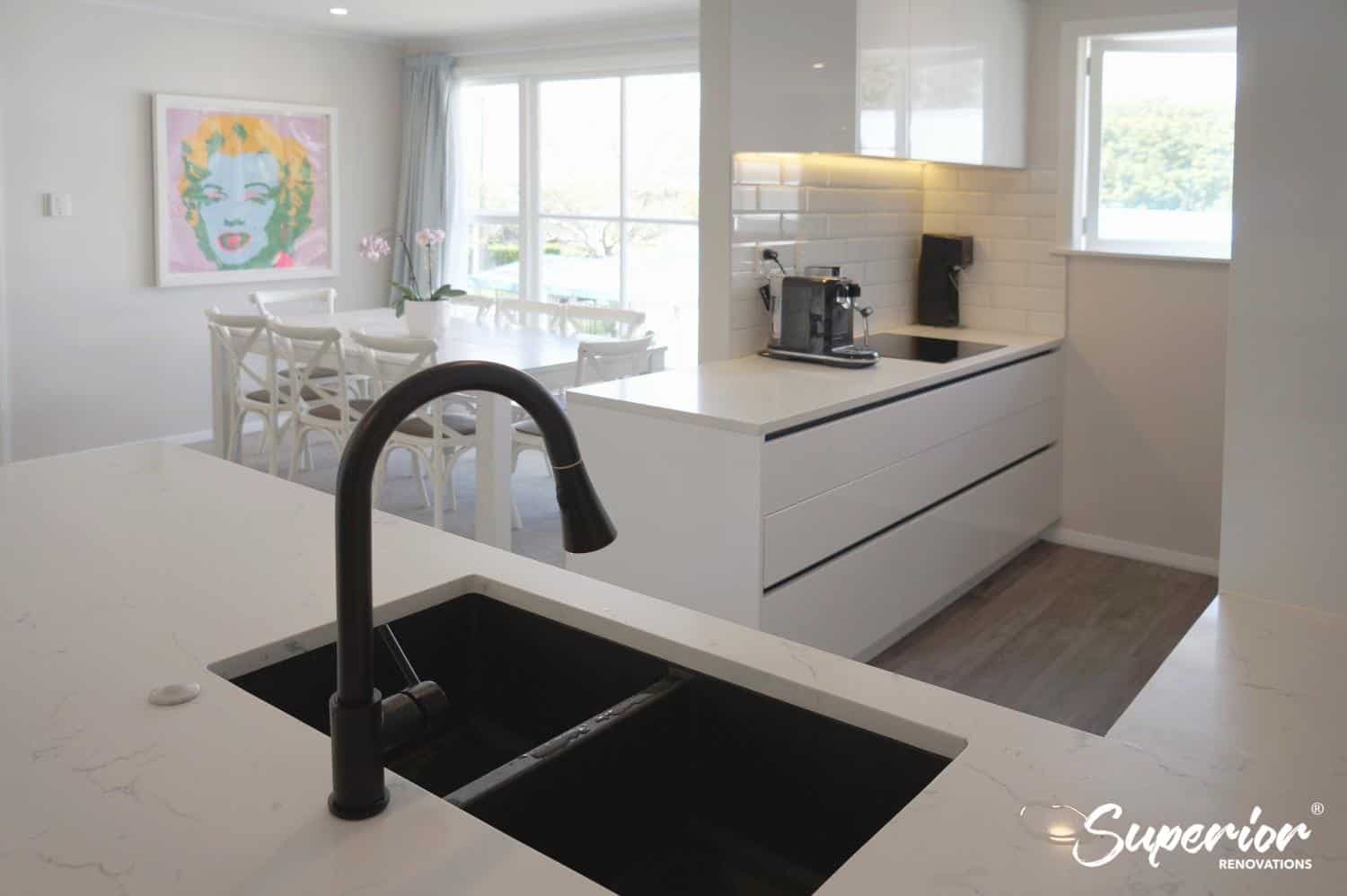
                Do I need a building consent for a small kitchen renovation?

                Most small kitchen renovations don't need a building consent if the work is like-for-like in the same footprint — cabinetry, benchtop, splashback, painting and swapping fixtures in their existing positions are exempt under Schedule 1 of the Building Act 2004. Consent is required when a load-bearing wall is removed, plumbing is relocated to a new wall, ventilation cuts a new roof penetration, or a new window or skylight is added. Auckland Council fees for residential consents in the $20,000 to $99,999 project-value band sit around $2,870 base.
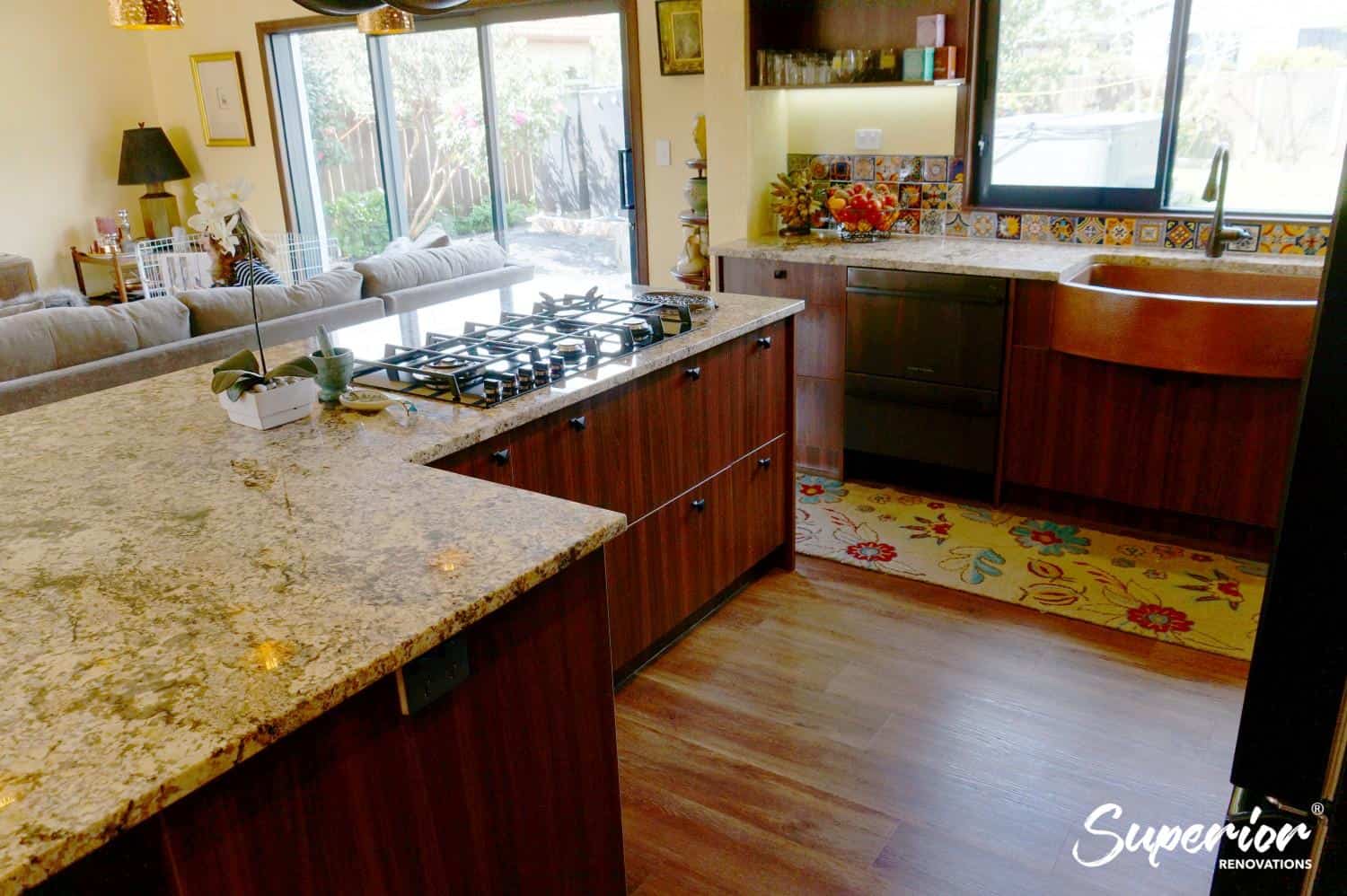
                How long does a small kitchen renovation take?

                A like-for-like small kitchen renovation in Auckland typically takes four to six weeks on site once demolition begins, with another four to eight weeks of design and cabinetry lead time beforehand. Projects involving layout changes or wall removal run six to ten weeks on site. Consent processing through Auckland Council adds another six to eight weeks before work can start. Realistic end-to-end timeframe from first consultation to handover is three to six months.

                What's the best layout for a small kitchen?

                In an Auckland villa or apartment kitchen under 10 square metres, a galley layout (two parallel runs of cabinetry with at least 1,000mm clearance between) gives the most efficient work triangle. For very small footprints under 5 square metres, a single-wall layout paired with a mobile island or fold-out prep surface works best. L-shape layouts work when the kitchen sits in a corner of an open-plan living space — magic-corner pull-outs make the dead corner usable.
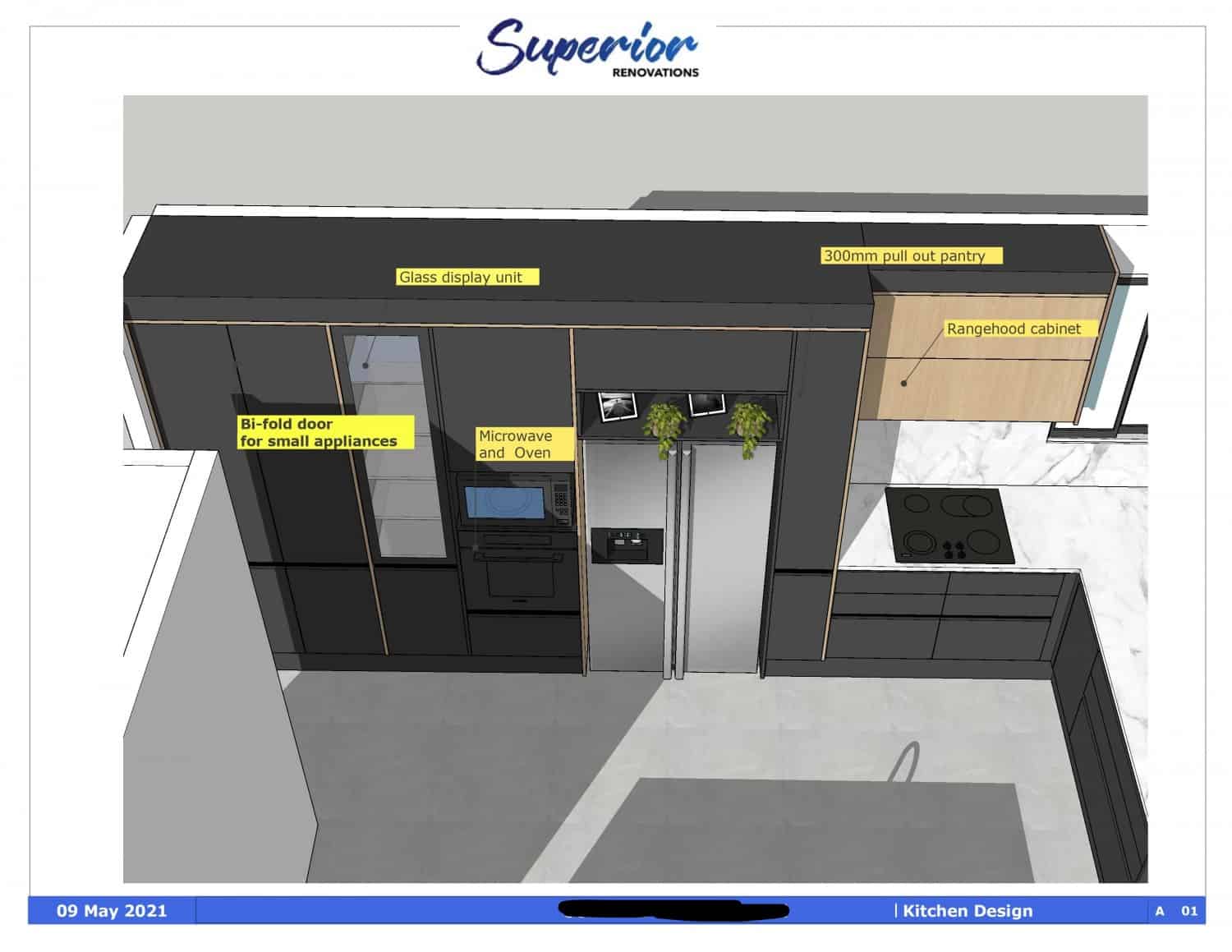
                Can I knock down a wall to open up my small kitchen?

                Yes, but the process depends on whether the wall is load-bearing. Non-load-bearing walls can be removed without a building consent in most cases, though consent is still required if removal affects fire safety or weathertightness. Load-bearing walls always require a structural engineer, a building consent, an LBP-supervised build, and a beam or lintel to carry the load. Expect to add $8,000 to $25,000 for the structural work on top of the kitchen renovation itself.

                How do I make a small kitchen feel bigger without renovating?

                Three changes that don't require consent or trades: paint the cabinetry and walls in the same light tonal family (warm off-whites and soft greys work best in Auckland's variable light), add under-cabinet LED strip lighting to remove shadow lines on the bench, and replace upper cabinet doors with glass-fronted ones to add visual depth. A rolling island cart adds flexible bench space without permanent install.

                Should I use light or dark colours in a small kitchen?

                Light tonal colours read as larger in small kitchens — warm off-whites, soft greys and pale neutrals bounce daylight and reduce visual breaks. Dark colours work as a single accent (an island, a splashback, a feature wall) but shouldn't dominate the cabinetry in a kitchen under 10 square metres. The bigger win is keeping cabinetry and walls in the same colour family so the eye doesn't register a join between cabinet and wall.

                What size dishwasher fits a small kitchen?

                A slimline 450mm dishwasher fits most small Auckland kitchens and handles the daily wash for a two-to-three-person household. Standard 600mm dishwashers consume 150mm of additional cabinetry run that small kitchens usually can't afford. For one or two-person households, an integrated 450mm drawer dishwasher under the bench frees up the equivalent of a small cupboard. Choose integrated panels matching the cabinetry for visual continuity.

                Is it worth adding an island to a small kitchen?

                An island earns its space in a small kitchen when there's at least 1,000mm of clearance around all sides — anything less and the kitchen becomes harder to use, not easier. A compact 1,200 x 700mm island adds prep bench, two-sided storage, and seating for two or three, which can let the dining table shrink or disappear. In kitchens under 10 square metres, a mobile island cart on castors is usually the smarter call.

                Should I hire a renovation company or just a cabinetmaker?

                Hire a cabinetmaker when the layout works, the plumbing stays put, and what you actually want is new cabinetry and a benchtop in the same footprint — adding renovation-company overhead to a cabinetry-only job adds cost you won't recover. Hire a renovation company when walls have to move, layout changes, consents are required, or the kitchen is one room of a larger renovation. The split between Superior Renovations and our sister brand Little Giant Interiors reflects exactly that scope difference.


                Further Resources for your small kitchen renovation

                1. Featured projects and Client stories to see specifications on some of the projects.
                2. Real client stories from Auckland

                Need more information?

                Take advantage of our FREE Complete Home Renovation Guide (48 pages), whether you’re already renovating or in the process of deciding to renovate, it’s not an easy process, this guide which includes a free 100+ point check list – will help you avoid costly mistakes.

                Download Free Renovation Guide (PDF)


                finance - Superior Renovations

                Have you been putting off getting renovations done?

                We have partnered with Q Mastercard ® to provide you an 18 Month Interest-Free Payment Option, you can enjoy your new home now and stress less.

                Learn More about Interest-Free Payment Options*

                *Lending criteria, fees, terms and conditions apply. Mastercard is a registered trademark and the circles design is a trademark of Mastercard International Incorporated.


                Still have questions unanswered?

                Book a no-obligation consultation with the team at Superior Renovations,
                we’d love to meet you to discuss your renovation ideas!

                  Services

                  Home RenovationKitchen RenovationBathroom RenovationOutdoor RenovationHouse ExtensionCommercialDesign ServicesOther

                  By submitting this form, you agree to receive communications from us via email or text regarding our services, you can unsubscribe at any time.

                  This site is protected by reCAPTCHA and the Google

                  Privacy Policy and Terms of Service apply.

                  initial consultation - Superior Renovations
                  Kitchen Renovation

                  The Importance of Lighting in Achieving a Beautiful Kitchen Design

                  Hey Aucklanders, if you’re planning a kitchen reno in your Grey Lynn villa or a modern Albany hub and want it to look stunning while actually working for busy mornings and evening gatherings, nailing the lighting is an absolute game-changer. This guide shows how layered lighting—mixing ambient, task, accent, and decorative—boosts functionality, highlights your flash features like backsplashes or islands, and creates that warm, inviting vibe we Kiwis love, all while dodging common pitfalls in our variable 2025 climate.

                  Why’s Lighting So Crucial for a Beautiful and Practical Kitchen in NZ Homes?

                  It’s not just about seeing what you’re chopping, eh? Good lighting sets the mood, makes tasks safer (no more shadows on the bench during veg prep), and turns your kitchen into a proper heart-of-the-home spot for barbies prep or family dinners. Designers like Dorothy and Sachi from Superior Renovations reckon planning it early complements your layout perfectly—think highlighting a herringbone tile splashback from Tile Depot in a Wairau Valley setup, or using skylights in Herne Bay renos for natural boost. Poor lighting leaves it flat and sterile; layered approaches make it versatile, energy-efficient with LEDs, and even smart-controlled for our busy lives.

                  What’s the Deal with the Four Main Types of Kitchen Lighting?

                  Break it down like this:

                  • Ambient — Gives that overall soft glow from recessed ceiling lights or sconces—dimmable ones are gold for welcoming vibes in Remuera kitchens.
                  • Task — Focused beams where you need ’em, like under-cabinet strips for bench work or pendants over sinks and stovetops—cuts eye strain in humid Auckland evenings.
                  • Accent — Spotlights or uplighters to showcase features, such as inside glass cabinets or on 3D tiles in Henderson Valley bars—adds depth and elegance.
                  • Decorative — Statement pieces like chandeliers or big pendants that double as art, perfect focal points over islands in modern Parnell designs.

                  Layer ’em up—combine with natural light from windows or skylights, chuck in dimmers, and you’re sorted for everything from bright cooking to cosy dinners.

                  How Can You Avoid Common Lighting Stuff-Ups in Your Auckland Reno?

                  Don’t rely on one harsh overhead fluoro—creates shadows and that cold feel. Skip insufficient task lights (accidents waiting to happen), overly bright or coloured bulbs that overwhelm, mismatched fixtures clashing with your style, or forgetting dimmers/smart controls. We’ve seen heaps of transformations, like matte acrylic cabinets in Remuera glowing with accent lights, or showroom displays with everything dimmable—gets it right and your kitchen feels epic year-round.

                  Fancy lighting that makes your kitchen pop and work brilliantly for your whānau? Reach out to Superior Renovations for a free consult—what’s your current lighting gripe?

                  Lighting is one of the most crucial elements in kitchen design. It does more than just illuminate the space; it sets the tone, enhances functionality, and contributes significantly to the overall aesthetic of the kitchen. As kitchen designers and interior designers know, the right lighting can transform a kitchen from ordinary to extraordinary. In this comprehensive guide, we’ll explore why lighting is so essential in kitchen design and how it can be effectively used to achieve a beautiful and functional kitchen space.

                  See more…

                  Our Newly Launched Design Department (Exclusive Design Studio)

                  Design Studio

                  Design Process

                  Design Packages

                  3 Main Role of Lighting in Kitchen Design used by designers

                  Enhancing Aesthetics

                  Lighting plays a significant role in defining the aesthetics of a kitchen. Whether your kitchen has a contemporary, traditional, or transitional style, the type of lighting you choose will enhance these design elements. For instance, pendant lights over a kitchen island can serve as both a focal point and a design statement, reflecting your kitchen’s style and character.

                  Moreover, lighting can highlight specific features in your kitchen, such as a backsplash, countertops, or cabinetry. By directing light toward these elements, you can draw attention to them, making them stand out and adding depth to the overall design.

                  Showcase: If you look at the lighting beneath the cabinets, in the picture below, you will see how our designer Dorothy installed these lights to showcase the beautiful splash back as a design feature. This also acts as a task light to make coffee or drinks. This classic kitchen design can be seen in our showroom at Wairau valley, Auckland.

                  Our Kitchen designers designed this beautiful classic kitchen

                  The beautiful tile sheets from Tile depot were used to add a touch of luxury to this feature wall. They are installed in a Herringbone style and are a combination of stone engineered to look like marble as well as gold metal. This can be seen in our kitchen showroom in Auckland (Wairau Valley).

                  See more: Details on all our renovation displays in our Auckland showroom

                  Superior renovations showroom – Walk in today

                  Improving Functionality

                  While aesthetics are important, functionality is paramount in kitchen design. The kitchen is a space where various tasks are performed, from cooking to cleaning to socializing. Proper lighting ensures that each of these tasks can be carried out efficiently and safely.

                  For example, task lighting under cabinets can provide direct illumination on countertops, making food preparation easier and reducing the risk of accidents. Similarly, well-placed overhead lighting can ensure that the entire kitchen is adequately lit, eliminating shadows and making the space more comfortable to work in.

                  Creating Ambiance

                  The kitchen is often the heart of the home, where families gather and guests are entertained. The right lighting can create a warm and inviting atmosphere, making the kitchen a more pleasant space to spend time in. Dimmers and layered lighting schemes can allow you to adjust the lighting to suit different occasions, from a bright, well-lit environment for cooking to a softer, more relaxed ambiance for dining or entertaining.

                  4 Types of Lighting in Kitchen Design

                  To achieve a well-lit and beautifully designed kitchen, it’s essential to incorporate different types of lighting. Kitchen designers typically use a combination of ambient, task, accent, and decorative lighting to create a balanced and functional lighting scheme.

                  Ambient Lighting

                  Ambient lighting sets the overall tone of your kitchen, transforming it from a purely functional space into a warm, welcoming environment. This type of lighting fills the room with a soft, even glow, making it comfortable for activities beyond cooking, such as dining and socializing. Options like recessed ceiling lights, track lighting, and strategically placed wall sconces create a well-lit space that feels open and inviting.

                  Showcase: This kitchen rendering designed by our Kitchen designer Sachi includes soft ambient lights at the ceiling, task lighting above the stove top and accent lighting in the cabinets to create a simple yet soft and warm kitchen. Below is a Kitchen rendering which our clients get after going through a comprehensive design process in our designer.

                  Kitchen designed by our kitchen designer Sachi to include a warm space with clever use of three types of lighting.

                  A soft kitchen design uses simple yet clever use of lighting for a warm kitchen design.

                  See more: Our Design Department Design Packages (Design Studio)

                  To enhance the versatility of ambient lighting, kitchen designers often recommend installing dimmer switches, allowing you to adjust the brightness according to the time of day or the mood you wish to create. By layering different light sources, such as over-cabinet lighting or toe kick lights, you can define various zones within your kitchen, making it a multifunctional space that caters to all your needs.

                  Task Lighting

                  ask lighting is crucial for creating a functional kitchen, as it provides focused illumination for essential work areas. Whether you’re chopping vegetables, reading recipes, or cleaning up, task lighting ensures you can perform these tasks safely and efficiently. Popular options include under-cabinet lighting, which eliminates shadows on countertops, and pendant lights over kitchen islands for direct, bright light.

                  Recessed lights can also be strategically placed above work zones like the sink, stove, and dishwasher, ensuring every area is well-lit. Integrating natural light sources, such as large windows or skylights, can further enhance task lighting by providing bright, even illumination throughout the day. By carefully planning and placing task lighting, kitchen designers ensure that every corner of your kitchen is practical and user-friendly.

                  Showcase: This Kitchen renovation that we designed for Henderson Valley boasts accent lights above below the cabinets in the bar area to enhance its aesthetic and showcase the beautiful 3D tiles. It also creates a beautiful ambience when paired with the recessed lights and pendant lighting. This simple use of different lighting creates a stunning design.

                  Lighting used to enhance the aesthetics of this kitchen design in West Auckland

                  Kitchen renovation designed by our designers in Henderson Valley.

                  See more: Full Case study + Before and After pictures for the above project.

                  Accent Lighting

                  Accent lighting plays a significant role in highlighting the design elements that make your kitchen unique. It draws attention to specific features, such as a stunning backsplash, open shelving, or an art piece, turning them into focal points within the room. Options like spotlights, uplighters, and directional sconces are ideal for showcasing these elements, adding depth and character to your kitchen. For example, if you have a feature wall with a beautiful tile design, accent lighting can emphasize its texture and color, making it a standout aspect of your kitchen.

                  Showcase: This Kitchen renovation in Remuera was designed by Dorothy. She used matte acrylic boards for the cabinets, contrasted by glossy benchtop and splash back with upper cabinets with glass door. She takes the kitchen design further by adding accent lights inside the glass cabinets and task lighting below it.

                  Modern and Sleek kitchen design with clever use of lighting.

                  Clever use of lighting to elevate the over all design of this kitchen design

                  Additionally, accent lighting can be used inside glass-front cabinets to illuminate decorative glassware or collectibles, adding a touch of elegance and sophistication to the space. Kitchen designers often use accent lighting to enhance the overall aesthetic appeal of the kitchen, ensuring that every design choice is highlighted to its fullest potential.

                  Designer Kitchen in Epsom

                  A closer look at the accent lighting and task lighting in the drinks/Coffee corner.

                  Showcase: This Kitchen Display in our renovation showroom in Auckland shows the various uses of lighting in this kitchen design. Accent lighting was used in the Veneer Open Cabinets, LED task lighting during the sink area, Accent lighting below the bottom cabinets to showcase the flooring, Pendant Lighting above the benchtop and recessed lighting on the ceilings. All these lights can be dimmed to create a cozy atmosphere and a warm atmosphere within the space. This design showcases that lights are not an after thought during the renovation. They can really add beautiful touches within the space, take the kitchen design to another level as well as add warms within the space and create a more functional space.

                  Modern sleek kitchen with accent lighting, task lighting, recessed lighting and decorative lighting

                  A look at one of our displays in our kitchen display in our showroom display in Auckland.

                  Below is a closer look a Kitchen renovation in Henderson Valley, Auckland with Accent lights.

                  Designer Kitchen in Auckland

                  A kitchen renovation in Henderson Valley

                  Decorative Lighting

                  Decorative lighting combines style with functionality, acting as both an illumination source and a design statement. In the kitchen, decorative lighting fixtures like chandeliers, large pendants, or unique light sculptures can serve as stunning focal points, elevating the overall aesthetic of the space. These fixtures not only provide essential lighting but also contribute to the kitchen’s design theme, whether it’s modern, rustic, or traditional.

                  Showcase: This Kitchen display in our Renovation showroom in Auckland show cases the use decorative chandelier lighting to add to the kitchen design. This shows how lighting is not necessarily for light but also as a design element.

                  Decorative lighting in our renovation showroom in Auckland.

                  This Kitchen design shows how different materials, textures, lighting and finishes can be harmoniously to create a cohesive Kitchen design.

                  Showcase: This Kitchen renovation we did uses pendant lighting as decorative lighting to elevate the kitchen design.

                  Simple modern kitchen design with decorative and pendant lighting

                  Simple modern Kitchen renovation uses decorative lighting within the kitchen design. See full video transformation below.

                  See below the full transformation of the above Kitchen renovation.

                  For example, a chandelier over the dining table can add a touch of luxury and sophistication, while pendant lights with natural materials can give your kitchen an organic, earthy feel. Kitchen designers carefully select decorative lighting to complement the overall design scheme, ensuring that each fixture enhances the space both visually and functionally. By incorporating decorative lighting, you can personalize your kitchen, making it a true reflection of your style and taste.

                  How Kitchen Designers Incorporate Lighting into Their Designs

                  Professional kitchen designers understand that lighting is an integral part of the kitchen design process. They consider lighting from the very beginning, ensuring that it complements the layout, enhances functionality, and aligns with the overall design vision. Here’s how they do it:

                  Planning the Layout

                  The first step in incorporating lighting into kitchen design is planning the layout. Kitchen designers assess the natural light available and decide where additional lighting is needed. They consider the kitchen’s workflow, identifying key areas that require task lighting, such as the stove, sink, and preparation areas.

                  Designers also think about the placement of electrical outlets and how lighting fixtures will be installed. For example, if pendant lights are planned for an island, they ensure that the wiring is in place to accommodate them.

                  See more: Top 16 Kitchen design ideas for Small Kitchens

                  Showcase: Below you can see a Kitchen render done by our designer Sachi (from our design studio) and showcases the use of natural lighting in the kitchen. She created two sky lights to bring in more light into the kitchen adding to the pendant lighting above the island, recessed lighting around the fridge and accent lighting near island.

                  Simple Kitchen design with skylights for added natural light

                  Beautiful Kitchen renders done by Sachi from our Design Studio

                  3D VIEW 03 - Superior Renovations

                  Elevation 2 of Render done by Sachi from our Design Studio

                  Showcase: This Kitchen that we renovated in Herne Bay shows the skylights within the Kitchen design.

                  Kitchen renovation in Grey Lynn with Sky lights for added natural light in the KItchen

                  Kitchen renovation in Herne Bay with Sky lights for added natural light in the Kitchen

                  See full Design Transformation for Above Project

                  Layering the Lighting

                  A well-designed kitchen typically features layered lighting, which combines different types of lighting to create a balanced and versatile lighting scheme. Kitchen designers layer ambient, task, accent, and decorative lighting to ensure that the kitchen is well-lit and functional.

                  By layering the lighting, designers can create different zones within the kitchen, each with its own lighting needs. For example, the cooking area may have bright task lighting, while the dining area may feature softer ambient lighting for a more relaxed atmosphere.

                  Kitchen Rendering from Our Kitchen Studio

                  This Kitchen renders by our designer Sachi from the design studio showcases the clever use of layered lighting, and a harmony of various textures and materials creating a cohesive design.

                  Choosing the Right Fixtures

                  The choice of lighting fixtures is crucial in kitchen design. Designers select fixtures that complement the kitchen’s style and meet the functional requirements of the space. For instance, sleek, modern kitchens may benefit from minimalist recessed lights, while traditional kitchens may feature ornate chandeliers or lantern-style pendant lights.

                  In addition to aesthetics, designers consider the quality of light each fixture provides. They opt for energy-efficient LED lights that offer bright, clear illumination and have a long lifespan. They also ensure that the color temperature of the lights matches the kitchen’s mood, whether it’s warm and inviting or cool and contemporary.

                  model 0120240708134936 2 - Superior Renovations

                  Elevation 2 of Kitchen renders by our Design studio

                  Integrating Smart Lighting Solutions

                  With the rise of smart home technology, many kitchen designers now incorporate smart lighting solutions into their designs. Smart lighting allows homeowners to control the brightness, color, and timing of their lights through a smartphone app or voice commands.

                  This technology offers convenience and flexibility, enabling homeowners to create different lighting scenes for various activities, such as cooking, dining, or entertaining. Smart lighting systems can also be integrated with other smart home devices, such as voice-activated assistants or motion sensors, for a fully automated and customizable kitchen experience.

                  What Kind of Lighting Not to Include in a Kitchen Design

                  While the right lighting can enhance the beauty and functionality of a kitchen, the wrong lighting choices can have the opposite effect. Here’s what to avoid when designing a kitchen:

                  1. Harsh, Overhead Lighting

                  Harsh, overhead lighting, especially when used as the sole source of illumination, can create an unwelcoming and clinical atmosphere in the kitchen. Fluorescent lights are a common culprit, as they often emit a cold, harsh light that can make the space feel sterile and uncomfortable.

                  Instead of relying solely on overhead lighting, it’s better to incorporate a mix of lighting types, including task and ambient lighting, to create a more balanced and inviting atmosphere. If overhead lighting is necessary, opt for fixtures with dimmable options and warm color temperatures.

                  1. Insufficient Task Lighting

                  A common mistake in kitchen design is neglecting task lighting. Without adequate task lighting, work areas can be poorly lit, making it difficult to perform tasks like chopping, cooking, and cleaning. Relying solely on ambient lighting can result in shadows and uneven light distribution, which can lead to accidents and eye strain.

                  To avoid this, ensure that all work areas in the kitchen are well-lit with appropriate task lighting. Under-cabinet lights, pendant lights, and recessed spotlights are all effective options for providing direct illumination where it’s needed most.

                  1. Overly Bright or Colorful Lighting

                  While bold, colorful lighting might seem like a fun way to add personality to the kitchen, it can quickly become overwhelming and distracting. Bright, neon-colored lights or overly bright LEDs can create an unsettling atmosphere, making the kitchen less enjoyable to spend time in.

                  It’s important to choose lighting that complements the kitchen’s overall design and color scheme. Subtle, neutral lighting with adjustable brightness is usually a better choice, as it can create a calm and cohesive environment.

                  See more: 10 Mistakes to avoid when designing your Kitchen

                  1. Mismatched Fixtures

                  Mismatched lighting fixtures can disrupt the visual harmony of the kitchen, making it look disjointed and chaotic. While it’s possible to mix different styles of lighting, such as combining modern and traditional elements, it’s essential to do so with care and intention.

                  When choosing lighting fixtures, consider how they will work together as a cohesive whole. Ensure that the fixtures complement each other in terms of style, finish, and scale. If you’re unsure, sticking to a consistent design theme or seeking the advice of a kitchen designer can help you achieve a harmonious look.

                  See more: A guide to Kitchen Layouts (understanding ergonomics)

                  1. Neglecting Dimmers and Controls

                  One of the most common mistakes in kitchen lighting is failing to incorporate dimmers and lighting controls. Without these, you’re left with a single level of brightness that may not be suitable for all tasks or occasions.

                  Dimmers allow you to adjust the brightness of your lights, creating different moods and atmospheres depending on the time of day or activity. For example, you can have bright lighting for cooking and softer, dimmer lighting for dining or entertaining. Incorporating smart controls can also provide convenience, allowing you to adjust the lighting with ease.

                  In conclusion, thoughtful lighting design can transform your kitchen into a space that is not only beautiful but also highly functional. By carefully selecting and positioning different types of lighting, you can create a kitchen that truly feels like the heart of your home. For more insights, consider exploring further information on kitchen lighting design.

                  Our Design Studio Experience

                  Meet our designers to transform your home with our exclusive design studio experience.


                  If you’re looking for “specific” cost estimates, try our Renovation Cost Calculator Tools

                  Need ideas? Check out our Kitchen Design Gallery or dive into our Bathroom Design Gallery for inspiration!


                  Need more information?

                  Take advantage of our FREE Complete Home Renovation Guide (48 pages), whether you’re already renovating or in the process of deciding to renovate, it’s not an easy process, this guide which includes a free 100+ point check list – will help you avoid costly mistakes.

                  Download Free Renovation Guide (PDF)


                  finance - Superior Renovations

                  Have you been putting off getting renovations done?

                  We have partnered with Q Mastercard ® to provide you an 18 Month Interest-Free Payment Option, you can enjoy your new home now and stress less.

                  Learn More about Interest-Free Payment Options*

                  *Lending criteria, fees, terms and conditions apply. Mastercard is a registered trademark and the circles design is a trademark of Mastercard International Incorporated.


                  Still have questions unanswered?

                  Book a no-obligation consultation with the team at Superior Renovations,
                  we’d love to meet you to discuss your renovation ideas!

                    Services

                    Home RenovationKitchen RenovationBathroom RenovationOutdoor RenovationHouse ExtensionCommercialDesign ServicesOther

                    By submitting this form, you agree to receive communications from us via email or text regarding our services, you can unsubscribe at any time.

                    This site is protected by reCAPTCHA and the Google

                    Privacy Policy and Terms of Service apply.

                    kitchen cost
                    Kitchen Renovation

                    厨房装修计算器(新西兰)- Superior Renovations

                    DSC04092 - Superior RenovationsSuperior Renovations

                    厨房装修是家庭改造的重要组成部分。有很多事情需要考虑,例如是选择塑胶地板还是瓷砖、如何选择新橱柜等等。

                    厨房翻新有可能使您的房屋增值10%。我们的大多数客户翻新厨房都是为了增加厨房的功能性和舒适度,以更好的适应他们的生活方式。


                    直接跳转至厨房装修计算器


                    整体厨房装修工程包括哪些内容?


                    1. 规划设计:

                    厨房装修第一步是规划和设计新的布局。这需要考虑您的需求和偏好,以及现有空间的限制。您可以与厨房设计师或承包商合作,创建新厨房的 3D 效果图。


                    1. 拆除:

                    下一步是拆除旧橱柜、台面和电器。这可能涉及到拆墙、拆除地板以及断开管道和电气系统。


                    1. 结构改造:

                    如果您要对厨房进行任何结构性改动,如拆除墙壁或添加窗户,通常都要在这一阶段完成。


                    1. 水管和电路改造:

                    拆除旧厨房后,可以更新或移动水管和电路系统,以适应新的布局。这可能涉及安装新的管道装置、重新布线电路系统以及添加新的插座和开关。


                    1. 地板和墙面工作:

                    管道和电路工程完成后,就可以安装新的地板和墙面饰面。这可能包括铺设新瓷砖、硬木地板或复合地板,以及粉刷或铺新墙纸。


                    1. 橱柜和台面:

                    下一步是安装新的橱柜和台面。这可能需要定制适合新布局的橱柜,以及选择台面材料的类型,如花岗岩、石英石或大理石。


                    1. 电器:

                    橱柜和台面就位后,就可以安装新的电器了。这包括冰箱、灶台、烤箱、洗碗机以及任何其他属于新厨房设计的电器。


                    1. 最后修饰:

                    最后一步是进行修饰,如安装照明灯具、橱柜五金件和装饰元素。这有助于为新厨房打造一个整体、精致的外观。


                    总的来说,一个完整的厨房装修项目可能需要几周到数月的时间才能完成,具体取决于项目的范围和可能出现的任何意外情况。与信誉良好的承包商合作非常重要,他们可以帮助管理项目时间表和预算,并确保最终结果符合您的期望。

                    厨房装修费用让人惊讶的地方

                    对许多房主来说,开展厨房翻新项目是一项令人兴奋的冒险,因为希望通过装修获得一个焕然一新的现代化烹饪空间。然而,在光鲜亮丽的商品目录图片和 Pinterest 完美厨房的背后,往往隐藏着让人猝不及防的意外开支。在这篇博客中,我们将深入探讨厨房翻新费用中最让人吃惊的地方,并揭示一些可能影响您预算的鲜为人知的事实。


                    结构变化: 无声的预算杀手:

                    许多房主都梦想拥有开放式厨房,但他们可能没有意识到这个需求存在着潜在的结构变化可能。拆除墙壁或改变布局会严重影响预算。此类改建的费用因承重考虑和电路改线等因素而异。


                    隐藏在表面之下的隐患:

                    拆除阶段开始后,隐藏的问题可能会浮出水面。过时的管道、电气问题或结构缺陷可能会让您的预算飙升。全面的翻新前检查至关重要,但很多业主都忽略了这一步。意料之外的问题会使整个翻新费用平均增加 1,000 到 3,000 纽币。


                    橱柜难题: 质量与成本:

                    橱柜在厨房美观和功能性方面起着举足轻重的作用,但优质橱柜的成本往往被低估。低价橱柜看似便宜,但可能经不起时间的考验。投资耐用材料和结构良好的橱柜至关重要。橱柜的平均价格从 5,000 纽币到 25,000 纽币不等,甚至更高。


                    家电价格震惊:

                    升级到高端家电可以让你的厨房焕然一新,但费用可能不会那么令人愉快。一整套高端家电很容易就会增加数千纽币的预算。房主应预留预算的10-15%用于厨房家电,其中包括配送和安装费用。


                    专业费用和许可证:

                    雇佣专业人员和获得必要的许可证是厨房装修中常被忽视的方面。建筑师、设计师和承包商的费用会迅速累积。此外,结构改造所需的建筑许可证也是必不可少的,这些许可证可能花费数百到数千纽币。在初期预算规划中,务必要包括这些费用。


                    开始厨房翻新之旅需要仔细规划并切实了解潜在费用。从结构变化到隐藏问题和质量考虑,了解这些意外情况可以帮助您更轻松有效地驾驭装修过程。始终将应急预算考虑在内,以应对意外支出,确保您的厨房梦想不会变成一场财务噩梦。

                    QR code to Page - Superior Renovations

                    扫描二维码, 在小红书上找到我

                    体验家居改造的艺术,选择Superior Renovations!我们是奥克兰首屈一指的浴室、厨房及全屋装修专家。从概念设计到完工,我们的团队确保每个细节都完美无缺。扫描二维码,在小红书上关注我们,获取最新项目、装修技巧和灵感

                    扫描二维码,通过微信联系我们!

                    想开始您的装修之旅吗?通过微信与Superior Renovations联系,享受便捷、个性化的服务体验。立即扫描,提问、获取专家建议,踏出家居改造的第一步!

                    SUPERIOR RENOVATIONS - Superior Renovations
                    grassmere kitchen renovation 0001 Background - Superior Renovations

                    Before – Kitchen Renovation


                    grassmere kitchen renovation 0000 DSC04088 - Superior Renovations

                    After – Kitchen Renovation

                    奥克兰新厨房装修的平均成本

                    陈旧的装饰、繁琐的布局和故障的电器会让人失去烹饪的乐趣。这些问题通常会让人们萌生翻新厨房的念头。然而,装修的起点往往会让人们感到不知所措,进而推迟整个项目。


                    制定厨房装修预算

                    评估您当前的厨房


                    1. 评估您当前的厨房

                    退一步看看您的厨房。是什么让您目前的厨房操作变得更加艰难?是空间、功能、不便的布局还是过时的台面、橱柜和设计。下一步,您可以考虑您的家庭需求是什么,以及您日常厨房使用习惯。例如,如果您经常招待客人,那么您可能会希望在厨房里加一个岛台。但如果您不常做饭,那么您可能只想升级厨房里的一些设备。一定要根据家人使用厨房的情况进行装修。在设计和主题方面,请对厨房翻新的想法做一些研究。网上有很多资源,可以帮助您大致了解家人喜欢的风格类型。


                    2 规划预算:

                    您的预算将决定装修的范围。您的预算最终将决定您的计划。移动管道和电源插座的费用可能会很高。因此,如果您的预算不允许,请考虑利用厨房的现有布局。我们下面的厨房翻新成本计算器将为您提供一个基本概念,让您了解在新西兰和奥克兰,新厨房翻新的不同方面将花费多少成本。


                    3. 研究并选择合适的公司:

                    每家装修公司都会为客户提供独特的服务,但并不是每家公司都能满足您的装修需求。因此,请仔细选择适合自己需求的公司。可以在网上做一些调查,并与多家公司会面,了解他们的经营方式,这样你就能知道在装修过程中他们会是什么样的表现。与其代表会面时,一定要向他们询问过去的案例研究、老客户的推荐信,以及他们提供的保修和保证。请查看我们的清单,了解您应该向装修公司或施工方询问哪些问题。

                    新厨房的成本将取决于您的布局、个人喜好、所选配件的质量、台面选择、瓷砖选择、额外费用等等。我们在下面列出了平均费用,让您有一个快速的概念,但您可以在厨房翻新费用计算器中输入您的确切细节,以获得一个粗略的估计。

                    对于许多奥克兰的房主来说,焕新厨房是他们家庭装修愿望清单上的首选。将一个破旧不堪的厨房改造成一个现代化的烹饪和用餐空间是许多人心中的梦想。然而,大多数人并不清楚厨房装修所需的具体费用。从可以自己动手安装的DIY厨房到高端定制厨房,我们整理了一份指南,帮助你为新厨房制定预算。


                    关于厨房费用计算器(新西兰)

                    在考虑厨房装修价格时,尤其是在奥克兰,了解这个价格实际上包含什么是非常重要的。通常,厨房装修费用包括橱柜本身的价格(即橱柜和储物柜)、拆除、管道工程、地板铺设、电气工程、燃气安装以及将这些设施安装到您家的费用。通常价格不包括电器的费用,如烤箱、冰箱、抽油烟机和洗碗机。

                    这个厨房装修费用计算器旨在根据提供的信息为您提供一个预期消费的指南。还有一些额外的因素可能会影响项目的成本。估算价格反映的是我们所做的全套厨房装修,即定制设计和制造,而不是部分装修/改造。每个成本因素的固定估算值也是基于平均值,因此请预留10-15%的变动空间。


                    例,拆除承重墙、额外的管道工程、新增厨房等
                    (厨房装修的常见附加项目)

                    将结果发送到哪里?

                    请在下面填写您的详细信息,计算结果将直接发送到您的电子邮箱。(请仔细检查您的垃圾邮件文件夹)


                      ssl cert 2 - Superior Renovations

                      This site is protected by reCAPTCHA and the Google

                      Privacy Policy and Terms of Service apply.

                      总结:

                      厨房翻新成本计算器(新西兰)是免费使用的吗?

                      是的,它是由 Superior Renovations 开发的,目的是为访客提供厨房翻新的成本计算,部分是应大众要求而开发的。

                      标准厨房翻新的平均费用是多少?

                      平均费用(包括材料、设计、项目管理、人工、管道和电气)从 19,000 纽币到 29,000 纽币不等,具体取决于材料/配件的选择。不包括电器费用。

                      翻新厨房是否需要建筑许可?

                      翻新厨房不需要建筑许可,除非对建筑结构进行改动,如拆除墙壁。


                      请注意:尽管所有信息在发布之日均被认为是真实和正确的,但发布之后情况的变化可能会影响信息的准确性。信息变更恕不另行通知,Superior Renovations 对打印和存储的任何信息的准确性或用户以任何方式解释和使用的任何信息的准确性不承担任何责任。

                      ​From the very first consultation, our experience with this team has been nothing short of stellar.

                      ​Working with Eunice, our sales consultant, set a high bar for the rest of the project.
                      Eunice is truly exceptional at what she does. When we first began our kitchen project, we went through several versions of our floor plan, and she was with us every step of the way—from the initial planning stages right through to the final concept. Her patience and dedication during the design process were remarkable.
                      Throughout the project, Eunice provided:
                      * **Invaluable Suggestions:** She has a keen eye for both aesthetics and functionality, pointing out details we never would have considered on our own.
                      * **Seamless Adjustments:** No matter how many tweaks we requested, she handled every change with professionalism and a "can-do" attitude.
                      * **Expert Guidance:** She transformed our vague ideas into a cohesive, stunning reality.

                      ​Once the planning was complete, Neil, our project manager, took the reins and truly blew us away. Neil is a consummate professional who balances technical expertise with fantastic communication.
                      ​ He kept us informed at every stage, ensuring we knew exactly what to expect and when.
                      Whenever a minor pivot was needed, Neil handled it with grace and efficiency, keeping the timeline on track.
                      His standards for the renovation work were incredibly high, ensuring the final result was polished and beautiful.

                      ​The transition from Eunice’s initial planning to Neil’s execution was flawless. If you are looking for a team that combines design expertise with top-tier project management, look no further. We are absolutely thrilled with our new kitchen and new flooring !
                      Superior Renovations has just finished a complete remodel of my bathroom. I can see, why the company has such a high reputation. At every stage, from sales, design, project management, and execution, the company excelled at every point. I am just so happy with the work that they have done and they have exceeded my expectations at every point.
                      Used Superior for a kitchen and bathroom renovation last year. They did an excellent job updating both rooms, communication was excellent ongoing tjrough the project, they coordinated all the tradies, synchronized so there was little downtime, and it all worked exactly as planned and on budget. Was really glad we chose Superior Renovations and plan to use again for our entrance way at some stage.
                      As I said to my work colleagues ‘I have just had the most pleasant experience’. When they realised it was with renovations at home they were shocked - ‘unheard of’ I was told.
                      Everything went to plan - timing, project management, costs, etc, etc. Neil communicated with me daily and made my whole bathroom renovation a pleasure.
                      The best decision I made was choosing Superior Renovations.
                      Thank you Kevin for our initial connection and for passing me on to Neil to manage the whole process.
                      We just finished a bathroom renovation and couldn’t be happier with the results. The craftsmanship is top-notch, and the attention to detail in the tiling and finishing is impressive. The team was professional, kept the workspace clean, and delivered exactly what we envisioned. Highly recommend them for anyone looking for a high-quality transformation.
                      Superior did an excellent job of renovating our ensuite. Project manager Jacob was easy to work with and communications were good.
                      This is our second review for Superior Renovations. They have done two projects earlier this year and we were so impressed by the work they have finished. After discussing and very careful consideration, we decided to go with more projects with them. So far, they have now completed stage 1 renovation of our house. We still amazed for their knowledge and services; they really listen to us and discuss anything with us if they feel/think could be better…
                      From the first day we work with them, we have no issue with them at all, from communication, discussing, designing to the teams working on the site.
                      Especially we are highly recommended to those who are considering doing the house renovation, please contact them and you will know why we are so pleased to have them to do our house renovation.
                      We are thanking Cici, Neil and the teams so much….
                      We are looking forward to seeing what the outcome will be.

                      David and Emily
                      We recently had our bathroom renovated by Superior Renovations and couldn’t be happier with the experience. Dorothy and Neil were an absolute pleasure to work with. They guided us through every step of the process, making what can be a stressful experience feel smooth and straightforward.
                      The quoting process was transparent and detailed, with no hidden fees or surprises. Neil was incredibly responsive and always available whenever we had questions or requests, which gave us real peace of mind throughout the project. We really love the end result and enjoy our new bathroom!
                      We’ll definitely be returning to the Superior Reno team for our next project. Highly recommended!
                      Our bathroom reno has just been completed & I am so happy. The whole process was easy & hassle free. Alison designed our bathroom & was very patient with our changes/then changes back again. Jacob our project manager was a delight to deal with. He always kept us informed of the scheduling & any other information we may have needed. All the tradies worked hard & the job was completed & signed off within 3 weeks. That's demo, full tiling, installation of new everything & delivery & pick up of the skip down a very tricky driveway. We absolutely love the new bathroom & would recommend Superior Renovations everyday. Future jobs I will definitely be contacting them again. Thank so much for your excellent work
                      Having explored our reno options, it was an easy decision to select Superior Renovations for our work. As first timers at anything like this we had to trust the system with grand old 100year old bungalow. We were so pleased to have Cici, Sonny and Kai working with us the whole way through. Be shout out to all the team, builders, plumbers, electricians, tilers and painters. A superb job delivered on budget and ahead of time. The communication from Cici and Sonny was first class. Would highly recommend working with Superior Renovations in fact, we already have more worked booked in. Thanks Superior you made Millie and Monty's parents very happy. 🐾
                      I am very happy with the recent renovation for my new kitchen.
                      The team worked really hard to get it done within the time frame.
                      The manager, Jacob, was very helpful and communicated well and always sorts out any issue immediately.
                      Thank you Irene
                      We couldn’t be happier with our new pergola! From start to finish, the team was professional, punctual, and easy to work with. They took the time to listen to what we wanted and offered great suggestions to make the design even better. The quality of the materials and workmanship is outstanding — everything feels solid, well-built, and beautifully finished. Kudos to Sinan Sun as she has been an amazing contact with the company.
                      We are very pleased with our bathroom reno by Superior Renovations! Jacob, Cici and the team always kept us up to date, were always friendly to deal with and finished ahead of schedule. Most importantly we are very happy with the quality of the work.
                      We have been working with Superior Renovations as a supplier now for over three years. In that time we have found the team to be very professional and well organised. Which is a welcome relief in this industry! Just recently we have become their sole supplier for portaloos, which recognises the collaboration we have forged over these three years.

                      In particular, Leanne and Elaine set a very high standard of communication and flexibility. This is of vital importance when scheduling deliveries and pickups with us, however, they understand not everything can be done at once and are willing to work with us for the best (supplier/contractor/client) outcome.

                      I would imagine this ethos would flow directly through to all their contracted renovation work. A pleasure to work with!
                      A very reliable supplier – we’ve been working with them for three years now, and they have never let us down. Well done to the team.
                      We have been working with these guys for the past 4 years and find them an awesome company to work with, very efficient and organised. I highly recommend!
                      Finding someone reliable for renovations has always been the most stressful thing for us. In the past, we had several painful renovation experiences—money was spent but the problems were never truly solved, and things often ended up worse than before. We really didn’t know where to find a trustworthy renovation company.

                      For more than ten years, our wish had been to renovate our bathroom, laundry, and toilet, so that we could finally enjoy a comfortable and functional living environment. Just when we were about to give up, we came across Superior Renovations online. We quickly made an appointment with Cici, who designed and provided us with a quote.

                      Throughout the whole process, I was deeply impressed by the professionalism of Superior Renovations. What stood out most was that they always delivered on their promises—everything agreed upon was completed on time. This built a relationship of trust and reliability. Up until completion, I was completely satisfied with their dedication and the quality of their workmanship.

                      During the renovation, we encountered some of the challenges that often come with older houses, but Cici and her team helped us resolve the discomforts we had been living with for years. We are truly grateful to the construction team.

                      Some say renovations are easy if you just have money, but I believe the most important thing is finding a trustworthy team that keeps their word, values quality, and cares about the customer’s experience.

                      Because of this renovation experience, we can now confidently plan our next project—the kitchen—and Superior Renovations will definitely be our first choice. We strongly recommend them.

                      Finally, I want to thank Cici and the team for helping us fulfill our dream.

                      Mark & Kate
                      Sinan is a very good consultant. She helps a lot during renovation. Very satisfied with their job.
                      It was great to have Alison's recommendations and input on how & what would look best for our kitchen and bathroom reno. Jacob, our project manager, has been a star too; ensuring that the project was delivered as planned, AND giving us great ideas & suggestions along the way.

                      We will definitely be calling on you guys again for our next home reno. Thanks team!
                      Very impressed with Superior Renovations.Building our pergola with blinds for a fair price .First thank you Sinan for quoting the job and your flexabilty and knowledge..Secondly the job was done well within the time frame, thanks to Jeff for supervising the job ( eventhough he wasn't too well) and keeping us up to date throughout the process. Payment was fair and easy as well .
                      Thoroughly recommend Superior Renovations for your reno job 👍
                      Very efficient team of workers and high quality finish.
                      Very happy with our renovated bathroom.
                      We will use this company again.
                      We’re very happy with the renovation work done by the team. It’s rare for renovation projects to finish on time, but they committed to completing ours before the Easter holiday—and they delivered! Our project manager, Jacob, worked incredibly hard (even physically! 😄) to make it happen.

                      I admit I might not have been the easiest client—I was particular about details like colours, tile placement, and exactly where the hand basin bowl should sit on the bench. But they listened, took it all on board, and got it done. Thank you, Jacob!
                      I’ll definitely bring you another challenge in the future. 😉
                      Thanks Superior Renovations for doing our house, it definitely looks a lot better now! Special thanks goes to Alison and Jacob for their excellent effort and good manners in handling the construction process, it wasn't easy but with them around it definitely became easier to handle. Cheers🥂
                      Absolutely thrilled with the outcome of our renovation of two bathrooms and kitchen in a double level home. Kevin and his entire team were an absolute pleasure to work with from the get-go. Every minor detail was attended to, and all our requests were accommodated. Cyrus deserves a special mention as under his watchful eye and expertise, nothing could go wrong.
                      I have recently finished a renovation in our 1930’s bungalow, updating the original (and I do mean original) kitchen and bathroom. Plus creating a new laundry and removing three fireplaces which created two new spaces including an office. From the initial appointment with Alison who came over and then provided drawings and a quotation, to the work with Frank, our project manager and the team, this has been a wonderful renovation experience. I would have described myself as a nervous-renovator prior to doing this, as I had never done a renovation before, but Frank, Alison, Sunny and all the team have worked so tirelessly and generously to create spaces that we love. Superior’s care in managing the project has meant that we have come away with much more than we originally sought to achieve and without the stress I hear others lament about when they renovate. I would recommend Frank, Alison, Sunny and the team at Superior Renovations wholeheartedly.