


Retentions: Who the Construction Contracts Act Actually Protects
Last updated:
Quick answer: The retentions regime in the Construction Contracts Act 2002 applies only to commercial construction contracts, which the Act defines as contracts where none of the parties is a residential occupier. A homeowner renovating the house they live in is a residential occupier, so subpart 2A does not reach their contract. The rest of the Act does apply, and the parts that matter most on a renovation are the payment claim and payment schedule rules.
Somewhere between the first quote and the contract, most people renovating in Auckland are told to hold back ten percent until they are happy. It is repeated on forums, in comment threads, and by well-meaning relatives who built in the 1990s. It is usually attached to a phrase that sounds authoritative: retentions, under the Construction Contracts Act.
The advice has a real thing behind it. Retentions exist, the Act does govern them, and since October 2023 the rules around them have real teeth. What almost nobody mentions is who those rules were written for. They were not written for you.
Free cost calculator
How much will your renovation cost?
Answer a few questions and we’ll email you an Auckland price range.
This article sets out what the Act says, section by section, in the order the definitions actually run. It is a description of the law, not advice about your contract. How the payment structure is set out before work starts is part of the way we run a renovation from first drawing to handover. For your own situation, the referral lines at the end point to MBIE’s consumer guidance and to your own legal advice.
What Retention Money Is, and Who the Regime Was Built to Protect
Start with what the words mean in the Act rather than in conversation.
Section 18B(1) of the Construction Contracts Act 2002 opens subpart 2A, the retention money regime. It provides that the subpart applies if a commercial construction contract allows one party, whom the Act calls party A, to withhold payment of an amount that would otherwise be payable to another party, party B, as security for the performance of party B’s obligations under the contract. The Act names that withheld amount a retainable amount, and section 18B(2) makes it retention money at the point the contract allows party A to withhold it.
Section 18C(1) then does the heavy lifting. Retention money is trust property, held on trust by party A for party B, and party A must deal with it in accordance with the subpart. That single sentence is why the 2023 amendments mattered: money held back stopped being an accounting entry on the head contractor’s ledger and became money held in trust for someone else.
MBIE’s retention money requirements page, last updated 26 February 2024, describes the arrangement plainly. It states that retention money is the amount held back from subcontractors out of a payment made to them, as security for their performance, and that the regime was put in place to protect retention money owed to subcontractors should a head contractor’s business fail. MBIE also states that it is not a legal requirement to withhold retention money, but that anyone who chooses to must meet the requirements of the Act.
Read those two things together and the shape of the regime is clear. It is a protection running downward through a commercial contracting chain: head contractor to subcontractor, with the Act standing behind the subcontractor if the head contractor collapses. It answers a question about insolvency risk in a commercial supply chain.
It does not answer the question a homeowner is asking when they wonder whether they can hold back money until the tiling is right.
The Definitional Chain, in the Order It Runs
This is the part that no single page states plainly, because the Act makes you follow it across three sections and MBIE’s guidance is written for the industry rather than for the person paying for a kitchen.
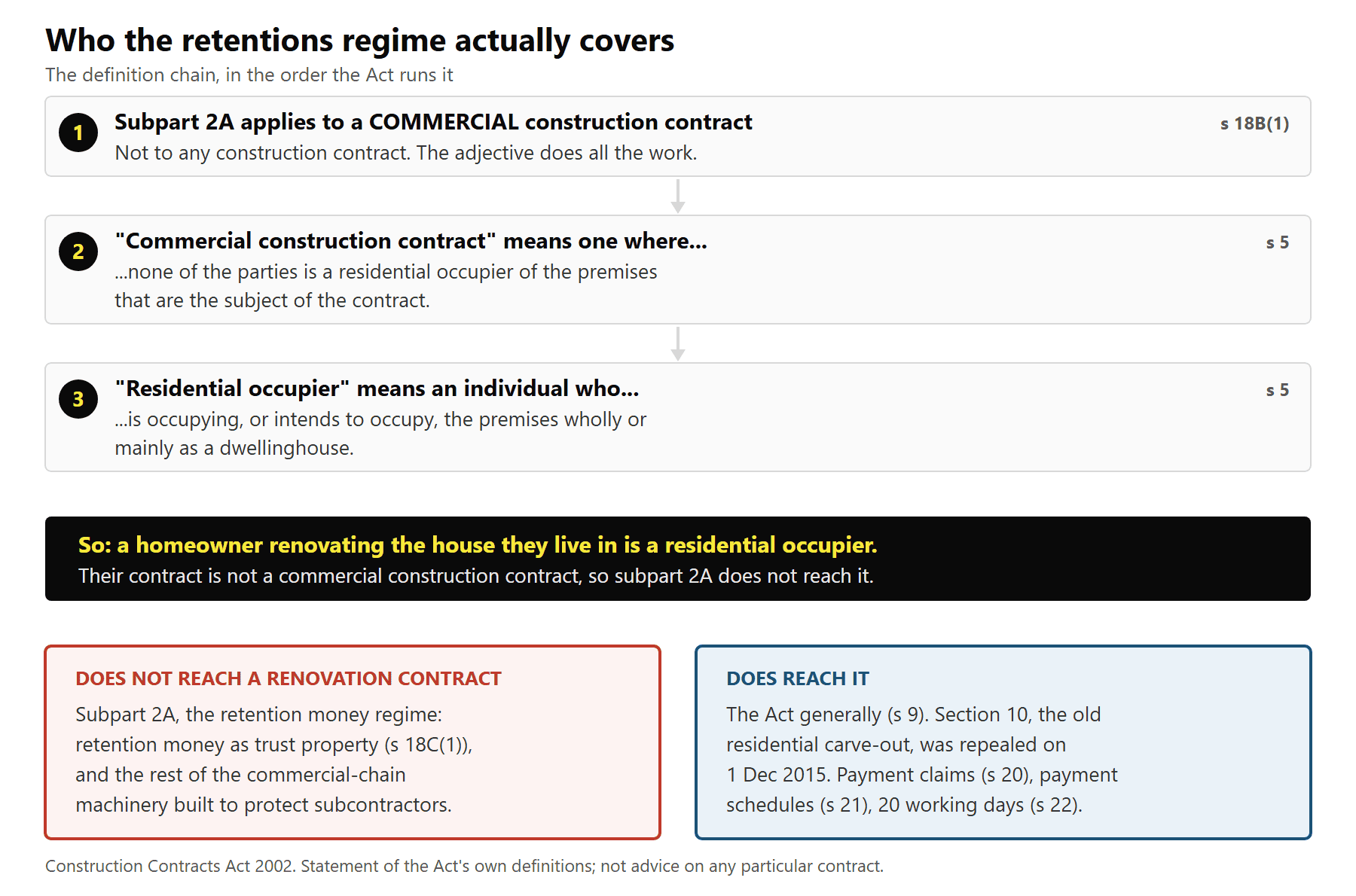
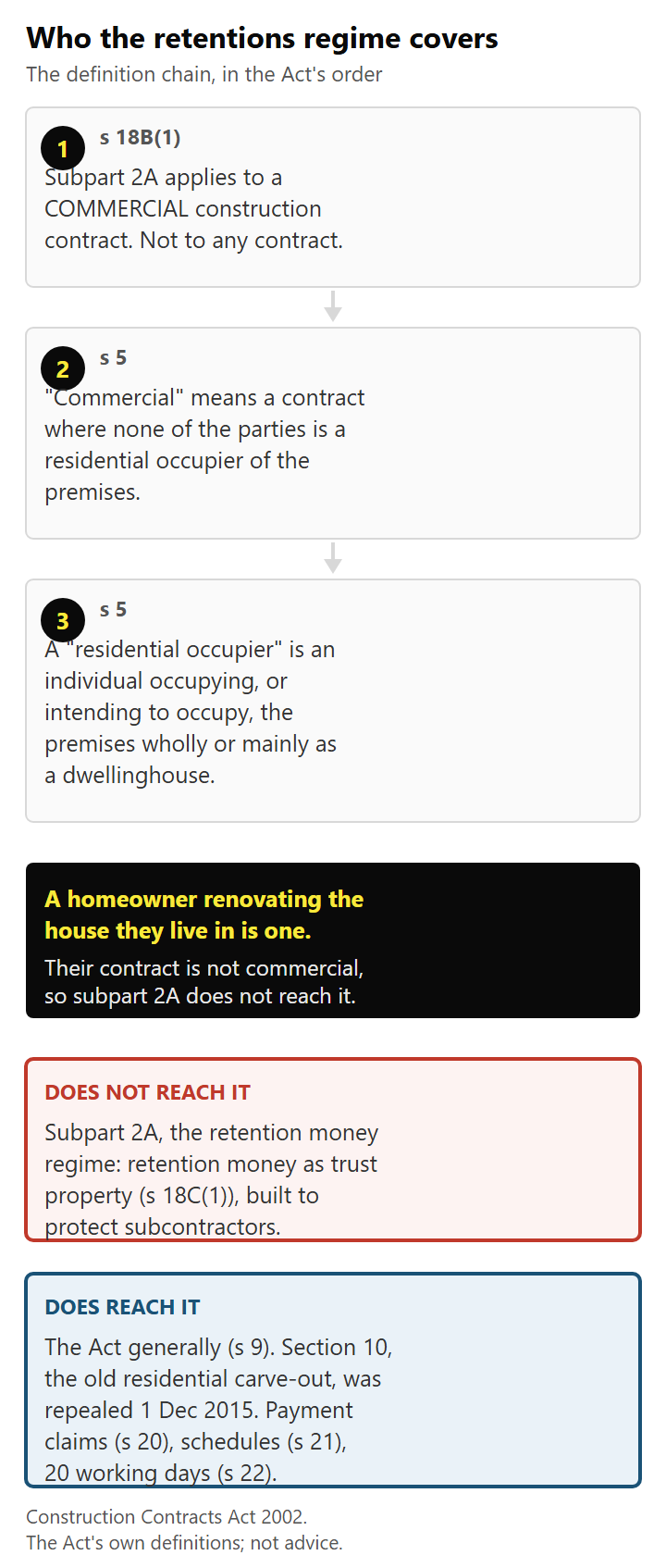
Step one. Section 18B(1) applies subpart 2A to a commercial construction contract. Not to any construction contract. The adjective is doing all the work.
Step two. The interpretation section, section 5, defines a commercial construction contract as a contract for carrying out construction work in which none of the parties is a residential occupier of the premises that are the subject of the contract.
Step three. Section 5 also defines a residential occupier: an individual who is occupying, or intends to occupy, the premises that are the subject of a construction contract wholly or mainly as a dwellinghouse.
Put the three together. A person renovating the house they live in, or intend to live in, is a residential occupier of those premises. A contract with that person is therefore not a commercial construction contract. Subpart 2A applies only to commercial construction contracts. So the retention money regime, trust property and all, does not reach a residential renovation contract at all.
MBIE states the same conclusion directly. On its Construction Contracts Act 2002 page it records that the new requirements which came into force on 5 October 2023 “apply only to new commercial contracts from 5 October 2023 and existing commercial contracts that are renewed on, or after, that date”, and that “they do not apply to construction contracts with homeowners/residential occupiers”.
So the ten percent advice is not a misreading of the retentions rules. It is a transplant of them from a contract the reader is not a party to.
Worth being precise about: none of this means a renovation contract cannot contain a holdback of some kind. It means that where one exists, it sits in the contract the parties signed and is governed by the terms of that contract, not by subpart 2A of the Act. The statutory trust, and the machinery that goes with it, belongs to the commercial regime.
The Part Almost Everyone Gets Backwards: the Act Does Apply
Because subpart 2A stops at the door, it is easy to conclude the Construction Contracts Act has nothing to do with a home renovation. That conclusion is wrong, and it is wrong in a way that costs homeowners the protections they do have.
Section 9 sets the general application. Subject to sections 11 and 11A, the Act applies to every construction contract, whether or not governed by New Zealand law, that relates to carrying out construction work in New Zealand, that was entered into on or after the Act’s commencement or renewed for a further term after it, and that is written or oral, or partly written and partly oral.
Every construction contract. Written or oral.
There used to be a carve-out. Section 10 was headed “When Act applies: residential construction contracts” and set separate application rules for them. It was repealed on 1 December 2015 by section 8 of the Construction Contracts Amendment Act 2015. Since that date there has been no separate residential application regime in the Act. The general rule in section 9 covers residential construction contracts the same way it covers any other.
And section 12 closes the obvious escape route. The Act has effect despite any provision to the contrary in any agreement or contract. A clause in a contract cannot displace it.
The result is a split that explains most of the confusion on this topic. The retentions subpart is commercial only. The payments part of the Act, which is where the practical machinery lives, applies to a residential renovation contract in Auckland as fully as it applies to a commercial build.
What the Payments Part of the Act Actually Provides
This is the material worth knowing before the payment structure is agreed, because it governs how money is claimed and answered on the contract either party signs.
Payment claims: section 20
Section 20(1) provides that a payee may serve a payment claim on the payer. Section 20(2) then sets out what a payment claim must contain. It must be in writing. It must contain sufficient details to identify the construction contract to which the payment relates. It must identify the construction work and the relevant period the payment relates to. It must state a claimed amount and the due date for payment. It must indicate the manner in which the payee calculated the claimed amount. And it must state that it is made under the Act.
Section 20(3) adds two accompanying documents. A payment claim must be accompanied by an outline of the process for responding to that claim, and an explanation of the consequences of not responding to a payment claim and of not paying the claimed amount or the scheduled amount in full. Section 20(4) requires those matters to be in writing and in the prescribed form, if any. MBIE publishes that prescribed material as Form 1.
That accompanying outline is the Act deciding that the party receiving a payment claim should be told, on the document itself, what happens next and what happens if they do nothing.
Payment schedules: section 21
Section 21(1) provides that a payer may respond to a payment claim by providing a payment schedule to the payee. Under section 21(2) a payment schedule must be in writing, must identify the payment claim it relates to, and must state a scheduled amount.
Section 21(3) is the subsection that matters when there is a disagreement. If the scheduled amount is less than the claimed amount, the payment schedule must indicate the manner in which the payer calculated the scheduled amount, the payer’s reason or reasons for the difference between the two amounts, and, where the difference is because the payer is withholding payment on any basis, the payer’s reason or reasons for withholding payment.
The Act therefore already contemplates a payer paying less than was claimed. What it requires is that the reasoning be written down and given, in a schedule, within the time the contract allows.
What happens when nobody responds: sections 22 and 23
Section 22 provides that a payer becomes liable to pay the claimed amount on the due date if a payee serves a payment claim and the payer does not provide a payment schedule within the time required by the contract or, where the contract does not provide for it, within 20 working days after the payment claim is served.
Section 23 sets out what follows if that liability arises and the amount still is not paid by the due date. Under section 23(2) the payee may recover the unpaid portion from the payer as a debt due in any court, together with the actual and reasonable costs of recovery awarded against the payer by that court, and may serve notice on the payer of the payee’s intention to suspend the carrying out of construction work under the contract. Section 23(3) requires that notice to state the grounds and to state that it is given under the Act.
Silence, in other words, is the one response the Act treats as an answer. Twenty working days of it converts a claimed amount into a liability.
💡 Worth knowing before the first claim arrives: the Act puts the onus on whoever receives a payment claim to respond in writing, and it fixes what that response has to contain. A payment schedule that pays less than was claimed has to show the calculation and give the reasons, including the reasons for withholding. That is a different thing from holding money back and saying nothing, which is what the ten percent advice usually amounts to in practice.
Why a dispute does not pause a debt: section 79
Section 79 is short and it surprises people. In any proceedings for the recovery of a debt under section 23, section 24 or section 59, the court must not give effect to any counterclaim, set-off or cross-demand raised by any party, other than a set-off of a liquidated amount where judgment has been entered for that amount or where there is not in fact any dispute between the parties about it.
A grievance about workmanship, raised at that point, does not operate as an answer to that debt in those proceedings. The Act separates the question of what is owed on a payment claim from the question of whether the work was good enough, and it deals with them on different tracks.
That separation is the real reason the ten percent advice is risky as a plan. It treats withholding as a costless way to hold leverage. The Act treats a payment claim as a document with a clock attached, and it is specific about what a party who wants to pay less has to put in writing and when.
What This Means for the Way a Renovation Contract Is Structured
Two things follow from the above, and both belong in the conversation before anything is signed rather than after.
The contract is where a holdback lives or does not. On our own projects the payment stages sit with the project management team who own the build programme, not with the sales conversation. Subpart 2A will not supply one on a residential renovation, and section 12 means the contract cannot remove what the Act does provide. So the payment structure, the trigger points for each progress claim, what has to be true before a claim is made, and what happens at practical completion are matters for the contract itself. We have set out what a renovation contract in New Zealand has to cover, and the documents that have to reach you before you sign, in our guide to renovation contracts in NZ, and the written-contract threshold in our explainer on the $30,000 rule.
The defects position is separate from the payments position. The Building Act 2004 carries implied warranties into every residential building contract and a twelve-month defect repair period, and they cannot be contracted out of. Those are the provisions that speak to work not being right. They sit alongside the Construction Contracts Act rather than inside it, and they are covered in the contract guide linked above.
A homeowner who understands that split is in a much stronger position than one holding ten percent and hoping it does the work of both.
Where to go for your own contract: this article describes what the legislation says. It does not tell you what to do on your project, and it is not a substitute for advice on your own contract. MBIE’s Building Performance site carries the consumer-protection guidance, including its pages on the Construction Contracts Act 2002 and on retention money requirements. For anything turning on the wording of a contract you have been given, or on money already in dispute, take your own legal advice.
The Short Version
- The retention money regime in subpart 2A applies to commercial construction contracts, which the Act defines as contracts where none of the parties is a residential occupier.
- A residential occupier is an individual occupying, or intending to occupy, the premises wholly or mainly as a dwellinghouse. A homeowner renovating their own home is one.
- The regime exists to protect money owed to subcontractors if a head contractor’s business fails. MBIE states so on its own pages, and section 18C(1) makes that money trust property.
- MBIE states withholding retention money is not a legal requirement at all, and that anyone who does it must meet the Act’s requirements.
- Section 10, the old residential carve-out, was repealed on 1 December 2015. The Act applies to residential construction contracts under the general rule in section 9, written or oral.
- The payments machinery does reach a renovation contract: payment claims under section 20, payment schedules with written reasons under section 21, a 20-working-day consequence under section 22, recovery as a debt and notice of intention to suspend under section 23, and no set-off in those recovery proceedings under section 79.
- Section 12 means none of it can be contracted out of.
➡ Book your free in-home consultation with Superior Renovations
➡ Put a price range around your project with our free cost calculators
➡ Request a free feasibility report for your project
Can a homeowner hold back retentions under the Construction Contracts Act?
No. Subpart 2A of the Construction Contracts Act 2002, which governs retention money, applies under section 18B(1) only to a commercial construction contract. Section 5 defines that as a contract for carrying out construction work in which none of the parties is a residential occupier of the premises, and defines a residential occupier as an individual occupying or intending to occupy the premises wholly or mainly as a dwellinghouse. A homeowner renovating their own home is a residential occupier, so the retention money regime does not apply to their contract. MBIE states the same position: the requirements that came into force on 5 October 2023 do not apply to construction contracts with homeowners or residential occupiers.
Who does the retention money regime protect?
Subcontractors. MBIE describes retention money as the amount held back from subcontractors out of a payment made to them as security for their performance, and states the regime was put in place to protect retention money owed to subcontractors should a head contractor's business fail. Section 18C(1) of the Act makes retention money trust property, held on trust by the party withholding it for the party it is owed to.
Does the Construction Contracts Act apply to residential building work at all?
Yes. Section 9 provides that, subject to sections 11 and 11A, the Act applies to every construction contract relating to construction work carried out in New Zealand, whether written or oral or partly both. Section 10, which had set separate application rules for residential construction contracts, was repealed on 1 December 2015 by section 8 of the Construction Contracts Amendment Act 2015. What does not apply to a residential contract is subpart 2A, the retention money regime.
What is a payment claim under the Construction Contracts Act?
Section 20(2) provides that a payment claim must be in writing, contain sufficient details to identify the contract, identify the construction work and the relevant period, state a claimed amount and the due date for payment, indicate how the claimed amount was calculated, and state that it is made under the Act. Section 20(3) requires it to be accompanied by an outline of the process for responding and an explanation of the consequences of not responding or not paying in full. MBIE publishes that accompanying material as Form 1.
What happens if a payment claim is ignored?
Section 22 provides that a payer becomes liable to pay the claimed amount on the due date if a payment claim is served and no payment schedule is provided within the time the contract requires or, where the contract does not provide for it, within 20 working days after the claim is served. Under section 23(2), where that liability has arisen and the amount is unpaid by the due date, the payee may recover the unpaid portion as a debt due in any court along with the actual and reasonable costs of recovery awarded by the court, and may serve notice of an intention to suspend the construction work.
Can a payer pay less than the amount claimed?
Section 21 provides that a payer may respond to a payment claim with a payment schedule. Where the scheduled amount is less than the claimed amount, section 21(3) requires the schedule to indicate how the scheduled amount was calculated, the reasons for the difference between the two amounts, and, where the difference is because the payer is withholding payment on any basis, the reasons for withholding payment. The Act contemplates a lower payment, and requires the reasoning to be given in writing in the schedule.
Can a dispute about workmanship be set off against a payment debt?
Section 79 provides that in proceedings for the recovery of a debt under section 23, 24 or 59, the court must not give effect to any counterclaim, set-off or cross-demand, other than a set-off of a liquidated amount where judgment has been entered for that amount or where there is no dispute about it. Questions about the standard of the work are dealt with separately from recovery of a debt arising under those sections. Implied warranties and the twelve-month defect repair period sit in the Building Act 2004, not the Construction Contracts Act.
Can a contract override the Construction Contracts Act?
No. Section 12 provides that the Act has effect despite any provision to the contrary in any agreement or contract.
Further Resources for your renovation planning
- Featured projects and Client stories to see specifications on some of the projects.
- Real client stories from Auckland
Need more information?
Take advantage of our FREE Complete Home Renovation Guide (48 pages), whether you’re already renovating or in the process of deciding to renovate, it’s not an easy process, this guide which includes a free 100+ point check list – will help you avoid costly mistakes.
Download Free Renovation Guide (PDF)

Have you been putting off getting renovations done?
We have partnered with Q Mastercard ® to provide you an 18 Month Interest-Free Payment Option, you can enjoy your new home now and stress less.
Learn More about Interest-Free Payment Options*
*Lending criteria, fees, terms and conditions apply. Mastercard is a registered trademark and the circles design is a trademark of Mastercard International Incorporated.
Still have questions unanswered?
Book a no-obligation consultation with the team at Superior Renovations, we’d love to meet you to discuss your renovation ideas!
References
Current as at 21 Sep 2026. Sources are linked throughout. For consumer-protection guidance see building.govt.nz, and seek your own legal advice for your specific situation.
- Construction Contracts Act 2002, sections 5, 9, 10 (repealed), 12, 18B, 18C, 20, 21, 22, 23 and 79 — New Zealand Legislation
- Construction Contracts Amendment Act 2015, section 8 (repeal of section 10) — New Zealand Legislation
- Construction Contracts Act 2002 — Building Performance (MBIE)
- Retention money requirements — Building Performance (MBIE), last updated 26 February 2024
- Building Act 2004, Part 4A implied warranties — New Zealand Legislation


