

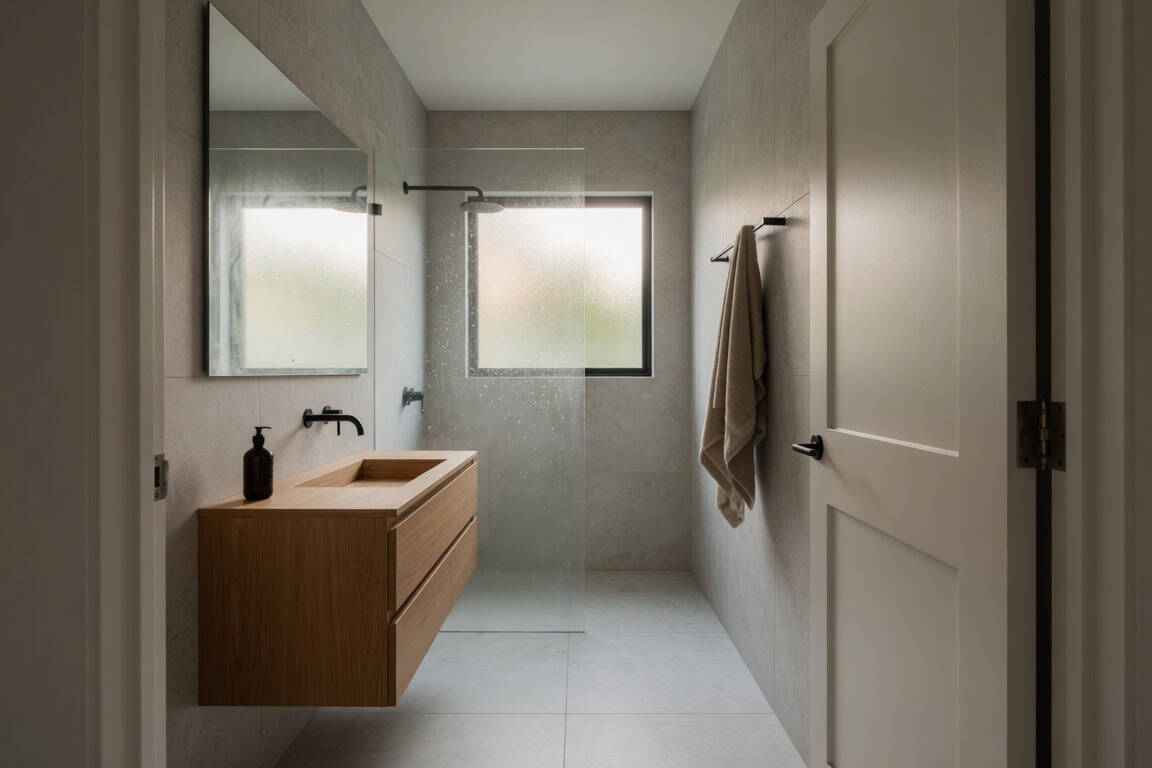
Guide On Small Bathroom Renovations: Layout, Costs and Designs
Last updated:
Quick answer: Small bathroom renovations in Auckland start at around $8,000–$15,000 for a budget refresh and $25,000–$35,000 for a full mid-range strip-out (2026 pricing). The biggest gains in a tight bathroom come from layout, plumbing on one wall, a floating vanity, large-format tiles and a single frameless glass panel, not from spending more.
If you’re wrestling with a pokey bathroom in a Grey Lynn bungalow, a tight ensuite in a Parnell apartment, or a 1970s three-quarter bath in Manurewa that’s never quite worked, you’re in the most common renovation we take on. Small bathrooms are also the ones where good planning pays off most. There’s no room for a mistake to hide.
We’ve renovated hundreds of Auckland bathrooms since 2017, and the tight ones follow a pattern. Get the layout, the ventilation and the tile choices right and a 3.5m² ensuite can feel twice the size. Get them wrong and no amount of nice tapware saves it. This guide walks through the layouts that work by bathroom size, what small bathroom renovations actually cost in Auckland in 2026, the NZ rules you need to know, and the mistakes we see most often.
How to Make a Small Auckland Bathroom Feel Bigger Without Moving Walls
Free cost calculator
How much will your bathroom renovation cost?
Get an instant Auckland price range for your project — no details required to see it.
You don’t need to knock out a wall to make a small bathroom feel open. Most of the difference comes from light, sightlines and a handful of design decisions that cost little more than the cluttered version.
Light, reflective surfaces do the heavy lifting. Matte white subway tiles with a simple grout, light neutral walls and a generous mirror bounce light around and double the perceived space, especially useful in dim Mt Eden villas with one small window. A large mirror or a mirrored cabinet above the vanity is the single highest-value move in a tight room.
Get fixtures off the floor. A floating (wall-hung) vanity, a wall-mounted toilet and a frameless glass shower panel all keep the floor visible from wall to wall, which is what makes a room read as larger. The eye follows the unbroken floor line. Break it up with bulky furniture and the room shrinks.
Use larger tiles, not smaller ones. It feels counter-intuitive, but big-format tiles mean fewer grout lines and fewer visual breaks, so a small floor reads larger than it is. Keep the walls calm and save any pattern for a single feature.
“In small Auckland bathrooms the optical tricks matter more than the budget. A big mirror, light large-format tiles and a floating vanity will make a tight room feel open before you’ve spent a dollar on anything fancy. We design the sightline from the door first, then place everything else around it.”
— Dorothy Li, Design Manager, Superior Renovations
💡 Quick tip: Swap a shower curtain for a single frameless glass panel. It’s one of the cheapest changes you can make, and clear glass visually extends the room instead of cutting it in half.
Want to see how this comes together in real Auckland homes? Browse our bathroom design gallery for inspiration.
Small Bathroom Layouts That Work — By Size
The right layout depends on your footprint. These are the four sizes we see most in Auckland, with a layout that works for each. None of them need walls moved, they keep the existing footprint and the existing waste-pipe positions, which is what keeps the cost sensible.
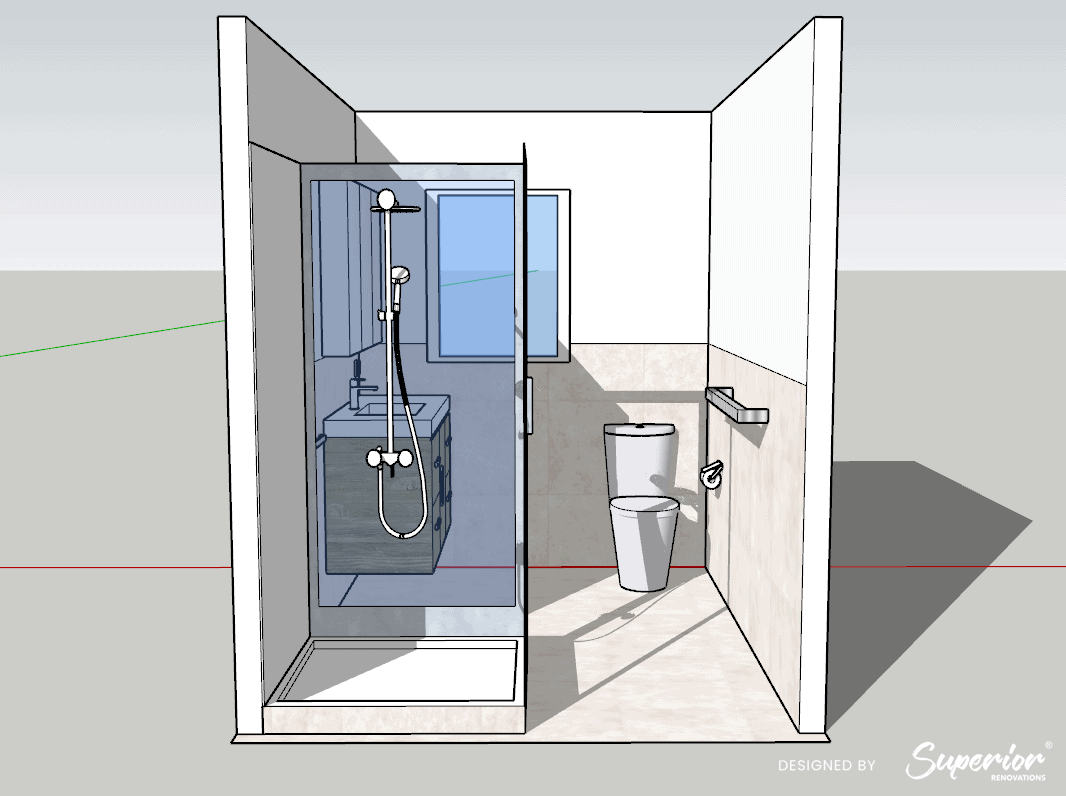
Standard Full Bathroom (around 3.6m² / 1,500 × 2,400mm)

Dimensions: about 3.6m² (1,500 × 2,400mm). Fixtures: vanity, toilet, and either a tub-shower combo or a walk-in shower.
This is the most common small bathroom size in Auckland, the minimum footprint to be considered a full bathroom. You’ve got two sensible options depending on how you bathe:
- A modest tub-shower combo (still the right call for families bathing young kids).
- A single walk-in shower, which frees up floor space and feels more open.
Either way, keep the vanity nearest the door and the wet zone at the far end so you’re not walking past a wet glass screen to brush your teeth.
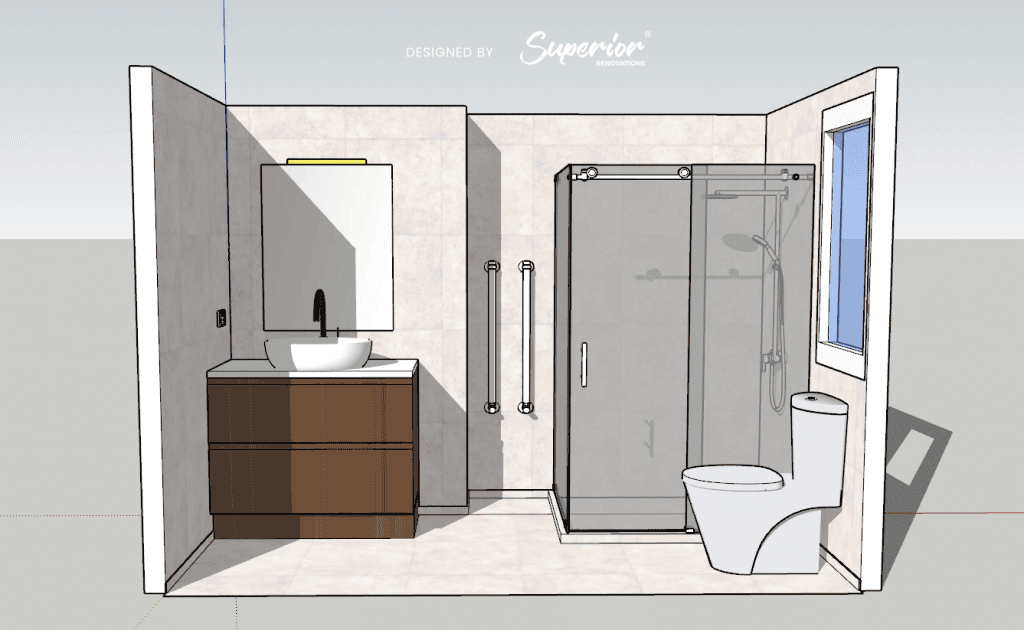

Three-Quarter Bathroom (around 3.3m² / 1,800 × 1,800mm)

Dimensions: about 3.3m² (1,800 × 1,800mm). Fixtures: vanity, toilet, and a standard shower.
A three-quarter bathroom drops the tub and runs vanity, toilet and shower in a simple line. We keep it deliberately simple here for two reasons: a busy layout eats the limited space, and a cramped, bulky arrangement makes the room feel smaller than it is. Tuck the shower or vanity into a corner to keep the traffic path clear.


Separate Tub and Shower (around 4.2m² / 1,500 × 2,750mm)
 About 4.2m² (1,500 × 2,750mm). Fixtures: vanity, toilet, tub and shower. |  Small bathroom with a sliding door |
Fitting both a tub and a separate shower into a small bathroom sounds like a stretch, but it works if you’ve got roughly 4.2m² and you plan the entry properly. Space for dressing gets tight, so we swap a standard swing door for a sliding or pocket door, that alone gives you back the half-square-metre a hinged door wastes.


Narrow Bathroom (around 2.5–3m² / 900 × 2,750mm or 1,200 × 2,400mm)

Dimensions: about 2.5–3m² (900 × 2,750mm or 1,200 × 2,400mm). Fixtures: vanity, toilet, and shower.
Narrow bathrooms are the trickiest to arrange, standard fixtures stick out and interrupt the walk-through. A few rules make them work:
- Outward-swinging, sliding or pocket door, get the door swing out of the room entirely.
- Vanity and toilet on the same wall, a single run reads cleaner and keeps the opposite wall clear.
- Wall niches for the basin and toilet cistern so nothing protrudes into the walk-through.
- Shower against the short wall at the far end to make the room feel longer.
Tiny Half Bathroom (around 2–2.8m²)

Dimensions: about 2–2.8m². Fixtures: toilet and basin, sometimes a compact shower.
The smallest layout, usually a guest WC with just a toilet and basin. You can still squeeze a shower in with a wet-room approach and a floor waste, but you’ll need proper tanking and good ventilation to keep it dry.
“Auckland villas and bungalows almost always have small, narrow bathrooms with fixed waste-pipe positions. The best layout keeps the plumbing on the existing wall, puts the vanity nearest the door and the shower at the far end with a frameless panel. A pocket door and a floating vanity buy you the floor space without touching the structure.”
— Alison Yu, Designer, Superior Renovations
💡 Quick tip: Keeping all the plumbing on one wall is the cheapest layout decision you can make, shorter pipe runs mean less labour and less chance of hitting a structural surprise behind the GIB.
For a deeper look at clearances and the most common layout mistakes, see our golden rule for bathroom layouts.
10 Ways to Maximise Space in a Small Bathroom Renovation
Once the layout’s locked, the detail decisions are what free up the last few centimetres. Here’s where we focus on a small bathroom renovation.
1. Plan around your fixtures early
Even a tiny bathroom needs a proper plan, basin, toilet, shower, lighting, mirror and storage all mapped before anything’s ordered. Space-saving fixtures (corner showers, compact vanities, slimline cisterns) make the difference in a tight room.
2. Keep plumbing where it is
Place new fixtures near the existing water and waste lines wherever possible. Moving plumbing, especially the toilet, which has a large soil pipe needing proper fall, is the single most expensive change you can make in a bathroom.
3. Use the walls for towels
A heated towel rail or a vanity with built-in rails keeps towels off the floor and frees the limited space you have.
4. Sort the ventilation
Easily the most-skipped step. In Auckland’s humid climate, a small bathroom with no airflow grows mould fast. If there’s no openable window, an extractor fan isn’t optional, it’s required under the Building Code (more on that below).
5. Go vertical with storage
Tall open shelving, a mirrored cabinet and niches built into the shower wall add storage without stealing floor space.
6. Keep it simple
Overdoing colour and pattern makes a small room feel closed-in and cluttered. Bright, simple tiles and a calm palette make it feel open.
7. Use a floating or pedestal basin
A wall-hung or pedestal basin takes up less visual floor space than a full vanity, though you trade some storage, so balance it against your needs.
8. Add floating shelves
Wall-mounted shelves give you somewhere for toiletries and towels without a single centimetre of floor lost.
9. Consider a wall-mounted toilet
A wall-hung toilet with an in-wall cistern frees floor space and keeps the room feeling open. It costs more to install but the visual payoff in a small room is real.
10. Don’t forget the door swing
A standard inward-swinging door eats roughly 0.7m² of floor and collides with the vanity or towel rail. A sliding, pocket or barn door reclaims that space permanently.
💡 Quick tip: Before you sign off a layout, open every drawer and cabinet door and simulate the door swing on the plan. If anything overlaps, fix it now, it’s a five-minute check that prevents an expensive regret. For the full design picture beyond small rooms, our complete guide to bathroom design in NZ covers layouts, trends, lighting and fixtures in depth.


What a Small Bathroom Renovation Costs in Auckland (2026)
Here’s the honest version. A small bathroom is rarely cheap to renovate properly, because the cost sits in the trades and the waterproofing, not the floor area. A compact bathroom still needs a plumber, electrician, tiler, waterproofer and plasterer, seven to eight specialist trades working in sequence in a space the size of a small car. That’s why a tight Ponsonby ensuite can cost nearly as much as a larger family bathroom in Flat Bush.
These are current Auckland figures for 2026, in line with our published bathroom renovation pricing:
| Type of small bathroom renovation | What it covers | Auckland cost (2026) |
|---|---|---|
| Budget refresh | Re-grout, paint, new tapware and vanity, minor tiling, same layout | $8,000–$15,000 |
| Mid-range full renovation | Full strip-out, new waterproofing, tiling, vanity, shower and fixtures, same footprint | $25,000–$35,000 |
| Luxury / wet-room | Wet-room tanking, premium fixtures, underfloor heating, custom joinery | $35,000–$65,000+ |
| Labour (most small jobs) | Specialist trades, ~$120–$150/hour | 40–60% of the total |
Why a small bathroom costs nearly as much as a big one
Most of a bathroom budget does not scale with floor area, which is why searching for an “average small bathroom renovation cost” gives you a number that fits almost nobody. Split the job in two and it becomes obvious.
Costs that barely move between a 3.5m² bathroom and a 7m² one: the demolition and the skip, the waterproofing system and the producer statement that comes with it, the plumber’s and electrician’s time (a small room still needs every fixture connected, tested and certified), the extractor and its ducting, making good the linings, and the project management to run seven trades through one doorway in sequence.
Costs that do scale: the tiling, the vanity, the glass and the tapware count. In a 3.5m² bathroom tiled floor to ceiling you are covering roughly 18–22m² of surface. Double the room and you are closer to 30–35m². The tiling line roughly doubles. Almost nothing else does.
That is the whole reason a compact ensuite in Ponsonby quotes close to a family bathroom in Flat Bush, and it is why the useful question is never “what is the average” but “which of my costs are fixed, and what am I actually choosing on the variable ones”.
Bath sizes that fit a small NZ bathroom
The default assumption is a 1700mm bath, and in a narrow bathroom that single number decides the whole layout. New Zealand supply runs well either side of it. Looking at Clearlite’s current bath range, the sizes on offer include the Pinnacle Bath 1200 at 1200mm, the Varo Back to Wall at 1520mm, the Pinnacle 1655 at 1655mm, the Nikau drop-in at 1675mm and the same Nikau at 1800mm.
In practice that gives you three moves in a tight room:
- Drop from 1700mm to 1520mm and you free up roughly 180mm at one end. That is often the difference between a door that clears the bath and one that does not.
- Go to a 1200mm soaker where the bath is there for young children rather than for adults to lie down in. It buys back enough length for a genuine vanity instead of a wall-hung basin.
- Keep 1675–1700mm and lose the separate shower, running a shower over the bath instead. In a bathroom under about 4m² that is almost always the better trade.
Measure the actual wall-to-wall dimension before you fall in love with a bath, not the nominal room size. Linings, packers and an out-of-square wall in an older Auckland home routinely eat 20–30mm, and a bath that is 10mm too long is a scribed-in compromise you look at every day.
What moves the number most: relocating plumbing ($1,000–$5,000), premium tiles ($50–$150/m² versus $30–$50/m² for basic ceramic), and whether the job needs council consent. Coastal suburbs like St Heliers also need proper waterproofing and ventilation, skip those and you’re paying for mould remediation later.
Construction costs have settled since the 2021–22 spikes. Per Cotality’s Cordell Construction Cost Index, residential building costs rose about 0.6% in the June 2025 quarter and 2.7% over the year, modest by recent standards. Our own bathroom pricing is up roughly 5–8% on 2025, driven by material and labour inflation. For a small renovation, stable costs make it a sensible time to go.
💡 Quick tip: Half-height tiling instead of floor-to-ceiling, and keeping every fixture in its existing position, are the two changes that save the most without showing in the finished room.
Want a figure for your own bathroom? Work up a ballpark with our bathroom renovation cost calculator, or read the full tier-by-tier breakdown in our Auckland bathroom renovation cost guide. If your budget’s tight, our guide to renovating a bathroom under $10,000 covers what’s realistic.
Refreshing a Small Bathroom on a Budget
Not every small bathroom needs a full strip-out. If the layout works and the bones are sound, these updates lift the room without the big spend:
- Re-grout tired tiles for a fresh look.
- Resurface the bath instead of replacing it.
- Refinish the cabinetry.
- Install new tapware and a new mirror.
- Repaint, the easiest win of all.
💡 Quick tip: Re-grouting and re-sealing a tired shower is the highest-impact budget job there is, it lifts the whole room for the price of about a day’s labour, and it buys you time to save for the bigger renovation.
A word on DIY: a bathroom is a wet area with electrical and waterproofing requirements, and a small one still involves up to a dozen trades. Cosmetic jobs like painting are fair game. Anything touching plumbing, electrical or waterproofing should go to a licensed tradesperson, both for compliance and because a bathroom is one of the top selling points in a house, and shoddy work shows.
Ventilation and Consent: The NZ Rules for Small Bathrooms
Two compliance points matter more in a small bathroom than a large one, because there’s less margin for error.
Ventilation and waterproofing (Building Code)
Under Clause E3 (Internal Moisture) of the New Zealand Building Code, wet areas must have adequate ventilation and impervious, easy-to-clean surfaces around showers and fixtures. In a small bathroom with no openable window, that means mechanical extraction, a fan vented outside, not into the ceiling cavity. Waterproofing membranes in wet areas are installed to AS/NZS 4858, the NZ standard for wet-area membranes. In Auckland’s humidity, this is what stands between you and a mould problem down the track. The official requirements are set out by Building Performance (MBIE).
“For tiny ensuites in Parnell or Remuera we design to E3 from the start, a properly vented extractor, impervious tiles and a waterproof membrane to standard. Get the moisture control right in a small room and it stays fresh for years. Get it wrong and you’re re-tiling inside five.”
— Cici Zuo, Head of Sales (NZ Dip. Interior Design), Superior Renovations
Do you need building consent?
For most small bathroom renovations, the answer is no, but it depends on what you’re changing:
- Usually exempt (no consent): replacing tiles, vanity, toilet and shower in the same positions. Like-for-like fixture replacement generally falls under Schedule 1 of the Building Act 2004.
- Consent likely required: moving plumbing to a new location, removing or adding walls, electrical changes beyond standard replacements, or any work on a home with a heritage overlay.
- Watch the wet area: installing a brand-new tiled wet-area shower means a new waterproof membrane, which Auckland Council treats as critical building work, so a wet-room conversion can need consent even when the rest of the job is like-for-like.
If consent is needed, Auckland Council processing typically adds four to eight weeks before work can start, plus fees. We assess this at your free consultation and manage the application for you. Check current requirements and fees with Auckland Council’s kitchen and bathroom renovation consent guidance before you set a start date.
Important note: Adding a fixture where none existed before, say, a new shower in a former half-bath, usually brings consent into play because of the new drainage. Replacing like-for-like in the same spot generally does not. When in doubt, get it assessed before you start, not at sign-off.
Two decisions come up in nearly every small bathroom we price: whether to tile the shower or fit an acrylic liner, and whether to go to a fully tanked wet room. We have set both out in detail in our comparison of acrylic versus tiled showers and our guide to wet room bathrooms in NZ.
15 Mistakes to Avoid in a Small Bathroom Renovation
Designing a small bathroom is a series of trade-offs. These are the ones that go wrong most often.
💡 Quick tip: For any small bathroom over about $20,000, a designer usually saves more than they cost, the right layout and clearances head off most of the expensive regrets on this list before a single tile is laid.
1. No budget
Renovating without a clear budget and scope is the fastest way to a stalled project. Know what you’re replacing and what your ceiling is before you start, and choose a company that respects it.
2. Poor ventilation
The most-overlooked failure. No airflow means damp, mould and mildew. If there’s no window, fit an extractor vented outside.
3. Cutting corners on finishes
Cheap waterproofing and bargain fixtures are a false economy in a wet room. Prioritise the membrane and the fixtures you touch every day.
4. Wrong materials
A bathroom is a wet environment. Avoid materials that rot, rust or harbour bacteria, get moisture-rated surfaces for the vanity top, cabinetry and tiles.
5. Bad lighting
Dim lighting makes a small room feel smaller and makes cleaning and grooming harder. Layer it, overhead, task lighting at the mirror, and natural light where you can.
6. Unskilled DIY
A small bathroom still involves up to 10–12 trades. Tiling and plumbing are not as simple as they look. Get a professional in for the wet-area work.
7. Neglecting storage
No storage means clutter, and clutter makes a small room feel cramped. Use vertical space, shelves above the toilet, a mirrored cabinet, niches in the shower wall.
8. Oversized fixtures
A full-size vanity or a standard tub overwhelms a tight room. Choose compact fixtures designed for small spaces, a wall-hung basin, a walk-in shower, a slimline cistern.
9. Bad fixture placement
Good fixtures mean nothing if you walk straight into the toilet. Placement and sightlines matter as much as the products, this is where a designer earns their fee.
10. Overcomplicating the design
Keep it simple. A limited palette and clean lines read as calm and open; too many elements read as busy and small.
11. Dark, heavy materials
Dark tiles and heavy window treatments close a small room in. Light tiles and sheer treatments open it up. Use mirrors to reflect light and stretch the space.
12. Too much pattern
Pattern works in a small bathroom, sparingly. One feature (a patterned floor, a single accent wall) adds interest; pattern everywhere overwhelms.
13. Ignoring the door swing
An inward-swinging door wastes floor space and clashes with fittings. A pocket or barn door solves it and adds character.
14. Wasting the corners
Corners are prime real estate in a small bathroom, a corner shower or corner basin frees the centre of the room, and corner shelving adds storage.
15. Forgetting functionality
Aesthetics matter, but in a small space function comes first. A handheld shower, an adjustable mirrored cabinet, well-placed storage, the practical details are what make a small bathroom a pleasure to use.
This small bathroom we renovated in Titirangi shows that pattern can work in a tight space when it’s handled carefully. Our client wanted art deco tiles for visual impact, so we used a patterned black-and-white floor in a small format, kept the wall tiles simple with matte white subway tiles and black grouting, and brought in warmth with oak-panelled cabinetry and black trim, a cohesive look that doesn’t overwhelm the room.
Project Spotlight: See the full project, before and after

A small bathroom design proving pattern can work without overwhelming the space.
For this small bathroom in Greenhithe we built a custom barn-style sliding door to claim back floor space. The corridor outside was too narrow for an outward swing, and a toilet sat right behind the door, so a sliding door was the only way to fit the tub, toilet, vanity and shower we wanted.
Project Spotlight: See the full Greenhithe vintage bathroom renovation

Custom barn door fitted in this Greenhithe small bathroom renovation.
Ready to Start Your Small Bathroom Renovation?
A small bathroom is the room where good design earns its keep. Get the layout, the ventilation and the tile choices right and a tight space works harder and feels bigger than its footprint. If you’d like a hand planning yours, that’s exactly what our in-house design team does on every job, and you can see how our team plans a small bathroom renovation from layout to handover.
➡ Book your free in-home consultation with Superior Renovations
➡ Talk through your layout with our in-house design team
➡ Request a free feasibility report for your project
How much does a small bathroom renovation cost in Auckland?
In Auckland in 2026, a budget refresh of a small bathroom (paint, re-grout, new tapware and vanity, same layout) runs $8,000–$15,000. A full mid-range strip-out with new waterproofing, tiling, vanity, shower and fixtures is $25,000–$35,000. A luxury or wet-room small bathroom with premium fixtures and underfloor heating starts from $45,000. Small bathrooms aren't cheap to renovate because the cost sits in the trades and waterproofing, not the floor area.
Can you renovate a small bathroom for $10,000?
Yes, for a basic refresh. A $10,000 budget covers new paint, re-grouting, new tapware, a new vanity and minor tiling, keeping the existing layout and plumbing. It won't cover a full strip-out, new waterproofing or any plumbing relocation, which push a small bathroom into the $25,000–$35,000 range. The trick to staying under $10,000 is changing nothing structural and keeping every fixture in its existing position.
What is the smallest a bathroom can be in NZ?
A functional full or three-quarter bathroom in New Zealand needs roughly 3.3–3.6m² to fit a vanity, toilet and shower comfortably. A tiny half bathroom (toilet and basin) works in around 2–2.8m². Below that, a wet-room approach with a single floor waste and a frameless panel is the only way to fit a shower in. The key constraint is clearances around each fixture, not just total floor area.
Do I need building consent for a small bathroom renovation in Auckland?
Usually not. Replacing tiles, vanity, toilet and shower in the same positions generally falls under a Schedule 1 exemption of the Building Act 2004 and needs no consent. You will need consent if you move plumbing to a new location, remove or add walls, change electrical beyond standard replacements, or if your home has a heritage overlay. Adding a fixture where none existed (a new shower in a former half-bath) usually triggers consent because of the new drainage. Check current rules with Auckland Council.
How long does a small bathroom renovation take?
A standard small bathroom renovation takes about 3 to 4 weeks on site from the day demolition begins, assuming the design is finalised and all materials are on site before work starts. If the job needs Auckland Council consent, for moving plumbing or structural changes, add 4 to 8 weeks for processing before work can begin. Your project manager gives you a clear timeline at the start and keeps you updated throughout.
How do you make a small bathroom look bigger?
Light, large-format tiles with minimal grout lines, a generous mirror, a floating vanity, a wall-mounted toilet and a single frameless glass shower panel all make a small bathroom read larger. The principle is an unbroken floor line and plenty of reflected light. Keep walls calm and save any pattern for one feature. These changes cost little more than the cluttered version and make the biggest difference of anything you can do.
What is the best layout for a small bathroom?
Keep the plumbing on one wall wherever possible, a linear run of vanity, toilet and shower keeps pipe runs short and leaves a clear path through the room. Put the vanity nearest the door and the shower at the far end so you're not walking past a wet screen. In narrow bathrooms, use wall niches and a sliding or pocket door. This keeps the existing waste-pipe positions, which is what keeps the cost down.
Does a small bathroom need a window or extractor fan?
Yes. Under Clause E3 of the New Zealand Building Code, wet areas must be adequately ventilated. If your small bathroom has no openable window, a mechanical extractor fan vented to the outside is required, not optional. In Auckland's humid climate this is essential to prevent mould and mildew, which take hold fast in a small, poorly vented bathroom.
What tiles are best for a small bathroom?
Large-format porcelain tiles are the best choice for a small bathroom. Fewer grout lines and fewer visual breaks make the floor and walls read larger than they are, and porcelain is impervious and easy to clean, important in a wet area under Building Code E3. Light, neutral tones reflect light and open the space up. Save any patterned tile for a single feature, such as the floor, rather than spreading it across every surface.
Is it worth renovating a small bathroom?
Yes. Bathrooms are one of the strongest resale drivers in a home, and a well-designed small bathroom improves daily life out of all proportion to its size. Even a budget refresh from $8,000–$15,000 lifts the look and function of a tired room, while a full renovation adds genuine value, particularly in Auckland's established suburbs where dated single bathrooms are common. The return is both in resale and in how the room feels to use every day.
How do you renovate a small bathroom on a budget in NZ?
Keep the plumbing where it is. Moving the toilet, basin, or shower is the single biggest cost jump. Refresh rather than rip out: re-tile or paint over sound surfaces, keep the existing layout, and spend where it shows, on tapware, a frameless shower screen, and good lighting. A budget small-bathroom refresh in Auckland typically starts around $8,000 to $15,000, while a small bathroom renovation handled end to end runs $25,000 to $35,000. Put waterproofing and ventilation ahead of finishes, because they are what protect the work long term.
Further Resources for your bathroom renovation
- Featured projects and Client stories to see specifications on some of the projects.
- Real client stories from Auckland
Need more information?
Take advantage of our FREE Complete Home Renovation Guide (48 pages), whether you’re already renovating or in the process of deciding to renovate, it’s not an easy process, this guide which includes a free 100+ point check list – will help you avoid costly mistakes.
Download Free Renovation Guide (PDF)

Have you been putting off getting renovations done?
We have partnered with Q Mastercard ® to provide you an 18 Month Interest-Free Payment Option, you can enjoy your new home now and stress less.
Learn More about Interest-Free Payment Options*
*Lending criteria, fees, terms and conditions apply. Mastercard is a registered trademark and the circles design is a trademark of Mastercard International Incorporated.
Still have questions unanswered?
Book a no-obligation consultation with the team at Superior Renovations, we’d love to meet you to discuss your renovation ideas!