

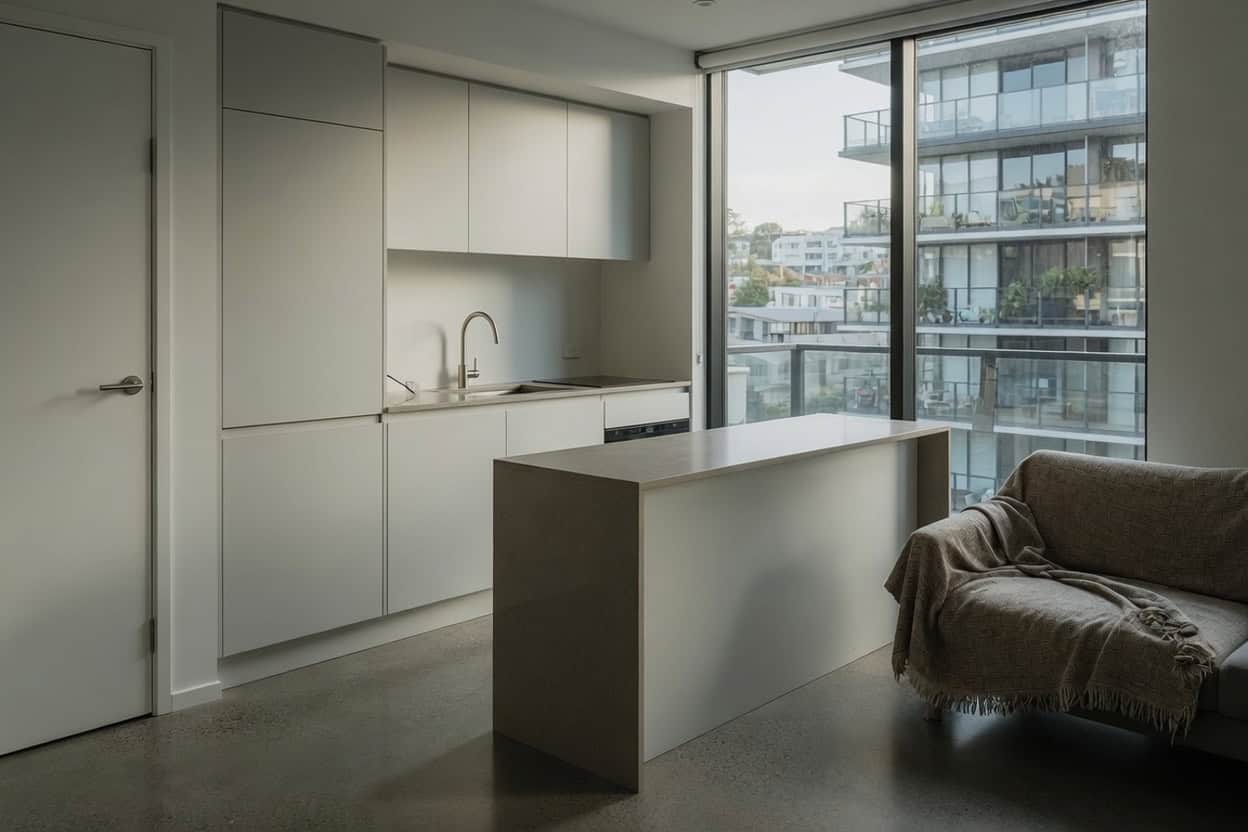
Apartment Renovation Cost Auckland: 2026 Price Guide
Last updated:
Apartment Renovation Cost in Auckland: A 2026 Price Guide
Quick answer: A cosmetic apartment refresh in Auckland — paint, flooring, new tapware, a benchtop swap and fresh cabinet doors — typically runs $5,000–$25,000 depending on how many rooms you touch. A full apartment renovation that redoes the kitchen and bathroom usually lands around $40,000–$80,000+. The bigger variable isn’t the finishes. It’s your body corporate.
Most apartment owners we talk to aren’t ripping out walls. They’re replacing a tired benchtop, swapping a 1990s toilet, re-carpeting before a new tenant moves in, or painting over scuffs that three flatmates left behind. Sensible work. It keeps costs down and, in most cases, it skips council consent entirely.
But an apartment isn’t a standalone house, and the things that catch people out have nothing to do with tile choices. They’re access, noise rules, and a body corporate that gets a say in what you do to your own unit. So this guide gives you the real numbers for the work apartment owners actually do — room by room, with Auckland 2026 pricing — then the apartment-specific stuff no general renovation cost guide bothers to explain.
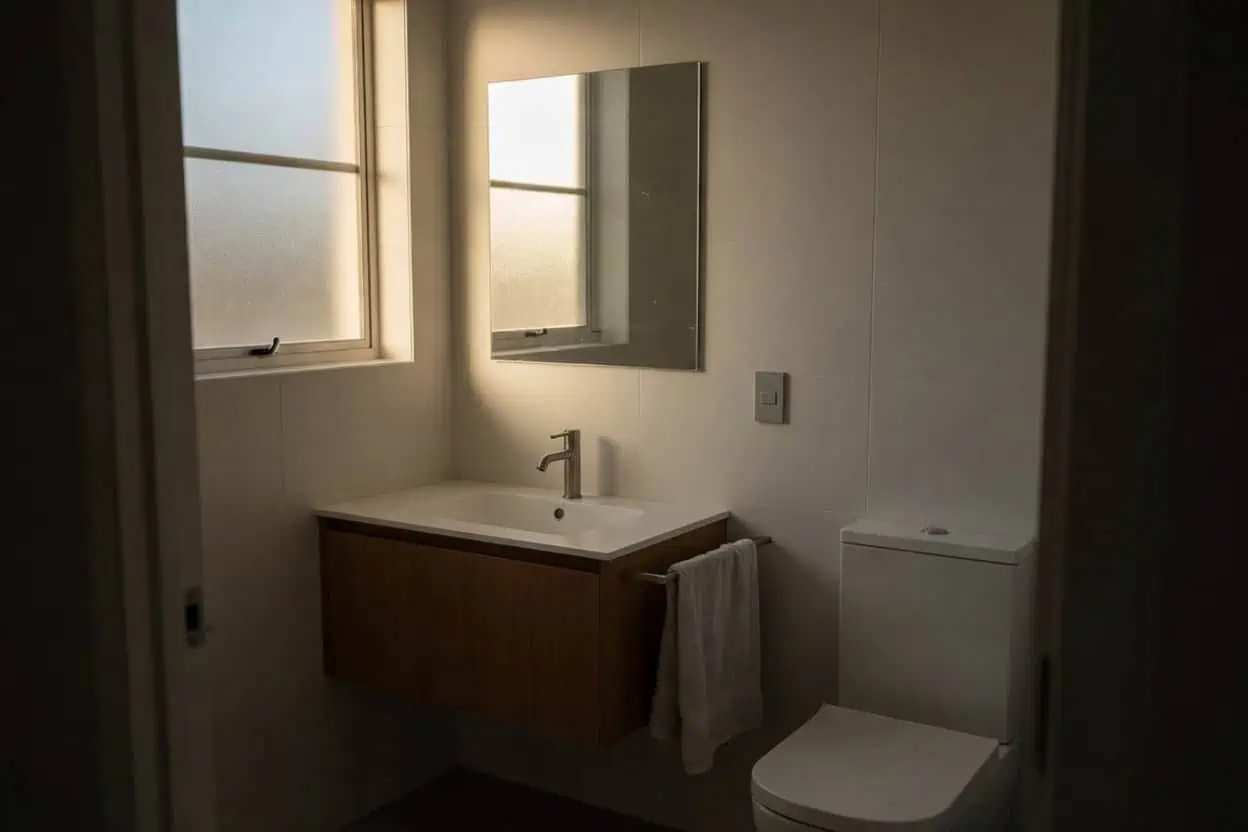
Why an Auckland Apartment Costs Differently to a House
Free cost calculator
How much will your renovation cost?
Get an instant Auckland price range for your project — no details required to see it.
Square-metre rates are how most cost guides start, and for a standalone house they’re a fair sanity check. For an apartment, the per-square-metre number lies to you — not because the finishes cost more, but because everything around the finishes does.
Think about a kitchen reno in a Mt Eden bungalow versus the same kitchen on the fourth floor of a Parnell apartment. Same cabinets. Same benchtop. The difference is getting the old kitchen out and the new one in. No skip bin on the verge — debris goes out by trolley, into the lift, through a lobby someone has to protect, during hours the building allows. That’s labour, and labour is the line that moves.
“People budget for the kitchen and forget the building. In an apartment, half the cost difference is access — booking the lift, carrying everything up, working in the hours the body corporate allows, and protecting the common areas so you’re not up for repairs to the lobby. Get clear on the building’s rules before you price the job, not after.”
— Dorothy Li, Design Manager, Superior Renovations
What Actually Drives the Number
For a standard Auckland renovation, the broad rate sits at $2,000–$4,500 per square metre, climbing past $5,500 for high-end work — you can see the full breakdown in our per-square-metre renovation cost guide for Auckland. Apartments tend to sit at the upper end of any given tier for three reasons:
- Access and disposal. No on-site skip means manual removal. General uplift and disposal runs roughly $200–$500 per skip-load on a normal job; in a tower it takes longer and costs more.
- Restricted hours. Many buildings only allow noisy work between set times on weekdays. A job that would take a week in a house can stretch out, and a longer programme costs more in labour.
- Concrete floors. Most apartments sit on a concrete slab. Levelling or grinding a slab before new flooring goes down adds about $10–$30 per square metre, per flooring specialists at Forté.
💡 Quick tip: Before you get a single quote, ask your body corporate (or read your building’s operational rules) for the renovation conditions — work hours, lift bookings, whether hard flooring is even allowed. It’s free, and it changes how a builder prices the job.
Basic and Cosmetic Apartment Renovation Costs, Room by Room
This is where most apartment money gets spent — and most of it is like-for-like work that keeps your existing plumbing and layout. Keeping fixtures where they are is the single biggest cost-saver in an apartment, because moving plumbing is what triggers both council consent and the heavier body corporate approvals. Here’s what each job costs in Auckland in 2026.
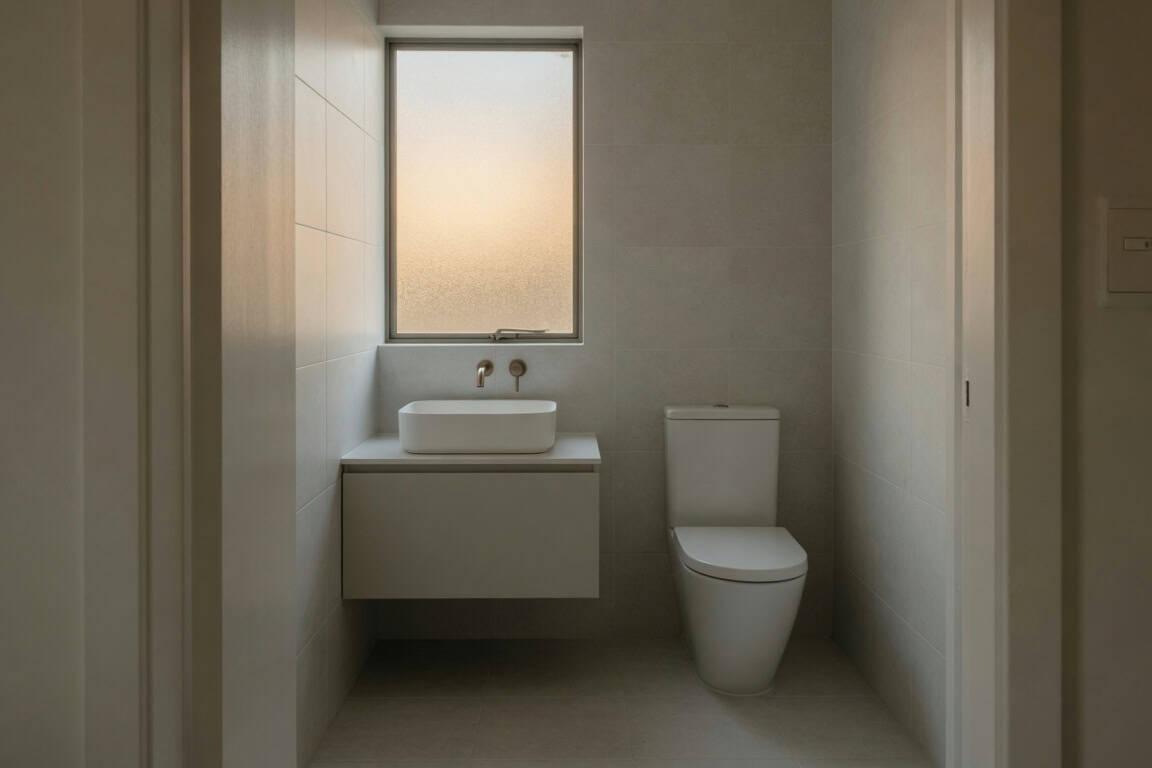
Bathroom: Toilet, Vanity and Tapware
A straight toilet swap — same spot, same waste — is the easiest win in the place. A like-for-like toilet replacement in Auckland runs $400–$1,500 all up, covering the suite ($250–$1,000+), a licensed plumber’s labour, and removal of the old one. Our full breakdown is in the cost to install a new toilet guide. Go wall-hung or smart and you’ll push past $1,000 on the suite alone.
Swapping a vanity in the same position sits around $800 for an off-the-shelf unit from Mitre 10, up to $3,000 for something custom. New tapware is cheaper again — usually a couple of hundred dollars per outlet plus a plumber’s time. None of this needs consent as long as the plumbing stays put. For finished apartment-bathroom looks, browse our bathroom designs.
💡 Quick tip: New toilets must meet a minimum 3-star WELS water-efficiency rating, and Watercare encourages 4-star or better. A 4.5/3-litre dual-flush uses roughly half the water of a pre-1990s loo — handy in an apartment where you’re often paying metered water through the body corporate.
Kitchen: Benchtops, Doors and Cabinet Refacing
You don’t need a whole new kitchen to make an apartment feel new. For finished-kitchen ideas that suit a compact footprint, browse our kitchen design ideas. The two highest-impact jobs are the benchtop and the doors.
A laminate benchtop runs $200–$500 per square metre; engineered stone runs $500–$1,200 per square metre. On a typical 3m² apartment benchtop, that’s roughly $600 in laminate versus $3,600 in stone — same surface, very different bill. For the doors, you’ve got three tiers: repainting or restoring existing doors ($500–$1,500), refacing (new doors and panels on the existing carcasses) at $4,830–$12,420, or full cabinet replacement at $4,140–$11,040. The figures sit in our Auckland kitchen renovation cost guide.
For a small apartment kitchen, new pre-made cabinetry from a supplier like Mitre 10 or Bunnings runs $3,000–$7,000. If the carcasses are sound, refacing the doors gets you a brand-new look for a fraction of a full replacement — which is exactly why it’s the go-to for rentals and pre-sale tidy-ups.
| Cosmetic job (like-for-like) | Auckland 2026 cost | Consent needed? |
|---|---|---|
| Toilet replacement (same position) | $400–$1,500 | No |
| Vanity replacement (same plumbing) | $800–$3,000 | No |
| Benchtop replacement (3m²) | $600 (laminate) – $3,600 (stone) | No |
| Cabinet door refacing | $4,830–$12,420 | No |
| Repaint existing cabinet doors | $500–$1,500 | No |
| Interior repaint (whole apartment) | from ~$4,000 (small 2-bed) | No |
| New flooring (supply + install, per m²) | carpet $75–$150 · vinyl plank $65–$150 | No (check body corp) |
| Multi-room cosmetic refresh | $5,000–$25,000 | Usually no |
Flooring: Carpet, Vinyl and the Acoustic Catch
Flooring is the job rentals get most often, and it’s where apartments differ sharply from houses. Carpet supply runs $25–$100 per square metre with installation from around $50 per square metre; vinyl plank sits at $40–$100 per square metre supplied, plus $25–$50 for laying, going by current NZ retailer and installer pricing. For a 70m² two-bedroom unit, re-carpeting lands somewhere around $5,000–$8,000 with underlay and uplift of the old floor.
Here’s the apartment-only wrinkle. Many body corporates restrict hard flooring — or require acoustic underlay under it — because timber, laminate or vinyl transmits footfall noise straight to the unit below. It’s not just etiquette: a body corporate’s operational rules can specify floor coverings to prevent noise transmission. Swapping carpet for hard flooring without that sign-off is one of the fastest ways to land yourself a body corporate dispute. Check the rules before you fall in love with engineered timber.
💡 Quick tip: If your building allows hard flooring, budget for a rated acoustic underlay — it’s a small line item that keeps you onside with the body corporate and the neighbour below. Cheaper than a noise complaint and a forced re-do.
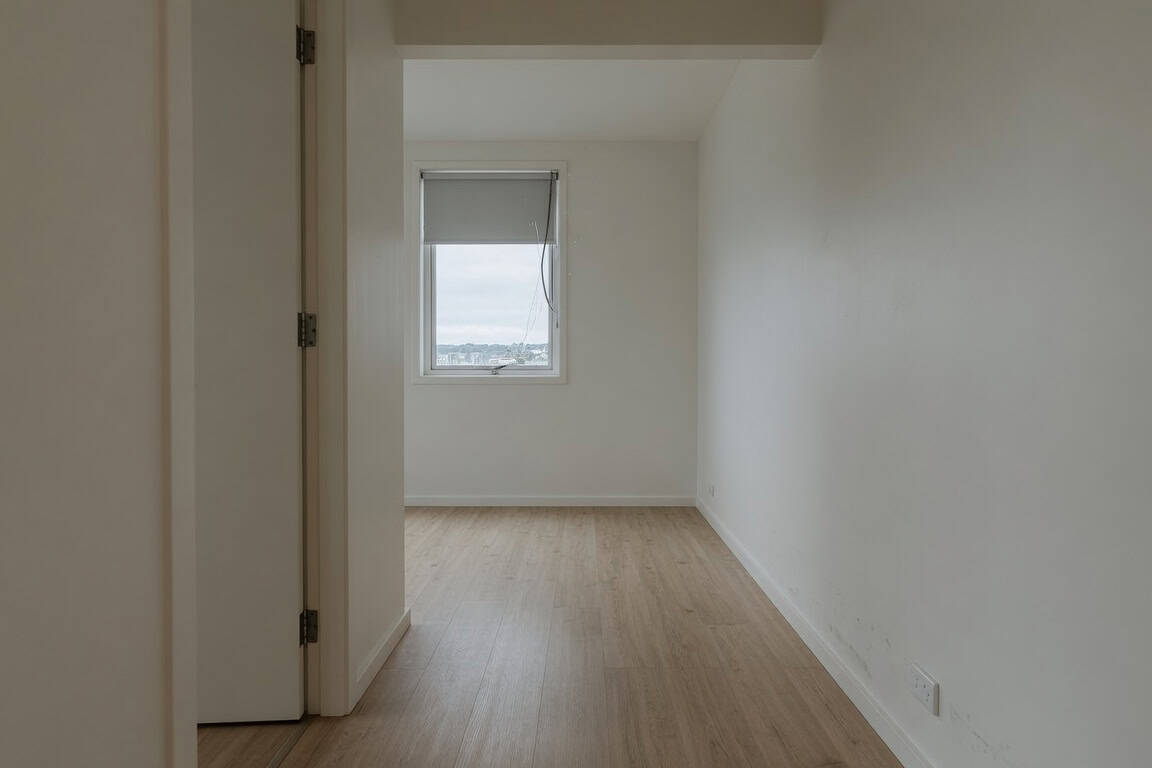
Painting: The Cheapest Transformation in the Building
Paint does more per dollar than anything else in an apartment. A standard repaint of a compact two-bedroom Auckland apartment (around 58m²) starts from roughly $4,000 including GST, and a single room sits at $800–$2,500 depending on prep, ceiling height and trim. Interior painting across a full home generally runs $5,000–$15,000, with most Auckland jobs between $7,000 and $12,000 — the detail’s in our guide to the cost of painting a house in NZ.
“In an apartment kitchen or bathroom the paint has to cope with steam, cooking grease and constant wiping. A washable low-sheen in those rooms isn’t a luxury upgrade — it’s what stops the walls looking tired inside two years. Everywhere else, a low-VOC paint keeps the off-gassing down, which matters more in a closed-up apartment than it does in a draughty villa.”
— Cici Zuo, Head of Sales (NZ Dip. Interior Design), Superior Renovations
Want a rough number before you call anyone? Plug your figures into our bathroom renovation cost calculator for the wet-area side of the job.
💡 Quick tip: If budget’s tight, paint the high-traffic rooms first — living, kitchen and the entrance. They carry most of the visual weight, and the impact-per-dollar beats redoing bedrooms nobody but you sees.
What Needs Consent — and the Body Corporate Catch
Most apartment owners skip the consent route, and for good reason: the work they’re doing doesn’t need it. Like-for-like fixture replacements — swapping a toilet, vanity, basin or bath in the same position — don’t require building consent in New Zealand. Neither does painting, re-flooring, or new cabinet doors. You’re not touching the structure or the weathertightness of the building.
💡 Quick tip: Fitting a new toilet, basin or vanity where there wasn’t one before is a different story to a like-for-like swap — adding a fixture can need consent. If you’re adding rather than replacing, get it confirmed before the plumber starts.
When Council Consent Does Kick In
You’ll need building consent if you move plumbing, alter the layout, install a fully tiled wet-area shower over framing, or make structural changes. In those cases Auckland Council consent fees typically run $1,000–$2,500, and you’ll want that confirmed before you sign anything — Auckland Council’s “what is a consent and do you need one” guidance is the place to check your specific scope. If you do touch the shower, the waterproofing has to meet the Building Code’s internal-moisture rules under clause E3, using a membrane to AS/NZS 4858 — and in an apartment, that membrane is the only thing standing between your reno and the ceiling of the unit below.
The Approval Most Guides Forget
Here’s the part that’s genuinely different in an apartment: even cosmetic work that needs no council consent can still need body corporate approval. Under the Unit Titles Act 2010, anything affecting common property, the building’s structure, or the exterior needs the body corporate’s sign-off — and many bodies corporate also have operational rules covering hard flooring, work hours, and noise. Unit Titles Services’ guidance on bodies corporate sets out how that works.
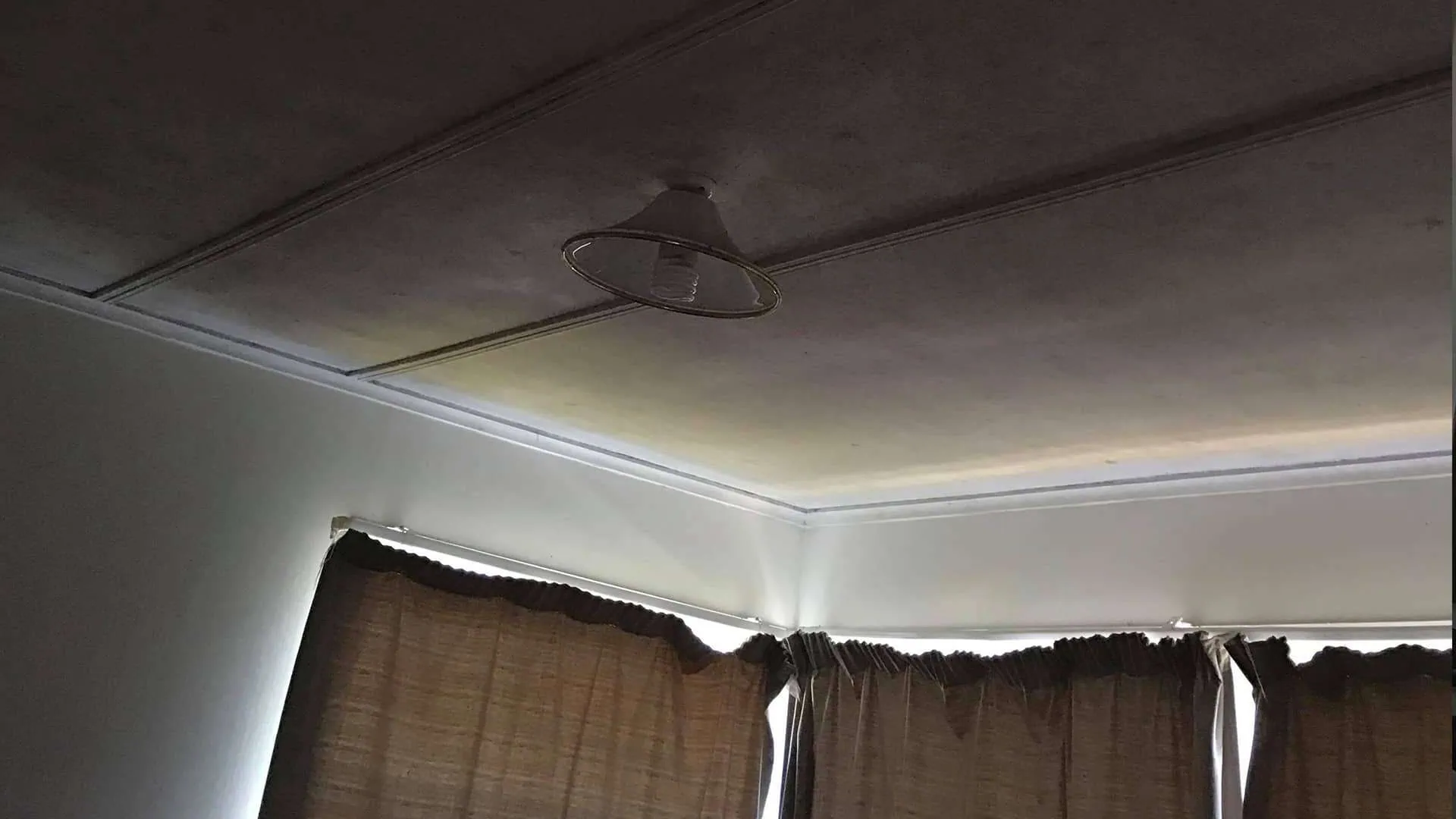 Before
 After
AfterSee the full project
So you can have a job that Auckland Council waves through but that your building still needs to approve. Imagine you’ve ordered engineered timber for a Takapuna apartment, only to find the body corporate rules require carpet or an acoustic underlay you didn’t budget for. That conversation is cheaper to have before the order goes in.
Important note: Body corporate approval and council consent are two separate processes. You can need one, both, or neither depending on the job. When you renovate with our team, our Auckland renovation crew handles apartment and unit projects including the consent paperwork — and we’ll flag body corporate requirements early so nothing stalls the job.
Renovating a Rental Apartment: Yield, Healthy Homes and Smart Spending
A big share of Auckland apartments are rentals, and the maths there is different. You’re not renovating for your own taste — you’re renovating to lift rent, reduce turnover, and stay compliant. Over-personalising a rental is money lost; classic, hard-wearing, easy-to-clean finishes are what attract and keep good tenants.
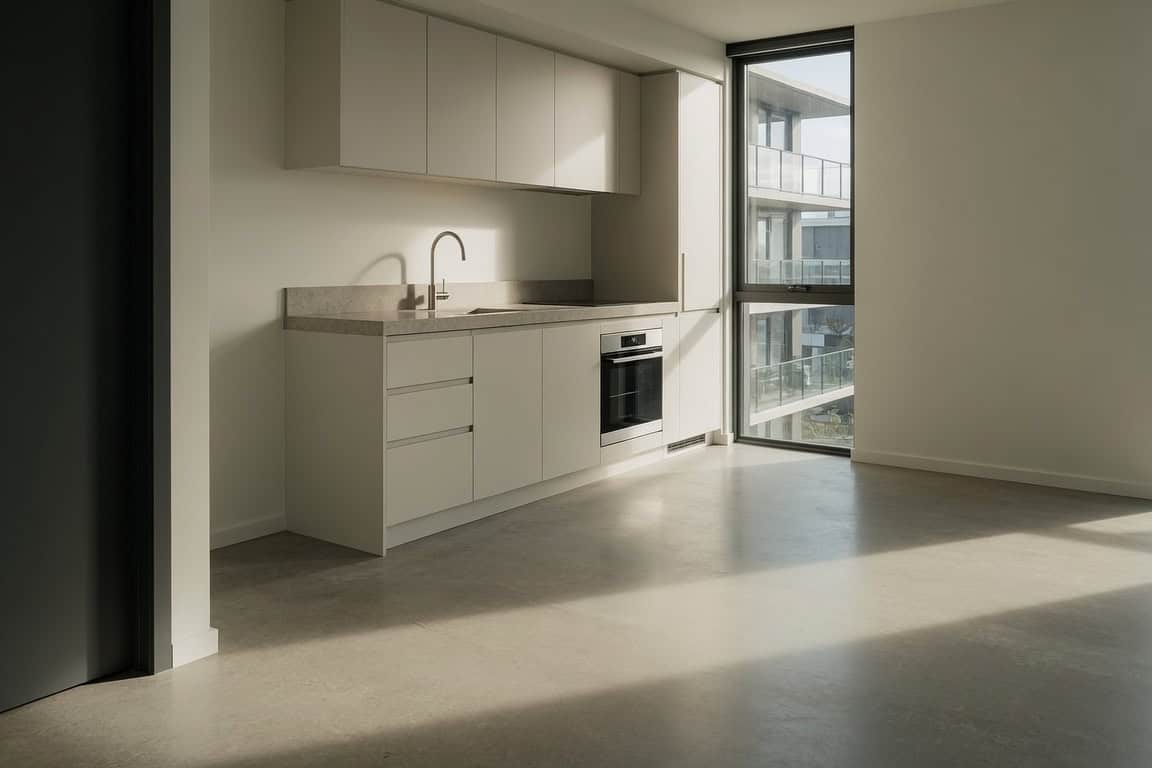
Where the Money Works Hardest in a Rental
A budget rental refresh — fresh paint, new flooring, a tidy kitchen and bathroom on the existing plumbing — can be done for roughly $1,500–$6,000 on the bathroom alone, and a multi-room cosmetic pass usually lands in that $5,000–$25,000 band from the table above. The detail on a budget-conscious wet-area refresh is in our Auckland bathroom renovation cost guide. Vinyl plank flooring is a rental favourite for a reason — waterproof, warm underfoot, and it shrugs off the wear a carpet won’t survive.
Healthy Homes Is Not Optional
Since 1 July 2025, every private rental in New Zealand must meet the Healthy Homes Standards — heating, insulation, ventilation, moisture and drainage, and draught-stopping. If you’re already opening up a rental apartment for a cosmetic refresh, it’s the cheapest time to close any Healthy Homes gaps, because the access cost is already covered. An extractor fan in the bathroom or a fixed heater in the living room costs far less bundled into a reno than booked as a standalone callout. These standards are administered by Tenancy Services, not Auckland Council.
💡 Quick tip: Renovating between tenancies? Sort ventilation and any Healthy Homes items first, then do the cosmetic work over the top. Doing it in that order means you’re not pulling up new flooring to run a duct three months later.
The Hidden Apartment Costs Nobody Quotes Upfront
By now the finishes make sense. It’s the apartment-specific extras that blow budgets, because they rarely show up on a first quote. These are the costs that separate an apartment renovation from the same job in a standalone Auckland house.
Access, Lifts and Disposal
Getting materials in and rubbish out is the quiet cost. Lift bookings, loading-dock windows, and carrying a demolished bathroom down in a trolley all add hours. Where a house job drops a skip on the driveway, an apartment job carries every load through shared space you’re responsible for protecting — so the disposal that costs $200–$500 a skip-load at a house takes longer, and the labour climbs with it. It rarely shows on a first quote, which is exactly why you should ask about it.
💡 Quick tip: Ask your builder to walk the route from the loading dock to your front door before quoting — lift size, stair turns and corridor protection all affect the price. A team that’s worked in Auckland apartment towers will price this properly; one that hasn’t will hit you with variations later.
Body Corporate Fees and the Unit Below
Some buildings charge an administration or bond fee for renovation works, and most want evidence your tradies are insured before anyone lifts a tool — both worth confirming with your body corporate manager before you budget. Then there’s the risk that doesn’t exist in a standalone house: if a poorly waterproofed shower or a botched plumbing join leaks, the damage isn’t yours alone — it’s the unit below you, and you’re liable for it. That’s the real reason apartment wet-area work is no place to cut corners on the membrane or the plumber.
“A leak in a house is your problem to fix. A leak in an apartment is the ceiling of the unit below, and that changes everything about how you do the waterproofing. We treat apartment wet areas as the highest-risk part of the job — proper membrane, certified, signed off — because the cost of getting it wrong isn’t your bathroom. It’s two.”
— Cici Zuo, Head of Sales (NZ Dip. Interior Design), Superior Renovations
That’s also why a fixed-price, fully-scoped quote matters more in an apartment than almost anywhere else. You can talk the whole thing through with our team at the Superior Renovations showroom at 16B Link Drive, Wairau Valley, where you can see finishes in person before you commit.
So What Should You Budget?
If you’re doing a cosmetic refresh on the existing layout — paint, flooring, tapware, a benchtop and doors — budget $5,000–$25,000 and expect to skip council consent. If you’re redoing the kitchen and bathroom properly, you’re looking at $40,000–$80,000+, and that’s where the body corporate, access and waterproofing realities start to bite. Either way, the move that saves the most money is the same: keep your plumbing where it is, and find out what your building allows before you spend a cent.
➡ Book your free in-home consultation with Superior Renovations
➡ Estimate your kitchen costs with our renovation calculator
➡ Request a free feasibility report for your project
How much does an apartment renovation cost in Auckland?
A cosmetic apartment refresh in Auckland — paint, flooring, new tapware, a benchtop swap and fresh cabinet doors — typically runs $5,000–$25,000 in 2026, depending on how many rooms you touch and the finishes you choose. A full apartment renovation that redoes the kitchen and bathroom usually lands around $40,000–$80,000 or more. Keeping fixtures in their existing positions is the single biggest cost-saver, because it avoids consent and the heavier body corporate approvals.
Do I need consent to renovate my apartment in Auckland?
Not for like-for-like work. Swapping a toilet, vanity, basin or bath in the same position, painting, re-flooring and replacing cabinet doors don't require building consent. You'll need consent if you move plumbing, alter the layout, install a tiled wet-area shower over framing, or make structural changes — Auckland Council fees for that run roughly $1,000–$2,500. Separately, your body corporate may still need to approve the work even when the council doesn't.
How much does it cost to replace a toilet in an apartment?
A like-for-like toilet replacement in Auckland runs $400–$1,500 all up, covering the toilet suite ($250–$1,000+), a licensed plumber's labour, and removal of the old unit. Wall-hung or smart toilets push past $1,000 on the suite alone. Replacing a toilet in its existing position doesn't require building consent, and new toilets must meet a minimum 3-star WELS water-efficiency rating.
How much does it cost to replace a kitchen benchtop?
A laminate benchtop runs $200–$500 per square metre and engineered stone $500–$1,200 per square metre. On a typical 3m² apartment benchtop, that's roughly $600 in laminate versus $3,600 in stone. Replacing a benchtop in the same position doesn't require consent. If your cabinet carcasses are sound, refacing just the doors ($4,830–$12,420) gives a near-new look for far less than full cabinet replacement.
Can I put hard flooring in my Auckland apartment?
Often, but check first. Many body corporates restrict hard flooring like timber, laminate or vinyl — or require acoustic underlay beneath it — because footfall noise transmits straight to the unit below. The flooring itself runs about $65–$150 per square metre supplied and installed, plus $10–$30 per square metre to level a concrete slab. Always confirm your building's rules before ordering, as installing hard flooring without approval can trigger a body corporate dispute.
How much does it cost to paint an apartment in Auckland?
A standard repaint of a compact two-bedroom Auckland apartment of around 58m² starts from roughly $4,000 including GST. A single room sits at $800–$2,500 depending on prep, ceiling height and trim. Painting is the highest-impact spend in any apartment, and it doesn't require consent. For wet rooms, a washable low-sheen paint resists steam and grease far better than standard interior paint.
Do I need body corporate approval to renovate?
Possibly, even for cosmetic work. Under the Unit Titles Act 2010, anything affecting common property, the building's structure or the exterior needs body corporate sign-off. Many bodies corporate also have operational rules covering hard flooring, work hours and noise. This is separate from council consent — you can have a job the council approves that your building still needs to sign off, so always read your building's renovation rules before pricing the work.
Is it worth renovating a rental apartment?
Usually yes, if you spend in the right places. Classic, hard-wearing, easy-to-clean finishes lift rent and reduce turnover without over-capitalising. A budget bathroom refresh on existing plumbing can be done for $1,500–$6,000, and vinyl plank flooring is a durable rental favourite. Since 1 July 2025 all private rentals must meet the Healthy Homes Standards, so it's smart to close any heating, insulation or ventilation gaps while the apartment is already open for cosmetic work.
What's the cheapest way to renovate an apartment?
Keep everything where it is. The biggest savings come from not moving plumbing or changing the layout, which avoids consent and major body corporate approvals. Repainting (from $4,000), refacing cabinet doors rather than replacing them, swapping a benchtop in laminate, and laying vinyl plank flooring deliver the most visible change for the least money. A focused cosmetic refresh on the existing layout typically lands between $5,000 and $25,000.
Who is liable if my apartment renovation causes a leak?
You are. Unlike a standalone house, a leak from a poorly waterproofed shower or a failed plumbing join in an apartment damages the unit below yours — and as the owner who did the work, you're liable for that damage. This is why apartment wet-area waterproofing must meet the Building Code's E3 internal-moisture rules with a certified membrane to AS/NZS 4858, and why it's the worst possible place to cut corners on materials or your plumber.
Further Resources for your apartment renovation
- Featured projects and Client stories to see specifications on some of the projects.
- Real client stories from Auckland
Need more information?
Take advantage of our FREE Complete Home Renovation Guide (48 pages), whether you’re already renovating or in the process of deciding to renovate, it’s not an easy process, this guide which includes a free 100+ point check list – will help you avoid costly mistakes.
Download Free Renovation Guide (PDF)
Have you been putting off getting renovations done?
We have partnered with Q Mastercard ® to provide you an 18 Month Interest-Free Payment Option, you can enjoy your new home now and stress less.
Learn More about Interest-Free Payment Options*
*Lending criteria, fees, terms and conditions apply. Mastercard is a registered trademark and the circles design is a trademark of Mastercard International Incorporated.
Still have questions unanswered?
Book a no-obligation consultation with the team at Superior Renovations, we’d love to meet you to discuss your renovation ideas!
References
- Auckland Council — What is a consent and do you need one?
- Building Performance (MBIE) — E3 Internal moisture and AS/NZS 4858 wet-area membranes
- Unit Titles Services (MBIE) — About unit titles and body corporate
- Unit Titles Services (MBIE) — Setting the operational rules
- Tenancy Services — Healthy Homes Standards
- Forté — How much does flooring cost (NZ per-m² data)