
Author: Cici Zuo

kitchen auckland 1 - Superior Renovations
Kitchen Renovation

How Long Does a Kitchen Renovation Take in Auckland?

How Long Does a Kitchen Renovation Take in Auckland?

Quick answer: A full kitchen renovation in Auckland takes 6–12 weeks from start to finish, depending on the scope, complexity, whether consent is involved, and whether cabinetry is made in-house or by a third party. Around 5–6 of those weeks are the on-site build.

If you’ve started ringing around for quotes, you’ve probably had three different companies give you three different timeframes. One says four weeks. Another says three months. So which is it?

Here’s the honest version. We’ve run more than 1,000 kitchen renovations across Auckland since 2017 — from tight little galley kitchens in Grey Lynn villas to full open-plan rebuilds in Flat Bush new-builds — and the time it takes comes down to a handful of decisions you make early. Get those right and a standard kitchen lands in the 6–12 week window. Drag your feet on material selections, or open a wall and find rot, and the clock keeps ticking.

This guide is about time, not cost. If you want the full step-by-step of what physically happens on site, we’ve covered that separately in the stage-by-stage breakdown of a kitchen renovation. Here, we’re answering one question: how long will the whole thing actually take, and where does the time go?


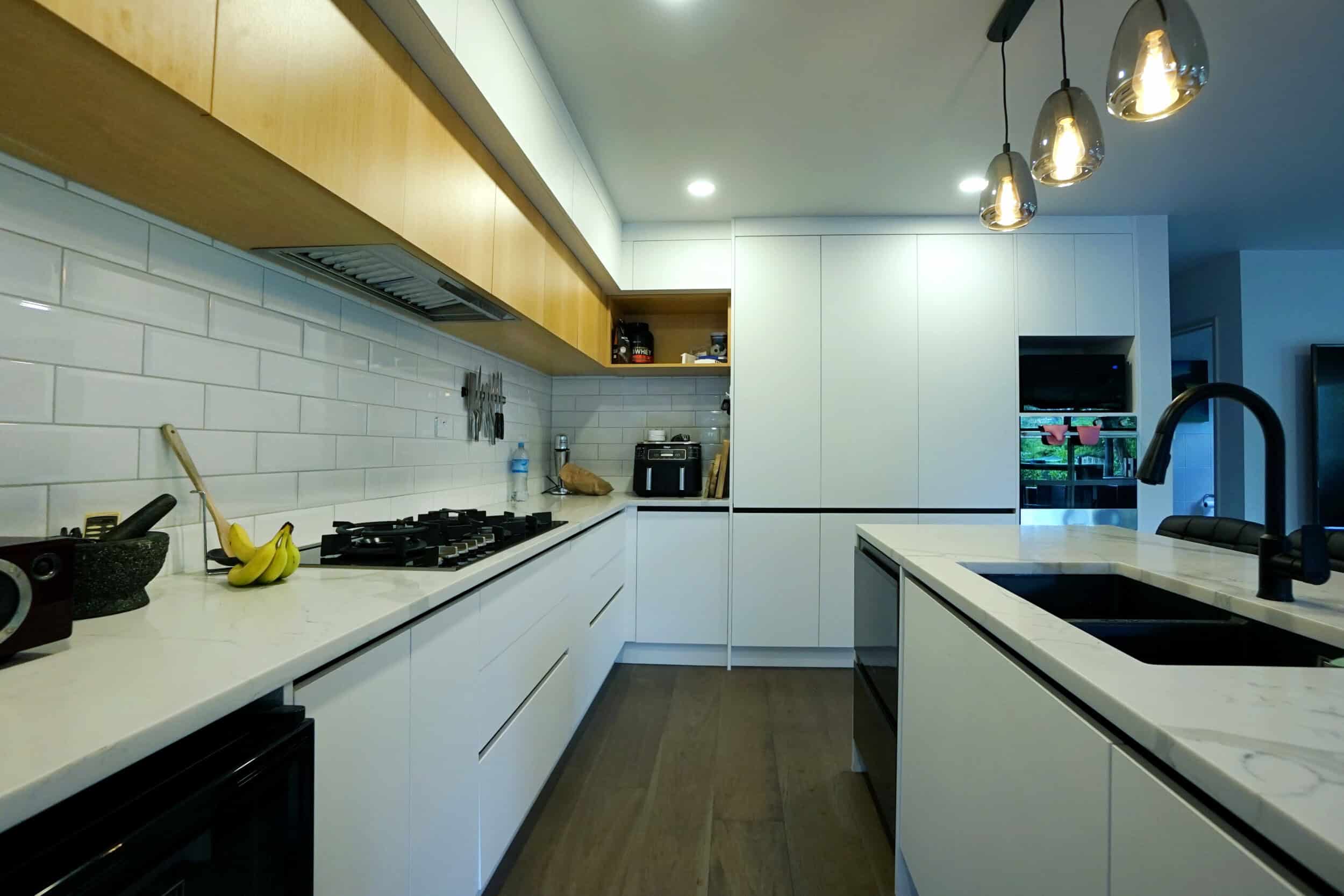
KIT 05 01 - Superior Renovations

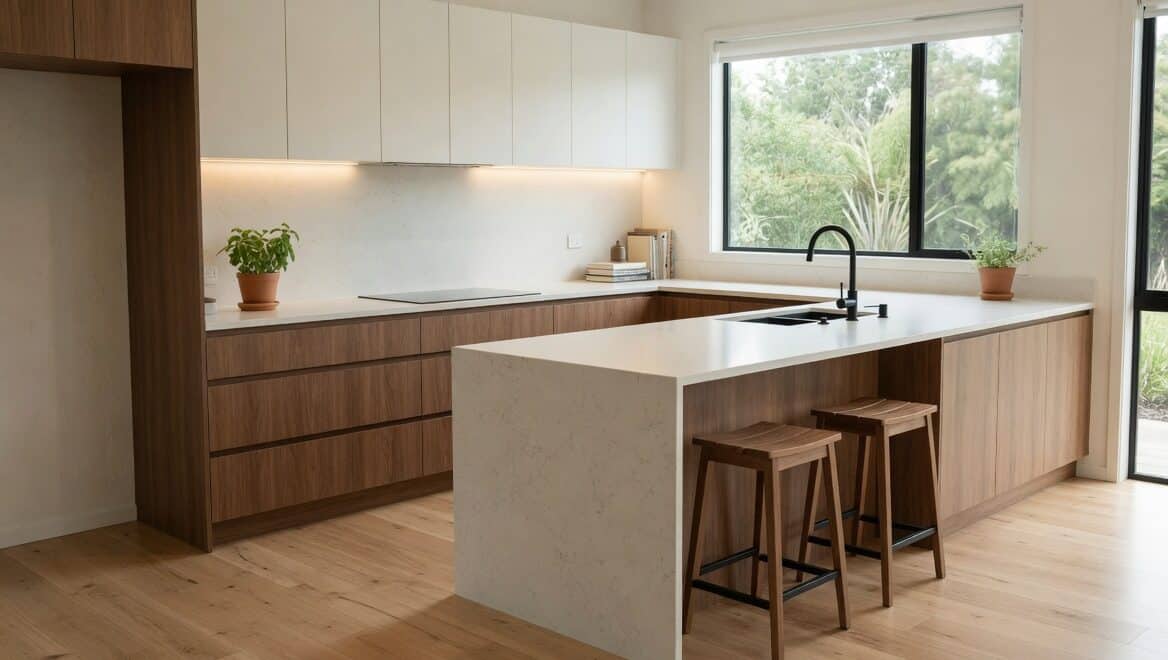
Kitchen Render by Sachi Amarasekara


The Honest Answer: 6 to 12 Weeks, Start to Finish

When we say a kitchen renovation takes 6–12 weeks, people often assume that’s all on-site work — tradies in the house for three months. It isn’t. The number splits into two parts that overlap: the planning and manufacturing lead time, and the on-site build.

Where the Weeks Actually Go

The on-site build — demolition through to final fit-off — is usually the shorter half. For a standard Auckland kitchen, that’s around 5–6 weeks with the trades on the tools. The longer, quieter half happens before anyone swings a hammer: design sign-off, ordering, and waiting for your cabinetry and benchtop to be manufactured. That’s typically another 4–8 weeks running in the background.

So how long does a kitchen renovation take in Auckland, all in? For most jobs, count on 6 to 12 weeks from the day you lock the design to the day you cook your first dinner. The spread depends almost entirely on scope.

Phase Typical timeframe What’s happening
Design & selections 2–4 weeks 3D design, layout sign-off, choosing finishes
Manufacturing lead time 3–4 weeks Cabinetry built, benchtop and splashback ordered (runs alongside design)
Demolition 2–4 days Old kitchen out, services capped
Build & installation 4–5 weeks Wiring, plumbing, GIB, cabinetry, benchtop, splashback, flooring
Total, end to end 6–12 weeks Standard Auckland kitchen; structural work pushes beyond

💡 Quick tip: The manufacturing clock starts the day you sign off the design — not demo day. The faster you lock your layout and finishes, the sooner your cabinetry goes into production and the shorter your overall timeline.

“People think the build is the long part. It isn’t — the build runs to a schedule. What blows timelines out is indecision in the design phase. If you’ve signed off your layout and chosen your finishes before we order, the whole thing runs like clockwork. If you’re still changing your benchtop colour the week before installation, that’s where the weeks disappear.”
— Dorothy Li, Design Manager, Superior Renovations


What Actually Moves the Number

Six things decide whether your kitchen lands at the six-week end or the twelve-week end. Some you control. Some you don’t.

1. Scope and Layout Changes

Swapping cabinetry, benchtops and appliances in the same footprint is the fastest kind of job. The moment you move the sink, relocate the cooktop, or knock the kitchen through into the dining room, you’ve added plumbing reroutes, electrical changes and often a structural element — and that adds weeks. A like-for-like refit is quick; a layout redesign is not.

2. Whether You Need Building Consent

Most cosmetic kitchen renovations in Auckland don’t need building consent. The trigger is structural or significant plumbing and drainage work — removing a load-bearing wall, for example, or relocating waste pipes. Per Building Performance (building.govt.nz), once a complete application is lodged, the council has 20 working days to process it.

Here’s the part most guides get wrong. The statutory limit is 20 working days, but it’s rarely the full bottleneck. MBIE’s consent monitoring shows the national median processing time in the fourth quarter of 2025 was just 10 working days, with 95.4% of applications cleared inside the statutory window. The real delays come from Requests for Information — an incomplete application stops the clock dead until you supply what’s missing. If your kitchen needs consent, removing a load-bearing wall is genuinely structural territory for our architectural team at Sonder Architecture, and getting the documentation right the first time is what keeps the timeline tight.

Important note: A consent application that triggers one Request for Information can add two to four weeks on its own. The fix is a complete, accurate application up front — not chasing the council afterward.

3. In-House vs Third-Party Manufacturing

This is the one nobody tells you about, and it’s often the single biggest variable. If your renovation company outsources its cabinetry to a third-party joinery shop, you’re sitting in someone else’s queue. Their production schedule, their delays, their lead times. We build a lot of our cabinetry through our in-house joinery team at Little Giant Interiors, which means we control the manufacturing slot rather than waiting on an external supplier. On a job where a third-party shop quotes a six-week cabinetry lead time, controlling it in-house can claw back two to three of those weeks.

4. Material and Benchtop Lead Times

Your finishes carry their own clocks, and they run whether you’ve decided or not. Engineered stone benchtops need templating after the cabinets are in, then fabrication — usually two to three weeks before they’re installed. Custom cabinetry runs three to four weeks in production. Glass and acrylic splashbacks have a manufacturing lead time too, which is why they get ordered early in the process. Laminate surfaces from a supplier like Laminex are quicker off the shelf than a slab of engineered stone — a real consideration if your timeline is tight.

Superior Renovations Showroom 15 - Superior Renovations

5. The Age and Condition of Your Home

Auckland’s housing stock has surprises baked in. Pull the cabinets off the wall in a 1920s Mt Eden villa and you might find single-skin walls, old wiring, or borer-chewed framing that needs sorting before the new kitchen goes in. The 1970s brick-and-tile places in Manukau and the leaky-era homes from the early 2000s each have their own quirks. Older homes carry a higher chance of hidden work, which is why we build a contingency buffer into the timeline rather than promising a date we can’t hold.

6. Season and Trade Availability

Kitchens can be done year-round in Auckland because the work is indoors. But summer is the busy season. If you want a January or February start, the trades and manufacturing slots fill up fast. Autumn and late winter tend to have shorter wait times — which, given it’s currently winter, makes right now a smart time to lock in a slot for spring.

Factor Effect on timeline
Like-for-like refit (no layout change) Fastest — toward the 6-week end
Layout redesign / moving services Adds 1–3 weeks
Building consent required Adds 2–4+ weeks (longer with an RFI)
Third-party cabinetry vs in-house Can add 2–3 weeks of queue time
Engineered stone vs laminate benchtop Adds ~2–3 weeks fabrication
Hidden damage in older homes Variable — buffer 1–2 weeks

“The trick with lead times is that they run in parallel, not one after another. If a client decides on their stone and cabinetry early, the manufacturing clock is already ticking while we sort the rest. Leave those decisions late and suddenly everything’s queued end to end. Deciding early is the cheapest way to save weeks.”
— Alison Yu, Designer, Superior Renovations


How Long Will You Be Without a Kitchen?

This is the question people actually mean when they ask about timelines. Not “how long is the project” — but “how long am I cooking dinner on a camp stove in the garage?”

The No-Sink Stretch

For a standard build, the genuinely disruptive period — no sink, no cooktop, no usable bench — runs around 3 to 4 weeks in the middle of the on-site phase. Demolition and the early services work are the start of it; the kitchen comes back to life once the cabinetry is installed, the benchtop is in, and the plumber returns for the final fit-off.

Setting Up a Temporary Kitchen

Most of our clients set up a temporary kitchen in the garage, laundry or dining room — a fridge, microwave, a kettle and a single induction hob get you a long way. If you’ve got a laundry tub, that becomes your sink. We had a family in Titirangi run their whole household out of the laundry for a month and barely blink. It’s a few weeks of mild inconvenience, not the end of the world.

💡 Quick tip: Box up the kitchen gear you actually use day to day — kettle, toaster, a few plates, the good knife — and keep it separate. Living out of a temporary kitchen is far easier when the essentials aren’t buried in a packing box in the garage.

Do You Need to Move Out?

For a kitchen-only renovation, almost never. The work is contained to one room, and you can live around it. Moving out only really comes into play on larger whole-home projects where multiple rooms are offline at once. For the way we run a full kitchen renovation, you stay put — and we keep the dust and disruption walled off as much as the job allows.

DSC03003 - Superior Renovations


Can You Speed It Up? And What Causes the Delays

Some of the timeline is fixed — stone takes as long as stone takes. But a good chunk of it is in your hands.

What Actually Speeds a Kitchen Reno Up

Decide early, decide once. The single fastest move you can make is signing off your layout and locking your finishes before manufacturing starts. Order long-lead items — stone, custom cabinetry, glass splashbacks — at the front of the process so their clocks run in parallel. And work with a single point of contact who coordinates the trades, rather than juggling separate plumbers, sparkies and tilers yourself. A coordinated trade schedule is the difference between a 6-week build and a 10-week one.

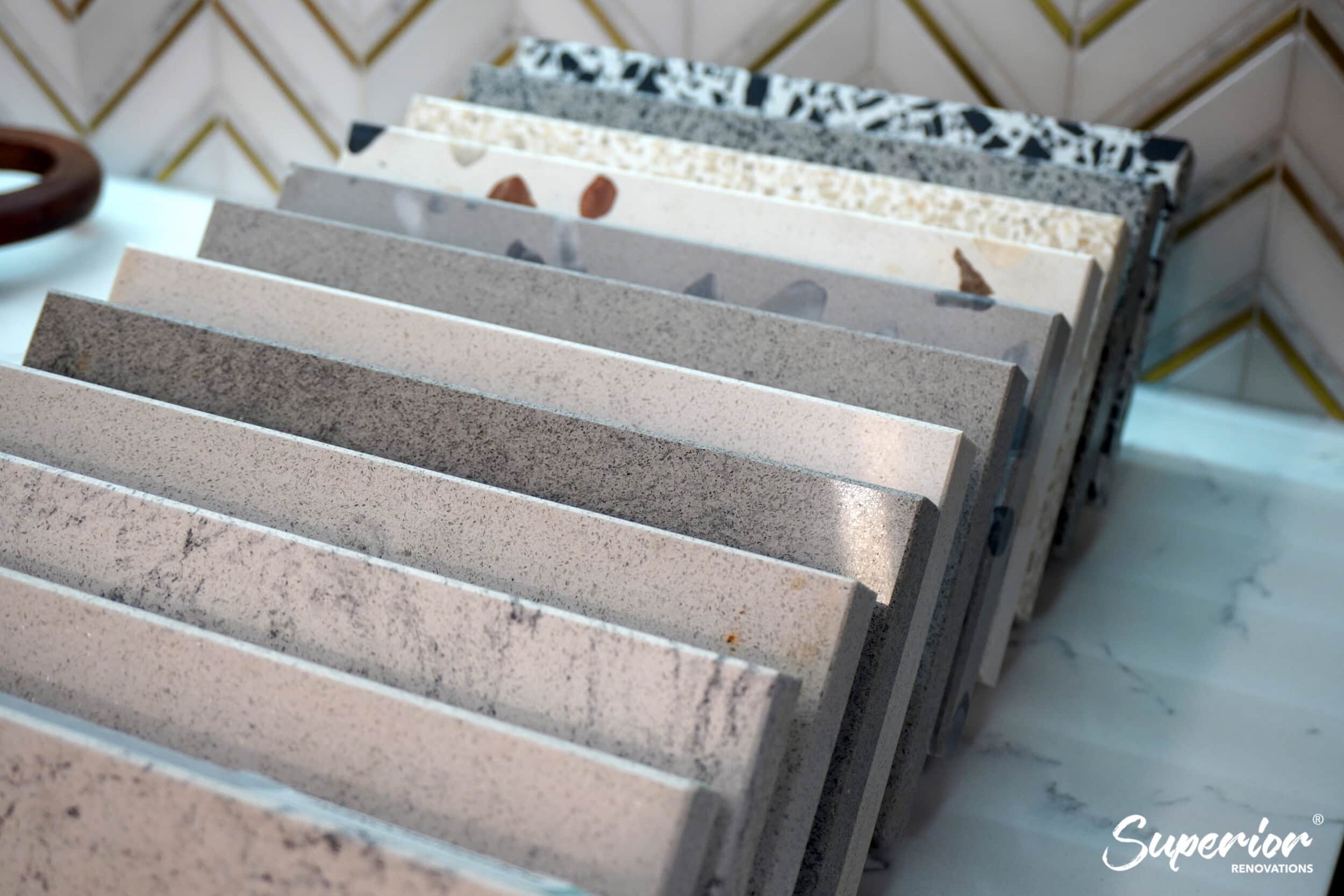
Selections are where most people stall, so it pays to see materials in person rather than second-guessing them off a screen. You can run your finishes past our design team at the Superior Renovations showroom at 16B Link Drive, Wairau Valley — touching the benchtop samples and seeing the cabinetry colours next to each other tends to settle decisions in an afternoon that would otherwise drag on for a fortnight.

The Usual Suspects Behind Delays

Late material selections are the number one cause — every week you spend deciding on a benchtop is a week the manufacturing clock isn’t running. After that: consent RFIs, a client supplying their own appliances that turn up late, and hidden damage uncovered at demolition. We’ve had jobs held up because an oven was sitting in a courier depot in Hamilton waiting on a delivery slot. If you’re supplying your own appliances, get them on site before fit-off week.

Why DIY Almost Always Takes Longer

People assume doing it themselves saves time. It usually does the opposite. Without a coordinated schedule, trades turn up in the wrong order, materials arrive late, and the job stretches across months of weekends. A managed renovation compresses the timeline precisely because someone is sequencing every trade to the day. Worth weighing up before you commit to the do-up yourself.

Cost and timeline are linked — a tighter, well-planned scope is both faster and easier to budget. If you want a rough number to plan around, our kitchen renovation cost calculator gives you an estimate in under a minute, and our kitchen renovation checklist walks you through what to pin down before you start. A mid-range Auckland kitchen typically runs $26,000–$35,000 — but this guide is about the weeks, not the dollars.


When to Book Your Auckland Kitchen Renovation

If you’re working toward a deadline — a new baby, family coming for Christmas, a house going on the market — work backwards from it.

Working Back From Your Deadline

For a standard kitchen, allow the full 6–12 weeks, then add the booking lead time on top. In the busy summer run, our calendar fills weeks ahead. If you want a job finished before Christmas, the conversation needs to start in winter or early spring — not in November. Leave it too late and you’re not waiting on the build; you’re waiting on a start date.

Why Winter Is the Smart Time to Plan

It feels counterintuitive, but the quieter, cooler months are the best time to get your design and consent sorted. Trades have more availability, manufacturing slots are easier to secure, and you walk into spring ready to build rather than starting from scratch. Sort the planning now and you skip the summer queue entirely.


A kitchen renovation in Auckland takes 6–12 weeks because that’s how long it takes to do it properly — design it, build the cabinetry, and install it without cutting corners. The companies promising four weeks are either skipping the design phase or sitting you in a third-party queue you’ll feel later. Lock your decisions early, work with one team that controls its own manufacturing, and the timeline looks after itself.

Book your free in-home consultation with Superior Renovations
Estimate your kitchen renovation cost in under a minute
Request a free feasibility report for your project


How long does a kitchen renovation take in Auckland?

A full kitchen renovation in Auckland takes 6–12 weeks from start to finish. Around 5–6 weeks is the on-site build (demolition through to final fit-off), with another 4–8 weeks of design and manufacturing lead time beforehand that often overlaps. Structural changes, building consent, or third-party cabinetry queues push the timeline toward — or beyond — the upper end.

How long will I be without a kitchen during the renovation?

The genuinely disruptive stretch — no sink, no cooktop, no usable bench — runs around 3 to 4 weeks in the middle of the on-site phase. Most homeowners set up a temporary kitchen in the garage or laundry with a fridge, microwave and a single induction hob to get through it. The kitchen comes back online once cabinetry, benchtop and plumbing fit-off are done.

Why do some companies quote four weeks for a kitchen renovation?

A four-week quote usually refers only to the on-site build, not the design and manufacturing lead time before it. It can also mean cabinetry is outsourced to a third-party joinery shop, where you sit in their production queue. A realistic end-to-end figure for a standard Auckland kitchen is 6–12 weeks once design, manufacturing and installation are all counted.

Do I need building consent for a kitchen renovation?

Most cosmetic kitchen renovations don't need building consent in Auckland. Consent is triggered by structural work, such as removing a load-bearing wall, or significant plumbing and drainage changes. Per Building Performance, councils have 20 working days to process a complete application. MBIE's monitoring showed a national median of 10 working days in late 2025, though Requests for Information can stop the clock and add weeks.

What's the longest part of a kitchen renovation?

It's not the build — it's the lead time before it. Design sign-off, cabinetry manufacture (3–4 weeks), and benchtop fabrication (2–3 weeks for engineered stone) make up the quiet half of the timeline. Indecision in the design phase is the single biggest cause of delays, because the manufacturing clock only starts once you've locked your layout and finishes.

Can I live in my house during a kitchen renovation?

Yes. For a kitchen-only renovation, you almost never need to move out — the work is contained to one room and you can live around it. Set up a temporary kitchen with the essentials and keep daily-use items separate from packed boxes. Moving out only becomes a consideration on larger whole-home projects where several rooms are offline at once.

How can I make my kitchen renovation faster?

Decide early and decide once. Sign off your layout and finishes before manufacturing starts, and order long-lead items — engineered stone, custom cabinetry, glass splashbacks — at the front of the process so their lead times run in parallel. Working with a single team that coordinates the trades, and ideally controls its own cabinetry manufacture, is the difference between a 6-week build and a 10-week one.

Does an engineered stone benchtop add time to the project?

Yes. Engineered stone is templated after the cabinets are installed, then fabricated off-site — usually 2–3 weeks before it's fitted. Laminate surfaces are quicker because they're not custom-fabricated the same way. If your timeline is tight, your benchtop choice is one of the few levers that genuinely moves the date, so factor it into your decision early.

When should I book a kitchen renovation to be finished by Christmas?

Work backwards: allow the full 6–12 weeks, then add booking lead time on top. Summer is the busy season in Auckland, so calendars fill weeks ahead. To be finished before Christmas, the conversation should start in winter or early spring. Planning over the cooler months means trades and manufacturing slots are easier to secure and you skip the summer queue.


Further Resources for your kitchen renovation

  1. Featured projects and Client stories to see specifications on some of the projects.
  2. Real client stories from Auckland

Need more information?

Take advantage of our FREE Complete Home Renovation Guide (48 pages), whether you’re already renovating or in the process of deciding to renovate, it’s not an easy process, this guide which includes a free 100+ point check list – will help you avoid costly mistakes.

Download Free Renovation Guide (PDF)


finance - Superior Renovations

Have you been putting off getting renovations done?

We have partnered with Q Mastercard ® to provide you an 18 Month Interest-Free Payment Option, you can enjoy your new home now and stress less.

Learn More about Interest-Free Payment Options*

*Lending criteria, fees, terms and conditions apply. Mastercard is a registered trademark and the circles design is a trademark of Mastercard International Incorporated.


Still have questions unanswered?

Book a no-obligation consultation with the team at Superior Renovations, we’d love to meet you to discuss your renovation ideas!

    Services

    Home RenovationKitchen RenovationBathroom RenovationOutdoor RenovationHouse ExtensionCommercialDesign ServicesOther

    By submitting this form, you agree to receive communications from us via email or text regarding our services, you can unsubscribe at any time.

    This site is protected by reCAPTCHA and the Google

    Privacy Policy and Terms of Service apply.


    References

    1. Building Performance (MBIE) — The building consent process
    2. MBIE — Building Consent System Performance Monitoring (Q4 2025)
    undefloor heating auckland - Superior Renovations
    Bathroom Renovation

    Underfloor Heating NZ: Cost, Running Costs & Worth It?

    Underfloor Heating NZ: What It Costs, What It Costs to Run, and When It’s Worth It

    Quick answer: Underfloor heating in NZ costs roughly $80–$150/m² installed for electric and $150–$200/m² for hydronic, and running an electric system in a 9m² bathroom works out around $12–$20 a month depending on your power price. It’s worth it when the floor is already coming up — far less so as a standalone retrofit.

    Most people who ask us about underfloor heating have stood on a cold tiled floor in a Mt Eden bungalow at 6am in July and thought, never again. That’s the right instinct. The wrong move is deciding it’s worth it — or not worth it — before anyone’s told you what it actually costs to run, or whether your floor can even take it without a major dig-up.

    We’re a renovation company, not a heating supplier. So this is the version we give clients across the table at our Wairau Valley showroom: what underfloor heating costs to put in, what it costs to run on real Auckland power prices, where it earns its keep, and where a $400 towel rail does the same job for a tenth of the money.


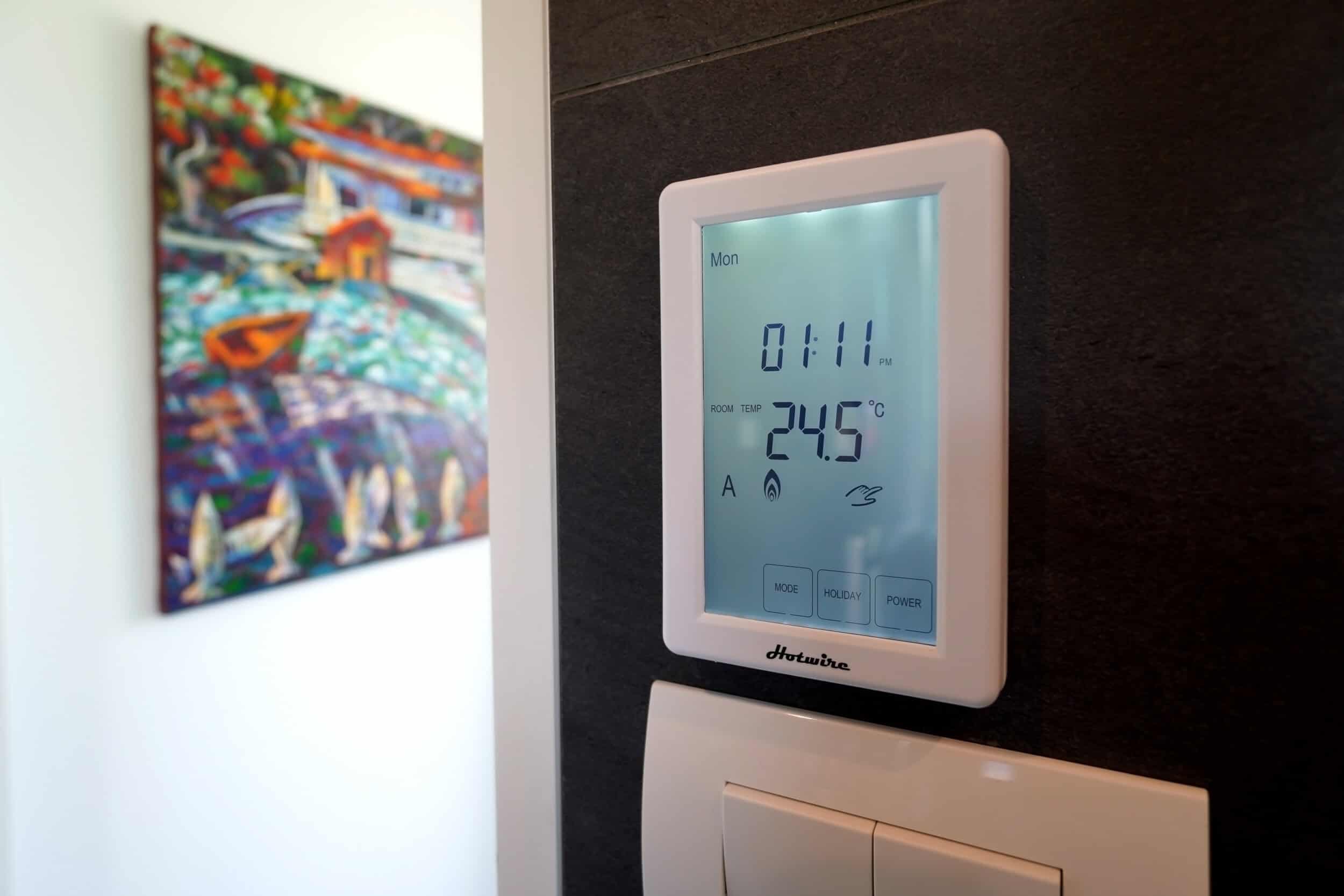
    Underfloor heating panel - Hotwire

    Underfloor heating panel – Hotwire


    Electric vs Hydronic Underfloor Heating: Which One Suits a Renovation?

    There are two systems, and the gap between them matters more for renovators than for new builds. Electric (sometimes called “wire” or “dry” systems) is a thin heating mat or cable that sits under your floor finish. Hydronic (“wet” systems) runs warm water through pipes laid in or under the floor.

    For a renovation, electric wins most of the time. The mat is only a few millimetres thick, so it barely changes your floor height — which is the thing that quietly kills retrofits. Warmup NZ, the brand most Kiwis associate with the category, makes the same point: electric suits upgrades to existing homes, hydronic suits new slabs.

    When Hydronic Actually Makes Sense

    Hydronic comes into its own on a concrete slab in a new build or a full ground-floor extension — heating a large area, every day, for years. The pipes and manifold cost more upfront, but the running cost per square metre is lower, so over a whole house it pays back. Pump it through a small bathroom retrofit and the maths falls over: too much plumbing, too much disruption, for one cold room.

    Here’s the short version we give people. Doing one or two rooms in an existing home? Electric. Building new or extending with a fresh slab and heating the whole floor plate? Get hydronic priced.

    “The number that decides it on a reno is floor height, not the heating spec. Once you’ve got tiles, underlay and a mat to stack up against an existing doorway and the hallway floor next door, a couple of millimetres is the difference between a clean job and re-hanging every door. We work that out before we ever talk brands.”
    — Cici Zou, Certified Designer (NZ Dip. Interior Design), Superior Renovations

    💡 Quick tip: If you’re tiling a bathroom or kitchen anyway, that’s the cheapest moment you’ll ever get to add electric underfloor heating — the floor’s open, the tiler’s there, and the only real extra is the mat and a thermostat.

    The system we spec on bathroom and tiled-area jobs is Heatwell electric — it’s reliable, easy to integrate while the floor’s up, and the running costs stack up sensibly for the room sizes most Auckland homes have. We recommend by the room, not by the brochure.


    How Much Does Underfloor Heating Cost to Install in NZ?

    Install cost depends on the system, the area, and what’s already under your floor. Here are the ranges we work with on Auckland renovations — and where the published supplier figures sit, so you can sanity-check any quote you’re handed.

    System Install cost (per m²) Typical bathroom (8–10m²) Best for
    Electric mat/cable $80–$150 $1,500–$4,000 Retrofits, bathrooms, single rooms, tiled areas
    Hydronic (water) $150–$200+ Rarely cost-effective at this size New builds, slabs, whole-home, large open-plan
    Whole-home hydronic (new build) $17,000–$40,000+ (full system) Designed in from the slab up

    Those per-m² figures line up with what NZ suppliers publish — installed electric figures from $60–$100/m² for straightforward jobs, climbing once you factor in a separate circuit, thermostat, and any floor prep. For a standard Auckland bathroom, budget $1,500–$4,000 for electric underfloor heating supplied and installed — and remember that’s a line item inside a wider $26,000–$35,000 mid-range bathroom renovation, not a standalone bill.

    The Hidden Cost Nobody Quotes For: Floor Prep

    The mat is cheap. Getting your floor ready for it sometimes isn’t. On a 1970s brick-and-tile in Manurewa with a timber subfloor, you may need a self-levelling compound or a backer board before anything goes down — that’s labour and material the headline per-m² rate doesn’t include. On a concrete slab it’s usually simpler. This is exactly why a real quote beats a calculator estimate, and why we’d rather see your floor than guess.

    Want a sense of where heating sits inside your total bathroom budget before we visit? Run the numbers on our bathroom renovation cost calculator — it’ll give you a realistic range to work from.

    💡 Quick tip: Always get the heating wired on its own thermostat with a timer. It’s a small line item at quote stage and it’s the single biggest lever on what the thing costs you to run later.


    Underfloor Heating Running Costs in NZ — The Number Most Guides Dodge

    This is where most underfloor heating content goes vague, because the honest answer takes a bit of maths. So let’s do it properly, on Auckland power prices.

    Electric underfloor heating draws roughly 150 watts per square metre — the standard output rating for residential heating mats sold in NZ, and the figure EECA uses when it talks about sizing electric heating to a room. Take a typical 9m² Auckland bathroom — that’s about 1,350 watts, or 1.35 kilowatts, at full draw.

    Now the price. Power costs vary a lot by retailer and plan, so we’ll run it two ways. On a keen low-user rate of 35c/kWh, running that bathroom flat-out costs around 47 cents an hour. On the MBIE national average of about 39c/kWh (its February 2026 Quarterly Survey of Domestic Electricity Prices), it’s closer to 53 cents an hour. Either way, you’re not running it flat-out.

    With a thermostat and timer set for an hour or two morning and evening through winter, you’re realistically looking at around $12–$18 a month on a low-user rate, or roughly $14–$20 a month at the MBIE average, across the colder months for that bathroom — and close to nothing the rest of the year. That’s the same ballpark as a heated towel rail left on, and far less than most people assume when they hear “electric heating.”

    Scale that up and the picture changes. Heat a whole open-plan living floor with electric and the monthly bill climbs fast — which is precisely why hydronic, with its lower cost per square metre, takes over for large areas. EECA makes the broader point that how you control heating matters as much as the system itself: a timer and thermostat are doing most of the work on your running cost, whatever the brand on the box.

    Area Approx. draw Cost/hr at 35c (low-user) Cost/hr at 39c (MBIE avg) Realistic winter month (timed use)
    9m² bathroom ~1.35 kW ~47c ~53c ~$12–$20
    15m² kitchen/diner ~2.25 kW ~79c ~88c ~$25–$45
    40m² open-plan (electric) ~6 kW ~$2.10 ~$2.34 Hydronic territory — price it instead

    The figures are indicative — your wattage, insulation, power plan and how long you run it all move the dial. But the shape is right, and it’s a lot more useful than “it depends.”

    💡 Quick tip: Good underfloor heating relies on a warm, dry slab or floor holding heat. If your subfloor’s poorly insulated, you’re paying to heat the dirt below. Pairing underfloor heating with proper floor insulation is what makes the running cost behave.


    Best Applications: Bathrooms, Tiles, and the Slab-vs-Timber Question

    Underfloor heating shines under hard floors. Tile, stone, polished concrete — they conduct heat well and they stay warm. That’s why bathrooms are the number-one spot we install it: cold tile underfoot is the exact problem it solves, and the room’s small enough that running cost stays sensible.

    Kitchens with tiled or stone floors are the next best fit. Engineered stone and quartz benchtops aside, a tiled kitchen floor over electric heating is a genuinely nice thing to stand on while you cook on a winter morning in Titirangi.

    Concrete Slab vs Timber Subfloor

    This is the make-or-break question for retrofits. A concrete slab is the ideal host — it stores heat and releases it slowly, so the system works efficiently. A suspended timber subfloor, common in older Auckland villas and bungalows, is trickier: there’s an air gap below, heat can escape downward without insulation, and the floor build-up has to be managed carefully. It’s still doable with electric mats over a properly prepped and insulated timber floor — we do it regularly — but it needs planning, not a punt.

    What Flooring Works (and What Doesn’t)

    Tile and stone are ideal. Many engineered timber and quality vinyl products are rated for underfloor heating too — but not all, and laying an unrated floating floor over heating can void its warranty or warp the boards. Always check the flooring’s underfloor-heating rating before you commit, not after. Solid hardwood is generally the wrong choice; it moves too much with the temperature swings. The Wooden Floor Company and other NZ suppliers note that engineered timber handles the temperature changes better than solid timber — which matches what we see on site.

    If you’re choosing tiles and heating together, our bathroom renovation team sorts both as one decision — the floor finish, the heating, the waterproofing and the levels all get worked out before the tiler starts, which is the whole point of doing it inside a renovation.

    underfloor heating being applied epsom auckland - Superior Renovations

    DSC03390 - Superior Renovations


    Underfloor Heating vs Heated Towel Rail vs Panel Heater

    Here’s the honest comparison — because for a lot of bathrooms, underfloor heating isn’t the right answer, and we’ll tell you that.

    Option Install cost Heats the room? Best when
    Electric underfloor $1,500–$4,000 Yes — warm floor + radiant warmth You’re retiling anyway and want the floor experience
    Heated towel rail $300–$700 Partly — dries towels, takes the edge off Budget’s tight or the floor’s staying put
    Panel / wall heater $300–$1,050 Yes — fast air heat You want quick warmth, not warm floors

    The truth most people don’t hear: if the floor isn’t already coming up, the cost of retrofitting underfloor heating alone rarely justifies it over a good towel rail plus a ceiling unit. Where it’s a no-brainer is when you’re already renovating — then the marginal cost is small and the payoff is daily.

    We go deeper on rails, ceiling units and wall heaters in our companion guide to choosing the right bathroom heater for NZ conditions — worth a read if you’re weighing underfloor against the simpler options.


    Can You Retrofit Underfloor Heating in an Existing Auckland Home?

    Yes — with one honest caveat. Retrofitting only makes sense when you’re already lifting the floor. Tearing up a perfectly good bathroom purely to add heating is money poorly spent. Doing it as part of a renovation, when the tiles are coming off anyway, is one of the best-value upgrades on the job.

    The practical hurdles in an older home are floor height and the subfloor type. Add a heating mat, backer board and new tiles, and your finished floor sits higher than it did — which affects door clearances and the transition to the hallway. On a villa in Grey Lynn with a timber subfloor, that needs designing around. On a slab-on-ground 1990s home in Albany, it’s usually straightforward. None of it is exotic; it just needs to be planned at design stage, not discovered mid-build.

    For whole-home or extension projects where heating is part of a bigger thermal upgrade, it’s worth thinking about the envelope as a whole — insulation, glazing and heating together. If you’re combining heating with a larger structural change, our house extensions team can build it into the plan from the start.

    “The clients who love their underfloor heating are the ones who added it during a reno they were doing anyway. The ones with regrets usually retrofitted a single room in isolation and paid for the disruption without the rest of the upgrade around it. Timing is most of the value.”
    — Cici Zou, Certified Designer (NZ Dip. Interior Design), Superior Renovations


    Does Underfloor Heating Help with Healthy Homes and Damp?

    Worth being straight here, because it’s oversold elsewhere. Underfloor heating is comfortable and it warms a room evenly, which helps keep surfaces above the dew point and discourages the mould that plagues Auckland bathrooms through our damp, humid winters — NIWA describes Auckland’s subtropical climate as warm and humid with rainfall plentiful all year round. That’s a real benefit.

    But it’s not a Healthy Homes compliance product. According to Tenancy Services, which administers the standards for MBIE, the Healthy Homes heating standard applies to rental properties and requires one or more fixed heaters (at least 1.5kW) that can directly heat the main living room to 18°C — alongside separate standards for insulation, ventilation, moisture and draught-stopping. Underfloor heating isn’t a recognised qualifying heater for that standard. If you’re a landlord, don’t install underfloor heating expecting it to tick the heating standard; check the actual requirements first. If you’re an owner-occupier chasing a warmer, drier home, it’s a genuine comfort upgrade — just paired with good ventilation and insulation, not instead of them.

    Important note: Hardwired underfloor heating must be installed by a licensed electrician and comply with the NZ Building Code. It’s not a DIY job — and if you’re already having electrical work done in a renovation, bundling it in is the cheapest, cleanest way to get it done right.


    So, Is Underfloor Heating Worth It in NZ?

    If you’re renovating and the floor’s coming up, electric underfloor heating in a bathroom or tiled area is one of the easiest yeses we give. Small marginal cost, daily payoff, sensible running cost. If you’re thinking about ripping up a sound floor purely to add it, the honest answer is usually no — put the money toward a great towel rail and ventilation instead.

    The decision really comes down to timing and floor type, and both are easiest to sort with someone looking at your actual home rather than a spec sheet. That’s what we do — across 1000+ Auckland renovations, heating gets decided alongside tiling, levels and waterproofing, not bolted on at the end.

    Book your free in-home consultation with Superior Renovations
    Estimate your bathroom renovation cost with our calculator
    Request a free feasibility report for your project


    Is underfloor heating worth it in NZ?

    It's worth it when you're already renovating and the floor is coming up — the marginal cost of electric underfloor heating in a bathroom or tiled area is small and the daily comfort payoff is high. As a standalone retrofit, where you'd tear up a sound floor just to add it, it's usually not worth it over a good heated towel rail plus a ceiling unit. The deciding factors are timing and floor type, not the heating brand.

    How much does underfloor heating cost in NZ?

    Electric underfloor heating runs about $80–$150/m² installed, which works out to roughly $1,500–$4,000 for a typical 8–10m² Auckland bathroom supplied and fitted. Hydronic (water) systems cost more at around $150–$200+/m² and make sense for new builds and whole-home slabs rather than single-room retrofits. Floor preparation, a dedicated circuit and a thermostat can add to the headline per-m² rate, which is why an on-site quote beats an online estimate.

    Is underfloor heating expensive to run in NZ?

    Not for a bathroom. Electric underfloor heating draws around 150 watts per m², so a 9m² bathroom pulls about 1.35kW — roughly 47 cents an hour on a low-user rate of 35c/kWh, or about 53 cents an hour at the MBIE national average of around 39c/kWh (February 2026). Run on a timer and thermostat for an hour or two morning and evening through winter, that's around $12–$20 a month and close to nothing the rest of the year. Costs climb fast over large areas, which is where hydronic takes over.

    What's the difference between electric and hydronic underfloor heating?

    Electric systems use a thin heating mat or cable under the floor finish — only a few millimetres thick, so they suit retrofits and single rooms. Hydronic systems run warm water through pipes laid in or under the floor; they cost more upfront but run cheaper per m², so they suit new builds, slabs and whole-home heating. For renovating one or two rooms in an existing Auckland home, electric is almost always the right call.

    Can you retrofit underfloor heating in an existing house?

    Yes, with electric mats — but it only makes financial sense when you're already lifting the floor as part of a renovation. The two practical hurdles are floor height (the mat, backer board and new tiles raise the finished floor, affecting door clearances) and subfloor type. A concrete slab is the ideal host; a suspended timber subfloor, common in older Auckland villas and bungalows, needs careful insulation and planning but is still doable.

    What flooring works with underfloor heating?

    Tile, stone and polished concrete are ideal — they conduct and hold heat well. Many engineered timber and quality vinyl products are rated for underfloor heating, but not all, so check the manufacturer's rating before laying anything over a heating system, as an unrated floating floor can warp or void its warranty. Solid hardwood is generally a poor choice because it moves too much with the temperature swings.

    Is underfloor heating good for bathrooms in Auckland?

    It's the single best application. Bathrooms are small, so running cost stays low, and cold tile underfoot is exactly the problem underfloor heating solves. Auckland's subtropical climate — NIWA describes it as warm and humid with rainfall plentiful year-round — makes warm, even heat useful for keeping surfaces dry and discouraging mould on fresh tiles. We install electric underfloor heating most often in bathrooms and tiled ensuites, specced in alongside the waterproofing and tiling rather than added afterwards.

    Does underfloor heating meet Healthy Homes Standards?

    Not on its own. According to Tenancy Services, the Healthy Homes heating standard applies to rental properties and requires one or more fixed qualifying heaters (at least 1.5kW) that can directly heat the main living room to 18°C, plus separate standards for ventilation, insulation, draught-stopping and moisture. Underfloor heating isn't a recognised qualifying heater for that standard, so landlords shouldn't install it expecting it to tick that box. For owner-occupiers it's a genuine comfort and dryness upgrade, best paired with good ventilation and insulation rather than used instead of them.

    Underfloor heating or a heated towel rail — which should I get?

    If you're retiling the bathroom anyway, underfloor heating ($1,500–$4,000) gives you a warm floor and radiant warmth across the whole room. If the floor's staying put or the budget's tight, a heated towel rail ($300–$700) dries towels and takes the chill off at a fraction of the cost. Many Auckland bathrooms do well with a towel rail plus a 3-in-1 ceiling unit, with underfloor reserved for when the floor is already open.

    Do I need building consent for underfloor heating?

    The heating mat itself usually doesn't, but the electrical work must be done by a licensed electrician and comply with the NZ Building Code, and any wider bathroom renovation it's part of may trigger consent for plumbing or waterproofing changes. The simplest path is to install underfloor heating as part of a managed renovation where the consents and the licensed trades are already handled — which removes the guesswork for you.


    Further Resources for your bathroom renovation

    1. Featured projects and Client stories to see specifications on some of the projects.
    2. Real client stories from Auckland

    Need more information?

    Take advantage of our FREE Complete Home Renovation Guide (48 pages), whether you’re already renovating or in the process of deciding to renovate, it’s not an easy process, this guide which includes a free 100+ point check list – will help you avoid costly mistakes.

    Download Free Renovation Guide (PDF)


    finance - Superior Renovations

    Have you been putting off getting renovations done?

    We have partnered with Q Mastercard ® to provide you an 18 Month Interest-Free Payment Option, you can enjoy your new home now and stress less.

    Learn More about Interest-Free Payment Options*

    *Lending criteria, fees, terms and conditions apply. Mastercard is a registered trademark and the circles design is a trademark of Mastercard International Incorporated.


    Still have questions unanswered?

    Book a no-obligation consultation with the team at Superior Renovations, we’d love to meet you to discuss your renovation ideas!

      Services

      Home RenovationKitchen RenovationBathroom RenovationOutdoor RenovationHouse ExtensionCommercialDesign ServicesOther

      By submitting this form, you agree to receive communications from us via email or text regarding our services, you can unsubscribe at any time.

      This site is protected by reCAPTCHA and the Google

      Privacy Policy and Terms of Service apply.


      References

      1. MBIE — Electricity cost and price monitoring (Quarterly Survey of Domestic Electricity Prices)
      2. EECA — Heat and cool your home efficiently
      3. Tenancy Services — Healthy Homes heating standard
      4. Tenancy Services — Healthy Homes standards overview
      5. NIWA — Auckland regional climate
      6. Warmup NZ — Electric underfloor heating costs and benefits
      7. Lake Road Electrical — Underfloor heating: the cost and benefits
      8. The Wooden Floor Company — Cost of underfloor heating
      bathroom renovation west auckland 3 - Superior Renovations
      Bathroom Renovation

      Full vs Partial Bathroom Renovation NZ — Which Is Right?

      Full Bathroom Renovation vs Partial Renovation (Cosmetic Refresh) — How to Decide in 2026

      Quick answer: A bathroom refresh in Auckland costs $3,000–$16,000 and takes a few days to two weeks, while a full bathroom renovation runs $25,000–$60,000+ and takes three to six weeks — the right choice depends on the age of your bathroom, the condition behind the walls, and how long you plan to stay in your home.

      This is the question we hear more than almost anything else at first consultations. A homeowner walks into our showroom at 16B Link Drive, Wairau Valley, pulls out their phone, shows us photos of a tired bathroom, and asks: “Do I actually need to gut the whole thing, or can I just update it?”

      Fair question. And the honest answer is: it depends. Not on what we’d prefer to sell you — but on what’s actually going on in that bathroom.

      A partial renovation (cosmetic refresh) works well when the bones are good — sound waterproofing, functional plumbing in the right positions, no moisture damage behind the tiles, and a layout that already works for your household. In those cases, spending $25,000+ to strip everything back to the framing would be overkill.

      A full renovation makes sense when the bathroom has deeper problems. We’re talking failed waterproofing membranes, outdated plumbing that’s rusting or undersized, poor ventilation causing mould behind the GIB, or a layout that just doesn’t work for the way your family uses the space. In an older Auckland villa — say, a 1960s place in Mt Eden or a 1970s brick-and-tile in Pakuranga — there’s often more going on behind the walls than the surface suggests.

      We’ve put this guide together because the existing advice online is mostly generic cost guides or thin pros-and-cons lists that don’t help you actually decide. What follows is a proper side-by-side comparison: what each option includes, what it costs in Auckland in 2026, when each one makes sense, and the hidden factors most homeowners miss.

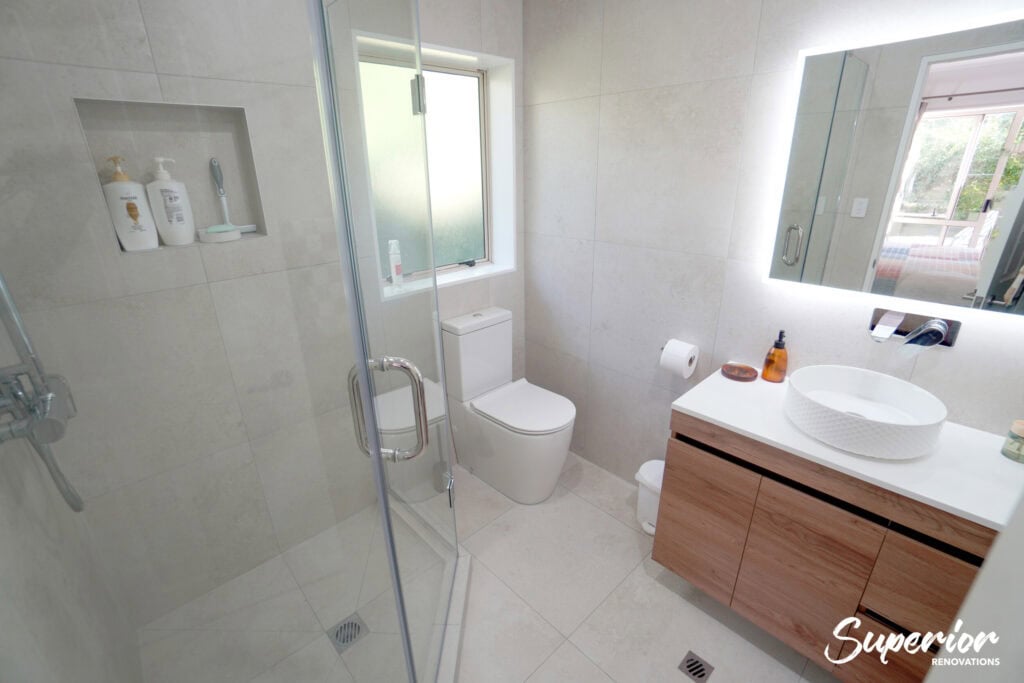
      d064 H2105474 hires.20233 WEB12 - Superior Renovations

      Superior Renovations


      What Counts as a Cosmetic Bathroom Refresh vs a Full Renovation?

      Before we get into costs, let’s define what we’re actually comparing. These two options are often talked about as if they’re just different price points for the same thing. They’re not. They’re fundamentally different scopes of work, involving different trades, different timelines, and different levels of disruption to your home.

      What a cosmetic refresh includes

      A cosmetic refresh keeps the existing layout, plumbing positions, and (critically) the existing waterproofing intact. You’re updating surfaces and fixtures — not rebuilding the room.

      Typical scope:

      • Replacing the vanity, mirror, and tapware
      • Swapping out the toilet (same position)
      • New shower screen or enclosure over the existing tray
      • Repainting walls and ceiling
      • Replacing lighting fixtures
      • New accessories — towel rails, hooks, toilet roll holder
      • Possibly replacing floor vinyl or adding a new bath panel

      What a cosmetic refresh does not touch: the tiles behind the shower, the waterproofing membrane, the plumbing pipe runs, the electrical wiring, or the GIB behind the walls. That’s the key distinction.

      💡 Quick tip: If your existing tiles are in good condition and firmly bonded, you can paint over them with a specialist tile paint (Dulux Renovation Range or similar) as part of a cosmetic refresh — but this is a short-to-medium-term solution, not a 15-year fix.

      What a full bathroom renovation includes

      A full renovation strips the bathroom back to the framing — and sometimes beyond it, if there’s damage to the timber structure. Everything comes out: tiles, GIB, waterproofing, fixtures, plumbing, and electrical.

      Then it all goes back in, built to current NZ Building Code standards. A full renovation typically involves eight to ten separate trades: demolition, plumbing, electrical, waterproofing, GIB stopping, tiling, painting, joinery installation, glazing, and final fit-off.

      At Superior Renovations, our full bathroom renovations include design, demolition, all trades, supply of materials and products, project management, and compliance documentation — from initial concept through to sign-off.

      “The moment you pull back the tiles, you’re committed. That’s why we always tell clients — if you’re going to open up the walls, do it properly. Half-measures on waterproofing or plumbing cause more problems down the track than the original issue.”
      — Cici Zou, Designer (NZ Dip. Interior Design, Certified Designer), Superior Renovations


      Auckland Bathroom Renovation Costs: Cosmetic Refresh vs Full Renovation in 2026

      Here’s where the numbers sit in Auckland right now. These reflect 2026 pricing, which has seen a 5–8% increase from 2025 driven by labour and material inflation. According to Stats NZ’s Business Price Indexes release, which includes the producers price index, construction input costs have continued to climb year on year.

      Scope Typical Auckland Cost (2026) Timeline Trades Involved
      DIY cosmetic tidy-up $3,000–$5,000 1–3 days Homeowner (paint, accessories, vanity swap)
      Professional cosmetic refresh $9,000–$16,000 1–2 weeks Plumber, electrician, painter, installer
      Mid-range full renovation $25,000–$35,000 3–4 weeks 8–10 trades, project manager, designer
      Full renovation with layout changes $35,000–$50,000 4–6 weeks As above + consent process
      Luxury / custom full renovation $45,000–$65,000+ 5–8 weeks As above + specialist trades (e.g. stone, underfloor heating)

      The jump from cosmetic refresh to full renovation is mostly driven by three things: waterproofing, tiling labour, and trade coordination. Fixtures and fittings matter, but trades and time dominate the budget in almost every Auckland bathroom renovation we’ve quoted.

      For a personalised estimate based on your bathroom size and scope, try our bathroom renovation cost calculator.

      Labour accounts for 40–50% of the total on a full renovation in Auckland, with tradesperson rates sitting at $90–$120 per hour in 2026. Materials make up 20–25%, and we always recommend allowing 15–20% contingency — particularly in older homes where what’s behind the tiles is genuinely unknown until demo day.

      💡 Quick tip: If you’re comparing quotes, check whether the price includes design, project management, demolition, disposal, and all materials — or just labour. An “all-inclusive” quote from a company like Superior Renovations covers everything. A labour-only quote from an independent tradie will look cheaper upfront but won’t include half the costs.


      When a Cosmetic Bathroom Refresh Is the Right Call

      Not every bathroom needs to be gutted. We say this openly, even though full renovations are our core business. A cosmetic refresh makes sense when the underlying structure and systems are sound — and the main issue is that the bathroom looks dated.

      The bathroom is under 15 years old

      If your bathroom was built or last renovated after 2010, there’s a good chance the waterproofing was done to a reasonable standard and the plumbing is still performing well. Bathrooms built in the 2010s in Auckland subdivisions like Hobsonville Point, Flat Bush, or Millwater were typically built to tighter standards than the leaky building era homes from a decade earlier.

      In these cases, swapping the vanity, updating tapware, replacing a tired shower screen, and repainting can transform the look without touching any of the infrastructure. You could achieve a significant visual upgrade for $9,000–$16,000.

      You’re renovating to sell — not to stay

      If you’re planning to list within the next 12–18 months, a $30,000 full bathroom renovation may not return dollar-for-dollar at sale. A clean, freshly painted bathroom with modern fixtures and good lighting photographs well and removes a buyer objection — and you can achieve that for far less than a full reno.

      Sound familiar? We’ve had a few clients in Remuera and Epsom who were preparing to sell and came in expecting to spend $40,000. After looking at the condition of their bathrooms, our design team advised them to save the money and do a targeted refresh instead.

      The layout already works

      If the shower is in the right spot, the vanity doesn’t block the door, and there’s enough storage — then a cosmetic update is all you need to bring the room up to date. Keeping existing plumbing positions is one of the easiest ways to control costs, because the moment pipes move, you’re into more labour, more materials, and potentially consent territory.

      Budget is fixed and tight

      If your total budget is under $15,000, a cosmetic refresh will give you a better result than trying to stretch a full renovation into that number. We’ve seen homeowners attempt a full gut-and-rebuild on a $15,000 budget using an independent tradie — and end up with cut corners on waterproofing that cost them far more to fix two years later.

      Custom built bathroom renovation. Luxury bathroom design


      When You Need a Full Bathroom Renovation

      There are situations where a cosmetic refresh is a Band-Aid on a bullet wound. If any of the following apply to your bathroom, a full renovation isn’t just the better option — it’s the only responsible one.

      The waterproofing has failed

      This is the big one. Waterproofing failure is the single most common reason a bathroom renovation escalates from “refresh” to “full strip-out” in Auckland.

      Per BRANZ guidance on waterproofing tiled showers, leaks are commonly traced back to floor-to-wall and hob-to-wall junctions and around drains — exactly the details a cosmetic refresh never touches. If water has been getting behind the tiles — even slowly, over years — the membrane has failed, the GIB is damp, and the framing behind it may be rotting.

      Signs to watch for: musty smell that won’t go away, soft or spongy flooring near the shower, discolouration or bubbling paint on the wall behind the shower, or visible mould in grout lines that keeps returning after cleaning.

      You can’t cosmetically refresh your way out of a waterproofing failure. The tiles have to come off, the wet area has to be rebuilt to comply with the Building Code clause E3 internal moisture requirements, and any damaged framing needs to be repaired or replaced before the room goes back together.

      “We opened up a bathroom in Titirangi last year where the homeowner just wanted new tiles. Once the old tiles came off, we found the membrane had been leaking for years — the bottom plate was completely rotten. What started as a cosmetic job became a full renovation with structural repairs. That’s why we always recommend a full scope assessment before committing to any approach.”
      — Dorothy Li, Design Manager, Superior Renovations

      Your bathroom is from the 1970s–1990s

      Auckland’s housing stock from this era — the brick-and-tile homes in Pakuranga, Manurewa, and Papatoetoe, the weatherboard bungalows in Henderson and Glen Eden — often has bathrooms with galvanised steel plumbing, asbestos-containing materials (in some cases), and waterproofing that predates modern standards.

      If your bathroom hasn’t been touched since before 2000, there’s a strong argument for going back to bare framing. Not because the surfaces look bad (some 1980s tiles are practically indestructible) — but because the systems behind them are past their serviceable life.

      💡 Quick tip: If your home was built before 1990, ask your renovation company about asbestos testing before any demolition work begins. Disturbing asbestos-containing materials without proper handling is a health hazard and a legal issue under the WorkSafe NZ guidance on asbestos in the home.

      The layout doesn’t work

      If the shower is too small, the vanity blocks the door swing, there’s no storage, or the bathroom was clearly designed for a different era — no amount of new paint or tapware fixes a fundamental layout problem. Changing the layout means moving plumbing, which means a full renovation.

      Common layout issues we fix in Auckland bathrooms: converting a bath-only setup to a separate shower and bath, widening a narrow shower recess to at least 900mm × 900mm, adding a double vanity where a single existed, or reconfiguring a combined toilet-bathroom into a more functional arrangement.

      You’re staying long-term and want it done once

      If this is your family home and you plan to be here for 10+ years, doing it properly now makes financial sense. A well-built full bathroom renovation should last 15–20 years before needing attention again. A cosmetic refresh might look good for three to five years, but it doesn’t address the ageing infrastructure underneath.

      One of our clients in Glendowie put it well during her consultation: “I’d rather spend $32,000 once and not think about it for 15 years than spend $12,000 now and $35,000 in five years when things start failing behind the tiles.”


      Building Consent: What Each Option Means for NZ Compliance

      This is where a lot of homeowners get tripped up. Consent requirements differ significantly between a cosmetic refresh and a full renovation — and getting it wrong can cause serious problems at resale.

      Cosmetic refresh — usually no consent required

      Under Schedule 1 of the Building Act 2004, work that replaces or repositions existing fixtures within the same bathroom — without increasing the number of sanitary fixtures — is generally exempt from building consent, provided an authorised person carries out any plumbing and drainage work.

      That means replacing a toilet, swapping a vanity, repainting, and updating tapware in the same positions is fine without consent. You can even reposition fixtures within the existing bathroom space — moving the vanity to the opposite wall, for example — without consent, as long as you’re not adding a new fixture.

      Full renovation — consent depends on scope

      A full renovation may require consent. It depends on what you’re doing.

      Consent is generally required if you are:

      • Installing a new tiled wet-area shower (because the waterproofing is regulated work)
      • Adding a bathroom or sanitary fixture where one didn’t exist before
      • Removing or altering structural walls
      • Making changes that affect the building envelope

      Consent is generally not required if you are:

      • Replacing fixtures like-for-like in the same positions
      • Replacing a proprietary shower unit with another proprietary shower unit
      • Remodelling within the existing bathroom footprint without adding fixtures

      The rules around tiled showers are the ones that catch people. Because the waterproofing in a tiled wet-area shower is critical work the council wants to inspect, installing one typically falls outside the Building Act Schedule 1 exemptions and requires consent. Auckland Council assesses this case by case, so confirm your specific scope with them before you start.

      💡 Quick tip: If you’re unsure whether your renovation needs consent, check with Auckland Council’s “do I need a consent?” advisory service before you start. Or ask your renovation company — at Superior Renovations, we assess consent requirements during the free consultation and manage all applications on your behalf.

      Important note: Even when consent isn’t required, all bathroom work in New Zealand must still comply with the NZ Building Code. That means waterproofing the wet area to the E3 internal moisture standard, compliant electrical work by a registered electrician, and plumbing by an authorised person. A renovation done without consent is not a renovation done without standards.


      The Hidden Factor: What’s Behind the Tiles?

      Here’s the part of this conversation that most online guides skip entirely. And it’s arguably the most important part.

      You cannot fully assess whether your bathroom needs a cosmetic refresh or a full renovation without knowing what’s behind the surfaces. And you won’t know what’s behind the surfaces until either (a) someone qualified inspects it, or (b) the tiles come off.

      This is why we always start with a thorough on-site assessment during the free consultation and feasibility process. We look for signs of hidden damage that would change the scope — and therefore the cost — of the project.

      Red flags that suggest deeper problems

      Some of these are visible without removing anything:

      • Musty or damp smell — especially persistent after cleaning. This suggests moisture behind walls or under flooring.
      • Cracked or loose tiles — can indicate substrate movement, which means the GIB or ply behind the tiles has swollen or shifted from moisture exposure.
      • Discolouration on the wall or ceiling in rooms adjacent to the bathroom — water is getting somewhere it shouldn’t be.
      • Soft or spongy flooring near the shower base or along the floor-wall junction.
      • Mould that keeps returning in grout lines or silicone joints, even after re-grouting or re-siliconing.
      • Water stains on the ceiling of the room directly below a first-floor bathroom.

      If any of these are present, a cosmetic refresh won’t fix the problem. It’ll hide it — and the problem will get worse over time.

      The “demo day surprise”

      We’ve been doing this since 2017. And one thing that still surprises homeowners — though it rarely surprises us anymore — is what turns up once demo starts on an older Auckland bathroom.

      Common discoveries during bathroom demolition:

      Discovery How Common Typical Cost Impact
      Failed or non-existent waterproofing membrane Very common in pre-2000 homes $2,000–$4,000 for membrane replacement
      Rotten bottom plate or framing Common in villas and older bungalows $1,500–$5,000+ depending on extent
      Galvanised steel plumbing (corroded) Common in 1960s–1980s homes $2,000–$5,000 to replace with copper or PEX
      Asbestos-containing materials (in flooring, walls, or pipe lagging) Occasional in pre-1990 homes $1,000–$3,000+ for safe removal
      Inadequate ventilation (no extractor fan or undersized duct) Very common $300–$800 for compliant extraction

      This is exactly why we recommend a 15–20% contingency budget for any full bathroom renovation in Auckland — especially in older homes like the Grey Lynn villas, Hillsborough bungalows, or Mt Albert weatherboards that make up so much of Auckland’s housing stock.


      bathroom renovators nz 29 1024x683 1 - Superior Renovations


      Side-by-Side: Choosing the Right Scope for Your Bathroom

      We’ve put this decision framework together based on the conversations we’ve had at hundreds of consultations. It’s the logic our design team actually uses when advising clients.

      Factor Cosmetic Refresh Full Renovation
      Bathroom age Under 15 years old Over 15–20 years old
      Waterproofing Sound — no signs of moisture damage Failed, suspect, or unknown
      Plumbing condition Modern copper or PEX — working well Galvanised, corroded, or undersized
      Layout Works for your household Doesn’t function — needs reconfiguring
      How long you’re staying 1–5 years (or renovating to sell) 10+ years — want it done once
      Budget Under $16,000 $25,000–$65,000+
      Consent likely? No (usually exempt) Depends on scope — tiled showers typically require it
      Expected lifespan of result 3–7 years (surfaces only) 15–20 years (full systems rebuild)

      “I always ask clients two questions: how old is your bathroom, and how long are you planning to stay? Those two answers tell me more about the right scope than any wish list. If it’s a 1980s bathroom and you’re staying for a decade, the answer is almost always a full renovation.”
      — Alison Yu, Designer, Superior Renovations

      The middle ground — is there one?

      Sometimes. We occasionally do what you might call a “targeted renovation” — where we replace the shower and retile the wet area (including new waterproofing), but leave the rest of the bathroom largely untouched. This can work when the shower is the main problem area and the rest of the room is in reasonable condition.

      A targeted shower replacement and retile in Auckland typically costs $12,000–$20,000 — less than a full renovation, but more than a cosmetic refresh, because you’re touching the waterproofing and tiling systems.

      The risk with this approach is that once you start opening up the shower area, you may find damage that extends beyond it. At that point, you’re making decisions on the fly — which is why a clear scope assessment upfront is worth the time.


      ROI and Resale Value: How Each Option Stacks Up

      Auckland homeowners often ask which option delivers better return on investment. The answer isn’t as straightforward as “spend more, get more back.”

      A well-executed cosmetic refresh delivers the best dollar-for-dollar ROI at resale — because you’re spending less to remove a buyer objection. A tired bathroom puts buyers off. A freshly painted, clean bathroom with modern fixtures doesn’t need to be brand new — it just needs to look like it’s been cared for.

      A full renovation adds more absolute value to the property, but the ROI percentage is typically lower because of the higher investment. Where it pays off is in how long that value lasts — a full renovation is an investment in the next 15–20 years of the home, not just the next sale.

      💡 Quick tip: If you’re renovating specifically to sell, focus your budget on the main bathroom and ensuite — these have the biggest impact on buyer perception. A guest toilet can get away with a simple cosmetic update. Check current Auckland property values for your suburb on homes.co.nz to gauge whether the renovation spend is proportionate to your property value.

      Have you been putting off your bathroom renovation because you’re not sure where to start? You’re not alone. The first step is understanding what your bathroom actually needs — and that starts with a proper on-site assessment.


      bathroom ideas by superior renovations 26 - Superior Renovations

      bathroom ideas auckland

      What Happens Next: How Superior Renovations Approaches This Decision

      When you book a free consultation with us, we don’t arrive with a pre-set scope or a minimum spend in mind. Our project consultant visits your home, looks at the bathroom, talks through what you’re hoping to achieve, and — just as importantly — assesses the condition of the existing space.

      After the consultation, you’ll receive an action plan that includes a recommended scope of works, concept designs from our design team, and a detailed fixed-price quote. We’ll tell you honestly whether a refresh or a full renovation is the right call for your specific bathroom.

      We’ve been renovating Auckland bathrooms since 2017 and have completed over 1,000 home renovations across the city. We work with clients from our showroom in Wairau Valley through to completion — design, supply, build, and project management, all under one roof. You can see real examples of completed projects in our bathroom design gallery and read client stories from homeowners across Auckland.

      Book your free in-home consultation with Superior Renovations
      Try our free bathroom renovation cost calculator
      Request a free feasibility report for your project


      How much does a cosmetic bathroom refresh cost in Auckland?

      A DIY cosmetic tidy-up (paint, new accessories, vanity swap) costs $3,000–$5,000. A professional cosmetic refresh — including new vanity, toilet, tapware, shower screen, painting, and lighting — typically runs $9,000–$16,000 in Auckland in 2026. These figures assume no changes to plumbing positions, waterproofing, or tiling.

      How much does a full bathroom renovation cost in Auckland in 2026?

      A mid-range full bathroom renovation in Auckland costs $25,000–$35,000 in 2026, covering design, demolition, all trades, materials, and project management. Full renovations with layout changes run $35,000–$50,000. Luxury or custom bathrooms with premium fixtures and features like underfloor heating start from $45,000 and can exceed $65,000.

      Do I need building consent for a bathroom renovation in NZ?

      Most cosmetic refreshes and like-for-like fixture replacements do not require consent under Schedule 1 of the Building Act 2004. Consent is typically required if you're installing a new tiled wet-area shower, adding a new bathroom, increasing the number of sanitary fixtures, or making structural changes. Auckland Council assesses consent requirements on a case-by-case basis.

      Can I do a partial bathroom renovation instead of a full one?

      Yes — if the waterproofing is sound, the plumbing is in good condition, and the layout works for your household, a cosmetic refresh can deliver a significant visual upgrade for $9,000–$16,000 without gutting the room. This works best for bathrooms under 15 years old with no signs of moisture damage behind the tiles.

      How long does a full bathroom renovation take compared to a refresh?

      A professional cosmetic refresh takes one to two weeks. A full bathroom renovation takes three to four weeks from demolition to completion, assuming design is finalised and materials are on site. If consent is required — for layout changes or tiled wet areas — add four to eight weeks for Auckland Council processing before work begins.

      How do I know if my bathroom needs a full renovation or just a refresh?

      Key indicators that a full renovation is needed: the bathroom is over 15–20 years old, there are signs of moisture damage (musty smell, soft flooring, recurring mould), the plumbing is galvanised steel or corroded, or the layout doesn't work. If the bones are sound and the main issue is appearance, a cosmetic refresh may be all you need.

      What is the ROI of a bathroom renovation vs a cosmetic refresh?

      A cosmetic refresh typically delivers better dollar-for-dollar ROI at resale because the investment is lower — you're removing a buyer objection for $9,000–$16,000. A full renovation adds more absolute value and lasts 15–20 years, making it better long-term value if you're staying in the home. The right choice depends on whether you're renovating to sell or to stay.

      What happens if my renovation company finds damage behind the tiles?

      This is common in older Auckland homes. Failed waterproofing, rotten framing, and corroded plumbing are frequently discovered during demolition. A reputable renovation company will document the damage, discuss options with you, and provide a revised quote for the additional work. Budget a 15–20% contingency for unexpected findings, especially in pre-2000 homes.

      Is it cheaper to stage a bathroom renovation over time?

      Staging can actually cost more overall because trades need to visit multiple times, each requiring setup, access, and coordination. If budget is tight, a well-scoped cosmetic refresh done in one go is usually better value than doing half a full renovation now and finishing later.

      Should I get a full bathroom renovation before selling my Auckland home?

      Not necessarily. If the bathroom is structurally sound, a professional cosmetic refresh ($9,000–$16,000) can be enough to present well to buyers. A $35,000 full renovation may not return dollar-for-dollar at sale. Ask your renovation company and real estate agent to assess what level of update will deliver the best return for your specific property and suburb.

      What trades are involved in a full bathroom renovation?

      A full bathroom renovation in Auckland typically involves eight to ten trades: demolition, plumbing, electrical, waterproofing, GIB stopping and plastering, tiling, painting, joinery installation, glazing (shower screen), and final fit-off. A project manager coordinates all trades and manages the build timeline. At Superior Renovations, all trades, design, and project management are included in our fixed-price quote.

      Does Superior Renovations do partial bathroom renovations?

      Superior Renovations specialises in full bathroom renovations — complete demolition to frame, rebuild, design, supply, and project management. We don't undertake minor cosmetic updates or maintenance work. Our projects typically start from $25,000 and include all trades, materials, compliance, and a dedicated project manager. For a proper assessment of what your bathroom needs, book a free in-home consultation.


      Further Resources for your bathroom renovation

      1. Featured projects and Client stories to see specifications on some of the projects.
      2. Real client stories from Auckland

      Need more information?

      Take advantage of our FREE Complete Home Renovation Guide (48 pages), whether you’re already renovating or in the process of deciding to renovate, it’s not an easy process, this guide which includes a free 100+ point check list – will help you avoid costly mistakes.

      Download Free Renovation Guide (PDF)


      finance - Superior Renovations

      Have you been putting off getting renovations done?

      We have partnered with Q Mastercard ® to provide you an 18 Month Interest-Free Payment Option, you can enjoy your new home now and stress less.

      Learn More about Interest-Free Payment Options*

      *Lending criteria, fees, terms and conditions apply. Mastercard is a registered trademark and the circles design is a trademark of Mastercard International Incorporated.


      Still have questions unanswered?

      Book a no-obligation consultation with the team at Superior Renovations,
      we’d love to meet you to discuss your renovation ideas!

        Services

        Home RenovationKitchen RenovationBathroom RenovationOutdoor RenovationHouse ExtensionCommercialDesign ServicesOther

        By submitting this form, you agree to receive communications from us via email or text regarding our services, you can unsubscribe at any time.

        This site is protected by reCAPTCHA and the Google

        Privacy Policy and Terms of Service apply.


        References

        1. Stats NZ — Business Price Indexes (includes Producers Price Index)
        2. BRANZ (Level) — Waterproofing tiled showers
        3. Building Performance (MBIE) — Building Code clause E3 Internal Moisture
        4. Building Performance (MBIE) — Building work that doesn’t need a building consent (Schedule 1)
        5. WorkSafe NZ — Asbestos in the home
        6. homes.co.nz — Auckland property values
        acrylic shower
        Bathroom Renovation

        Acrylic Shower vs Tiled Shower NZ — Honest Comparison

        Acrylic Shower vs Tiled Shower NZ: Cost, Consent and Which to Choose

        Quick answer: A standard acrylic shower in Auckland costs $900–$2,000 installed and takes half a day. A tiled shower runs $2,500–$4,000, takes considerably longer, and usually requires a building consent — but it lasts two to three times as long and adds genuine value to your bathroom.

        We hear this question at nearly every bathroom consultation. The client has done some browsing, they’ve seen the supplier websites, and they want a straight answer: acrylic or tiled?

        Here’s the thing most of those supplier articles won’t tell you — they’re written by companies that sell one or the other. Newline makes acrylic showers. Englefield makes acrylic showers. Crest Showers sells glass and tile packages. Each one is going to nudge you toward their product. That’s not a criticism — it’s just how it works.

        We’re a renovation company. We install acrylic showers and tiled showers across Auckland every week. We don’t manufacture either. We don’t get a better margin on one versus the other. So when a client in Remuera asks us what they should put in their ensuite, or a landlord in Henderson asks what makes sense for a rental refresh, we give them the honest answer based on their specific situation.

        This post is that honest answer, written for Auckland homeowners. We’ll cover exactly what each option costs, what’s involved in the installation, whether you need a building consent (this one trips people up constantly), how long each lasts, and — at the end — what we actually recommend based on eight years of doing this.

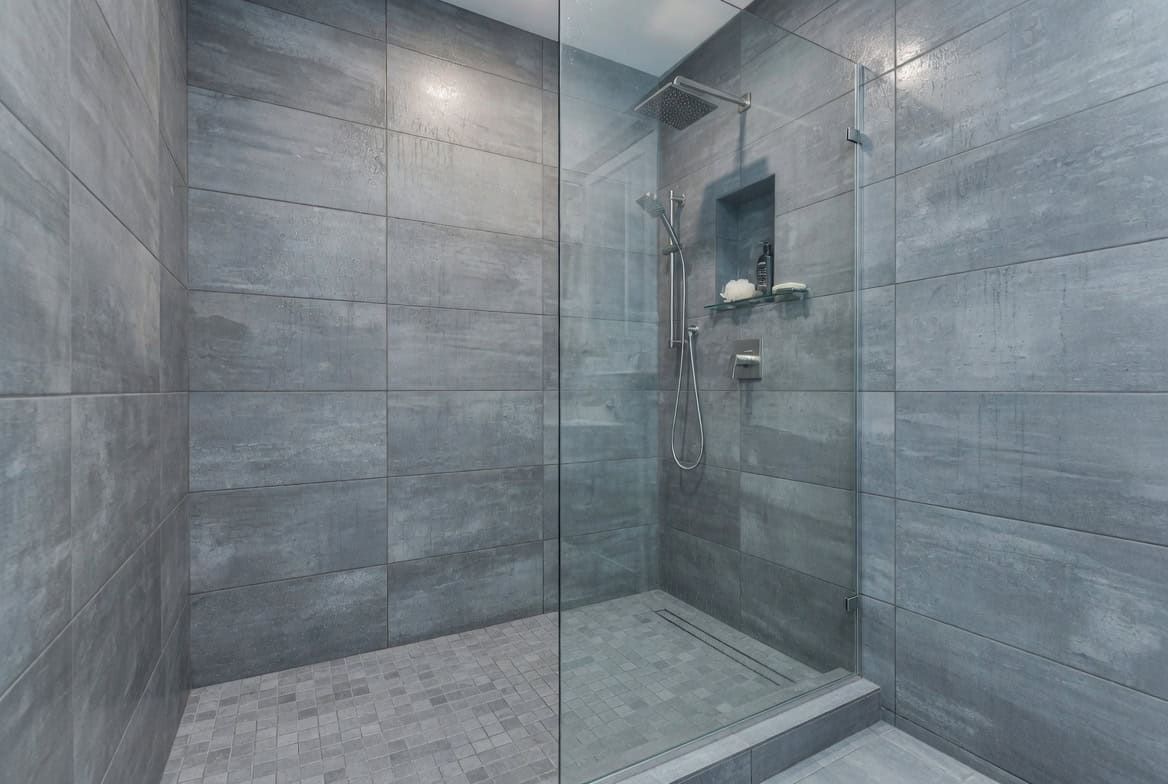
        Tiled shower vs acrylic shower comparison in an Auckland bathroom renovation


        What Does an Acrylic Shower Actually Cost vs a Tiled Shower in Auckland?

        Let’s get the numbers on the table first, because this is usually what decides it.

        An acrylic shower package — base, wall liner, glass, and waste — costs between $900 and $2,000 fully installed in Auckland. That’s the complete job. The lower end gets you a standard 900×900mm two-sided Newline or Englefield unit with framed glass. The upper end gets you a larger 1200×900mm unit with semi-frameless or frameless glass and a low-profile tray.

        A tiled shower is a different proposition entirely. Expect to pay $2,500–$4,000 for a tiled shower as part of a bathroom renovation in Auckland — and that’s when you’re already renovating the room. The tiling labour, waterproof membrane, GIB Aqualine lining, tile supply, grout, and shower glass all add up. If you’re tiling the entire bathroom floor-to-ceiling (which most of our clients do when they go the tiled route), the shower becomes part of a larger tiling package rather than a standalone cost.

        Acrylic vs tiled shower cost breakdown for an Auckland bathroomFull Cost Breakdown — Acrylic vs Tiled Shower NZ

        Cost Component Acrylic Shower Tiled Shower
        Shower base/tray $200–$500 (included in package) $300–$800 (tile-over tray or built on site)
        Walls $250–$600 (acrylic liner) $500–$1,500 (tiles + waterproof membrane + GIB Aqualine)
        Shower glass $300–$800 (framed to semi-frameless) $800–$2,500 (frameless custom-cut)
        Installation labour $300–$600 (4–6 hours) $1,000–$2,000 (multiple trades, multiple days)
        Building consent Not typically required (like-for-like) $500–$2,500 (often required — see below)
        Total installed cost $900–$2,000 $2,500–$4,000+

        A few things to note. Those tiled shower figures assume you’re already doing a full bathroom renovation and the tiler is on site anyway. If you wanted to rip out a standalone acrylic unit and replace it with a tiled shower on its own — without renovating the rest of the bathroom — you’d be looking at $7,000–$10,000 or more once you add consent, waterproofing, tiling, plumbing, and glass. That’s what we consistently see on standalone shower jobs across Auckland.

        💡 Quick tip: If you’re renovating the whole bathroom anyway, the cost gap between acrylic and tiled shrinks considerably — because the tiler, waterproofer, and plasterer are already booked. The real cost difference is when you’re replacing a shower in isolation.

        One more number worth knowing. Across our Auckland projects, labour rates for bathroom trades run $90–$120 per hour. Tiling labour is on the higher end of that range, and a skilled tiler working on shower walls and a shower floor will spend 2–3 days minimum. That labour cost is baked into the tiled shower figures above.

        Completed tiled shower with frameless glass by Superior Renovations Auckland

        Superior Renovations


        Building Consent — The Part Most People Get Wrong

        This is where the acrylic vs tiled shower conversation gets genuinely complicated in New Zealand. And it’s the section most supplier websites either skip entirely or oversimplify.

        If you’re replacing an acrylic shower with another acrylic shower in the same position, you generally don’t need a building consent. It’s a like-for-like replacement. The plumbing stays where it is, no structural changes, no waterproof membrane work. A plumber swaps the waste, the installer fits the new unit, and you’re done in a day. Building Performance (MBIE) lists replacing an existing shower with a stand-alone or ready-made shower among the work that sits within the Schedule 1 exemptions.

        Tiled showers are a different story — particularly level-entry ones.

        Why Tiled Wet-Area Showers Usually Need Consent in NZ

        According to Building Performance (MBIE), installing a “wet area” shower requires a building consent. A wet-area (or level-entry) shower is one where the shower floor is a continuation of the bathroom floor rather than a separate raised tray. MBIE’s position is that this work is not low-risk: the substructure for the tanking and the waterproofing falls outside the Schedule 1 exemptions because the consequences of getting it wrong are significant.

        Auckland Council follows this guidance. If you’re building a tiled level-entry shower, expect to apply for consent.

        But — and this is the part that’s been confusing tradies and homeowners across the country — a 2024 MBIE determination muddied the water. Determination 2024/054 looked at two tiled showers installed in an existing dwelling and found that, because the work involved removing existing linings and installing new ones, the wet-area membrane work fell within the scope of Clause 12 of Schedule 1. In plain English: in that specific situation, membrane work that MBIE’s own guidance treats as needing consent was found to be exempt under the Act itself.

        “We always advise clients to get consent for a tiled shower. The cost is a few hundred to a couple of thousand dollars and it protects you when you sell. The determination created some grey area, but grey area in building compliance isn’t something you want to gamble on — especially in Auckland where LIM reports flag everything.”
        — Dorothy Li, Design Manager, Superior Renovations

        Our position is straightforward. Get the consent. It’s a few hundred dollars and a few weeks of processing time. When you sell your home, a consented tiled shower is an asset. An unconsented one is a negotiation point — and not in your favour. We’ve seen Auckland property transactions where the buyer’s solicitor knocked $5,000–$10,000 off the purchase price because bathroom work wasn’t consented. That makes the consent fee look like very cheap insurance.

        💡 Quick tip: If a tradie tells you a tiled shower doesn’t need consent, ask them to put that in writing. Most won’t — because they know the liability sits with the homeowner, not the installer. Use MBIE’s “Do you need a building consent?” tool or call Auckland Council’s building desk directly.

        What This Means in Practice

        For most Auckland homeowners doing a full bathroom renovation with a tiled shower, the consent is part of the process anyway. Superior Renovations handles all consent applications on behalf of our clients — it’s built into how we manage projects. You won’t be chasing council inspectors or trying to interpret Schedule 1 yourself. We work with Sonder Architecture for any projects that require architectural drawings or resource consent documentation.

        For landlords doing a quick rental refresh with an acrylic swap? The consent question rarely comes up. That’s one of acrylic’s genuine advantages.

        Auckland bathroom renovation with consented tiled shower by Superior Renovations


        How Long Does Each Shower Type Actually Last?

        This is where the value equation shifts — and where acrylic’s upfront cost advantage starts to shrink.

        A quality acrylic shower typically lasts 10–20 years. The walls hold up well — acrylic is non-porous, doesn’t absorb moisture, and resists mould naturally. The tray is usually the first thing to show wear. Manufacturer warranties give you a sense of the range: Atlantis backs its Ellure acrylic wall panels for around 7 years, while its premium tile-over EasyTile shower base carries a 25-year leak-free warranty. Higher-end units with thicker acrylic and reinforced bases sit at the top of that lifespan range.

        A tiled shower? Properly installed with quality porcelain or ceramic tiles, expect 40–50 years. The tiles themselves are almost indestructible. What needs attention is the grout and the waterproof membrane underneath. Per BRANZ, the waterproofing system under wet-area tiling must have a durability of at least 15 years under Building Code Clause B2 — and a well-maintained membrane often outlasts that. Grout should be resealed every 8–10 years, and silicone around glass and junctions needs replacing every 2–3 years (or sooner in Auckland’s humidity). That maintenance isn’t free — a professional silicone replacement and grout reseal runs $300–$600 — but it’s a fraction of a full shower replacement.

        Maintenance Comparison

        Maintenance Task Acrylic Shower Tiled Shower
        Weekly cleaning Wipe with soft cloth + mild soap — 5 mins Clean tiles + scrub grout lines — 10–15 mins
        Silicone replacement Every 3–5 years Every 2–3 years
        Grout resealing N/A — no grout Every 8–10 years ($300–$600)
        Damage repair Difficult — cracks often mean full replacement Individual tiles can be replaced without redoing the whole shower
        Expected lifespan 10–20 years 40–50 years (with grout maintenance)

        Here’s the maths that matters. Over a 40-year period in your Auckland home, you’d likely replace an acrylic shower two to three times — spending $2,700–$6,000 total. A single tiled shower installation at $3,500 with two grout reseals ($600–$1,200) totals around $4,200–$4,700 over the same period. Similar lifetime cost, but the tiled shower adds more to your home’s market value throughout.

        💡 Quick tip: Auckland’s humidity is harder on both options than you’d expect — NIWA classifies the region’s climate as warm and humid, with mean morning relative humidity sitting around 80%. For acrylic, make sure your extractor fan is rated for the room size — inadequate ventilation accelerates yellowing. For tiled showers, use porcelain over ceramic where budget allows. Porcelain’s water absorption rate is under 0.5%, well inside the 6% maximum BRANZ specifies for shower tiles, making it far better suited to Auckland’s damp conditions.

        “I always tell clients — the grout is not the enemy. Poor ventilation is the enemy. We see tiled showers in Ponsonby villas that look brand new after 12 years because the extractor fan is doing its job. And we see acrylic showers in new builds that have yellowed in five years because the bathroom has no window and a cheap fan.”
        — Cici Zou, Designer (NZ Dip. Interior Design, Certified Designer), Superior Renovations


        Design and Aesthetics — When Each Option Makes Sense

        Let’s be direct about this. A tiled shower looks better. That’s not a controversial statement — it’s why the majority of our Auckland bathroom renovation clients choose tiled. When you tile a shower floor-to-ceiling using the same tiles as the rest of the bathroom, you create visual continuity that makes the whole room feel larger and more cohesive. An acrylic box sitting inside a tiled bathroom does the opposite — it breaks the visual flow and immediately reads as a separate, lower-spec element.

        That said, acrylic has come a long way. It’s not just the white plastic boxes people remember from the ’90s.

        What Acrylic Can and Can’t Do

        Modern acrylic showers from NZ brands like Englefield and Newline now offer low-profile trays, near-frameless glass, and cleaner wall profiles. Some manufacturers produce tile-look acrylic liners — Atlantis makes its Ellure range specifically to mimic a tiled wall without the waterproofing and consent requirements.

        But there are hard limits. Acrylic is usually only available in white (coloured options exist but are made to order and significantly more expensive). You’re locked into the sizes the manufacturer offers — usually 900×900mm, 1000×1000mm, or 1200×900mm. If your bathroom has an awkward alcove or a non-standard dimension (common in older Auckland villas and bungalows), acrylic may not fit without compromising the layout.

        What Tiled Showers Offer That Acrylic Can’t

        Full design freedom. Any tile, any colour, any pattern, any size. You can run the same large-format 600×600mm porcelain across the bathroom floor and straight into the shower. You can create feature walls with textured or patterned tiles. You can build the shower to any dimension — wall-to-wall, oversized, or shaped to fill dead space in an unusual floor plan.

        We recently completed a bathroom in Grey Lynn where the homeowner wanted a double-width walk-in shower spanning the full back wall of the room — 2.4 metres wide with a single glass panel. That’s not something an acrylic unit can do. The tiled shower with large-format charcoal porcelain and a linear channel drain made the bathroom look twice its actual size.

        Wide tiled walk-in shower with frameless glass in a Grey Lynn bathroom renovation

        For clients working with our in-house design studio, the tiled shower becomes a design element — not just a functional box. Our designers source tiles from The Tile Depot and work with fixtures from Reece to create bathrooms where the shower is the centrepiece, not an afterthought.

        Porcelain shower tiles selected for an Auckland bathroom renovation

        💡 Quick tip: If you’re renovating a bathroom in a character home — an early 1900s villa in Mt Eden, a 1930s bungalow in Epsom — a tiled shower with artisan or handmade-look tiles will complement the home’s character far better than a white acrylic unit. Continuity between the shower and the rest of the bathroom is what separates a good renovation from a great one.


        So Which Should You Choose? Our Honest Recommendation

        After installing hundreds of both across Auckland, here’s where we land.

        Choose Acrylic If:

        You’re renovating a rental property. The maths are simple. An acrylic shower at $1,200 installed, lasting 10–15 years with almost zero maintenance, is the right call for a rental. Your tenants won’t appreciate (or maintain) expensive tilework, and you don’t need the design premium. We’ve done plenty of rental bathroom refreshes across Henderson, Papakura, and South Auckland where an acrylic unit with a basic vanity and new flooring brings the bathroom up to a good standard at the lower end of the budget range.

        You’re on a very tight budget. If every dollar matters, acrylic saves you $1,500–$3,000 on the shower alone — money you can redirect to a better vanity, decent tapware, or underfloor heating.

        You need it done fast. Moving in next week? Selling in a month? Acrylic goes in within a day. No consent, no waiting for a tiler, no curing time.

        Choose a Tiled Shower If:

        You’re renovating your own home. If this is the bathroom you’ll use for the next 10–20 years, spend the extra. The tiled shower will outlast the acrylic option by decades, and you’ll appreciate the design every morning. It’s not about luxury — it’s about doing it once and doing it properly.

        You’re spending $25,000+ on the bathroom renovation. At this budget level, putting an acrylic shower in a fully tiled bathroom looks and feels wrong. It’s the equivalent of fitting laminate benchtops in a kitchen with custom cabinetry. The shower should match the standard of the rest of the room. A mid-range bathroom renovation in Auckland runs $25,000–$35,000 — and at that price point, our bathroom renovation cost calculator already factors the tiled shower in.

        You’re trying to add value before selling. A tiled, consented bathroom reads as a quality renovation on a property listing. An acrylic shower in an otherwise upgraded bathroom sends mixed signals. Buyers notice.

        “When clients come to our showroom at 16B Link Drive in Wairau Valley, we always show them both options side by side. Nine times out of ten, once they see the difference in person, they choose tiled. It’s not about cost at that point — it’s about how their bathroom will feel every day.”
        — Alison Yu, Designer, Superior Renovations

        The Hybrid Option

        There’s a middle ground worth mentioning. Some homeowners choose an acrylic tray with tiled walls. The acrylic base handles the waterproofing at floor level (where leaks cause the most damage), while the tiled walls give you the design flexibility and premium look. It can work — but talk to your renovation company about how the junction between tray and tile is detailed, because that’s where problems occur if it’s not done properly. It’s not a shortcut we recommend for most clients, but it has its place.

        Superior Renovations showroom bathroom display in Wairau Valley, Auckland


        What Happens During Installation — Acrylic vs Tiled

        Understanding what’s actually involved helps explain the cost and time difference.

        Acrylic Shower Installation

        Total time: 4–6 hours, one tradie. The process is straightforward. The plumber connects the waste fitting to the shower tray, the tray is set onto the floor (levelled with packing if needed), the acrylic wall liners are glued to the walls, silicone is applied at all junctions, and the glass is fitted. Done.

        The simplicity is acrylic’s biggest practical advantage. One person, one day, minimal disruption. If you’re replacing an existing acrylic unit with a new one and the plumbing is in the same position, there’s very little that can go wrong.

        Tiled Shower Installation

        Total time: 5–10 working days (as part of a full bathroom renovation), involving multiple trades. Here’s the typical sequence:

        Day 1–2: Demolition of existing shower, wall preparation, any structural modifications to floor joists or framing. Day 3: GIB Aqualine (or equivalent wet-area lining) installed on walls. Shower tray positioned and waste connected by plumber. Day 4: Waterproof membrane applied to all wet-area surfaces — walls and floor. This is the critical step. The membrane needs to cure for 24–48 hours minimum before tiling. Day 5–7: Tiling — walls first, then floor. Larger tiles reduce labour time, which is why 600×600mm formats have become standard in Auckland bathrooms. Day 8: Grouting and initial clean. Day 9–10: Silicone applied at all junctions, glass measured and fitted (custom glass may require a separate visit).

        The waterproof membrane is what makes or breaks a tiled shower. Get it wrong and you’re dealing with leaks that damage framing, flooring, and potentially rooms below. This is why MBIE cares about consent for wet-area showers — and why you want a renovation company that uses licensed building practitioners, not a mate with a trowel. We use certified waterproofing systems and provide PS3 waterproofing producer statements as standard on every tiled shower we install.

        💡 Quick tip: Ask your renovation company for a PS3 producer statement for the waterproofing. This is a document signed by the waterproofing applicator confirming the membrane was installed to the manufacturer’s specifications. It’s required for consent sign-off and it’s your proof that the job was done correctly. If a company can’t or won’t provide one, that’s a red flag.


        Book your free in-home consultation with Superior Renovations
        Use our bathroom renovation cost calculator to estimate your project
        Request a free feasibility report for your project


        How much does an acrylic shower cost in NZ?

        A standard acrylic shower package — base, wall liner, glass, and waste — costs between $900 and $2,000 fully installed in Auckland. The price depends on the size (900×900mm to 1200×900mm), glass type (framed vs frameless), and brand. Popular NZ brands include Englefield, Newline, Atlantis, and Clearlite. Labour is typically 4–6 hours with one tradesperson.

        How much does a tiled shower cost in Auckland?

        A tiled shower costs $2,500–$4,000 when installed as part of a full bathroom renovation in Auckland. This includes the tile-over tray, waterproof membrane, GIB Aqualine lining, tiles, grouting, and glass. If you're replacing a standalone acrylic shower with a tiled shower without renovating the rest of the bathroom, expect $7,000–$10,000+ including building consent.

        Do I need a building consent for a tiled shower in NZ?

        In most cases, yes. Building Performance (MBIE) states that installing a wet-area (level-entry) shower requires a building consent because it involves waterproof membrane work classified as higher-risk. Auckland Council follows this guidance. A 2024 MBIE determination (2024/054) found membrane re-lining work in an existing dwelling could fall within a Clause 12 exemption, creating some grey area — but our strong advice is to get consent regardless. It protects you when selling your home.

        Do I need consent to replace an acrylic shower with another acrylic shower?

        Generally no, provided it's a like-for-like replacement in the same position with no changes to plumbing layout or structure. Building Performance (MBIE) lists replacing an existing shower with a stand-alone or ready-made shower among Schedule 1 exempt work. An authorised plumber should handle the waste connection. This is one of acrylic's key advantages — a straightforward swap with no council involvement.

        How long does an acrylic shower last in NZ?

        A quality acrylic shower typically lasts 10–20 years depending on the brand and maintenance. Manufacturer warranties give a guide — Atlantis backs its Ellure acrylic wall panels for around 7 years and its premium EasyTile shower base for 25 years. Auckland's high humidity can accelerate wear if ventilation is poor, so a decent extractor fan rated for the room size is essential.

        How long does a tiled shower last?

        A properly installed tiled shower with porcelain or ceramic tiles can last 40–50 years. The tiles themselves are extremely durable — it's the grout and waterproof membrane that determine overall lifespan. Under Building Code Clause B2, BRANZ notes the waterproofing system must have a durability of at least 15 years. Grout should be resealed every 8–10 years, and silicone at junctions replaced every 2–3 years. With regular maintenance, a tiled shower will outlast multiple acrylic replacements.

        Is an acrylic shower or tiled shower easier to clean?

        Acrylic is easier for day-to-day cleaning. The smooth, non-porous surface wipes clean with a soft cloth and mild soap in about 5 minutes. Tiled showers require more effort — you need to clean between grout lines where soap scum and mould can build up, especially in Auckland's humid climate. Using larger tiles (fewer grout lines) and porcelain over ceramic reduces the cleaning burden significantly.

        Can I replace an acrylic shower with a tiled shower myself?

        We strongly advise against it. A tiled shower involves waterproof membrane application, wet-area lining (GIB Aqualine), correct fall for drainage, and tiling to building code standards. Errors in waterproofing can cause thousands of dollars in hidden water damage. The work typically requires a building consent with council inspections. Use a licensed renovation company that provides PS3 waterproofing producer statements.

        Which adds more value to my home — acrylic or tiled shower?

        A tiled shower adds more value. When buyers inspect an Auckland property, a fully tiled, consented bathroom reads as a quality renovation. An acrylic shower in an otherwise well-renovated bathroom can signal cost-cutting. For owner-occupied homes and properties being prepared for sale, tiled is the better investment. For rentals where tenant-proof durability matters more than aesthetics, acrylic is the practical choice.

        What is a PS3 waterproofing producer statement and why does it matter?

        A PS3 producer statement is a document signed by the waterproofing applicator confirming the membrane was installed according to the manufacturer's specifications. It's used for building consent sign-off on tiled showers in NZ and serves as your proof that the waterproofing was done correctly. Always ask your renovation company for this document — if they can't provide one, consider it a warning sign.

        What tiles are best for a shower in Auckland?

        Porcelain tiles are the best choice for Auckland showers. Their water absorption rate is under 0.5%, well within the 6% maximum BRANZ specifies for shower tiles — important given Auckland's high humidity. Large-format tiles (600×600mm or larger) reduce grout lines and cleaning time. For the shower floor, use smaller mosaic tiles or textured porcelain for grip. Source options from NZ suppliers like The Tile Depot (tiledepot.co.nz) who carry a wide range.

        How long does it take to install a tiled shower vs acrylic?

        An acrylic shower installs in 4–6 hours with one tradesperson. A tiled shower takes 5–10 working days as part of a full bathroom renovation — involving demolition, wall preparation, waterproofing membrane application (plus 24–48 hours curing time), tiling, grouting, and glass fitting. Multiple trades are needed: plumber, waterproofer, tiler, and glass installer.


        Further Resources for your bathroom renovation

        1. Featured projects and Client stories to see specifications on some of the projects.
        2. Real client stories from Auckland

        Need more information?

        Take advantage of our FREE Complete Home Renovation Guide (48 pages), whether you’re already renovating or in the process of deciding to renovate, it’s not an easy process, this guide which includes a free 100+ point check list – will help you avoid costly mistakes.

        Download Free Renovation Guide (PDF)


        finance - Superior Renovations

        Have you been putting off getting renovations done?

        We have partnered with Q Mastercard ® to provide you an 18 Month Interest-Free Payment Option, you can enjoy your new home now and stress less.

        Learn More about Interest-Free Payment Options*

        *Lending criteria, fees, terms and conditions apply. Mastercard is a registered trademark and the circles design is a trademark of Mastercard International Incorporated.


        Still have questions unanswered?

        Book a no-obligation consultation with the team at Superior Renovations,
        we’d love to meet you to discuss your renovation ideas!

          Services

          Home RenovationKitchen RenovationBathroom RenovationOutdoor RenovationHouse ExtensionCommercialDesign ServicesOther

          By submitting this form, you agree to receive communications from us via email or text regarding our services, you can unsubscribe at any time.

          This site is protected by reCAPTCHA and the Google

          Privacy Policy and Terms of Service apply.


          References

          1. Building Performance (MBIE) — Wet area showers need building consent
          2. Building Performance (MBIE) — Determination 2024/054 (tiled showers and notice to fix)
          3. Building Performance (MBIE) — “Do you need a building consent?” tool (canibuildit.govt.nz)
          4. BRANZ / Level — Waterproofing tiled showers (Clause B2 durability, tile absorbency)
          5. Auckland Council — Building work you can do yourself and consent exemptions
          6. NIWA (Earth Sciences New Zealand) — Auckland regional climate (humidity)
          7. Atlantis — Ellure tile-look acrylic wall panels (warranty information)
          garage conversion auckland
          House Renovation

          Garage to Granny Flat Auckland 2026: Cost + Consent Guide

          Quick answer: Converting a 30m² garage into a self-contained granny flat in Auckland typically costs $110,000–$145,000 in 2026, plus around $10,000–$20,000 in design and consent fees on top. The work needs building consent, and almost always resource consent for the second household unit. The new 70m² consent-free granny flat exemption that came into force on 15 January 2026 only applies to detached new builds — not to a garage conversion.

          We’ve been getting heaps of these enquiries lately. With Auckland property prices where they are and rents not getting any softer, families are looking at that under-used double garage and seeing a granny flat, a teenager’s retreat, or a rental that could pull $350–$650 a week depending on the suburb and the spec. Turning a garage into a self-contained flat is one of the most popular projects our Auckland garage conversion specialists take on.

          This guide is the one we’d hand to a client at their first consultation. It covers what actually changed in 2026, which type of conversion you’re really planning, what it’ll cost, and where the consent process trips people up.


          Curious about your number? Try our Garage Conversion Cost Calculator

          Takes less than 60 seconds. Results land straight in your inbox.

          Open the Garage Conversion Cost Calculator


          The 2026 granny flat rules — what actually changed (and what didn’t)

          This is the section most other articles are getting wrong, so it’s worth getting right up front.

          On 15 January 2026, the Building and Construction (Small Stand-alone Dwellings) Amendment Act 2025 came into force, introducing a building consent exemption for small standalone dwellings up to 70m². According to Building Performance (MBIE), a qualifying dwelling can be built without a building consent if it has a simple design, meets the Building Code, the council is notified before and after the work, and the work is carried out or supervised by Licensed Building Practitioners. At the same time, the resource consent pathway was streamlined under the new National Environmental Standards for Detached Minor Residential Units (NES-DMRU) — the Resource Management (National Environmental Standards for Detached Minor Residential Units) Regulations 2025. Where a qualifying granny flat meets every NES-DMRU permitted-activity standard in a relevant zone, it can be built without a resource consent either.

          That sounds like brilliant news for anyone planning a garage conversion. Here’s the catch.

          The exemption does NOT apply to a garage conversion. It only applies to a brand-new, detached, single-storey, lightweight dwelling that sits on its own footprint and uses simple plumbing, drainage, and structural systems. A garage conversion is a change of use of an existing structure under the Building Act — it still needs full building consent, and almost always resource consent on top.

          A second thing worth being clear on: even for a new detached build, the resource consent exemption isn’t automatic. The NES-DMRU only removes resource consent in certain zones and only where every permitted-activity standard is met — setbacks, site coverage, height, and natural hazard rules among them. If any standard is breached, the project drops back into the standard consenting process. Always confirm your zone and site constraints before assuming the exemption applies.

          So why is the exemption worth knowing about at all? Because if your garage isn’t actually a good candidate for conversion (low ceiling, dodgy slab, awkward location), the smarter play might be to leave the garage alone and build a small detached granny flat in the backyard instead. Under the new rules, that path is now faster, cheaper, and lighter on paperwork than a full conversion. We’ll cover both options in this guide.

          Either way, you’ll still need to notify Auckland Council, apply for a Project Information Memorandum (PIM), pay any Development Contributions, and have the work carried out or supervised by Licensed Building Practitioners. The exemption removes the consent step — it does not remove your obligation to comply with the Building Code.


          Which type of conversion are you actually planning?

          This is where most homeowners get confused — and where Auckland Council classifies your project differently depending on the answer. There are four distinct paths, and the consent, cost, and complexity look very different for each.

          1. Garage to non-habitable space (storage, workshop, hobby room)

          If you’re not adding a kitchen, not sleeping in there, and not running plumbing, this is the simplest option. Often no consent required, though weatherproofing, insulation, and electrical work all need to comply. Suitable for: storage upgrade, dedicated hobby workshop, home gym without a shower.

          2. Garage to habitable room (bedroom, home office, media room)

          The moment you intend to live, sleep, or work in there full-time, the room is reclassified from a Class 7.0 outbuilding to a Class 2.0 habitable space under the Building Code. Building consent is required. You’ll need to meet minimum ceiling height, ventilation, natural light, insulation, and fire safety standards. A bathroom is allowed within this scope. A kitchen is not — adding one shifts you into the next category.

          3. Garage to self-contained minor dwelling (granny flat)

          Once it has a kitchen, it’s a second household unit under the Auckland Unitary Plan. This needs both building consent and resource consent, and it’s the path most of our clients are on. You’ll also trigger Development Contributions from Auckland Council, which can add $5,000–$20,000 depending on your zone and what infrastructure capacity is already there.

          4. New detached granny flat (built fresh on the section)

          If your garage is genuinely not suitable, this is now the easier path. Under the 2026 exemption, a qualifying detached unit up to 70m² needs no building consent and no resource consent — just notification to the council, a PIM, and Licensed Building Practitioners doing or supervising the work, provided the NES-DMRU standards are met in your zone. You still keep the existing garage, which is worth real money to most Auckland buyers.

          For the rest of this guide we’ll focus on Option 3 — the self-contained garage-to-granny-flat conversion — since that’s the most common scenario we see. The principles for Option 2 are similar; just take off the kitchen costs and the resource consent.


          Is your garage actually suitable for conversion?

          Before you start pricing tradies, you need to know whether the bones of your garage can carry the conversion at all. We run this check at every feasibility visit — it takes about twenty minutes and saves people a lot of wasted design fees.

          Check What we’re looking for
          Ceiling height Minimum 2.4m clear height for a habitable space. Plenty of older Auckland garages — especially attached single garages in 60s and 70s homes — come in at 2.2–2.3m. Raising the ceiling is possible but adds significant cost and structural work.
          Structural condition No major cracks in the slab, walls plumb, roof structure sound, no signs of subsidence. We see issues most often in older brick garages and lean-to additions.
          Slab and drainage A garage slab typically slopes towards the door for water runoff. For a habitable space, it needs to be level, waterproofed, and insulated. If the slab is below the surrounding ground level, drainage gets complicated quickly.
          Wastewater fall For a bathroom and kitchen, you need fall away from the building toward the sewer. Detached garages and low-lying sites often need a sewage pump system, which adds $4,000–$8,000 and ongoing maintenance.
          Utility connections Power can usually be extended. Water and waste are the harder ones — distance from the main house and the existing line capacity both matter.
          Zoning and site coverage Your Auckland Unitary Plan zone sets the rules for what’s allowed. Heritage overlays (common in Mt Eden, Ponsonby, Devonport) add another layer. Pull your property file from Auckland Council early.
          Parking You’ll lose your garage parking. Most Auckland zones still require off-street parking for the primary dwelling, so check what’s left on the site after the conversion.
          Fire egress A habitable space needs compliant exits and smoke alarms. Attached garage conversions sometimes need a fire-rated wall between the new space and the main house.

          If the answers are mostly “yes,” you’ve got a viable project. If two or three are no’s, the economics shift toward Option 4 — building detached under the new exemption — and we’ll usually steer you that way.


          What does a garage-to-granny-flat conversion cost in Auckland in 2026?

          Cost ranges shift with site conditions, finish level, and which suburb you’re in — but here’s what we’re seeing across our recent projects.

          Conversion type Typical size Build cost (2026)
          Garage to habitable room (no kitchen, no bathroom) ~30m² (single garage) $55,000–$80,000
          Garage to habitable room with bathroom (no kitchen) ~30m² (single garage) $80,000–$110,000
          Garage to self-contained minor dwelling (kitchen + bathroom) ~30m² (single garage) $110,000–$145,000
          Double garage to two-bedroom self-contained unit ~50–60m² $160,000–$220,000
          New detached granny flat under 2026 exemption Up to 70m² $180,000–$260,000

          These build cost figures are drawn from Superior Renovations’ own recent Auckland garage conversion projects. They cover the build itself — they don’t include design and consent fees (typically $10,000–$20,000), Development Contributions ($5,000–$20,000 depending on your zone), foundation remediation if required, or major drainage works like pump systems.

          Where the money actually goes

          For a 30m² self-contained conversion, here’s roughly how a $130,000 build breaks down:

          • Bathroom — full ensuite with tiled shower, vanity, toilet: $22,000–$28,000
          • Kitchen — compact open-plan kitchenette with appliances: $18,000–$28,000
          • Structural and weatherproofing — slab works, wall lining, insulation, weather membrane: $25,000–$35,000
          • Plumbing and electrical — rough-in and fit-off, separate water and waste connection: $15,000–$22,000
          • Glazing and external joinery — replacing the garage door with a wall, windows, and entry door: $12,000–$18,000
          • Interior finishes — flooring, painting, ceiling, joinery: $12,000–$18,000

          Where conversions blow out is in the things you can’t see until the slab is up: existing drainage that doesn’t have fall, slab cracks needing remediation, undersized incoming power, or weathertightness issues in the existing structure. Always budget a 10–15% contingency on top of the quoted figure.

          What can you rent it for?

          A well-finished self-contained one-bedroom unit in Auckland is currently letting at $380–$580 per week across most suburbs, with central and inner-west suburbs at the higher end. A two-bedroom from a double-garage conversion lifts that to $520–$720 per week. At those numbers, a $130,000 conversion pays back the build cost in 5–7 years before factoring in property value uplift.


          The consent path — building consent, resource consent, and Development Contributions

          If you’re going down the self-contained granny flat route, you’re working through three Auckland Council processes in parallel.

          Building consent

          Required because you’re changing the use of the structure from a Class 7.0 outbuilding to a Class 2.0 habitable space. Your architectural drawings need to demonstrate compliance with the New Zealand Building Code — fire safety, weathertightness, durability, ventilation, energy efficiency, and sanitary fittings. The standard processing window is 20 working days from a complete application.

          Resource consent

          Required because adding a kitchen creates a second household unit, which most Auckland Unitary Plan zones treat as a non-permitted activity without consent. The plan you’re under (Single House, Mixed Housing Suburban, Mixed Housing Urban, Terraced Housing and Apartment Building) sets the rules around site coverage, building setbacks, height to boundary, and minimum site size. Heritage zones add another layer.

          Development Contributions

          An additional dwelling triggers a Development Contribution from Auckland Council to cover its share of the infrastructure load — water, wastewater, stormwater, transport, parks. As Auckland Council sets out, these contributions apply to additional dwellings; for most Auckland zones in 2026 the figure lands in the $5,000–$20,000 range. The bill arrives with your building consent and has to be paid before work starts.

          💡 Quick tip: Pull your property file from Auckland Council before you spend a cent on design. It’ll show your zoning, any overlays (heritage, character, special character), existing consents, and any unconsented work on the property — all of which affect what’s possible. We’ve had clients save $5,000+ in wasted design fees by spotting an issue at this stage.


          How our process works with Sonder Architecture

          For anything consent-related — and a self-contained garage conversion always is — we work with our sister brand Sonder Architecture. Their studio sits in the same building as our showroom at 16B Link Drive, Wairau Valley, so handovers between design and build are tight.

          The typical path:

          1. Initial enquiry — you get in touch through our contact page or by calling the office.
          2. Discovery call — we’ll run through what you’re trying to achieve, take some preliminary site information, and loop in Sonder’s lead architect.
          3. Property file pull — you request the property file from Auckland Council. This usually takes 5–10 working days.
          4. Onsite feasibility visit — Sonder visits the site, walks through what’s possible, and identifies any constraints before any design fees are spent.
          5. Concept and quote for documentation — concept drawings and a fixed quote for the consent-ready architectural set.
          6. Consent documentation and submission — Sonder lodges with Auckland Council. We project-manage council back-and-forth.
          7. Detailed build quote — once drawings are consented, our renovation consultant works up the fixed-price build proposal with full specifications.
          8. Build phase — managed end-to-end by Superior Renovations, including all subtrades.

          Most full conversions run 6–10 months from first enquiry to handover, with the consent phase taking 3–5 months and the build phase 12–16 weeks.


          Attached vs. detached garage — what changes

          The base process is the same, but a few practical differences are worth flagging.

          Attached garages usually carry lower structural cost. The walls and roof are already part of the main house, services are close at hand, and the existing slab and roofline can often be re-used. The downside: you’ll likely need a fire-rated wall between the new dwelling and the main house, and any shared wall acoustics need to be properly thought through if it’s going to be rented.

          Detached garages carry their own slab, their own connections, and usually a longer drainage run back to the main sewer. That adds cost — sometimes $10,000–$25,000 over and above an equivalent attached conversion. But the upside is a properly independent unit, no shared walls, and a cleaner separation between the granny flat and the main house. For rental purposes, detached almost always lets faster and at a higher rate.

          Where the resource consent process is concerned, attached conversions are generally less likely to trigger consent issues around site coverage and building footprint, since the existing structure is already counted. Detached projects can run into site coverage caps, particularly on smaller suburban sections.


          The unconsented conversion trap — and why it costs more than getting it done properly

          This is the one we wish more homeowners knew before they listened to a mate or watched a YouTube tutorial.

          If your garage gets converted to a habitable space without the right consents and final Code Compliance Certificate, you’ve created an unconsented dwelling. The consequences sound abstract until they hit:

          • Insurance — many insurers won’t cover unconsented work, and some will void the entire house policy if a claim touches the unconsented area.
          • Sale process — pre-purchase inspections flag it. Buyers either walk or use it to negotiate the price down by more than the conversion cost itself.
          • Council enforcement — Auckland Council can issue a Notice to Fix and require you to either remove the work or apply for a Certificate of Acceptance retrospectively, which is harder and more expensive than getting consent in the first place.
          • Bank lending — refinancing or drawing equity against the property gets messy when the registered floor area doesn’t match what’s there.

          If you’ve inherited an unconsented conversion when you bought the property, or one was done before you understood the implications, the right move is to contact the council and start the Certificate of Acceptance process before you list the property. It’s not a quick fix, but it’s the only one that actually clears the issue.


          Curious about your number? Try our Garage Conversion Cost Calculator

          Takes less than 60 seconds. Results land straight in your inbox.

          Open the Garage Conversion Cost Calculator


          Common cost drivers (and how to keep them in check)

          If you want to keep the project on budget, these are the levers worth understanding.

          Drainage and waste. The single biggest cost surprise on detached garages. If there’s no natural fall to the sewer, you’re looking at a sewage pump system, which adds $4,000–$8,000 plus ongoing maintenance. Get this checked at feasibility — not after design is locked in.

          Insulation and weathertightness. Garages weren’t built to keep warm bodies dry and comfortable. Upgrading to current Building Code standards — particularly wall and ceiling insulation, weather membrane, and continuous flashing — is non-negotiable for a Code Compliance Certificate. Budget $8,000–$15,000 for a 30m² space.

          Replacing the garage door. The big roller door comes out and gets replaced with framed wall, windows, French doors, or a sliding door. Joinery choice drives the cost here — entry-level aluminium is around $4,000–$6,000 for the wall section; thermally broken aluminium or timber joinery can push that to $10,000–$15,000.

          Kitchen spec. A compact granny flat kitchen done well — flat-pack carcasses, laminate fronts, basic stone benchtop, mid-range appliances — runs $18,000–$22,000. Step up to bespoke joinery from Little Giant Interiors with stone benchtops and integrated appliances and you’re at $28,000–$40,000. The unit will rent for the same either way, so for a pure investment build, the lower spec is the smarter call.

          Raising the ceiling. If your garage doesn’t meet 2.4m clear, raising the roof structure adds $20,000–$40,000 and triggers more structural engineering. In many cases it kills the economics — and the detached-new-build path becomes the better option.


          FAQ

          How much does it cost to convert a garage into a granny flat in Auckland?

          A typical 30m² self-contained garage conversion in Auckland costs $110,000–$145,000 for the build itself in 2026, plus $10,000–$20,000 in design and consent fees and another $5,000–$20,000 in Auckland Council Development Contributions. A larger double-garage conversion to a two-bedroom unit (~50–60m²) typically runs $160,000–$220,000. These figures are drawn from Superior Renovations' own recent Auckland projects.

          Do I need consent to convert my garage to a granny flat?

          Yes — both building consent and resource consent are required for a self-contained minor dwelling. The 2026 granny flat consent exemption only applies to detached new builds up to 70m², not to garage conversions. Adding a kitchen makes the space a second household unit under the Auckland Unitary Plan, which triggers resource consent on top of the building consent required for change of use.

          Does the 2026 granny flat law apply to my garage conversion?

          No. The Building and Construction (Small Stand-alone Dwellings) Amendment Act 2025, which came into force on 15 January 2026, only applies to brand-new detached single-storey dwellings up to 70m² with simple design and construction. A garage conversion is a change of use of an existing structure and still needs full consents.

          How long does a garage conversion take in Auckland?

          Most full self-contained conversions run 6–10 months from initial enquiry to handover. Design and consent typically takes 3–5 months. The build phase is usually 12–16 weeks. Simpler conversions to a non-self-contained room can be faster, with less consent work and a shorter build.

          Can I add a toilet and shower in my garage conversion?

          Yes, but drainage is the key constraint. The Building Code requires proper fall to the sewer, and many garages — particularly detached ones — don't have natural fall. Options include cutting the existing slab to run waste lines, trenching to a new connection, or installing a sewage pump system. A pump system adds $4,000–$8,000 plus ongoing maintenance.

          What's the minimum ceiling height for a habitable garage conversion?

          The New Zealand Building Code requires a minimum 2.4m clear ceiling height for habitable spaces. Many older Auckland garages — particularly in 1960s and 1970s homes — come in at 2.2–2.3m. Raising the ceiling is possible but adds significant structural cost. If you're more than 100mm short, the economics often favour building a new detached granny flat instead.

          What can I rent a converted granny flat for in Auckland?

          A well-finished self-contained one-bedroom unit currently lets at $380–$580 per week across most Auckland suburbs in 2026, with inner-city and inner-west suburbs at the higher end. A two-bedroom from a double-garage conversion lifts that to $520–$720 per week. At those figures, a $130,000 conversion typically pays back the build cost in 5–7 years before factoring in property value uplift.

          What happens if I convert my garage without consent?

          Unconsented conversions create real problems at insurance time, at sale, and with the bank. Many insurers won't cover unconsented work and can void the entire house policy. Buyers either walk from the deal or use it to discount the price. Auckland Council can issue a Notice to Fix requiring removal or retrospective Certificate of Acceptance. The right move is always to start the Certificate of Acceptance process before listing if an unconsented conversion is on the property.

          Attached or detached garage — which is easier to convert?

          Attached garages are usually cheaper to convert because the walls, roof, and services are already integrated with the main house. Resource consent issues around site coverage and building footprint are also less likely. Detached garages give you a properly independent unit and typically rent faster and at a higher rate, but the longer drainage runs and separate connections can add $10,000–$25,000 over an equivalent attached conversion.


          finance - Superior Renovations

          Have you been putting off getting renovations done?

          We have partnered with Q Mastercard ® to provide you an 18 Month Interest-Free Payment Option, you can enjoy your new home now and stress less.

          Learn More about Interest-Free Payment Options*

          *Lending criteria, fees, terms and conditions apply. Mastercard is a registered trademark and the circles design is a trademark of Mastercard International Incorporated.


          Still have questions unanswered?

          Book a no-obligation consultation with the team at Superior Renovations,
          we’d love to meet you to discuss your renovation ideas!

            Services

            Home RenovationKitchen RenovationBathroom RenovationOutdoor RenovationHouse ExtensionCommercialDesign ServicesOther

            By submitting this form, you agree to receive communications from us via email or text regarding our services, you can unsubscribe at any time.

            This site is protected by reCAPTCHA and the Google

            Privacy Policy and Terms of Service apply.


            References

            1. Building Performance (MBIE) — Granny flats exemption: Guidance and resources
            2. New Zealand Legislation — Resource Management (National Environmental Standards for Detached Minor Residential Units) Regulations 2025
            3. Building Performance (MBIE) — New Zealand Building Code compliance
            4. Auckland Council — Development Contributions
            5. Auckland Council — How to order a property file
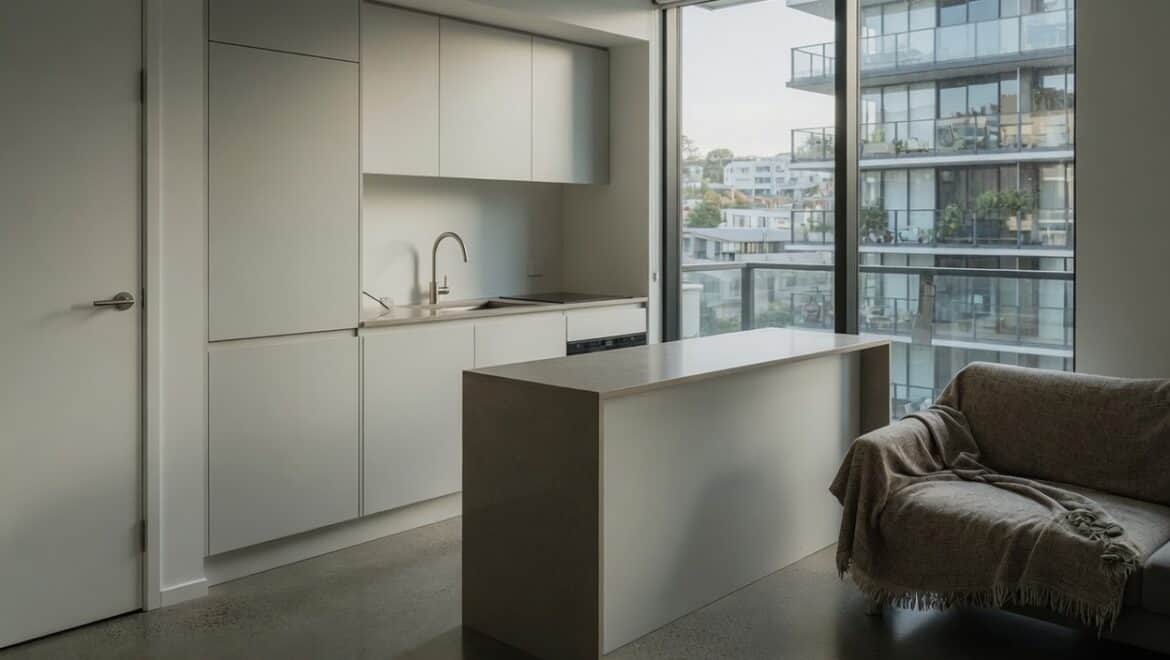
            bathroom renovation west auckland 2 - Superior Renovations
            Bathroom Renovation

            Common Bathroom Renovation Mistakes NZ | 2026 Guide

            Quick answer: The most common bathroom renovation mistakes in NZ include underestimating costs (Auckland mid-range sits at $25,000–$35,000, not the $10,000 many expect), skipping building consent, cutting corners on waterproofing, poor ventilation planning, and choosing materials based on looks rather than performance in our humid climate.

            A bathroom renovation should be one of the best investments you make in your Auckland home. When it goes right, you get a space that works better, feels better, and adds genuine value to your property.

            When it goes wrong? You get mould behind new tiles, a $15,000 budget that blows out to $25,000, or a call from Auckland Council asking why nobody applied for consent before the plumber moved that waste pipe.

            We’ve been renovating bathrooms across Auckland since 2017 — from tired ensuites in Grey Lynn villas to family bathrooms in Flat Bush new builds. We’ve seen every version of “I wish I’d known that before we started.” The patterns are remarkably consistent. The same mistakes keep showing up, project after project, suburb after suburb. And nearly all of them are avoidable with straightforward planning.

            This isn’t a list of vague warnings. Every mistake below comes with the real cost of getting it wrong, the NZ-specific rule or standard that applies, and the specific fix. Whether you’re planning a quick $9,000 refresh or a $45,000+ custom wet room, these are the things worth knowing before demo day.

            Custom built bathroom renovation. Luxury bathroom design


            Mistake #1: Getting the Budget Wrong From Day One

            This is the single most common bathroom renovation mistake we see in Auckland. Not by a small margin — by a huge one.

            Homeowners walk in expecting to spend $10,000–$15,000 on a full bathroom renovation. The reality? A mid-range full bathroom renovation in Auckland costs $25,000–$35,000 in 2026, covering design, all materials, trades, and project management. That’s not luxury — that’s a properly done standard job with new tiles, vanity, shower, lighting, and fixtures.

            Where the Numbers Actually Land

            Here’s what bathroom renovation actually costs in Auckland right now, based on completed projects across our portfolio:

            Renovation Tier Typical Cost (Auckland, 2026) What’s Included
            Budget refresh $9,000–$16,000 New paint, fittings, minor tiling — no layout changes
            Mid-range full renovation $25,000–$35,000 New tiles, vanity, shower, fixtures, lighting, labour, project management
            Luxury / custom wet room $45,000–$65,000+ Premium brands, wet room, underfloor heating, custom design

            Those figures reflect a 5–8% increase from 2025, driven by material and labour inflation across Auckland’s construction sector (Stats NZ confirmed residential construction prices rose 1.9% in the 12 months to March 2025, with further pressure through 2026).

            The Real Damage of Underbudgeting

            When people start a renovation with unrealistic numbers, one of two things happens. Either they run out of money mid-project — which means compromised finishes, half-done work, and a bathroom that’s worse than what they started with — or they start making reactive cuts that undermine the whole job. Cheap waterproofing. No consent. Tiles from the clearance bin that crack in six months.

            We had a client in Henderson who budgeted $15,000 for a 10m² bathroom renovation but skipped a $1,500 consent for plumbing changes. Auckland Council halted the job. Three weeks of delays, $3,000 in corrections — total cost hit $22,000. With proper planning and the consent sorted upfront, it would have been $18,000.

            💡 Quick tip: Use the Superior Renovations bathroom cost calculator to get an initial estimate based on your specific bathroom size and finish level before you start talking to anyone.

            “The number one thing I tell clients in the first design meeting — be honest about your budget and add 10–15% on top for contingency. Auckland bathrooms always have surprises behind the walls, especially in pre-2000s homes. The contingency isn’t a luxury, it’s the thing that stops your project falling apart halfway through.”
            — Cici Zou, Designer (NZ Dip. Interior Design, Certified Designer), Superior Renovations


            Mistake #2: Skipping Waterproofing and Ventilation — the Invisible Killers

            If budget mistakes are the most common, waterproofing and ventilation failures are the most expensive to fix after the fact.

            Think about it. You can’t see waterproofing once the tiles are on. You can’t see ventilation once the ceiling is closed up. These are the parts of a bathroom renovation that nobody photographs for Instagram — and they’re the parts that determine whether your bathroom lasts 20 years or starts growing mould behind the wall in 18 months.

            designer bathroom auckland 11 - Superior Renovations

            designer bathroom auckland 12 - Superior Renovations

            Waterproofing: What the NZ Building Code Actually Requires

            NZ Building Code Clause E3 (Internal Moisture) mandates that all bathroom wet areas must be waterproofed to prevent moisture penetrating the building structure. That means the shower floor and walls, around the bath, and any area that regularly gets wet. The membrane must be applied by a qualified waterproofer, tested, and signed off before tiles go on.

            Older Auckland homes — villas in Mt Eden, bungalows in Sandringham, even the 1990s–2000s builds in Albany — are already prone to moisture issues. Many have single-skin walls, poor subfloor ventilation, and decades of deferred maintenance. Layering a new bathroom on top of compromised waterproofing is like painting over rust.

            Failed DIY waterproofing is one of the most common reasons bathrooms need to be re-renovated within five years. The cost? Ripping out tiles, reapplying membrane, and re-tiling a shower alone can run $5,000–$10,000 — on top of whatever the original job cost.

            Ventilation: Auckland’s Humidity Problem

            Auckland’s average humidity sits between 75–85% through winter. That’s high. Without proper mechanical ventilation — a decent extractor fan ducted to the outside, not just into the ceiling cavity — you’re creating a mould breeding ground.

            For rental properties, an extractor fan is mandatory under the Healthy Homes standards. For owner-occupied homes, it’s not legally required in the same way, but it’s the single cheapest piece of insurance you can add to a bathroom renovation. We’re talking $300–$800 installed for a quality fan — against thousands to remediate mould damage later.

            💡 Quick tip: Always have your waterproofing inspected and photographed before tiles go on. If your renovation company can’t show you documented sign-off on the membrane, ask why. At Superior Renovations, we photograph every stage and share it with the client.

            A Titirangi homeowner we spoke to last year had their bathroom renovated by a previous company without documented waterproofing inspection. Eighteen months later, tiles started lifting in the shower. The repair bill came to $8,500 — more than they’d saved by going with the cheaper original quote.


            Mistake #3: Ignoring Building Consent Requirements

            This one catches more Auckland homeowners than you’d expect. The logic usually goes: “It’s just a bathroom. Why would I need consent for my own bathroom?”

            Fair question. And for many bathroom renovations, you don’t need consent. Replacing tiles, vanity, toilet, and shower in the same positions is generally exempt under Schedule 1 of the Building Act 2004.

            But the moment you start moving things — relocating the shower, shifting the toilet waste pipe, removing a wall, changing the electrical layout beyond basic replacements — consent is almost certainly required. And the consequences of getting this wrong are not theoretical.

            designer bathroom auckland 18 - Superior Renovations

            Designer Bathroom By Superior Renovations


            What Happens When You Skip Consent

            Auckland Council can issue a notice to fix. That means stopping work, applying retrospectively (which costs more than applying upfront), and potentially ripping out and redoing work that doesn’t meet code. Fines for unconsented work can reach $200,000 under the Building Act 2004, with a further $20,000 per day the offence continues. An instant infringement fine of $1,000 can be issued on the spot.

            The practical cost is usually less dramatic — but still painful. A consent application for a standard bathroom renovation runs $500–$2,500 through Auckland Council. Compare that to $5,000–$10,000 in forced rework and delays when council discovers unconsented work. The maths is obvious.

            The Selling Problem

            Even if council never finds out during the renovation, unconsented work shows up later. When you sell, your solicitor or the buyer’s building inspector will ask about Code Compliance Certificates. Work done without consent can’t get a CCC. That flags on the LIM report. Unconsented bathroom work can reduce your property value or kill a sale entirely — we’ve seen this happen in Remuera and Ponsonby, where buyers walked away from otherwise excellent homes because the bathroom renovation had no paper trail.

            💡 Quick tip: Not sure if your bathroom renovation needs consent? The government’s exempt building work guide on building.govt.nz lists exactly what’s covered. Or just ask during your free consultation — we assess consent requirements for every project.

            designer bathroom auckland 21 - Superior Renovations

            designer bathroom auckland 16 - Superior Renovations


            Mistake #4: Choosing Materials That Look Good but Don’t Perform

            Pinterest boards are full of beautiful bathrooms. And about half of them would fall apart within three years in an Auckland bathroom.

            The problem is simple: materials that perform well in a dry Californian climate don’t necessarily survive in a high-humidity Auckland environment. Natural timber vanities that haven’t been properly sealed. Unsealed natural stone tiles on a shower floor. Cheap imported tapware with no NZ warranty. These are the material decisions that look great on day one and become problems by year two.

            Tiles: Where Cheap Gets Expensive

            The difference between budget tiles ($30–$50/m²) and quality porcelain or ceramic ($60–$120/m²) is often less than $1,000 for an entire bathroom floor and wall area. But cheap tiles can crack, absorb moisture (especially if they’re not fully vitrified), and stain within a couple of years. The cost of retiling? $3,000–$6,000 including removal and disposal.

            We generally source tiles through The Tile Depot, where the range covers everything from budget-friendly options to premium large-format tiles. The key isn’t spending the most — it’s matching the tile specification to the application.

            designer bathroom auckland 15 - Superior Renovations

            Designer Bathroom By Superior Renovations

            Tapware and Fixtures: The False Economy

            Matte black tapware has been the dominant trend across Auckland bathrooms for the past three years. A full set of quality matte black fixtures runs $500–$1,500. The budget versions? $200–$400. The difference shows within 12 months — cheap coatings wear, handles loosen, and cartridges fail.

            We work with Reece for our bathroom plumbing and fixtures because the product range is backed by NZ warranties and the supply chain is reliable. When a mixer cartridge needs replacing in five years, you want it to be available — not discontinued by a no-name import brand.

            designer bathroom auckland 10 - Superior Renovations

            Designer Bathroom By Superior Renovations

            designer bathroom auckland 13 - Superior Renovations

            Designer Bathroom By Superior Renovations

            “I always tell clients — spend your money where water touches things. Waterproofing, tiles in the shower, quality tapware. The vanity mirror and accessories? That’s where you can save. But the wet zone is not the place to cut corners in Auckland’s climate.”
            — Alison Yu, Designer, Superior Renovations

            💡 Quick tip: Ask your renovation company whether tapware comes with a minimum 5-year NZ warranty. If the answer is vague, the product is probably an unbranded import with no local support.


            Mistake #5: Poor Layout Planning and the Space You Can’t Get Back

            A bathroom is the smallest room most people renovate — and paradoxically, that makes layout planning more important, not less. Every centimetre counts.

            The most common layout mistake we see? Homeowners keeping the same layout because it’s cheaper, even when the existing layout is the reason the bathroom doesn’t work. Sometimes keeping the layout makes perfect sense — same-position replacements save $2,000–$5,000 in plumbing relocation costs and usually avoid consent. But sometimes the existing layout is the problem, and preserving it means spending $25,000+ on a bathroom that still feels cramped, awkward, or poorly lit.

            The Circulation Problem

            NZ Building Code requires minimum clearances around fixtures. You need at least 450mm clear space in front of a toilet, and doors need to open without hitting anything. In Auckland’s older homes — the 3m × 2m bathrooms in 1970s brick-and-tile houses, the narrow bathrooms in pre-war bungalows — these clearances are tight even with careful planning.

            We’ve worked on bathrooms in Hillsborough and Mt Roskill where the original toilet was so close to the vanity you couldn’t sit down without your knee touching the cabinet. The homeowners had lived with it for years. The fix was moving the toilet 300mm — a $2,000–$3,000 plumbing change that transformed the room.

            Lighting: The Forgotten Layout Element

            Most homeowners plan the floor layout carefully and forget about lighting entirely. A single ceiling downlight is not enough. You need task lighting at the vanity (for shaving, makeup, grooming), ambient lighting for the overall space, and ideally a night light option so you’re not blinded at 2am.

            Layered lighting adds $500–$1,500 to a bathroom renovation — and it’s one of the highest-impact, lowest-cost upgrades you can make. Backlit mirrors, LED strip lighting under the vanity, and dimmable downlights turn a basic bathroom into a space that actually feels good to use. PDL by Schneider Electric supply a range of bathroom-rated switches and dimmers designed for NZ wet areas.

            designer bathroom auckland 9 - Superior Renovations

            Designer Bathroom By Superior Renovations

            💡 Quick tip: Before committing to a layout, visit the Superior Renovations showroom at 16B Link Drive, Wairau Valley to see real bathroom layouts in person. It’s easier to judge spatial proportions when you’re standing in an actual bathroom rather than staring at a floor plan.


            Mistake #6: Hiring Wrong, Managing Trades Poorly, and DIY Overreach

            A bathroom renovation involves a minimum of five or six trades: builder, plumber, electrician, waterproofer, tiler, and painter. Potentially a plasterer and gasfitter too. Coordinating these people is project management — and it’s where DIY-managed renovations consistently come unstuck.

            The Cost of Poor Trade Coordination

            When trades aren’t coordinated properly — tiles arrive late, the plumber and electrician are booked for the same day, or the waterproofer can’t come for three weeks — idle time alone adds $500–$1,000 to the job. Auckland tradies charge $90–$120/hour. A plumber standing around for half a day waiting for the tiler to finish is $400–$600 of your money doing nothing.

            We’ve seen projects where homeowners managed their own trades and it took 8–10 weeks for a job that should have taken 3–4. The extended disruption — no functioning bathroom, living with dust, makeshift washing arrangements — costs something too, even if it doesn’t show up on a receipt.

            The DIY Trap

            Some bathroom tasks are genuinely DIY-friendly. Painting. Installing towel rails. Maybe even fitting a vanity if it’s a straight swap. But plumbing, electrical, waterproofing, and tiling are not weekend warrior territory.

            Under NZ law, plumbing and gasfitting work must be carried out by or under the supervision of a registered person under the Plumbers, Gasfitters, and Drainlayers Act 2006. Electrical work beyond basic like-for-like replacements requires a registered electrician. These aren’t suggestions. Doing your own plumbing or electrical work in a bathroom renovation is illegal in New Zealand — and uninsurable if something goes wrong.

            Checking Credentials Matters

            Licensed Building Practitioners (LBPs) can be verified on the LBP register. Plumbers and drainlayers can be checked on the Plumbers, Gasfitters, and Drainlayers Board register. If your builder or renovation company can’t provide LBP numbers, that’s a red flag. Sound familiar?

            A full-service renovation company like ours handles all trade coordination, scheduling, consents, and quality checks under one contract and one project manager. It’s not the only way to do a bathroom renovation — but it eliminates most of the coordination headaches that cause delays and cost blowouts.

            Have a look at our real client stories from Auckland homeowners to see how the process works from their perspective.


            Mistake #7: Forgetting About Storage, Access, and Long-Term Liveability

            A new bathroom can look incredible on completion day and become frustrating within weeks if basic liveability details were overlooked. Storage is the biggest culprit.

            Most Auckland bathrooms are between 3m² and 8m² — and nearly all of them lack sufficient storage. Shampoo bottles on the floor of the shower. Towels piled on the toilet cistern. Cleaning products under the vanity next to the hair dryer. These are signs of a bathroom that was designed for the photo, not for daily life.

            Storage Solutions That Actually Work

            Recessed shower niches (built into the wall during the tiling phase) cost almost nothing extra during construction but add genuine daily functionality. A wall-mounted vanity with drawers rather than a pedestal basin gives you usable storage without taking floor space. Mirrored cabinets above the vanity double as storage and lighting.

            These aren’t luxury additions. They’re standard specifications that should be part of every bathroom renovation brief — and they’re easy to include during the design phase but expensive or impossible to add later.

            Future-Proofing and Accessibility

            If you’re planning to stay in your home long-term, or you’re renovating for ageing parents, think about grab rails (or at least blocking in the wall so they can be added later), barrier-free shower entries, and slip-resistant flooring. These features cost very little to include during a renovation but thousands to retrofit.

            💡 Quick tip: Ask your designer to include timber blocking behind the tiles in the shower and toilet areas during construction. It costs under $100 and means you can install grab rails at any point in the future without retiling.


            How to Avoid These Bathroom Renovation Mistakes — the Summary

            Every mistake on this list has the same root cause: not enough planning upfront. The bathroom renovation itself — demo, build, tile, fit — takes 3 to 4 weeks for a standard Auckland project. The planning should take at least that long again.

            Get your budget realistic before you start talking to anyone. Understand what consent applies to your specific project. Choose a renovation company that manages all trades under one contract, provides a fixed-price quote, and documents every stage. Visit a showroom. Talk to a designer. And build in that 10–15% contingency — because Auckland’s older homes always have something behind the walls.

            The best bathroom renovations we’ve delivered — the ones where clients are still happy years later — all had one thing in common. They were planned properly before anyone picked up a hammer.

            Book your free in-home consultation with Superior Renovations
            Try our free bathroom renovation cost calculator
            Request a free feasibility report for your project


            What are the most common bathroom renovation mistakes in NZ?

            The most common bathroom renovation mistakes in New Zealand include underestimating costs (Auckland mid-range is $25,000–$35,000, not the $10,000–$15,000 many expect), skipping building consent when moving plumbing or making structural changes, cutting corners on waterproofing under tiles, poor ventilation planning in Auckland's high-humidity climate, choosing cheap materials that don't perform in wet areas, and not coordinating trades properly — which adds weeks of delays and idle labour costs.

            How much does a bathroom renovation cost in Auckland in 2026?

            In Auckland in 2026, a budget bathroom refresh costs $9,000–$16,000, a mid-range full renovation runs $25,000–$35,000, and a luxury or custom wet room starts from $45,000 upwards. These figures reflect a 5–8% increase from 2025 due to material and labour inflation. Auckland costs run higher than the national average because of elevated labour rates ($90–$120/hour) and higher compliance costs. Use our free bathroom renovation cost calculator for an estimate tailored to your specific project.

            Do I need building consent for a bathroom renovation in Auckland?

            Most standard bathroom renovations — replacing tiles, vanity, toilet, and shower in the same positions — do not require Auckland Council consent. Consent is required if you are moving plumbing to a new location, removing or adding walls, or making electrical changes beyond standard like-for-like replacements. Consent applications typically cost $500–$2,500. Skipping consent when required can result in fines up to $200,000 under the Building Act 2004, plus forced rework costing $5,000–$10,000.

            How long does a bathroom renovation take in Auckland?

            A standard full bathroom renovation takes 3 to 4 weeks from demolition, assuming design is finalised and all materials are pre-ordered. If consent is required (for moving plumbing or structural changes), add 4 to 8 weeks for Auckland Council processing before work can begin. More complex projects with custom elements or heritage considerations may take 6 to 8 weeks on site. Your project manager should provide a clear timeline before work starts.

            What is the biggest waste of money in a bathroom renovation?

            The biggest waste of money is doing a renovation twice — which happens when waterproofing fails (repair cost $5,000–$10,000), when unconsented work needs to be ripped out and redone ($5,000–$10,000+), or when cheap materials fail within two to three years. Spending properly on waterproofing, quality tiles in wet areas, and reputable tapware with NZ warranties prevents the expensive second renovation that catches many Auckland homeowners.

            Should I move my bathroom layout or keep it the same?

            Keeping the same layout saves $2,000–$5,000 in plumbing relocation costs and usually avoids the need for building consent. Keep the layout if the existing positions work well and your budget is under $20,000. Consider changing the layout if the current arrangement creates circulation problems, if you have dead space that could be better used, or if fixtures are so close together that daily use is uncomfortable. A designer can advise whether the relocation cost is justified for your specific bathroom.

            Can I DIY my bathroom renovation in New Zealand?

            Some tasks are DIY-friendly — painting, installing towel rails, and minor cosmetic work. But plumbing, gasfitting, and drainage work must legally be done by a registered professional under the Plumbers, Gasfitters, and Drainlayers Act 2006. Electrical work beyond basic like-for-like replacements requires a registered electrician. Waterproofing and tiling in wet areas should be done by qualified tradespeople. DIY plumbing or electrical work is illegal in NZ and uninsurable if something goes wrong.

            How do I choose the right bathroom renovation company in Auckland?

            Check that the company uses Licensed Building Practitioners (verifiable on the LBP register). Ask for a fixed-price quote rather than an estimate. Confirm they manage all trades — plumber, electrician, tiler, waterproofer — under one contract with a dedicated project manager. Read genuine Google and Facebook reviews. Visit their showroom if they have one. Ask whether consent is managed on your behalf and whether all work is photographed and documented at each stage.

            What waterproofing is required for a bathroom renovation in NZ?

            NZ Building Code Clause E3 (Internal Moisture) requires all wet areas to be waterproofed with a membrane system that prevents moisture penetrating the building structure. This applies to shower floors and walls, around baths, and any area that gets regularly wet. The waterproofing must be applied by a qualified professional, inspected, and documented before tiles are installed. Failed waterproofing is one of the most common causes of bathroom rework — repair costs typically run $5,000–$10,000.

            Is a bathroom renovation worth it for resale value in Auckland?

            Yes — a well-executed bathroom renovation is one of the highest-ROI improvements for Auckland homes. REINZ data consistently shows updated bathrooms as a top factor in buyer decision-making. A mid-range renovation ($25,000–$35,000) can add $15,000–$30,000 in perceived value depending on the property and suburb. The key is neutral, quality finishes that appeal to broad buyer taste — avoid overly personal design choices if you plan to sell within five years.

            What should I do before starting a bathroom renovation?

            Start by getting a realistic budget using an online cost calculator or a free consultation. Check whether your project needs building consent (moving plumbing or walls usually triggers consent). Visit a renovation showroom to see real materials and finishes. Get a fixed-price quote from a reputable renovation company. Pre-order tiles and fixtures 4–6 weeks before your start date to avoid delays. Plan for 10–15% contingency in your budget, especially if your Auckland home was built before 2000.


            Further Resources for your bathroom renovation

            1. Featured projects and Client stories to see specifications on some of the projects.
            2. Real client stories from Auckland

            Need more information?

            Take advantage of our FREE Complete Home Renovation Guide (48 pages), whether you’re already renovating or in the process of deciding to renovate, it’s not an easy process, this guide which includes a free 100+ point check list – will help you avoid costly mistakes.

            Download Free Renovation Guide (PDF)


            finance - Superior Renovations

            Have you been putting off getting renovations done?

            We have partnered with Q Mastercard ® to provide you an 18 Month Interest-Free Payment Option, you can enjoy your new home now and stress less.

            Learn More about Interest-Free Payment Options*

            *Lending criteria, fees, terms and conditions apply. Mastercard is a registered trademark and the circles design is a trademark of Mastercard International Incorporated.


            Still have questions unanswered?

            Book a no-obligation consultation with the team at Superior Renovations,
            we’d love to meet you to discuss your renovation ideas!

              Services

              Home RenovationKitchen RenovationBathroom RenovationOutdoor RenovationHouse ExtensionCommercialDesign ServicesOther

              By submitting this form, you agree to receive communications from us via email or text regarding our services, you can unsubscribe at any time.

              This site is protected by reCAPTCHA and the Google

              Privacy Policy and Terms of Service apply.

              DSC07267 - Superior Renovations
              Kitchen Renovation

              Is $10,000 Enough to Renovate a Kitchen in NZ?

              Is $10,000 Enough to Renovate a Kitchen in NZ? (What About $20,000?)

              Quick answer: $10,000 won’t cover a full kitchen renovation in New Zealand — but it can fund a surprisingly effective cosmetic refresh. For a proper renovation with new cabinets, benchtops, and appliances, you’ll need at least $15,000–$25,000. In Auckland, most mid-range kitchen renovations land between $30,000 and $50,000.

              It’s one of the most Googled renovation questions in New Zealand, and the answer isn’t what most people want to hear.

              Ten grand sounds like real money. And it is. But in the world of kitchen renovations — where cabinets alone can eat $5,000–$15,000 and a plumber charges $120–$150 an hour in Auckland — it doesn’t stretch as far as you’d think. A cosmetic kitchen refresh (new paint, handles, tap, and maybe a splashback) can come in under $10,000. A full renovation? That’s a different story.

              We’ve had this conversation with hundreds of Auckland homeowners at our Wairau Valley showroom. Someone walks in with a $10,000 budget, expecting new cabinets and stone benchtops. We’d rather be upfront about what’s realistic than let you burn through your savings on half a job.

              This guide breaks down three budget tiers — $10,000, $20,000, and $30,000+ — so you can see exactly what each one delivers. No fluff. Just real numbers from real Auckland projects.


              DSC07267 - Superior Renovations


              What $10,000 Actually Gets You in a Kitchen Renovation

              Let’s be direct. $10,000 is not enough for a full kitchen renovation in New Zealand. New cabinets, benchtop, appliances, flooring, a plumber, an electrician, and a builder? That runs $15,000 minimum for a small kitchen on basic materials with zero layout changes. In Auckland, $20,000 is more realistic.

              But $10,000 can do a lot if you know where to spend it.

              The $10,000 Cosmetic Refresh — Item by Item

              A cosmetic refresh keeps the existing layout, keeps the existing cabinets (or most of them), and focuses on the surfaces and finishes that make the biggest visual impact. Here’s a realistic Auckland breakdown:

              Item DIY / Budget Option Estimated Cost
              Cabinet painting (professionally sprayed) Spray-coat existing doors $2,000–$4,000
              New handles and hardware Modern pulls from Mitre 10 or Bunnings $150–$500
              New laminate benchtop Laminex range, standard L-shape $1,500–$3,000
              Tile splashback Subway or metro tiles, professionally laid $800–$2,000
              New mixer tap and sink Mid-range from Reece or Bunnings $400–$1,000
              Plumber (tap and sink swap, same position) Licensed plumber, 2–3 hours $300–$500
              New light fixture Under-cabinet LED strip + pendant $300–$800
              Wall paint DIY with Resene or Dulux $150–$400
              Total $5,600–$12,200

              On the lean end — painting cabinets yourself, fitting your own handles, and keeping the splashback simple — you can land under $6,000. Get a professional spray-coat and a decent laminate benchtop from Laminex, and you’re closer to $8,000–$10,000.


              designer kitchen auckland 10 1 - Superior Renovations

              Designer Kitchen By Superior Renovations

              💡 Quick tip: The single biggest visual change you can make under $10,000 is professionally painting or spray-coating your existing cabinets. A dated pine or melamine kitchen from the 1990s can look genuinely modern with a matte charcoal or white spray finish — and it costs a fraction of new cabinetry.

              What a $10,000 Budget Cannot Do

              There are hard limits at this price point. $10,000 won’t cover new cabinetry, new appliances, or any layout changes. Specifically:

              You won’t be replacing cabinets. Even flat-pack cabinets from Mitre 10 for a standard kitchen run $3,000–$7,000 — and that’s before installation, benchtop, and trades. Add a plumber, electrician, and builder, and you’ve already blown past $10,000 before buying a single appliance.

              You won’t be moving the sink, the oven, or the dishwasher. Relocating plumbing in an Auckland home adds $2,000–$10,000 to the job. Moving electrical adds more. At this budget, everything stays where it is.

              You also won’t be replacing appliances — not as part of the renovation, anyway. If your oven is on its last legs, that’s a separate purchase. A decent oven and cooktop package runs $2,000–$5,000 from brands like Fisher & Paykel, Bosch, or Westinghouse.

              “A $10,000 refresh works best when the bones of the kitchen are still solid — structurally sound cabinets, decent layout, no plumbing issues. We’re changing the skin, not the skeleton. That’s where the value sits at this price.”
              — Alison Yu, Designer, Superior Renovations

              When a $10,000 Refresh Makes Sense

              This budget suits a few specific scenarios. If you’re preparing a house for sale and the kitchen is dated but functional, a cosmetic refresh offers the best return without overcapitalising. A $10,000 refresh on a $700,000 home in Hillsborough or Henderson is smart money — a $40,000 renovation on the same property probably isn’t.

              It also works if you’re renovating a rental property, doing a quick pre-tenancy spruce-up, or staging a phase-one upgrade before a larger renovation down the line.

              Where it doesn’t make sense: if the cabinets are water-damaged, the layout is genuinely broken, or you’re dealing with an older Auckland home where the plumbing needs replacing anyway. In that case, spending $10,000 on cosmetics is putting lipstick on a problem.


              What $20,000 Gets You — The Entry Point for a Real Kitchen Renovation

              $20,000 is the realistic starting point for a genuine kitchen renovation in New Zealand — new cabinets, new benchtop, and basic new appliances, provided you keep the existing layout. In Auckland, you’ll need to be disciplined about materials and smart about where you save.

              At this budget, you’re no longer just refreshing surfaces. You’re stripping out the old kitchen and installing something new. But the rules are strict: no layout changes, no structural work, no premium materials.

              The $20,000 Kitchen — What’s Included

              Item Specification Estimated Cost
              Flat-pack or pre-made cabinets Standard sizes, MDF or acrylic panel doors $4,000–$8,000
              Laminate benchtop 30mm laminate, standard L-shape or galley $1,500–$3,000
              Entry-level appliances Oven, cooktop, rangehood (Westinghouse/Bosch) $2,000–$4,000
              Sink and tapware Stainless steel sink, mid-range mixer tap $400–$800
              Tile splashback Ceramic or subway tiles from The Tile Depot $800–$2,000
              Vinyl plank or laminate flooring Budget-friendly, durable for kitchens $500–$1,500
              Plumber Disconnect and reconnect (same positions) $800–$1,500
              Electrician Disconnect, reconnect, new under-cabinet lighting $800–$1,500
              Builder / installer labour Demo, install cabinets, benchtop, finishing $2,000–$4,000
              Paint and finishing Walls and ceiling $300–$600
              Total $13,100–$26,900

              Notice the range. At the lean end — a small galley kitchen in a Papakura townhouse, flat-pack cabinets, basic appliances — you might squeeze in under $15,000. A standard kitchen in a three-bedroom Massey home with better materials? Closer to $22,000–$25,000. In Auckland specifically, $20,000 is the entry point for a basic full renovation — not a generous one.

              DSC02914 - Superior RenovationsHigh End Kitchen Design

              We completed a small kitchen renovation in Greenlane for around $22,000 — smart storage, neutral tones, laminate benchtop, and a tight layout that didn’t need any plumbing changes. It came up well. But the homeowner was realistic about what that budget delivered: clean, modern, and functional — not magazine-feature material.

              💡 Quick tip: The single biggest cost-saver at this budget level is keeping the existing layout. The moment you move a sink or oven, you’re adding $2,000–$10,000 in plumbing and electrical work — and that’s budget you can’t afford to lose when you’re working with $20,000.

              Where to Save (and Where Not To)

              Save on cabinets. Flat-pack from Mitre 10 or Bunnings is genuinely good now — melamine or acrylic panel doors in white or neutral tones look sharp and hold up well. The difference between a $5,000 flat-pack kitchen and a $15,000 custom job is quality and longevity, but at this budget, flat-pack is the right call.

              Save on benchtops. Laminate has come a long way. The Laminex range includes stone-look and timber-look finishes that are genuinely convincing. At $170–$300 per square metre, it’s a fraction of engineered stone ($500–$800/m²).

              Don’t save on trades. In New Zealand, all plumbing and electrical work must be done by licensed professionals — that’s the law, per building.govt.nz. Cutting corners here to save $1,000 can cost you $5,000+ in rework, plus your insurance may not cover unlicensed work. Auckland Council is strict on this.

              Don’t save on the rangehood. It sounds minor, but a cheap recirculating rangehood in an Auckland kitchen — where humidity is already an issue — leads to moisture damage, peeling paint, and mould behind cabinets. Spend the extra $200–$400 on a ducted model if at all possible.

              “I always tell clients at the $20,000 mark — pick two things to do really well and accept basic everywhere else. If the benchtop and handles are beautiful, the whole kitchen lifts. If you try to upgrade everything, you end up with a kitchen where nothing quite feels right.”
              — Cici Zou, Designer (NZ Dip. Interior Design), Superior Renovations

              The $20,000 Trap: When It’s Not Enough

              Here’s where homeowners get caught. They budget $20,000, start the renovation, and discover the framing behind the old cabinets is damp. Or the electrician finds wiring that doesn’t meet current standards. Or the floor underneath is uneven and needs levelling before new vinyl goes down.

              Older Auckland homes — especially 1970s–80s brick-and-tile in suburbs like Mt Roskill, Mangere, and Manurewa — are particularly prone to hidden surprises. Pre-1940s villas in Grey Lynn or Ponsonby can throw up issues too: outdated plumbing, single-skin walls, asbestos in textured ceilings.

              The standard advice is to add a 10–15% contingency to your budget. On $20,000, that’s $2,000–$3,000 set aside for the unexpected. If nothing goes wrong, you keep it. If something does, you’re not scrambling for a personal loan mid-build.

              Important note: If your Auckland home was built before 2000, consider budgeting for a pre-renovation inspection ($500–$1,000). It can flag asbestos, outdated wiring, or hidden moisture before you commit to a build — and potentially save you thousands.

              Want to see how your specific kitchen stacks up? Try our free kitchen renovation cost calculator — it gives you a tailored estimate based on your kitchen size, materials, and scope.


              The Real Cost of a Mid-Range Kitchen Renovation in Auckland

              So if $10,000 gets you a refresh and $20,000 gets you a basic renovation, what does a proper mid-range kitchen renovation actually cost?

              In Auckland in 2026, a mid-range kitchen renovation — custom cabinets, stone or engineered benchtops, good appliances, minor layout tweaks — runs between $30,000 and $50,000 + GST. The national average sits lower, around $28,000–$35,000, but Auckland’s labour rates ($120–$150/hour) and material demand push costs 10–20% higher than the rest of the country.

              That figure comes from completed projects, not guesswork. We’ve renovated kitchens across Auckland from Avondale ($95,000 for a large modern build) to Greenlane ($22,000 for a compact refresh) — and the most common spend for a standard three-bedroom home lands between $30,000 and $45,000.

              What You Get at $30,000–$50,000

              This is the budget where a kitchen starts to feel designed, not just assembled. At this level, you’re typically getting:

              Component Mid-Range Specification
              Cabinets Custom-made to fit your space, soft-close hinges, quality MDF or acrylic panel doors
              Benchtop Engineered stone (e.g., caesarstone or equivalent) — $3,000–$6,000
              Appliances Mid-tier brands — Fisher & Paykel, SMEG, Bosch — $4,000–$8,000
              Splashback Porcelain tiles or glass — from The Tile Depot or similar
              Flooring Quality vinyl plank or porcelain tiles ($100–$200/m²)
              Layout changes Minor — repositioning an appliance or adding a breakfast bar
              Design Professional 3D design, material selection, project management
              All trades Builder, plumber, electrician, tiler — all licensed and managed

              This is the sweet spot for most Auckland homeowners. You’re getting a kitchen that looks and functions well, uses materials that’ll last 15–20 years, and is built by professionals who handle everything from design to handover. It’s also the tier where renovation companies like us add the most value — managing the build, coordinating trades, and catching problems before they become expensive.

              west harbour kitchen design


              For inspiration on what this budget delivers in practice, have a look at our kitchen design gallery — it includes projects at various price points from across Auckland.

              Why the Jump from $20,000 to $30,000 Is Worth It

              The gap between a $20,000 kitchen and a $30,000 kitchen is bigger than the numbers suggest.

              At $20,000, you’re typically assembling flat-pack cabinets, accepting laminate surfaces, and coordinating trades yourself. At $30,000+, you’re getting custom cabinetry built to your exact dimensions, professional design input, a project manager keeping everything on track, and materials that genuinely last.

              A well-renovated kitchen can recoup 50–80% of its cost in added property value — and mid-range renovations tend to deliver the best return without overcapitalising. For a $1 million home in a suburb like Meadowbank or Westmere, a $35,000–$45,000 kitchen renovation is well within the 5–10% of property value guideline that most property experts recommend.

              We work with our in-house design team to make sure every dollar in a mid-range budget pulls its weight. Dorothy Li, our Design Manager, will tell you that 80% of the impact in a kitchen comes from the cabinets and benchtop — get those right, and the rest follows.

              💡 Quick tip: If you’re torn between a $20,000 DIY-managed renovation and a $30,000 professionally managed one, consider the time cost. Managing trades, ordering materials, and troubleshooting problems yourself can take 40–80 hours of your time. If you value your time at even $50/hour, the “saving” disappears fast.

              How to Decide Which Budget Is Right for You

              Here’s a simple framework we use with our clients:

              Your Situation Recommended Budget Approach
              Selling soon, kitchen is dated but functional $5,000–$10,000 Cosmetic refresh — paint, handles, benchtop, splashback
              Rental property spruce-up $8,000–$15,000 Basic renovation with durable, low-maintenance materials
              First home, tight budget, kitchen is unusable $18,000–$25,000 Full basic renovation, same layout, pre-made cabinets
              Family home, want it done properly $30,000–$50,000 Mid-range renovation with professional design and build
              Forever home, premium result $50,000–$100,000+ Custom design, premium materials, layout changes

              The honest answer? Most Auckland homeowners who come to us end up in the $30,000–$45,000 range. That’s where the balance between cost, quality, and longevity sits. If you’ve only got $10,000–$20,000 right now, a cosmetic refresh or phased approach might make more sense than trying to stretch a tight budget across a full renovation.


              Smart Strategies for Stretching a Tight Kitchen Budget

              If you’re working with $10,000 or $20,000 and determined to make the most of it, here are the strategies that actually work — not the generic “shop around” advice you’ll find everywhere else.

              Phase Your Renovation

              The smartest move for a tight budget is staging the work over two phases. Phase one (now): cosmetic refresh for $8,000–$10,000 — spray-coat the cabinets, new benchtop, new handles, fresh splashback. Phase two (12–18 months later): replace appliances, upgrade lighting, add better storage solutions.

              This way, you get an immediate visual transformation and spread the cost over time. We’ve seen homeowners in Takapuna and Albany do this effectively — phase one makes the kitchen liveable and attractive, phase two finishes the job when the budget allows.

              Do the Right Things Yourself (and Nothing Else)

              DIY saves money only on the tasks where your mistakes won’t cost more to fix than the professional would have charged. Safe DIY territory: painting walls, installing handles, removing old splashback tiles (carefully), and laying vinyl plank flooring if you’ve done it before.

              Leave the plumbing, electrical, and cabinet installation to licensed professionals. In New Zealand, unlicensed plumbing and electrical work is illegal — and in Auckland, the council takes compliance seriously. A botched plumbing job can void your insurance and create moisture problems that cost far more than the $800 you saved.

              Buy Smart, Not Cheap

              There’s a difference. Cheap is a $1,200 rangehood that breaks in 18 months. Smart is buying a mid-range Fisher & Paykel model during a seasonal sale at Bunnings or Noel Leeming and saving 20–30% without sacrificing quality.

              Watch for end-of-line appliance sales, ex-display kitchen packages from Mitre 10, and clearance benchtop offcuts from suppliers. The Tile Depot often has run-out stock at significant discounts — perfect for a splashback when you’re not fussy about having this season’s trend tile.

              modern kitchen design

              Consider Finance to Bridge the Gap

              If you’ve got $20,000 saved but the kitchen really needs a $30,000 renovation, stretching the budget with finance can make sense — provided the terms work for you. We’ve partnered with Q Mastercard to offer 18 months interest-free on renovation projects. That means the difference between a $20,000 basic job and a $30,000 mid-range result could be as little as $550 a month interest-free.

              Not everyone wants to take on debt for a kitchen, and that’s fair. But if the alternative is spending $20,000 on a kitchen you’re not happy with — and then spending another $20,000 to redo it in five years — the maths works out better doing it once, properly.

              💡 Quick tip: Before committing to any budget, get a free quote from a renovation company. The number in your head and the number on the quote are often different — sometimes higher, sometimes lower. We offer free in-home consultations specifically so you can make decisions based on real figures, not guesswork.


              The Bottom Line on Budget Kitchen Renovations in New Zealand

              $10,000 is not enough for a kitchen renovation. It is enough for a kitchen transformation — if you focus on the right things and accept the limits of a cosmetic refresh.

              $20,000 gets you into genuine renovation territory: new cabinets, benchtop, and appliances in a small-to-medium kitchen with no layout changes. It’s tight in Auckland, but doable.

              $30,000–$50,000 is where most Auckland homeowners end up — and where the value proposition is strongest. You get professional design, quality materials, managed trades, and a result that lasts 15–20 years.

              The worst thing you can do is start a renovation you can’t finish. If $10,000 is your budget right now, do a smart cosmetic refresh and plan phase two for later. If $20,000 is your ceiling, be disciplined about keeping the layout and choosing materials wisely. And if you can stretch to $30,000+, you’ll get a kitchen that genuinely changes how you live in your home.

              Whatever your budget, we’re happy to talk it through. No pressure, no obligation — just straight answers about what your money will deliver.

              Book your free in-home consultation with Superior Renovations
              Get an instant kitchen renovation cost estimate with our free calculator
              Request a free feasibility report for your project


              Is $10,000 enough to renovate a kitchen in New Zealand?

              Not for a full renovation — but it's enough for a cosmetic refresh. For $10,000 you can professionally paint or spray-coat existing cabinets, replace the benchtop with laminate, install new handles, add a tile splashback, and update the mixer tap. You'll need to keep the existing layout and cabinets. A full kitchen renovation with new cabinets and appliances starts from $15,000–$25,000 in NZ.

              Can I renovate my kitchen for $20,000 in Auckland?

              Yes, but it's the entry-level for a genuine renovation. $20,000 covers new flat-pack cabinets, a laminate benchtop, entry-level appliances, basic flooring, and trade labour — provided you keep the existing layout. In Auckland, labour costs run $120–$150/hour, so this budget is tighter than in regional NZ. Add 10–15% contingency for unexpected issues, especially in older homes.

              What is the cheapest way to update a kitchen in NZ?

              The cheapest effective update is a cosmetic refresh for $5,000–$10,000: spray-paint existing cabinets ($2,000–$4,000), install new handles ($150–$500), replace the benchtop with laminate ($1,500–$3,000), and add a fresh splashback ($800–$2,000). Painting walls yourself saves another $300–$500 in labour. Keep everything in the same position to avoid plumbing and electrical costs.

              How much does a mid-range kitchen renovation cost in Auckland?

              In Auckland in 2026, a mid-range kitchen renovation costs between $30,000 and $50,000 + GST. This includes custom cabinets, engineered stone benchtops, mid-tier appliances (Fisher & Paykel, SMEG, Bosch), professional design, and all trades managed. Auckland averages 10–20% higher than the national average of $28,000–$35,000 due to higher labour rates and material demand.

              Do I need a building consent for a kitchen renovation in Auckland?

              Most kitchen renovations don't require consent — replacing cabinets, benchtop, appliances, and finishes in the same layout is typically exempt. Consent is required if you're removing load-bearing walls, relocating plumbing to a new position, or making structural changes. If you're unsure, Auckland Council or your renovation company can assess your specific situation during a consultation.

              How long does a kitchen renovation take in Auckland?

              A standard kitchen renovation takes 5–6 weeks from demolition to handover, assuming the design is finalised and materials are on-site before work starts. A basic cosmetic refresh can be done in 1–2 weeks. More complex projects with structural changes or open-plan conversions take 6–12 weeks. If consent is required, add 4–8 weeks for Auckland Council processing.

              Should I renovate my kitchen before selling my house?

              It depends on the scope. A cosmetic refresh ($5,000–$10,000) almost always pays for itself in buyer appeal — a dated kitchen is one of the top reasons Auckland homes sell below expectations. A full renovation makes sense only if the kitchen is genuinely broken or the property value supports it. As a rule, keep renovation spend under 10–15% of your property's value to avoid overcapitalising.

              Can I do a kitchen renovation in stages to save money?

              Yes — phasing is one of the smartest strategies for tight budgets. Phase one ($8,000–$10,000): cosmetic refresh with painted cabinets, new benchtop and splashback. Phase two (12–18 months later): new appliances, lighting, and storage upgrades. This gives you an immediate visual improvement while spreading costs. Many Auckland homeowners use this approach successfully.

              What are the hidden costs of a kitchen renovation in NZ?

              Common hidden costs include: asbestos removal ($1,000–$5,000 in pre-2000 homes), outdated plumbing or wiring that needs upgrading ($1,000–$3,000), floor levelling before new flooring ($500–$1,500), and Auckland Council consent fees if structural work is involved ($500–$2,000). Budget a 10–15% contingency to cover surprises — especially in older Auckland villas and brick-and-tile homes.

              Is it cheaper to renovate or replace a kitchen in NZ?

              A cosmetic renovation (repainting cabinets, new benchtop, new handles) costs $5,000–$10,000 versus $15,000–$25,000+ for a full replacement with new cabinets. Renovation makes sense if cabinets are structurally sound. Replacement is better if cabinets are water-damaged, warped, or the layout genuinely doesn't work. A renovation company can assess which approach gives you the best value.

              How much does it cost to paint kitchen cabinets in NZ?

              Professional spray-coating of existing kitchen cabinet doors in NZ costs between $2,000 and $4,000 for a standard kitchen, depending on the number of doors and finish quality. DIY painting is cheaper ($200–$500 in materials) but rarely achieves the same factory-smooth finish. Spray-coating is one of the highest-impact, lowest-cost kitchen upgrades available.

              What is the average kitchen renovation cost per square metre in NZ?

              Kitchen renovation costs in NZ range from approximately $1,500 to $4,200 per square metre depending on materials and scope. In Auckland specifically, expect $2,500–$4,000/m² for a mid-range renovation. A standard 10–12m² kitchen at mid-range specification would cost $30,000–$50,000. Smaller kitchens (8–9m²) can come in at $20,000–$30,000 with basic materials.


              Further Resources for your kitchen renovation

              1. Featured projects and Client stories to see specifications on some of the projects.
              2. Real client stories from Auckland

              Need more information?

              Take advantage of our FREE Complete Home Renovation Guide (48 pages), whether you’re already renovating or in the process of deciding to renovate, it’s not an easy process, this guide which includes a free 100+ point check list – will help you avoid costly mistakes.

              Download Free Renovation Guide (PDF)


              finance - Superior Renovations

              Have you been putting off getting renovations done?

              We have partnered with Q Mastercard ® to provide you an 18 Month Interest-Free Payment Option, you can enjoy your new home now and stress less.

              Learn More about Interest-Free Payment Options*

              *Lending criteria, fees, terms and conditions apply. Mastercard is a registered trademark and the circles design is a trademark of Mastercard International Incorporated.


              Still have questions unanswered?

              Book a no-obligation consultation with the team at Superior Renovations,
              we’d love to meet you to discuss your renovation ideas!

                Services

                Home RenovationKitchen RenovationBathroom RenovationOutdoor RenovationHouse ExtensionCommercialDesign ServicesOther

                By submitting this form, you agree to receive communications from us via email or text regarding our services, you can unsubscribe at any time.

                This site is protected by reCAPTCHA and the Google

                Privacy Policy and Terms of Service apply.

                laundry renovation auckland
                House Renovation

                How Much Does a Laundry Renovation Cost in NZ? (2026 Auckland Guide)

                How Much Does a Laundry Renovation Cost in NZ? (2026 Auckland Guide)

                Quick answer: A laundry renovation in Auckland costs between $5,000 and $40,000+ depending on scope — a cosmetic refresh starts from $5,000–$10,000, a mid-range upgrade runs $10,000–$20,000, and a full laundry renovation typically lands between $20,000 and $40,000.

                The laundry. It’s probably the most-used room in your house and the one that gets the least love when renovation budgets are being divvied up. You put it off. You tell yourself it’s fine. And then one day you realise you’ve been wrangling clothes around a cracked tub, slamming a swollen cabinet door, and stacking detergent on the floor for the last five years.

                Sound familiar? You’re not alone. We renovate laundries alongside bathrooms and kitchens all the time at Superior Renovations — and once homeowners finally sort theirs out, they genuinely can’t believe they waited so long.

                The most common question we get is: “How much does a laundry renovation actually cost in Auckland?” And the honest answer is: it depends. But that’s not helpful on its own, so this guide breaks it down properly — by tier, by trade, by finish level, and by the specific factors that push a laundry reno up or down in price.

                Whether you’re in a 1960s bungalow in Hillsborough with a cramped laundry nook tucked off the kitchen, or a newer North Shore home with a dedicated laundry room that just needs a proper fit-out, we’ll give you real figures based on what we’re actually quoting and delivering in Auckland right now.

                We’ll cover the three main cost tiers, what drives the price at each level, the individual trade and material costs you need to budget for, how to get the most out of a tight laundry budget, and the design moves our team is doing for Auckland homeowners in 2026. By the end, you’ll know exactly what your laundry renovation should cost — and what questions to ask before you commit.

                Let’s get into it.

                DSC06389 - Superior Renovations

                renovations auckland 19 - Superior Renovations

                Superior Renovations


                Laundry Renovation Cost Tiers in Auckland: Budget, Mid-Range, and Full Renovation

                Before we get into the line items, it helps to know which tier you’re working with. Not every laundry needs a full gut-and-redo. Some need a smart cosmetic refresh. Others are genuinely past saving and need everything stripped out. Here’s how the three main tiers shake out for Auckland in 2026.

                Tier 1 — Budget Refresh: $5,000–$10,000

                A budget refresh covers the cosmetic and functional basics without touching plumbing positions or structure. Think: a new pre-fabricated laundry tub and cabinet, fresh paint, vinyl plank flooring, open shelving, new tapware, and maybe a tiled splashback. At this level, you’re working with what you’ve got — same layout, same plumbing locations, same appliance positions.

                This tier suits homeowners who have a functional laundry that just looks tired. It’s also popular for rental investment properties where the goal is durability and presentation rather than premium finish. A client in Papakura recently refreshed their laundry in a three-bedroom rental for around $7,500 — new flatpack cabinetry, a replacement trough, vinyl flooring, and a coat of paint. Sorted in four days, no consent required.

                💡 Quick tip: Keeping your existing plumbing in the same position is the single biggest cost saver in any laundry renovation. Moving a waste outlet or supply lines adds $800–$2,500 to your plumber’s bill — sometimes more in older homes.

                Tier 2 — Mid-Range Upgrade: $10,000–$20,000

                This is where most Auckland homeowners land when they want a proper renovation — not just a tidy-up, but a genuinely functional and good-looking laundry. A mid-range laundry renovation at $10,000–$20,000 typically includes custom or semi-custom cabinetry, a quality built-in sink, new tapware, tiled floor, tiled splashback, upgraded lighting, and a fresh coat of paint.

                At this tier you can usually include one minor plumbing change — such as shifting the trough position by 600mm — without blowing the budget. The cabinetry steps up from flatpack to moisture-resistant melamine or polyurethane doors with soft-close hardware, which makes a significant difference to the feel and longevity of the space. Products like Melteca / Laminex moisture-resistant board are a good call in the humid Auckland environment — they resist swelling and warping far better than standard particle board.

                luxury bathroom designs 26 - Superior Renovations

                Laundry Design and Renovation


                luxury bathroom designs 27 - Superior Renovations

                Laundry Design and Renovation


                luxury bathroom designs 28 - Superior Renovations

                Laundry Design and Renovation

                Tier 3 — Full Laundry Renovation: $20,000–$40,000+

                A full laundry renovation involves a complete strip-out and rebuild — everything from the floor up. At this level, the scope typically includes: full custom cabinetry, premium tapware and sink, full floor-to-ceiling tiling, reconfigured plumbing layout, upgraded electrical (additional GPOs, exhaust fan, new lighting circuit), and potentially structural changes such as widening a doorway or repositioning the hot water cylinder.

                Full laundry renovations in Auckland regularly run $20,000–$40,000 when custom joinery, quality tile work, and multiple trade disciplines are involved. At the higher end — where premium materials, heated floors, and bespoke storage systems come in — costs can push beyond $40,000, particularly for combined laundry and mudroom spaces.

                A client in Remuera recently combined their laundry renovation with an adjacent bathroom project, bringing in a heated tile floor, full custom cabinetry to ceiling height, a built-in ironing station, and a stacked washer-dryer configuration that freed up the room for bench and storage space. That project came in at $34,000 for the laundry scope alone — not cheap, but it genuinely transformed a dark, cramped space into one of the most functional rooms in the house.

                “The laundry is one of those rooms where the design brief is almost entirely functional — but that doesn’t mean it has to be boring. When we design a laundry properly, we’re thinking about workflow: where the dirty clothes come in, where they’re sorted, where they wash and dry, where they’re folded and put away. Get that workflow right and the room almost designs itself. Then we add the finishes that make it look as good as it works.”
                — Cici Zou, Designer (NZ Dip. Interior Design, Certified Designer), Superior Renovations

                Summary Cost Table — Auckland Laundry Renovation 2026

                Tier Cost Range (Auckland) Typical Scope
                Budget Refresh $5,000–$10,000 Flatpack cabinetry, new tub, vinyl floor, paint, no plumbing moves
                Mid-Range Upgrade $10,000–$20,000 Semi-custom cabinetry, tiled floor and splashback, quality tapware, minor plumbing changes
                Full Renovation $20,000–$40,000+ Full strip-out, custom joinery, full tiling, plumbing reconfiguration, electrical upgrades
                New Laundry Room Addition $30,000–$80,000+ Adding a new laundry room where none exists — includes building consent, structural work, plumbing, full fit-out

                These figures reflect 2026 Auckland pricing and include design, supply, all trades, and project management. Labour in Auckland runs at $90–$150 per hour depending on the trade — plumbers and electricians sit at the higher end, painters and tilers towards the lower. Costs have risen approximately 5–8% since 2024 following material and labour inflation across the construction sector, consistent with data from Stats NZ.

                Now we know the tiers. In the next section, we’ll break down exactly what you’re paying for — trade by trade, material by material — so you can understand where your laundry renovation budget actually goes.


                What Actually Drives the Cost of a Laundry Renovation in Auckland

                The question we get asked a lot is: “Why does a laundry cost so much when it’s such a small room?” Fair point. But here’s the thing about small rooms — they’re often deceptively complex. A 4m² laundry might involve a plumber, an electrician, a tiler, a cabinetmaker, and a painter, all needing to be sequenced correctly. Each trade has a call-out cost, and there’s less area over which to amortise that. The result: small rooms can have surprisingly high per-m² costs.

                Here’s what eats your laundry renovation budget.

                Cabinetry and Joinery: $2,000–$15,000+

                Cabinetry is typically the single largest cost driver in a laundry renovation, accounting for 30–50% of the total budget in mid-range and full renovations. The spectrum runs from flatpack melamine units at $2,000–$4,000 installed, through semi-custom moisture-resistant cabinetry at $5,000–$9,000, right up to fully custom floor-to-ceiling joinery at $10,000–$15,000+.

                The material choice matters enormously in a laundry. Standard melamine particle board can swell and degrade in the damp conditions typical of an Auckland laundry — particularly in older homes with limited ventilation. Moisture-resistant board (like Laminex’s moisture-resistant range) or polyurethane-faced doors are a much better investment. Yes, they cost more upfront — typically 35–55% more than standard melamine — but they’ll outlast the alternative by a decade or more.

                DSC06580 - Superior RenovationsDSC06585 - Superior Renovations

                💡 Quick tip: Stacking your washer and dryer is one of the most effective ways to free up laundry floor space — and it allows for a full-height cabinetry run alongside, dramatically increasing storage capacity. Ask your designer about custom cabinetry that frames the stack on all sides.

                Plumbing: $800–$4,000+

                Plumbing is where costs can surprise people. If you’re keeping all services in their existing positions, expect plumbing to come in at $800–$1,500 for a standard laundry renovation — covering disconnection and reconnection of supply and waste lines, new tapware, and a new laundry tub install.

                Move anything — even 300mm in any direction — and that figure climbs. Relocating a waste outlet can cost $1,500–$2,500 in Auckland depending on the pipe routing and floor construction. Hot water connections, new mixing valves, or upgrading to a thermostatic mixer add further. If your renovation coincides with a hot water cylinder replacement or an upgrade to a heat pump hot water system — which EECA recommends for energy efficiency — budget for that separately.

                Plumbers in Auckland charge $120–$150 per hour. Always confirm your plumber is a licensed drainlayer and registered plumber under the Plumbers, Gasfitters and Drainlayers Act — any plumbing work must be carried out by a registered tradesperson.

                Electrical: $500–$2,500

                Basic electrical work for a laundry renovation — adding a GPO, installing a new exhaust fan, or upgrading to LED lighting — typically costs $500–$1,200. More extensive electrical work, such as adding a dedicated circuit for a dryer or installing heated floor elements, can push costs to $1,500–$2,500. All electrical work in New Zealand must be carried out by a registered electrician and signed off with an Electrical Certificate of Compliance per the requirements of Building Performance / MBIE.

                One often-overlooked upgrade: a quality exhaust fan. Auckland’s humidity is real, and a laundry without adequate ventilation will develop mould on cabinetry and walls faster than almost any other room in the house. A good inline fan with an external vent costs $300–$600 to supply and install — and it’ll protect your cabinetry investment for years. Products from PDL by Schneider Electric include ventilation control solutions compatible with smart home systems if that’s your direction.

                Tiling: $1,500–$6,000+

                Tiles are the right call for laundry floors and splashbacks — they’re water-resistant, durable, and easy to clean. Expect to pay $60–$150 per m² for floor tiles supplied and installed, with wall tiles running $80–$200 per m² depending on tile size, format, and complexity of the installation. Rectified large-format tiles cost more to lay than standard 300×300 — the cutting and levelling demands more time. Feature tiles for splashbacks from suppliers like The Tile Depot can lift a laundry from purely functional to genuinely beautiful — and a small laundry means a small splash area, so you can afford to go bold without blowing the budget.

                Benchtops: $600–$3,500

                Laundry benchtops don’t need to be expensive to be practical. Laminate benchtops start from $600–$1,200 installed and are perfectly fine for a budget-to-mid-range laundry. Stone or engineered stone benchtops cost $1,500–$3,500+ and make sense in a high-end laundry or where the room connects to a kitchen and visual consistency matters. The most practical laundry benchtop decision is height — 900mm bench height rather than the standard 870mm makes a significant ergonomic difference for sorting and folding.

                Painting and Finishing: $500–$1,500

                Labour is $60–$90 per hour for painting trades in Auckland. A small laundry takes 1–2 days to prep and paint properly — including ceiling, walls, and any gib stopping around new fittings. Use a washable, mould-resistant paint finish: semi-gloss or satin rather than flat, and a product with a mould-resistant formula. Standard undercoat plus two topcoats is the right spec for a high-use, humid room.

                With all the cost drivers mapped out, the next natural question is: what can you do to bring a laundry renovation in under budget without cutting corners? Let’s look at that — along with the smartest design choices for small laundry spaces in Auckland.


                Smart Design Choices That Get More From Your Laundry Renovation Budget

                The laundry is almost always the smallest dedicated wet room in the house. In many Auckland homes — particularly the bungalows and weatherboard houses in Grey Lynn, Sandringham, and Mt Albert — the laundry is a literal nook: a 1.5m × 2m space wedged between the bathroom and the back door. Designing it well is partly about aesthetics and partly pure problem-solving. Here’s how our design team approaches it.

                Floor-to-Ceiling Storage Beats Width Every Time

                The most impactful design move in a small laundry is going vertical. Floor-to-ceiling cabinetry on a single wall — with the tub integrated at counter height, the washer and dryer stacked below or beside, and upper cabinets reaching to the ceiling — can pack an extraordinary amount of storage into a 2.5m run. It’s the same principle our kitchen designers use: treat every centimetre of height as usable space. Upper cabinets that stop at 2100mm waste 400–600mm of storage height in a standard 2.4m ceiling room.

                Going vertical also creates a cleaner visual effect. When everything is contained to one wall, the room feels larger and more purposeful — not like a cupboard that happened to get a tub dropped in it.

                “In a small laundry, your worst enemy is visual clutter — open shelving piled with detergent bottles, cleaning products stacked everywhere. That’s what makes a laundry feel cramped and chaotic. When we design storage, we close everything off behind doors. The space immediately feels twice the size. Then we add one or two open shelves for the daily-use items, and everything has a place.”
                — Alison Yu, Designer, Superior Renovations

                The Plumbing Rule: Don’t Move What You Don’t Have To

                We touched on this in the cost section, but it bears repeating from a design perspective. The single most effective way to control laundry renovation costs is to design around existing plumbing positions. Before you fall in love with a layout that puts the tub on a different wall or moves the washing machine to the other side of the room, ask us to check the plumbing rough-in first. Often, a 90° rotation of the layout achieves a similar functional outcome without a single pipe being moved.

                That said — sometimes the existing plumbing position is genuinely working against you. A trough in the wrong position that forces an awkward workflow, or a waste outlet that sits in the middle of where you want your cabinetry run, is worth moving. Just price it properly before you commit.

                Stacking Machines Is Almost Always the Right Call

                In a standard New Zealand laundry of 4–6m², stacking the washer and dryer is nearly always the most space-efficient configuration. A side-by-side arrangement takes up 1,200mm of floor width. Stacked, the same two machines occupy 600mm — freeing up 600mm for a full-height storage cabinet, a benchtop extension, or simply better circulation space.

                💡 Quick tip: When stacking machines, get a purpose-built stacking kit from your appliance manufacturer — not a generic bracket. And raise the whole stack on a custom plinth cabinet to bring the dryer door to a comfortable height and create a drawer underneath for laundry supplies. Your back will thank you.

                Lighting: The Most Underestimated Laundry Upgrade

                Laundries are frequently lit by a single ceiling oyster fitting with a warm-tone bulb — which gives the room the ambience of a broom closet. Switching to recessed downlights with a cool white (4000K) or daylight (5000K) colour temperature makes a significant functional difference — you can actually see stains when sorting laundry, read care labels properly, and the room feels larger and more intentional. A decent lighting upgrade costs $400–$800 installed and is money very well spent.

                Integrating the Laundry with Bathroom Renovations

                If your bathroom is adjacent to your laundry — which is extremely common in Auckland homes — renovating both at the same time almost always reduces the total cost versus doing them separately. Plumbing is already disrupted, trades are already mobilised, and the project management overhead is shared. We regularly deliver combined bathroom-and-laundry renovations at Superior Renovations, and clients consistently report that the combined cost is materially lower than two sequential projects would have been.

                For design continuity between the two spaces, our design studio can develop a cohesive material palette — using the same tile family in both rooms, complementary cabinetry finishes, and consistent tapware — so the spaces feel intentional rather than mismatched. Our sister brand Little Giant Interiors also offers detailed interior design services and a laundry cabinetry cost calculator if you’re focused primarily on joinery and fit-out.


                Does a Laundry Renovation Need a Building Consent in Auckland?

                This is the question that catches homeowners off guard — particularly when they’re hoping to move fast. The short answer: most standard laundry renovations don’t need consent. But there are specific situations where they do, and getting this wrong can cause real headaches down the track — especially when it comes time to sell.

                When You Don’t Need Consent

                A straightforward laundry renovation that replaces like for like — same tub position, same appliance positions, no structural changes — is typically exempt from building consent under Schedule 1 of the Building Act 2004. This includes replacing cabinetry, benchtops, flooring, tiling, painting, new tapware, a new trough and cabinet, and standard electrical replacements (swapping fittings, adding a GPO to an existing circuit). According to Building Performance / MBIE, exempt building work can be carried out by licensed tradespeople without a consent, provided it doesn’t affect the primary structure or essential services in a material way.

                When You Do Need Consent

                Consent is required if your laundry renovation involves any of the following:

                Moving plumbing waste or supply lines to a new location. Removing or modifying walls — including load-bearing walls or GIB-lined internal walls with insulation or services. Adding a new laundry room where none currently exists, including garage conversions or additions. Structural modifications to accommodate the new layout. Any drainage work that connects to the public sewer. Auckland Council consent fees for residential plumbing and drainage work start from approximately $1,500–$3,000 depending on scope, and processing currently takes 4–6 weeks. Factor this into your project timeline if consent is needed.

                Important note: Auckland Council requires all plumbing work — even exempt work — to be carried out by a registered plumber. Always ask your tradesperson for their licence number and request a producer statement or certificate of compliance on completion of any plumbing or electrical work. This documentation protects you at sale time.

                Adding a New Laundry Room — What It Costs and What’s Involved

                Some older Auckland homes — particularly character bungalows in areas like Ponsonby, Grey Lynn, and Herne Bay — have no dedicated laundry room at all. The washing machine is in the kitchen, the garage, or crammed into a cupboard. Adding a proper laundry room in these homes typically costs $30,000–$80,000+, depending on where it’s located and how much plumbing and structural work is required.

                The options range from converting an existing large bathroom or bedroom, to an addition off the back of the house, to incorporating a laundry as part of a larger full-home renovation. If the laundry addition involves breaking through exterior walls or extending the footprint, you’ll need to involve an architect or designer for the consent drawings. Our sister company Sonder Architecture handles exactly this kind of residential design work and can manage the consent process end-to-end.

                Do You Need an LBP for Laundry Renovation Work?

                Yes — for certain categories. Any Restricted Building Work (RBW) carried out as part of a laundry renovation — including structural changes to walls or adding new drainage — must be done by or supervised by a Licensed Building Practitioner (LBP). Standard laundry fit-out work (cabinetry, tiling, painting, flooring) doesn’t require an LBP, but the structural and drainage elements do. At Superior Renovations, all work is managed by an LBP-qualified project manager and coordinated with the relevant registered tradespeople — so homeowners don’t have to navigate this themselves.

                With the consent question sorted, let’s look at the specific products and finishes our team is choosing for Auckland laundry renovations in 2026 — and what’s actually worth spending money on.


                Products, Finishes, and Trends in Auckland Laundry Renovations for 2026

                The laundry has had something of a design moment over the past few years. What was once the most utilitarian room in the house is increasingly being treated as a proper space — with considered tile choices, premium tapware, and cabinetry that wouldn’t look out of place in a kitchen. Here’s what we’re seeing and doing for Auckland clients in 2026.

                Cabinetry Finishes: Matte and Texture Are Leading

                The dominant cabinetry direction for laundry rooms in 2026 is matte finishes — particularly in warm whites, soft greys, and deep forest greens. High-gloss doors have largely given way to textured polyurethane and matte laminates, which are more fingerprint-resistant and easier to maintain in a working room. Handle-free push-to-open systems give a clean, contemporary look, while brushed brass and matte black handles are popular for those who want a bit of character. The Laminex range has a wide selection of matte and textured finishes that work well in laundry environments.

                laundry renovation

                Tapware and Sinks: Quality Over Caution

                The laundry tub is a workhorse. It needs to handle soaking, hand-washing, rinsing, and the occasional muddy boot. A quality built-in undermount or inset sink — ceramic or solid composite — with a proper mixer tap is one of the better investments in a laundry renovation. Expect to pay $400–$1,200 for a quality sink from suppliers like Reece, and $300–$800 for a wall-mounted or deck-mounted mixer tap. The pull-out spray mixer is a practical favourite for laundry use — the extended reach is genuinely useful for filling buckets and rinsing large items.

                Tiles: Go Bolder Than You Think

                Because laundries are small, you don’t need a lot of tile to make a big impact. This is the room to use that feature tile you loved but thought was too expensive or too bold for a larger space. Patterned floor tiles, textured wall tiles, or a coloured grout on a simple white subway tile can transform a utilitarian room into something genuinely special. The Tile Depot stocks an excellent range of feature tiles at accessible price points — and in a 4m² laundry, a full floor tile supply might cost $300–$600, which makes even premium tiles affordable.

                💡 Quick tip: If you’re tiling both the laundry floor and a bathroom floor, use the same tile family across both to create a cohesive look. Ordering tiles for both rooms together often means you hit better price brackets and avoid batch colour variation.

                Heated Floors: Worth It in a Laundry?

                Electric underfloor heating in a laundry is a modest upgrade — typically $600–$1,200 for the element plus thermostat, with installation adding $400–$600. In a room where you’re often barefoot, it’s one of those upgrades that’s hard to take back once you have it. It also helps manage humidity in the room by gently warming the floor, reducing condensation on tile surfaces. Not essential, but genuinely enjoyable.

                Mudroom Integration: The Trend Worth Watching

                In Auckland families with kids, a laundry that connects to a mudroom or back-entry area is increasingly the aspiration. A combined laundry-mudroom with bench seating, built-in hooks, dedicated shoe storage, and direct access to the backyard or garage is one of the highest-use, highest-value room configurations in a family home. It keeps muddy boots, wet gear, and school bags out of the main living areas. For a combined laundry-mudroom renovation, expect to budget $25,000–$50,000+ depending on size and finish level.

                For a full home renovation that incorporates a new laundry design alongside kitchen and bathroom work, our full home renovation service covers all of this under one project manager. Or if you want to start smaller, our free feasibility report will give you a clear scope and indicative budget before you commit to anything.


                How to Get the Best Outcome From Your Auckland Laundry Renovation

                We’ve done enough laundry renovations — in St Heliers, in Titirangi, in Albany, in Glendowie, and everywhere in between — to know what separates a renovation that runs smoothly and lands on budget from one that becomes a stressful, expensive ordeal. Here’s what actually matters.

                Get a Fixed-Price Quote — Not a Day-Rate Estimate

                The most important piece of advice we can give you about laundry renovation costs is this: never commit to a project without a fixed-price quote that spells out exactly what’s included. Day-rate or estimate-based contracts are fine for small repair jobs, but for a laundry renovation involving multiple trades, a fixed price with a clear scope of works protects both you and the contractor. If something unexpected comes up — which does happen, particularly in older homes where pipework conditions can only be confirmed once walls are opened — a good renovation company will issue a formal variation with pricing for your approval before proceeding.

                At Superior Renovations, every project runs on a fixed-price contract. You know the number before we start. Full stop.

                Plan the Design Before You Get Quotes

                Getting quotes without a design brief is like asking a builder to price a house before they have drawings. The number you get will be vague, the scope will be ambiguous, and comparing quotes from different contractors becomes almost impossible. Spend time upfront on the design — even if it’s just a sketch of the layout and a mood board of finishes — before approaching contractors for pricing. Better yet, use our design packages to get a full set of drawings and material specifications before any building work begins.

                A clear design brief also makes it easier to get accurate quotes from tradspeople and avoid scope creep during the build — which is consistently one of the biggest causes of budget blowouts in small renovation projects.

                Budget for Contingency — Especially in Older Homes

                In Auckland’s housing stock — much of which dates from the 1950s to the 1980s — laundry spaces often hide older plumbing, inadequate waterproofing, and occasionally asbestos-containing materials in floor tiles or wall linings. A 10–15% contingency on any laundry renovation budget is a sensible buffer, rising to 15–20% for homes built before 1980. This isn’t money you expect to spend — it’s money you don’t get caught out without if something unexpected turns up.

                If asbestos is a concern — particularly in vinyl floor tiles or textured paint in pre-1980 homes — WorkSafe NZ guidelines require licensed removal for Class A and B asbestos materials. Your renovation company should assess this during the pre-build inspection.

                Consider Finance Options for Larger Projects

                If your laundry is being renovated alongside a bathroom or as part of a full home renovation, the combined budget can feel significant. Our finance partner Loan Market can help structure renovation finance alongside your existing mortgage, and we offer interest-free payment options through Q Mastercard for eligible projects. See our finance options page for details. Renovation finance is often more cost-effective than people expect — particularly when the renovation adds measurable value to the property.

                Use Our Cost Estimation Tools to Plan Your Budget

                Not ready to commit to a consultation yet? Use our renovation cost calculator tools to get a ballpark figure for your scope. Our bathroom renovation cost calculator is also useful if you’re combining laundry and bathroom work in one project. These tools won’t replace a proper quote, but they’ll give you a defensible starting number to work with.

                “Auckland homeowners are much more informed than they were five years ago — they come to us with ideas, mood boards, and a clear sense of what they want. The projects that go most smoothly are always the ones where the homeowner has done their thinking before we get there. They know their non-negotiables, they’ve thought about the layout, and they’re realistic about budget. That combination makes the design conversation so much more productive.”
                — Dorothy Li, Design Manager, Superior Renovations

                A well-planned laundry renovation — even a modest one — will make a noticeable difference to your daily life. It’s one of those projects where the return on the investment isn’t just financial. It’s the ten minutes every day you’re not wrestling with a broken cabinet door or stepping around a poorly positioned tub. That adds up. And when you eventually do sell, a clean, functional laundry is one of those details that buyers notice — and that distinguishes an immaculately presented home from a merely tidy one.

                Ready to get your laundry sorted? Here’s where to start.

                Book your free in-home consultation with Superior Renovations
                Use our renovation cost calculator tools to estimate your project budget
                Request a free feasibility report for your laundry or bathroom renovation


                How much does a laundry renovation cost in Auckland in 2026?

                In Auckland in 2026, a laundry renovation costs between $5,000 and $40,000+ depending on scope. A budget refresh (flatpack cabinetry, new tub, vinyl floor, paint) runs $5,000–$10,000. A mid-range renovation with semi-custom cabinetry, tiles, and quality tapware lands $10,000–$20,000. A full strip-out and rebuild with custom joinery, full tiling, plumbing reconfiguration, and electrical upgrades typically costs $20,000–$40,000. Adding a new laundry room where none exists starts from $30,000–$80,000+.

                How much does laundry cabinetry cost in NZ?

                Laundry cabinetry in NZ ranges from $2,000–$4,000 for installed flatpack melamine units, $5,000–$9,000 for semi-custom moisture-resistant cabinetry with soft-close hardware, and $10,000–$15,000+ for fully custom floor-to-ceiling joinery. Material upgrades from standard melamine to moisture-resistant board or polyurethane typically add 35–55% to the cabinetry cost — but are strongly recommended for Auckland's humid environment.

                Do I need a building consent for a laundry renovation in Auckland?

                Most standard laundry renovations — replacing cabinetry, tub, tapware, flooring, and tiling in existing positions — do not require building consent under Schedule 1 of the Building Act 2004. Consent is required if you are moving plumbing to a new location, removing or modifying walls, adding a new laundry room, or connecting new drainage to the public sewer. All plumbing work must be carried out by a registered plumber regardless of whether consent is required.

                How long does a laundry renovation take?

                A standard laundry renovation takes 1–2 weeks from demolition to completion, assuming design is finalised and materials are ordered in advance. A more complex renovation involving custom cabinetry (which has a manufacturing lead time of 4–6 weeks), plumbing reconfiguration, and full tiling may take 3–4 weeks on site. If building consent is required — for example, for plumbing relocation or structural changes — add 4–6 weeks for Auckland Council processing before work begins.

                Is it worth renovating a laundry in Auckland?

                Yes — a well-renovated laundry adds real value to an Auckland home, both functionally and at resale. Buyers notice functional, clean laundry spaces, and a poorly presented laundry can reduce perceived property value. Functionally, a properly designed laundry with adequate storage, good workflow, and quality fixtures makes a noticeable difference to daily life. Combined laundry-bathroom renovations typically offer strong value by sharing trade mobilisation costs.

                Can I renovate a laundry without moving plumbing?

                Yes — keeping plumbing in its existing position is one of the most effective ways to control laundry renovation costs. A full cosmetic and cabinetry renovation that works around existing plumbing positions is entirely achievable at the $5,000–$15,000 level. Moving waste outlets, supply lines, or hot water connections adds $1,500–$4,000+ to plumbing costs depending on the extent of relocation and the floor/wall construction of the home.

                What is the cheapest way to renovate a laundry in NZ?

                The most cost-effective laundry renovation approach is: keep plumbing in its existing position; use quality flatpack or semi-custom cabinetry rather than fully custom joinery; choose vinyl plank flooring over tiles; use a pre-fabricated laundry tub and cabinet combo; paint rather than tile the walls (except for a small tiled splashback); and combine the laundry renovation with a bathroom renovation to share trade call-out and project management costs. Budget $5,000–$10,000 for this approach in Auckland.

                How much does plumbing cost for a laundry renovation in Auckland?

                Standard plumbing for a laundry renovation in Auckland — reconnecting supply and waste lines in existing positions, installing new tapware and tub — costs $800–$1,500. Relocating plumbing to a new position adds $1,500–$2,500+ depending on the complexity of the pipe routing. Auckland plumbers charge $120–$150 per hour. All plumbing must be carried out by a registered plumber and signed off with a Certificate of Compliance.

                Should I renovate my laundry and bathroom at the same time?

                Yes — if your laundry and bathroom are adjacent (which is very common in Auckland homes), renovating both simultaneously almost always reduces the total combined cost. Plumbing is already disrupted, trades are already mobilised, project management overhead is shared, and you can achieve material consistency across both spaces. Homeowners who do both simultaneously typically save 10–20% compared to two sequential renovation projects.

                What size is a standard laundry room in NZ?

                A standard New Zealand laundry room is typically 4–6m² for a dedicated room, or as small as 1.5m × 2m for a laundry nook. Auckland homes — particularly pre-1980 bungalows — often have compact laundry spaces integrated into a bathroom or utility area. Good design can make even a 3m² laundry highly functional through vertical storage, stacked appliances, and careful layout planning.

                Does a laundry renovation add value to an Auckland home?

                A functional, well-presented laundry adds value both in daily liveability and at resale. While laundry renovations don't have a formal ROI study in the NZ market, real estate agents consistently note that buyers notice functional wet rooms. Combined bathroom and laundry renovations in Auckland are one of the most common pre-sale renovation strategies because they address practical buyer concerns without requiring the larger budgets associated with kitchen renovations.

                Can Superior Renovations do laundry and bathroom renovations together?

                Yes — we regularly deliver combined laundry and bathroom renovations across Auckland. We manage all trades under a single fixed-price contract with one project manager responsible for the entire project. This includes design through our in-house design team, supply of all materials, and coordination of all trades including plumbers, electricians, tilers, cabinetmakers, and painters. Visit our showroom at 16B Link Drive, Wairau Valley, or book a free in-home consultation at superiorrenovations.co.nz.


                Further Resources for your laundry and bathroom renovation

                1. Featured projects and Client stories to see specifications on some of the projects.
                2. Real client stories from Auckland homeowners who have renovated with us

                Need more information?

                Take advantage of our FREE Complete Home Renovation Guide (48 pages), whether you’re already renovating or in the process of deciding to renovate, it’s not an easy process, this guide which includes a free 100+ point check list – will help you avoid costly mistakes.

                Download Free Renovation Guide (PDF)


                finance - Superior Renovations

                Have you been putting off getting renovations done?

                We have partnered with Q Mastercard ® to provide you an 18 Month Interest-Free Payment Option, you can enjoy your new home now and stress less.

                Learn More about Interest-Free Payment Options*

                *Lending criteria, fees, terms and conditions apply. Mastercard is a registered trademark and the circles design is a trademark of Mastercard International Incorporated.


                Still have questions unanswered?

                Book a no-obligation consultation with the team at Superior Renovations,
                we’d love to meet you to discuss your renovation ideas!

                  Services

                  Home RenovationKitchen RenovationBathroom RenovationOutdoor RenovationHouse ExtensionCommercialDesign ServicesOther

                  By submitting this form, you agree to receive communications from us via email or text regarding our services, you can unsubscribe at any time.

                  This site is protected by reCAPTCHA and the Google

                  Privacy Policy and Terms of Service apply.

                  IMG 0769 1200x800 1 - Superior Renovations
                  House Renovation

                  Is $50,000 Enough for a House Extension in NZ? | Superior Renovations

                  Is $50,000 Enough for a House Extension in New Zealand? (Honest 2025/2026 Auckland Guide)

                  Quick answer: Yes — but only for specific project types, on the right site, with a tight scope. A $50,000 extension budget in Auckland in 2025 can realistically cover a small bedroom addition (15–18m²) on a flat section, or an enclosed deck or carport conversion up to about 25m². It is not enough for a kitchen extension, a bathroom addition, a second-storey build, or anything on a sloped Auckland section without a top-up.

                  Read on for the full picture — every cost, every hidden trap, and exactly how to make your extension budget go as far as possible in New Zealand.

                  DSC03358 - Superior Renovations

                  Here’s the thing about $50,000 as an extension budget: it makes a lot of Auckland homeowners either very hopeful or very stressed — sometimes both in the same afternoon. You’ve been staring at your West Auckland brick-and-tile or your Grey Lynn villa thinking, “There must be a way to squeeze another room out of this place without selling a kidney.” And honestly? There might be. But the answer depends enormously on what you’re trying to build, where your house sits, and whether you’ve accounted for the costs that nobody puts on the glossy brochures.

                  This series is the guide we wish every Auckland homeowner had before they started. We’ve broken it into five focused sections — each around 1,000 words — covering exactly what $50k buys you in today’s market, the hidden costs that blow budgets, Auckland Council’s consent process, smart strategies to stretch your dollars, and how to choose the right team so your investment doesn’t become a horror story.

                  We’ve designed every section to give skimmers a clear takeaway and give deep-divers the full picture. Whether you spend five minutes or fifty on this guide, you’ll leave knowing more than you did — and more than most of what you’ll find on ArchiPro.


                  Section 1: What Does a $50,000 Extension Budget Actually Get You in New Zealand?

                  The honest answer to “Is $50,000 enough for a house extension in NZ?” is: it depends — but here’s what the numbers actually say.


                  IMG 0769 1200x800 1 - Superior Renovations

                  Let’s cut straight to it: $50,000 is a tight but workable extension budget in Auckland in 2025 — provided your scope is small and your site is cooperative. It’s not enough for the extension most people imagine when they type “$50k extension NZ” into Google. But in the right circumstances, it is genuinely enough to add a usable, consented, value-adding space to your home.

                  Here’s what the industry data actually shows.

                  The Real Cost Per Square Metre for Extensions in New Zealand

                  According to New Zealand Certified Builders (NZCB) and Superior Renovations’ own project data, a standard single-storey extension in Auckland currently costs between $2,000 and $5,500 per square metre — and that’s for the build alone, before consents and professional fees. The most basic end of that range ($2,000–$2,500/m²) applies to no-frills rooms: no plumbing, flat section, standard weatherboard cladding, minimal electrical. Complex builds, sloped sections, premium finishes, or any wet room pushes that number higher — sometimes significantly.

                  Here’s a practical breakdown of what different extension types cost, and how a $50,000 extension budget NZ stacks up:

                  Extension Type Typical Size Cost Range (Build Only) $50k Covers It?
                  Small bedroom addition (no wet room) 15–18m² $30,000–$55,000 ✅ Possible on a flat site with tight scope
                  Enclosed deck or carport conversion 20–25m² $25,000–$60,000 ✅ Best value scenario for $50k
                  Home office or studio addition 12–20m² $28,000–$55,000 ✅ Achievable with standard finishes
                  Bedroom + ensuite addition 20–30m² $80,000–$150,000+ ❌ Plumbing makes this 2–3× over budget
                  Open-plan kitchen/dining extension 30–50m² $100,000–$250,000+ ❌ Not a realistic $50k project
                  Second-storey addition 50m²+ $200,000–$450,000+ ❌ Different category entirely

                  💡 Quick tip for skimmers: The most achievable $50,000 extension in NZ is an enclosed existing deck or carport conversion. You leverage structure that’s already there — and that changes everything cost-wise.

                  Important note on the figures above: Our FAQ page shows that a typical ground floor extension starts from $80,000. The lower end of the table ($25,000–$55,000) reflects the absolute minimum scope only — enclosing existing covered structure, no wet room, flat site, standard finishes. These figures are not representative of a full new-build extension. If you are starting from scratch on a bare section, $80,000 is a more realistic starting point.

                  What a $50k Extension Budget Actually Looks Like in Real Life

                  Let’s talk about three real-world scenarios that actually work at or near the $50k mark in Auckland.

                  Scenario 1 — The Henderson Patio Conversion: One of our clients enclosed a 25m² covered outdoor patio in Henderson, turning it into a multi-use living room with proper insulation, weatherboard cladding, double-glazed windows and joinery, and a new exterior door. Total cost: around $50,000 — including consents. The existing roof and concrete slab were the key — no new foundations, no new roofline. This is the sweet spot for an extension budget NZ at the $50k level.

                  Scenario 2 — The Mt Roskill Bedroom: A young family needed a fourth bedroom and had a flat section with room to expand. A simple 16m² bedroom-only addition — weatherboard cladding, standard GIB lining, basic carpet and a single window — came in just under $50,000. No wet room, no complex electrical, no plumbing. Flat ground, straightforward access. Everything aligned to make the budget work.

                  Scenario 3 — The Prefab Studio: A Remuera homeowner needed a home office and ordered a prefabricated studio module. Installed and consented, the 15m² space cost around $48,000 — and because the build happened off-site, the on-site timeline was dramatically shorter. Prefab is worth investigating for $50k extension budget NZ scenarios where speed and cost predictability matter.

                  What a $50k Extension Budget Doesn’t Cover (Be Honest With Yourself)

                  The $50k ceiling means you can’t add plumbing, you can’t tackle a sloped section without a top-up, and you probably can’t do anything more complex than a single, simple room. The moment you add a wet room, a kitchen bench, or a complex structural connection to an existing multi-level home, you’re in a different financial territory.

                  That’s not us trying to upsell you. That’s just Auckland construction costs in 2025. Labour alone accounts for 40–50% of any build — at $50–$100 per hour for skilled trades in Auckland, a complex eight-week project can burn through $50k in labour before you’ve touched materials.

                  “The happiest clients we have are the ones who come in with clear priorities. ‘I need a bedroom. Nothing fancy. Just a proper, consented bedroom that my teenager can sleep in.’ That’s a project we can build a great outcome around at $50k. The ones who struggle are those who start with $50k but expect $150k worth of scope.”
                  — Dorothy Li, Designer, Superior Renovations

                  Why Auckland’s Property Market Makes Even a Small Extension Worth It

                  Here’s the good news. Even a modest extension — a single bedroom addition — can add 10–20% to your Auckland home’s value, according to property data from homes.co.nz and industry insights from NZCB. With Auckland’s median house price estimated at $949,000–$1.1M depending on the data source and period (REINZ, January 2025; homes.co.nz), that’s a potential value bump of $95,000–$220,000 from a well-executed bedroom addition. A $50k investment with a $95k+ return is a genuinely compelling case.

                  And when you consider that buying up to a larger home means real estate agent commissions (typically 3–4%), legal fees, moving costs, and the disruption of leaving a neighbourhood you love — staying put and extending often wins on pure economics. Consumer NZ notes that moving costs including legal fees and inspections alone can exceed $20,000. That’s nearly half your extension budget, gone just to move house.

                  Have you already run the numbers on your specific project? Our free House Extension Cost Calculator is built specifically for Auckland homes and gives you a realistic ballpark in under a minute.


                  Section 2: The Hidden Costs of a House Extension in NZ That Will Blow Your Extension Budget

                  The biggest reason extension budgets in NZ blow out isn’t the build — it’s what nobody told you was coming before the build even started.

                  Bathroom design by our designer dorothy


                  Every year, Auckland homeowners come to us mid-panic. They got a quote that seemed reasonable, said yes, and then watched the costs climb as one unexpected line item after another appeared. The structure wasn’t what they expected. The council wanted more information. The electrical switchboard needed upgrading. The section wasn’t as flat as it looked on Google Maps.

                  None of these things are anyone’s fault. But they are predictable — and preventable — if you plan for them upfront.

                  This section is about making sure your $50,000 extension budget NZ is a real number, not an optimistic one.

                  Hidden Cost #1: Site and Foundation Conditions

                  Auckland’s terrain is famously “characterful.” Sloped sections in suburbs like Titirangi, Remuera, Epsom, or anywhere on the North Shore with clay soil can add anywhere from $10,000 to $75,000 to your build cost — purely in foundation work, earthworks, and retaining structures. This cost doesn’t appear in a simple per-metre estimate. It only shows up when an engineer actually looks at your site.

                  Before you get attached to any design or budget, spend $2,000–$4,000 on a geotechnical report. It tells you exactly what’s beneath your section. If the news is good, you’ve confirmed your budget is solid. If the news is bad, you’ve saved yourself from a $30,000 surprise mid-build.

                  💡 Quick tip: Clay soil is extremely common in Auckland’s older inner suburbs. If your home was built before 1980 on a sloped section, assume you’ll need geotechnical advice before finalising your extension budget.

                  Hidden Cost #2: Professional and Consent Fees

                  This is the most consistently underestimated cost in any extension budget NZ conversation. Here’s what professional and consent fees realistically look like for a small-to-medium residential extension in Auckland:

                  Fee Category Typical Range (Auckland) Notes
                  Architectural drawings $5,000–$15,000 Required for consent application
                  Structural engineering sign-off $2,000–$5,000 All structural work requires this
                  Building consent fees (Auckland Council) $2,000–$10,000 Varies by project value; includes MBIE levy of $1.75 per $1,000. Resource consent, if also required, adds a further $5,000–$15,000+
                  Resource consent (if required) $5,000–$15,000+ Adds 3–6 months to timeline; not always needed
                  Geotechnical report $2,000–$4,000 Recommended on any non-flat or older section
                  Code of Compliance Certificate (CCC) fees Included in consent fees Applied for at completion
                  Total professional + consent fees $13,000–$40,000+ Must be inside your total budget, not in addition to it

                  Read that last row carefully. On a $50,000 project, professional and consent fees can easily consume 25–40% of your entire budget. This is not optional spending — it’s the legal, safety-critical framework your extension sits within. If you’re building to Auckland Council’s standards (and you must), these fees are non-negotiable.

                  The good news? Auckland Council confirms that development contributions are not charged on house extensions — only on new standalone dwellings. That’s one significant fee off the list.

                  Hidden Cost #3: Connecting to Existing Services

                  Every new room needs power. It might need data cabling, heating, and ventilation. And the way that connects back to your existing home’s systems isn’t always straightforward — especially in Auckland’s older housing stock where switchboards are often undersized for modern loads.

                  For a basic dry room extension (bedroom or office), electrical connection costs typically run $3,000–$8,000. That’s before any HVAC — and in Auckland winters, you’ll want proper heating. Heat pump installation from suppliers like those available through Harvey Norman (one of our supplier partners) typically adds $2,000–$4,000 for a standard wall unit, including installation. See our full supplier partners list for the brands we work with.

                  Hidden Cost #4: Insulation — An Investment You’ll Never Regret

                  New Zealand’s building code requires minimum insulation standards in all new building work — and frankly, the minimums aren’t that impressive. If you’re building a new room, build it properly. The Energy Efficiency and Conservation Authority (EECA) estimates that quality insulation — costing $40–$160/m² — saves Auckland homeowners up to $600 per year in heating costs. On a 20m² room, good insulation costs $800–$3,200. That’s paid back in two to five years in energy savings — and the room is infinitely more liveable.

                  For ceiling insulation, aim for R3.2 or higher. For walls, R2.2 minimum. For new builds in Auckland’s variable climate, these aren’t luxury specs — they’re just sensible. Our suppliers at Mitre 10 and Bunnings stock a solid range; your builder can advise on the right product for your specific build method.

                  Hidden Cost #5: The “While We’re At It” Trap

                  This is human nature, and it derails more extension budgets than any structural surprise. Once the walls are open and the trades are on site, it becomes deeply tempting to say: “Can we just move this doorway while they’re here?” or “While we’re at it, let’s upgrade the flooring in the adjacent room.”

                  Every one of those decisions is a contract variation — and variations cost money. At Superior Renovations, all variations are costed and presented to you in writing before any work starts. You’re never surprised by an invoice. But we still encourage every client to make a “nice to have” list before the project starts — so those ideas don’t creep in as assumptions during the build.

                  “I call it the compound effect of good ideas. Every single ‘while we’re at it’ costs money — not because builders are charging for nothing, but because changes mid-build require re-planning, re-ordering, and re-doing. The best extension projects are the ones where the scope is locked in tight before a single board is cut.”
                  — Cici Zou, NZ Dip. Interior Design, Certified Designer, Superior Renovations

                  Hidden Cost #6: The 15–20% Contingency — Non-Negotiable

                  On a $50,000 project, you should have $7,500–$10,000 sitting in a contingency reserve before work begins. Not as a wish, not as “we’ll see” — as a genuine, ringfenced fund. Rotting timber behind cladding. A water pipe in an unexpected location. A rainy week that delays concrete pours. These things happen in almost every Auckland extension project, and the homeowners who handle them calmly are the ones who planned for them.

                  Practically speaking: if your build budget is $50,000, your actual cash position needs to be $57,500–$60,000 before you sign anything. If it’s not, scale the scope down until you have that buffer.

                  The Total “Real Cost” of a $50,000 Extension Budget in NZ

                  Budget Component Amount
                  Construction (build cost) $30,000–$40,000
                  Professional fees (architect, engineer) $7,000–$15,000
                  Building consent (Auckland Council) $4,000–$10,000
                  Electrical / services connection $3,000–$6,000
                  Insulation (proper spec) $1,000–$3,000
                  Contingency (15–20%) $7,500–$10,000
                  Total cash position needed $52,500–$84,000

                  See the issue? If your only available cash is $50,000, the all-in costs of a “small” extension may already push you over. This doesn’t mean you can’t do it — it means you need to know these numbers going in, not after you’ve signed a build contract.

                  Our free feasibility report service is designed specifically for this moment — before you commit to anything. We’ll assess your property, your goals, and your realistic budget, and give you a straight picture of what’s achievable.


                  Section 3: Auckland Council Consent for House Extensions — The Complete Process for Homeowners on a Budget

                  Almost every house extension in Auckland requires building consent — and skipping it has serious financial and legal consequences that will follow your home forever.


                  west harbour auckland renovation 13 - Superior Renovations

                  Superior Renovations


                  Here’s something that shocks a lot of Auckland homeowners who are managing an extension budget NZ of $50,000: the consent process isn’t just a box-ticking exercise. It’s a legal requirement under the Building Act 2004, and it protects your investment, your family’s safety, and your home’s resale value. Getting it right — or having the right team handle it — is one of the most important things you can do for your project.

                  Do You Actually Need Building Consent for Your Extension?

                  Almost certainly yes. Auckland Council confirms that all new building work requires consent unless it’s specifically exempt under Schedule 1 of the Building Act 2004. Schedule 1 exemptions cover minor structures like small sheds, basic garden walls, and certain decks — not habitable rooms. If you’re adding a room to your house, you need consent. Full stop.

                  You may also need resource consent if your planned extension pushes against the Auckland Unitary Plan’s zoning rules — specifically around height-to-boundary ratios, site coverage maximums, or impervious surface limits. This is more common than people realise, particularly in older inner-city suburbs with tighter sections.

                  💡 Quick tip: Use Auckland Council’s online “Do I need a consent?” tool before calling anyone. It takes five minutes and can save you weeks of going down the wrong track.

                  The Building Consent Process: Step by Step

                  Understanding the consent process helps you plan your timeline — and your extension budget NZ — realistically. Here’s how it works in Auckland:

                  1. Pre-application check: Confirm your zoning and check for heritage overlays (common in Ponsonby, Grey Lynn, Herne Bay). Our architectural partner Sonder Architects carries out feasibility studies at this stage for Superior Renovations projects.
                  2. Design development: Architect prepares concept plans and detailed working drawings to building code standards.
                  3. Engineering sign-off: Structural engineer reviews and stamps the structural design.
                  4. Consent application preparation: Full documentation package assembled for Auckland Council submission.
                  5. Lodgement: Application submitted via Auckland Council’s online portal (recommended for faster processing) or in person.
                  6. Processing: Auckland Council has 20 working days to approve or decline — but can issue an RFI (Request for Further Information) which pauses the clock until the information is provided.
                  7. Consent granted: Fees paid, consent formally issued. Work must commence within 12 months.
                  8. Construction: Build phase begins, with mandatory inspections at key stages (foundations, pre-slab, framing, pre-line, final inspection).
                  9. Code of Compliance Certificate (CCC): Applied for upon completion. Auckland Council has 20 working days to issue once satisfied all work meets the building code.

                  How Long Does Building Consent Actually Take in Auckland?

                  Realistically, allow 2–4 months for building consent under normal conditions. If resource consent is also required, add another 3–6 months on top of that. This is not your build time — this is the approval process that has to happen before a single spade goes in the ground.

                  If your application isn’t watertight — incomplete documents, unclear plans, missing engineer’s statements — Auckland Council will issue RFIs that stop the clock and delay your project further. Working with experienced professionals who understand Auckland’s consent requirements from the start is the most effective way to keep this timeline moving.

                  Auckland’s Zoning Rules and What They Mean for Your Extension

                  Auckland’s Unitary Plan determines what you can build, and it varies suburb to suburb. The key rules that affect most residential extensions are:

                  • Site coverage: Maximum percentage of your section that can be built on (typically 35–50% depending on zone)
                  • Height-to-boundary: Rules about how close to and how tall you can build near property boundaries
                  • Setbacks: Minimum distances from boundaries (typically 1–2m)
                  • Impervious surface limits: Total hard surface allowed on site — affects stormwater management

                  If your extension pushes any of these limits, resource consent is required — which adds cost and time but isn’t always a dealbreaker. A skilled architect can often redesign around constraints while preserving the core purpose of the project.

                  What Happens If You Build Without Consent? (Don’t.)

                  Unpermitted work in Auckland follows your home like a bad credit rating. It can void your home insurance, prevent mortgage lenders from financing against the property, and must be declared in any sale and purchase agreement. Retrospective (“as-built”) consent is possible in some cases, but it’s expensive, not guaranteed, and sometimes requires partial demolition of non-compliant work. The cost of fixing it after the fact almost always exceeds the cost of getting it right from the start.

                  “The consent process is where a lot of people working to a tight budget try to cut corners. But consent isn’t optional — it’s the document that makes your extension a legal, insured, sellable part of your home. I always frame it this way: consent fees are not an extra cost on top of your extension. They’re the cost of making sure your extension actually counts.”
                  — Eunice Qin, Designer, Superior Renovations

                  Want to understand exactly how Superior Renovations manages the consent process for your project? Our House Extensions Auckland page details the full five-stage client process from initial enquiry to CCC. We also offer a free feasibility report that includes a preliminary assessment of consent requirements for your specific property.


                  Section 4: 8 Smart Ways to Stretch Your Extension Budget in NZ Further Than You Think

                  A $50,000 extension budget NZ can go a lot further with the right decisions — not by cutting corners, but by being genuinely strategic about where every dollar lands.


                  kitchens north shore

                  This section is where the practical wins live. We’ve watched hundreds of Auckland homeowners navigate tight extension budgets over the years, and the ones who finished smiling weren’t the ones with the most money — they were the ones who made the smartest decisions early in the process. Here are the eight that make the biggest difference.

                  1. Work With Existing Structure Wherever Possible

                  This is the single biggest cost-saving lever available on a tight extension budget NZ. Enclosing an existing covered deck, converting a double carport, or transforming a basement or garage into habitable space means the foundations, roofline, and framing are already there. You’re paying for walls, insulation, windows, joinery, and finishing — not the bones of a whole new structure.

                  Our 2025 Auckland extension cost guide documents a Henderson example where a covered 25m² patio was converted into a fully consented living room for around $50,000 — because the existing structure made the project dramatically more affordable. Without that existing roof and slab, the same space would have cost $90,000–$120,000.

                  2. Keep the Shape Simple

                  Architects talk about “complexity” — and in construction, complexity translates directly to cost. A rectangular footprint is cheaper than an L-shape. A flat or skillion roof is cheaper than a gabled roof that needs to match your existing home’s pitch precisely. Fewer corners, fewer junctions, fewer structural complications.

                  Ask your architect or designer to show you a “value-engineered” option alongside the premium design. Sometimes a modest change — a flat roof instead of a hip, a rectangular room instead of an irregular one — saves $8,000–$20,000 with almost no impact on how the finished space feels or functions.

                  3. Take Plumbing Off the Table (For Now)

                  Wet rooms are the single biggest cost multiplier in any extension. A single mid-range bathroom addition adds $30,000–$50,000 above the base build cost. If you’re working to a $50,000 extension budget NZ, removing plumbing from your scope entirely is the most powerful cost reduction available to you.

                  That doesn’t mean you can never have the bathroom — it means you build the extension now without it, but design it so adding a bathroom in a future stage is straightforward. A little forethought about where pipes could run, and where a wet area could logically sit, costs almost nothing at design stage and avoids major rework later.

                  4. Choose Materials That Look Premium but Aren’t

                  Cladding and interior surfaces are where a lot of extension budgets quietly inflate. Standard weatherboard from our supplier partners at Mitre 10 performs beautifully in Auckland’s climate and is significantly cheaper than cedar or brick. For interior surfaces, the Laminex range — one of our trusted supplier partners — delivers a genuinely premium look at a fraction of solid timber or stone pricing. Our designers use Laminex regularly to create spaces that feel custom and high-end without the associated cost.

                  SR partners 2024 inverted - Superior Renovations

                  5. Investigate Prefab or Modular Options

                  Prefabricated and modular extensions are having a genuine moment in New Zealand. With construction happening off-site in controlled conditions, labour costs reduce, on-site time shortens, and build quality is often more consistent. For a straightforward bedroom or home office addition on a flat section, prefab can realistically save $10,000–$15,000 versus traditional construction — potentially putting a 20m² room within reach of a $50,000 extension budget NZ.

                  Prefab isn’t right for every situation. Complex sites, heritage homes, and intricate integrations with existing structure often still need traditional methods. But for a simple addition on a compliant section, it’s worth getting a prefab quote alongside your traditional options.

                  6. Stage Your Build — Don’t Do Everything at Once

                  One of the smartest moves available to homeowners with a tight extension budget NZ: do the structural work and shell now, and fit out the interior progressively over 12–18 months as budget allows. This means the consented structure is complete and weathertight, the room is there — but the finishing choices (flooring, joinery, lighting, feature wall) happen over time without the pressure of a build deadline.

                  A caveat: staging works best when it’s planned from the start, not improvised mid-build. Your builder and designer need to know that the plan is a staged delivery — so the shell is built to accommodate the future fit-out without costly rework.

                  7. Use a Fixed-Price Contract to Protect Every Dollar

                  A fixed-price contract isn’t just a nice-to-have when you’re managing a tight budget — it’s essential. Without one, cost overruns have nowhere to go except your pocket. At Superior Renovations, all projects operate on fixed-price contracts, with any variations formally costed and presented for written approval before work proceeds. You know what you’re paying before the first foundation is poured.

                  Not every builder offers fixed pricing — some operate on cost-plus or time-and-materials, which shifts all cost risk to you. Ask explicitly before signing anything. Our Our Promise page explains exactly how we protect your budget through every stage of the project.

                  8. Access Interest-Free Finance to Top Up a Tight Budget

                  If your scope genuinely needs $65,000–$70,000 but you have $50,000 in cash, finance can bridge that gap without derailing the project. Superior Renovations has partnered with Q Mastercard to offer an 18-month interest-free option, and works with Loan Market for longer-term renovation lending at competitive rates.

                  DSC02902 - Superior Renovations

                  The principle: only finance what you can comfortably service, and only use it to close a real gap — not to inflate scope beyond what you actually need. Extensions that add genuine functionality and a bedroom add real value to an Auckland home. That value should justify the finance cost several times over.


                  Section 5: How to Choose the Right Builder for Your Auckland Extension — And Protect Your Budget from Start to Finish

                  The single most important budget decision you’ll make for your extension in NZ isn’t a material choice or a design decision — it’s which company you hand the project to.

                  A lot of content about extension budgets NZ stops at “here’s what things cost.” This section is about the more uncomfortable truth: who you choose to build your extension has more impact on whether you finish on budget, on time, and with a result you actually love than any other single decision. Wrong choice here and all the budget planning in the world doesn’t save you.

                  Auckland has seen its share of extension horror stories. Builders who disappeared mid-project. Work that failed council inspections. Costs that tripled between quote and invoice. These are real, and they happen to real homeowners every year. Here’s how to make sure you’re not one of them.

                  What “Licensed” Actually Means in New Zealand

                  New Zealand law requires that any “restricted building work” — structural elements, weathertightness, foundations, fire safety systems — be carried out or directly supervised by a Licensed Building Practitioner (LBP). This is mandatory under the Building Act 2004, not optional.

                  You can verify any builder’s LBP licence status through the Ministry of Business, Innovation and Employment (MBIE) building performance website. It takes two minutes. Do it for every builder you seriously consider — and if they’re evasive about LBP status, that’s a hard no.

                  The New Zealand Certified Builders (NZCB) association is also a useful resource for finding vetted, qualified builders in your area — members are required to hold current LBP licences and meet ongoing professional development standards.

                  Full-Service vs. Owner-Managed: The Real Cost Comparison

                  There’s a persistent belief that managing your own extension project saves money. Sometimes it does — on paper. In practice, the hidden costs of owner-managed projects are significant:

                  Factor Full-Service Company Owner-Managed
                  Consent management Handled by company Your time and responsibility
                  Trade coordination Single project manager You chase each trade separately
                  Budget control Fixed-price contract (if offered) Cost-plus risk falls on you
                  Timeline control PM ensures trades arrive on schedule Trade no-shows common; delays costly
                  Quality assurance 147-point QA process (Superior Renovations) You assess everything yourself
                  Design expertise In-house designers + 3D renders You source separately

                  On a $50,000 extension budget NZ where every dollar and every week matters, the full-service model often costs less in total — because delays, mistakes, and re-work in owner-managed projects frequently exceed any savings on management fees.

                  The Questions You Must Ask Every Builder

                  Before signing anything with any builder — no matter how good their Google reviews look — ask these questions and write down the answers:

                  • Are you a Licensed Building Practitioner? What is your licence number? (Then verify it at building.govt.nz)
                  • Do you carry full contractor all-risk insurance and public liability insurance? Can I see the certificates?
                  • Do you offer fixed-price contracts? How are variations handled?
                  • Can you provide three to five references from extension projects specifically — not renovations, extensions?
                  • Who will be my single point of contact throughout the project?
                  • Have you worked on similar projects in my suburb or area?
                  • What does your consent process look like — who manages it?
                  • What is your realistic timeline from signing to Code of Compliance Certificate?

                  Red Flags That Should End the Conversation

                  Walk away from any builder who: won’t confirm their LBP status, can’t provide insurance certificates, requests more than 10–15% upfront, has no verifiable reviews or references, dismisses consent as something to “sort out later,” or quotes dramatically lower than every other builder you’ve spoken to. In New Zealand construction, a suspiciously low quote is not a bargain — it’s a warning.

                  What Superior Renovations Brings to Your Extension Project

                  We know this is our blog, so let’s keep this specific rather than self-congratulatory. Here’s what our full-service model actually delivers for extension clients:

                  • In-house design team: Dorothy Li, Alison Yu, Cici Zou (NZ Dip. Interior Design), and Eunice Qin are certified designers who create full 3D renders before anything gets built. You know exactly what your space will look like.
                  • Architectural partnership: We work with Sonder Architects as our preferred partner for consent-related projects — they know Auckland Council’s requirements deeply and keep consent timelines moving.
                  • 147-point quality assurance process: Three-stage sign-off (Team Member, Team Leader, Project Manager) before handover. Not just a checklist — an actual structured process.
                  • Fixed-price contracts: No surprise invoices. Any variation is costed and approved in writing before work begins.
                  • Auckland-wide coverage: We work across all Auckland suburbs — from Remuera and Ponsonby to Henderson, Manukau, Albany, and everywhere in between.


                  initial consultation - Superior Renovations

                  Read our client stories on our client stories page, or check what Auckland homeowners say about their experience on our reviews page. The proof, as they say, is in the projects.

                  For a deeper dive into how the extension process actually unfolds — from first consultation to CCC — our guide to house extension costs in NZ for 2025 covers every stage in detail.


                  So — Is $50,000 Enough for a House Extension in NZ? Here’s the Final Answer

                  Yes. With conditions.

                  A $50,000 extension budget NZ can absolutely deliver a real, consented, value-adding space — if you’re building a dry room (no plumbing), on a flat section, with a tight and disciplined scope, and you’ve accounted for the full picture of costs from day one.

                  Here’s the summary you can rely on:

                  Scenario Realistic on $50k?
                  Enclosed existing deck / carport (20–25m²) ✅ Yes — best case for this budget
                  Small bedroom addition (15–18m², no wet room, flat section) ✅ Yes — with tight scope and standard materials
                  Home office or sunroom addition (12–20m²) ✅ Yes — prefab option makes this very achievable
                  Bedroom + ensuite (20–30m²) ⚠️ No — plumbing alone blows the budget
                  Any extension on sloped Auckland section ⚠️ Unlikely — foundation costs may double the build price
                  Kitchen / open-plan extension (30m²+) ❌ No — not a realistic $50k project in Auckland

                  The homeowners who get the best outcomes from a $50,000 extension budget NZ are the ones who are honest about this from the start — with themselves, and with their builder. They know what they’re getting. They plan for the hidden costs. They build in contingency. They choose a team with fixed-price contracts and a track record they can verify.

                  If you’re not sure where your project sits, the most valuable thing you can do right now is have a no-obligation conversation with a team that will give you a straight answer.

                  Book your free in-home consultation with Superior Renovations
                  Try our free house extension cost calculator for Auckland
                  Request a free feasibility report for your extension project

                  Have you been through an extension project at a similar budget? We’d love to hear what worked — drop a comment below. And if this guide answered a question you’ve been wrestling with, share it with someone else who’s standing in front of their house doing the same maths.


                  Is $50,000 enough for a house extension in New Zealand?

                  Yes — for specific project types. A $50,000 extension budget NZ is enough for a small bedroom addition (15–18m²) on a flat section with no wet rooms, or an enclosed existing deck or carport conversion up to about 25m². It is not enough for extensions involving plumbing, sloped sections, or any build over approximately 20–25m² with standard finishes. Professional fees and building consent costs must be included within the $50k total — not added on top. Total cash position needed (including contingency) is typically $57,500–$60,000 for a genuinely $50k build.

                  What can $50,000 buy for a house extension in Auckland?

                  At $50,000, the most realistic options in Auckland are: enclosing an existing covered deck or carport (20–25m²), a simple bedroom addition (15–18m²) with standard finishes on a flat section, or a prefabricated home office or studio module (12–20m²). These scenarios work because they either leverage existing structure (reducing foundation and framing costs) or keep the build scope very tight. Anything requiring new plumbing, second-storey structural work, or complex foundations requires a larger budget.

                  What is the cost per square metre for a house extension in NZ in 2025?

                  A standard single-storey extension in Auckland costs $2,000–$5,500 per m² in 2025, according to New Zealand Certified Builders (NZCB) industry data and Superior Renovations' project history. Basic dry rooms (no plumbing, standard cladding, flat site) sit at $2,000–$2,500/m². Extensions involving wet rooms, premium finishes, or complex foundations push toward $3,500–$5,500/m² or beyond. These figures are for construction only — professional fees and consent costs are separate line items.

                  What hidden costs should I budget for in an extension in NZ?

                  The main hidden costs in an extension budget NZ are: Site and foundation conditions: $0–$75,000+ on sloped or clay-soil Auckland sections Architectural drawings: $5,000–$15,000 Building consent fees (Auckland Council): $2,000–$10,000 (resource consent, if also required, adds a further $5,000–$15,000+) Structural engineering sign-off: $2,000–$5,000 Electrical and services connections: $3,000–$8,000+ Proper insulation: $1,000–$3,200 (EECA recommends R3.2 ceiling, R2.2 walls minimum) Contingency reserve (15–20%): $7,500–$10,000 on a $50k project — non-negotiable Total cash position needed including all costs: typically $52,500–$84,000 for a project with a $50,000 construction budget.

                  Do I need building consent for a house extension in Auckland?

                  How long does building consent take for a house extension in Auckland?

                  Allow 2–4 months for building consent under normal conditions in Auckland. Auckland Council has 20 working days to process, but Requests for Information (RFIs) pause the clock and are common on incomplete applications. If resource consent is also required, add a further 3–6 months. This is approval time only — construction cannot begin until consent is formally granted and fees are paid.

                  Does Auckland Council charge development contributions for house extensions?

                  No. Auckland Council confirms that development contributions are not charged for house extensions — only for new standalone dwellings. This is one significant fee category that does not apply when extending an existing home.

                  What is the cheapest way to extend a house in NZ?

                  The cheapest approach to a house extension in NZ is to leverage existing structure. In order of cost-effectiveness: Enclose an existing covered deck, carport, or garage (foundations and roofline already in place) Use a prefabricated or modular addition for a bedroom or studio (off-site build reduces labour costs by $10,000–$15,000) Keep the footprint rectangular and the roof flat or skillion — fewer corners and junctions = lower build cost Exclude plumbing entirely — a dry room costs roughly half what a wet room costs per m² Choose standard weatherboard cladding and Laminex-range interior finishes over premium materials

                  What return on investment can I expect from a $50,000 house extension in Auckland?

                  Adding a bedroom in Auckland typically increases property value by 10–20%, according to property data from homes.co.nz and NZCB industry insights. With Auckland's median house price estimated at $949,000–$1.1M depending on the data source and period (REINZ, January 2025; homes.co.nz), a well-executed single bedroom addition could add $95,000–$220,000 in value — a strong return on a $50,000 build investment. Return varies by suburb, execution quality, and market conditions at time of sale. Consumer NZ also notes that moving costs (legal fees, inspections) can exceed $20,000 — making extending often more cost-effective than upsizing.

                  Should I use a full-service renovation company or manage my extension myself in NZ?

                  For a tight $50,000 extension budget NZ, a full-service company with a fixed-price contract is often more cost-effective than owner-managing, because delays and cost overruns in self-managed projects frequently exceed savings on management fees. Look for: a Licensed Building Practitioner (LBP) on the job, fixed-price contracts with a formal variation approval process, a single project manager point of contact, and verifiable references from extension projects specifically in Auckland. Check any builder's LBP licence at building.govt.nz.

                  How much contingency should I allow on a $50,000 extension in NZ?

                  Allow 15–20% contingency on any extension budget NZ — that's $7,500–$10,000 ringfenced before work starts on a $50k project. This covers unforeseen site conditions (rotting timber, unexpected pipe locations, weather delays), scope clarifications, and minor variations. If this contingency isn't in your available cash before signing a contract, scale the scope down until it is. Do not start a build without it.

                  Can I add a bathroom to a $50,000 house extension in NZ?

                  No — not within a $50,000 total budget in Auckland. A mid-range bathroom or ensuite addition costs $30,000–$50,000 on top of the base build cost due to waterproofing, drainage, plumbing fixtures, ventilation, and additional consent conditions. If a bathroom is your goal, plan for a minimum total budget of $80,000–$130,000 for a bedroom-plus-ensuite addition, or consider staging the project — building the dry shell now and adding the wet room as a second stage when budget allows.


                  Further Resources for your house renovation

                  1. Featured projects and Client stories to see specifications on some of the projects.
                  2. Real client stories from Auckland

                  Need more information?

                  Take advantage of our FREE Complete Home Renovation Guide (48 pages), whether you’re already renovating or in the process of deciding to renovate, it’s not an easy process, this guide which includes a free 100+ point check list – will help you avoid costly mistakes.

                  Download Free Renovation Guide (PDF)


                  finance - Superior Renovations

                  Have you been putting off getting renovations done?

                  We have partnered with Q Mastercard ® to provide you an 18 Month Interest-Free Payment Option, you can enjoy your new home now and stress less.

                  Learn More about Interest-Free Payment Options*

                  *Lending criteria, fees, terms and conditions apply. Mastercard is a registered trademark and the circles design is a trademark of Mastercard International Incorporated.


                  Still have questions unanswered?

                  Book a no-obligation consultation with the team at Superior Renovations,
                  we’d love to meet you to discuss your renovation ideas!

                    Services

                    Home RenovationKitchen RenovationBathroom RenovationOutdoor RenovationHouse ExtensionCommercialDesign ServicesOther

                    By submitting this form, you agree to receive communications from us via email or text regarding our services, you can unsubscribe at any time.

                    This site is protected by reCAPTCHA and the Google

                    Privacy Policy and Terms of Service apply.

                    Exterior painting after 1000 - Superior Renovations
                    House Renovation

                    Can I Reclad My House Without Building Consent? | Auckland Guide 2025

                    Can I Reclad My House Without Building Consent? The Complete Auckland Homeowner’s Guide (2025)

                    DSC062692 - Superior Renovations

                    Here’s a question we get asked constantly at Superior Renovations — almost every week, actually. A homeowner calls us, mentions their walls are bubbling or peeling, maybe they’ve spotted some dark staining near the window frames, and then asks: “Do I actually need building consent to reclad, or can I just get someone in to do it?”

                    It’s a fair question. Recladding sounds, on the surface, like a bit of an exterior facelift — strip the old stuff off, slap some new stuff on, job done. But in New Zealand, and in Auckland particularly, it’s a whole lot more nuanced than that. And the consequences of getting it wrong can be genuinely painful — financially, legally, and when it comes to selling your home.

                    The short answer? In almost every case, yes — you do need building consent to reclad your house. But there are genuine exemptions, grey areas, and scenarios where you might be able to do repair work without going through the full consent process. This blog series breaks it all down.

                    We’ve written this guide specifically for Auckland homeowners. Our city has a unique cocktail of factors — a legacy of leaky homes from the 1990s and early 2000s, a coastal climate that’s tough on exterior cladding, and one of the busier property markets in the country. All of that makes understanding your recladding obligations not just important, but genuinely urgent for a lot of Kiwis. Consent rules are one of the first things we work through when recladding a house in Auckland for our clients.

                    Over the five sections in this series, we cover:

                    • Section 1: What recladding actually is — and when it legally requires building consent
                    • Section 2: The genuine exemptions — when you can do like-for-like repairs without consent
                    • Section 3: The risks of recladding without consent (they’re bigger than you think)
                    • Section 4: The Auckland consent process, step by step
                    • Section 5: Choosing the right cladding material for your Auckland home

                    We’ve drawn on guidance from Building Performance (MBIE), Auckland Council, and the Licensed Building Practitioners (LBP) programme, as well as our own team’s hands-on experience recladding homes across Auckland. Let’s get into it.


                    1: What Is Recladding — And When Does It Need Building Consent in NZ?

                    renovation west auckland

                    Superior Renovations

                    Let’s start with the basics, because “recladding” is one of those words that gets thrown around a lot — sometimes loosely. If you’re not sure exactly what it means in the eyes of the law, you might accidentally step into territory that requires building consent without even realising it.

                    So, What Exactly Is Recladding?

                    In plain terms, recladding means replacing any part of the exterior envelope of a building — the outer layer that sits between your home’s internal structure and the elements outside. This includes weatherboards, fibre cement panels, plaster systems (like stucco), and other cladding materials attached to the exterior walls.

                    According to Auckland Council, recladding is defined as replacing any component of the exterior envelope that is used to prevent moisture from entering the building. That’s the key thing to understand here. It’s not just about aesthetics. Cladding is fundamentally a weathertightness system — and weathertightness is one of the most tightly regulated aspects of the New Zealand Building Code.

                    Think about it this way. Your home’s cladding isn’t just a pretty face. Behind it sits the wall framing — the structural skeleton of your house. Between the cladding and the framing, there’s (or should be) insulation, a building wrap, cavity battens, and flashings around windows and doors. When any part of that external skin is replaced, it directly affects whether water can get in and how well it drains away if it does. That’s exactly why consent is required — because getting it wrong can lead to the very problems that turned thousands of Kiwi homes into what we now call “leaky homes.”

                    When Does Recladding Require Building Consent Under NZ Law?

                    Under the Building Act 2004 and its associated regulations, all building work in New Zealand requires a building consent unless it is specifically listed as exempt under Schedule 1 of the Act. Full recladding is not listed as exempt work. So the default position is: if you’re recladding your house — replacing the exterior cladding, even if with the same material — you almost certainly need consent.

                    There are several reasons why recladding consistently triggers the consent requirement:

                    1. It Affects Weathertightness

                    Weathertightness is one of the most critical functions of a building. The Building Code’s Clause E2 (External Moisture) requires that buildings are designed and built to prevent water ingress that could cause damage or affect the health of occupants. When you reclad, you’re directly working on the system that delivers that protection. Auckland Council — and the broader MBIE guidelines — confirm that building consent is required to ensure new cladding systems meet current standards.

                    2. It’s Classified as Restricted Building Work (RBW)

                    Recladding in New Zealand is classified as Restricted Building Work — which means it must be carried out or supervised by a Licensed Building Practitioner (LBP). This isn’t just a recommendation; it’s a legal requirement. If your reclad involves any work on the external envelope of a dwelling, only an LBP holding the relevant licence class (typically “Carpentry” or “Roofing”) can legally take responsibility for that work and sign off on a Record of Work. This requirement exists to protect homeowners — and it applies whether or not you’re going through the full consent process.

                    3. It May Expose Hidden Structural Damage

                    Here’s the thing about recladding — you often don’t know what you’re dealing with until the old cladding comes off. Many Auckland homes, particularly those built between the mid-1990s and mid-2000s, have hidden framing damage from years of water ingress. The building consent process includes inspections at key stages specifically to ensure that any discovered framing damage is properly repaired before the new cladding goes on. Without consent, there’s no mechanism for those inspections, and structural issues can simply be covered up.

                    “In my experience, the homes where we find the worst hidden damage are often the ones where someone has done a patch job without consent — they’ve covered up the problem rather than fixed it. Consent inspections exist for a reason, and they genuinely protect the homeowner.”

                    Dorothy Li, Designer, Superior Renovations

                    What Does “Full Recladding” Actually Look Like?

                    To give you a concrete picture: a full reclad of a typical Auckland home involves removing all the existing exterior cladding, inspecting and repairing the underlying wall framing, replacing the building wrap and cavity battens, installing new flashings around all openings (windows, doors, roof-to-wall junctions), and then installing the new cladding system. It’s a major undertaking — and the building consent process is there to make sure every one of those steps is done correctly.

                    The consent documentation for a reclad is typically extensive. Auckland Council’s guidance requires detailed drawings and specifications showing ground clearances, deck and balcony details, the cladding system specification, flashing details at every opening, and weathertightness membrane information. It’s thorough — deliberately so.

                    Quick Reference: Does My Project Need Consent?

                    Type of Work Consent Required? Notes
                    Full reclad (all external walls) Yes — always Restricted Building Work; LBP required
                    Partial reclad (significant sections) Yes — in most cases Check with council if extent is unclear
                    Like-for-like repair (small area, no durability failure) Possibly exempt See Section 2 — Schedule 1 Exemption 1
                    Changing cladding type (e.g., plaster to weatherboard) Yes — always Different material = different weathertightness system
                    Repainting existing cladding No Maintenance; not building work
                    Replacing cladding that failed within 15 years Yes — always Durability failure triggers consent requirement
                    Replacing 30-year-old weatherboards like-for-like Potentially exempt If durability requirement met; confirm with council

                    If you’re unsure where your project sits, the best first step is to use the MBIE’s “Can I Build It?” tool at canibuildit.govt.nz, or simply give Auckland Council a call. They’re generally helpful at the pre-application stage, and it’s far better to ask the question upfront than to discover you’ve done unconsented work after the fact.

                    We also cover the full consent process in detail in Section 4 of this guide, including the step-by-step process for Auckland homeowners. And if you want to understand what your options are for new cladding materials, head to our comprehensive guide to cladding options in NZ.


                    2: The Real Exemptions — When Can You Reclad or Repair Without Building Consent?


                    villa renovation

                    Here’s where things get genuinely interesting — and where a lot of homeowners and even some builders get caught out. While full recladding almost always requires consent, there are legitimate exemptions in New Zealand law that allow certain repair and replacement work to go ahead without a building consent. Understanding exactly where those boundaries lie is critical.

                    The key piece of legislation to understand is Schedule 1 of the Building Act 2004 — specifically Exemption 1. This exemption is the one that applies to most repair, maintenance, and like-for-like replacement work on existing buildings. But it comes with conditions, and those conditions matter enormously when it comes to cladding.

                    Schedule 1, Exemption 1: What It Actually Says

                    According to MBIE’s guidance on Exemption 1, building work is exempt from consent if it involves:

                    1. The repair and maintenance of any component of a building, provided that comparable materials are used; OR
                    2. The replacement of any component of a building, provided that: (a) a comparable component is used, AND (b) the replacement is in the same position.

                    Sounds straightforward, right? In practice, it’s a bit of a judgement call — and the MBIE guidance is clear that when in doubt, you should either seek a discretionary exemption from the council or just apply for building consent. The cost of getting it wrong is simply too high.

                    The Critical Durability Rule: The 15-Year Test

                    Here’s the single most important rule when it comes to cladding exemptions. The Building Code’s Clause B2 (Durability) requires that moderately difficult-to-access elements like exterior wall claddings last a minimum of 15 years from installation. This creates a specific rule for cladding repairs:

                    If your cladding has failed within its first 15 years — meaning it hasn’t met its durability requirement — you cannot replace it without building consent. This applies even if you’re doing a like-for-like replacement. The reason is logical: if the same cladding, installed the same way, failed once, simply repeating it won’t solve the problem. Consent ensures the new installation meets Building Code performance standards.

                    On the other hand, if your cladding is more than 15 years old and you’re replacing it with a comparable material in the same position, you may be able to do so without consent. According to MBIE’s Building Performance guidance, once cladding has exceeded its 15-year durability requirement, normal wear and end-of-life replacement may fall under the Schedule 1 exemption.

                    The practical implication: If your 1980s weatherboards are simply showing their age and you want to replace them with new timber weatherboards in the same position — that’s potentially exempt. But if your 2002 plaster cladding has been leaking for the past few years, you absolutely need consent, regardless of what you plan to replace it with.

                    What Does “Comparable” Actually Mean?

                    This is where the grey area lives. The legislation says “comparable materials” — not “identical materials.” According to MBIE’s guidance, comparability is about the level of performance of a product or element, not necessarily its physical likeness.

                    Here are some examples of what this looks like in practice:

                    Replacement Scenario Consent Needed? Reasoning
                    30-year-old timber weatherboards replaced with new timber weatherboards (same position) Likely exempt Comparable material, durability requirement met, same position
                    12-year-old plaster cladding replaced (failed with leaks) Consent required Failed within 15-year durability requirement
                    Timber weatherboards replaced with fibre cement weatherboards Consent required Change in cladding material/type = different weathertightness system
                    Replacing asbestos cladding with fibre-cement sheet Consent required Asbestos cannot be used as replacement; fibre cement is the modern substitute but system changes
                    Repainting exterior walls Not building work Pure maintenance; exempt
                    Patching a small damaged section of weatherboard (like-for-like) Likely exempt Maintenance/minor repair with comparable material

                    One thing the LBP guidance is very clear about: “It is a judgement call sometimes on whether your material is comparable or whether the element you are replacing has failed its durability requirements under the Building Code.” The recommendation from the Licensed Building Practitioners’ Board is that if you’re in any doubt, either seek a discretionary exemption from the council (what’s called an “Exemption 2”) or simply apply for consent. Don’t risk it.

                    “A lot of clients come to us having had someone tell them their repair work was exempt. Sometimes that’s right — but the key question is always whether the original cladding met its 15-year durability requirement. If there’s been any sign of water damage or weathertightness failure, we advise getting consent every single time. It’s not extra bureaucracy — it’s protection.”

                    Alison Yu, Designer, Superior Renovations

                    Helpful Tip: The “When in Doubt” Rule

                    💡 Quick Tip for Skimmers: If your cladding is over 15 years old and you’re replacing it with the same type in the same position, you may not need consent. If your cladding has shown any signs of weathertightness failure at any age, you do need consent. If you’re changing cladding type, you need consent. When genuinely unsure — ask Auckland Council before you start.

                    The Asbestos Exception

                    There’s one important scenario that warrants special mention: asbestos-containing cladding. Many Auckland homes built before the mid-1980s — particularly those with flat “super six” fibrous cement cladding sheets — may contain asbestos. You cannot simply replace asbestos cladding under the maintenance exemption, and handling, removal, and disposal of asbestos-containing materials is subject to strict rules under WorkSafe New Zealand. Any recladding project involving potential asbestos should always involve proper testing, a licensed asbestos removalist, and a building consent. For more information, visit WorkSafe New Zealand’s asbestos guidance.

                    Resource Consent: A Different Thing Entirely

                    One important distinction that often trips people up: building consent and resource consent are two completely separate things. Residential recladding almost never requires resource consent — that’s the domain of matters like land use, zoning, and heritage overlays. But it does require building consent (unless a Schedule 1 exemption clearly applies). The two are issued by different teams within the council and serve different purposes. Don’t confuse them.


                    3: The Real Risks of Recladding Your Auckland Home Without Consent


                    IMG 0723 - Superior Renovations

                    Let’s be honest about something. The reason people consider skipping the consent process isn’t because they’re trying to dodge safety — it’s usually because getting building consent takes time, costs money, and involves a fair amount of paperwork. We get it. But the decision to reclad without consent when one is required isn’t just a minor administrative shortcut. The risks are serious enough that they deserve their own section in this guide.

                    We’ve seen this play out for Auckland homeowners. And the pattern is consistent: the upfront cost or inconvenience of getting consent looks much smaller in the rearview mirror compared to what happens when things go wrong.

                    Risk 1: Your Insurance May Not Cover You

                    This is the big one that most homeowners don’t think about until it’s too late. Most home insurance policies in New Zealand include clauses that limit or exclude cover for loss or damage arising from unconsented building work. If a future leak — whether related to the recladding or not — leads to a claim, and your insurer discovers that significant recladding work was done without consent, they may decline your claim or reduce the payout. You’re not just gambling with the cost of the reclad; you’re potentially gambling with your ability to claim on your entire home insurance policy.

                    Risk 2: Significant Financial Penalties

                    Under the Building Act 2004, carrying out building work that requires consent without obtaining one is an offence. The penalties can be significant — fines of up to $200,000 are available to the courts in serious cases, though the more typical enforcement pathway involves infringement notices and orders to remove or redo non-compliant work. The MBIE guidance notes an infringement fee of $1,000 for specific breaches under the Building (Forms) Regulations. But beyond the fines themselves, being required to strip off recently installed cladding and redo the work — this time with consent — is where the real financial pain lands.

                    Risk 3: You May Not Be Able to Sell Your Home

                    This is a scenario that catches people completely off-guard, often years after the unconsented work was done. When you sell your home in Auckland, both you and your real estate agent have a legal obligation to disclose material facts about the property. A property that has had significant recladding done without consent — which would show up when a buyer’s solicitor or building inspector reviews the property file — is a material fact. Buyers may walk away, or they’ll extract a significant price reduction to cover the cost of retrospectively obtaining consent or redoing the work.
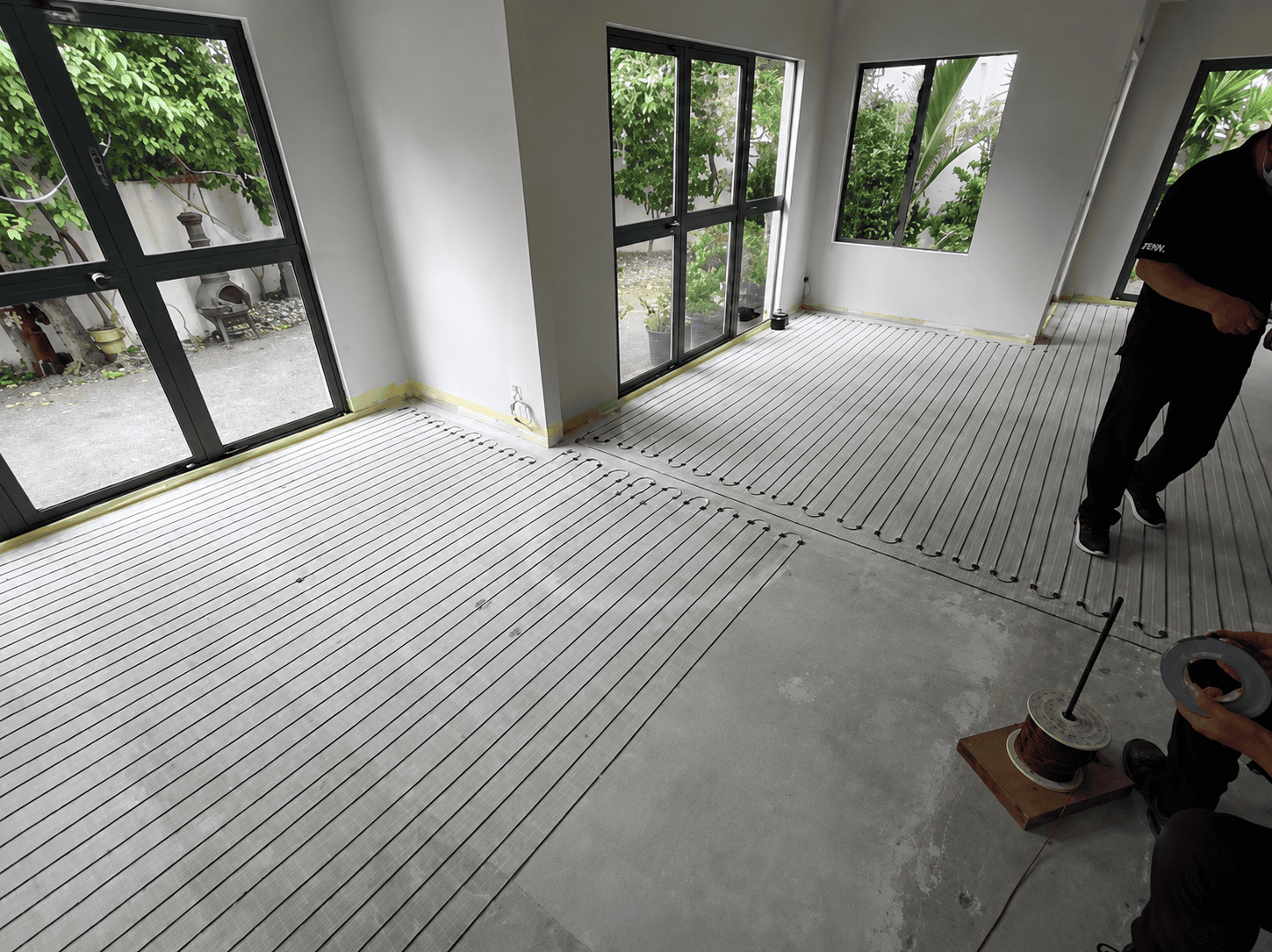
                    Research from the University of Auckland Business School’s Department of Property found that properties with properly consented reclads — including the associated Code Compliance Certificate — are perceived far more favourably by buyers than those where the recladding history is unclear or where no CCC exists. A home with a fully documented reclad, done with consent, is a much easier sale than one with question marks over its history.

                    Risk 4: Hidden Structural Damage Gets Covered Up

                    Auckland’s leaky home crisis — concentrated in homes built between roughly 1994 and 2004 — was largely caused by a combination of poor design, monolithic cladding systems applied without adequate drainage cavities, and untreated timber framing. The consent inspection process for recladding exists specifically to catch framing damage that isn’t visible until the cladding comes off.

                    When a reclad is done without consent, there are no mandatory council inspections at key stages. A builder — even a well-meaning one — can install brand new cladding over badly damaged or rotting framing. The result looks fine from the outside. But inside the walls, the damage continues, often accelerating because the new cladding has introduced new drainage details that interact unexpectedly with the underlying structure. You may have paid for a full reclad and ended up in a worse position than you started.

                    “The case that really stuck with me was a homeowner in Pt Chevalier who had a reclad done in the early 2000s, apparently without consent. The framing was already compromised when the new cladding went on. By the time they came to us, the damage had spread throughout the entire wall cavity and into the floor framing. What might have been a $180,000 reclad had become a $350,000 remediation job. The consent would have caught it. And the cost of the consent would have been a rounding error.”

                    Cici Zou, Designer, Superior Renovations

                    Risk 5: A Second Wave of Weathertightness Issues — Why 2025 Is a Critical Year

                    This is something that doesn’t get nearly enough attention. Industry experts across New Zealand have been warning that we may be seeing the early signs of a second wave of weathertightness issues — this time in homes built in the construction boom of the 2010s. With construction running at full pace through that period, pressure to build quickly and cheaply, combined with labour shortages, led to non-compliant work appearing more often than many realise.

                    The Weathertight Homes Tribunal — the specialist body set up to deal with historical leaky-home claims — is now winding down, and no new claims can be made. That means many Auckland homeowners won’t have formal legal pathways available if weathertightness problems are discovered in the future. Early action, proper consent, and quality workmanship are now the only real protection available.

                    Risk 6: Retrospective Consent Is Painful

                    If you’ve done — or inherited — recladding work that was done without consent, getting “retrospective consent” (formally known as a Certificate of Acceptance) is possible but genuinely difficult. Auckland Council typically requires invasive investigation to verify that unconsented work meets the Building Code — which can mean cutting holes in cladding, exposing framing, and other disruptive and expensive work. There’s no guarantee a Certificate of Acceptance will be issued, and the cost and disruption can far exceed what the original consent would have required.

                    The MBIE guidance is clear: exemptions are not retrospective. If unconsented work was carried out, you need to apply to the territorial authority for a certificate of acceptance, and the bar for approval is high.

                    Summary: The Real Cost of Skipping Consent

                    Risk Area Potential Consequence
                    Insurance Declined claims; reduced payouts on unrelated events
                    Legal Fines up to $200,000; orders to redo work
                    Property Value Reduced sale price; difficulty selling; buyer withdrawal
                    Structural Hidden damage not caught; escalating repair costs
                    Retrospective remediation Invasive investigation; Certificate of Acceptance costs

                    💡 Quick Tip for Skimmers: The cost of building consent for a reclad (typically $5,000–$7,000 for Auckland) is a tiny fraction of what it costs to deal with the consequences of skipping it. It’s not red tape — it’s protection.

                    We go into detail on the full building consent process for recladding in Auckland in Section 4. And if you want to understand what your Auckland home might cost to reclad properly, check out our recladding cost calculator tool for a ballpark figure.


                    4: The Auckland Building Consent Process for Recladding — Step by Step


                    house renovation 1 - Superior Renovations

                    Alright — so you’ve established that your recladding project needs consent. (As most do.) The next logical question is: what does the process actually look like? How long does it take? What does it cost? And who do you need on your team?

                    The honest answer is that the Auckland consent process for recladding is more involved than consents for, say, a new deck or bathroom addition. Auckland Council takes reclad applications seriously — partly because of the legacy of the leaky homes crisis, and partly because weathertightness failures are among the most costly and complex issues they deal with. That seriousness means more documentation, more inspections, and a bit more patience required. But it also means that when you’re done, you have a properly documented, fully protected home.

                    Here’s what the process typically looks like from start to finish.

                    Step 1: Get Your Property File

                    Before anything else happens, you — or your architect/designer — will need to obtain your property file from Auckland Council. This is not the same as a LIM (Land Information Memorandum) report. Your property file contains all historical consents, as-built drawings, certificates, and correspondence related to your specific property. For a reclad, the architect needs this to understand what the original consented construction was, whether there are any prior weathertightness issues on record, and what the current consented cladding system looks like.
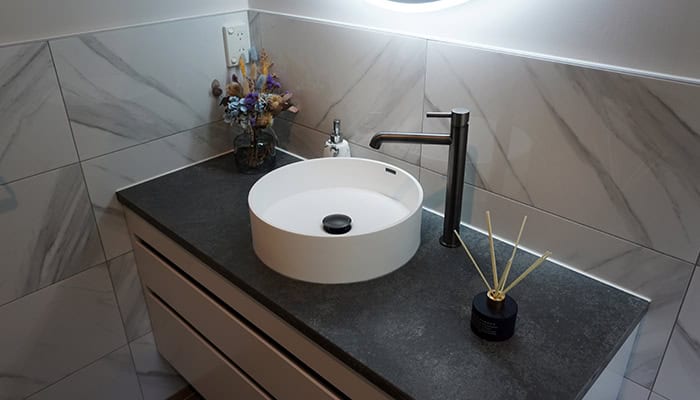
                    If your home was built under the 1991 Building Act and was never issued a Code Compliance Certificate, Auckland Council may also require a Durability Inspection before processing your reclad consent application. This is an important step — it establishes the baseline condition of your home before remediation begins.

                    Step 2: Engage an Architect or Remedial Designer

                    For a reclad in Auckland, you’ll need a qualified designer — typically a registered architect or experienced building designer — to prepare your consent documentation. This isn’t optional for most reclads. The documentation needs to demonstrate clearly how the new cladding system will manage water, what the flashings look like at every junction, how ground clearances are handled, and how the system meets Building Code Clause E2 (External Moisture) requirements.

                    At Superior Renovations, we work closely with our trusted architects and designers who are specifically experienced in recladding projects. Having someone who knows the Auckland Council consent process inside out — and who understands the particular challenges of Auckland’s housing stock — is genuinely invaluable. We can refer you to our preferred architectural team as part of our full home renovation service.

                    Step 3: Pre-Application Meeting with Auckland Council (Strongly Recommended)

                    Auckland Council strongly recommends a pre-application meeting for reclad consents. This is an opportunity to sit down with a council consent officer and talk through your project before you submit the formal application. It’s not a rubber stamp — but it is a chance to identify any potential issues early, ensure your documentation is likely to be complete, and avoid costly delays once the application is lodged.

                    There’s typically a fee for a pre-application meeting, but it’s usually well worth it. Incomplete applications are a common cause of delay, and the council’s processing clock doesn’t start until they consider the application complete. Getting it right the first time saves time and money.

                    Step 4: Prepare and Lodge the Consent Application

                    Your architect will prepare the full consent application, which for a reclad typically includes:

                    • Detailed architectural drawings (site plan, elevations, sections)
                    • Weathertightness details — flashing specifications at windows, doors, roof-to-wall junctions, decks
                    • Cladding system specifications (what system is being used, its CodeMark certification or equivalent)
                    • Ground clearance details
                    • Cavity and drainage system details
                    • Schedule of materials
                    • Producer Statements (PS1) from the designer confirming design compliance

                    The application is lodged with Auckland Council, along with the consent fee. For a standard two-storey Auckland home, building consent fees for a reclad typically range from $5,000 to $7,000, depending on the project complexity. This is separate from the design fees and the building work itself.

                    Step 5: Council Processing and Approval

                    Once lodged, Auckland Council has 20 working days to process a building consent application — though this period can be suspended if they issue a Request for Information (RFI) asking for additional documentation. A well-prepared application minimises the risk of an RFI. When the consent is approved, you’ll receive the consent documentation and can begin construction.

                    Step 6: Council Inspections During Construction

                    This is where the consent process really earns its keep. For a reclad, Auckland Council typically requires inspections at several key stages, including:

                    • Foundation/base inspection — before new framing or building wrap is installed
                    • Framing inspection — after existing cladding is removed and framing is exposed, before any repair work is concealed
                    • Building wrap / underlay inspection — before cavity battens and cladding are installed
                    • Cladding and flashing inspection — before any joints or junctions are sealed
                    • Final inspection — when all work is complete

                    It’s also common for a weathertightness consulting engineer to be involved, providing Producer Statements (PS3) at key stages confirming that the work in progress meets the consented design. Your Licensed Building Practitioner will coordinate these inspections and provide a Record of Work on completion.

                    Step 7: Code Compliance Certificate (CCC)

                    Once the final inspection is passed and all required documentation is received, Auckland Council issues a Code Compliance Certificate (CCC). This is the formal confirmation that your reclad has been completed in accordance with the consented plans and meets the requirements of the Building Code. The CCC is one of the most valuable documents associated with your property. It’s what future buyers, their lawyers, and their lenders will want to see as evidence that the work was done properly.

                    “The consent process sounds daunting, but it’s genuinely straightforward when you have the right team around you. Our role is to manage the whole thing — from getting your property file through to the final CCC. You shouldn’t need to be chasing council inspectors or worrying about documentation. That’s what we’re here for.”

                    Eunice Qin, Designer, Superior Renovations

                    How Long Does the Consent Process Take in Auckland?

                    Stage Typical Timeframe
                    Engage architect / obtain property file 2–4 weeks
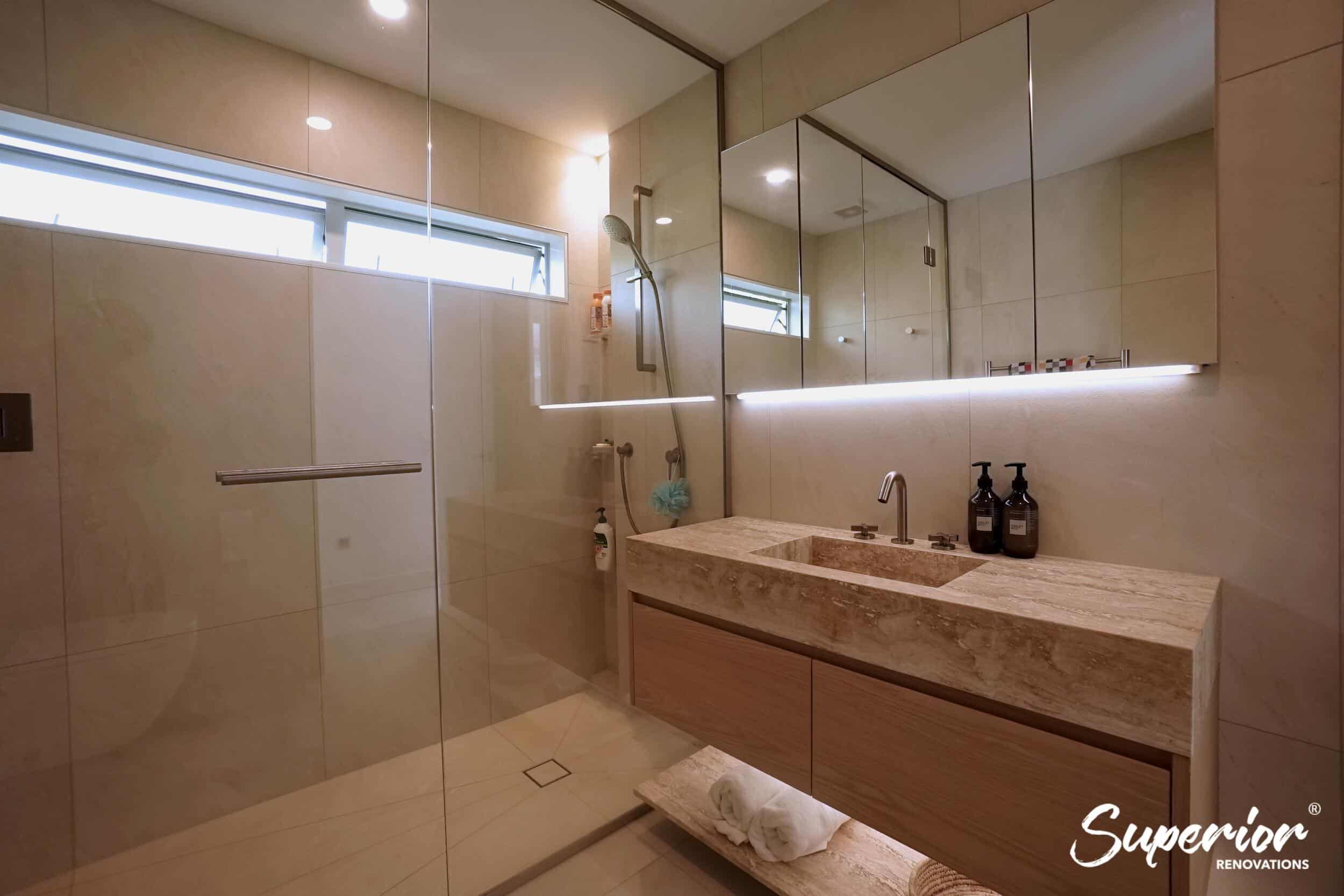
                    Prepare architectural drawings & documentation 4–8 weeks
                    Pre-application meeting with council 1–2 weeks to schedule
                    Council processing (statutory 20 working days) 4–10 weeks (may extend if RFI issued)
                    Construction + council inspections 8–20 weeks depending on project scope
                    Code Compliance Certificate issuance 2–4 weeks after final inspection

                    For a full reclad of a standard two-storey Auckland home, the overall process from initial engagement through to CCC is typically in the range of 6 to 12 months, including the design, consent, and construction phases. It’s a significant undertaking — which is exactly why working with an experienced renovation company that knows this process well makes such a difference.

                    For more detail on the building consent process in general — including for other types of renovation work — check out our comprehensive guide to building consents for Auckland renovations.


                    5: Choosing the Right Cladding Material for Your Auckland Home — What Works, What Doesn’t, and What Lasts

                    IMG 0903 - Superior Renovations

                    If you’ve made it this far, you know that recladding almost always requires building consent, you understand the exemptions, you know the risks of skipping consent, and you understand the Auckland process. The last major question is the fun one: what should you reclad with?

                    This is where the decisions get genuinely exciting — because a reclad isn’t just a maintenance exercise. It’s an opportunity to transform the look of your home, improve its energy performance, and future-proof it against Auckland’s particular climate challenges. And in a city where property values are what they are, the right cladding choice can meaningfully affect what your home is worth.

                    Auckland’s climate is genuinely demanding on exterior cladding. You’ve got high humidity, regular rainfall, UV exposure that’s more intense than most people realise (we’re close to the ozone hole, folks), and in coastal areas like Takapuna, Devonport, or Mission Bay, salt-laden air that accelerates corrosion and deterioration. Not every cladding material that performs well in, say, central Otago will work well on a north-facing wall in Parnell.

                    Fibre Cement Cladding: The Gold Standard for Auckland Reclads

                    If there’s one cladding material that dominates reclad work in Auckland right now, it’s fibre cement — and for good reason. Fibre cement is resistant to moisture, rot, and fire, and it handles Auckland’s coastal and humid conditions exceptionally well.

                    The market leader in New Zealand is James Hardie, whose range includes several products we regularly specify on Auckland reclad projects:

                    JH.Kaikoura.420 2024 11 20 230638 qqkg - Superior Renovations

                    Axon™ Panel Grooved 133mm

                    Image from jameshardie.co.nz/products/cladding/axon-panel-collection showing Axon Panel on an Auckland home.

                    • Axon™ Panel: A vertical shiplap panel available in several finishes including Grooved, Brushed Concrete, and Smooth. The Axon Panel is a modern favourite for both full reclads and feature wall applications in Auckland — it can be painted any colour, including the dark tones currently trending in Auckland residential design. Available in five finishes, it complements both contemporary and classic Auckland homes. View the Axon Panel range here.
                    • Linea™ Weatherboard: A bevel-back fibre cement weatherboard that replicates the classic timber weatherboard aesthetic that’s traditional in many Auckland neighbourhoods — from Grey Lynn villas to North Shore bungalows. It carries a 25-year product warranty and is specifically designed for NZ conditions.
                    • Stria™ Cladding: Features deep horizontal grooves and can be installed horizontally or vertically, giving it a distinctive architectural character. Its interlocking edges make for efficient installation, and it comes with a 25-year warranty.
                    • Oblique™ Weatherboard: A two-width bevel weatherboard available for both horizontal and vertical installation, offering design flexibility for more complex facades.

                    What all James Hardie fibre cement products share is engineered resistance to Auckland’s specific conditions — fire resistance, moisture resistance, and durability against the UV exposure and salt air that characterise many Auckland locations. Our supplier partner Mitre 10 stocks a wide range of fibre cement products, and as a trusted partner of Superior Renovations, can assist with sourcing the right products for your project.

                    Timber Weatherboard: Classic, Sustainable, Excellent for Character Homes

                    Timber weatherboard remains one of the most beautiful exterior cladding options for Auckland’s many pre-war and character homes. Done right — with proper priming, painting, and sealing — quality timber weatherboard can last decades. The catch is maintenance: timber needs more regular attention than fibre cement, and in a coastal or high-humidity environment, the painting and sealing schedule needs to be taken seriously.

                    For villas in Ponsonby, bungalows in Mt Eden, or heritage homes in Remuera, timber weatherboard often makes the most architectural sense — and can actually be the more sympathetic choice from a character preservation perspective. It’s also worth noting that certain Auckland properties may fall under heritage overlays or special character zones, which can influence what cladding materials are acceptable. Always check with Auckland Council if your property has any heritage designations.

                    The E2 Risk Matrix: A Critical Tool for Auckland Homeowners

                    Before committing to any cladding material, the Building Code’s Clause E2/AS1 risk matrix should be used to assess your specific site. This matrix scores your project based on factors including wind zone (medium-high in most coastal Auckland areas), exposure level, building height, roof-to-wall junctions, and deck attachments. The score guides what cavity requirements and cladding systems are appropriate for your home.

                    High-risk coastal locations — Devonport, Takapuna, Mission Bay, anywhere on the Waitematā or Manukau harbours — typically score high on the E2 matrix, which means a properly drained and vented cavity system (minimum 20mm) is not optional. Skipping a proper cavity in these locations is, in our experience, the single biggest hidden risk in any reclad project.

                    “Run the E2 risk matrix early — coastal North Shore homes often score high, so we default to fibre cement or metal cladding with proper cavities. It’s not about being overly cautious; it’s about making sure the material we specify will still be performing in 25 years. Auckland’s weather deserves respect.”

                    Dorothy Li, Designer, Superior Renovations

                    Cladding Material Comparison: Auckland Context

                    Material Durability Maintenance Best For Auckland Considerations
                    Fibre Cement (James Hardie) Excellent (25yr warranty) Low Modern & traditional homes Ideal for coastal/humid areas; fire resistant
                    Timber Weatherboard Good (with maintenance) Medium-High Character / heritage homes Needs regular painting; avoid in very high exposure zones
                    Metal (Aluminium / Steel) Excellent Low Contemporary / coastal Specify marine-grade for coastal; check wind zone compatibility
                    Brick Veneer Excellent Very Low Prestige / traditional Higher cost; weight considerations; not suitable for all structures
                    Monolithic Plaster Fair (with cavity system) Medium Contemporary / Mediterranean Requires robust cavity system; not recommended without engineering input

                    💡 Quick Tip for Skimmers: In Auckland — especially coastal suburbs — fibre cement with a properly drained cavity system is the combination that delivers the best long-term performance. The upfront cost difference versus cheaper options is almost always recovered through lower maintenance and better durability.

                    Don’t Forget Dulux — Finishing Your Reclad the Right Way

                    One detail that’s easy to overlook: the finishing coat on your new cladding matters enormously for long-term performance. We work with our supplier partner Dulux to ensure the right exterior coatings are specified for each project. The coating system needs to be compatible with the cladding material and rated for the exposure level at your specific site. A premium exterior paint system properly applied to fibre cement cladding can extend the life of your cladding significantly — and choosing Dulux’s Weathershield range, for example, gives you colour-fast, weather-resistant protection backed by a reputable brand.


                    Exterior Corner After 1000 - Superior Renovations


                    Conclusion: What You Need to Know Before You Start Your Auckland Recladding Project

                    Let’s pull all of this together. The question that started this whole guide — “Can I reclad my house without building consent?” — deserves a clear, direct answer.

                    In almost every real-world scenario, no. A full or significant partial reclad of a residential building in Auckland requires building consent. There are legitimate exemptions under Schedule 1 of the Building Act — primarily for like-for-like maintenance and replacement of cladding that has met its 15-year durability requirement — but these exemptions are narrow, require careful interpretation, and if applied incorrectly expose you to serious financial and legal risk.

                    The consent process, while it takes time and costs money, is genuinely protective. It ensures that hidden structural damage is caught and repaired, that your new cladding system is properly designed for your specific site, and that you end up with a Code Compliance Certificate that protects your home’s value and insurability for decades to come.

                    Here are the five things every Auckland homeowner should take away from this guide:

                    1. Always check before you start. Use the MBIE “Can I Build It?” tool or call Auckland Council. The five minutes you spend asking the question could save you years of headaches.
                    2. The 15-year durability rule is the key threshold. Cladding that’s failed within 15 years needs consent for replacement, full stop. If you’re not sure when your current cladding was installed or whether it’s met its durability requirement, get a professional assessment.
                    3. Work with Licensed Building Practitioners. Recladding is Restricted Building Work. Only LBPs can legally carry it out or take responsibility for it. Always ask to see your builder’s LBP licence and relevant licence class.
                    4. Choose your material carefully for your location. In Auckland, fibre cement with a properly drained cavity system is the standard recommendation for most homes — particularly in coastal or high-exposure areas. The E2 risk matrix is your friend.
                    5. Get everything documented. From the consent application through to the final Code Compliance Certificate, keep all documentation associated with your reclad. Future buyers, their lawyers, and their bank will thank you for it.

                    At Superior Renovations, we’ve managed reclad projects across Auckland — from heritage villas in Remuera and Ponsonby to modern townhouses on the North Shore. We manage the entire process — design, consent, construction, council inspections, and final sign-off — under one roof, with a dedicated project manager keeping you informed at every stage. If you’re thinking about recladding your home, the first step is a conversation.


                    Do I always need building consent to reclad my house in New Zealand?

                    What happens if I reclad my Auckland home without consent?

                    The consequences can be serious: financial penalties under the Building Act (up to $200,000 in serious cases), difficulty or inability to sell your property, insurance complications, and the costly prospect of having to apply for retrospective consent — which often requires invasive investigation of the unconsented work. It's simply not worth the risk.

                    Can I replace a few damaged weatherboards without consent?

                    Replacing a small number of damaged weatherboards with comparable material in the same position may be exempt under Schedule 1, Exemption 1 — provided the original cladding has met its 15-year durability requirement and the damage isn't the result of a weathertightness failure. If the damage is the result of water ingress or if significant sections need replacing, you should seek advice from Auckland Council or a Licensed Building Practitioner before proceeding.

                    How much does a building consent cost for a reclad in Auckland?

                    For a standard residential reclad in Auckland, building consent fees typically range from $5,000 to $7,000. This is separate from design fees (typically $8,000–$13,000 for remedial design drawings) and the building work itself. The total cost of a full reclad on a standard two-storey Auckland home, including all consenting, design, and construction, typically ranges from $330,000 to $380,000 — depending on the extent of framing damage discovered and the materials chosen. See our detailed guide to recladding costs in NZ for a full breakdown.

                    What is Restricted Building Work, and does recladding qualify?

                    Restricted Building Work (RBW) is a category of building work in New Zealand that must be carried out or supervised by a Licensed Building Practitioner (LBP). Recladding — because it involves work on the external envelope of a dwelling — is classified as Restricted Building Work. This means your builder must hold an appropriate LBP licence, and they must provide a Record of Work on completion. Using an unlicensed builder for RBW is illegal.

                    Does recladding require resource consent as well as building consent?

                    No. Residential recladding does not require resource consent. Resource consent relates to land use, zoning, and matters regulated under the Resource Management Act — not building work. However, if your property is in a heritage overlay or special character zone, you should check with Auckland Council whether your chosen cladding material is acceptable before proceeding.

                    What cladding material is best for an Auckland reclad?

                    Fibre cement — particularly products like James Hardie's Axon Panel, Linea Weatherboard, and Stria Cladding — is widely considered the best option for most Auckland reclads. It's moisture-resistant, fire-resistant, low-maintenance, and performs exceptionally well in Auckland's coastal and humid conditions. Timber weatherboard remains a great option for character homes, particularly in heritage areas, provided the maintenance schedule is adhered to. The right choice always depends on your specific site, exposure level, and design goals — which is why we assess the E2 risk matrix for every project we undertake.

                    How long does the Auckland recladding consent process take?

                    From initial engagement with an architect through to receiving a Code Compliance Certificate, the full process typically takes 6 to 12 months for a standard Auckland home. The statutory processing time for Auckland Council is 20 working days, but this is just one part of a longer process that includes design, documentation, construction, and inspections. Working with an experienced team who knows the Auckland consent process can help minimise unnecessary delays.


                    Further Resources for your house renovation

                    1. Featured projects and Client stories to see specifications on some of the projects.
                    2. Real client stories from Auckland

                    Need more information?

                    Take advantage of our FREE Complete Home Renovation Guide (48 pages), whether you’re already renovating or in the process of deciding to renovate, it’s not an easy process, this guide which includes a free 100+ point check list – will help you avoid costly mistakes.

                    Download Free Renovation Guide (PDF)


                    finance - Superior Renovations

                    Have you been putting off getting renovations done?

                    We have partnered with Q Mastercard ® to provide you an 18 Month Interest-Free Payment Option, you can enjoy your new home now and stress less.

                    Learn More about Interest-Free Payment Options*

                    *Lending criteria, fees, terms and conditions apply. Mastercard is a registered trademark and the circles design is a trademark of Mastercard International Incorporated.


                    Still have questions unanswered?

                    Book a no-obligation consultation with the team at Superior Renovations,
                    we’d love to meet you to discuss your renovation ideas!

                      Services

                      Home RenovationKitchen RenovationBathroom RenovationOutdoor RenovationHouse ExtensionCommercialDesign ServicesOther

                      By submitting this form, you agree to receive communications from us via email or text regarding our services, you can unsubscribe at any time.

                      This site is protected by reCAPTCHA and the Google

                      Privacy Policy and Terms of Service apply.

                      ​From the very first consultation, our experience with this team has been nothing short of stellar.

                      ​Working with Eunice, our sales consultant, set a high bar for the rest of the project.
                      Eunice is truly exceptional at what she does. When we first began our kitchen project, we went through several versions of our floor plan, and she was with us every step of the way—from the initial planning stages right through to the final concept. Her patience and dedication during the design process were remarkable.
                      Throughout the project, Eunice provided:
                      * **Invaluable Suggestions:** She has a keen eye for both aesthetics and functionality, pointing out details we never would have considered on our own.
                      * **Seamless Adjustments:** No matter how many tweaks we requested, she handled every change with professionalism and a "can-do" attitude.
                      * **Expert Guidance:** She transformed our vague ideas into a cohesive, stunning reality.

                      ​Once the planning was complete, Neil, our project manager, took the reins and truly blew us away. Neil is a consummate professional who balances technical expertise with fantastic communication.
                      ​ He kept us informed at every stage, ensuring we knew exactly what to expect and when.
                      Whenever a minor pivot was needed, Neil handled it with grace and efficiency, keeping the timeline on track.
                      His standards for the renovation work were incredibly high, ensuring the final result was polished and beautiful.

                      ​The transition from Eunice’s initial planning to Neil’s execution was flawless. If you are looking for a team that combines design expertise with top-tier project management, look no further. We are absolutely thrilled with our new kitchen and new flooring !
                      Superior Renovations has just finished a complete remodel of my bathroom. I can see, why the company has such a high reputation. At every stage, from sales, design, project management, and execution, the company excelled at every point. I am just so happy with the work that they have done and they have exceeded my expectations at every point.
                      Used Superior for a kitchen and bathroom renovation last year. They did an excellent job updating both rooms, communication was excellent ongoing tjrough the project, they coordinated all the tradies, synchronized so there was little downtime, and it all worked exactly as planned and on budget. Was really glad we chose Superior Renovations and plan to use again for our entrance way at some stage.
                      As I said to my work colleagues ‘I have just had the most pleasant experience’. When they realised it was with renovations at home they were shocked - ‘unheard of’ I was told.
                      Everything went to plan - timing, project management, costs, etc, etc. Neil communicated with me daily and made my whole bathroom renovation a pleasure.
                      The best decision I made was choosing Superior Renovations.
                      Thank you Kevin for our initial connection and for passing me on to Neil to manage the whole process.
                      We just finished a bathroom renovation and couldn’t be happier with the results. The craftsmanship is top-notch, and the attention to detail in the tiling and finishing is impressive. The team was professional, kept the workspace clean, and delivered exactly what we envisioned. Highly recommend them for anyone looking for a high-quality transformation.
                      Superior did an excellent job of renovating our ensuite. Project manager Jacob was easy to work with and communications were good.
                      This is our second review for Superior Renovations. They have done two projects earlier this year and we were so impressed by the work they have finished. After discussing and very careful consideration, we decided to go with more projects with them. So far, they have now completed stage 1 renovation of our house. We still amazed for their knowledge and services; they really listen to us and discuss anything with us if they feel/think could be better…
                      From the first day we work with them, we have no issue with them at all, from communication, discussing, designing to the teams working on the site.
                      Especially we are highly recommended to those who are considering doing the house renovation, please contact them and you will know why we are so pleased to have them to do our house renovation.
                      We are thanking Cici, Neil and the teams so much….
                      We are looking forward to seeing what the outcome will be.

                      David and Emily
                      We recently had our bathroom renovated by Superior Renovations and couldn’t be happier with the experience. Dorothy and Neil were an absolute pleasure to work with. They guided us through every step of the process, making what can be a stressful experience feel smooth and straightforward.
                      The quoting process was transparent and detailed, with no hidden fees or surprises. Neil was incredibly responsive and always available whenever we had questions or requests, which gave us real peace of mind throughout the project. We really love the end result and enjoy our new bathroom!
                      We’ll definitely be returning to the Superior Reno team for our next project. Highly recommended!
                      Our bathroom reno has just been completed & I am so happy. The whole process was easy & hassle free. Alison designed our bathroom & was very patient with our changes/then changes back again. Jacob our project manager was a delight to deal with. He always kept us informed of the scheduling & any other information we may have needed. All the tradies worked hard & the job was completed & signed off within 3 weeks. That's demo, full tiling, installation of new everything & delivery & pick up of the skip down a very tricky driveway. We absolutely love the new bathroom & would recommend Superior Renovations everyday. Future jobs I will definitely be contacting them again. Thank so much for your excellent work
                      Having explored our reno options, it was an easy decision to select Superior Renovations for our work. As first timers at anything like this we had to trust the system with grand old 100year old bungalow. We were so pleased to have Cici, Sonny and Kai working with us the whole way through. Be shout out to all the team, builders, plumbers, electricians, tilers and painters. A superb job delivered on budget and ahead of time. The communication from Cici and Sonny was first class. Would highly recommend working with Superior Renovations in fact, we already have more worked booked in. Thanks Superior you made Millie and Monty's parents very happy. 🐾
                      I am very happy with the recent renovation for my new kitchen.
                      The team worked really hard to get it done within the time frame.
                      The manager, Jacob, was very helpful and communicated well and always sorts out any issue immediately.
                      Thank you Irene
                      We couldn’t be happier with our new pergola! From start to finish, the team was professional, punctual, and easy to work with. They took the time to listen to what we wanted and offered great suggestions to make the design even better. The quality of the materials and workmanship is outstanding — everything feels solid, well-built, and beautifully finished. Kudos to Sinan Sun as she has been an amazing contact with the company.
                      We are very pleased with our bathroom reno by Superior Renovations! Jacob, Cici and the team always kept us up to date, were always friendly to deal with and finished ahead of schedule. Most importantly we are very happy with the quality of the work.
                      We have been working with Superior Renovations as a supplier now for over three years. In that time we have found the team to be very professional and well organised. Which is a welcome relief in this industry! Just recently we have become their sole supplier for portaloos, which recognises the collaboration we have forged over these three years.

                      In particular, Leanne and Elaine set a very high standard of communication and flexibility. This is of vital importance when scheduling deliveries and pickups with us, however, they understand not everything can be done at once and are willing to work with us for the best (supplier/contractor/client) outcome.

                      I would imagine this ethos would flow directly through to all their contracted renovation work. A pleasure to work with!
                      A very reliable supplier – we’ve been working with them for three years now, and they have never let us down. Well done to the team.
                      We have been working with these guys for the past 4 years and find them an awesome company to work with, very efficient and organised. I highly recommend!
                      Finding someone reliable for renovations has always been the most stressful thing for us. In the past, we had several painful renovation experiences—money was spent but the problems were never truly solved, and things often ended up worse than before. We really didn’t know where to find a trustworthy renovation company.

                      For more than ten years, our wish had been to renovate our bathroom, laundry, and toilet, so that we could finally enjoy a comfortable and functional living environment. Just when we were about to give up, we came across Superior Renovations online. We quickly made an appointment with Cici, who designed and provided us with a quote.

                      Throughout the whole process, I was deeply impressed by the professionalism of Superior Renovations. What stood out most was that they always delivered on their promises—everything agreed upon was completed on time. This built a relationship of trust and reliability. Up until completion, I was completely satisfied with their dedication and the quality of their workmanship.

                      During the renovation, we encountered some of the challenges that often come with older houses, but Cici and her team helped us resolve the discomforts we had been living with for years. We are truly grateful to the construction team.

                      Some say renovations are easy if you just have money, but I believe the most important thing is finding a trustworthy team that keeps their word, values quality, and cares about the customer’s experience.

                      Because of this renovation experience, we can now confidently plan our next project—the kitchen—and Superior Renovations will definitely be our first choice. We strongly recommend them.

                      Finally, I want to thank Cici and the team for helping us fulfill our dream.

                      Mark & Kate
                      Sinan is a very good consultant. She helps a lot during renovation. Very satisfied with their job.
                      It was great to have Alison's recommendations and input on how & what would look best for our kitchen and bathroom reno. Jacob, our project manager, has been a star too; ensuring that the project was delivered as planned, AND giving us great ideas & suggestions along the way.

                      We will definitely be calling on you guys again for our next home reno. Thanks team!
                      Very impressed with Superior Renovations.Building our pergola with blinds for a fair price .First thank you Sinan for quoting the job and your flexabilty and knowledge..Secondly the job was done well within the time frame, thanks to Jeff for supervising the job ( eventhough he wasn't too well) and keeping us up to date throughout the process. Payment was fair and easy as well .
                      Thoroughly recommend Superior Renovations for your reno job 👍
                      Very efficient team of workers and high quality finish.
                      Very happy with our renovated bathroom.
                      We will use this company again.
                      We’re very happy with the renovation work done by the team. It’s rare for renovation projects to finish on time, but they committed to completing ours before the Easter holiday—and they delivered! Our project manager, Jacob, worked incredibly hard (even physically! 😄) to make it happen.

                      I admit I might not have been the easiest client—I was particular about details like colours, tile placement, and exactly where the hand basin bowl should sit on the bench. But they listened, took it all on board, and got it done. Thank you, Jacob!
                      I’ll definitely bring you another challenge in the future. 😉
                      Thanks Superior Renovations for doing our house, it definitely looks a lot better now! Special thanks goes to Alison and Jacob for their excellent effort and good manners in handling the construction process, it wasn't easy but with them around it definitely became easier to handle. Cheers🥂
                      Absolutely thrilled with the outcome of our renovation of two bathrooms and kitchen in a double level home. Kevin and his entire team were an absolute pleasure to work with from the get-go. Every minor detail was attended to, and all our requests were accommodated. Cyrus deserves a special mention as under his watchful eye and expertise, nothing could go wrong.
                      I have recently finished a renovation in our 1930’s bungalow, updating the original (and I do mean original) kitchen and bathroom. Plus creating a new laundry and removing three fireplaces which created two new spaces including an office. From the initial appointment with Alison who came over and then provided drawings and a quotation, to the work with Frank, our project manager and the team, this has been a wonderful renovation experience. I would have described myself as a nervous-renovator prior to doing this, as I had never done a renovation before, but Frank, Alison, Sunny and all the team have worked so tirelessly and generously to create spaces that we love. Superior’s care in managing the project has meant that we have come away with much more than we originally sought to achieve and without the stress I hear others lament about when they renovate. I would recommend Frank, Alison, Sunny and the team at Superior Renovations wholeheartedly.