

Kitchen Layout Guide NZ: 7 Layouts + Floorplans (2026)
Last updated:
Kitchen Layout Guide: 7 Layouts, Floorplans and How to Choose the Right One for Your Auckland Home
Free cost calculator
How much will your kitchen renovation cost?
Get an instant Auckland price range for your project — no details required to see it.
Quick answer: There are seven main kitchen layout types — single-wall, galley, L-shape, U-shape, island, peninsula and open-plan. The right one is mostly decided by your home’s footprint: galley layouts suit narrow villa kitchens, L-shapes and U-shapes suit enclosed 1970s brick-and-tile kitchens, and islands need at least 3.5 metres of room width to work.
Your house has already chosen your kitchen layout. You just haven’t been told yet.
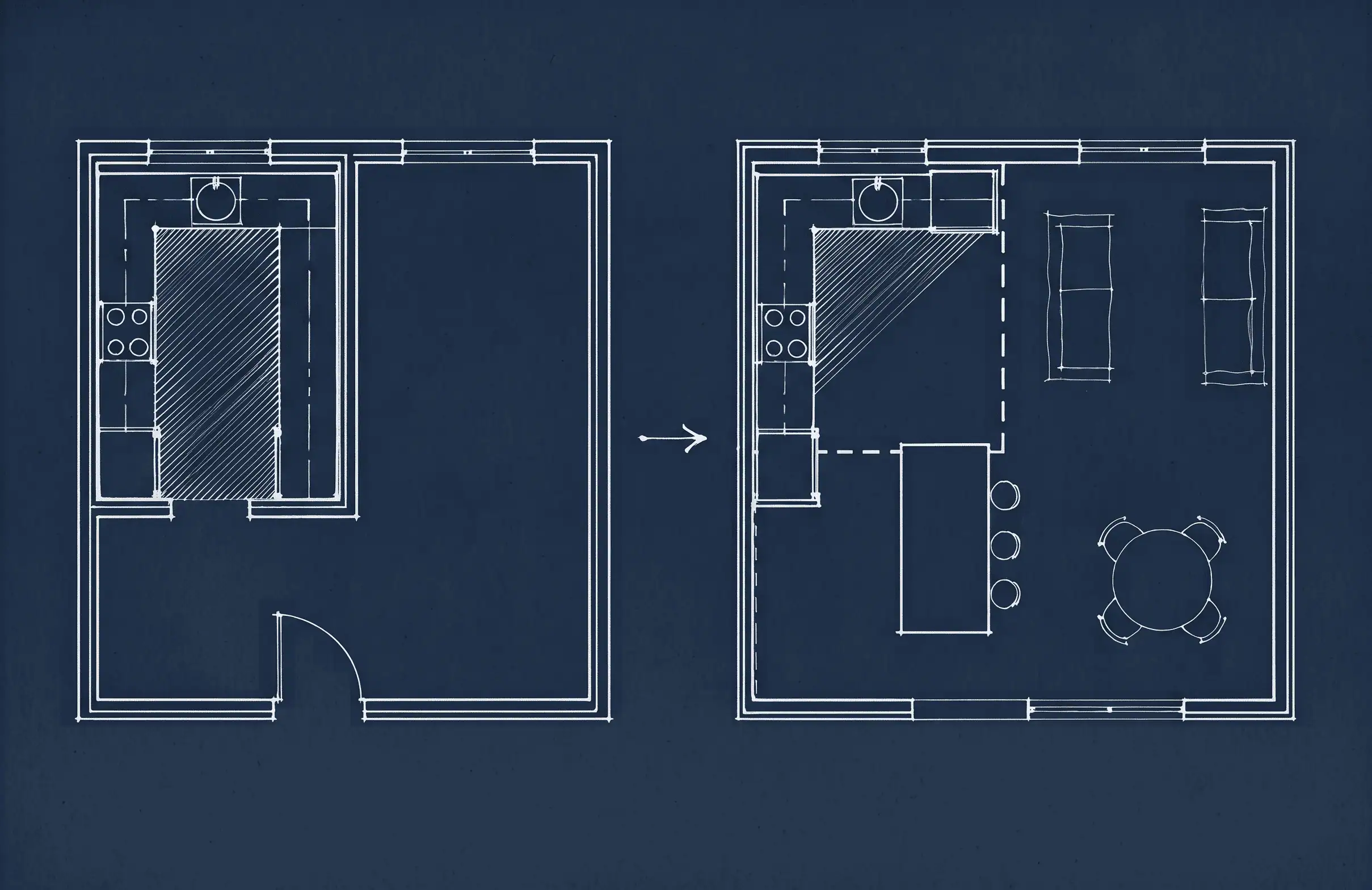
That’s the part most layout guides skip. They’ll show you six pretty diagrams and tell you to “pick what suits your lifestyle” — as if the long, narrow room at the back of your Grey Lynn villa could somehow take a U-shape, or the 3m × 3m enclosed kitchen in a Papatoetoe brick-and-tile could swallow an island. The layout question is really two questions: what does your existing footprint allow, and what would it cost to change that footprint.
After 1,000+ Auckland renovations, our design team at Superior Renovations has drawn kitchens into just about every housing type this city has — villas, bungalows, brick-and-tiles, leaky-era plaster homes, apartments, and the new subdivisions out at Hobsonville and Flat Bush. This guide walks through all seven layouts with a floorplan for each, the minimum clearances in millimetres, which Auckland homes each one actually suits, and what happens (to your consent status and your budget) the moment you decide to move a wall or a sink.
How to Plan a Kitchen Layout: The Work Triangle and the Five Zones
Before the shapes, the rule that sits underneath all of them.
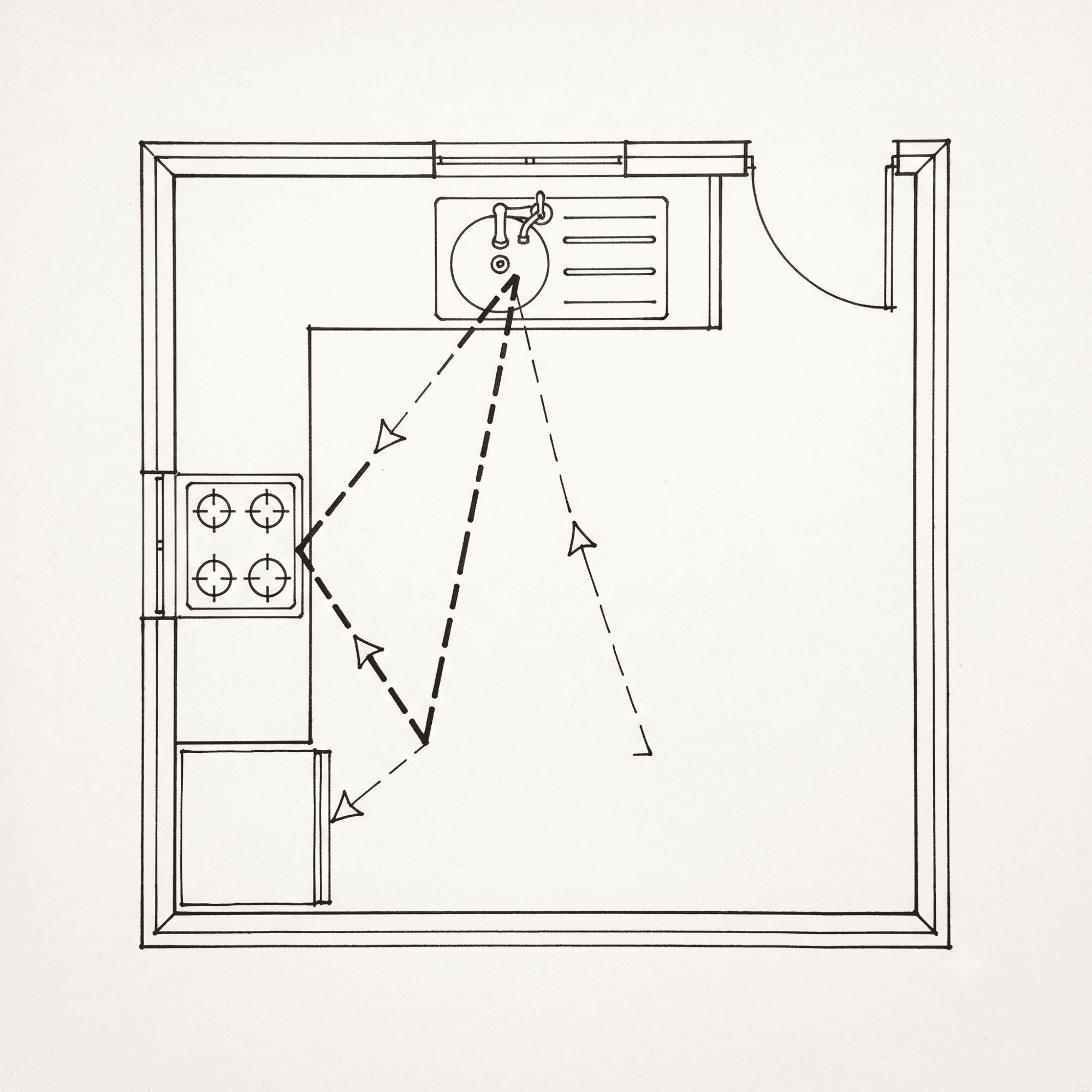
The work triangle
Draw a line between your sink, your cooktop and your fridge. That’s the work triangle — the path you walk hundreds of times a week. The planning guideline our designers work to: each leg of the triangle between 1.2 and 2.7 metres, and the three sides adding up to somewhere between 4 and 8 metres in total. Hardware manufacturer Häfele, whose fittings go into a good share of NZ cabinetry, publishes a slightly tighter version — legs of 1 to 2.5 metres and a total under 7 metres — in its working triangle planning guide.
Under four metres and two people can’t cook without colliding. Over eight and you’re doing laps between the fridge and the stove every dinner.
“The triangle is a starting point, not a law. In an open-plan kitchen I care more that nothing crosses it — if the path from the hallway to the deck cuts straight between your sink and cooktop, the layout has failed before we’ve picked a single cabinet.”
— Dorothy Li, Design Manager, Superior Renovations
The five zones
Modern kitchens — especially open-plan ones — are planned in zones as much as triangles: storage (pantry and fridge), prep (your longest clear bench run), cooking, cleaning (sink and dishwasher), and serving. The zones should run in roughly the order you cook: food comes out of storage, gets prepped, gets cooked, gets served, and the dishes land at the sink. When a kitchen “just works”, it’s almost always because the zones follow that sequence without crossing each other.
Minimum clearances — the numbers that decide everything
Every layout below lives or dies on walkway width. The working figures: 1,000–1,100 mm of clearance for a single-cook kitchen, and 1,200 mm minimum anywhere two people cook or the kitchen doubles as a through-route. We’ve broken down every bench height, walkway and island dimension in our kitchen planning measurements guide — keep it open alongside this one when you start sketching.
💡 Quick tip: Measure your clearances with the appliance doors open, not closed. A dishwasher door drops about 600 mm into the walkway. If your galley corridor is 1,000 mm wide, an open dishwasher blocks it completely — and you’ll only discover this after installation.
Compact Kitchen Layouts: Single-Wall and Galley
These two layouts own the small end of the market — apartments, townhouses, minor dwellings, and the original kitchens in most of Auckland’s pre-1940s housing.
Single-wall (I-shaped) kitchen layout
Everything — storage, prep, cooking, cleaning — on one run of cabinetry along a single wall. The work triangle flattens into a work line, so the sequencing matters more than ever: fridge at one end, sink in the middle, cooktop toward the other end, with prep bench between sink and cooktop.
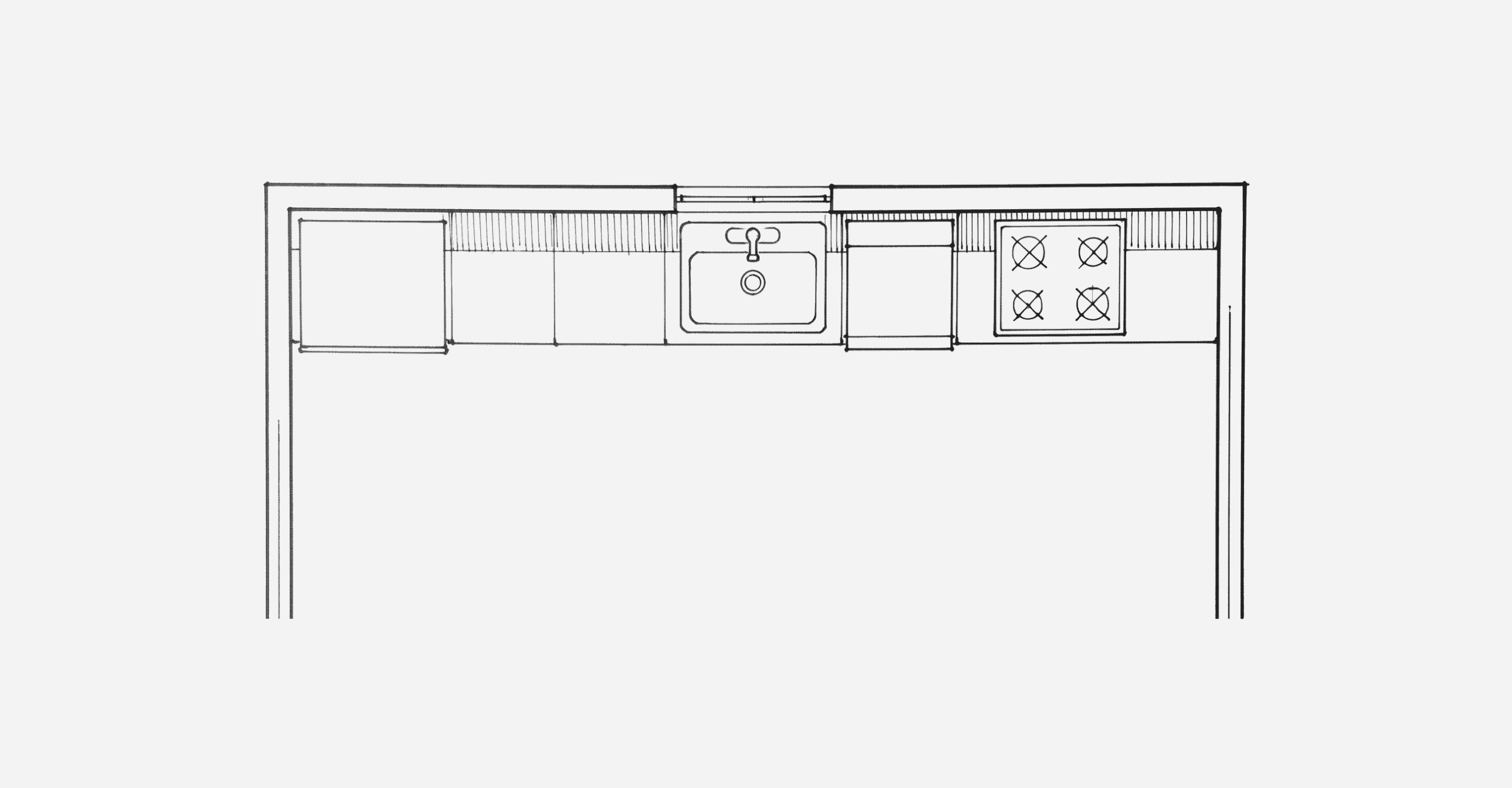
Minimum workable run: about 3,000 mm. Comfortable: 3,600 mm+. Below three metres you’re choosing between bench space and a full-size fridge.
Where you’ll find it in Auckland: city apartments, new townhouses in Flat Bush and Hobsonville, and increasingly in minor dwellings — worth knowing that since 15 January 2026, standalone dwellings up to 70 m² can be built without building consent under the new Schedule 1A exemption, and nearly every granny flat design we’ve seen uses a single-wall kitchen to keep the living area open.
Pros: cheapest layout to build, easiest to make disappear into an open-plan room. Cons: least bench space of any layout, and one cook only.
Galley kitchen layout
Two parallel runs of cabinetry with a corridor between them. Professional kitchens use galleys for a reason — nothing beats the efficiency of pivoting between two benches. Sink and prep on one side, cooktop and pantry on the other, and the triangle stays beautifully tight.
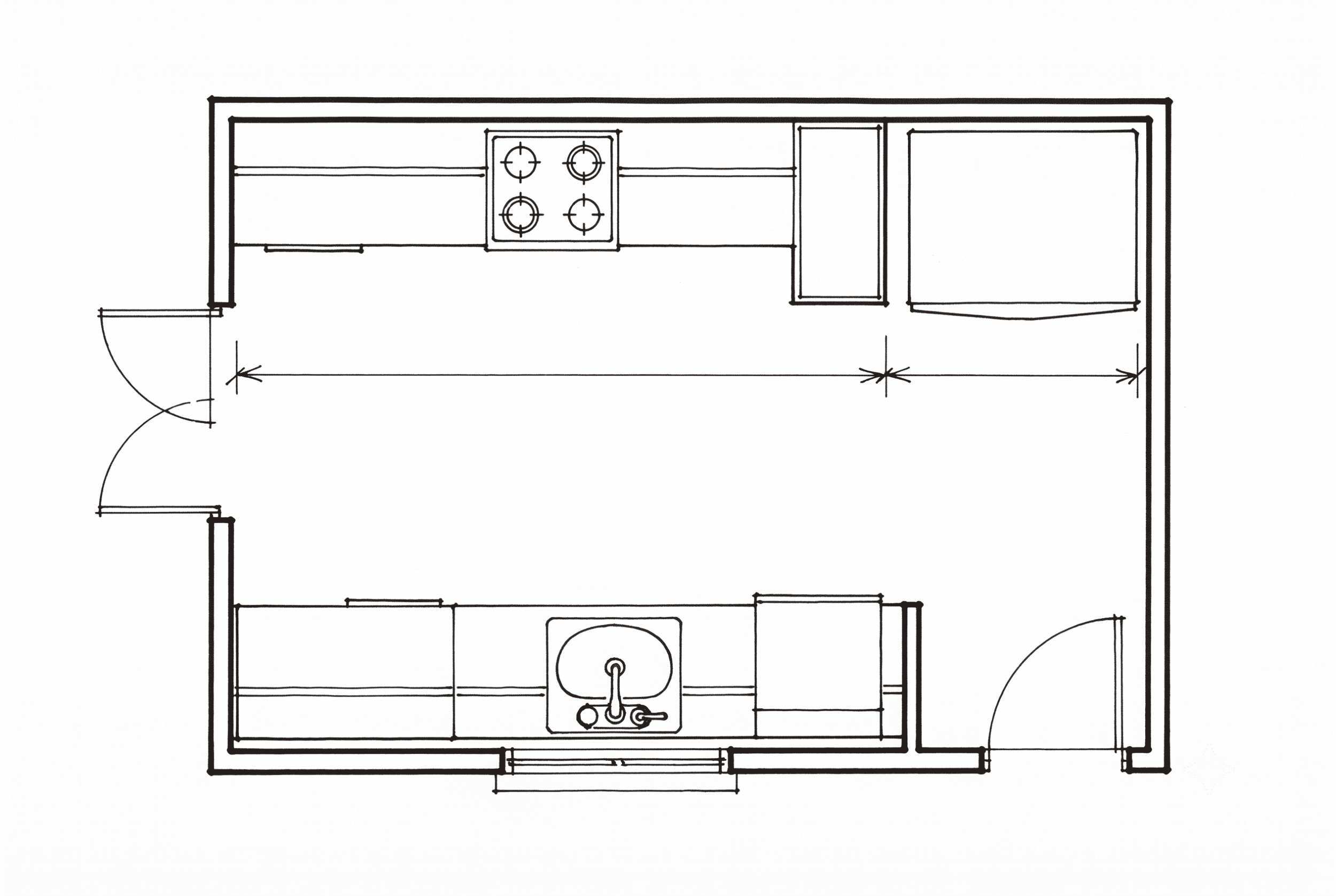
The corridor between the two runs needs at least 1,000 mm — 1,200 mm if the galley is also a walkway to a laundry or back door, which in Auckland villas it almost always is. Wider than about 1,500 mm and the galley loses its advantage; you’re walking instead of pivoting.
This is the natural layout for the classic villa kitchen. The long, narrow room at the back of a Grey Lynn or Ponsonby villa was practically drawn for a galley — we covered how to make these tight spaces feel bigger in our small kitchen design ideas guide.
“In villa galleys I put every tall element — fridge, pantry, oven tower — on the wall you don’t see from the hallway. The eye reads the visible run as one low, clean line and the kitchen instantly feels wider than its measurements. It’s the cheapest spatial trick we have.”
— Alison Yu, Designer, Superior Renovations
💡 Quick tip: In a galley, put the dishwasher and the sink on the same run. Split them across the corridor and you’ll drip water across the floor every single load — a small detail on the plan, a daily irritation in real life.
Corner Kitchen Layouts: L-Shape and U-Shape
The workhorses of suburban Auckland. If your home went up between the 1960s and the 1990s, odds are you’re living with one of these right now.
L-shaped kitchen layout
Cabinetry along two adjacent walls meeting in a corner. The L is the most forgiving layout there is — it fits small rooms and large ones, closes a natural work triangle, and leaves the rest of the room free for a dining table or, with enough width, an island later.
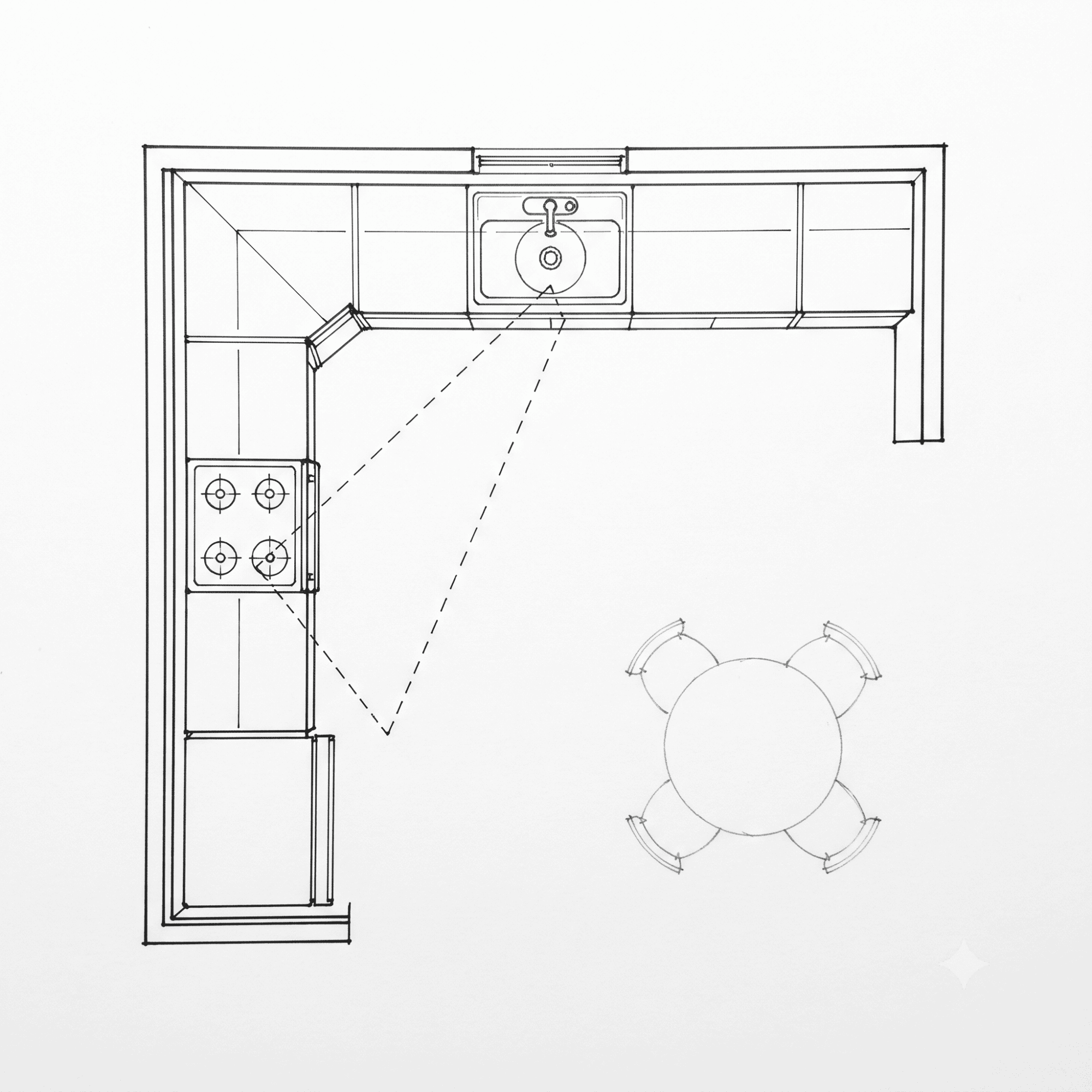
Each leg of the L wants to be at least 2,400 mm to fit a full appliance-plus-bench sequence; the corner itself is the weak point. A blind corner swallows storage unless you spec a corner carousel or a pull-out unit — budget for one, because the dead corner is the single most common complaint we hear about existing L-shaped kitchens.
Where you’ll find it: everywhere, honestly, but especially the squarish enclosed kitchens of 1970s and 80s brick-and-tile homes across Manurewa, Papatoetoe and West Auckland. We draw more L-shapes than any other shape across our design-to-build kitchen renovations — it’s the default answer to the average Auckland kitchen footprint.
U-shaped kitchen layout
Cabinetry on three walls. Maximum bench, maximum storage, the tightest possible triangle — the U is the serious cook’s layout.
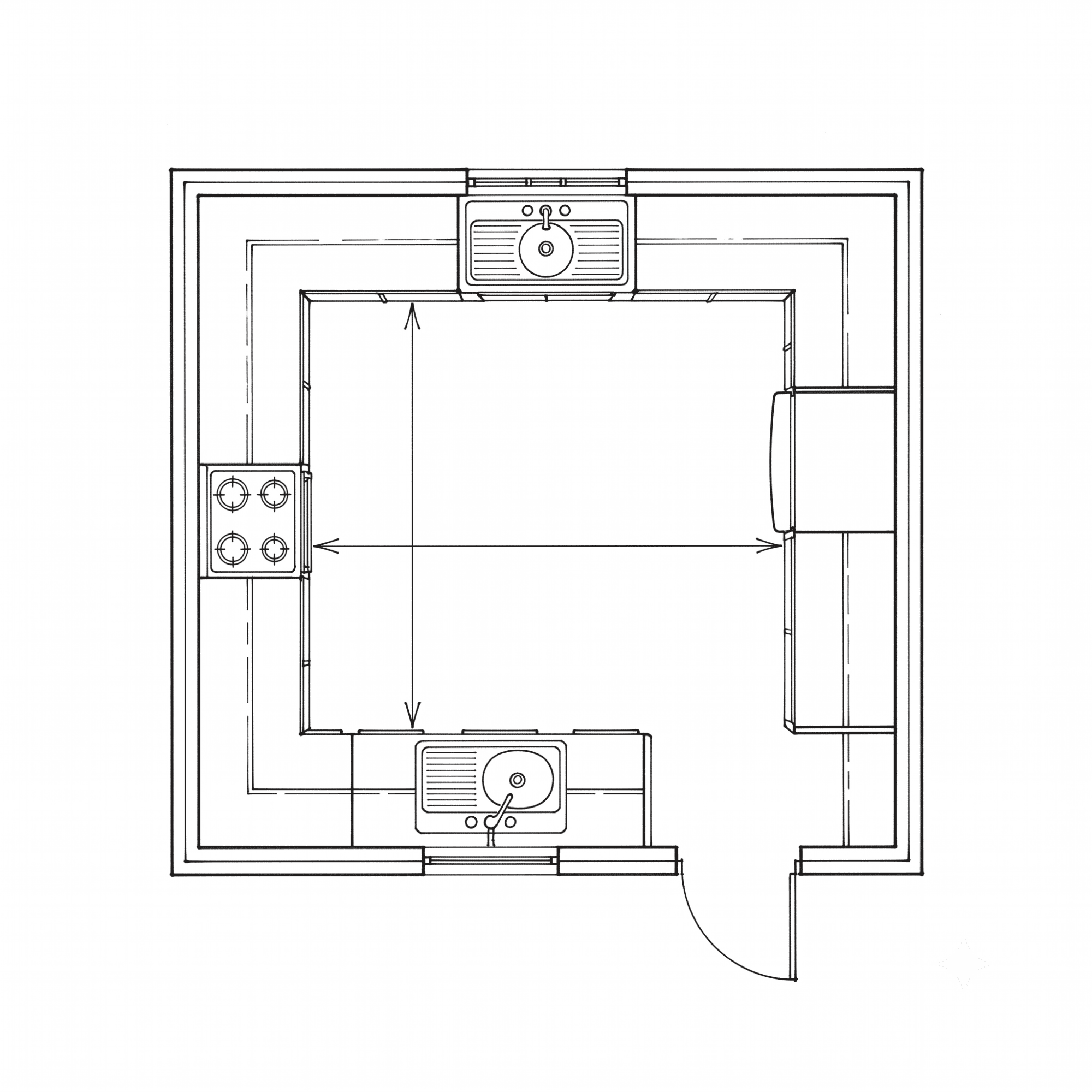
The catch is width. The room needs to be at least 3,000 mm wall-to-wall: two 600 mm bench runs plus a genuinely usable gap between them. That leaves 1,800 mm of floor — comfortable. At 2,700 mm total width you’re down to a 1,500 mm gap, which works for one cook. Below that, choose an L or a galley instead; a cramped U is worse than either.
Two corners means two blind spots, so the storage-hardware conversation matters twice. But if you have the room and you cook properly — big weekend meals, baking, preserving — nothing else comes close for working bench.
💡 Quick tip: In a U-shape, resist putting the sink in a corner to “save space”. Corner sinks force you to stand at an awkward angle and kill the bench on both sides of the corner. Centre the sink on the window wall — it’s the classic position because it works.
Social Kitchen Layouts: Island and Peninsula
The two layouts everyone asks for. One of them needs more room than most Auckland kitchens have — and the other is the honest alternative when it doesn’t fit.
Island kitchen layout
An L-shape or single-wall run plus a freestanding bench in the middle of the room. The island is prep space, breakfast bar, homework station and the place every guest ends up standing. It’s the default layout of every new subdivision from Millwater to Flat Bush, and the end goal of most open-plan conversions in older homes.
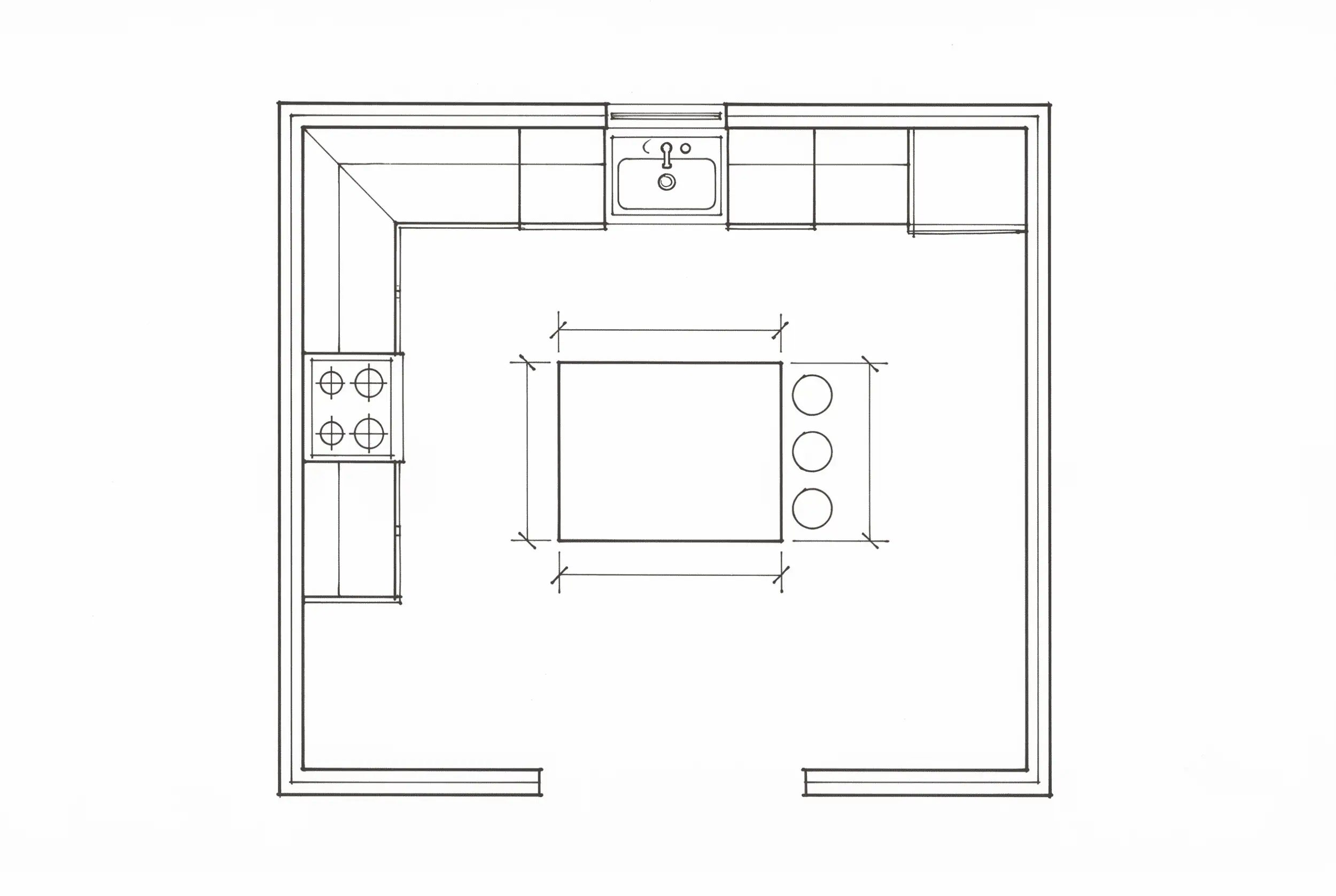
Here’s the arithmetic nobody runs before falling in love with islands. A useful island is at least 1,200 × 900 mm. Add 1,000–1,200 mm of clearance on every working side, plus a 600 mm bench run against the wall, and the room needs to be roughly 3,500–4,000 mm wide before an island is even on the table. Squeeze one into less and you get the worst of both worlds — a galley’s tight corridor with none of a galley’s efficiency.
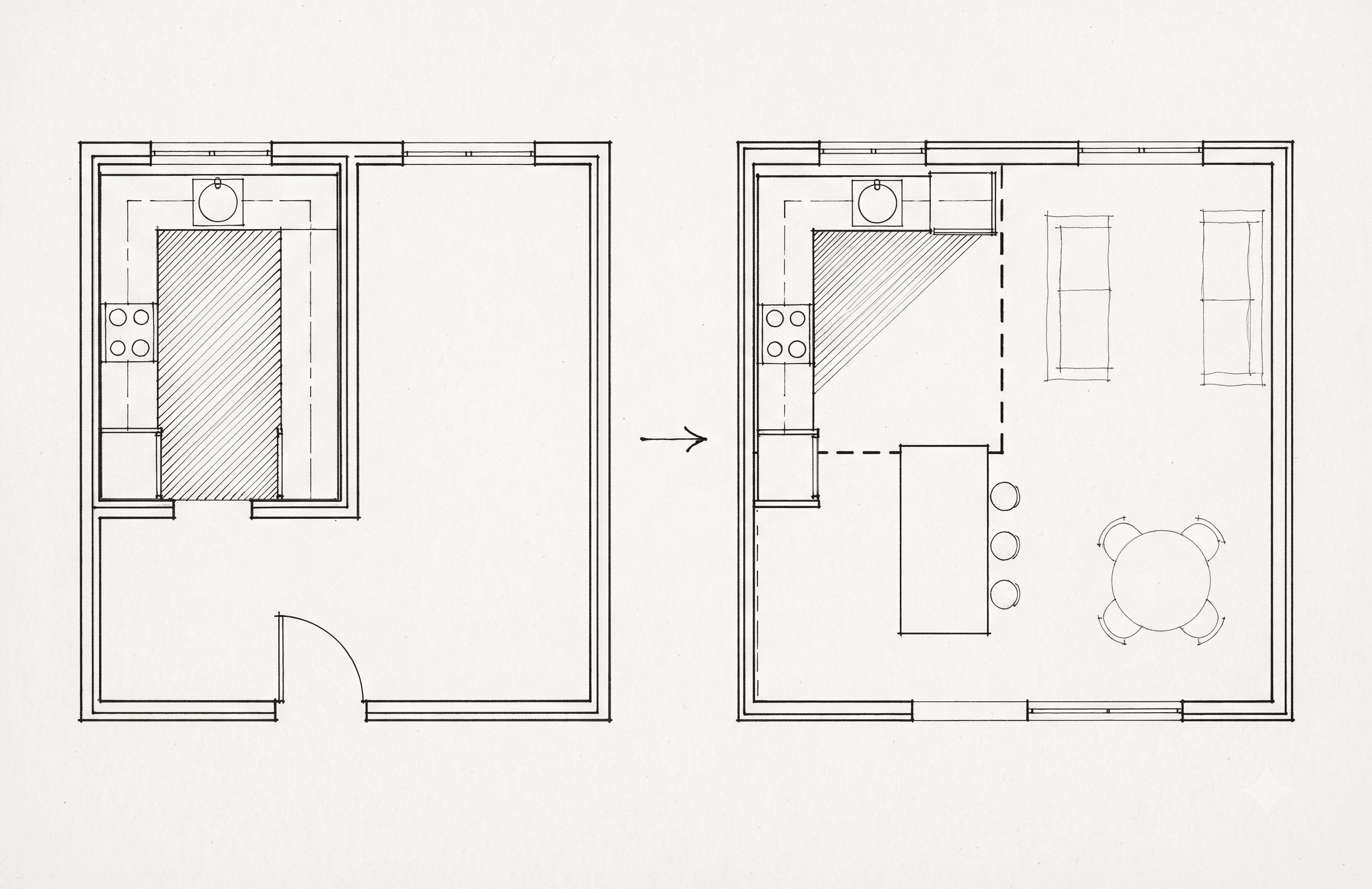
One of our clients, Lua, brought us her Mangere family home — in her family for 40 years before she bought it from her mum — wanting the closed kitchen opened into one connected kitchen, dining and lounge space. Designer Cici Zuo rebuilt it around an island that now anchors the whole open plan. You can see the full project in our Mangere kitchen renovation case study.
“Clients always ask for the biggest island that fits. I design the walkways first and let the island take whatever’s left. A 2.4-metre island you can move around beats a 3-metre island you have to shuffle past sideways — and in the 3D render, the moment they ‘walk’ the space, they see it too.”
— Cici Zuo, Head of Sales (NZ Dip. Interior Design), Superior Renovations
Peninsula kitchen layout
An island with one end attached to a wall or bench run — a G-shape, if you like naming conventions. The peninsula delivers about 80% of an island’s function in rooms that are 500–800 mm too narrow for a true island, because one connected end means one fewer walkway to fit.
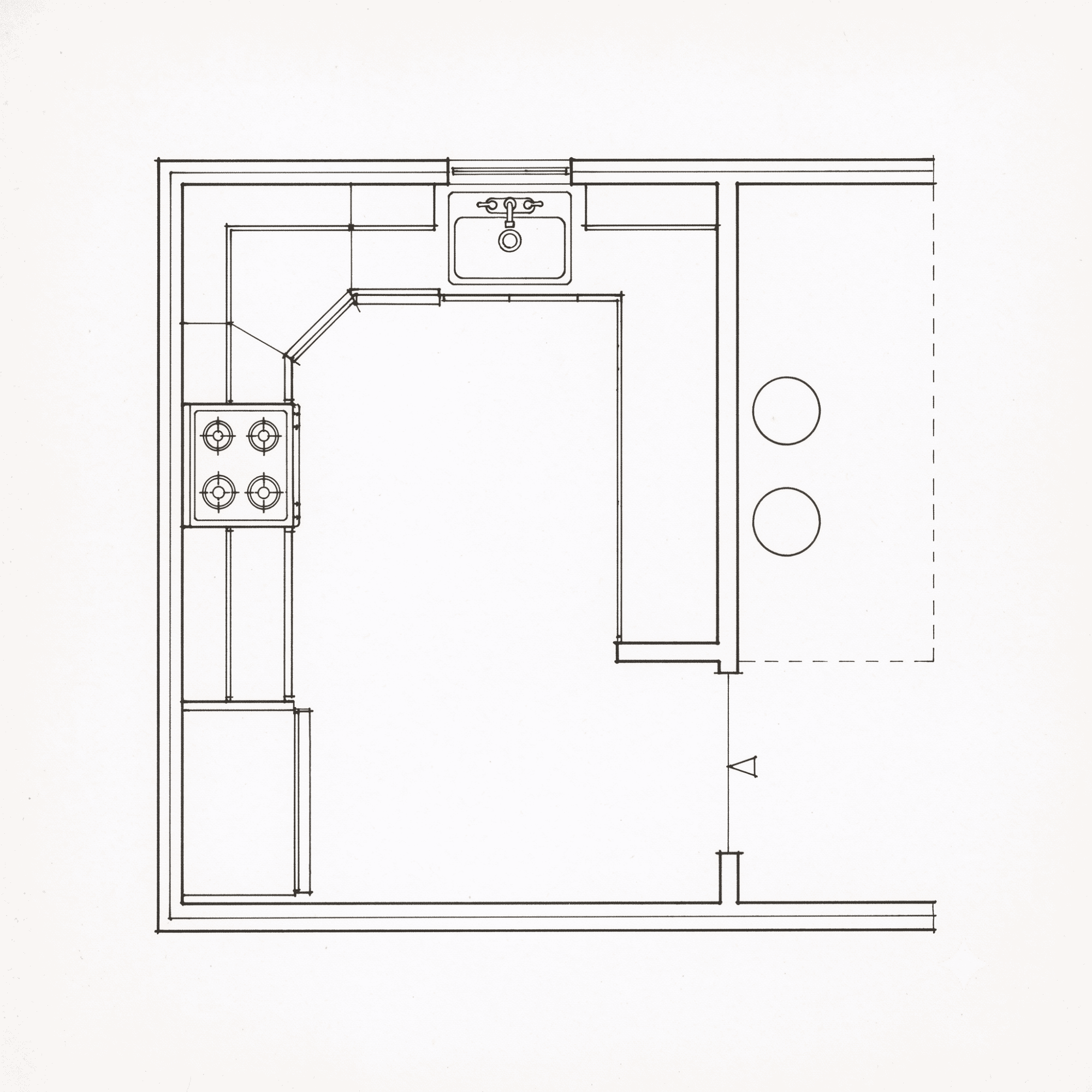
It also does something islands can’t: it defines a boundary. In semi-open 1990s and 2000s homes — the Albany and East Auckland plaster-and-brick era — the peninsula marks where the kitchen ends and the dining begins without a single wall. Seating goes on the outside face, cooking stays on the inside, and the cook faces the room instead of a wall.
The trade-off is the corner where the peninsula meets the main run (same blind-corner rules as the L-shape) and a pinch point at the open end. Keep that entry gap at 1,000 mm minimum or the whole kitchen funnels badly at dinner time.
💡 Quick tip: If your island or peninsula will have seating, allow 300 mm of benchtop overhang for knees and 600 mm of width per stool. Three stools need 1,800 mm of bench — measure that against your plan before ordering the stone, because an undersized overhang turns “breakfast bar” into “shelf you sit near”.

Open-Plan Kitchens — and What Changing Your Layout Actually Involves
Open-plan isn’t a cabinet arrangement — it’s a decision about walls. Which is why it belongs in its own section: the moment your new layout requires the room itself to change, the project changes category.
When a layout change needs building consent
According to Auckland Council’s guidance on kitchen and bathroom renovations, you can remodel an existing kitchen within the same space, leaving the sink in the same position, without a building consent — provided authorised tradespeople handle the plumbing and electrical work. Swap every cabinet, change a galley to an L within the same footprint, replace the benchtops: no consent.
The common triggers that DO require consent:
- Removing or altering a load-bearing wall — the number one trigger in Auckland open-plan conversions. That wall between your kitchen and lounge has a decent chance of holding your roof up.
- Relocating plumbing to a new position — moving the sink into a new island is the classic example, because it changes the drainage layout.
- New drainage or significant electrical circuits beyond like-for-like replacement.
Important note: Not sure where your project lands? MBIE’s free checker at canibuildit.govt.nz walks you through it in a few minutes. And even consent-exempt work must still comply with the Building Code — exempt means no application, not no rules.
What a layout change costs
Layout is the biggest cost lever in a kitchen renovation. A mid-range Auckland kitchen renovation that keeps the existing layout averages $26,000–$35,000, or roughly $2,300 per square metre. Start moving walls and plumbing and you’re adding structural engineering, consent fees, drainage work and extra trades — large kitchens of 18 m²+ with full layout redesigns run $62,000–$138,000+. Run your own numbers through our kitchen renovation cost calculator before you get attached to a floorplan.
Is the wall worth it? Usually, yes — in our Blockhouse Bay kitchen transformation, the kitchen of the client’s childhood home had been congested, dim and cut off behind a wall, and removing that one wall did more for the house than any finish upgrade could have. But it’s a decision to make with the numbers in front of you, not after demolition starts.
Which Kitchen Layout Suits Your Auckland Home?
Sound familiar yet? Here’s the whole guide compressed into the question that actually matters — what you’re renovating.
| Your home | Typical kitchen footprint | Best-fit layouts |
|---|---|---|
| Pre-1940s villa or bungalow (Grey Lynn, Ponsonby, Mt Eden) | Long, narrow room at the rear | Galley; single-wall. Island only with an extension |
| 1960s–80s brick-and-tile (Manurewa, Papatoetoe, West Auckland) | Squarish enclosed room, ~3 m × 3 m | L-shape; U-shape. Island possible after wall removal (consent) |
| 1990s–2000s plaster/brick era (Albany, East Auckland) | Semi-open, medium width | Peninsula; L-shape with island if 3.5 m+ wide |
| Apartment or townhouse (city centre, Hobsonville, Flat Bush) | Compact, part of open living | Single-wall; galley; compact peninsula |
| New-build subdivision (Millwater, Flat Bush, Hobsonville) | Wide open-plan living zone | Island (usually with scullery); open-plan |
How our designers turn a layout into a kitchen
A layout diagram is maybe 10% of a kitchen design. The other 90% is fitting that shape to your walls, your plumbing, your family and your budget — which is where our in-house design team earns its keep. Every Superior Renovations kitchen starts with a measured site visit, then a full 3D render so you can walk the layout before anything is built (the full sequence is in our stages of a kitchen renovation guide). Moving a sink 600 mm on a drawing costs nothing; moving it after the plumber has roughed-in costs real money — a design investment of around $2,500 routinely saves $10,000+ in construction changes.
You can also stand inside full kitchen displays at our showroom at 16B Link Drive, Wairau Valley — clearances make far more sense when you’re physically standing in them. Details on superiorrenovations.co.nz.
Imagine you’ve spent months debating galley versus L-shape, then you stand in a 1,050 mm galley corridor at the showroom and instantly know it’s too tight for your family of five. That’s the whole visit paying for itself in about four seconds.
Choose the Layout Your House Wants — Then Make It Yours
Seven layouts, one honest rule: the best kitchen layout isn’t the one on your Pinterest board — it’s the one your footprint, your walls and your budget agree on. Get the shape and the clearances right and every other decision, from cabinetry to benchtops, gets easier. Get them wrong and no finish in the world will fix it.
If you’re staring at your current kitchen wondering which of these seven it could become, that’s exactly the conversation to have with a designer — with a tape measure, not a mood board.
➡ Book your free in-home consultation with Superior Renovations
➡ See how these layouts look finished in our kitchen design gallery
➡ Request a free feasibility report for your project
Which kitchen layout is the most functional?
For pure cooking efficiency, the galley layout wins — two parallel benches keep the work triangle tight and every zone within a pivot. For family life, an L-shape or island layout is usually more functional because it handles traffic and seating as well as cooking. In practice, the most functional layout is the one that fits your room with full clearances — a generous galley beats a cramped island every time.
What is the best layout for a small kitchen?
Single-wall for rooms under about 2.4 m wide, galley for long narrow rooms with at least 2.2 m of width (two 600 mm benches plus a 1,000 mm corridor). Both keep clearances workable in the compact kitchens typical of Auckland villas, apartments and townhouses. Save islands for rooms at least 3.5 m wide.
What is a galley kitchen layout?
A galley kitchen has two parallel runs of cabinetry with a walking corridor between them, borrowed from ship and commercial kitchen design. The corridor should be 1,000–1,200 mm wide. It is the most space-efficient layout for the long, narrow kitchens found in most pre-1940s Auckland villas and bungalows.
What is a U-shaped kitchen layout?
A U-shaped kitchen runs cabinetry along three walls, giving the most bench and storage space of any layout. The room needs to be at least 3,000 mm wall-to-wall so that 1,500–1,800 mm of clear floor remains between the benches. It suits enclosed kitchens and serious cooks, but feels cramped in rooms narrower than about 2.7 m.
What is a peninsula kitchen layout?
A peninsula is an island with one end connected to a wall or bench run, forming a G-shape. It delivers most of an island's bench and seating in rooms 500–800 mm too narrow for a true island, and it naturally divides the kitchen from the dining area in semi-open homes — common in 1990s–2000s Auckland houses.
How do I plan a kitchen layout?
Start with the work triangle: sink, cooktop and fridge, each leg 1.2–2.7 m, total 4–8 m, with no through-traffic crossing it. Then check clearances — 1,000–1,100 mm walkways for one cook, 1,200 mm for two. Then organise the five zones (storage, prep, cooking, cleaning, serving) in cooking order. Only then choose the shape: the layout should come out of those rules, not before them.
What is a 10x10 kitchen layout?
A 10×10 kitchen is an American industry term for a sample kitchen of 10 by 10 feet — roughly 3 m × 3 m, or about 9.3 m² — used to compare cabinetry pricing. In NZ terms it matches the typical enclosed kitchen of a 1970s brick-and-tile home, which usually suits an L-shaped or U-shaped layout.
Do I need building consent to change my kitchen layout in Auckland?
Not if you stay within the existing space and leave the sink in its current position — Auckland Council confirms you can remodel a kitchen within the same footprint without consent, provided authorised tradespeople do the plumbing and electrical work. You do need consent to remove or alter a load-bearing wall, relocate plumbing (such as moving the sink to an island), or add new drainage. MBIE's canibuildit.govt.nz tool can check your specific project.
How much does it cost to change a kitchen layout in NZ?
A mid-range Auckland kitchen renovation keeping the existing layout averages $26,000–$35,000, or around $2,300 per square metre. Changing the layout — moving walls, relocating plumbing, opening the room up — adds structural, consent and drainage costs, and large 18 m²+ kitchens with full layout redesigns run $62,000–$138,000+. Get a project-specific figure with a free feasibility report.
How wide should a kitchen walkway be?
Minimum 1,000–1,100 mm for a single-cook kitchen, and 1,200 mm wherever two people cook or the kitchen doubles as a through-route to another room. Around an island, allow 1,000–1,200 mm on every working side. Measure with appliance doors open — a dishwasher door takes about 600 mm out of a walkway.
Further Resources for your kitchen renovation
- Featured projects and Client stories to see specifications on some of the projects.
- Real client stories from Auckland
Need more information?
Take advantage of our FREE Complete Home Renovation Guide (48 pages), whether you’re already renovating or in the process of deciding to renovate, it’s not an easy process, this guide which includes a free 100+ point check list – will help you avoid costly mistakes.
Download Free Renovation Guide (PDF)

Have you been putting off getting renovations done?
We have partnered with Q Mastercard ® to provide you an 18 Month Interest-Free Payment Option, you can enjoy your new home now and stress less.
Learn More about Interest-Free Payment Options*
*Lending criteria, fees, terms and conditions apply. Mastercard is a registered trademark and the circles design is a trademark of Mastercard International Incorporated.
Still have questions unanswered?
Book a no-obligation consultation with the team at Superior Renovations, we’d love to meet you to discuss your renovation ideas!