

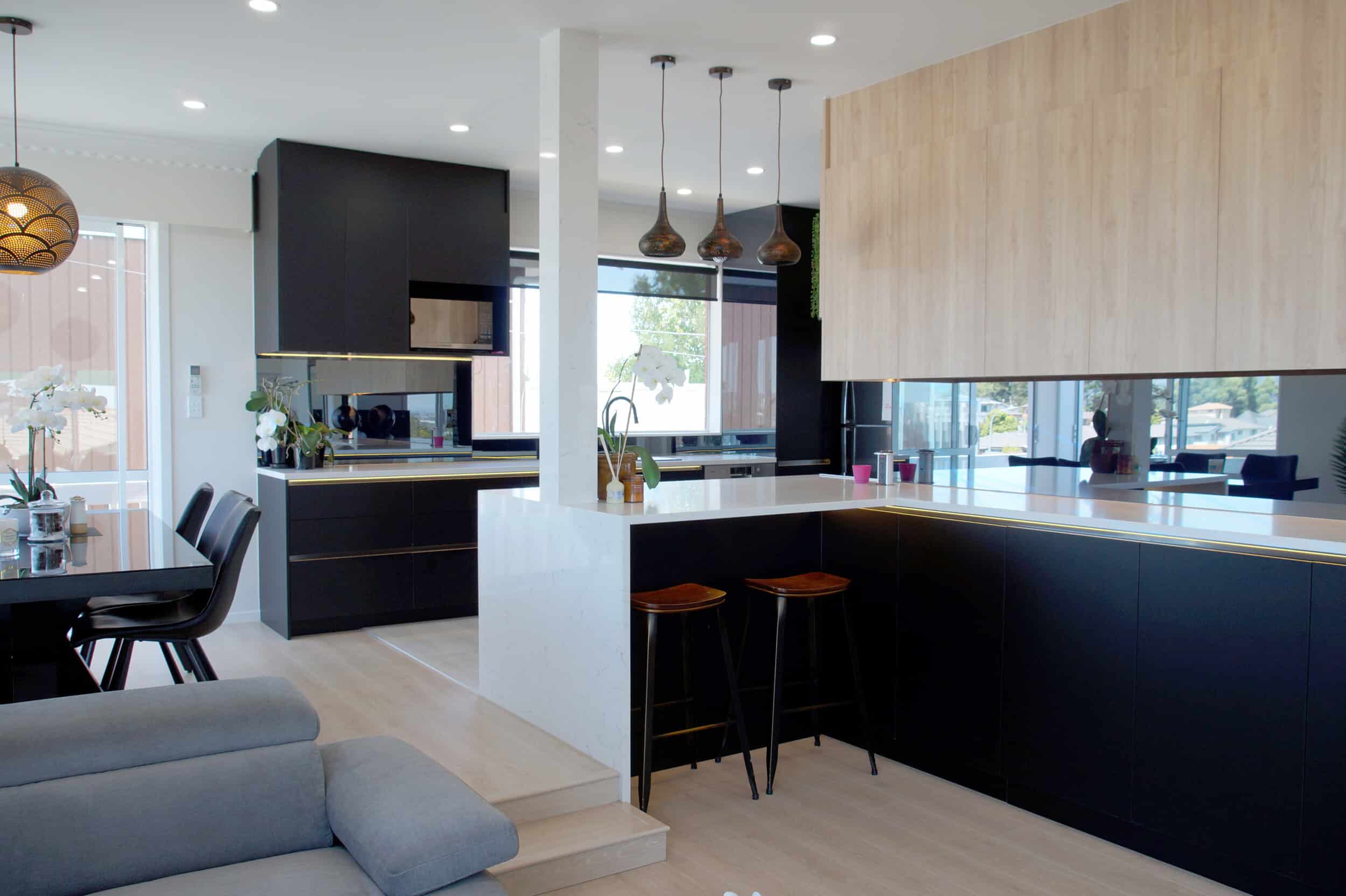
Is $10,000 Enough to Renovate a Kitchen in NZ?
Last updated:
Quick answer: $10,000 is not enough to renovate a kitchen in NZ; it buys a cosmetic refresh of a kitchen that still works. Small kitchen renovations start from around $15,000 to $25,000, and mid-range Auckland kitchens run $26,000–$35,000 + GST.
Ten grand sounds like real money, and it is. But a kitchen is the one room where a cabinetmaker, a plumber and an electrician all need to be on site, and in Auckland tradie labour runs $120–$150 an hour. Spend $10,000 on surfaces and you can change how the room looks. Spend it on a full renovation and you end up with half a kitchen.
Free cost calculator
How much will your kitchen renovation cost?
Answer a few questions and we’ll email you an Auckland price range.
We’d rather say that upfront, at our Wairau Valley showroom or on this page, than watch someone run out of money with the old benchtop off and the new one not yet ordered. The bands we quote below are our published prices; the item-by-item tables are planning estimates, and we say so where they appear.
Is $10,000 Enough to Renovate a Kitchen? What It Actually Gets You
Let’s be direct. $10,000 is not enough for a full kitchen renovation in New Zealand. On our published pricing, a small Auckland kitchen renovation (new cabinetry, benchtop, splashback and installation) starts from around $15,000 to $25,000, and that assumes a similar layout with no structural changes or plumbing moved. Check what any other quote leaves out of that list before you compare it.
But $10,000 can do a lot if you know where to spend it.
The $10,000 Cosmetic Refresh — Item by Item
A cosmetic refresh keeps the existing layout and cabinets and changes the surfaces you see. It sits a step below the basic refresh we price from $15,000, which replaces the doors, drawer fronts, benchtop and splashback on the existing cabinet boxes. We haven’t put a dollar figure against each item below, because every one depends on your kitchen and should be quoted on its own. What the table shows is what moves each price:
| Item | DIY / Budget Option | What Drives the Cost |
|---|---|---|
| Cabinet painting (professionally sprayed) | Spray-coat existing doors | How many doors and drawer fronts, the finish, and how much prep the old surface needs |
| New handles and hardware | Modern pulls from Mitre 10 or Bunnings | How many doors and drawers, and whether old screw holes need filling |
| New laminate benchtop | Laminex range, standard L-shape | Length of the run, joins, the sink and hob cut-outs, and the edge profile |
| Tile splashback | Subway or metro tiles, professionally laid | Area, tile size and pattern, and taking the old splashback off |
| New mixer tap and sink | Mid-range from Reece or Bunnings | The products you pick, and whether the new sink fits the existing cut-out |
| Plumber (tap and sink swap, same position) | Licensed plumber | Time on site at Auckland labour rates of $120–$150 an hour; nothing moving keeps it short |
| New light fixture | Under-cabinet LED strip + pendant | Whether the electrician can work off existing circuits |
| Wall paint | DIY with Resene or Dulux | Your own time against a painter’s |
The lean version is the one you partly do yourself: painting the cabinets, fitting the handles and keeping the splashback simple. Pay for a professional spray-coat and a decent Laminex laminate benchtop and the trades become most of the bill, so get each item quoted before you decide which jobs to keep.
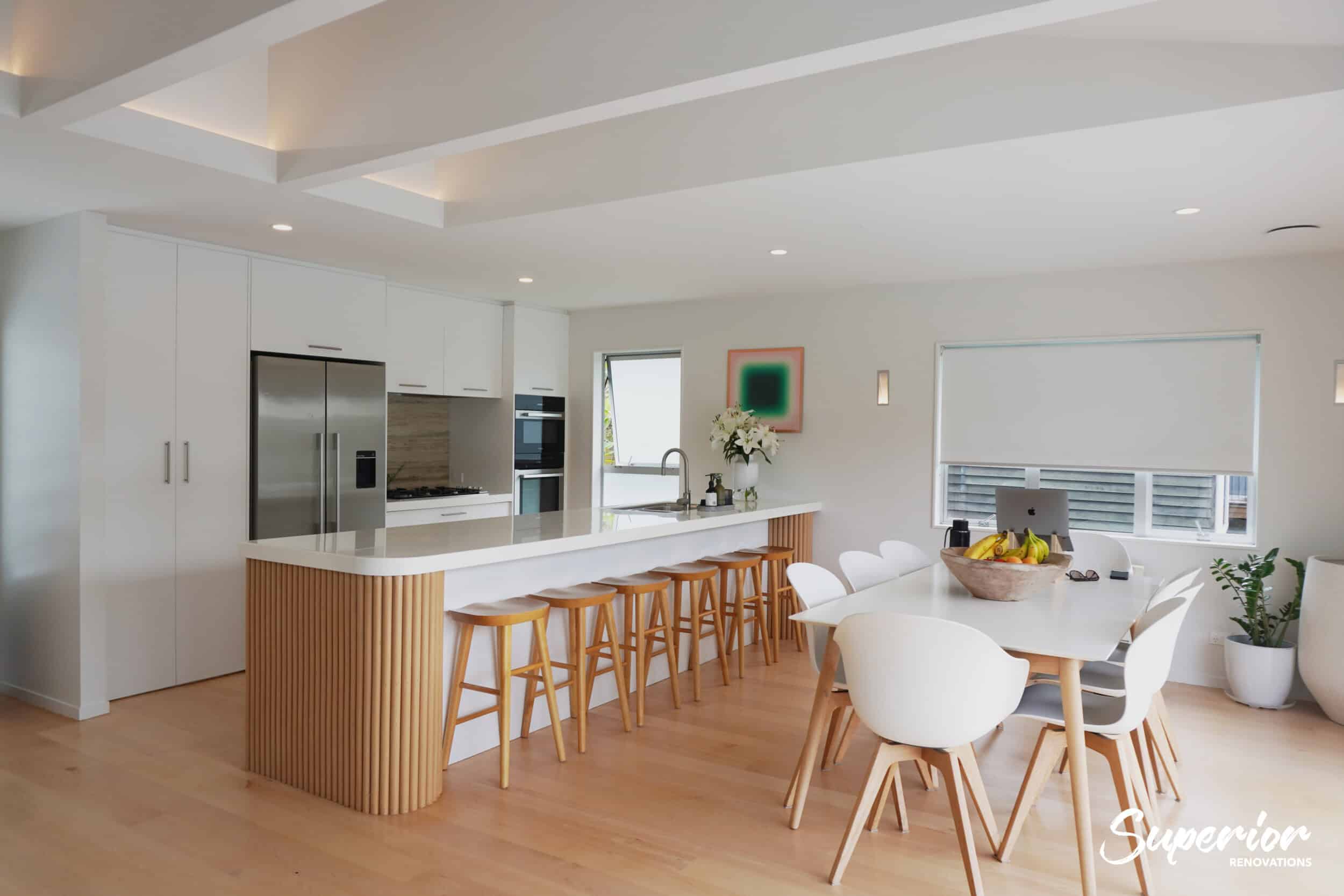
Designer Kitchen By Superior Renovations
💡 Quick tip: The single biggest visual change you can make under $10,000 is professionally painting or spray-coating your existing cabinets. A dated pine or melamine kitchen from the 1990s can look genuinely modern with a matte charcoal or white spray finish — and it costs a fraction of new cabinetry.
What a $10,000 Budget Cannot Do
There are hard limits at this price point. $10,000 won’t cover new cabinetry, new appliances, or any layout changes. Specifically:
You won’t be replacing cabinets. New carcasses and doors for a standard kitchen eat most of a $10,000 budget on their own, before installation, a benchtop and three trades. Add a plumber, an electrician and a builder, and you’re past $10,000 before you’ve bought a single appliance.
You won’t be moving the sink, the oven or the dishwasher either. Relocating plumbing means a plumber’s time, new pipework through the floor or wall, and possibly a consent question. Moving electrical adds more. At this budget, everything stays where it is.
Important note: Moving a sink, adding a fixture, changing circuits or taking out a wall can each raise a building consent question, and structural work such as removing a load-bearing wall can be Restricted Building Work. Confirm your plans with Auckland Council or a Licensed Building Practitioner before you price them. We assess consent requirements at our free consultation.
You also won’t be replacing appliances, not as part of the renovation anyway. If the oven is on its last legs, that’s a separate purchase from the appliance retailer, outside a $10,000 refresh.
“A $10,000 refresh works best when the bones of the kitchen are still solid — structurally sound cabinets, decent layout, no plumbing issues. We’re changing the skin, not the skeleton. That’s where the value sits at this price.”
— Alison Yu, Designer, Superior Renovations
When a $10,000 Refresh Makes Sense
This budget suits a few specific scenarios. If you’re preparing a house for sale and the kitchen is dated but functional, a cosmetic refresh offers the best return without overcapitalising. A modest refresh on a modest home in Hillsborough or Henderson is smart money; a full renovation on the same property may not be.
It also works if you’re renovating a rental property, doing a quick pre-tenancy spruce-up, or staging a phase-one upgrade before a larger renovation down the line.
Where it doesn’t make sense: if the cabinets are water-damaged, the layout is genuinely broken, or you’re dealing with an older Auckland home where the plumbing needs replacing anyway. In that case, spending $10,000 on cosmetics is putting lipstick on a problem.
What $20,000 Gets You — The Entry Point for a Real Kitchen Renovation
$20,000 sits in the middle of the $15,000 to $25,000 range our small kitchen renovations start from: new cabinetry, benchtop and splashback, installed, provided the layout stays as it is. In Auckland, you’ll need to be disciplined about materials and smart about where you save.
At this budget, you’re no longer just refreshing surfaces. You’re stripping out the old kitchen and installing something new. But the rules are strict: no layout changes, no structural work, no premium materials.
The $20,000 Kitchen: What’s Included
| Item | Specification | What Drives the Cost |
|---|---|---|
| Flat-pack or pre-made cabinets | Standard sizes, MDF or acrylic panel doors | Number of units, the door finish, and drawers versus doors |
| Laminate benchtop | 30mm laminate, standard L-shape or galley | Run length, joins and cut-outs |
| Entry-level appliances | Oven, cooktop, rangehood (Westinghouse/Bosch) | Brand tier, and whether the rangehood can be ducted outside |
| Sink and tapware | Stainless steel sink, mid-range mixer tap | The products you pick |
| Tile splashback | Ceramic or subway tiles from The Tile Depot | Area, tile size and pattern |
| Vinyl plank or laminate flooring | Budget-friendly, durable for kitchens | Floor area, and whether the subfloor needs levelling first |
| Plumber | Disconnect and reconnect (same positions) | Hours at $120–$150 an hour, kept down by moving nothing |
| Electrician | Disconnect, reconnect, new under-cabinet lighting | New circuits versus existing ones |
| Builder / installer labour | Demo, install cabinets, benchtop, finishing | Kitchen size, and how far out of square the walls are |
| Paint and finishing | Walls and ceiling | Area and the state of the linings once the old cabinets are off |
Every one of those lines moves with your kitchen. That’s why the same $20,000 can be comfortable for a small galley kitchen in a Papakura townhouse with flat-pack cabinets and basic appliances, and tight for a standard kitchen in a three-bedroom Massey home with better materials. In Auckland, $20,000 buys a basic renovation of a small kitchen, not a generous one.


Imagine a compact galley kitchen in a 1970s brick-and-tile house in Torbay. The sink stays under the window, the oven stays in its tower, and the money goes on laminate benchtops, neutral doors and better drawers. Done that way, $20,000 buys a kitchen that’s clean, modern and works properly. It won’t be magazine material, and nobody should promise you it will.
💡 Quick tip: The single biggest cost-saver at this budget level is keeping the existing layout. The moment you move a sink or oven, you’re paying for new pipework and circuits, and possibly a consent, out of a budget with no room for either.
Where to Save (and Where Not To)
Save on cabinets. Flat-pack is genuinely good now: melamine or acrylic panel doors in white or neutral tones look sharp and hold up well. Custom cabinetry wins on fit, quality and lifespan, but at this budget flat-pack is the right call.
Save on benchtops. Laminate has come a long way. Laminex’s laminate range includes stone-look and timber-look finishes that are genuinely convincing, at a fraction of what engineered stone costs per metre.
Don’t save on trades. Plumbing, gas and electrical work in a kitchen is licensed work, and the homeowner exceptions are narrow and come with conditions. Our guide to the kitchen jobs a homeowner may legally take on goes through them task by task. A cut corner here is work you end up paying for twice.
Don’t save on the rangehood. Building Code clause G4 requires buildings to have a means of collecting or otherwise removing cooking fumes and odours from the spaces where they are generated (Building Regulations 1992, Schedule 1). A rangehood ducted to the outside takes the air out of the house. A recirculating one filters grease and odour and returns the air, and its moisture, to the room, which in a humid Auckland kitchen shows up as peeling paint and mould behind the cabinets. Pay the difference for a ducted model if the room allows it.
“I always tell clients at the $20,000 mark — pick two things to do really well and accept basic everywhere else. If the benchtop and handles are beautiful, the whole kitchen lifts. If you try to upgrade everything, you end up with a kitchen where nothing quite feels right.”
— Cici Zuo, Sales Manager, Superior Renovations
Flat-Pack, Kitset or Custom Cabinetry: Where the Money Goes
Cabinetry is the biggest single decision in a kitchen budget, and the routes price differently. Flat-pack comes in standard widths, ready to assemble. It’s the cheapest to buy, but someone still has to build it, fit it, scribe it to walls that are never quite square and fill the gaps where standard sizes don’t meet your room.
Kitset and “complete kitchen” packages bundle the carcasses, doors and sometimes a benchtop. That simplifies the ordering, but the installation, plumbing, electrical work and splashback are still yours to organise and pay for, so compare a package price with a renovation price only once you’ve added those back in.
Custom cabinetry is made to the room’s measurements, so there are no filler panels and the storage fits your actual pots and appliances. And if your cabinet boxes are sound and only the fronts look tired, there’s a fourth route: new doors and drawer fronts on the existing carcasses. Little Giant Interiors, our in-house cabinetry division, makes cabinetry in its Auckland factory and has a cabinet door replacement calculator for exactly that job.
The $20,000 Trap: When It’s Not Enough
Here’s where homeowners get caught. They budget $20,000, start the renovation, and discover the framing behind the old cabinets is damp. Or the electrician finds wiring that doesn’t meet current standards. Or the floor underneath is uneven and needs levelling before new vinyl goes down.
Older Auckland homes are particularly prone to hidden surprises, especially 1970s–80s brick-and-tile in suburbs like Mt Roskill, Mangere and Manurewa. Pre-1940s villas in Grey Lynn or Ponsonby can throw up issues too: outdated plumbing, single-skin walls, asbestos in textured ceilings.
The standard advice is to add a 10–15% contingency to your budget. On $20,000, that’s $2,000–$3,000 set aside for the unexpected. If nothing goes wrong, you keep it. If something does, you’re not scrambling for a personal loan mid-build.
Important note: If your home was built before 1 January 2000, the Health and Safety at Work (Asbestos) Regulations 2016 require a business refurbishing it to make sure any asbestos likely to be disturbed is identified and, so far as is reasonably practicable, removed before the work starts (regulations 19 and 26). Minor or routine maintenance is outside the rule. Identification goes to a competent asbestos surveyor and removal to a licensed asbestos removalist; here’s what an asbestos survey involves before the strip-out.
Want a range for your own kitchen? Try our free kitchen renovation cost calculator: answer a few questions and we’ll email you an Auckland price range.
The Real Cost of a Mid-Range Kitchen Renovation in Auckland
So if $10,000 gets you a refresh and $20,000 gets you a basic renovation, what does a proper mid-range kitchen renovation actually cost?
In Auckland, a mid-range kitchen renovation costs between $26,000 and $35,000 + GST for a 10–12m² kitchen with custom cabinets, stone benchtops and quality appliances. Those are the kitchen figures on our FAQ page, and they cover design, cabinetry, benchtop, splashback, appliances and installation. Basic refreshes start from $15,000, luxury and custom kitchens reach $138,000+, and Auckland runs higher than the national average on labour rates ($120–$150/hour) and compliance costs.
Where your kitchen lands inside that band comes down to three things: the cabinetry, the benchtop material, and whether anything moves. Keep the sink, cooktop and oven where they are and you’ll sit toward the lower end. Open the kitchen up to the living room and you’re into structural work, almost certainly a consent, and a different budget.
What You Get at $26,000–$35,000 + GST
This is the budget where a kitchen starts to feel designed, not just assembled. At this level, you’re typically getting:
| Component | Mid-Range Specification |
|---|---|
| Cabinets | Custom-made to fit your space, soft-close hinges, quality MDF or acrylic panel doors |
| Benchtop | Engineered stone or a comparable stone surface |
| Appliances | Mid-tier brands such as Fisher & Paykel, SMEG or Bosch |
| Splashback | Porcelain tiles or glass |
| Flooring | Quality vinyl plank or porcelain tiles |
| Layout changes | Minor: repositioning an appliance or adding a breakfast bar |
| Design | Professional 3D design, material selection, project management |
| All trades | Builder, plumber, electrician and tiler, coordinated by one project manager |
This is the sweet spot for most Auckland homeowners. You’re getting a kitchen that looks and functions well, uses materials chosen to last, and is built by professionals who handle everything from design to handover. It’s also the tier where renovation companies like us add the most value — managing the build, coordinating trades, and catching problems before they become expensive.

For inspiration on what this budget delivers in practice, have a look at our kitchen design gallery — it includes projects at various price points from across Auckland.
Why the Jump from $20,000 to $30,000 Is Worth It
The gap between a $20,000 kitchen and a $30,000 kitchen is bigger than the numbers suggest.
At $20,000, you’re typically assembling flat-pack cabinets, accepting laminate surfaces, and coordinating trades yourself. At $30,000+, you’re getting custom cabinetry built to your exact dimensions, professional design input, a project manager keeping everything on track, and materials that genuinely last.
The bigger difference is who carries the risk. On a self-managed $20,000 job, the gaps between the cabinetmaker, plumber, electrician and tiler are yours to manage. On a managed renovation, one fixed-price contract covers the whole job, and you’ll know the price, the timeline and exactly what’s included before any work starts.
We work with our in-house design team to make sure every dollar in a mid-range budget pulls its weight. Dorothy Li, our Head of Design, will tell you that 80% of the impact in a kitchen comes from the cabinets and benchtop — get those right, and the rest follows.
💡 Quick tip: If you’re torn between a $20,000 DIY-managed renovation and a $30,000 professionally managed one, consider the time cost. Managing trades, ordering materials and sorting out clashes between them takes hours of your own time in every week of the job. Put a value on those hours before you count the saving.
How to Decide Which Budget Is Right for You
Here’s a simple way to match the budget to the situation:
| Your Situation | Recommended Budget | Approach |
|---|---|---|
| Selling soon, kitchen is dated but functional | Under $15,000 | Cosmetic refresh — paint, handles, benchtop, splashback |
| Rental property spruce-up | From $15,000 | Basic renovation with durable, low-maintenance materials |
| First home, tight budget, kitchen is unusable | $15,000–$25,000 | Full basic renovation, same layout, pre-made cabinets |
| Family home, want it done properly | $26,000–$35,000 + GST | Mid-range renovation with professional design and build |
| Forever home, premium result | Above $35,000 + GST, up to $138,000+ | Custom design, premium materials, layout changes |
The honest answer? For a family kitchen done properly, plan around our published mid-range of $26,000 to $35,000 + GST. If you’ve only got $10,000–$20,000 right now, a cosmetic refresh or a phased approach makes more sense than stretching a tight budget across a full renovation.
Why GST Decides Whether You Need a Written Contract
Check the GST before you check the contract. The Building (Residential Consumer Rights and Remedies) Regulations 2014 set the prescribed minimum price at $30,000 inclusive of GST (regulation 4). At or above that price, the Building Act 2004 requires the contract for residential building work to be in writing and dated, and the builder must give you the prescribed disclosure information and checklist before you sign (sections 362D and 362F). You can ask for both on a smaller job too.
Our mid-range kitchen band is quoted + GST, and that matters here. A $26,000 + GST kitchen is $29,900 once GST is added, just under the line; anything above about $26,100 + GST is over it. So most mid-range kitchens fall inside the rule, while a $20,000 job does not, unless you ask. Either way, get the price in writing and read what it includes. Before you sign, go through the clauses worth checking in a kitchen renovation contract.
Smart Strategies for Stretching a Tight Kitchen Budget
If you’re working with $10,000 or $20,000 and determined to make the most of it, here are the strategies that actually work, not the generic “shop around” advice you’ll find everywhere else.
Phase Your Renovation
The smartest move for a tight budget is staging the work over two phases. Phase one (now): a cosmetic refresh, with the cabinets spray-coated, a new benchtop, new handles and a fresh splashback. Phase two (12–18 months later): replace appliances, upgrade lighting, add better storage.
This way, you get the visual change now and spread the cost over time. Phase one makes the kitchen liveable and good-looking; phase two finishes the job when the budget allows. The one rule: don’t put a new benchtop on cabinets you plan to replace in phase two.
Do the Right Things Yourself (and Nothing Else)
DIY saves money only on the tasks where your mistakes won’t cost more to fix than the professional would have charged. Safe DIY territory: painting walls, installing handles, removing old splashback tiles (carefully), and laying vinyl plank flooring if you’ve done it before.
Leave the plumbing, gas and electrical work to licensed tradespeople, and the cabinet installation to someone who fits cabinets every week. The DIY guide above sets out where the legal line sits for each trade. A botched plumbing job can also leave you with moisture damage that costs far more than the plumber would have.
Buy Smart, Not Cheap
There’s a difference. Cheap is the rangehood that gives up in its second winter. Smart is buying a mid-range model in an end-of-season sale without dropping a quality tier.
Watch for end-of-line appliances, ex-display stock and benchtop offcuts, and ask your tile supplier about run-out lines for the splashback if you’re not fussy about this season’s trend tile.

Consider Finance to Bridge the Gap
If you’ve got $20,000 saved but the kitchen really needs a $30,000 renovation, stretching the budget with finance can make sense, provided the terms work for you. We’ve partnered with Q Mastercard to offer up to 18 months interest-free. The 18-month term applies to full-price renovation projects of $20,000 or more, the offer is for Auckland clients only, and lending criteria, fees, terms and conditions apply, so read the full terms on that page before you count on it.
Not everyone wants to take on debt for a kitchen, and that’s fair. But if the alternative is spending $20,000 on a kitchen you’re not happy with, then spending another $20,000 to redo it in five years, the maths works out better doing it once, properly.
💡 Quick tip: Before committing to any budget, get a free quote from a renovation company. The number in your head and the number on the quote are often different — sometimes higher, sometimes lower. We offer free in-home consultations specifically so you can make decisions based on real figures, not guesswork.
The Bottom Line on Budget Kitchen Renovations in New Zealand
$10,000 is not enough for a kitchen renovation. It is enough to change how your kitchen looks, if you focus on the right things and accept the limits of a cosmetic refresh.
$20,000 gets you into genuine renovation territory: new cabinets, benchtop, and appliances in a small-to-medium kitchen with no layout changes. It’s tight in Auckland, but doable.
$26,000 to $35,000 + GST is our published mid-range for a 10–12m² Auckland kitchen, and it’s where the value is strongest: professional design, quality materials, managed trades and a result built to last.
The worst thing you can do is start a renovation you can’t finish. If $10,000 is your budget right now, do a smart cosmetic refresh and plan phase two for later. If $20,000 is your ceiling, be disciplined about keeping the layout and choosing materials wisely. And if you can stretch to $30,000+, you’ll get a kitchen that genuinely changes how you live in your home.
Whatever your budget, we’re happy to talk it through: no pressure, no obligation, just straight answers about what your money will deliver.
➡ Book your free in-home consultation with Superior Renovations
➡ Get an emailed kitchen renovation cost estimate from our free calculator
➡ Request a free feasibility report for your project
Is $10,000 enough to renovate a kitchen in New Zealand?
Not for a full renovation. $10,000 pays for a cosmetic refresh of a kitchen that still works: spray-coating the existing cabinets, new handles, a laminate benchtop, a tiled splashback and a new mixer tap, with the layout left as it is. Our small kitchen renovations, with new cabinetry, benchtop, splashback and installation, start from around $15,000 to $25,000, and a mid-range Auckland kitchen costs $26,000 to $35,000 + GST.
Is $10,000 enough for a new kitchen?
Not for a new kitchen with new cabinetry. On our published Auckland pricing, a small kitchen renovation starts from around $15,000 to $25,000, and that assumes the layout stays the same. What $10,000 buys is new surfaces on the kitchen you already have: cabinets spray-coated, handles and tap replaced, a laminate benchtop and a tiled splashback. If the cabinet boxes are sound, new doors and drawer fronts are the next step up.
Can I renovate my kitchen for $20,000 in Auckland?
Yes, if the layout stays where it is. $20,000 sits inside the $15,000 to $25,000 range our small kitchen renovations start from, which covers new cabinetry, benchtop, splashback and installation. Auckland labour runs $120–$150 an hour, so keep the sink and oven in place, choose laminate over stone, and set aside 10–15% for surprises, especially in a house built before 2000.
What is the cheapest way to update a kitchen in NZ?
A cosmetic refresh: spray-coating the existing cabinets, new handles, a laminate benchtop and a tiled splashback, plus a new tap and lighting. It sits below the basic refresh we price from $15,000, because the cabinet boxes and doors stay and nothing moves. Painting the walls yourself trims it further, and keeping the sink, cooktop and oven in place means you are not paying a plumber and an electrician to move them.
How much does a mid-range kitchen renovation cost in Auckland?
Our published mid-range for an Auckland kitchen renovation is $26,000 to $35,000 + GST for a 10–12m² kitchen with custom cabinets, stone benchtops and quality appliances, covering design, cabinetry, benchtop, splashback, appliances and installation. Basic refreshes start from $15,000 and luxury custom kitchens reach $138,000+. Auckland runs higher than the national average on labour rates ($120–$150 an hour) and compliance costs.
What does a new kitchen cost in NZ?
On our published Auckland pricing, a small kitchen renovation with new cabinetry, benchtop, splashback and installation starts from around $15,000 to $25,000, a mid-range 10–12m² kitchen costs $26,000 to $35,000 + GST, and luxury custom kitchens reach $138,000+. What moves you within those bands is the cabinetry, the benchtop material and whether the sink, cooktop or walls move. Our kitchen calculator emails you a range for your own scope.
Do I need a building consent for a kitchen renovation in Auckland?
Replacing cabinetry, benchtop and appliances in the same layout usually does not need a building consent. Removing a load-bearing wall, relocating plumbing, or adding or significantly changing electrical circuits typically does, and an open-plan conversion almost certainly does. Every house is different, so confirm yours with Auckland Council or a Licensed Building Practitioner before you price the work. We assess consent requirements at our free consultation.
How long does a kitchen renovation take in Auckland?
A standard kitchen renovation takes 5 to 6 weeks from the day demolition begins, assuming the design is finalised and cabinetry manufacturing is underway before the build starts. Cabinetry manufacturing typically takes 4 to 6 weeks, so it should be ordered early. If consent is required, allow an additional 4–8 weeks for Auckland Council processing. A cosmetic refresh that keeps the cabinets is a much shorter job.
Should I renovate my kitchen before selling my house?
It depends on the scope. A cosmetic refresh suits a kitchen that is dated but works: it changes what buyers see in the listing photos and at the open home without a full rebuild. A full renovation before a sale makes sense only when the kitchen is genuinely broken. Ask a local agent what buyers in your suburb expect, and a registered valuer before spending big money, then get both options priced.
Can I do a kitchen renovation in stages to save money?
Yes. Phasing is one of the better strategies for a tight budget. Phase one: spray-coated cabinets, a new benchtop and a new splashback. Phase two, 12–18 months later: appliances, lighting and storage upgrades. You get the visual change now and spread the cost over time. The one rule is not to put a new benchtop on cabinets you plan to replace in phase two, or you pay for it twice.
What are the hidden costs of a kitchen renovation in NZ?
The usual ones are asbestos in homes built before 2000 (it has to be identified before a refurbishment, and removal is licensed work), plumbing or wiring that needs bringing up to standard once the walls are open, floor levelling before new flooring goes down, and consent costs if the work turns structural. None of them can be priced until someone has looked, so set aside 10–15% of the budget for surprises, especially in older villas and brick-and-tile homes.
Is it cheaper to renovate or replace a kitchen in NZ?
Refreshing is cheaper because the cabinets stay: repainted doors, new handles and a laminate benchtop on the existing boxes. A small kitchen replacement with new cabinetry starts from around $15,000 to $25,000 on our published pricing. Refreshing suits cabinets that are structurally sound; replacing is better when they are water-damaged, warped, or the layout does not work. New doors and drawer fronts on sound carcasses sit between the two.
Related guides
- how long each stage of a kitchen renovation takes
- what moves a kitchen renovation quote up or down
- planning a renovation before you ask for quotes
Further Resources
- Featured projects and Client stories to see specifications on some of the projects.
- Real client stories from Auckland
Need more information?
Take advantage of our FREE Complete Home Renovation Guide (48 pages), whether you’re already renovating or in the process of deciding to renovate, it’s not an easy process, this guide will help you avoid costly mistakes.
Download Free Renovation Guide (PDF)
Have you been putting off getting renovations done?
We have partnered with Q Mastercard ® to offer up to 18 months interest-free, so you can enjoy your new home now and stress less.
Learn More about Interest-Free Payment Options*
*Lending criteria, fees, terms and conditions apply. Mastercard is a registered trademark and the circles design is a trademark of Mastercard International Incorporated.
Still have questions unanswered?
Book a no-obligation consultation with the team at Superior Renovations, we’d love to meet you to discuss your renovation ideas!
References
- Building (Residential Consumer Rights and Remedies) Regulations 2014, regulation 4 (prescribed minimum price)
- Building Act 2004, sections 362D and 362F
- Health and Safety at Work (Asbestos) Regulations 2016, regulations 19 and 26
- Building Regulations 1992, Schedule 1 (Building Code), clause G4 Ventilation