
House Renovation

Kid friendly renovation ideas 1 1 - Superior Renovations
House Renovation

12 Kid-Friendly Renovation Ideas for Auckland Families

12 Kid-Friendly Renovation Ideas Auckland Families Are Actually Adding to Their Homes

Quick answer: The best kid-friendly renovation ideas for Auckland homes solve the daily chaos without making the place look like a daycare — drop zones for school bags, durable kitchen surfaces that survive crayons, a separate rumpus so the lounge stays adult-zone, bunk-room layouts that grow with the kids, and warm bedrooms that meet the new H1 insulation standard. Most fit inside a kitchen, bathroom, or full-home reno without blowing the budget.

It’s 7:42am on a Tuesday in May. School starts in 18 minutes. One kid can’t find a shoe, the other has glued something to the dining table, the dog is mid-bark at the courier, and you’re standing at the kitchen island trying to make a school lunch on the only 30cm of bench that isn’t covered in lego, art folders, and someone’s spelling list.

Sound familiar?

This is the lived experience of a growing family in a 1990s 4-bed in Hobsonville, a 1970s brick-and-tile in Howick, or a renovated villa in Mt Eden that worked beautifully when there was one toddler — and now feels two rooms too small. According to Stats NZ’s 2023 Census household highlights, couples with children were the most common household type in New Zealand. Stats NZ’s national family and household projections also estimate Auckland will hold around 35% of the country’s households by 2038, up from 30% in 2013. The renovation question for most of these families isn’t “should we move?” — it’s “how do we make this house work harder?”

We’ve worked on more than 1,000 Auckland renovation projects across the past decade. The brief from families with school-age kids has shifted noticeably in the last five years. It’s less “we need a bigger lounge” and more “we need somewhere for the school bags, somewhere for the homework, somewhere the kids can be loud while we’re trying to have a conversation, and please — for the love of god — somewhere to put the lego.” If you’ve ever shared this list, this article is for you.

Twelve renovation-scale ideas Auckland parents are actually requesting, with real 2026 cost figures, designer notes, and product specs that survive a six-year-old. None of them will turn your house into a daycare. All of them will give you back forty minutes of your weekend.

(If you’ve also got a dog in the mix — and most families do — pair this with our 12 pet-friendly renovation ideas for Auckland dog owners. There’s heavy overlap on the mudroom, the durable flooring, and the indoor-outdoor flow.)

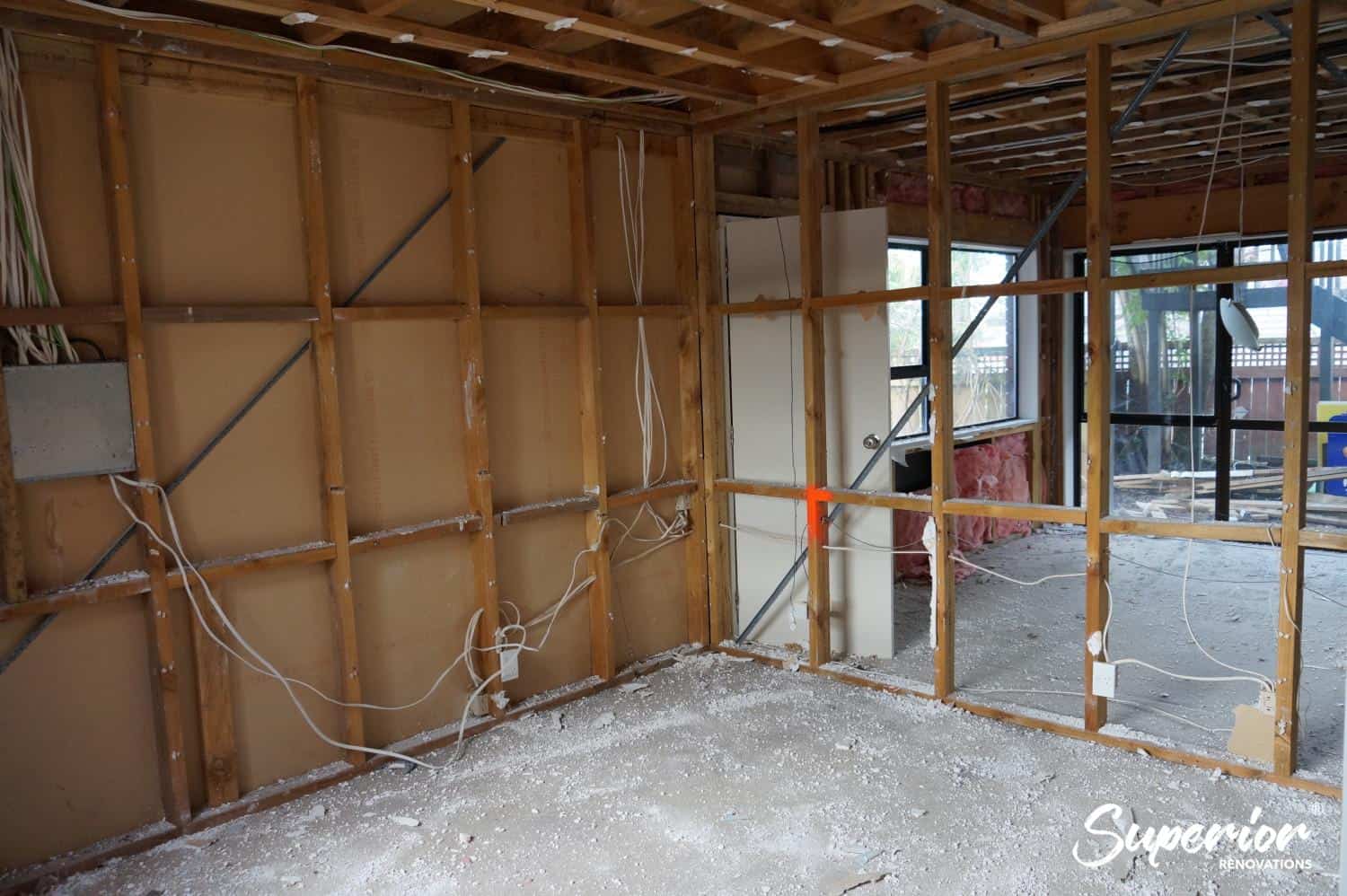
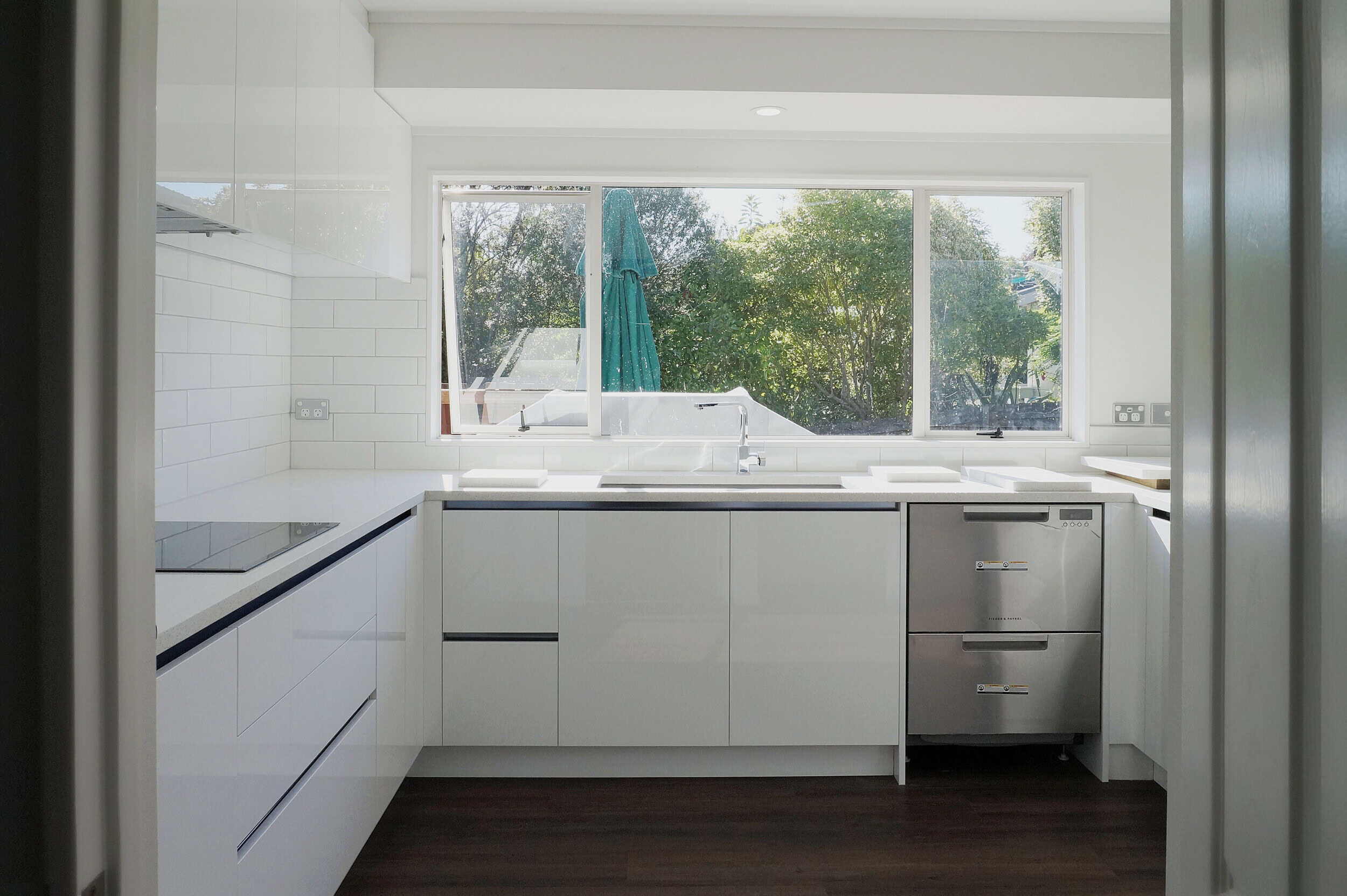
Kid friendly renovation ideas 4 - Superior Renovations


1. The Drop Zone — A Mudroom That Absorbs the School-Run Chaos

If your back door or garage entry opens straight into the kitchen — which it does in plenty of 1990s subdivisions and 1970s brick-and-tiles — the school run is happening in your kitchen. Bags on the bench. Shoes under the table. Lunchboxes wedged between cookbooks.

A proper drop zone is the single highest-impact kid-friendly addition for an Auckland home. Even a small one — 2.5m by 1.5m carved out of an existing laundry, hallway, or internal garage wall — gives every family member a peg, a cubby, and a basket. The standard joinery brief is straightforward: a bench seat at kid-shoulder height with hooks above, a low cubby per child for shoes and wet leads, a clip-in laundry basket per kid for the gym kit nobody remembers to bring in, and a tile or vinyl floor that won’t sulk about a wet sock.

“The single biggest predictor of whether a kid-friendly renovation works in practice — not on paper, in practice — is whether the family has somewhere to put stuff the moment they walk through the door. Without a drop zone, the kitchen island becomes the drop zone by default, and the kitchen never feels finished.”
— Dorothy Li, Design Manager, Superior Renovations

💡 Quick tip: If your laundry currently runs off the kitchen, you can usually convert it into a combined laundry-mudroom without moving plumbing — the cheapest path to a working drop zone. Budget $5,000–$15,000 in joinery and finishes as part of transforming your family home.


2. Storage Walls That Swallow the Toys (Without the Daycare Aesthetic)

Open shelving with woven baskets photographs beautifully on Instagram. It also means every Lego brick, plush toy, and half-broken Bluey figurine is visible from the lounge couch.

The fix is built-in joinery — floor-to-ceiling, push-touch, no handles — that runs along one wall of the family living area. Behind those doors: drawers and tubs sized to swallow the actual toy inventory. In front of those doors: a clean, calm wall in a neutral that doesn’t compete with the rest of the room. Built-in storage is the difference between a family home and a showroom that happens to have kids in it.

For a typical 4m run of full-height built-in joinery in melamine or Laminex finishes, expect $8,000–$15,000 supplied and installed as part of a wider renovation. Push for matte finishes rather than gloss — they hide fingerprints, scuff marks, and the inevitable felt-tip pen incident.

💡 Quick tip: Spec at least 30% of the internal storage as deep drawers rather than shelves. Drawers force visible categories (the puzzle drawer, the art drawer, the random-craft-supplies drawer). Shelves just become the place where toys go to die at the back.


3. A Kitchen Island That Doubles as a Kid Bench

The kitchen island is the centre of family life from age 3 to about age 16. Snack prep, breakfast, baking, homework, lunchbox assembly, Sunday-night meal planning, and the place where every conversation about how school went actually happens.

The renovation upgrade we’re seeing more of: a section of the island that drops to a lower bench height — 850mm rather than the standard 900–910mm — so a 6-year-old can stand and make their own toast without a step stool. Or a pull-out drawer-style step built into the toe-kick. Or both. A kitchen that lets a kid participate is a kitchen that buys you back ten minutes every morning.

Other family-specific kitchen moves worth costing in: a deep pot drawer (not a cupboard) for the heavy stuff so a kid can grab their own bowl, a dedicated lunchbox drawer at child height, and a charging cabinet for the school iPads that gets the cables off the bench entirely. Add roughly $3,000–$6,000 to your kitchen build for these features — well inside the mid-range Auckland kitchen renovation band of $28,000–$50,000.

“Most family kitchens fail not because of the layout but because the bench-to-storage ratio is wrong. You need more bench than a couple’s kitchen and less precious display than a Pinterest kitchen. Two-thirds of your storage should be drawers, not cupboards. Kids can’t open cupboards safely without slamming them.”
— Alison Yu, Designer, Superior Renovations

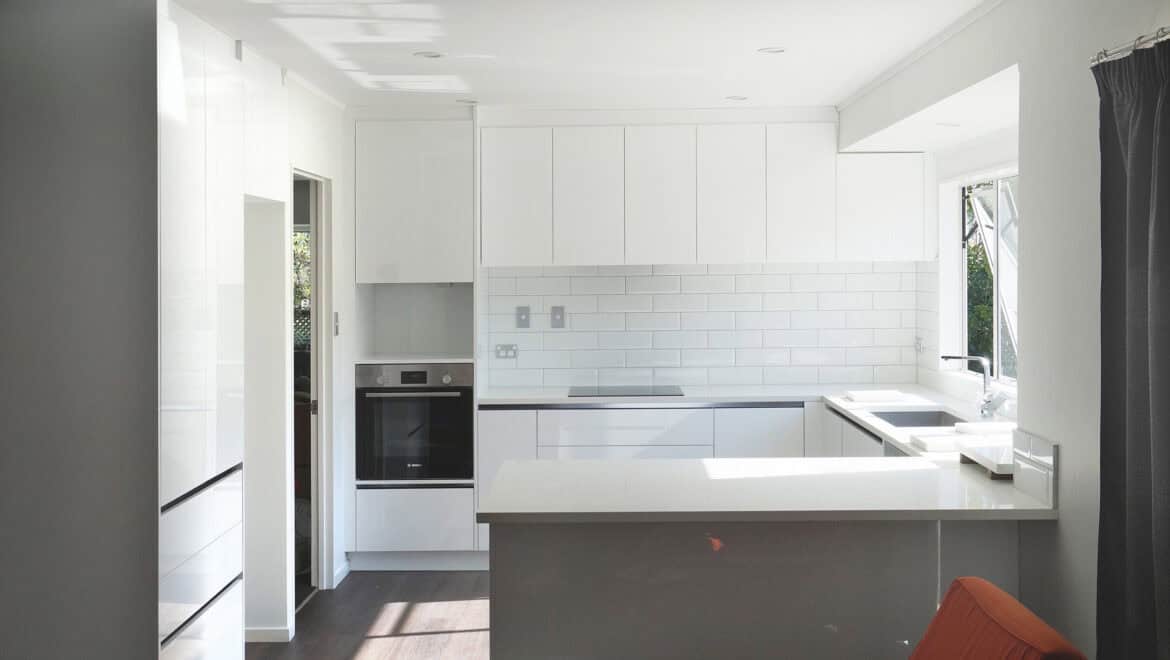
Kid friendly renovation ideas 3 - Superior Renovations


4. Surfaces That Actually Survive a Six-Year-Old

This is the unglamorous part of family renovation design and it’s also the part that matters most. The wrong surface choice means you’re repainting at year three, re-sanding the engineered oak at year five, and replacing the kitchen splashback after the felt-tip pen lives forever.

For floors: porcelain tiles in living and wet areas, engineered timber or quality vinyl plank in bedrooms, and avoid pale natural-finish oak in any high-traffic family zone. For benchtops: engineered stone in mid-grey or warm white — it’s almost impossible to stain and resists heat, scratches, and the inevitable nail polish spill. For paint: a durable washable finish like Resene SpaceCote Low Sheen across all family living spaces, hallway walls, and kid bedrooms — it stands up to scrubbing and survives both magic eraser and toddler artwork. For cabinetry: matte Laminex finishes in textured profiles that disguise fingerprints. For splashbacks: tiles over glass — tile grout can be replaced, glass can’t be un-scratched.

The rule we give every family: spec for the worst day, not the best day. Choose the finish that survives the wet pram wheels in the hallway, the spilled blueberries on the rug, the texta on the wall. The aesthetic version of that finish almost always exists — you just have to ask for it.

“There’s a particular kind of regret that hits a family eighteen months after a renovation. It’s the moment they realise they chose the surface that looks beautiful in a magazine instead of the one that survives a Tuesday. We have the conversation with every family at design stage — pick the materials assuming things will get worse, not better.”
— Eunice Qin, Designer, Superior Renovations


5. Kitchen-to-Backyard Sightlines — Watch the Kids Without Standing Up

This is the single most-requested feature from Auckland families with kids aged 2 to 8. The ability to make dinner and see the trampoline at the same time. The ability to load the dishwasher and confirm nobody is climbing the fence. The ability to be in two places at once without actually being in two places at once.

For older Auckland homes — the 1970s brick-and-tile in particular — this often means a structural change. A wall comes out, a steel beam goes in, and the kitchen, the dining, and a wider sliding door to the deck become a single visual axis. A clear sightline from the kitchen bench to the backyard is worth more in family quality-of-life terms than almost any other renovation move.

Where this becomes a full renovation rather than a cosmetic one is when the wall in question is load-bearing or the slider in question needs a wider opening than the existing lintel allows. That’s a structural engineer’s job, a building consent, and typically $15,000–$40,000 of structural and joinery work depending on the span. Within a wider full-home renovation in the $140,000–$180,000+ Auckland band, it’s often the move that delivers the most daily impact.

💡 Quick tip: If you can’t take the wall out, put a window in it. A wide internal window between the kitchen and the next room costs a fraction of an opened-up plan and still lets you see what’s happening. We’ve done this for older West Auckland homes where the structural cost wasn’t worth it.


6. A Rumpus or Second Living Zone — Keep the Lounge Adult

The single best renovation gift you can give yourself once the kids are old enough to colonise a room is a second living zone. A rumpus. A TV den. A converted garage. A reclaimed dining room that nobody was using as a dining room. Anywhere that isn’t the main lounge.

The unspoken rule of every functional family home: the lounge stays adult-zone, and the kids get their own space. Without a second living zone, every Saturday morning is a quiet domestic standoff between Bluey on the big TV and the parent who would quite like to read the paper.

The cheapest version of this is reconfiguring an existing room — a fourth bedroom nobody’s using, a dining room you eat in three times a year, a study that’s already half a junk room. Add a built-in storage wall, decent acoustic treatment in the ceiling, a wall-mounted TV, and you’ve got a rumpus for $8,000–$20,000 inside a wider renovation. The more ambitious version is a garage conversion ($40,000+ for a basic conversion, more if you’re adding insulation and a separate entrance) or a single-storey extension via our Auckland house extensions service starting from $80,000.

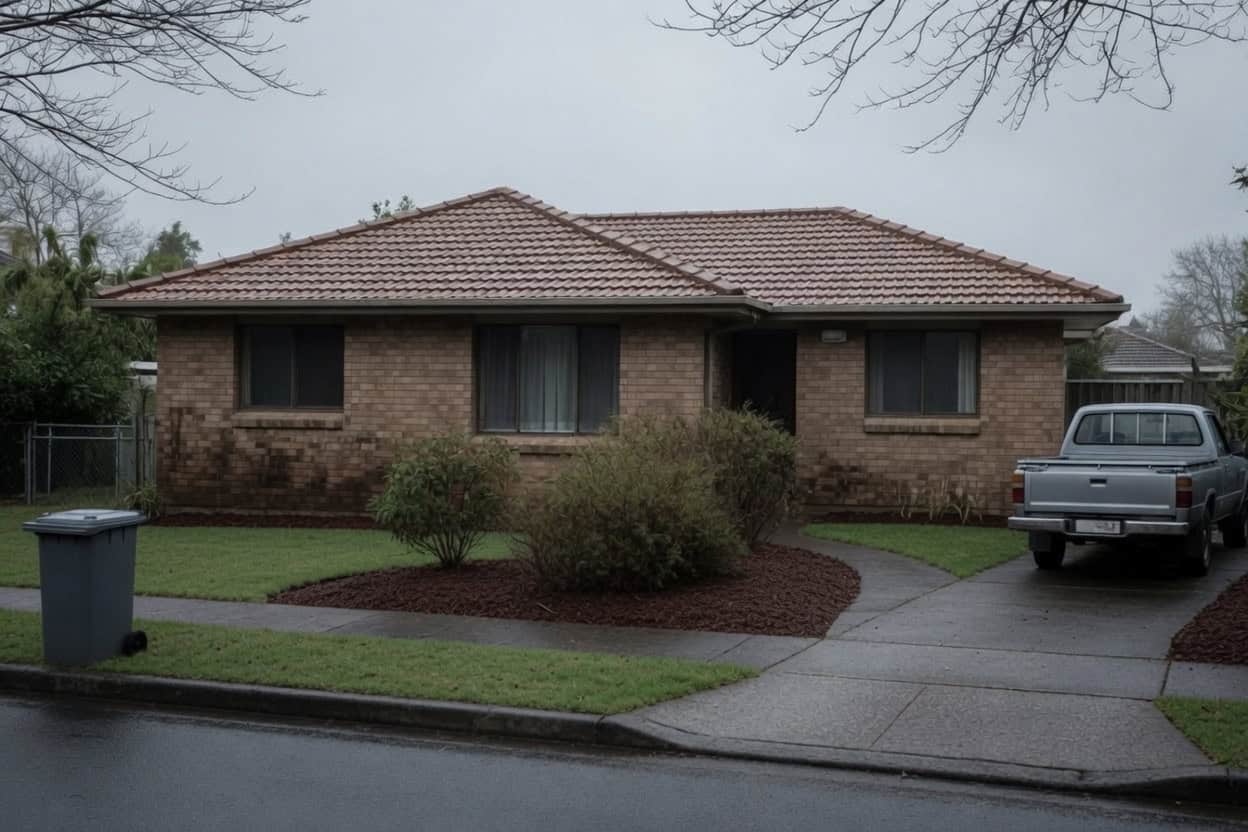
Kid friendly renovation ideas 1 - Superior Renovations


7. Bunk-Room Layouts That Don’t Feel Like a Backpacker Hostel

Two kids sharing a bedroom doesn’t have to mean two single beds wedged against opposite walls with a metre of carpet in between. Done right, a shared kids’ bedroom is one of the most functional spaces in an Auckland family home — it frees up a fourth room for the rumpus, it builds in sibling bonding, and it often becomes the favourite room in the house.

The renovation move is built-in bunk joinery rather than freestanding bunks. Built-in bunks running along one wall, each with its own reading light, its own USB charging point, its own small shelf for the book and the bottle of water, and ideally its own curtain for the bottom bunk. Underneath: deep drawers for clothes and toys. Above the top bunk: shelving for the soft-toy graveyard. The whole assembly typically runs $4,500–$9,000 in custom joinery — comparable to two decent freestanding bunk beds but with five times the storage and zero floor-space penalty.

Spec note: ceiling height matters. If your existing ceilings are 2.4m, a top bunk leaves about 800mm of headroom — workable but tight. For older villas with 2.7m ceilings (Mt Eden, Grey Lynn, Ponsonby), built-in bunks become genuinely spacious. The 1970s and 1990s housing stock with standard 2.4m ceilings still works, but talk to your designer about exact mattress thickness and rail heights early.


8. Homework Nooks — Not a Full Home Office

Most Auckland families don’t have room for a dedicated study for the kids, and most kids don’t need one. What they need is a built-in desk surface, a chair that fits properly, a power point at desk height, and good light. That’s it.

The trick is finding 90cm of wall somewhere it doesn’t intrude — under the stairs, at the end of a hallway, in a wide landing on the second storey, or in a corner of the rumpus. A built-in desk in melamine or Laminex with two shallow drawers below and an open shelf above runs about $1,800–$3,500 for the joinery, plus a dedicated double power-point with USB outlets. Add a wall-mounted shelf for a printer if needed.

A homework nook done at the renovation stage is a tenth the cost of converting a bedroom into a home office later — and it doesn’t take a bedroom out of circulation. For a family with kids who’ll be doing NCEA in five years, this is the move that pays off the longest.

💡 Quick tip: Don’t put the homework nook in the kid’s bedroom unless you really, really have to. Homework in the bedroom is one of the hardest habits to break later. Putting it in a semi-public family space — landing, end of hallway, rumpus corner — keeps the focus higher and the screens accountable.


9. A Family Bathroom That Survives the School-Morning Rush

The standard 1990s and 2000s Auckland family bathroom was designed for a couple. One vanity. One toilet inside the same room as the bath and shower. One mirror. It works fine until you’ve got two kids brushing teeth at 7:45am while a third needs the toilet and a parent needs to shower.

The two renovation moves that solve this:

First, a double vanity. Two basins, two mirrors, two drawers each — kids can brush teeth simultaneously and the mornings get measurably shorter. A double vanity adds about $2,000–$4,000 to a standard Auckland bathroom renovation in the $25,000–$35,000 mid-range band.

Second, a separate WC. If you can isolate the toilet behind its own door — either as a small adjacent room or via internal wall changes — the bathroom becomes usable by two people at once. A separate WC is the single biggest functional upgrade an Auckland family bathroom can have, and it adds maybe $3,000–$8,000 to a renovation when the plumbing allows it.

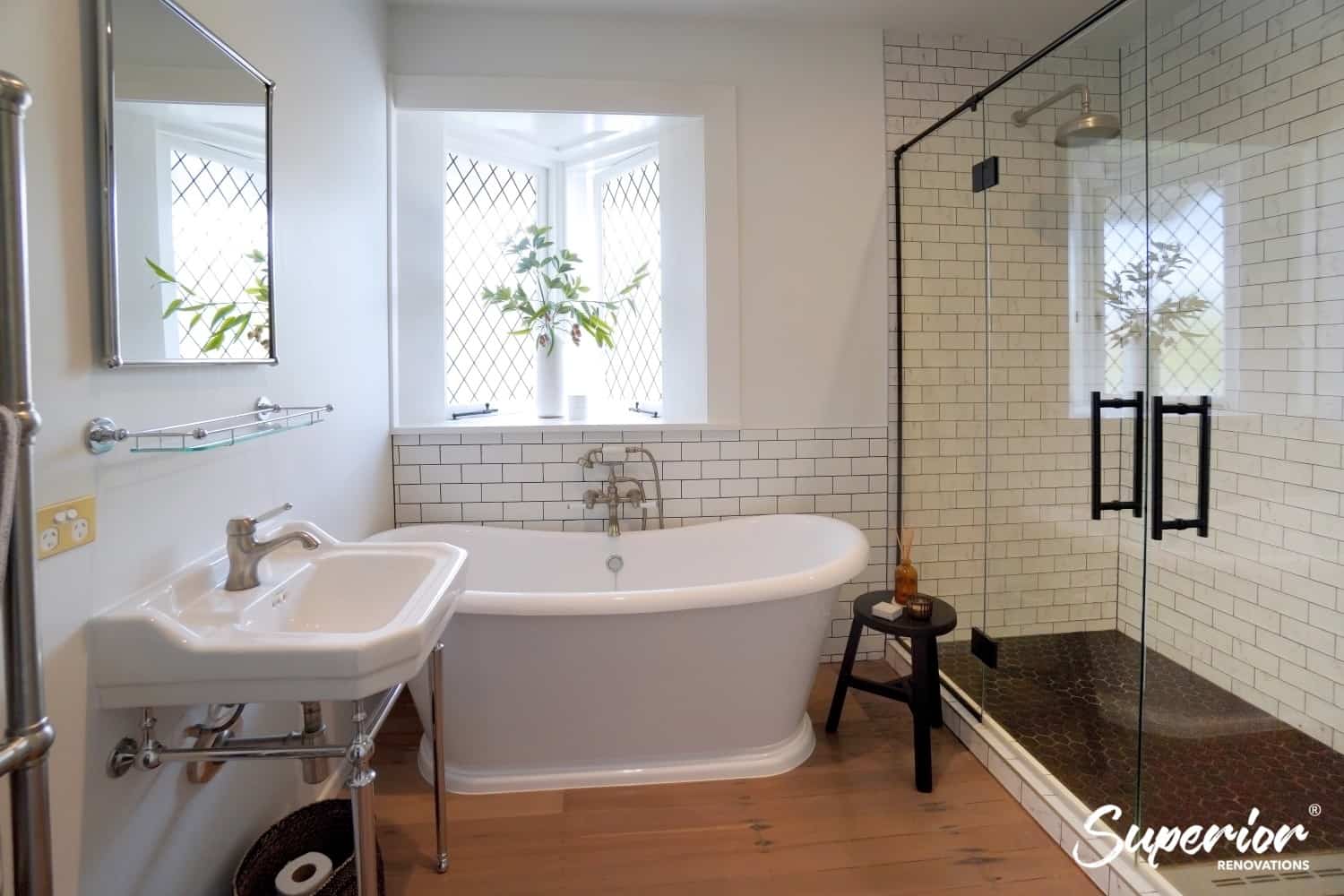
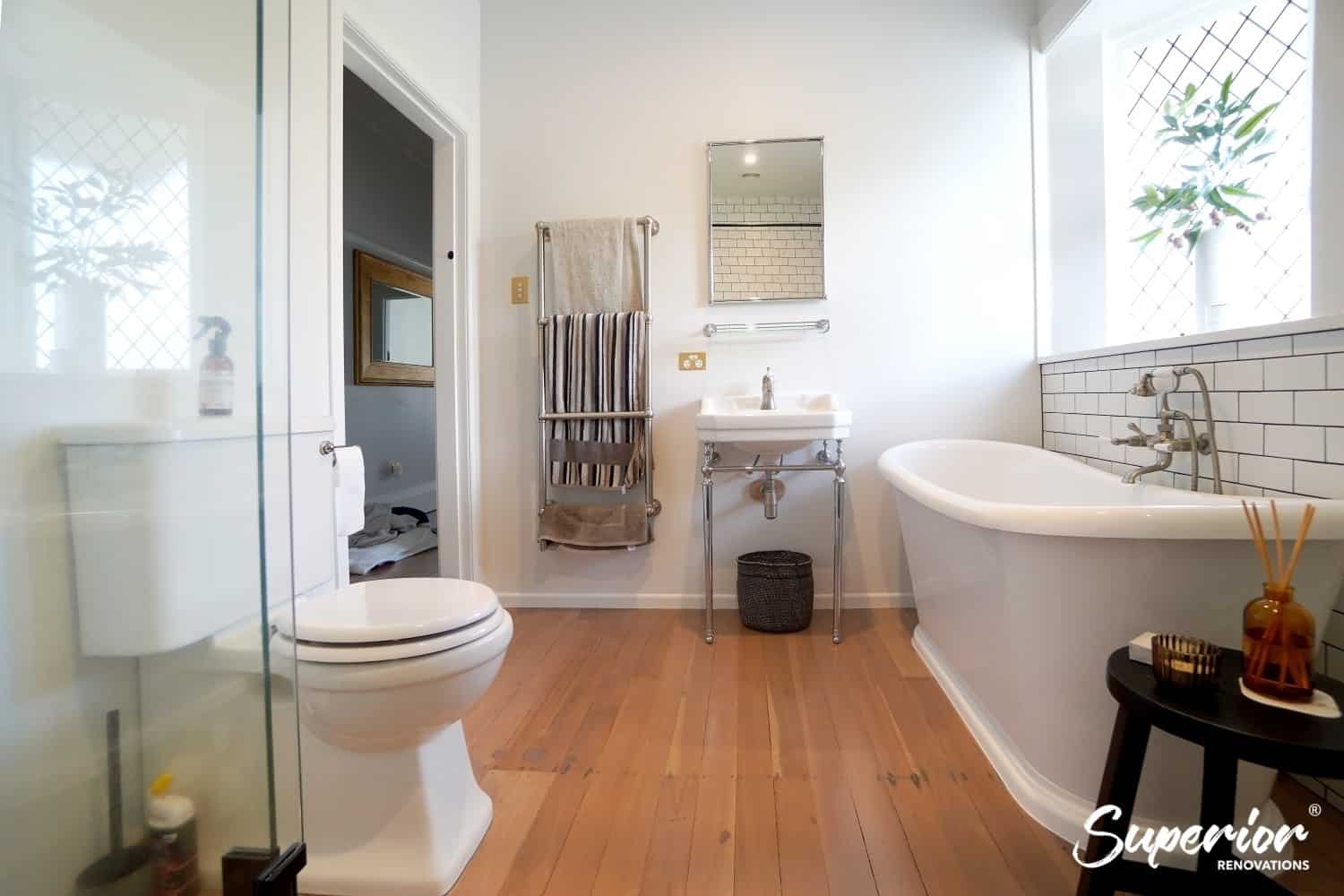
Other family-specific bathroom moves: a hand-held shower head from Reece for washing hair without flooding the bathroom, slip-rated floor tiles from The Tile Depot (look for an R10 minimum rating), and a wider freestanding bath if you’ve got a toddler — it’s easier to lean over and easier to clean around.

“The school-morning bathroom is one of the most under-designed rooms in a typical Auckland family home. Families think they need a bigger bathroom. Almost always, what they actually need is the same bathroom with a separate WC and two basins instead of one. The footprint stays roughly the same. The functional capacity doubles.”
— Cici Zou, Designer, Superior Renovations (NZ Dip. Interior Design, Certified Designer)

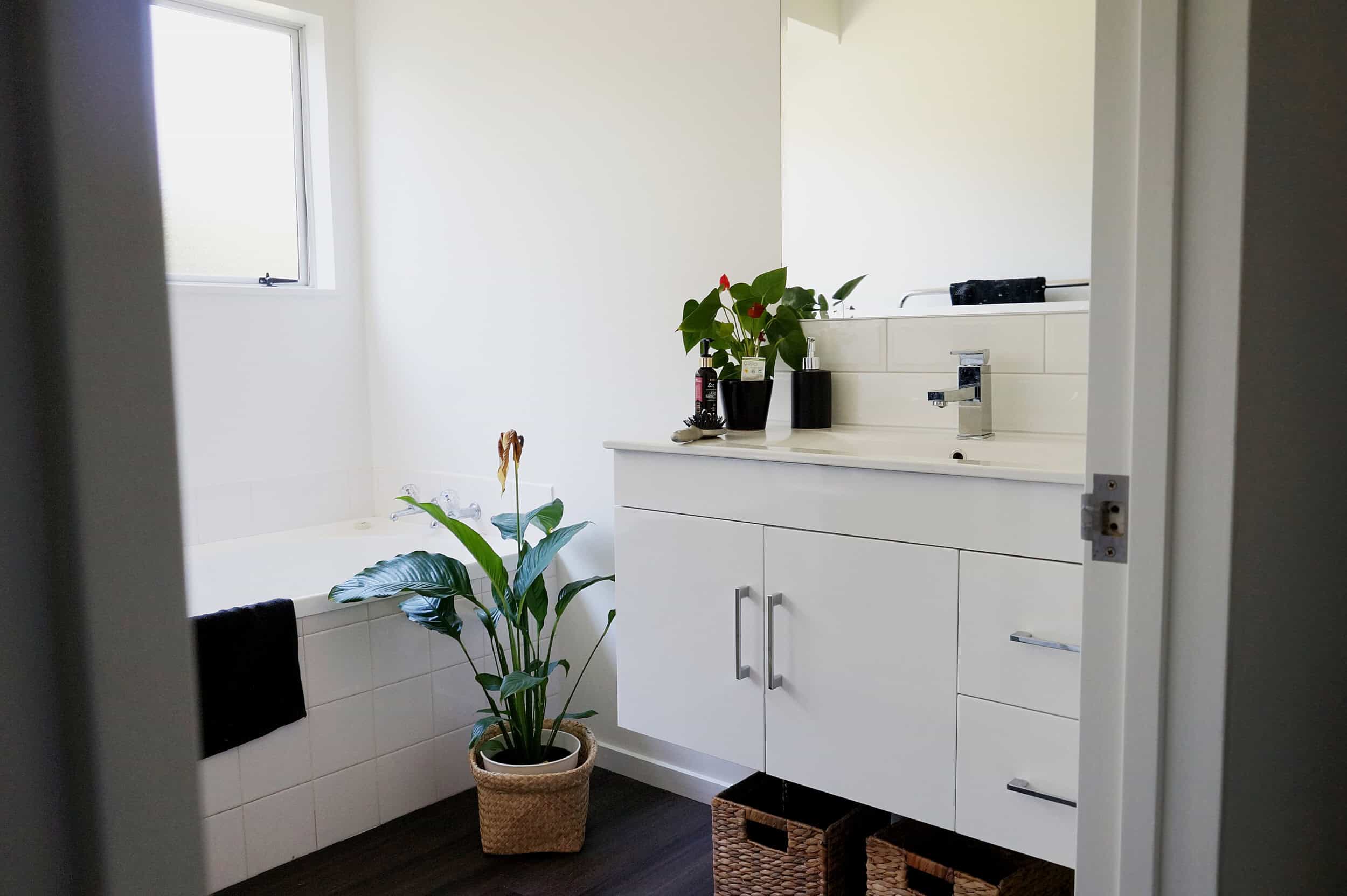
Kid friendly renovation ideas 2 - Superior Renovations


10. A Quiet Parent Wing — Acoustic Separation You’ll Be Grateful For

The most underrated family renovation move is sound insulation between the parent’s bedroom and everything else. Built well, the master bedroom becomes the one room in the house where nobody can hear Paw Patrol at 6:30am on a Sunday.

The build spec: insulation batts in the internal walls (most NZ homes have zero internal wall insulation), solid-core doors instead of hollow-core doors, draught seals around the door frames, and a layout where the master sits at the opposite end of the house to the kid bedrooms or the rumpus. Adding internal acoustic insulation during a renovation costs roughly $1,500–$3,500 for a typical master suite — a rounding error inside a full-home renovation and the move that probably saves your marriage.

In Auckland’s 1990s housing stock the master is often already at the opposite end of the house — the brief is usually about upgrading the insulation and the doors. In an older bungalow or villa with all four bedrooms in a row off a central hallway, the acoustic case for a future extension at the rear of the property becomes much stronger. That’s where a Sonder Architecture-led house extension often pays for itself in family quality of life within the first year.


11. Convertible Spaces — Design It for the 12-Year-Old, Not the Toddler

The most expensive renovation mistake we see Auckland families make is designing the new house for the kids they have right now. Toddler-themed playrooms with built-in train tables. Bunk rooms with princess-pink walls. A nursery painted Resene Quarter Spanish White because the design magazine said so.

The kids you’ve got now will be teenagers in eight to ten years. The renovation will still be standing. Spec every kid-zone in the house twice — once for the age the child is now, and once for the age they’ll be at the end of the build’s design life. The playroom needs to be reconvertible into a teenager’s bedroom by removing a built-in train table. The nursery needs to make sense as a teenager’s room with the changing table out. The homework nook needs to be sized for an adult-height chair, not a toddler stool.

The way to do this practically: pick neutral wall and floor finishes (Resene Half Spanish White, Resene Half Truffle, mid-grey vinyl) that work across decades, then layer the kid-specific colour and personality into the rugs, curtains, bed linen, and wall art. That stuff can be replaced for a couple of hundred dollars at the start of each life stage. The cabinetry and the flooring cannot.

💡 Quick tip: If you’re working with our in-house design studio, ask the designer to sketch the family-home layout for two life stages — kids aged 4 to 10, and kids aged 11 to 18. The conversation about what should be built-in vs. what should stay flexible becomes much easier when you can see both versions on paper.


12. Warm Kid Bedrooms — Meet the New H1 Insulation Standard

Auckland’s older housing stock has a real problem keeping kid bedrooms warm in winter. A 1970s brick-and-tile in Howick, a 1990s 4-bed in Flat Bush, a character bungalow in Mt Eden — most of these homes were built to insulation standards that fell well short of where the NZ Building Code sits today. Winter mornings in a kid’s room can dip into single digits, and damp, cold rooms drive the respiratory issues NZ kids see far more of than they should.

When you’re renovating, the moment to fix this is during the build — not as a retrofit five years later. The November 2022 update to Schedule H1 of the NZ Building Code raised the minimum insulation R-values significantly for new and renovated residential walls, ceilings, and floors. For Auckland (Climate Zone 1), the current minimums are R2.0 for walls, R6.6 for ceilings, and R3.0 for underfloors — a meaningful jump from where most older Auckland homes currently sit.

If you’re already opening up walls during a renovation, the marginal cost to bring the kid bedrooms up to current H1 standard is small — typically $1,500–$3,500 per room for ceiling, wall, and floor insulation depending on access. If you wait until the renovation is finished and then try to retrofit, the same outcome costs five to ten times as much because the linings have to come off. The EECA Warmer Kiwi Homes programme also offers grants of 50–90% towards ceiling and underfloor insulation in eligible homes — worth checking before signing off the scope.

💡 Quick tip: Spec a heat pump head in the rumpus, the master, and the main living zone — but not in every kid bedroom. Properly insulated bedrooms in Auckland’s mild climate don’t need active heating overnight. Save the heat pump budget for the rooms where everyone gathers.


Pulling It Together — What This Looks Like as a Whole Renovation

Most Auckland families don’t tackle all twelve of these ideas in one renovation. Three or four of them, picked deliberately, will change how the house feels day to day. A drop zone, a separate WC, a rumpus, and a kitchen island with proper storage will hand most growing families back forty minutes a morning and a whole lot of weekend.

The full-home version — taking a tired 1990s 4-bed in Hobsonville or a 1970s brick-and-tile in Howick and reconfiguring it around how a family actually lives — typically sits in the $140,000–$200,000+ range, with two-storey homes and full extensions running higher. For a family weighing up “renovate vs. move”, the maths usually favours staying put once you account for stamp-equivalent costs, agent fees, the moving cost, and the school zone you’d rather not lose. A renovation that adds a rumpus, fixes the bathroom, and brings the bedrooms up to H1 standard is almost always cheaper than the equivalent four-bed in the same postcode.

If you’re already past the daydreaming stage and want to know what’s actually possible inside your house, our in-house design team at Wairau Valley runs the design-to-build process — scope, drawings, fixed-price quote, and consent application all under one roof. The first conversation is free, on-site, and takes about an hour.

Book your free in-home consultation with Superior Renovations
Use our renovation cost calculator hub for kitchen, bathroom, and extension estimates
Request a free feasibility report for your project


How much does a kid-friendly renovation cost in Auckland?

There's no single figure — kid-friendly renovation costs depend on whether you're adding individual upgrades to an existing house or doing a full reconfigure. A drop zone or homework nook added inside a wider renovation typically costs $2,000–$15,000 each in joinery. A double-vanity family bathroom in the mid-range band sits at $25,000–$35,000. A full reconfigure of a 1990s 4-bed or 1970s brick-and-tile to add a rumpus, a family bathroom, and a proper kitchen typically runs $140,000–$200,000+ in 2026 Auckland pricing. Use our renovation cost calculator hub for itemised estimates.

Is it cheaper to renovate or move for a growing Auckland family?

For most Auckland families with school-age kids, renovating beats moving — once you add up agent fees, legal costs, the upgrade premium on a larger house in the same school zone, and the moving cost itself, a $140,000–$200,000 renovation often comes out cheaper than the equivalent next-size-up home in the same area. The exception is when the existing section can't physically take an extension or the structural condition of the house is poor. We assess this honestly during the free consultation.

What is the most important kid-friendly renovation idea?

The drop zone — a small mudroom or built-in storage wall at the family entry point. It absorbs the school-bag, shoe, jacket, and lunchbox chaos that otherwise lands on the kitchen island every morning. It's the single highest-impact change for families with kids aged 5 to 15, costs $5,000–$15,000 within a wider renovation, and is the one upgrade families almost never regret. Every other idea on the list works better once the drop zone is in place.

Do I need consent for a family-friendly renovation in Auckland?

It depends on what you're changing. Cosmetic upgrades — built-in joinery, surface replacements, painting, new tiles — do not require consent. Structural changes like opening up a kitchen-to-backyard sightline, removing a wall to create a rumpus, or building an extension all require Auckland Council building consent. So does relocating plumbing for a family bathroom with a separate WC. As a rule, if you're changing the structure of the house or the location of services, consent is required. We manage every consent application in-house.

How long does a family renovation take in Auckland?

A standalone bathroom renovation takes 3–4 weeks of build time. A kitchen takes 5–6 weeks. A full-home reconfigure with kitchen, bathrooms, and structural changes typically runs 3–6 months on site, plus 6–12 weeks of design and consent before that. If you're combining a renovation with a single-storey extension, expect 4–8 months total from site start. Your project manager gives you a week-by-week construction schedule before work begins so you know exactly what to expect.

Do I need to move out during a family renovation?

It depends on scope. For a single-bathroom or single-kitchen renovation, most families stay put — we set up temporary kitchen facilities or work around bathroom access. For a full-home renovation involving multiple wet areas, structural changes, and the kitchen at the same time, most families either move out for 6–12 weeks or stage the work in two phases. We discuss this honestly at the design stage — it's much better to plan the move-out than to discover halfway through that the bathroom is unusable on a Tuesday night.

What surfaces survive a young family the longest?

For floors: porcelain tiles in living and wet zones, engineered timber or quality vinyl plank in bedrooms — avoid pale natural-finish oak in family living rooms. For walls: a durable washable interior paint like Resene SpaceCote Low Sheen throughout, which survives both magic erasers and toddler artwork. For benchtops: engineered stone in mid-grey or warm white, which resists stains, scratches, and heat. For cabinetry: matte Laminex finishes in textured profiles that hide fingerprints. The rule we give every family is to spec for the worst day, not the best day — choose the finish that handles the spilled blueberries, not the one that looks best in a magazine.

Do kid bedrooms need to meet the new H1 insulation standard?

If you're renovating, yes — the November 2022 update to Schedule H1 of the NZ Building Code raised the minimum insulation R-values for residential walls, ceilings, and floors. For Auckland (Climate Zone 1), current minimums are R2.0 for walls, R6.6 for ceilings, and R3.0 for underfloors. Bringing kid bedrooms up to standard during a renovation typically costs $1,500–$3,500 per room when the wall and ceiling linings are already off. Retrofitting later costs five to ten times as much. EECA's Warmer Kiwi Homes programme also offers grants for ceiling and underfloor insulation in eligible homes.

Should kids share a bedroom or have separate rooms?

From a renovation cost-per-functionality perspective, two kids sharing a well-designed bunk room often beats two separate small bedrooms — it frees up a fourth room for a rumpus, which usually delivers more daily benefit than a slightly bigger kid bedroom. Built-in bunk joinery with reading lights, USB charging, and integrated storage typically runs $4,500–$9,000 and works particularly well in older Auckland villas and bungalows with 2.7m ceilings. The exception is when there's a significant age gap or different bedtimes — in that case separate rooms make more sense.

What's the best layout for a family bathroom in Auckland?

The two highest-impact features for a family bathroom are a double vanity and a separate WC. A double vanity halves the time it takes to get two kids ready for school. A separate toilet means the bathroom can be used by two people at once on a school morning. Beyond that, family bathrooms benefit from a hand-held shower for washing hair, slip-rated floor tiles (R10 minimum), durable wall tile rather than glass, and a freestanding bath if you've got a toddler. Mid-range Auckland family bathroom renovations sit in the $25,000–$35,000 band in 2026.

Can I add a rumpus without extending the house?

Often yes. The cheapest version is reconfiguring an existing room — a fourth bedroom that's been used as a storage room, a dining room nobody eats in, or a study that's now a junk room. Add a built-in storage wall, decent ceiling acoustic treatment, and a wall-mounted TV and you've got a rumpus for $8,000–$20,000 inside a wider renovation. The next step up is a garage conversion, which typically starts from $40,000. A new single-storey extension to create a dedicated family living zone starts from $80,000 and goes up from there.

How do I make my renovation work for kids of different ages?

Design for the older kid, not the younger one. The children you've got now will be teenagers within eight to ten years, and the renovation will still be standing. Pick neutral wall and floor finishes that work across decades — Resene Half Spanish White, Resene Half Truffle, mid-grey vinyl — then layer the personality and colour through rugs, curtains, bed linen, and wall art. Those items can be replaced for $200–$500 at the start of each life stage. The cabinetry, the flooring, the built-in joinery cannot. The most expensive mistake we see is families building toddler-themed playrooms that become useless three years later.


Further Resources for your family home renovation

  1. Featured projects and Client stories to see specifications on some of the projects.
  2. Real client stories from Auckland

Need more information?

Take advantage of our FREE Complete Home Renovation Guide (48 pages), whether you’re already renovating or in the process of deciding to renovate, it’s not an easy process, this guide which includes a free 100+ point check list – will help you avoid costly mistakes.

Download Free Renovation Guide (PDF)


finance - Superior Renovations

Have you been putting off getting renovations done?

We have partnered with Q Mastercard ® to provide you an 18 Month Interest-Free Payment Option, you can enjoy your new home now and stress less.

Learn More about Interest-Free Payment Options*

*Lending criteria, fees, terms and conditions apply. Mastercard is a registered trademark and the circles design is a trademark of Mastercard International Incorporated.


Still have questions unanswered?

Book a no-obligation consultation with the team at Superior Renovations,
we’d love to meet you to discuss your renovation ideas!

    Services

    Home RenovationKitchen RenovationBathroom RenovationOutdoor RenovationHouse ExtensionCommercialDesign ServicesOther

    By submitting this form, you agree to receive communications from us via email or text regarding our services, you can unsubscribe at any time.

    This site is protected by reCAPTCHA and the Google

    Privacy Policy and Terms of Service apply.


    References

    1. Stats NZ — 2023 Census household, family, and extended family highlights
    2. Stats NZ — National family and household projections: 2013(base)–2038
    3. Building Performance (MBIE) — H1 Energy efficiency
    4. EECA — Warmer Kiwi Homes programme
    5. Resene — interior paint product range
    6. Laminex New Zealand
    7. Reece New Zealand — bathroomware
    8. The Tile Depot
    modern skylight
    House Renovation

    How Much Does a Skylight Cost in NZ? (Installed, 2026)

    How Much Does a Skylight Cost in NZ? Real Installed Prices for Auckland Homes (2026)

    Quick answer: A skylight in Auckland costs $1,800–$3,000 installed for a tubular unit, $3,500–$6,000 for a fixed or manual opening skylight, and $4,500–$8,000 for solar or electric opening units. Custom rooflights run $7,500–$15,000+.

    The most common renovation enquiry we get isn’t actually about kitchens or bathrooms. It’s a homeowner asking why their hallway is pitch black at 2pm in winter, or why the stairwell in their Grey Lynn villa feels like a tunnel. The answer, nine times out of ten, involves a skylight. But here’s where it gets messy: every cost guide online quotes you a unit price and conveniently leaves out installation. That’s like quoting a kitchen reno by the price of the cabinetry alone.

    What follows is the all-in installed cost — by skylight type, by room, and by Auckland housing era. We’re upfront about the upper bounds too, because pretending a bathroom skylight costs $2,000 is how you end up with a half-finished ceiling and a quote variation you weren’t budgeting for.


    What a Skylight Actually Costs in NZ — Installed, Not Just the Unit

    Most articles you’ll find quote the skylight unit and skip the installation. That’s not the number you’ll pay. The unit is typically 35–45% of the total job. The rest is labour, flashing, framing, ceiling work, scaffolding (if needed), and rubbish removal. Here’s what a typical Auckland skylight job looks like all-in, based on what we quote across our 1000+ completed Auckland renovation projects.

    All-in installed cost by skylight type (Auckland, 2026)

    Skylight Type Typical Size Installed Cost (NZD)
    Tubular skylight / sun tunnel 250–550mm diameter $1,800–$3,000
    Small fixed skylight ~550 × 550mm $2,500–$4,000
    Standard fixed skylight (e.g. Velux) 780 × 1180mm to 780 × 1650mm $3,500–$5,500
    Manual opening skylight 780 × 1180mm to 940 × 1600mm $3,500–$6,000
    Solar or electric opening skylight 780 × 1180mm to 940 × 1600mm $4,500–$8,000
    Large rooflight, lantern or walk-on glass Custom (1m² to 4m²+) $7,500–$15,000+
    Typical Auckland bathroom skylight (real spend) Opening unit + lightwell $5,000–$9,000

    💡 Quick tip: If a quote excludes installation, flashing, scaffolding, framing modifications, ceiling lining and paint reinstatement, you’re looking at roughly half the real cost. Always ask for an all-in fixed-price scope.

    What’s actually inside that installed cost

    Here’s where the money goes on a standard Auckland skylight install:

    • The skylight unit itself: $900–$3,500 depending on brand, size, glazing and opening mechanism. Velux dominates the premium end; First Windows manufactures aluminium roof windows locally in Auckland.
    • Flashing kit: $150–$400 — non-negotiable, and the single most important component for keeping water out. BRANZ research into flashing weathertightness found that even small gaps under a flashing open up leakage paths that carry water deep into the joint — which is exactly why nearly every leaky skylight we inspect has failed at the flashing, not the glass (BRANZ SR332, The weathertightness of flashing downturns).
    • Labour to cut, frame and fit: $1,000–$3,500 depending on roof access, pitch, framing complexity and the skill required.
    • Lightwell construction: $400–$1,500 if your skylight needs to drop down through a ceiling cavity to reach the room (very common in Auckland villas and bungalows with high ceilings).
    • Gib reinstatement, taping and painting: $300–$900 for the interior finishing once the skylight is in.
    • Scaffolding: $400–$1,200 if your roof pitch or height requires it — most two-storey installs do.
    • Consent and inspection fees: $200–$500 if consent is triggered (it usually isn’t — more on that below).

    So when a homeowner sees “fixed skylight $1,020” on a manufacturer’s website, that’s about a third of the real spend. The rest is what makes it watertight, structurally sound, and properly finished.


    DSC03716 - Superior Renovations

    Skylight Cost by Room — Where You’re Putting It Matters More Than What You’re Buying

    The room matters more than the brand. A bathroom skylight has ventilation, condensation and privacy considerations a hallway sun tunnel doesn’t worry about. A kitchen skylight over an island wants thicker, lower-E glass than a stairwell sun tunnel. The unit price gap between brands is around $500. The room-driven cost gap is often $3,000.

    Here’s how it breaks down room by room.

    Hallway and stairwell skylights — $1,800 to $3,500 installed

    If you’ve got a long internal hallway in a Ponsonby villa or a stairwell in a 1970s split-level in Glen Innes that’s been dark since the day the house was built, this is your highest-impact spend. A tubular skylight (often called a sun tunnel) is usually the right call here. They’re cheaper, install faster, and deliver surprising punch — a 350mm tube can light a 10–15m² hallway during daylight hours.

    The catch in hallways is the light shaft length. Tube longer than 2m starts losing meaningful light, so positioning matters.

    Bathroom skylights — $4,500 to $9,000 installed

    Bathrooms are where skylights pay off the most emotionally — and where they go wrong the most often. The reasons are climate-specific. Auckland’s humidity, paired with a hot shower below a cold piece of glass, creates condensation that runs down the lightwell walls and stains the gib. We’ve inherited too many bathrooms in Mt Eden and Hillsborough where the previous installer used single-glazed glass and now the homeowner has a mould problem they didn’t sign up for.

    For bathrooms, we always specify double-glazed units, an opening mechanism (manual or electric), and a lightwell painted in a moisture-resistant finish. Solar-powered opening skylights with rain sensors are worth the extra $1,500 in a bathroom — they vent steam and close themselves when the weather turns.

    “A skylight over a kitchen island gets used every day. A skylight over a corridor that no one stands in is just a hole in your insulation. We always start with where you actually live in the room — where you stand at the bench, where you sit on the couch, where you shower — then we work the position back from there. Light placement is design, not just a roof penetration.”
    — Dorothy Li, Design Manager, Superior Renovations


    Kitchen skylights — $5,000 to $10,000 installed

    Kitchen skylights are often the centrepiece of a renovation. A 940 × 1600mm opening unit over an island, especially in an older villa with a high stud, lifts the whole room. Pendants and downlights can’t compete with natural overhead light. Costs run higher than a hallway for three reasons: the units are larger, ventilation is needed to deal with cooking moisture and smells, and kitchen skylights usually go in alongside other work (which we’ll get to in the bundling section).

    If your kitchen is being renovated anyway, the marginal cost of adding a skylight is meaningfully lower — the ceiling is already getting reworked and the gib trades are already on site.

    Living and lounge skylights — $5,500 to $12,000 installed

    These are usually the larger installs — sometimes two or three skylights in a row across a cathedral ceiling, sometimes a single statement rooflight or lantern. Open-plan living areas in Hobsonville and Flat Bush are often designed with these from the start, but retrofits into older homes (think a Howick brick-and-tile with an upgraded living area) work too.

    Walk-on glass rooflights — the ones you can stand on in an upstairs deck while still letting light into the room below — start around $7,500 installed and climb fast. They’re impressive, but only justify the spend in a few real-world situations.

    💡 Quick tip: North-facing skylights deliver the most natural light in Auckland, but they also bring the most summer heat gain. If you’re putting one over a living area, specify a Low-E coating and consider an integrated blind. The blind option adds about $300–$500 per unit and saves you running the heat pump on hot afternoons.

    Cost by room — at a glance

    Room Recommended Type Installed Cost (NZD)
    Hallway / stairwell Tubular / sun tunnel $1,800–$3,500
    Bathroom / ensuite Opening, double-glazed $4,500–$9,000
    Kitchen Opening, larger pane $5,000–$10,000
    Living / lounge Fixed (often multiple) or lantern $5,500–$12,000
    Master bedroom Opening with blackout blind $4,500–$7,500
    Loft / attic conversion Opening roof window $5,000–$8,500

    If you’re already planning an attic conversion in Auckland, skylights are not optional — they’re often the only way to bring natural light into the space and meet the requirements for a habitable room.


    Cost by Auckland Housing Era — What Your Roof Structure Does to the Price

    The age of your home affects the skylight cost more than most homeowners expect. The reason is structural: different eras of Auckland housing have different roof framing, different roofing materials, and different ceiling assemblies. All three change the labour bill.

    Pre-1940s villas and bungalows — $4,500 to $9,500 installed

    Villas in Grey Lynn, Ponsonby, Mt Eden and Herne Bay typically have rafter framing rather than trusses, sarking timber under the roof iron, and often original lath-and-plaster ceilings — or older gib that’s been patched many times. That’s a more involved install. We’re cutting through more material, patching more lining, and sometimes working around existing ceiling roses or decorative cornices.

    The upside: rafter framing is usually easier to work with than modern trusses — you can position the skylight more freely, not constrained by truss webs. The downside: every extra hour of patching, painting and matching original profiles costs money.

    1970s and 1980s brick-and-tile homes — $3,500 to $7,500 installed

    The classic 70s and 80s brick-and-tile homes across Manurewa, Pakuranga, Glenfield and the West Auckland fringe usually have lower roof pitches, concrete tile roofing, and rafters at tighter spacing. The skylight unit itself isn’t more expensive. But the tile flashing requires more care than long-run steel, and the lower pitch can mean a longer lightwell drop into the room.

    These homes often have low stud heights too. If you’re putting a skylight in a room with a 2.4m ceiling and there’s only 600mm of roof cavity above it, the lightwell is short and bright. In a villa with 3.6m ceilings and a 1.5m attic above, you’ve got more work to do.

    Leaky-building-era homes (1994–2004) — variable, often $5,500–$10,000+

    If your home was built or reclad during the leaky-building era — common across Albany, the North Shore generally, parts of East Auckland and apartment blocks across the city — we’re cautious. Very cautious. Cutting a new penetration through a roof that may already have weathertightness issues isn’t something we’ll do without inspecting the existing roofing assembly first. Sometimes a skylight install on a leaky-era home becomes the trigger for a wider conversation about recladding or reroofing.

    It’s better to know that upfront than discover it mid-job.

    Modern subdivisions (post-2010) — $2,500 to $6,000 installed

    New subdivisions in Hobsonville, Flat Bush, Millwater and Silverdale generally have trussed roofs, long-run steel or pressed metal tile roofing, and recent gib lining. Installs are usually straightforward — until you hit a truss. Modern truss design uses webs and chords that can’t be cut without engineering input, so positioning matters. If the skylight needs to go between trusses, it’s a quick job. If it doesn’t, you’re paying for a structural review and possibly trussed-roof modification — easily another $1,500–$3,000.

    💡 Quick tip: Before you sign off on a skylight position, make sure your installer has been into the roof cavity and confirmed the framing. Designing the position from the room below and assuming the roof will cooperate is the most common reason skylight quotes get blown out.

    DSC03721 1 - Superior Renovations


    Building Consent, Weathertightness and the H1 Insulation Reality

    This is the section every other cost article skips. Adding a skylight to your home in Auckland touches three regulatory areas: the consent regime, the weathertightness rules under E2/AS1 of the NZ Building Code, and the H1 thermal performance clause.

    Do you need building consent for a skylight in Auckland?

    Usually not. Under Schedule 1 of the Building Act, certain types of building work are exempt from needing consent. A skylight installation fits the exemption when it meets all of these conditions:

    • The installation is by a Licensed Building Practitioner (LBP) or under their supervision.
    • The opening fits between existing rafters or trusses without cutting structural members.
    • The skylight is a manufactured unit with a tested flashing kit.
    • The opening doesn’t significantly alter the building’s structural integrity or weathertightness.

    Most domestic skylights — Velux, FAKRO, First Windows — meet these conditions when fitted properly between rafters in a single-storey roof.

    When you do need consent: Large or multiple skylights, walk-on glass, lanterns, and any installation that requires cutting truss members or modifying load-bearing structure. Also any skylight forming part of a larger renovation that already requires consent (extension, reroofing, structural changes) — it gets folded into the wider Auckland Council consent rather than being assessed separately.

    Weathertightness — the real risk

    The NZ Building Code clause E2 is what’s meant to keep water out of buildings. The Acceptable Solution E2/AS1 sets out how roof penetrations like skylights have to be flashed and sealed. This isn’t optional. Every leaky skylight we’ve ever been called to inspect has failed at the flashing, not the glass.

    The flashing kit that comes with the skylight is designed to work with the specific roofing material — long-run steel, concrete tile, asphalt shingle, or membrane. Mixing flashing kits or trying to fabricate site-made flashing is how leaks start. Use the manufacturer’s kit, fit it per the instructions, and don’t skip the steps.

    H1 thermal performance — the cost you didn’t see coming

    The 2022 update to Clause H1 raised the minimum insulation values for new construction and major retrofits. A skylight is a thermal weak point — single-glazed glass has an R-value of roughly 0.17, compared to R-3.6 for modern Auckland ceiling insulation. Add a single-glazed skylight and you’ve put a hole in your insulation envelope.

    The practical implication: always specify double-glazed skylights at minimum, ideally with a Low-E coating. According to EECA, a Low-E coating can cut heat loss through glazing by up to 30% compared with regular glass, and double glazing is one of the most effective ways to reduce heat lost through windows (EECA — Window insulation for home energy efficiency). The cost difference is $200–$500 per unit and you’ll recover it through reduced heat loss within a few winters.

    Important note: If your renovation already requires building consent (kitchen with structural changes, full bathroom strip-out with re-plumbing, extension), the skylight is rolled into that consent. Don’t apply for two — your designer or builder handles this as part of the wider project.


    What Actually Goes Wrong With Skylight Installs — and How to Avoid Paying Twice

    Most cost guides treat skylights as a clean off-the-shelf purchase. They aren’t. After installing hundreds of them across Auckland, we know exactly where they go sideways. Here’s the practitioner’s view.

    DSC03732 - Superior Renovations

    “Nine times out of ten, the framing surprise isn’t a structural problem — it’s a positioning problem. The exact spot a client wants the skylight is the exact spot a rafter or truss is sitting. I check this at the site visit by going into the roof cavity before we quote, not after the gib is off. That one extra hour up there saves three days of rework later.”
    — Alison Yu, Designer, Superior Renovations

    The framing surprise

    Picked the position from below. Didn’t verify from above. That’s the single most common reason a skylight quote gets blown out mid-job. By the time the gib is cut, you discover a rafter, a strut, an electrical run or a plumbing vent right in the way. Now the position has to move — or the framing has to be modified — or worst case, the gib gets patched and you start again.

    Fix: any reputable installer goes into the roof cavity before quoting. If they’re quoting off plan only, that’s a red flag.

    Flashing failures and leaks

    Skylights don’t usually leak from the glass. They leak from where the flashing meets the existing roof. The most common causes: wrong flashing kit for the roofing material, flashing fitted on top of the roof rather than woven under the laps, sealant used as a substitute for proper flashing, and metal corrosion at the flashing edges five to ten years post-install.

    Fix: use the manufacturer’s flashing kit matched to your specific roof material, fit it strictly to the manufacturer’s spec, and check it on the first heavy rain.

    💡 Quick tip: Ask your installer to show you the manufacturer’s flashing instructions before they start. If they shrug and reach for the silicone, walk away. Every skylight leak we’ve ever inspected came from someone improvising the flashing instead of following the kit.

    Condensation in bathrooms and kitchens

    Skylights in moist rooms condense. Warm humid air rises, hits the cold glass surface, and the water runs back down — usually onto the lightwell walls. In Auckland’s climate, with hot showers and cooking happening multiple times a day, this isn’t an edge case — it’s standard physics.

    Fix: specify double glazing at minimum (single glazing is the main culprit), add an opening mechanism so steam can vent, use moisture-resistant gib in the lightwell, and consider an extraction fan as the primary moisture control rather than relying on the skylight alone.

    Ceiling lining and finishing — the part the quote often hides

    Cutting a hole in your ceiling means patching, taping, sanding and painting. If the existing ceiling has a textured finish, popcorn texture (common in 1980s homes), or detailed cornices, matching it is a real job. Some quotes price this in. Some don’t. Ask before you sign.

    The mid-job consent trigger

    Occasionally a job starts as an exempt skylight install and turns into a consent-required job mid-stream — usually because the framing modification turned out to be bigger than expected, or the homeowner decided to upgrade the size. The fix here is to confirm the scope before work begins. A licensed builder will tell you upfront whether your install is borderline.


    Choosing the Right Skylight — and Saving Real Money by Bundling It With Your Renovation

    The cheapest skylight isn’t always the right one. The right skylight is the one that matches your roof type, your room’s purpose, and the rest of your renovation.

    Fixed vs opening vs tubular — when each makes sense

    • Fixed skylights are the cheapest per square metre of glass. They’re right for living areas, bedrooms with good cross-ventilation, and stairwells. They aren’t right for bathrooms or kitchens unless paired with strong mechanical ventilation.
    • Opening skylights (manual or motorised) are non-negotiable for bathrooms and kitchens. Pay the extra $1,500–$2,500 for solar or electric opening with a rain sensor — you’ll use it constantly.
    • Tubular skylights / sun tunnels are right for hallways, walk-in wardrobes, internal bathrooms with no roof access for a full skylight, and tight spaces in trussed roofs where a rectangular unit won’t fit between members.

    Skylight brands in NZ — what we specify

    The most common brands in Auckland renovations:

    • Velux — global leader, full range, premium price. Velux NZ is the brand most homeowners recognise.
    • FAKRO — strong alternative to Velux, often slightly more affordable for comparable spec.
    • First Windows (Window Factory) — Auckland-made aluminium roof windows in a range of sizes. Worth specifying when you want a locally-made unit and a custom powder-coat colour. First Windows roof windows are made here in Auckland.
    • Solatube and equivalent tubular brands — the tubular-skylight specialists.

    DSC03739 - Superior Renovations

    Glazing options that change the cost — and the comfort

    • Double glazing: standard spec we recommend for every install. Adds $200–$500 to the unit.
    • Low-E coating: reflects infrared, keeping winter heat in and summer heat out. Adds $100–$300. Worth it for north-facing skylights especially.
    • Laminated or toughened glass: required for overhead glazing under NZS 4223. Already standard in most reputable skylight units, but worth confirming.
    • Solar reflective tint: useful in west-facing or large north-facing skylights to control summer heat gain. Adds about $150–$400.

    The bundling angle — where you save real money

    Add a skylight as a standalone job and you’re paying a one-off mobilisation: site visit, scaffolding, multiple trades for one day each, project management. Bundle it into a kitchen reno, bathroom reno, reroof or full home renovation, and that overhead gets shared. The marginal cost of a skylight in a kitchen renovation we’re already doing is often $1,500–$3,000 less than the same skylight as a one-off — because the scaffolding’s there, the gib trades are on site, the project manager is already running the schedule, and the ceiling is already coming down.

    If you’re planning on renovating your bathroom or a renovating your kitchen and you’ve been thinking about a skylight, add it now. The same logic applies if you’re reroofing — the roofers are already up there and the flashing trade is already on the job.

    “The clients who get the best result on skylights are the ones who add them as part of a wider plan rather than as a one-off. The skylight isn’t an afterthought — it’s a piece of the design. When we’re already redesigning the kitchen or rebuilding the bathroom, positioning a skylight properly costs almost nothing extra and changes how the whole room feels.”
    — Dorothy Li, Design Manager, Superior Renovations

    For Auckland homeowners planning a larger project, we recommend pricing the skylight as part of the wider home renovation rather than as a separate job. If you’re considering structural changes — for example, opening up a roof line to add a skylight as part of a wider extension — our partner Sonder Architecture handles the architectural design and consent side.

    💡 Quick tip: If you’re planning multiple skylights across the same project — say, three over an open-plan kitchen-dining — most installers will discount the unit price for bulk. The labour scales sub-linearly too, because they’re already set up and scaffolded.

    Want a rough estimate before booking a consultation? Our double glazing cost calculator includes a skylight area field for getting indicative pricing across all your glazed openings.


    The Bottom Line on Skylight Costs in Auckland

    Skylights in Auckland run from $1,800 for a small tubular up to $15,000+ for a custom lantern or walk-on glass. Big spread. The most common renovation skylight — a double-glazed opening unit in a bathroom or kitchen — sits at $4,500 to $8,000 installed. Where you land in that range depends less on the brand and more on the room you’re putting it in, the age and structure of your roof, and whether you’re adding it during an existing renovation or as a standalone job.

    If your home is dark and you’ve been putting up with it for years, a well-positioned skylight isn’t a luxury. It’s a comfort upgrade with measurable health and energy benefits. Done properly, with the right glazing, the right flashing and the right ventilation, it lasts 20+ years and pays back across reduced lighting bills and a warmer, drier home in winter.

    If you’d like us to scope a skylight as part of a kitchen, bathroom or full home renovation in Auckland, book a free in-home consultation. We’ll go into the roof cavity, check the framing, and give you a fixed-price quote that includes everything — unit, flashing, lightwell, finishing, scaffolding, and consent if required. Or pop into our showroom at 16B Link Drive, Wairau Valley — we’ve got working examples of double-glazed and opening units on display, and you can see what an Auckland-spec install actually looks like.

    Book your free in-home consultation with Superior Renovations
    Use our double glazing and skylight cost calculator
    Request a free feasibility report for your project


    FAQ — Skylight Cost and Installation in NZ

    How much does a skylight cost installed in NZ?

    A standard fixed or manual opening skylight in Auckland costs $3,500–$6,000 installed in 2026. Tubular skylights run $1,800–$3,000. Solar or electric opening units sit at $4,500–$8,000. Custom rooflights, lanterns and walk-on glass start at $7,500 and climb past $15,000. These figures cover the unit, flashing, framing, lightwell, ceiling finishing and scaffolding — everything except wider renovation work.

    Do I need building consent for a skylight in Auckland?

    Usually not. Under Schedule 1 of the Building Act, skylight installation is exempt from building consent when fitted between existing rafters or trusses by a Licensed Building Practitioner, using a manufactured unit and tested flashing kit. Consent is required for large or multiple skylights, walk-on glass, lanterns, or any install that cuts truss members or modifies load-bearing structure. If consent is needed, Auckland Council fees run $200–$500.

    How much does a Velux skylight cost in NZ?

    Velux skylight units in NZ start at around $900 for a small fixed model and run to $3,500+ for larger solar-powered opening units. Installed cost, including flashing, lightwell, framing and ceiling finishing, runs $3,500–$7,500 for most domestic installs. Solar-powered Velux units with rain sensors typically come in at $5,000–$8,000 installed, depending on roof type and access.

    How long does it take to install a skylight?

    A standard skylight install in an Auckland home takes one to two days on site for the structural and weathertightness work, plus a follow-up day for gib, taping and paint reinstatement. Tubular skylights are usually completed in a single day. Custom rooflights or installs requiring framing modifications can run three to five days. Weather is the biggest variable — open roof penetrations need a dry day to complete safely.

    Are skylights worth it in Auckland's climate?

    Yes, in the right rooms. Auckland gets roughly 2,060 sunshine hours per year, so a well-positioned skylight delivers meaningful natural light most of the year. The two cautions are heat gain in summer (especially north-facing) and condensation in bathrooms and kitchens. Both are managed by specifying double-glazed Low-E glass, an opening mechanism, and proper ventilation. Done right, a skylight reduces lighting energy use 10–20%.

    Do skylights leak?

    A properly installed skylight should not leak for 20+ years. Leaks almost always trace back to the flashing — wrong kit for the roofing material, flashing fitted on top instead of woven under the laps, or sealant used as a substitute for proper flashing. Use the manufacturer's flashing kit matched to your specific roof type, fit strictly to spec, and check it after the first heavy rain. The skylight glass itself rarely fails.

    What's the cheapest type of skylight in NZ?

    Tubular skylights (sun tunnels) are the cheapest option in NZ at $1,800–$3,000 installed. They're best for hallways, walk-in wardrobes and small internal rooms with no roof access for a full skylight. They deliver surprising amounts of light — a 350mm tube can effectively light a 10–15m² space during daylight hours — but they don't open and they don't offer a view of the sky.

    Can I add a skylight to a trussed roof?

    Yes, but with constraints. If the skylight fits between existing trusses without cutting any truss members, it's a straightforward install. If the desired position requires cutting a truss chord or web, you need a structural engineer to design the modification and consent from Auckland Council. Trussed-roof modifications typically add $1,500–$3,000 to the cost. Most modern subdivisions in Hobsonville, Flat Bush and Millwater have trussed roofs.

    Should I get a skylight installed during my bathroom renovation?

    Usually yes. Adding a skylight during an existing bathroom renovation typically costs $1,500–$3,000 less than the same skylight as a standalone job. The scaffolding's already up, the gib trades are on site, the lining is already coming off, and the project manager runs both as one job. For bathrooms specifically, an opening skylight is recommended for ventilation and condensation control — single-glazed fixed skylights cause moisture problems in Auckland's climate.

    What's the difference between a skylight and a roof window?

    Functionally similar, with a technical distinction. A roof window opens (manually or electrically) and is designed to act partly as a window for ventilation and emergency egress. A traditional skylight is fixed and provides light only. In NZ, the terms are used interchangeably — Velux's product range is marketed as roof windows. What matters more than the name is whether the unit opens, the glazing spec, and the flashing kit compatibility with your roof.

    How much value does a skylight add to an Auckland home?

    A well-designed skylight is more about liveability than resale, but it does add value. Real estate agents in Auckland generally view skylights positively because they brighten dark rooms — the most common buyer objection in older villas and 70s brick-and-tile homes. Quantifying the exact resale return is difficult because skylights are usually one factor among many in a wider renovation. The bigger gain sits in the years you live in the brighter space yourself.


    Further Resources for your skylight or whole-home renovation

    1. Featured projects and Client stories to see specifications on some of the projects.
    2. Real client stories from Auckland

    Need more information?

    Take advantage of our FREE Complete Home Renovation Guide (48 pages), whether you’re already renovating or in the process of deciding to renovate, it’s not an easy process, this guide which includes a free 100+ point check list – will help you avoid costly mistakes.

    Download Free Renovation Guide (PDF)


    finance - Superior Renovations

    Have you been putting off getting renovations done?

    We have partnered with Q Mastercard ® to provide you an 18 Month Interest-Free Payment Option, you can enjoy your new home now and stress less.

    Learn More about Interest-Free Payment Options*

    *Lending criteria, fees, terms and conditions apply. Mastercard is a registered trademark and the circles design is a trademark of Mastercard International Incorporated.


    Still have questions unanswered?

    Book a no-obligation consultation with the team at Superior Renovations,
    we’d love to meet you to discuss your renovation ideas!

      Services

      Home RenovationKitchen RenovationBathroom RenovationOutdoor RenovationHouse ExtensionCommercialDesign ServicesOther

      By submitting this form, you agree to receive communications from us via email or text regarding our services, you can unsubscribe at any time.

      This site is protected by reCAPTCHA and the Google

      Privacy Policy and Terms of Service apply.


      References

      1. BRANZ — SR332: The weathertightness of flashing downturns
      2. Building Performance (MBIE) — E2 External moisture
      3. Building Performance (MBIE) — Building work that doesn’t need a building consent (Schedule 1)
      4. Building Performance (MBIE) — H1 Energy efficiency
      5. Auckland Council — Building and consents
      6. EECA — Window insulation for home energy efficiency
      full house renovation auckland 21 - Superior Renovations
      House Renovation

      Renovation Builders Auckland: Why Specialists Aren’t Generalists

      Renovation Builders in Auckland: What Sets a Specialist Apart From a New-Build Builder

      Quick answer: Renovation builders work inside an existing house, with all its surprises, while new-build builders work from a flat section. The skills overlap, but the day-to-day job isn’t the same — and the wrong pick on an Auckland renovation can cost you weeks of time and tens of thousands of dollars.

      Imagine you’ve signed a fixed-price quote on a $35,000 bathroom reno in your 1925 Grey Lynn villa. Day three of demolition, the builder pulls the wall off behind the shower. The framing’s spongey. There’s a slow leak that’s been seeping into the bearer below the floor for the past decade. He looks at you and says: “I haven’t done this before. I’ll need to bring in another guy. The price needs to change.”

      That’s not a renovation builder. That’s a new-build builder who took a renovation job. After more than a thousand Auckland renovations, we’ve watched this play out enough times to know exactly where it goes wrong, why it goes wrong, and what kind of builder doesn’t let it happen in the first place.

      basement conversion 3 - Superior Renovations

      Basement Conversion


      The Real Difference: New Builds Start From Zero, Renovations Don’t

      A new build is a known quantity. Flat section, set of consented plans, predictable materials, predictable trades. You schedule it, you build it, you hand it over. Most things on site go the way the plans said they would.

      A renovation is the opposite. You’re working inside a house that someone else built, sometimes decades ago, often using methods or materials that wouldn’t pass code today. The first time you actually see what’s behind the wall is the day demo starts. You can plan a renovation thoroughly, but you can’t make it predictable — that’s the part new-build builders find hardest.

      Why the Quote Always Looks Cheaper From a New-Build Crew

      This is the part that catches Auckland homeowners out. Three builders quote on the same Mt Eden bungalow kitchen. Two come in around $48,000. One comes in at $36,000. The cheap one looks like the win.

      It usually isn’t. New-build crews quote off the plans because that’s how new builds work — what’s on the page is what gets built. Renovation builders quote the same job knowing how often they’ll find a non-load-bearing wall that’s actually load-bearing once it comes down, an old single-skin chimney that needs bracing, or a section of subfloor that’s failed. The cheap quote isn’t cheap. It’s an opening bid.

      What 1000+ Auckland Renovations Taught Us

      The pattern is consistent. Generalist builders are great when the work is what the drawings show. They struggle when the work is what’s actually there. Renovation specialists carry the muscle memory for the surprises — the asbestos check before demo, the consent path for moving a load-bearing line, the protection plan for the kitchen the family’s still using, the right trade order so eight subcontractors don’t trip over each other.

      Sound familiar? If you’ve already had a quote that felt suspiciously low, or you’ve been talking to a builder whose photos are all of new homes on bare sections, that’s worth paying attention to.

      “The minute we open a quote conversation, the design feasibility step tells us whether someone has renovated before. They ask about the bearer beam under the kitchen. They ask whether the subfloor has been inspected. They ask what year the house was built. New-build builders don’t ask those questions because on a new build, none of it matters yet.”
      — Dorothy Li, Design Manager, Superior Renovations

      💡 Quick tip: Ask any builder pricing your renovation to walk you through their three most recent renovation projects — not new builds, not extensions, renovations. If they can’t name three from the past 12 months with specific suburbs and scope, they’re a new-build builder taking a reno job.


      Where the Wrong Builder Costs You: Five Auckland Failure Zones

      There are five places renovations consistently go off the rails when the builder doesn’t have specialist experience. Each one is a known problem in Auckland’s housing stock. None of them appear on the original quote.

      1. Hidden Surprises — Asbestos, Rot, and the Pre-2000 Tax

      If your house was built before 2000, there’s a real chance there’s asbestos somewhere — in the soffit linings, the textured ceiling, the vinyl floor under the lino, the eaves. Per WorkSafe NZ, asbestos must be identified before demolition or refurbishment work begins, and any asbestos-containing material has to be handled according to its rules — often by a licensed removalist. A specialist renovation builder schedules the asbestos check before the quote is locked. A new-build crew finds it on day two and stops the job for a fortnight.

      Same story with rot. Leaky-era homes from 1994 to 2004 are scattered through Albany, Hobsonville, parts of North Shore and West Auckland — monolithic plaster cladding, often with framing damage you don’t see until it’s too late. A renovation builder budgets for the possibility. A new-build builder budgets for none of it, then charges for all of it as a variation.

      2. Material Matching — When Bunnings Doesn’t Stock 1925 Weatherboard

      Older Auckland homes were built in imperial sizing. Modern weatherboards, skirting, scotia, and architraves are metric. When you need to patch in 200mm of weatherboard on a villa elevation, you can’t just grab a length off the rack at Mitre 10 — you need it custom-machined to imperial dimensions to match the existing run.

      Renovation builders know which timber merchants will run small-batch imperial profiles. They’ve sourced them before. They know the lead times. A new-build builder will tell you they can’t match it and suggest you replace the whole elevation — a $4,000 patch turns into a $25,000 reclad.

      3. Access and Protection — The Ponsonby Driveway Problem

      Inner-suburb sections are tight. A villa in Ponsonby might have a 2.8 metre driveway with a brick fence on one side and the neighbour’s hedge on the other. A new-build site has a wide-open run for the concrete truck. Renovations don’t.

      That changes how you stage materials, where the skip goes, how you protect the existing floors, the timber, the bath you’re keeping. A renovation builder turns up with floor protection, building wrap, dust barriers, and a logistics plan before day one. A new-build crew turns up with the same kit they’d use on a new section and leaves you with grout on your floorboards and dust through three rooms you weren’t even renovating.

      4. Consent Complexity — What Triggers Auckland Council

      Not every renovation needs Auckland Council consent. Like-for-like replacement of fittings, cabinetry, finishes, and most cosmetic upgrades don’t. Move a wall, relocate plumbing, change the structural framing, or alter the external envelope, and you’re into consent territory. Heritage overlay zones — parts of Mt Eden, Ponsonby, Devonport — add another layer.

      Building consent processing in Auckland is set by the statutory clock of 20 working days for a complete application, though in practice it often takes longer once requests for further information are factored in. Council fees vary with the value and complexity of the work. A renovation builder flags this in the feasibility stage and builds the timeline around it. A new-build builder learns it the hard way after Council issues a stop-work notice.

      5. Trade Coordination — Eight to Ten Trades on One Job

      A standard Auckland renovation involves eight to ten different trades — demo, plumbing, electrical, gasfitting, waterproofing, tiling, cabinetry, painting, plastering, sometimes flooring and glazing. If one trade doesn’t show up on the right day, every trade behind them slides. New-build crews tend to use their own framers and finishers for most of the work. Renovation specialists are running orchestras.

      This is where a lot of cheaper quotes hide. They’re priced on the assumption you’ll project-manage the trades yourself. Read the scope carefully. If you see “client to arrange plumber” or “electrical by others,” that’s a $35k renovation that’s going to take you six months and three arguments.

      💡 Quick tip: A renovation should never make you the trade scheduler. If the builder isn’t arranging every trade themselves and giving you a single point of contact, the price is missing a project manager’s salary — and that absence is the difference between a 4-week bathroom and a 12-week bathroom.


      The LBP Question: What Renovation Work Legally Requires a Licensed Builder

      This is the bit a lot of homeowners get wrong. Not every job needs a Licensed Building Practitioner. But the moment you cross the threshold into Restricted Building Work, it’s a legal requirement — not a recommendation.

      d064 H2105474 hires.20233 WEB12 - Superior Renovations

      Superior Renovations


      Restricted Building Work — The Legal Threshold

      Per MBIE’s Building Performance, Restricted Building Work covers the parts of a home that are critical to weathertightness and structure. In practical terms, an LBP is required for:

      • Removing or modifying load-bearing walls, beams, or columns
      • Adding or removing floors, ceilings, or staircases that affect structure
      • Modifying foundations, piles, or subfloor framing
      • Extensions and second-storey additions
      • Recladding, including changing cladding material
      • Roofing work that affects structure or weathertightness
      • Fire safety design in small-to-medium apartments and townhouses
      • Bracing and other primary-structure work

      What Doesn’t Need an LBP (And Why Some Builders Won’t Tell You)

      Painting, fitting new sanitary fixtures where there weren’t any before, installing a wood burner, insulating external walls, and like-for-like kitchen and bathroom fittings — none of this is Restricted Building Work, according to MBIE’s own examples. We mention this because a lot of homeowners get talked into paying premium rates for jobs that aren’t restricted. The LBP requirement protects you on the parts of your house that hold the rest of it up and keep the water out. It doesn’t apply to the parts that don’t.

      How We Handle Consent Work — The Sonder Architecture Bridge

      When a renovation crosses into Restricted Building Work or needs a building consent, we work alongside Sonder Architecture — they sit in the same Wairau Valley showroom we do, which makes the architectural drawings and engineering documentation process much shorter than handing it off to a separate firm across town. The handover process: enquiry comes in, we run the feasibility, Sonder does the architectural drawings if consent is needed, we cost the build off the consented plans, you sign once, and we manage the council communication through to Code Compliance Certificate.

      💡 Quick tip: Before signing a renovation contract, check the builder’s LBP licence on the public register at lbp.govt.nz. It’s free, takes 30 seconds, and tells you whether they’re licensed for the specific class of work your renovation involves (Carpentry, Site, Design, Bricklaying and Blocklaying, External Plastering, Roofing, Foundations).


      Credentials That Matter — And the Ones That Don’t Mean What You Think

      There are three credential systems flying around the Auckland building industry, and homeowners often assume they’re interchangeable. They’re not.

      Registered Master Builders vs NZ Certified Builders

      Both are legitimate industry associations and both have credibility. Registered Master Builders is the older, larger body, with a 10-year Master Build Guarantee available on new builds and major renovations. NZ Certified Builders is a trade-qualification-led body — every member must hold a recognised trade qualification in carpentry to join, which isn’t a requirement for Master Builders. NZCB members can offer the Halo 10-Year Residential Guarantee.

      Here’s the part most homeowners don’t know: neither badge guarantees the builder has done a single renovation. Both schemes admit builders whose entire portfolio is new builds. Ask to see specifically renovation-focused projects, not just the badge on the website.

      What an LBP Licence Actually Proves

      The LBP scheme is a government licensing system — not an industry association. Holding an LBP licence means a builder has been assessed against the minimum competencies for their licence class as competent to carry out specific categories of Restricted Building Work. It’s the legal minimum for structural and weathertightness work on most Auckland renovations.

      It does not, on its own, mean someone is good at renovations. It means they’re licensed to legally do certain work. That distinction matters.

      “Master Builder isn’t a renovation badge. It says someone is qualified to build a house. It doesn’t say they know what to do when you pull the weatherboard off your Herne Bay villa and find the framing’s rotten. Those are different jobs entirely, and the credential won’t tell them apart for you.”
      — Cici Zou, NZ Dip. Interior Design, Certified Designer, Superior Renovations

      The Insurance Baseline — Public Liability and Professional Indemnity

      Any company renovating your home should carry Public Liability Insurance and, where they provide design or specification work, Professional Indemnity Insurance. PL protects you against property damage and injury during the build; PI protects you against design and specification errors. Always ask for a current certificate of currency before you sign — not a screenshot from two years ago. We’re happy to send ours through on request, and any legitimate renovation builder will do the same.

      💡 Quick tip: When you ask for proof of insurance, ask for the current Certificate of Currency from their broker — that’s the document that confirms the policy is active right now. A copy of a policy schedule from 18 months ago doesn’t tell you whether they paid the premium last month.


      The Seven Questions That Filter Out the Wrong Builder Fast

      Ask every renovation builder you’re considering these seven questions. The answers separate specialists from generalists in about 15 minutes.

      1. “Can you show me three Auckland renovations you’ve completed in the past 12 months, with suburbs and scope?”
      A specialist names them immediately. A new-build builder hesitates or pivots to new-build projects.

      2. “Who organises the asbestos check, and at what stage?”
      The right answer: before the quote is finalised, by a licensed assessor, with the cost factored in. Any other answer means you’re carrying the asbestos risk yourself.

      3. “What’s your fixed-price scope, and what counts as a variation?”
      A serious renovation builder gives you a written scope with named exclusions. Vague answers are how $35,000 bathrooms become $50,000 bathrooms.

      4. “How many trades will you coordinate, and who’s my single point of contact?”
      Eight to ten trades on a full renovation is normal. There should be one project manager named on the contract, not “we’ll let you know.”

      5. “Can I see your LBP licence number and current Certificate of Currency for your insurance?”
      If they can’t produce both within a day, walk.

      6. “What’s your approach when something unexpected comes up behind the wall?”
      You want to hear about a documented variation process — written notice, costed quote, your sign-off before extra work begins. Not “we just keep going and sort it out at the end.”

      7. “Will you handle the consent application, or do I need to engage an architect separately?”
      For any structural or extension work, full-service renovation builders manage the consent process end-to-end. If they’re sending you off to find your own architect, you’re managing the project, not them.

      💡 Quick tip: Run these seven questions over the phone before booking site visits. You’ll save yourself three or four wasted meetings. The builders worth meeting will answer in detail without needing to call you back.


      Can a Renovation Builder Do a New Build? Mostly Yes — With One Caveat

      The reverse question matters too. We do new builds occasionally, and most experienced renovation builders can. The problem-solving habits transfer well: detail orientation, weathertightness obsession, trade coordination, working to a fixed price under real conditions.

      Where they don’t transfer is volume work. A new-build production builder turning out dozens of homes a year on a Hobsonville subdivision has systems, supply contracts, and crews optimised for repetition. A renovation specialist isn’t priced for that game and shouldn’t pretend to be. If you’re building one architectural home on a one-off section, a renovation builder can absolutely do it. If you’re building five identical townhouses, hire a volume builder.


      What Happens Next

      If you’re at the stage of choosing a renovation builder for an Auckland home, the seven questions above will narrow your shortlist quickly. From there, the next step is a free in-home consultation — that’s where the design feasibility, scope, and fixed-price quote come together. We do these across all of Auckland — North Shore, Central, West, East, South — and there’s no obligation to engage us after.

      If you’d rather start with rough costs first to check the project’s feasible against your budget, our renovation cost calculators cover bathrooms, kitchens, extensions, recladding, and full home renovations.

      Book your free in-home consultation with Superior Renovations
      Explore our Auckland home renovation services
      Request a free feasibility report for your project


      Do all builders in Auckland do renovations?

      No. Most builders are new-build specialists — they build houses on bare sections from consented plans. Renovation builders work inside existing homes and deal with unknowns behind the walls. Both hold LBP licences, both can be Master Builders or NZ Certified Builders, but the day-to-day work and the skills required are different. Always ask any builder to show you their last three renovation projects with suburbs and scope before signing.

      Do I need a Licensed Building Practitioner (LBP) for a renovation?

      Only for Restricted Building Work — load-bearing wall changes, foundation work, recladding, extensions, second-storey additions, structural roofing work, and fire safety design in small-to-medium apartments. Per MBIE, cosmetic work like painting, fitting new sanitary fixtures, insulating external walls, and like-for-like cabinetry replacement is not Restricted Building Work and does not legally require an LBP. Check the full list at building.govt.nz, and verify any builder's licence free on the public register at lbp.govt.nz.

      How much should an Auckland renovation cost in 2026?

      As of 2026, a mid-range bathroom renovation runs $26,000–$35,000 and a mid-range kitchen runs $26,000–$35,000, both including design, all trades, and project management. A mid-range full house renovation typically runs $80,000–$160,000, or roughly $2,000–$4,500 per square metre depending on scope and the age of the home. House extensions run $2,000–$5,500 per square metre for single-storey work, with second-storey additions higher again. These are guide ranges only — your fixed-price quote depends on scope, finishes, and what's found behind the walls.

      What's the difference between a Master Builder and an NZ Certified Builder?

      Both are legitimate industry associations. Registered Master Builders is the larger, older body and offers the Master Build 10-Year Guarantee on major work. NZ Certified Builders requires every member to hold a recognised carpentry trade qualification to join — which is not a requirement for Master Builders — and its members can offer the Halo 10-Year Residential Guarantee. Neither badge confirms the builder has any specific renovation experience; both schemes include builders whose portfolio is entirely new builds. Always ask for renovation-specific project references.

      How long does an Auckland renovation take?

      A standard bathroom renovation takes 3–4 weeks from demolition. A standard kitchen renovation takes 5–6 weeks, or 6–12 weeks if structural changes are involved. A full house renovation (two bathrooms, kitchen, flooring, painting on a three-bedroom home) usually takes 12–16 weeks. If Auckland Council consent is needed, allow time for processing before site work can begin — the statutory clock is 20 working days for a complete application, though it can run longer in practice. Splashbacks add a separate installation visit after the main build.

      What insurance should a renovation builder have?

      A renovation builder should carry Public Liability Insurance, and Professional Indemnity Insurance where they provide design or specification work. PL covers property damage and injury during the build; PI covers design and specification errors. Ask for a current Certificate of Currency from their insurance broker — not a screenshot or a copy from 12 months ago. A legitimate Auckland renovation builder will produce this within a day of your request. Confirm the cover amounts and dates are current before you sign.

      Do I need consent for my Auckland renovation?

      Like-for-like replacement of fittings, cabinetry, finishes, and most cosmetic work does not need Auckland Council consent. Consent is generally required for: removing load-bearing walls, moving plumbing to a new location, changing the external envelope or cladding, structural roofing changes, extensions, and most work in heritage overlay zones (parts of Mt Eden, Ponsonby, Devonport, Parnell, Remuera). Check whether your project needs consent with Auckland Council before you start, as fees and processing times depend on the value and complexity of the work.

      Can a new-build builder still do my renovation?

      Technically yes — both jobs use overlapping skills and the same legal licensing. In practice, new-build builders frequently underquote renovations because they price off the plans without budgeting for the unknowns renovation specialists expect (asbestos, rot, non-matching materials, single-skin construction, framing surprises). The result is variations stacking up during the build. If a quote is significantly lower than others on the same scope, ask specifically what's been allowed for behind the walls.

      What questions should I ask before hiring a renovation builder?

      Seven questions cover most of the risk: (1) Show me three Auckland renovations from the past 12 months with suburb and scope. (2) Who organises the asbestos check, and when? (3) What's your fixed-price scope and what counts as a variation? (4) How many trades will you coordinate, and who's my single point of contact? (5) Can I see your LBP licence and current insurance Certificate of Currency? (6) What's your variation process when something unexpected appears? (7) Do you handle consent applications in-house, or do I need a separate architect?

      Why is the cheapest renovation quote often the most expensive in the end?

      Because new-build builders quote off what's on paper, while renovation specialists quote with an allowance for what's likely behind the walls. The cheap quote isn't dishonest — it's just incomplete. Once demo starts and the unknowns appear (rotten subfloor, asbestos linings, non-matching weatherboards, undersized framing), every one becomes a variation. The final cost frequently lands above what the more expensive quote would have been, with weeks of delay added. Fixed-price contracts from experienced renovation builders are the protection against this.

      What areas of Auckland do Superior Renovations cover?

      All of Auckland. Central Auckland (Ponsonby, Grey Lynn, Mt Eden, Epsom, Remuera, Newmarket, Parnell, Herne Bay, St Heliers), North Shore (Takapuna, Devonport, Albany, Glenfield, Milford, Birkenhead, Browns Bay), East Auckland (Howick, Pakuranga, Botany Downs, Flat Bush, Bucklands Beach), West Auckland (Henderson, Te Atatu, New Lynn, Glen Eden, Titirangi), and South Auckland (Manukau, Papatoetoe, Mangere, Papakura, Takanini, Pukekohe). Our showroom is at 16B Link Drive, Wairau Valley.


      Further Resources for choosing your Auckland renovation builder

      1. Featured projects and Client stories to see specifications on some of the projects.
      2. Real client stories from Auckland homeowners
      3. 20-point checklist for selecting the right renovation company
      4. Quick checklist for choosing a builder on the North Shore
      5. How to choose an architect for your renovation

      Need more information?

      Take advantage of our FREE Complete Home Renovation Guide (48 pages), whether you’re already renovating or in the process of deciding to renovate, it’s not an easy process, this guide which includes a free 100+ point check list – will help you avoid costly mistakes.

      Download Free Renovation Guide (PDF)


      finance - Superior Renovations

      Have you been putting off getting renovations done?

      We have partnered with Q Mastercard ® to provide you an 18 Month Interest-Free Payment Option, you can enjoy your new home now and stress less.

      Learn More about Interest-Free Payment Options*

      *Lending criteria, fees, terms and conditions apply. Mastercard is a registered trademark and the circles design is a trademark of Mastercard International Incorporated.


      Still have questions unanswered?

      Book a no-obligation consultation with the team at Superior Renovations, we’d love to meet you to discuss your renovation ideas!

        Services

        Home RenovationKitchen RenovationBathroom RenovationOutdoor RenovationHouse ExtensionCommercialDesign ServicesOther

        By submitting this form, you agree to receive communications from us via email or text regarding our services, you can unsubscribe at any time.

        This site is protected by reCAPTCHA and the Google

        Privacy Policy and Terms of Service apply.


        References

        1. WorkSafe NZ — Asbestos
        2. MBIE Building Performance — Restricted building work (RBW)
        3. Licensed Building Practitioners — Find an LBP (public register)
        4. Auckland Council — Consents, building and renovation projects
        5. Registered Master Builders Association of New Zealand
        6. New Zealand Certified Builders Association
        garage conversion auckland
        House Renovation

        Garage to Granny Flat Auckland 2026: Cost + Consent Guide

        Quick answer: Converting a 30m² garage into a self-contained granny flat in Auckland typically costs $110,000–$145,000 in 2026, plus around $10,000–$20,000 in design and consent fees on top. The work needs building consent, and almost always resource consent for the second household unit. The new 70m² consent-free granny flat exemption that came into force on 15 January 2026 only applies to detached new builds — not to a garage conversion.

        We’ve been getting heaps of these enquiries lately. With Auckland property prices where they are and rents not getting any softer, families are looking at that under-used double garage and seeing a granny flat, a teenager’s retreat, or a rental that could pull $350–$650 a week depending on the suburb and the spec. Turning a garage into a self-contained flat is one of the most popular projects our Auckland garage conversion specialists take on.

        This guide is the one we’d hand to a client at their first consultation. It covers what actually changed in 2026, which type of conversion you’re really planning, what it’ll cost, and where the consent process trips people up.


        Curious about your number? Try our Garage Conversion Cost Calculator

        Takes less than 60 seconds. Results land straight in your inbox.

        Open the Garage Conversion Cost Calculator


        The 2026 granny flat rules — what actually changed (and what didn’t)

        This is the section most other articles are getting wrong, so it’s worth getting right up front.

        On 15 January 2026, the Building and Construction (Small Stand-alone Dwellings) Amendment Act 2025 came into force, introducing a building consent exemption for small standalone dwellings up to 70m². According to Building Performance (MBIE), a qualifying dwelling can be built without a building consent if it has a simple design, meets the Building Code, the council is notified before and after the work, and the work is carried out or supervised by Licensed Building Practitioners. At the same time, the resource consent pathway was streamlined under the new National Environmental Standards for Detached Minor Residential Units (NES-DMRU) — the Resource Management (National Environmental Standards for Detached Minor Residential Units) Regulations 2025. Where a qualifying granny flat meets every NES-DMRU permitted-activity standard in a relevant zone, it can be built without a resource consent either.

        That sounds like brilliant news for anyone planning a garage conversion. Here’s the catch.

        The exemption does NOT apply to a garage conversion. It only applies to a brand-new, detached, single-storey, lightweight dwelling that sits on its own footprint and uses simple plumbing, drainage, and structural systems. A garage conversion is a change of use of an existing structure under the Building Act — it still needs full building consent, and almost always resource consent on top.

        A second thing worth being clear on: even for a new detached build, the resource consent exemption isn’t automatic. The NES-DMRU only removes resource consent in certain zones and only where every permitted-activity standard is met — setbacks, site coverage, height, and natural hazard rules among them. If any standard is breached, the project drops back into the standard consenting process. Always confirm your zone and site constraints before assuming the exemption applies.

        So why is the exemption worth knowing about at all? Because if your garage isn’t actually a good candidate for conversion (low ceiling, dodgy slab, awkward location), the smarter play might be to leave the garage alone and build a small detached granny flat in the backyard instead. Under the new rules, that path is now faster, cheaper, and lighter on paperwork than a full conversion. We’ll cover both options in this guide.

        Either way, you’ll still need to notify Auckland Council, apply for a Project Information Memorandum (PIM), pay any Development Contributions, and have the work carried out or supervised by Licensed Building Practitioners. The exemption removes the consent step — it does not remove your obligation to comply with the Building Code.


        Which type of conversion are you actually planning?

        This is where most homeowners get confused — and where Auckland Council classifies your project differently depending on the answer. There are four distinct paths, and the consent, cost, and complexity look very different for each.

        1. Garage to non-habitable space (storage, workshop, hobby room)

        If you’re not adding a kitchen, not sleeping in there, and not running plumbing, this is the simplest option. Often no consent required, though weatherproofing, insulation, and electrical work all need to comply. Suitable for: storage upgrade, dedicated hobby workshop, home gym without a shower.

        2. Garage to habitable room (bedroom, home office, media room)

        The moment you intend to live, sleep, or work in there full-time, the room is reclassified from a Class 7.0 outbuilding to a Class 2.0 habitable space under the Building Code. Building consent is required. You’ll need to meet minimum ceiling height, ventilation, natural light, insulation, and fire safety standards. A bathroom is allowed within this scope. A kitchen is not — adding one shifts you into the next category.

        3. Garage to self-contained minor dwelling (granny flat)

        Once it has a kitchen, it’s a second household unit under the Auckland Unitary Plan. This needs both building consent and resource consent, and it’s the path most of our clients are on. You’ll also trigger Development Contributions from Auckland Council, which can add $5,000–$20,000 depending on your zone and what infrastructure capacity is already there.

        4. New detached granny flat (built fresh on the section)

        If your garage is genuinely not suitable, this is now the easier path. Under the 2026 exemption, a qualifying detached unit up to 70m² needs no building consent and no resource consent — just notification to the council, a PIM, and Licensed Building Practitioners doing or supervising the work, provided the NES-DMRU standards are met in your zone. You still keep the existing garage, which is worth real money to most Auckland buyers.

        For the rest of this guide we’ll focus on Option 3 — the self-contained garage-to-granny-flat conversion — since that’s the most common scenario we see. The principles for Option 2 are similar; just take off the kitchen costs and the resource consent.


        Is your garage actually suitable for conversion?

        Before you start pricing tradies, you need to know whether the bones of your garage can carry the conversion at all. We run this check at every feasibility visit — it takes about twenty minutes and saves people a lot of wasted design fees.

        Check What we’re looking for
        Ceiling height Minimum 2.4m clear height for a habitable space. Plenty of older Auckland garages — especially attached single garages in 60s and 70s homes — come in at 2.2–2.3m. Raising the ceiling is possible but adds significant cost and structural work.
        Structural condition No major cracks in the slab, walls plumb, roof structure sound, no signs of subsidence. We see issues most often in older brick garages and lean-to additions.
        Slab and drainage A garage slab typically slopes towards the door for water runoff. For a habitable space, it needs to be level, waterproofed, and insulated. If the slab is below the surrounding ground level, drainage gets complicated quickly.
        Wastewater fall For a bathroom and kitchen, you need fall away from the building toward the sewer. Detached garages and low-lying sites often need a sewage pump system, which adds $4,000–$8,000 and ongoing maintenance.
        Utility connections Power can usually be extended. Water and waste are the harder ones — distance from the main house and the existing line capacity both matter.
        Zoning and site coverage Your Auckland Unitary Plan zone sets the rules for what’s allowed. Heritage overlays (common in Mt Eden, Ponsonby, Devonport) add another layer. Pull your property file from Auckland Council early.
        Parking You’ll lose your garage parking. Most Auckland zones still require off-street parking for the primary dwelling, so check what’s left on the site after the conversion.
        Fire egress A habitable space needs compliant exits and smoke alarms. Attached garage conversions sometimes need a fire-rated wall between the new space and the main house.

        If the answers are mostly “yes,” you’ve got a viable project. If two or three are no’s, the economics shift toward Option 4 — building detached under the new exemption — and we’ll usually steer you that way.


        What does a garage-to-granny-flat conversion cost in Auckland in 2026?

        Cost ranges shift with site conditions, finish level, and which suburb you’re in — but here’s what we’re seeing across our recent projects.

        Conversion type Typical size Build cost (2026)
        Garage to habitable room (no kitchen, no bathroom) ~30m² (single garage) $55,000–$80,000
        Garage to habitable room with bathroom (no kitchen) ~30m² (single garage) $80,000–$110,000
        Garage to self-contained minor dwelling (kitchen + bathroom) ~30m² (single garage) $110,000–$145,000
        Double garage to two-bedroom self-contained unit ~50–60m² $160,000–$220,000
        New detached granny flat under 2026 exemption Up to 70m² $180,000–$260,000

        These build cost figures are drawn from Superior Renovations’ own recent Auckland garage conversion projects. They cover the build itself — they don’t include design and consent fees (typically $10,000–$20,000), Development Contributions ($5,000–$20,000 depending on your zone), foundation remediation if required, or major drainage works like pump systems.

        Where the money actually goes

        For a 30m² self-contained conversion, here’s roughly how a $130,000 build breaks down:

        • Bathroom — full ensuite with tiled shower, vanity, toilet: $22,000–$28,000
        • Kitchen — compact open-plan kitchenette with appliances: $18,000–$28,000
        • Structural and weatherproofing — slab works, wall lining, insulation, weather membrane: $25,000–$35,000
        • Plumbing and electrical — rough-in and fit-off, separate water and waste connection: $15,000–$22,000
        • Glazing and external joinery — replacing the garage door with a wall, windows, and entry door: $12,000–$18,000
        • Interior finishes — flooring, painting, ceiling, joinery: $12,000–$18,000

        Where conversions blow out is in the things you can’t see until the slab is up: existing drainage that doesn’t have fall, slab cracks needing remediation, undersized incoming power, or weathertightness issues in the existing structure. Always budget a 10–15% contingency on top of the quoted figure.

        What can you rent it for?

        A well-finished self-contained one-bedroom unit in Auckland is currently letting at $380–$580 per week across most suburbs, with central and inner-west suburbs at the higher end. A two-bedroom from a double-garage conversion lifts that to $520–$720 per week. At those numbers, a $130,000 conversion pays back the build cost in 5–7 years before factoring in property value uplift.


        The consent path — building consent, resource consent, and Development Contributions

        If you’re going down the self-contained granny flat route, you’re working through three Auckland Council processes in parallel.

        Building consent

        Required because you’re changing the use of the structure from a Class 7.0 outbuilding to a Class 2.0 habitable space. Your architectural drawings need to demonstrate compliance with the New Zealand Building Code — fire safety, weathertightness, durability, ventilation, energy efficiency, and sanitary fittings. The standard processing window is 20 working days from a complete application.

        Resource consent

        Required because adding a kitchen creates a second household unit, which most Auckland Unitary Plan zones treat as a non-permitted activity without consent. The plan you’re under (Single House, Mixed Housing Suburban, Mixed Housing Urban, Terraced Housing and Apartment Building) sets the rules around site coverage, building setbacks, height to boundary, and minimum site size. Heritage zones add another layer.

        Development Contributions

        An additional dwelling triggers a Development Contribution from Auckland Council to cover its share of the infrastructure load — water, wastewater, stormwater, transport, parks. As Auckland Council sets out, these contributions apply to additional dwellings; for most Auckland zones in 2026 the figure lands in the $5,000–$20,000 range. The bill arrives with your building consent and has to be paid before work starts.

        💡 Quick tip: Pull your property file from Auckland Council before you spend a cent on design. It’ll show your zoning, any overlays (heritage, character, special character), existing consents, and any unconsented work on the property — all of which affect what’s possible. We’ve had clients save $5,000+ in wasted design fees by spotting an issue at this stage.


        How our process works with Sonder Architecture

        For anything consent-related — and a self-contained garage conversion always is — we work with our sister brand Sonder Architecture. Their studio sits in the same building as our showroom at 16B Link Drive, Wairau Valley, so handovers between design and build are tight.

        The typical path:

        1. Initial enquiry — you get in touch through our contact page or by calling the office.
        2. Discovery call — we’ll run through what you’re trying to achieve, take some preliminary site information, and loop in Sonder’s lead architect.
        3. Property file pull — you request the property file from Auckland Council. This usually takes 5–10 working days.
        4. Onsite feasibility visit — Sonder visits the site, walks through what’s possible, and identifies any constraints before any design fees are spent.
        5. Concept and quote for documentation — concept drawings and a fixed quote for the consent-ready architectural set.
        6. Consent documentation and submission — Sonder lodges with Auckland Council. We project-manage council back-and-forth.
        7. Detailed build quote — once drawings are consented, our renovation consultant works up the fixed-price build proposal with full specifications.
        8. Build phase — managed end-to-end by Superior Renovations, including all subtrades.

        Most full conversions run 6–10 months from first enquiry to handover, with the consent phase taking 3–5 months and the build phase 12–16 weeks.


        Attached vs. detached garage — what changes

        The base process is the same, but a few practical differences are worth flagging.

        Attached garages usually carry lower structural cost. The walls and roof are already part of the main house, services are close at hand, and the existing slab and roofline can often be re-used. The downside: you’ll likely need a fire-rated wall between the new dwelling and the main house, and any shared wall acoustics need to be properly thought through if it’s going to be rented.

        Detached garages carry their own slab, their own connections, and usually a longer drainage run back to the main sewer. That adds cost — sometimes $10,000–$25,000 over and above an equivalent attached conversion. But the upside is a properly independent unit, no shared walls, and a cleaner separation between the granny flat and the main house. For rental purposes, detached almost always lets faster and at a higher rate.

        Where the resource consent process is concerned, attached conversions are generally less likely to trigger consent issues around site coverage and building footprint, since the existing structure is already counted. Detached projects can run into site coverage caps, particularly on smaller suburban sections.


        The unconsented conversion trap — and why it costs more than getting it done properly

        This is the one we wish more homeowners knew before they listened to a mate or watched a YouTube tutorial.

        If your garage gets converted to a habitable space without the right consents and final Code Compliance Certificate, you’ve created an unconsented dwelling. The consequences sound abstract until they hit:

        • Insurance — many insurers won’t cover unconsented work, and some will void the entire house policy if a claim touches the unconsented area.
        • Sale process — pre-purchase inspections flag it. Buyers either walk or use it to negotiate the price down by more than the conversion cost itself.
        • Council enforcement — Auckland Council can issue a Notice to Fix and require you to either remove the work or apply for a Certificate of Acceptance retrospectively, which is harder and more expensive than getting consent in the first place.
        • Bank lending — refinancing or drawing equity against the property gets messy when the registered floor area doesn’t match what’s there.

        If you’ve inherited an unconsented conversion when you bought the property, or one was done before you understood the implications, the right move is to contact the council and start the Certificate of Acceptance process before you list the property. It’s not a quick fix, but it’s the only one that actually clears the issue.


        Curious about your number? Try our Garage Conversion Cost Calculator

        Takes less than 60 seconds. Results land straight in your inbox.

        Open the Garage Conversion Cost Calculator


        Common cost drivers (and how to keep them in check)

        If you want to keep the project on budget, these are the levers worth understanding.

        Drainage and waste. The single biggest cost surprise on detached garages. If there’s no natural fall to the sewer, you’re looking at a sewage pump system, which adds $4,000–$8,000 plus ongoing maintenance. Get this checked at feasibility — not after design is locked in.

        Insulation and weathertightness. Garages weren’t built to keep warm bodies dry and comfortable. Upgrading to current Building Code standards — particularly wall and ceiling insulation, weather membrane, and continuous flashing — is non-negotiable for a Code Compliance Certificate. Budget $8,000–$15,000 for a 30m² space.

        Replacing the garage door. The big roller door comes out and gets replaced with framed wall, windows, French doors, or a sliding door. Joinery choice drives the cost here — entry-level aluminium is around $4,000–$6,000 for the wall section; thermally broken aluminium or timber joinery can push that to $10,000–$15,000.

        Kitchen spec. A compact granny flat kitchen done well — flat-pack carcasses, laminate fronts, basic stone benchtop, mid-range appliances — runs $18,000–$22,000. Step up to bespoke joinery from Little Giant Interiors with stone benchtops and integrated appliances and you’re at $28,000–$40,000. The unit will rent for the same either way, so for a pure investment build, the lower spec is the smarter call.

        Raising the ceiling. If your garage doesn’t meet 2.4m clear, raising the roof structure adds $20,000–$40,000 and triggers more structural engineering. In many cases it kills the economics — and the detached-new-build path becomes the better option.


        FAQ

        How much does it cost to convert a garage into a granny flat in Auckland?

        A typical 30m² self-contained garage conversion in Auckland costs $110,000–$145,000 for the build itself in 2026, plus $10,000–$20,000 in design and consent fees and another $5,000–$20,000 in Auckland Council Development Contributions. A larger double-garage conversion to a two-bedroom unit (~50–60m²) typically runs $160,000–$220,000. These figures are drawn from Superior Renovations' own recent Auckland projects.

        Do I need consent to convert my garage to a granny flat?

        Yes — both building consent and resource consent are required for a self-contained minor dwelling. The 2026 granny flat consent exemption only applies to detached new builds up to 70m², not to garage conversions. Adding a kitchen makes the space a second household unit under the Auckland Unitary Plan, which triggers resource consent on top of the building consent required for change of use.

        Does the 2026 granny flat law apply to my garage conversion?

        No. The Building and Construction (Small Stand-alone Dwellings) Amendment Act 2025, which came into force on 15 January 2026, only applies to brand-new detached single-storey dwellings up to 70m² with simple design and construction. A garage conversion is a change of use of an existing structure and still needs full consents.

        How long does a garage conversion take in Auckland?

        Most full self-contained conversions run 6–10 months from initial enquiry to handover. Design and consent typically takes 3–5 months. The build phase is usually 12–16 weeks. Simpler conversions to a non-self-contained room can be faster, with less consent work and a shorter build.

        Can I add a toilet and shower in my garage conversion?

        Yes, but drainage is the key constraint. The Building Code requires proper fall to the sewer, and many garages — particularly detached ones — don't have natural fall. Options include cutting the existing slab to run waste lines, trenching to a new connection, or installing a sewage pump system. A pump system adds $4,000–$8,000 plus ongoing maintenance.

        What's the minimum ceiling height for a habitable garage conversion?

        The New Zealand Building Code requires a minimum 2.4m clear ceiling height for habitable spaces. Many older Auckland garages — particularly in 1960s and 1970s homes — come in at 2.2–2.3m. Raising the ceiling is possible but adds significant structural cost. If you're more than 100mm short, the economics often favour building a new detached granny flat instead.

        What can I rent a converted granny flat for in Auckland?

        A well-finished self-contained one-bedroom unit currently lets at $380–$580 per week across most Auckland suburbs in 2026, with inner-city and inner-west suburbs at the higher end. A two-bedroom from a double-garage conversion lifts that to $520–$720 per week. At those figures, a $130,000 conversion typically pays back the build cost in 5–7 years before factoring in property value uplift.

        What happens if I convert my garage without consent?

        Unconsented conversions create real problems at insurance time, at sale, and with the bank. Many insurers won't cover unconsented work and can void the entire house policy. Buyers either walk from the deal or use it to discount the price. Auckland Council can issue a Notice to Fix requiring removal or retrospective Certificate of Acceptance. The right move is always to start the Certificate of Acceptance process before listing if an unconsented conversion is on the property.

        Attached or detached garage — which is easier to convert?

        Attached garages are usually cheaper to convert because the walls, roof, and services are already integrated with the main house. Resource consent issues around site coverage and building footprint are also less likely. Detached garages give you a properly independent unit and typically rent faster and at a higher rate, but the longer drainage runs and separate connections can add $10,000–$25,000 over an equivalent attached conversion.


        finance - Superior Renovations

        Have you been putting off getting renovations done?

        We have partnered with Q Mastercard ® to provide you an 18 Month Interest-Free Payment Option, you can enjoy your new home now and stress less.

        Learn More about Interest-Free Payment Options*

        *Lending criteria, fees, terms and conditions apply. Mastercard is a registered trademark and the circles design is a trademark of Mastercard International Incorporated.


        Still have questions unanswered?

        Book a no-obligation consultation with the team at Superior Renovations,
        we’d love to meet you to discuss your renovation ideas!

          Services

          Home RenovationKitchen RenovationBathroom RenovationOutdoor RenovationHouse ExtensionCommercialDesign ServicesOther

          By submitting this form, you agree to receive communications from us via email or text regarding our services, you can unsubscribe at any time.

          This site is protected by reCAPTCHA and the Google

          Privacy Policy and Terms of Service apply.


          References

          1. Building Performance (MBIE) — Granny flats exemption: Guidance and resources
          2. New Zealand Legislation — Resource Management (National Environmental Standards for Detached Minor Residential Units) Regulations 2025
          3. Building Performance (MBIE) — New Zealand Building Code compliance
          4. Auckland Council — Development Contributions
          5. Auckland Council — How to order a property file
          IMG 0712 - Superior Renovations
          House Renovation

          Cost Of Recladding A House in Auckland (2026) – Recladding Cost Guide

          Recladding Cost Auckland 2026: Complete Pricing & Process Guide

          Quick answer: A standard Auckland two-storey reclad in 2026 costs $330,000–$380,000 (excl. GST), with single-storey homes from $135,000 and complex leaky homes reaching $500,000+. The biggest variable is framing condition once the cladding comes off.

          This guide has been updated in June 2026 to reflect current Auckland market recladding costs, NZ Building Code requirements, source references, and Superior Renovations’ completed-project data across 1,000+ renovation jobs.

          If you’re staring at cracked plaster on a 1990s Auckland home, or you’ve found mould creeping along a window frame and you’re starting to suspect the worst — this guide is what you need to read before you talk to a builder. Auckland recladding in 2026 typically costs between $135,000 and $500,000+, with a standard two-storey reclad landing in the $330,000–$380,000 range (excl. GST). Where your project sits inside that range depends on three things: the size and complexity of your home, the cladding system you replace with, and how much of the timber framing behind the cladding needs treating or replacing once it’s exposed.

          That last factor is why no reputable builder will give you a guaranteed reclad price sight-unseen. Until the existing cladding comes off, the condition of the framing underneath is a known unknown. Honest pricing builds an allowance for it. Cheap pricing pretends it isn’t there.

          Recladding Cost Calculator NZ — Your Estimate in 60 Seconds

          Quick answer: Get a personalised recladding cost estimate emailed straight to your inbox in under 60 seconds. Use the calculator below — no phone calls, no sales pitches, no waiting on a builder’s diary. Tell us your home’s size, cladding type, and scope, and we’ll send back a project-specific number based on real 2026 Auckland pricing.

          ↓ Jump Straight to the Calculator


          How much does recladding actually cost in Auckland in 2026?

          For a standard Auckland reclad with no surprises, the realistic 2026 ranges sit like this (all figures excl. GST):

          Project type Indicative total range
          150m² single-level plaster home, good eaves, low-risk framing from $135,000
          Split-level plaster top / brick base, straightforward scope from $160,000
          Standard 200m² 3–4 bedroom standalone plaster home, simple scope from $240,000
          Standard Auckland two-storey reclad — typical project $330,000–$380,000
          Two-storey with roof works, eaves extensions, or partial redesign $275,000–$400,000+
          Heritage character home, extensive framing replacement, full redesign for compliance $350,000–$500,000+

          These figures are consistent with what other Auckland reclad specialists are quoting in 2026, and match what we see in our own completed jobs across 1,000+ Auckland renovation projects. Auckland sits roughly 10–20% above the national NZ average for any building work because of higher trade rates, tighter consent processes, and supply chain costs. According to MBIE Building Performance guidance, there is no standardised national pricing for recladding — costs vary significantly by region and project specifics.

          A standard $330k–$380k two-storey reclad typically breaks down like this:

          • Remedial design (if needed): $8,000–$13,000
          • Auckland Council building consent: $5,000–$7,000
          • Independent building consultants and inspections: $2,000–$3,000
          • Building work itself (scaffolding, demolition, framing repair, new cladding system, painting, joinery): $220,000–$400,000+

          💡 Quick tip: Per-square-metre pricing tells you very little for a reclad. Most of the cost isn’t the cladding material — it’s access, scaffolding, framing remediation, consent, and design. A home with awkward access on a steep section can cost more to reclad than a larger home on a flat, easy site.


          What drives the price up — and what brings it down?

          Five factors do most of the work in either direction:

          1. The cladding system you choose

          Fibre cement weatherboard (James Hardie Linea or similar) is the most common reclad finish on Auckland homes — durable in our salt air, low maintenance, sensible price point. Cedar weatherboards run higher and need re-staining every 8–10 years but suit villa and character home aesthetics. Metal longrun and brick veneer sit higher again. According to MBIE’s Building Code clause E2/AS1, direct-fix plaster (the old monolithic system) is no longer recommended — drained, ventilated cavities behind cladding are now the standard for weathertightness compliance.

          2. House size and storeys

          A two-storey home doesn’t just have more wall area to reclad — it needs scaffolding ($10,000–$20,000 for a typical Auckland reclad), more complex access for trades, and longer time on site. A single-storey home of the same floor area can come in $40,000–$70,000 cheaper just on the structural side.

          3. Framing condition

          This is the variable nobody can quote accurately until the cladding comes off. On 1994–2004 plaster homes we budget a 15–25% framing replacement allowance in the fixed-price contract because it’s rarely zero on these builds. On pre-1990 weatherboard homes the allowance drops to 5–15%, usually concentrated at bottom plates and corner studs. If the framing is worse than the allowance, that triggers a variation; if it’s better, you bank the saving.

          4. Window and joinery replacement

          When you take cladding off and put new cladding on, the natural moment to replace single-glazed aluminium windows is now — the flashing, sealing, and detailing all integrate cleanly. Replacing windows during a reclad typically runs $800–$1,500 per window. Doing it later as a separate project costs $1,200–$2,000 per window because you’re paying for re-flashing the cladding twice.

          5. Asbestos and pre-2000 hazards

          According to WorkSafe’s asbestos guidance for homeowners, any home built before 1 January 2000 may contain asbestos materials — in linings, claddings, or soffits. Testing is cheap ($300–$500); removal under WorkSafe rules can add $5,000–$30,000 to a project depending on quantity and location. Budget a contingency.

          Where you can save money: a partial reclad on the worst-affected elevation only (suitable for isolated damage on newer homes), or bundling the reclad with insulation, joinery, or roof works that share scaffolding and access costs.

          “The cost blowouts we see on reclads almost always come from the framing. You can design and scope a budget, but until you see what’s behind the plaster, you’re estimating. We build a 15–25% allowance into two-storey projects for this reason. If the framing is better than we budgeted, the client banks the saving. If it’s worse, we have a documented variation conversation with full transparency before we proceed.”
          — Cici Zou, Head of Sales & Certified Designer, Superior Renovations


          Which cladding system gives the best long-term value for Auckland’s climate?

          Fibre cement weatherboard

          James Hardie Linea, Stria, ColorSteel composites — tough against Auckland’s salt-laden air and humidity, sensible upkeep, around $250–$280/m² for the cladding material itself. The default choice for most Auckland reclads.

          Cedar weatherboards

          The look you want on a Mt Eden bungalow or Ponsonby villa. Needs re-staining every 8–10 years but ages with character. Higher per-metre than fibre cement.

          Metal longrun and corrugated profiles

          Good for modern aesthetics, coastal homes, and any reclad where speed matters. Rust-resistant grades essential within 500m of the coast.

          Brick veneer

          The long-term play. Thermal mass helps with energy bills, lifespan is 60–80 years, repainting every 5–10 years rather than full repaint cycles. Higher upfront cost.

          What we won’t recommend anymore is direct-fix monolithic plaster. Even if the cladding system itself can be made to perform, the resale stigma is real. A buyer’s mortgage broker, lawyer, and building inspector will all flag it. Switching to a cavity-backed weatherboard or fibre cement system in a reclad changes how the property is perceived in the market.


          Curious about the cost of recladding your home?

          Try our cost calculator tool for a quick estimate based on your home’s size, style, and known issues.

          Open the recladding cost calculator


          What is recladding?

          Recladding means replacing the exterior cladding on your home — the weatherboards, plaster, brick, or metal that sits on the outside of your framing — with a new system. Most people don’t reclad for cosmetic reasons. They reclad because the existing cladding is failing, water is getting in, or the property has been flagged as a leaky building risk that needs sorting before resale, insurance renewal, or further damage. For a fixed scope and timeline on your project, see how our recladding service works from weathertightness assessment to completion.

          The reclad isn’t just a new exterior — it’s a chance to fix every weathertightness weakness in the building envelope at once. New cavities for moisture to escape. New flashings at windows and roof junctions. New cladding to current Building Code standards. Often new insulation in the wall framing while the cavity is open.

          It’s a big job. Done properly, it’s the kind of job you only do once per home.


          What is a leaky home, and how do you know if you have one?

          A leaky home isn’t a home that leaks every time it rains. It’s a home where water has been getting trapped inside the wall structure — usually behind a direct-fix monolithic plaster cladding system with no cavity for moisture to escape — and slowly rotting the timber framing from the inside out.

          The leaky building crisis came out of a specific window in NZ construction history. From the early 1990s through to about 2004, a combination of changes hit at the same time: untreated kiln-dried timber became standard, monolithic plaster cladding systems were applied direct-fix to framing without drained cavities, complex roof and wall junction designs created entry points for water, and the building consent process didn’t catch any of it. The result was tens of thousands of homes built to a spec that couldn’t survive New Zealand’s climate. The scale was enormous — MBIE puts the consensus estimate at around 42,000 affected buildings nationally, with repair and replacement costs estimated at $11.3 billion. Three quarters of the dwellings under claim were in greater Auckland.

          Where the 1998–2004 cohort sits today is the interesting question. Many homes built then are now showing symptoms for the first time — moisture damage takes 15–25 years to surface visibly. Owners who assumed “we’d know by now” are finding out they were wrong.

          A rough timeline of risk by build year for Auckland homes:

          • 1990–1997: Emerging risk. Some monolithic direct-fix issues, lower incidence.
          • 1998–2004: Peak risk. Highest incidence of weathertightness failure. This cohort dominates current reclad demand.
          • 2005–2009: Declining risk. Awareness improved, but legacy specifications persisted on many builds.
          • 2010 onwards: Low risk. Mandatory drained cavities under E2/AS1 changed the construction standard.

          Common signs to watch for

          Most leaky home symptoms aren’t dramatic. They creep in. By the time they’re obvious from outside, the damage inside is usually significant. Per MBIE’s Signs of a leaky home guidance:

          • Musty smells, especially in rooms with exterior walls
          • Bulging, soft, or sagging wall and ceiling linings
          • Uneven or springy floor sections
          • Stained or rotting skirting boards and carpet edges
          • Black mould spots near windows or wall junctions
          • Persistent allergy symptoms or unexplained respiratory issues for residents
          • Visible cracking on monolithic plaster, especially around windows and at storey transitions
          • Paint peeling or blistering on exterior walls in patches

          If three or more of these are present in a home built 1990–2009, get an independent weathertightness inspection before doing anything else. A qualified building surveyor uses moisture probes through small holes drilled into wall linings to give you a picture of what’s happening behind the cladding without pulling it off. The cost is usually $1,000–$2,500 for a thorough Auckland-wide inspection.

          “The 1998–2004 plaster homes are still the bulk of the reclads we quote. Most owners think they’re past the danger zone because nothing has gone wrong yet. But the rot timeline on these homes is 15 to 25 years — which means now. We’ve had owners come to us with what looked like a $50k targeted repair turn into a $300k+ full reclad once the cladding came off and we could see what was actually going on behind it.”
          — Kevin Yang, Managing Director, Superior Renovations


          Monolithic plaster homes — the recladding question

          If you own a monolithic plaster home built between 1994 and 2004, you have one of three situations:

          1. The cladding is failing and the framing is damaged. Recladding isn’t optional — it’s the cost of holding onto a habitable, insurable, sellable home. Budget the upper end of the standard Auckland reclad range ($330,000–$500,000+) and plan for framing replacement.

          2. The cladding is showing early symptoms but framing damage is limited. Reclad now and you’ll spend in the $240,000–$330,000 range, depending on the property. Wait five years and you’re likely looking at a higher figure as damage compounds.

          3. The cladding still looks fine and there are no symptoms. You have a strategic decision rather than a forced one. Some owners reclad pre-emptively to remove the leaky home stigma before they sell. Others wait. Either way, the cavity-backed weatherboard or fibre cement system that replaces the direct-fix plaster is what most Auckland buyers now look for — a 2026 reclad permanently removes that asterisk from the property file.

          “Recladding is one of the few renovation decisions where waiting genuinely costs you money. Every year the framing damage progresses, the price goes up. But it’s also the renovation where the property value lift is most predictable — taking a stigmatised plaster home off the leaky list and putting cavity-backed weatherboard on it changes how the home is valued, insured, and sold. We have clients who reclad three years before they list, and the difference at sale more than covers the spend.”
          — Alison Yu, Designer, Superior Renovations

          For projects where the reclad involves significant redesign — second-storey additions, heritage matching on character homes, or restructured window arrangements — we work alongside our sister brand Sonder Architecture for the consent-stage design work (their guide to E2 External Moisture is worth a read if you want the weathertightness rules unpacked properly). Architectural design and reclad delivery under one project umbrella shortens the consent timeline and removes the homeowner’s coordination burden.


          Should you buy a monolithic cladding house in Auckland?

          The short answer: only if the price reflects the reclad you’ll likely need to do within the next 10 years, and only after a full weathertightness inspection has told you what you’re walking into.

          Monolithic plaster homes can be excellent buys when the maths works. They’re often priced below comparable weatherboard or brick homes because the market discounts them — sometimes by $100,000 or more in equivalent Auckland suburbs. If that discount is bigger than your likely reclad cost, you’re getting a deal. If it’s smaller, you’re paying full price for a problem.

          What to do before signing anything:

          • Commission a moisture survey from an independent weathertightness specialist — not the building inspector your real estate agent suggests. A specialist uses moisture probes and thermal imaging. Cost $1,500–$2,500. This is the most important $2,000 you’ll spend in the purchase process.
          • Request the full property file from Auckland Councilanyone can order a property file online, and the file shows all building consent history, any remedial work, and any weathertightness claims. Per MBIE’s Weathertight Services, the scheme closed to new claims on 31 December 2021, so any WHRS history on a property is a documented record of past weathertightness issues.
          • Check insurability before you offer — call IAG, Tower, or your insurer of choice and confirm they will insure the property and at what premium. Some insurers decline monolithic plaster homes or apply moisture-related exclusions.
          • Get a contingent reclad quote — a properly scoped reclad estimate from a builder who can see the home in person. We do these as part of our free in-home consultation.
          • Talk to a lawyer with weathertightness experience — particularly important if the property has a history with the Weathertight Homes Resolution Service or has been the subject of past remediation.

          The risk profile is manageable when you go in with full information. It becomes a financial disaster when you don’t.


          The Superior Renovations reclad process

          Every reclad we do follows the same four-stage process. The detail varies by project; the structure doesn’t.

          Stage 1 — Protect the home

          Before any cladding comes off, the home is wrapped in temporary weatherproof membrane. Internal floor and joinery protection is laid down. Power, water, and access logistics are confirmed. If you’re staying in the home, we agree which zones are off-limits and when.

          Stage 2 — Remove existing cladding

          The existing cladding is removed elevation by elevation, in sequence, and disposed of off-site under WorkSafe rules. If asbestos is present in the existing cladding, removal is handled by a licensed asbestos remediation contractor before main works continue.

          Stage 3 — Inspect timber framing

          Once the cladding is off, an independent building consultant or LBP inspects the exposed framing. The inspection documents the condition of every framing member, identifies decayed timber, and produces a scope of remedial framing work. This stage is where the project’s final cost is locked — every reclad we do builds the framing remediation allowance into the fixed-price contract, so the inspection either confirms the allowance is sufficient or triggers a documented variation if it isn’t.

          Stage 4 — Repair, reclad, and reinstate

          Damaged framing is replaced with H1.2 treated timber to current Building Code standard. New building wrap, cavity battens, flashings, and cladding are installed. Windows and joinery are reflashed or replaced. Soffits, downpipes, gutters, and any decking that interfaces with the cladding line are reinstated. Painting and final finishing complete the build phase. A final inspection from Auckland Council and the issue of the Code Compliance Certificate signs off the project.

          “The framing inspection is the moment of truth on any reclad. Most projects fall within the allowance we’ve budgeted. Some come in under and we credit the saving back. A small number come in over and we work through a variation with the client before we proceed — they see exactly what we found, what it costs to fix, and they sign off before we touch a thing. The clients who get burned on reclads are the ones whose builder didn’t budget a framing allowance at all and then hit them with a surprise variation invoice once the cladding was off.”
          — Jacob Sun, Project Manager, Superior Renovations


          Auckland Council consent realities in 2026

          Recladding requires a building consent from Auckland Council in nearly all cases. The exceptions are vanishingly rare — most are limited to direct like-for-like replacement of small areas of cladding under repair classification, and even then most builders pull a consent to avoid future issues. Recladding is also classified as Restricted Building Work under the Building Act — work on external moisture management systems, including wall cladding, must be carried out or supervised by a Licensed Building Practitioner.

          In 2026 the realistic Auckland Council reclad consent timeline looks like this:

          • Initial application processing: 2–4 weeks for a complete, well-documented application
          • Requests for further information: usually one round, 1–2 weeks to respond
          • Decision: typically 4–8 weeks from initial application to issued consent
          • Inspections during build: framing, pre-cladding, mid-cladding, final — each booked 1–2 weeks in advance
          • Code Compliance Certificate after final inspection: 2–4 weeks

          The most common reason consents get held up isn’t the council — it’s incomplete documentation at submission. A reclad consent application that goes in with a full producer statement set, complete cladding specifications, weathertightness report, and framing plan tends to come back fast. Applications missing any of these get RFI’d (request for information) and the clock effectively resets.

          Consent costs sit in the $5,000–$7,000 range for a standard Auckland reclad. Add architectural drawings ($8,000–$13,000), building consultants ($2,000–$3,000), and any resource consent issues if the property is in a heritage overlay zone (extra $3,000–$15,000 depending on scope).

          💡 Quick tip — Bundle consent applications where you can. If you’re considering a reclad and an extension or a second-storey addition, consenting them together usually saves $2,000–$5,000 versus applying separately. The architectural and engineering work overlaps and the council application fee structure rewards combined scope.


          Maintaining a reclad home — keeping it trouble-free for 25 years

          A properly executed reclad with current Building Code standards behind it should give you a 25–40 year lifespan with low maintenance. The maintenance schedule isn’t onerous:

          • Year 1: Full house wash. Visual check on all flashings, seals, and junctions. Report any settling issues during the defect liability period.
          • Years 2–5: Annual cavity vent inspection. Touch-up paint on any high-exposure areas. Re-stain timber elements (cedar, decks) per material schedule.
          • Years 6–10: Repaint of painted weatherboards (the timing depends on exposure — north and west elevations weather faster than south). Re-seal any silicone joints around windows and penetrations.
          • Years 10–15: Full external inspection. Address any flashing failures. Repaint timeline depends on product and exposure.
          • Ongoing: After major storms, check flashings, gutters, and any decking interfaces for displaced water or debris.

          Caring for the home properly after a reclad doubles the realistic lifespan of the work. Caring for it badly halves it.

          For the long-term performance of any reclad project, the materials matter less than the detailing — the small junctions where cladding meets window heads, roof lines, and ground-level flashings. Those are the failure points historic Auckland weathertightness problems have always returned to. A reclad done well in 2026 is one where every junction has been properly detailed, sealed, and back-checked.


          Do you need to replace your windows during a reclad?

          If your home was built between 1994 and 2004 and still has its original aluminium joinery, the answer is almost always yes. Two reasons:

          1. Detailing. Current weathertight detailing at window head, jamb, and sill flashings doesn’t retrofit cleanly to single-glazed joinery designed for direct-fix cladding. To get a properly weathertight window detail on a new reclad, the windows need to be specified for the new cladding system.

          2. Economics. Cost to replace windows during a reclad: $800–$1,500 per window. Cost to replace later as a separate project: $1,200–$2,000 per window. The flashings have to be redone either way; doing them once is cheaper than doing them twice.

          Auckland Council building consent for a reclad now routinely flags single-glazed joinery as a weathertightness concern. Most reclad consents we lodge include new joinery as part of the scope.

          More on double-glazed joinery costs and options here: double glazing cost calculator.


          Combining a reclad with other work

          The best reclads we do are the ones combined with other planned work. Scaffolding is already up. Trades are already on site. Consent applications are already in front of council. Adding scope is far cheaper at this stage than coming back to do it as a separate project.

          Common combinations:

          • Reclad + insulation upgrade — when the cladding is off, the wall cavity is accessible. Adding R-value beyond current minimums (R2.6 or higher walls) is much cheaper now than retrofitting later. Note that EECA’s Warmer Kiwi Homes grants cover ceiling and underfloor insulation only, for eligible owner-occupiers — wall insulation isn’t grant-funded, which is exactly why the reclad is the cheapest moment you’ll ever have to do it.
          • Reclad + second-storey addition — both involve scaffolding, structural engineering, and the same consent process. Combined cost is typically 15–25% lower than sequential projects.
          • Reclad + interior renovation — particularly relevant when leak damage has extended into the interior, requiring kitchen, bathroom, or living-area replastering and refinishing. See our house renovation services.
          • Reclad + extension — when the recladding work crosses into elevations that are also being extended. Our house extensions service covers this combined scope.
          • Reclad + design consultation — when the reclad changes the home’s visible character significantly (e.g. monolithic plaster to weatherboard), our Design Studio handles material selection, colour palette, and finish coordination.

          Why work with Superior Renovations on a reclad

          Recladding sits at the intersection of structural work, weathertightness expertise, design, and consent management. It isn’t a builder’s job alone — it’s a coordinated project involving designers, engineers, building consultants, asbestos specialists where applicable, council inspectors, and trade subcontractors across framing, cladding, joinery, painting, and roofing.

          Three things matter when choosing who to do your reclad:

          Track record on reclads specifically. Building a new home and recladding a 1998 plaster home are different jobs. We’ve completed 1,000+ Auckland renovations across the Superior Renovations group, with recladding as a specific service stream over the past decade. Every project goes through our Design-to-Build Action Plan process — scope, specifications, framing allowance, variation procedure, fixed-price contract, all documented before site work starts.

          Full in-house consent and design capability. Our in-house design team at the Wairau Valley Design Studio handles the architectural and material design work, and consent applications are managed internally rather than handed off to a third party for the homeowner to chase. For projects requiring architectural redesign, we work with our sister brand Sonder Architecture on the same project umbrella.

          10-year Master Build Guarantee and documented warranties. The reclad work itself, the framing remediation, and the cladding system supplier warranties are all documented. You receive a complete handover pack at project completion that you can hand to any future buyer or insurer.

          If you’ve read this far and you’re getting closer to a decision, the next step is a free in-home consultation. We come out, look at the home, talk through scope, and give you a realistic picture of what your project will involve and what it will cost.

          Book your free in-home consultation with Superior Renovations
          See how we manage a reclad from weathertightness assessment to Code Compliance Certificate
          Request a free feasibility report for your project


          Further Resources for your recladding project

          1. Featured recladding projects and case studies from across Auckland
          2. Real client stories from recently completed reclads

          Need more information?

          Take advantage of our FREE Complete Home Renovation Guide (48 pages), which includes practical steps for planning and budgeting renovation work, including guidance on recladding and weathertightness.

          Download Free Renovation Guide (PDF)


          finance - Superior Renovations

          Have you been putting off getting renovations done?

          We have partnered with Q Mastercard ® to provide you an 18 Month Interest-Free Payment Option, you can enjoy your new home now and stress less.

          Learn More about Interest-Free Payment Options*

          *Lending criteria, fees, terms and conditions apply. Mastercard is a registered trademark and the circles design is a trademark of Mastercard International Incorporated.


          Still have questions unanswered?

          Book a no-obligation consultation with the team at Superior Renovations, we’d love to meet you to discuss your recladding project!

            Services

            Home RenovationKitchen RenovationBathroom RenovationOutdoor RenovationHouse ExtensionCommercialDesign ServicesOther

            By submitting this form, you agree to receive communications from us via email or text regarding our services, you can unsubscribe at any time.

            This site is protected by reCAPTCHA and the Google

            Privacy Policy and Terms of Service apply.


            Frequently Asked Questions

            How much does a full reclad cost in Auckland in 2026?

            A standard Auckland two-storey reclad in 2026 costs $330,000–$380,000 excl. GST. Single-storey homes on simple sites start from $135,000. Heritage character homes with extensive framing replacement can reach $500,000+. The biggest variable is the condition of the framing behind the existing cladding, which can only be confirmed once the cladding is removed.

            How long does a full reclad take in Auckland?

            A standard Auckland two-storey reclad takes 12–18 weeks from site setup to Code Compliance Certificate. The high-disruption phase — cladding removal and framing exposure — lasts 6–10 weeks, after which the home is weathertight again. Most clients move out for the rough phase and return once the new cladding is on.

            Do I need building consent to reclad my house?

            Yes, nearly always. Auckland Council requires building consent for any recladding work that changes the cladding system or affects weathertightness, and recladding is Restricted Building Work that must be carried out or supervised by a Licensed Building Practitioner. Consent costs typically $5,000–$7,000 and processing takes 4–8 weeks from a complete application to issued consent. Reclads in heritage zones may also require resource consent.

            What is the difference between a partial and full reclad?

            A partial reclad replaces cladding on one or two affected elevations only — suitable for isolated damage on newer homes. A full reclad replaces all exterior cladding around the home. Partial reclads save 40–60% upfront but don't suit 1994–2004 plaster homes, where leaks are rarely confined to one elevation.

            Should I move out during a reclad?

            Most clients move out for the 6–10 week rough phase when cladding is off and framing is exposed. The home is wrapped in temporary weatherproof membrane but it's not comfortable to live in. Some clients with single-storey homes and limited damage stay in the home for the full duration with agreed off-limits zones.

            Will I need to replace my windows during a reclad?

            For 1994–2004 plaster homes with original single-glazed aluminium joinery, almost always yes. Auckland Council building consent for a reclad routinely flags single-glazed joinery as a weathertightness concern. Replacing during the reclad costs $800–$1,500 per window versus $1,200–$2,000 as a separate later project.

            What's the best cladding material for Auckland's climate?

            Fibre cement weatherboard (such as James Hardie Linea) is the most common choice — durable against salt air and humidity, sensible upkeep, suitable for most home styles. Cedar weatherboards suit villa and character homes, metal longrun suits modern and coastal homes, brick veneer offers long-term thermal mass. Direct-fix monolithic plaster is no longer recommended.

            Will recladding add value to my Auckland home?

            For ex-plaster homes from the leaky era, yes — often significantly. Taking a 1994–2004 monolithic plaster home and recladding to a cavity-backed weatherboard or fibre cement system removes the resale stigma, restores insurability, and changes how the property is valued. The value lift commonly exceeds the reclad cost on these homes.

            What if I find worse framing damage than budgeted during the reclad?

            This is a known risk on reclads, particularly on 1994–2004 homes. We budget a 15–25% framing replacement allowance in our fixed-price contracts. If damage exceeds the allowance, we document the additional scope, provide a written variation quote, and proceed only with your written sign-off. You never get a surprise bill.


            References

            1. MBIE Building Performance — An introduction to Acceptable Solution E2/AS1
            2. MBIE Building Performance — Signs of a leaky home
            3. MBIE Building Performance — Weathertight Services
            4. MBIE — Weathertight homes: a bold response to regulatory failure
            5. LBP / MBIE — Restricted Building Work
            6. WorkSafe New Zealand — Asbestos in the home
            7. Auckland Council — How to order a property file
            8. EECA — Warmer Kiwi Homes: insulation and heater grants
            Superior Renovations Auckland 3 1000 1 - Superior Renovations
            House Renovation

            奥克兰房屋装修费用指南 | 每平方米单价与分项费用 — Superior Renovations

            无论是为了自住的舒适度,还是为了提升房产价值,房屋翻新都是奥克兰业主最常见、也最值得认真规划的投资之一。装修不只是让房子内外更美观——更重要的是提升功能性,让日常生活更便捷。

            但装修涉及大量技术环节,远不像调整家具摆放那么简单。无论您计划扩建房屋,还是只想对室内做一些改动,提前了解真实的费用区间,是整个项目最关键的第一步。这篇指南会为您拆解奥克兰房屋装修的各项费用——从每平方米单价、分项费用表,到扩建成本和如何选对装修公司。

            想了解装修贷款?

            很多人以为装修费用主要取决于房间或空间的大小,但事实并非如此。在奥克兰,装修费用更多取决于风格选择、布局改动、固定家具以及装修材料的档次。

            砖房翻新前后对比(新西兰)——一幢位于 West Harbour 的砖房外部翻新案例,包括:屋顶粉刷、新混凝土车道、墙砖粉刷、新雨水管、整屋升级双层玻璃窗、新电动院门、全外观维修及外墙隔板粉刷。


            本文目录


            扫描二维码,在小红书上找到我们

            Superior Renovations 小红书二维码

            体验家居改造的艺术,选择 Superior Renovations!我们是奥克兰首屈一指的浴室、厨房及全屋装修专家。从概念设计到完工,我们的团队确保每个细节都完美无缺。扫描二维码,在小红书上关注我们,获取最新项目、装修技巧和灵感。

            扫描二维码,通过微信联系我们

            Superior Renovations 微信二维码

            想开始您的装修之旅吗?通过微信与 Superior Renovations 联系,享受便捷、个性化的中文服务。立即扫描,提问、获取专家建议,踏出家居改造的第一步!


            1. 奥克兰业主为什么选择翻新?

            奥克兰的房屋翻新需求多年来持续旺盛。一方面,大量上世纪建造的老房子在保温、布局和管线上已经跟不上现代生活;另一方面,在搬家成本高企的市场环境下,翻新现有住宅往往比换房更划算,也是保持和提升房产价值最直接的方式。

            业主考虑装修,通常出于以下几个原因:

            • 扩建房屋,或在原有基础上加盖一层
            • 按个人喜好改造室内空间
            • 升级厨房或浴室
            • 分割或重组住宅的功能区域
            • 改善日常居住体验
            • 提升房产价值,为出售或出租做准备

            奥克兰厨房翻新案例 — Superior Renovations

            奥克兰以其房产和地段闻名——尤其在 Ponsonby、Mt Eden、Sandringham、Glenfield、Howick 等传统老区,有大量值得翻新的老房子。近年来,由于不少老房占地面积大,土地分割(subdivision)也越来越受欢迎。无论您的目的是自住升级还是提升市场售价,翻新方案都应该围绕目标买家和实际居住需求来设计。

            我们会结合客户的预算和生活方式进行设计,在可承受的范围内,尽可能为客户呈现最理想的装修成果。想了解更多,请参考自住房 vs 投资房装修指南——如何兼顾投资回报与居住舒适度


            2. 在奥克兰,装修费用如何确定?

            确认装修成本是整个项目中最棘手、也最因人而异的环节——同样面积的房子,因为需求和方案不同,费用可能相差数倍。

            如果您正考虑购买一处需要翻新的房产,提前了解大致的装修费用,可以避免买房后预算不足的窘境。如果是翻新自住房,建议先解决日常必需的部分,再在预算允许时考虑更多升级。

            如果您清楚即将装修区域的面积,可以用每平方米单价提前估算一个参考值(注意这只是平均数)。无论项目大小,都请预留至少 10% 的应急预算——开工后总会出现不可预见的支出,比如临时想增加的项目,或需要更换的腐烂木材。

            整屋翻新案例

            奥克兰 St Heliers 整屋翻新包含:洗手间装修、两间卫浴装修、洗衣区装修、整屋内部粉刷、露台翻新、内部房间门换新、内部楼梯及玻璃围栏扶手安装、移除墙纸和墙面批灰、外部粉刷和扶手安装。

            更多不同需求的奥克兰整屋翻新案例:


            3. 奥克兰房屋扩建成本

            明明可以卖掉房子搬去更大的,为什么还要考虑扩建?通常出于以下四个理由:

            • 您喜欢现在居住的区域,不想搬离
            • 想要真正符合需求的改变,而不是将就于”还可以”的现状
            • 扩建的总成本可能低于换购更大的房子
            • 对现在的房子和社区有感情

            在奥克兰,50 平方米的底层房屋扩建费用一般为 100,000 至 150,000 纽币,相当于每平方米 2,000 至 3,000 纽币。差异主要来自建筑类型和建材品质。

            在确定扩建规模和具体内容之前,无法得出准确报价。仅扩建方案的设计费用,就会因复杂程度从 3,000 至 5,000 纽币不等。

            想了解自己扩建项目的定制估价?请使用 Superior Renovations 开发的免费房屋扩建成本计算器(新西兰)

            奥克兰两层房屋扩建的费用

            如果两层楼面积相同,一个通行的估算规律是:在单层扩建成本的基础上增加约 50%,再加上约 20% 的专业服务费用和 15% 的消费税(GST)。例如:$150,000 + 50% × $150,000 = $225,000(未含专业费用和 GST)。

            预估扩建成本时,别忘了窗户和固定装置——务必把它们纳入规划和估算,否则收到最终发票时可能会大吃一惊。规划扩建是一项大工程,最好的起点就是先把成本算清楚——对总成本有了大致概念后,后续决策都会容易得多。

            新西兰房屋扩建的一般流程

            1. 向建筑/装修公司进行初步咨询
            2. 由建筑设计师进行可行性研究
            3. 拟定前期费用
            4. 客户确认初始费用
            5. 客户、设计师和施工方进行实地考察会议
            6. 起草扩建方案草案并向客户介绍
            7. 提交最终方案申请建筑许可(Building Consent)
            8. 建筑许可获批
            9. 施工方根据获批方案出具报价和规格书
            10. 客户确认
            11. 签署建筑合同
            12. 收取初始定金
            13. 确认开工日期及预计完工日期

            了解更多:在奥克兰,哪些翻新工程需要建筑许可?

            完整的内部翻新案例,包括:新围板、重新设计楼梯、安装玻璃栏杆、新吊灯、新地毯,以及全屋更换 LED 灯。


            4. 新西兰每平方米的装修费用

            在奥克兰,不同类型的装修费用从每平方米 1,800 至 2,500 纽币不等。

            整屋室内翻新通常从约 41,000 纽币起步,根据需求不同可能达到甚至超过 100,000 纽币。这只是基于奥克兰不同区域装修价格得出的基础参考。

            如何使用每平方米参考价

            每平方米费用并不精确,只是一个预估值,但可以帮您根据预算框定装修范围:每平方米 1,800 纽币属于入门档,2,500 纽币左右是平均水平,超过 3,000 纽币则属于高端定制档。

            新西兰每平方米装修费用参考 — Superior Renovations


            5. 房屋装修分项均价表

            以下为各分项费用的参考区间,实际报价以现场评估为准:

            房屋装修费用类型 价格区间(纽币)
            家装设计师费用 $2,000 – $6,000
            测量师/工程师费用 $1,500 – $4,000
            暖风机 $1,500 – $3,500
            翻新项目管理 $1,200 – $3,000
            电气工程 $2,200 – $4,400
            管道工程 $2,700 – $4,200
            施工团队 $15,000 – $25,000
            精细木工(窗户) $4,000 – $7,000
            保温层 $1,000 – $3,600
            屋顶 $4,400 – $9,600
            整屋室内翻新 $41,000 起,高端项目远超 $100,000
            浴室翻新 基础升级 $7,500 起;$12,000 – $19,000 为平均支出;全面重新设计远超 $25,000
            厨房翻新 标准整体厨房翻新平均 $19,000 – $29,000(含材料、设计、项目管理、人工、水电,不含电器)
            房屋扩建 $100,000 +
            重装外墙(Recladding) $150,000 +

            新西兰每平方米双层玻璃的成本

            相比更换全新的双层玻璃和窗框,在现有窗框上加装双层玻璃组件的费用要低得多——以 100 平方米的房子为例,大致费用在 15,000 至 18,000 纽币。

            不过,加装方案只适用于窗框状况良好的房子。奥克兰许多老房子的窗框因损坏或变形并不具备改造条件。如果您的房子较新、目前是单层玻璃,加装双层玻璃的保温效果与整窗更换接近,是更具性价比的选择。

            完整的双层玻璃成本分析,请查看:什么是双层玻璃?我们还提供双层玻璃成本计算器,输入您的信息即可获得预估费用。

            翻新后的浴室 — Superior Renovations

            Renovated Bathroom

            厨房与整屋翻新 — Superior Renovations

            Kitchen and House Renovation

            房屋翻新是否值得?

            很多业主纠结:装修到底能不能提升房产价值?如果您的房子在奥克兰,专业的翻新是提升房产价值和吸引力最可靠的方式之一。关键在于把预算和目标售价放在一起做利润分析——先确定装修预算和预期回报,再决定投入的档次和范围,而不是边做边加。

            无论您是打算翻新老旧厨房,还是想通过加建露台改善户外空间,规划装修的第一步永远是:弄清项目涉及的成本、工作量和时间。


            6. 让装修有个好开端的四个准备工作

            1. 做足调查,弄清自己想要什么。在询价和选材之前,先对需求形成清晰的概念。如果想翻新浴室但不确定风格,可以从家装设计杂志获取灵感,或在 Pinterest 和小红书上收藏喜欢的方案备用。

            2. 制定详细的计划。详细的装修计划是项目成功的关键。装修公司可以协助,但预算、偏好材料和期望效果这几件事,需要您提前自己想清楚。

            3. 为装修预留充足的时间。奥克兰的装修项目经常比预期耗时更长。把时间规划得比您认为需要的更宽裕,可以在进度放缓时避免不必要的压力。

            4. 确保比较过所有选项。做最终决定前,从多家奥克兰装修公司获取建议和报价进行比较。优质材料价格更高,经验丰富的承包商收费也往往更高——重点是核实承包商的口碑、多提问题、留意隐藏费用。

            要把奥克兰的房子装修得漂亮又经济,关键是先为自己设定清晰的目标,描绘出想要的完整画面,再在一家值得信赖的装修公司的指导下逐步推进——专业团队会在全程给出合理建议,帮您避开代价高昂的错误。


            7. 选择装修公司时应该注意什么?

            不要被华丽的网站和精美的工程车吸引。合适的装修公司需要的是经验、资源、组织能力,以及真正帮您实现理想家园的意愿。奥克兰业主在筛选装修公司时,最应关注以下六点:

            1. 有说服力的过往项目。查看案例研究和装修规格细节,并主动提问。完成过大量项目的公司,已经在别人的项目中踩过坑、积累过教训,能帮您避免重蹈覆辙。

            2. 在类似规模项目上有可靠记录。确保对方做过与您的项目类似甚至相同的工作。最常见的错误,是选了一家”什么都做、什么都不精”的公司。

            3. 良好的沟通。线索藏在客户主动留下的在线评价和视频推荐里(并非所有公司都有视频推荐——获得热情客户的真实反馈并不容易)。可以要求公司提供愿意接受电话核实的老客户名单——如果一家公司连 5 个客户都提供不出,这是危险信号。

            4. 优秀的组织能力。这一点体现在细节上:销售流程是否系统化?跟进是否主动?与办公室团队的预约是否顺畅?是否有明确的下一步指引?根据您的要求给出的建议是否准确?

            5. 来自第三方平台的真实评价。不要只看公司官网上的评价——去 Google 和 Facebook 查看他们的评论和帖子,留意是否有负面评价以及公司如何回应。

            6. 与信誉良好的供应商合作。弄清材料和零配件的来源,确保您拿到的是有质量保障的产品,并且享有独立的产品保修支持。


            8. 免费装修费用计算器

            应广大客户的要求,我们自主开发了三个免费成本计算器,帮助正在考虑或研究装修的您快速获得估算:


            房屋装修前后对比(新西兰)by Superior Renovations


            更多家庭装修资源

            1. 奥克兰厨房装修图库中获取厨房设计灵感
            2. 奥克兰卫浴装修图库中获取浴室设计灵感
            3. 特色项目与客户案例研究——了解真实项目的规格与预算
            4. 来自奥克兰客户的真实评价

            常见问题

            我可以自己选购并提供固定装置和零配件吗?

            当然可以。如果您想自行购买部分产品并在合适的时间交给我们安装,我们不反对。但我们通常建议客户选用我们的供应商,原因包括:我们对产品质量有信心、可以统一管理物流、能拿到批发价格,并且与供应商有直接联系,装修期间出现任何产品问题都能更快解决。

            我是否需要另外雇用其他工种的施工人员?

            不需要。一家完善的装修公司会统筹安排所有工种,并拥有长期合作的供应商资源,这样压力更小、成本效益更高。一次房屋装修通常涉及 8 到 10 个不同工种,任何一个环节不可靠都会拖累整个项目。因此如果客户希望单独雇用某个工种,我们很难保证整体进度和质量。

            很多建筑商都说能做我的项目,Superior Renovations 有什么不同?

            市面上的建筑商确实很多,但 Superior Renovations 不只是建筑商。我们专注于家居翻新——把现有房产改造成现代化住宅。我们的服务覆盖家装设计、与设计师的协调、建筑许可申请、供应商沟通和物流管理,是从设计到完工的一站式服务。

            厨房装修需要多长时间?

            一般来说,厨房装修从拆除之日起 5 到 6 周内完成。前提是设计稿已最终确认、厨房所需的定制部件已制造完成(需要额外制造时间的防溅板不包括在内)。

            浴室装修需要多长时间?

            一般来说,浴室装修从拆除之日起 3 到 4 周内完成。如果涉及建筑许可申请,时间会相应延长。

            如何规划房屋装修?

            首先准确确定您要完成的工作,并从装修公司获取详细的工程范围说明。有了这份信息,您就清楚需要考虑哪些事项。使用检查清单可以大幅简化流程——我们的免费装修电子书中包含一份 100 多项的装修检查清单可供使用。

            整屋装修需要多长时间?

            通常情况下,全屋装修需要 3 到 6 个月,取决于装修的范围、复杂程度和规模。

            全屋装修要花多少钱?

            在奥克兰,全屋装修(包括浴室和厨房)的平均花费在 80,000 至 160,000 纽币之间,取决于房屋大小、建筑要求、产品与设备的选择等因素。

            我的装修需要申请建筑许可吗?

            部分工程需要。需要建筑许可(Building Consent)的常见例子包括:任何结构性工程(新建、加建、改建、附属建筑、重新打桩)、改动原有的管道和排水系统、高于 1.5 米的挡土墙或顶部附近有建筑物或车道的挡土墙、高于 2.5 米的围栏及任何泳池围栏、游泳池,以及离地超过 1.5 米的露台。如有疑问,建议直接致电奥克兰市议会咨询您的具体项目。

            需要更多信息?

            下载我们免费的完整家庭装修指南(48 页)。无论您已经在装修,还是仍在做决定,这份指南都能帮上忙——其中包含一份 100 多项的免费装修检查清单,帮您避开代价高昂的错误。

            下载免费装修指南(PDF)


            还有问题没解决?预约 Superior Renovations 团队的免费咨询


              This site is protected by reCAPTCHA and the Google

              Privacy Policy and Terms of Service apply.

              由 Superior Renovations 撰写

              Superior Renovations 迅速成为奥克兰最受推荐的装修公司之一,这归功于我们友好的态度、透明的定价和公开的工作方式。当您的奥克兰房屋需要装修改造服务时,Superior Renovations 是您可以信赖的团队——高质量的工艺、高效的进度和具有成本效益的解决方案。

              或致电我们:0800 199 888


              18个月免息分期付款 — Superior Renovations

              一直在推迟您的装修计划吗?

              我们与 Q Mastercard® 合作,为您提供 18 个月免息分期付款方案——现在就享受您的新家,减少资金压力。

              了解更多:免息分期付款方案*

              *Lending criteria, fees, terms and conditions apply. Mastercard is a registered trademark and the circles design is a trademark of Mastercard International Incorporated.

              DSC05975 1000 - Superior Renovations
              House Renovation

              Cost of Building a Deck in Auckland 2026 | Superior Renovations

              Cost of Building a Deck in Auckland: A 2026 Guide

              Quick answer: A professionally built deck in Auckland costs $250–$650 per square metre installed in 2026. Most projects come in between $7,000 (small pine, flat site) and $50,000+ (large hardwood or composite with pergola). Material choice, deck height, and site conditions drive the spread. GST-inclusive figures throughout.

              Walk into any Auckland backyard mid-summer and the deck is doing the work — Sunday lunches that turn into dinner, kids tracking water from the pool, the boss’s barbecue you said yes to before you remembered the lawn was patchy. It’s the room that pulls the rest of the house outdoors.

              The question we get asked first, every single time: what does it actually cost?

              The honest answer is wider than most online calculators suggest. A small treated-pine deck on a flat section starts around $5,000. A 40m² hardwood deck with a louvered pergola, screening blinds, and integrated lighting can push past $50,000. The variables that drive that spread — material, height, foundations, finishing, the suburb you’re in — are what the rest of this guide unpacks.

              After 1,000+ completed renovation projects across Auckland, we’ve built decks on coastal sites where salt air dictates the timber, on Titirangi hillsides where foundation work outweighs the deck itself, and on the back of Mt Eden villas where character architecture rules the design. The figures below reflect that work — not generic industry averages or AUD prices someone forgot to convert.

              Custom Kwila deck on a renovated Auckland home, designed and built by Superior Renovations


              2026 Auckland Deck Costs: The Quick Reference

              For a professionally built deck in Auckland, expect to invest:

              • Small pine deck (10–20m², flat site): $5,000–$15,000
              • Medium kwila or vitex deck (20–40m²): $15,000–$35,000
              • Large hardwood or composite deck (40–80m²): $30,000–$70,000+
              • Add a pergola, screens, lighting, or in-built seating: $10,000–$30,000 on top

              All figures GST-inclusive, fully built (materials, labour, foundations, balustrades where required, finishing). They exclude consent fees ($2,000–$5,000 if your build requires consent) and major earthworks on difficult sites.

              DIY pine decks are technically possible. The cost saving is usually smaller than people expect once you factor in consent, engineering, hire costs, and the warranty you don’t get from doing it yourself. The real saving comes from getting material and structural choices right at design stage — not from skipping a professional install. More on that throughout the guide, including a section on how the choices play out across different Auckland suburbs.

              💡 Quick tip: Auckland’s typical deck build runs 1–4 weeks on site after consent is sorted. Add 4–8 weeks for consent applications if your deck triggers building consent (most decks above 1.5m do). Budget the timeline, not just the dollars.

              What Actually Drives the Cost

              Skip the spreadsheet detail for a moment. The cost variance on Auckland decks comes from a handful of decisions you’ll make in the first design meeting. Get them right and the rest is execution.

              Material choice — the single biggest variable

              The timber or composite you specify can shift the per-square-metre cost by a factor of three. Treated pine professionally installed sits around $250–$400/m² (GST-incl). A premium composite or aluminium deck can hit $700–$900/m². Same footprint, very different invoice. Full material breakdown in the next section.

              Deck height and foundation engineering

              Ground-level decks on flat sections are the simplest builds. Push above 1.5 metres or onto a sloping site and the engineering cost climbs fast. Sloping sites in Titirangi, Glendowie, parts of Mt Eden, and the eastern bays often need concrete piles, structural posts, and engineered bracing. The foundation cost on a hillside deck can match or exceed the deck timber. If your section drops away from the house, get a geotech assessment built into the quote.

              Balustrades, stairs, and screening

              Flat ground-level decks don’t need a railing. Under New Zealand Building Code clause F4 (Safety from Falling), a barrier is required wherever you could fall 1 metre or more — including off the edge of a deck. Glass balustrades run $400–$700 per linear metre installed. Powder-coated aluminium balustrades run $250–$450 per linear metre. Stairs add $1,500–$4,000 per flight depending on width and material.

              Pergolas, screens, and add-ons

              Most decks we build at Superior Renovations include some form of cover. A timber pergola sits at $5,000–$12,000. A motorised louvered roof — weather-responsive, opens and closes from your phone — runs $15,000–$35,000. Screening blinds for wind and privacy add $3,000–$8,000. Detailed numbers on this side sit in our pergola cost calculator.

              Site access and ground conditions

              A back deck reached by a wide concrete drive is one job. A back deck behind a 1930s Grey Lynn villa with a 60cm side passage is a different one entirely. Subsoil and material have to come in and out by wheelbarrow, and labour absorbs that cost. Ground conditions matter too — Auckland’s clay and volcanic soil mix means geotech expectations vary suburb by suburb. Pre-purchase site assessments are worth their weight in saved variations.


              Material Comparison: What Actually Works in Auckland’s Climate

              Auckland’s humidity, UV intensity, salt air on the coastal fringe, and rainfall mean material choice matters more here than in drier parts of New Zealand. A deck specified for Christchurch will underperform in Mission Bay. The realistic options:

              Treated Pine (H3.2 or H4)

              The budget option, and for many homeowners the right call. Pressure-treated pine costs $250–$400/m² installed. Built and maintained properly — stained or oiled every 12–18 months — a pine deck will last 15–20 years before significant boards need replacing.

              Pine’s weaknesses: it’s soft, dents under heavy outdoor furniture, and the treatment colour shifts as it ages. Without regular maintenance it greys and roughens quickly. Pine also can’t carry the same load over the same span as hardwood, so structural framing requirements are slightly heavier — a quiet cost you don’t always see in the headline timber price. Radiata pine for exterior decking must be treated to at least H3.2, one of the species options set out in NZS 3602:2003 for decking timber.

              Kwila (Merbau)

              Auckland’s traditional hardwood favourite. Kwila is dense, naturally oily, naturally insect-resistant, and rated for 25+ year decks with light annual oiling. Installed cost: $450–$650/m² (GST-incl). The rich red-brown colour fades to a soft silver-grey if left unoiled.

              Two catches. Kwila is a tropical hardwood, almost entirely imported — sourcing from FSC-certified suppliers matters if sustainability is part of your brief. And it leaches red tannin in its first year, which can stain concrete, paving, painted weatherboards, or anything underneath. Worth knowing before specifying it next to a freshly painted exterior.

              Vitex

              The quiet contender, and the option more Auckland homeowners choose once they’ve actually seen both kwila and vitex side by side. Vitex is a dense Pacific hardwood — typically sourced from the Solomon Islands or Vanuatu — that combines long deck life with a paler honey tone that ages to silver-grey without the tannin issue kwila has. Installed cost sits around $450–$650/m², similar to kwila.

              What makes vitex genuinely suited to Auckland decks:

              • No tannin leaching. Safe to install next to light-coloured paving, painted weatherboard, and tiled outdoor areas. The number one practical reason designers specify it over kwila on character home renovations.
              • Strong dimensional stability. Vitex moves comparatively little in Auckland’s seasonal humidity swings, meaning fewer cupped or twisted boards by year three or four.
              • Lighter, more contemporary aesthetic. The honey-blond tone suits modern architectural homes, painted villas, and contemporary extensions. Where kwila reads traditional, vitex reads current.
              • Naturally durable without chemical treatment. Vitex carries a Class 2 natural durability rating (durable above ground), giving a 25+ year deck life with normal maintenance. It is one of the decking species recognised in NZS 3602.
              • Sustainability profile. Commonly supplied from community-based operations in the Solomon Islands under forestry oversight.

              The kwila-vs-vitex call usually comes down to colour preference and what’s underneath the deck. If white concrete, light paving, or painted weatherboard is in the picture, vitex is the safer specification. If the deck floats over soil or dark paving and you want the classic Kiwi hardwood look, kwila still works. Kwila carries a Class 1 (very durable) rating to vitex’s Class 2 — but both will outlast a pine deck by years with normal maintenance, and the tannin difference matters more to most Auckland sites than the durability gap does.

              Garapa

              A South American hardwood — paler than kwila, denser than pine. Installed cost $400–$600/m². Garapa carries a Class 2 natural durability rating, similar to vitex, with a deck life around 20–25 years. Good option when vitex isn’t readily available and the brief calls for a paler timber.

              Iroko

              A premium West African hardwood at $500–$700/m² installed. Less common in Auckland than kwila or vitex; often specified by designers for high-end character home extensions where matching original timber tones matters. Highly durable, with a 30+ year life.

              Composite Decking (Trex, Outdure, Millboard)

              The fastest-growing category in Auckland’s premium deck market. Composite boards combine recycled timber fibre with polymer — no oiling, no splintering, minimal fading, no warping. Installed cost: $500–$900/m² depending on brand and grade.

              The trade-off: composite reads as a product more than as timber. Some clients love that — barefoot-safe, no maintenance, kids and dogs proof. Others prefer the patina of real wood. Composite is also harder to repair locally if a board is damaged — replacement boards come from the original supplier, which can mean lead times.

              Aluminium Decking

              The newest category, gaining traction on coastal Auckland sites. Aluminium boards are non-combustible (helpful near boundaries), don’t rust, don’t fade, don’t warp. Installed cost: $600–$900/m². Best fit: coastal homes in Mission Bay, Takapuna, St Heliers, Devonport, where salt air degrades traditional timber finishes within years.

              The drawbacks: aluminium runs hot in summer sun (uncomfortable barefoot), dents under impact, and visually reads more commercial than residential. Most Auckland homes still specify timber.

              Hardwood deck installation on an Auckland home with stairs and balustrade detailing


              Consent, LBP, and the Rules That Actually Apply

              Deck consent rules in New Zealand sit under Schedule 1 of the Building Act 2004. The thresholds for residential decks:

              Building consent is NOT required if:

              • It is not possible to fall more than 1.5 metres from the deck, even if the structure collapses
              • The deck doesn’t structurally affect the existing house’s load-bearing structure

              Building consent IS required if:

              • Any point of the deck allows a fall of more than 1.5 metres
              • The deck attaches structurally to the house in a way that affects load-bearing walls
              • A pergola, roof, or covered structure triggers separate building work rules

              This is Exemption 24 of Schedule 1, as set out by Building Performance (MBIE). On a sloping section the fall height has to be measured at the worst-case point — over a slope or retaining wall, the drop may be greater than at the front edge.

              Resource consent is a separate question. Even a low ground-level deck can trigger resource consent if it breaches site coverage limits, encroaches on yard setbacks under the Auckland Unitary Plan, or affects a heritage overlay (relevant for Ponsonby, Grey Lynn, Mt Eden, Devonport, and other character areas).

              Consent advice is site-specific. The thresholds above are general guidance — always confirm your own project with Auckland Council or a Licensed Building Practitioner before you start.

              The LBP requirement that catches people out

              Decks that require building consent almost always involve Restricted Building Work — structural work, weathertightness work, or design that affects the building envelope. RBW must be carried out or supervised by a Licensed Building Practitioner (LBP), and the LBP must provide a Record of Work for council.

              If you’re hiring a builder direct, ask for their LBP number and the licence class before you sign anything. If the build is consent-required and your builder isn’t LBP-licensed for that class of work, the consent application will stall — and you’ll be the one paying for the variation. At Superior Renovations, LBP coverage is built into our team across every consent-required project.

              The handrail rule

              Separate from consent: any deck where you could fall 1 metre or more must have a barrier or handrail, under New Zealand Building Code clause F4. This applies whether or not the deck needed consent to build. Barrier height and the spacing between balustrades are specified in F4 and its Acceptable Solutions — worth confirming at design stage rather than fixing at compliance inspection.

              For official source detail, see the Auckland Council deck consent guidance and the Building Performance (MBIE) guidance on Exemption 24 for decks.

              💡 Quick tip: If you’re already planning a renovation alongside the deck — kitchen, indoor-outdoor flow, full extension — bundle the consent application. One consent for the whole package costs less and runs faster than two separate applications. See our outdoor renovations and landscaping service for how outdoor and indoor work combine on a single Action Plan.

              The Real Question: What Does a Cheap Deck Actually Cost?

              Three quotes, three numbers, lowest one wins. We’ve watched this go wrong enough times to know how it usually ends.

              The cheapest quote isn’t always lying. Sometimes the spec is genuinely lighter — undersized framing, missing balustrade detail, pine where the brief said kwila, no provision for the slope, no consent budget. The price is real. So is the deck. It just isn’t the deck you thought you were buying.

              The hidden costs of the cheap quote typically land in year two or three:

              • Variations during the build. The original quote excluded foundation engineering. Once piles are in the ground and quoted separately, the cheap deck isn’t cheap.
              • Re-work on consent. The cheap quote assumed no consent was needed. Council inspector says otherwise. You pay to retrofit the structure to comply.
              • Premature failure. Pine specified without H4 treatment rots underneath at the bearer level. Hardwood without proper fixings cups within two years.
              • No LBP, no Record of Work, no resale paper trail. The cheap deck is on your house but not on your file. The buyer’s lawyer finds it during due diligence.

              A properly built deck at the right material specification with a written Action Plan, fixed price, and consent management built in costs more upfront. It costs less over ten years. Most of our deck clients have either lived through a cheap-quote regret on a previous job, or watched a neighbour live through it. They know the real maths.

              If you’re at the quote-comparison stage right now, book a free in-home consultation and we’ll walk through where the variations risk sits in your specific brief — even if you end up going with a competitor.


              How We Build Decks: The Action Plan Process

              What sets a Superior Renovations deck apart from a quote-and-build contractor isn’t only the workmanship. It’s the written Action Plan behind the quote. Every deck project follows the same six-stage process:

              1. Free in-home consultation. A senior designer visits your home, sees the site, takes measurements, and listens to how you actually want to use the space. No template forms. No checkbox briefs.

              2. Design Studio collaboration. You visit our Wairau Valley Design Studio, where material samples, balustrade options, lighting, and pergola configurations can be seen, touched, and selected before any commitment is signed.

              3. Detailed Action Plan document. Before any work begins, you receive a written Action Plan covering scope, specifications, materials by brand, timeline, variations process, and fixed price. No vague “we’ll work it out as we go” estimates.

              4. Consent management. If your deck requires building or resource consent, our team handles the application, engineer’s drawings, LBP documentation, and council liaison. You don’t deal with Auckland Council directly.

              5. Project management on site. A dedicated project manager runs the build, coordinates trades, and provides regular progress updates. The person you spoke to at the start of the project is the same person there at handover.

              6. Warranty and post-build support. All work is covered under our standard renovation warranty, plus material-specific manufacturer warranties for composite, aluminium, and hardware components.

              This is the same Design-to-Build process behind 1,000+ completed Auckland renovation projects and our 170+ Google reviews.

              Custom kwila deck completed by Superior Renovations on an Auckland residential property


              Auckland Suburb Considerations

              A few suburb-specific patterns shape what works and what doesn’t:

              Coastal suburbs — Mission Bay, St Heliers, Takapuna, Devonport, Browns Bay

              Salt air shortens the life of pine and softens hardwood finishes faster than further inland. Vitex, composite, or aluminium are the practical specifications on coastal properties. Annual oiling on a kwila deck becomes maintenance you genuinely have to do rather than skip. Stainless steel fixings are non-negotiable — galvanised will rust within years on a salt-exposed site. Use 316-grade stainless decking screws for coastal builds.

              Hillside suburbs — Titirangi, Glendowie, Mt Eden, Mt Albert, Onehunga

              Foundation engineering is the biggest cost variable here. A deck cantilevered off a sloping section needs piles, structural posts, and engineered bracing — sometimes adding $8,000–$25,000 to the build before any timber goes on. Geotech assessment at design stage is genuinely worth the spend. Building Code requirements for fall protection on elevated decks also bite hard on hillside sites — any deck with a 1m-plus fall needs barriers, which adds another $3,000–$8,000 to the spec.

              Character and heritage suburbs — Ponsonby, Grey Lynn, Herne Bay, Devonport

              Heritage and character overlay rules in the Auckland Unitary Plan affect what’s permitted — particularly for visible decks at the front or sides of a property. Allow extra time for resource consent review and design adjustments. Recent villa renovations we’ve worked on have needed deck designs that step down from the original floor level rather than extending out, to keep character compliance intact.

              Modern build suburbs — Hobsonville Point, Long Bay, Millwater, Karaka

              Covenants and design controls in master-planned subdivisions often dictate material and colour choices. Check your covenant document before specifying material — some restrict composite or aluminium for visual consistency, others mandate specific timber tones or balustrade styles. The covenant is enforceable; “but the council said it was fine” doesn’t help if your neighbour escalates.

              Auckland deck extension with handrail and integrated stair access, designed and built by Superior Renovations


              Frequently Asked Questions

              Do I need consent to build a deck in Auckland?

              Building consent is not required where it is not possible to fall more than 1.5 metres from the deck, even if the structure collapses — this is Exemption 24 of Schedule 1 of the Building Act 2004. Any deck with a potential fall of more than 1.5 metres, or any deck attached to the house in a way that affects load-bearing structure, requires building consent. Resource consent is a separate question — even low decks can trigger it if site coverage, yard setbacks, or heritage overlay rules apply under the Auckland Unitary Plan. Always confirm your specific site with Auckland Council.

              How much does it cost to build a deck in Auckland in 2026?

              Most Auckland decks fall in the $250 to $650 per square metre range fully built (GST-inclusive). Small treated-pine decks start around $5,000. Larger hardwood decks with pergolas and lighting reach $50,000 to $70,000 or more. The biggest variables are material choice, deck height, and site conditions. Sloping sites and coastal locations cost more than flat inland builds.

              Vitex or kwila — which is better for an Auckland deck?

              Both are durable Pacific hardwoods suited to 25-plus year decks. The practical difference is tannin. Kwila leaches red tannin in its first year, which can stain light paving and painted exteriors. Vitex doesn't. Kwila carries a higher natural durability class (Class 1 to vitex's Class 2 under NZS 3602), but for most Auckland sites the tannin difference matters more than the durability gap. Vitex also reads more contemporary in colour. Cost is similar — around $450 to $650 per square metre installed for either. If your deck sits next to white concrete or painted weatherboard, vitex is the safer specification.

              How long does it take to build a deck in Auckland?

              A typical deck build takes 1 to 4 weeks on site after consent is sorted. Add 4 to 8 weeks for building consent applications if your deck triggers consent — most decks with a fall of more than 1.5 metres do. Sloping sites with engineered foundations can add another 1 to 2 weeks for piles to set. Plan the timeline around consent, not just the build.

              Can I extend my existing deck without consent?

              If the extension keeps the potential fall under 1.5 metres and doesn't structurally attach to the house in a load-bearing way, no building consent is needed. If the extension takes the fall above 1.5 metres, attaches structurally to the dwelling, or breaches site coverage rules under the Auckland Unitary Plan, consent will be required. Penalties for unconsented work can be significant — get a qualified designer or your council to check first.

              What is the cheapest decking material in NZ?

              Treated pine is the cheapest professionally installed deck material in New Zealand, at around $250 to $400 per square metre fully built. For exterior decking it must be treated to at least H3.2. It needs staining or oiling every 12 to 18 months and lasts 15 to 20 years before significant boards need replacing. The trade-off is that pine dents under furniture, greys quickly without maintenance, and isn't as load-bearing as hardwood.

              Do I need an LBP for a deck in Auckland?

              If your deck requires building consent, it almost always involves Restricted Building Work (RBW). RBW must be carried out or supervised by a Licensed Building Practitioner (LBP), and the LBP must provide a Record of Work for Auckland Council. If you're hiring a builder direct, ask for their LBP number and the licence class before you sign anything.

              How long does a hardwood deck last in Auckland?

              A well-built kwila or vitex deck lasts 25-plus years in Auckland conditions with light annual oiling. Coastal sites in Mission Bay, Takapuna, St Heliers or Devonport may see shorter life on hardwoods due to salt air. Composite and aluminium decks are warrantied for 25 to 30 years and don't require oiling. Whatever the material, ventilation under the deck and stainless fixings make a real difference to how long it lasts.

              Do I need a handrail on my deck?

              Any deck where you could fall 1 metre or more must have a barrier or handrail, under New Zealand Building Code clause F4 (Safety from Falling). This applies whether or not the deck needed building consent. Glass balustrades run $400 to $700 per linear metre installed. Powder-coated aluminium balustrades run $250 to $450 per linear metre. Barrier height and balustrade spacing are specified in F4 and its Acceptable Solutions.

              Is composite decking worth it in Auckland?

              Composite is worth it if low maintenance matters more than the look of real timber. The upfront cost ($500 to $900 per square metre) is higher than pine and similar to or above kwila and vitex. The trade-off is no oiling, no splintering, minimal fading, no warping, and 25 to 30 year warranties. Coastal Auckland sites in particular favour composite or aluminium because salt air shortens timber life.


              Get a Real Quote for Your Auckland Deck

              The figures in this guide are accurate for typical Auckland projects in 2026. Every site is different. The only way to get a true cost for your specific home is a free in-home consultation with our design team. We’ll assess the site, walk through material options, and produce a written Action Plan with a fixed price.

              Book your free in-home consultation with Superior Renovations
              Estimate your pergola or deck cover cost
              Request a free feasibility report for your project

              Please note: Whilst all information is considered to be true and correct at the date of publication, changes in circumstances after the time of publication may impact on the accuracy of the information. The information may change without notice and Superior Renovations is not in any way liable for the accuracy of any information printed and stored or in any way interpreted and used by a user.


              Further Resources for your deck and outdoor renovation

              1. Featured projects and Client stories to see specifications on some of the projects.
              2. Real client stories from Auckland

              Need more information?

              Take advantage of our FREE Complete Home Renovation Guide (48 pages), whether you’re already renovating or in the process of deciding to renovate, it’s not an easy process, this guide which includes a free 100+ point check list – will help you avoid costly mistakes.

              Download Free Renovation Guide (PDF)


              finance - Superior Renovations

              Have you been putting off getting renovations done?

              We have partnered with Q Mastercard ® to provide you an 18 Month Interest-Free Payment Option, you can enjoy your new home now and stress less.

              Learn More about Interest-Free Payment Options*

              *Lending criteria, fees, terms and conditions apply. Mastercard is a registered trademark and the circles design is a trademark of Mastercard International Incorporated.


              Still have questions unanswered?

              Book a no-obligation consultation with the team at Superior Renovations, we’d love to meet you to discuss your renovation ideas!

                Services

                Home RenovationKitchen RenovationBathroom RenovationOutdoor RenovationHouse ExtensionCommercialDesign ServicesOther

                By submitting this form, you agree to receive communications from us via email or text regarding our services, you can unsubscribe at any time.

                This site is protected by reCAPTCHA and the Google

                Privacy Policy and Terms of Service apply.


                References

                1. Auckland Council — Build a deck: check if you need consent
                2. Building Performance (MBIE) — Exemption 24: decks, platforms, bridges, boardwalks
                3. Standards New Zealand — NZS 3602:2003 Timber and wood-based products for use in building
                DSC06533 - Superior Renovations
                House Renovation

                How to Choose a Renovation Company in Auckland [2026]

                How to Choose a Renovation Company in Auckland (20-Point Checklist)

                Quick answer: Before signing with any renovation company in Auckland, verify their builders on the LBP public register, insist on a fixed-price written contract (legally required over $30,000), check completed local projects and independent reviews, and confirm exactly who will project-manage your build.

                768 construction companies went into liquidation in New Zealand in the year to March 2026 — more than any other industry, according to Centrix data reported by RNZ. Most were fine businesses run by decent people who got squeezed. That’s not the point. The point is that some of them were halfway through someone’s kitchen when the doors closed.

                Choosing the right renovation company in Auckland isn’t about finding the friendliest sales rep or the cheapest quote — it’s about verification. After 1,000+ completed renovations across Auckland, we’ve taken plenty of calls from homeowners partway through fixing someone else’s unfinished job. The pattern behind those calls is almost always the same: nobody checked the licence, nobody read the contract properly, and the cheapest quote turned out to be the most expensive decision they made.


                What Separates Good Renovation Companies in Auckland From the Rest

                Anyone with a ute and a website can call themselves a renovation company. There’s no legal definition of the term. What the law does define is who can touch the structure and weathertightness of your home, what a contract must contain, and what warranties you’re owed — and the good companies are fluent in all three.

                The rest of the difference comes down to systems. A renovation in an occupied Grey Lynn villa or a 1970s brick-and-tile in Manurewa typically involves 8 to 10 different trades, sequenced so the waterproofer isn’t waiting on the plumber who’s waiting on the sparky. One Auckland renovation company might run that sequence through a dedicated project manager with a written schedule. Another might run it through the owner’s phone. Both will quote you. Only one will finish on time.

                Here’s the uncomfortable part. You can’t tell which is which from the website, the showroom, or the first meeting. Sales is a skill. Building is a different one.

                💡 Quick tip: Treat every claim a renovation company makes as checkable, then check it. Licence numbers, insurance certificates, past clients, guarantee documents — a good company hands these over within a day. Hesitation is data.


                Check Their Licensing First — LBP Verification Step by Step

                Any work affecting the structure or weathertightness of your home is restricted building work, and it legally requires a Licensed Building Practitioner. That covers removing walls, foundations, framing, roofing, cladding and exterior alterations — the exact things a serious renovation usually involves, as set out by MBIE’s LBP scheme.

                How to Search the LBP Register

                Verifying takes about three minutes, and it’s the single highest-value check you’ll do:

                1. Ask the company for the names and licence numbers of the LBPs who’ll work on your job.
                2. Search each name on the LBP public register and confirm the licence is current.
                3. Check the licence class matches the work — Carpentry, Roofing, External Plastering, Site or Design.
                4. Review their licence history on the register for any disciplinary action in the last three years.
                5. On site, ask to see their licence ID — every current LBP carries a digital licence with a QR code.

                A company that gets cagey about licence numbers has just answered your most important question for free.

                When LBP Work Is Legally Required

                Not everything needs an LBP. Painting, tiling, kitchen cabinetry and most cosmetic work doesn’t. But the moment your renovation touches a load-bearing wall in your Mt Eden bungalow, alters the roofline, or changes the cladding on a 1990s monolithic home in Albany, you’re in restricted building work territory. Auckland Council will want the LBP details on record before issuing your Code Compliance Certificate — so a company working unlicensed doesn’t just risk fines, it can leave your consent file permanently incomplete.

                Why Bathrooms Need Certified Waterproofers

                Waterproofing is where corner-cutting hides longest. A failed membrane behind tiles can leak quietly for years before the damage shows — and by then you’re re-doing the whole room plus the framing behind it. Ask who applies the membrane, what product system they use, and whether the applicator is certified by the membrane manufacturer. A producer statement for the waterproofing should be part of your handover documents, not a favour you have to chase.


                The Contract: Your Single Biggest Protection

                Written Contracts Are Mandatory Over $30,000

                If your renovation will cost $30,000 or more including GST, a written contract is required by law — and your contractor must give you a disclosure statement and the consumer protection checklist before you sign, per Building Performance (MBIE). The disclosure statement is the useful one: it must reveal the company’s insurance details, key contact person and any guarantees offered. Contractors can be fined for skipping it, and per MBIE’s consumer protection rules, you can request both documents even for jobs under $30,000.

                Given that a full house renovation in Auckland typically runs $80,000–$160,000, every renovation worth doing sits well past that threshold. If you’re still scoping numbers, our free renovation cost calculators will give you a realistic starting range before quotes come in.

                Fixed-Price vs Estimate vs Charge-Up

                Three pricing structures, three very different risk profiles. A fixed-price contract locks the number before work begins — the company carries the pricing risk. An estimate is a forecast with no ceiling; you carry the risk. A charge-up (cost-plus) arrangement bills time and materials as they go — fine for genuinely unknowable remedial work, dangerous as the default for a planned renovation.

                “A fixed price is only as good as the scope behind it. If a company can price your whole renovation without measuring your home or asking what’s behind the walls, they haven’t priced it — they’ve guessed it. The variations arrive later, and that’s where budgets die.”
                — Dorothy Li, Design Manager, Superior Renovations

                What a Vague Quote Tells You

                Put two quotes side by side. One runs to twelve pages: itemised scope, named products, PC sums flagged, exclusions listed. The other is one page with a total at the bottom. The one-pager isn’t simpler — it’s a blank cheque you haven’t noticed you’re signing. Every item missing from the scope is a future variation, priced after you’ve committed and your bargaining power is gone. Sound familiar? It’s the most common story we hear from homeowners burned on a previous job.

                💡 Quick tip: Ask each company how variations are handled before you sign. The right answer is written variation orders, costed and approved by you before any extra work starts. “We’ll sort it as we go” is the wrong answer.


                Proof of Work: Portfolios, Reviews and References That Can’t Be Faked

                Reading Google Reviews Properly

                Star ratings are the start, not the finish. Read the one and two-star reviews first and watch how the company responds — defensiveness under criticism on a public page tells you exactly how a dispute will go on your job. Then look at volume and recency: 15 reviews spread over eight years paints a different picture than a steady stream. Check that reviews mention specifics — suburbs, project types, project managers by name — because vague praise is easy to manufacture and detail isn’t. Our 170+ Google and Facebook reviews are public for precisely that reason, and we’d encourage you to read our critical ones too.

                Asking for Projects in Suburbs Like Yours

                A renovation in a 1910s Ponsonby villa is a different animal from one in a 2015 Flat Bush townhouse. Scrim walls, native timber framing, no insulation, heritage overlays — versus modern framing and a body corporate. Ask for completed projects in your suburb or in homes of your era, then ask to speak with those homeowners directly. Photos can be sourced from anywhere; a phone conversation with the actual client in Henderson whose kitchen-and-laundry job ran nine weeks can’t be. Video interviews with past clients are the next best thing — harder to fake than a testimonial paragraph, and you can judge the tone for yourself.

                “When a homeowner asks me for references, I take it as a good sign — it means they’re serious. The clients I worry about are the ones who choose on price alone. Ask to see a project we finished two years ago, not two months ago. How a renovation looks after two Auckland winters is the real review.”
                — Cici Zou, Head of Sales & Certified Designer (NZ Dip. Interior Design), Superior Renovations


                The 20 Questions to Ask Before You Sign

                This is the checklist we first published in 2018, rebuilt for how Auckland renovations actually run in 2026. Don’t just ask the questions — listen for the quality of the answers. Print it, take it to every consultation, and score each company out of 20.

                Track Record and Credentials (Questions 1–5)

                Question What a good answer sounds like
                1. How many years have you renovated Auckland homes, and how many projects have you completed? A specific number, backed by case studies you can view — not “heaps of experience”.
                2. Are your builders Licensed Building Practitioners, and can I have their licence numbers? Numbers offered without hesitation. Verify them yourself on the LBP public register.
                3. What insurance do you hold, and what are your cover limits? Public Liability of at least $2 million, with current certificates available on request.
                4. Have you renovated homes like mine — same era, same construction type? Specifics about villas, 1970s brick-and-tile, or monolithic-clad homes — not a generic yes.
                5. Can I speak with two or three past clients directly? An easy yes with contact details within days. References that take weeks to appear are being hand-picked.

                Money and Contract (Questions 6–10)

                Question What a good answer sounds like
                6. Is your quote fixed-price, and what exactly does it include and exclude? A line-item scope with PC sums and exclusions clearly flagged in writing.
                7. How and when is the final price determined? Price locked in a written contract before work starts — not “we’ll firm it up once the walls are open”.
                8. How do progress payments work? A payment schedule tied to completed stages, written into the contract. Never large upfront sums.
                9. How do you handle variations during the build? Written variation orders, costed and signed off by you before any extra work begins.
                10. Can I see your standard contract and disclosure statement before committing? Both offered freely — they’re legally required to provide them for work over $30,000.

                Process and People (Questions 11–15)

                Question What a good answer sounds like
                11. Who project-manages my renovation day to day, and will I meet them before signing? A named person you can meet — not “one of our team”.
                12. How many trades will be on my job, and who coordinates them? A full renovation involves 8–10 trades. Coordination should be entirely theirs, not yours.
                13. How long will my renovation take, and what happens if it runs over? A written construction schedule before work starts, and a straight answer about how delays are managed.
                14. How and when can I access my home during the build? Clear site rules, regular scheduled walk-throughs, and updates you don’t have to chase.
                15. Who handles consent and deals with Auckland Council? They manage drawings, applications, inspections and the Code Compliance Certificate — in-house or through named partners.

                Protection and After-Care (Questions 16–20)

                Question What a good answer sounds like
                16. What guarantee do you offer, and does it survive if your company fails? A named, written guarantee — an independent scheme like Master Build or Halo, or documented workmanship and trade warranties.
                17. What does your workmanship warranty cover, and for how long? A defined period (e.g., 12 months) on top of the implied warranties every homeowner gets under the Building Act 2004.
                18. What brands and materials will you use, and are substitutions allowed? Named brands in the quote — GIB, Laminex, quality tapware — with substitutions only on your written approval.
                19. What’s your inspection and defect process at handover? A documented quality assurance process and a final walk-through producing a written defect list that actually gets actioned.
                20. What happens after handover if something goes wrong? A maintenance period, a named contact, and all warranty documents handed over in writing — not a goodbye.

                💡 Quick tip: On guarantees, compare what’s behind the paper. The Master Build 10-Year Guarantee covers claims up to $1 million or the contract value, while the NZCB Halo 10-Year Guarantee covers workmanship for the first two years and structural defects for ten, underwritten through Lloyd’s of London. Both must be applied for before work starts — neither is automatic.


                Red Flags That Should End the Conversation

                Some warning signs deserve a second look. These don’t:

                A large deposit before any work starts. A small commitment payment for design or ordering is normal. 30–50% upfront is your money funding someone else’s previous job.

                “We don’t need a contract for this.” Over $30,000, that sentence is a legal breach before the first hammer swings. Walk.

                Pressure to skip consent. Unconsented restricted building work surfaces on your LIM report and follows the property forever — it can derail a sale years later and void your insurance long before that.

                A quote dramatically below the others. If three quotes land around $120,000 and one lands at $80,000, the cheap one hasn’t found efficiencies. It’s missing scope, and you’ll buy that scope back at variation prices. As Consumer NZ’s guide to choosing tradies notes, the contract type and what sits inside it determine who carries the risk — make sure it isn’t quietly you.

                Only stock photos and no addresses. A portfolio that can’t be tied to real Auckland projects, suburbs or clients isn’t a portfolio. It’s a mood board.

                No physical presence. A company you can visit — office, showroom, staff — has something to lose. We’re at 16B Link Drive, Wairau Valley, and you’re welcome to turn up and kick the tyres before you commit to anything.


                Choosing Your Auckland Renovation Company: Evidence, Not Promises

                Every renovation company in Auckland will tell you they’re reliable. The good ones can prove it: current LBP licences you’ve verified yourself, a fixed-price contract with a disclosure statement, insurance certificates, an independent guarantee, and past clients who’ll take your call. Run the 20 questions, check the register, read the contract — and the right company tends to identify itself. If you’d like to see how a design-and-build company answers all 20, we’re happy to be tested against our own checklist.

                Book your free in-home consultation with Superior Renovations
                See how we run a full design-and-build renovation in Auckland
                Request a free feasibility report for your project


                What should I look for in a renovation company?

                Five things: current LBP licensing for any structural or weathertightness work (verify on the public register), Public Liability insurance of at least $5 million, a fixed-price written contract with a detailed scope, an independent guarantee or written workmanship warranty, and completed Auckland projects with clients you can actually speak to. A physical office or showroom and a named project manager are strong supporting signs. Sales polish proves nothing — documents do.

                How do I check a builder's LBP licence in NZ?

                Search their name on the free LBP public register at lbp.ewr.govt.nz. The register shows whether the licence is current, the licence class (Carpentry, Roofing, Design and so on), and any disciplinary history from the past three years. Every current LBP also carries a digital licence ID with a QR code you can scan on site. If a company won't give you licence numbers, treat that as your answer.

                Do I need a written contract for my renovation?

                Yes — under the Building Act 2004, a written contract is mandatory for residential building work worth $30,000 or more including GST. Your contractor must also give you a disclosure statement and the consumer protection checklist before you sign, covering their insurance, key contact and guarantees. Contractors can be fined for skipping these. Since most Auckland renovations exceed $30,000 comfortably, assume the requirement applies to you.

                How many quotes should I get for a renovation?

                Three is the practical sweet spot — enough to see the market range without drowning in consultations. Make sure each company quotes the same written scope, otherwise you're comparing different projects, not different prices. Be wary of an outlier 30%+ below the rest: it usually signals missing scope that returns later as variations. The cheapest quote and the cheapest renovation are rarely the same thing.

                Is a design-and-build company better than managing trades myself?

                It depends on your time and experience. Managing trades yourself can save on margin, but you take on sequencing 8–10 trades, Building Code responsibility, consent management and site health and safety — effectively a part-time job for several months. A design-and-build company carries all of that under one contract and one point of accountability. For full home renovations, most Auckland homeowners find the single-contract route cheaper once their own time and the cost of mistakes are counted.

                What guarantees should a renovation company offer?

                At minimum, a written workmanship warranty (12 months is common) plus the manufacturer and trade warranties for plumbing, electrical and waterproofing. The stronger protection is an independent 10-year scheme — the Master Build 10-Year Guarantee or the NZCB Halo Guarantee — which can cover structural defects, loss of deposit and non-completion even if the company stops trading. Both must be applied for before work starts, so raise it at quote stage, not handover.

                How much does it cost to renovate a house in Auckland?

                A full home renovation in Auckland typically costs $80,000–$160,000 depending on size, scope and product choices. A standard single-level home starts from around $140,000 for a full-scope renovation covering kitchen, bathrooms, flooring, painting and interior works; two-level homes start from around $180,000. Individual rooms cost less — a mid-range bathroom runs $25,000–$35,000 and a mid-range kitchen $28,000–$35,000. A fixed-price quote after an in-home assessment is the only reliable number.

                What is the most expensive part of a house renovation?

                Kitchens and bathrooms cost the most per square metre because they concentrate plumbing, electrical, waterproofing, cabinetry and tiling into small spaces. Structural changes are the other big-ticket item — removing load-bearing walls, foundation work and anything requiring engineering and consent. Labour makes up roughly half of most renovation budgets in Auckland, which is why scope changes mid-build are so expensive: you're paying trades to return and redo sequencing.

                How do I avoid budget blowouts on a renovation?

                Lock in a fixed-price contract — it transfers pricing risk to the company. Finalise your design and product selections before work starts, because mid-build changes are the single biggest source of cost overruns. Insist on written, costed variation orders signed by you before extra work begins. Keep plumbing in its existing locations where possible, and hold a contingency of around 10–15% for genuine surprises like rot or old wiring behind walls.

                What happens if my renovation company goes under mid-project?

                Without protection, you join the unsecured creditors' queue — your deposit and any prepaid work are likely gone, and the implied Building Act warranties are worthless against a company that no longer exists. This is exactly what independent guarantees cover: Master Build includes loss of deposit (up to $50,000) and non-completion cover, and Halo covers builder insolvency. It's also why progress payments should always trail completed work, never lead it.


                Further Resources for your home renovation

                1. Featured projects and Client stories to see specifications on some of the projects.
                2. Real client stories from Auckland

                Need more information?

                Take advantage of our FREE Complete Home Renovation Guide (48 pages), whether you’re already renovating or in the process of deciding to renovate, it’s not an easy process, this guide which includes a free 100+ point check list – will help you avoid costly mistakes.

                Download Free Renovation Guide (PDF)


                finance - Superior Renovations

                Have you been putting off getting renovations done?

                We have partnered with Q Mastercard ® to provide you an 18 Month Interest-Free Payment Option, you can enjoy your new home now and stress less.

                Learn More about Interest-Free Payment Options*

                *Lending criteria, fees, terms and conditions apply. Mastercard is a registered trademark and the circles design is a trademark of Mastercard International Incorporated.


                Still have questions unanswered?

                Book a no-obligation consultation with the team at Superior Renovations, we’d love to meet you to discuss your renovation ideas!

                  Services

                  Home RenovationKitchen RenovationBathroom RenovationOutdoor RenovationHouse ExtensionCommercialDesign ServicesOther

                  By submitting this form, you agree to receive communications from us via email or text regarding our services, you can unsubscribe at any time.

                  This site is protected by reCAPTCHA and the Google

                  Privacy Policy and Terms of Service apply.


                  References

                  1. RNZ — Worst March month for liquidations in 11 years (Centrix data)
                  2. Licensed Building Practitioners (MBIE) — When you need an LBP
                  3. LBP Public Register — Search
                  4. Building Performance (MBIE) — Contracts for your building project
                  5. Building Performance (MBIE) — Consumer protection: disclosure and checklist
                  6. Consumer NZ — Home renovation: choosing tradies and builders
                  7. Registered Master Builders — Master Build 10-Year Guarantee
                  8. New Zealand Certified Builders — Halo 10-Year Residential Guarantee
                  Reroofing Cost
                  House Renovation

                  How Much Does it Cost to Reroof in Auckland 2026? Superior Renovations

                  How Much Does It Cost to Reroof a House in Auckland? (2026 Price Guide)

                  Last updated: May 2026

                  Quick answer: A full reroof on a standard Auckland home costs between $10,000 and $45,000 in 2026, with most homeowners paying $15,000–$30,000 for Colorsteel longrun steel — the most popular option at $90–$180 per square metre installed, including removal and disposal of the old roof.

                  Your roof takes a hammering. Auckland’s salt-laden westerlies, UV through summer, driving rain through winter — and it all lands on the same surface, year after year. When that surface starts rusting, leaking, or shedding tiles into the garden, the question isn’t if you’ll need to reroof. It’s how much it’ll cost and what you’ll get for the money.

                  Construction-cost inflation has flattened right off after the sharp rises of 2022–2024 — Stats NZ’s building cost indexes show only marginal movement through 2025, which makes 2026 one of the more stable pricing windows Auckland homeowners have had in years. Material costs have plateaued. Labour rates are steady. If you’ve been sitting on a tired roof waiting for the right time, this is about as good as it gets.

                  We’ve put this guide together from current Auckland pricing, more than 1000 completed renovation projects across the region, and verified data from MBIE Building Performance, WorkSafe NZ, and Colorsteel. Whether you’re replacing a 1970s concrete tile roof in Manurewa or stripping decramastic off a North Shore split-level, the numbers below will give you a realistic starting point before the quotes arrive.

                  Want a quick estimate right now? Try our free Reroofing Cost Calculator — it takes two minutes and gives you a ballpark based on your roof size and material choice.


                  What Does It Actually Cost to Reroof an Auckland Home in 2026?

                  The short version: most Auckland reroofing jobs land between $15,000 and $30,000 for a standard single-storey home of 120–200m². But “standard” does a lot of heavy lifting in that sentence. Your final price depends on what’s going up, what’s coming off, and what the roofer finds underneath once the old cladding is stripped.

                  Here’s what current Auckland pricing looks like by material, based on a typical residential reroof including removal, disposal, new underlay, flashings, and installation:

                  Roofing Material Cost per m² (Installed) Total for 150m² Roof Expected Lifespan
                  Colorsteel Longrun (most popular) $90–$180 $13,500–$27,000 40–60+ years
                  Corrugated Iron $70–$140 $10,500–$21,000 30–50 years
                  Metal Tiles (e.g. Decramastic replacement) $100–$160 $15,000–$24,000 30–50 years
                  Concrete Tiles $120–$200 $18,000–$30,000 50+ years
                  Clay Tiles $160–$260 $24,000–$39,000 75–100+ years
                  Membrane (Flat/Low-Pitch Roofs) $180–$280 $27,000–$42,000 20–30 years

                  These numbers include GST and assume standard access — single-storey, simple gable or hip roof, no asbestos. Two-storey homes, steep pitches, and complex roof shapes push costs higher. We’ll get into the specifics shortly.

                  Where Most Auckland Homeowners Land

                  Colorsteel longrun steel accounts for the majority of residential reroofing work across Auckland. It’s lightweight (no framing upgrades), corrosion-resistant, fast to install, and comes with warranties of up to 50 years for roofing depending on the product grade. For a typical three-bedroom home with a 150–180m² roof, expect roughly $15,000–$28,000 all up.

                  That price typically covers removal and disposal of the old roof, new timber battens or purlins where needed, quality underlay, Colorsteel longrun sheets, new ridge capping and flashings, and gutter/spouting replacement if it’s due. It won’t include scaffolding for two-storey homes (add $2,000–$8,000) or structural repairs if the roofer finds rotten framing underneath.

                  💡 Quick tip: When comparing reroofing quotes, always check what’s included. Some quotes exclude scaffolding, gutter replacement, or disposal of old materials — which can add $3,000–$8,000 to the final bill. Ask for a fully itemised quote so you’re comparing apples with apples.

                  Real-World Auckland Pricing Examples

                  Numbers in a table are one thing. Here’s what reroofing actually costs on the kinds of homes we see every week across Auckland:

                  Three-bedroom weatherboard bungalow in Henderson (120m² gable roof, old concrete tiles to Colorsteel longrun): $14,000–$20,000. Simple roof shape, good access, single storey — the kind of job a roofing crew turns around in 3–5 working days in decent weather.

                  Four-bedroom two-storey in Botany Downs (200m² hip-and-valley roof, decramastic tiles to longrun): $25,000–$38,000. The two-storey access adds scaffolding costs, and hip-and-valley roofs have more flashings, more cuts, more waste. Add a week to the timeline.

                  Character villa in Grey Lynn (130m² roof, old corrugated iron to new corrugated iron with colour match): $16,000–$24,000. Character homes often have steeper pitches and decorative detailing around gables that add labour time. Worth it for the look, but it shows in the price.

                  “The most common mistake we see is homeowners budgeting for the roof alone and forgetting the extras — spouting, fascia boards, insulation upgrades. A reroof is the one time you’ve got the entire roof envelope exposed, so it makes sense to deal with everything at once rather than paying for scaffolding twice.”
                  — Dorothy Li, Design Manager, Superior Renovations


                  Roofing Materials Compared: Which One Suits Your Auckland Home?

                  Material choice isn’t just about upfront cost. The cheapest roof to install isn’t always the cheapest roof to own — especially in Auckland’s climate, where salt air, humidity, and UV all accelerate wear. Here’s how the main options stack up.

                  Colorsteel Longrun Steel — The Auckland Standard

                  If you’re reroofing in Auckland and you don’t have a specific reason to use something else, Colorsteel longrun is the default choice. It’s lightweight (so no structural framing upgrades), corrosion-resistant, fast to install, and backed by manufacturer warranties of up to 50 years for roofing applications.

                  The product range changed in 2024. Per Colorsteel, NZ Steel now offers Colorsteel MAXAM™ — a single product replacing both the previous Endura and Maxx lines. MAXAM uses patented ACTIVATE® technology: an aluminium-zinc-magnesium (AM) metallic coating that delivers stronger corrosion resistance across most NZ environments, from inland suburbs like Henderson and Mt Roskill through to coastal Devonport and Beachlands.

                  For homes within 500 metres of the coast — Mission Bay, Takapuna, Milford, anywhere along the Hibiscus Coast — that corrosion protection matters. Salt spray attacks fasteners, cut edges, and flashings faster than most homeowners realise. The right product choice here is the difference between a 30-year roof and a 50-year roof.

                  For very severe coastal exposure — homes directly fronting the water on the eastern beaches or exposed North Shore points — Colorsteel also offers ALTIMATE®, an upgraded product designed for the harshest NZ environments. It costs more, but for the wrong site, MAXAM on its own may not be enough.

                  Cost: $90–$180 per m² installed, depending on the profile (tray vs corrugated vs standing seam), the product grade (MAXAM vs ALTIMATE), and roof complexity.

                  💡 Quick tip: Ask your roofer which Colorsteel product they’re quoting — MAXAM is the new default; ALTIMATE for very exposed coastal sites; Zincalume for sheltered inland environments where corrosion risk is lowest. The cheapest option isn’t always the smartest one 500 metres from the water.

                  Corrugated Iron — The Classic Kiwi Look

                  Corrugated iron has been on New Zealand roofs for over a century. The name’s a bit misleading these days — it hasn’t been actual iron since the mid-1900s. Modern corrugated roofing is pressed from Colorsteel or Zincalume and offers solid performance at a slightly lower price point than tray or standing seam profiles.

                  It’s a natural fit for character villas and bungalows across Grey Lynn, Ponsonby, Mt Eden, and Devonport — where the look matters as much as the function. Corrugated profiles also suit simple gable roofs well, with fewer flashings and less waste than tray profiles on the same roof shape.

                  Cost: $70–$140 per m² installed. The lower end of that range covers basic Zincalume in a simple profile. Colorsteel with a colour finish and quality underlay sits mid to upper.

                  Concrete and Clay Tiles — Heavy, Durable, and Not for Every Home

                  Tile roofs are common across Auckland — especially on homes built from the 1960s through to the 1990s. If you’re replacing tiles with tiles, concrete runs $120–$200/m² and clay sits at $160–$260/m². Clay tiles can last a century or more. Concrete is slightly less — 50+ years with good maintenance.

                  The catch is weight. Concrete and clay tiles are significantly heavier than metal, which means your roof framing needs to handle the load. If you’re switching from tiles to longrun steel, you’ll actually reduce the load on your structure. Going the other way — from metal to tiles — usually requires structural engineering and framing upgrades, adding $3,000–$10,000 to the project.

                  Tile roofs also take longer to install. Where a longrun metal reroof on a simple home might take 3–5 days, a tile reroof on the same home could take 7–10.

                  One thing we see often in suburbs like Epsom and Remuera: homeowners who love the look of tiles but want the performance of metal. Metal tile profiles (stone-coated steel like Decra or AHI) give you that tile appearance at $100–$160/m² — lighter, faster to install, and no structural upgrades needed.

                  Membrane Roofing — For Flat and Low-Pitch Roofs

                  Flat roofs and low-pitch roofs (under about 8 degrees) can’t use standard longrun or tile — water won’t shed properly. Membrane roofing is the solution, but it’s the most expensive option per square metre at $180–$280/m² installed.

                  Membrane systems come in several types — butyl rubber, TPO, PVC, and liquid-applied. Each has its strengths depending on whether you need to walk on the roof (a deck, for instance), deal with ponding water, or accommodate penetrations for plumbing vents.

                  We see a lot of flat-roof sections on 1970s and 1980s homes across West Auckland and the North Shore — often a flat garage roof connecting to a pitched main roof. These are the areas where leaks tend to show up first, and where a well-installed membrane system pays for itself quickly.

                  “Material choice has to start with site conditions and the home itself — not just what looks good in photos. A Titirangi home surrounded by bush is a completely different conversation than an Albany ridgeline exposed to coastal wind. The material has to fit the environment, not just the brief.”
                  — Alison Yu, Designer, Superior Renovations

                  💡 Quick tip: If you’re switching from one material type to another (e.g. tiles to longrun), check with your roofer about structural implications. Changing material weight can affect your framing requirements and may change whether you need building consent.


                  What Drives the Final Price of Your Auckland Reroof?

                  You’ve picked your material. You’ve got a rough per-m² number in your head. But the quote that arrives might look different from what you expected — and understanding why saves you from sticker shock.

                  Roof Size, Pitch, and Complexity

                  Roof size is the single biggest cost driver — a 200m² roof costs roughly twice what a 100m² roof does for the same material. That part’s straightforward. What catches people off guard is pitch and complexity.

                  A simple gable roof with two flat planes is the cheapest to reroof. Add hips, valleys, dormers, skylights, or chimney flashings and both material waste and labour time increase. Steep pitches above 30 degrees require safety harnesses and extra staging, which can push labour costs 30–80% higher than a standard low-pitch job.

                  Auckland’s hilly terrain adds another layer. Homes in Titirangi, the Waitākere Ranges, parts of the North Shore, and steep sections across Hillsborough or Mt Eden can be genuinely difficult to access with scaffolding and materials. That difficulty shows up in the quote.

                  Scaffolding and Access

                  Scaffolding for an Auckland reroof typically runs $2,000–$8,000. Single-storey homes with flat sites are at the low end. Two-storey homes, steep sites, or properties with narrow driveways where materials can’t be craned directly to the roof sit at the top.

                  Scaffolding isn’t optional — it’s a legal safety requirement under NZ law. Always check whether it’s included in your reroofing quote or priced separately.

                  Removal and Disposal of Old Roofing

                  Every reroof starts with stripping the old roof. Removal and disposal of standard roofing materials (metal, concrete tiles, or decramastic) typically adds $15–$40/m² to the project. For a 150m² roof, that’s $2,250–$6,000 just for getting the old stuff off and to the tip.

                  If your old roof has multiple layers — yes, we’ve seen homes in Auckland with two or three layers of roofing stacked on top of each other — the removal cost goes up, and your roofer may find structural issues that were hidden by the outer layer.

                  Asbestos — The Hidden Cost in Pre-1980s Auckland Homes

                  This one’s serious. Many Auckland roofs installed before the mid-1980s contain asbestos — particularly pressed metal tiles, bitumen-based products, and some textured cladding sheets. Asbestos was widely used in NZ construction until it was banned from import in 2016 (with most use phasing out much earlier).

                  According to WorkSafe New Zealand, removing more than 10m² of bonded (non-friable) asbestos, or any friable asbestos, must be done by a licensed asbestos removalist. In practice, that covers most roof areas — so on a typical reroof, licensed removal is the safe assumption. That adds both cost and compliance requirements to your project.

                  Testing and safe removal of asbestos roofing in Auckland adds $3,000–$15,000 to the project, depending on roof size and the condition of the material. The cost varies because some asbestos-containing products are relatively straightforward to remove intact, while others are friable (crumbling) and require full containment procedures.

                  If your home was built before 1985, get the roof tested before you commit to a quote. Any reputable roofer will recommend this — and we include it as standard in our free site assessments.

                  💡 Quick tip: Don’t try to identify asbestos yourself. Visual inspection alone isn’t reliable — many asbestos-containing tiles look identical to safe ones. A professional test costs $100–$300 and gives you certainty before work starts. It’s the cheapest insurance you’ll buy on the whole project.

                  Timber Repairs and Rot

                  The most common budget blowout on any reroof is what’s hiding underneath the old roof. Once the cladding comes off, rotten purlins, damaged battens, or deteriorated sarking can add $2,000–$10,000+ to the project.

                  This is especially common on older Auckland homes where minor leaks have been going undetected for years. Water tracking along a batten or sitting against a purlin doesn’t take long to cause structural damage — and you won’t know about it until the roof is stripped.

                  Good roofers build a contingency allowance into their quotes for exactly this situation. Ask about it upfront so you’re not blindsided mid-project.

                  Spouting, Fascia, and Insulation Upgrades

                  A reroof is the perfect time to deal with everything attached to your roof envelope. Replacing spouting and downpipes adds $1,500–$5,000. New fascia boards run $2,000–$6,000 depending on the length and material. And if your home’s ceiling insulation is below current standards, adding or upgrading it while the roof is open is far cheaper than doing it separately later.

                  The numbers have moved a long way. The 2022–2023 overhaul of the Building Code’s H1 energy efficiency clause lifted the benchmark for Auckland roof and ceiling insulation to around R6.6 — more than double the R2.9–R3.3 that applied before. Homes built before the mid-2000s are almost always well short of that, and many have little or no ceiling insulation at all. A reroof, with the ceiling space accessible from above, is the cheapest opportunity you’ll get to close that gap.


                  Do You Need Building Consent to Reroof in New Zealand?

                  This is one of the most common questions we get — and the answer isn’t a clean yes or no. It depends on what you’re doing and the condition of the roof being replaced.

                  When You Don’t Need Consent

                  Under Schedule 1 of the Building Act 2004, a like-for-like roof replacement on a roof that’s more than 15 years old generally does not require building consent. This is covered by Exemption 1, which allows repair, maintenance, and replacement of building elements using comparable materials — provided the original installation has met its Building Code durability requirements (Clause B2 requires a minimum 15-year durability for roofing).

                  MBIE has clarified that normal reroofing work on roofs older than 15 years — where the roof has simply reached the end of its serviceable life — does not need consent, even if you’re switching from one material to another (e.g. concrete tiles to longrun steel).

                  That said, the work still needs to comply with the Building Code. Even exempt work must be done properly.

                  When You Do Need Consent

                  You’ll need building consent if:

                  The roof being replaced is less than 15 years old and has failed to meet the Building Code’s durability requirements — for instance, a roof installed 12 years ago that’s already leaking due to a defect. That’s a durability failure, not normal wear, and consent is required.

                  You’re making structural changes — adding skylights, changing the roof pitch, modifying the roof structure, or adding a new roof area as part of an extension.

                  The work involves significant changes to the building envelope that go beyond a straightforward reclad — for example, adding new ventilation systems, substantially upgrading insulation, or altering drainage.

                  Auckland Council consent fees for reroofing work are typically $500–$2,000, with processing times of 2–6 weeks depending on the scope. If structural engineering is required (e.g. for material changes that affect roof load), add $1,500–$4,000 for the engineer’s report and calculations.

                  At Superior Renovations, when a reroof needs consent as part of a wider project, we handle the application in-house — so you’re not coordinating between a designer, a roofer, and the council yourself.

                  💡 Quick tip: Even if your reroof doesn’t require building consent, it’s smart to notify Auckland Council and provide documentation (photos, specs, contractor details) so your property file is updated. This avoids questions from future buyers or their solicitors when you come to sell.

                  Who Should Do the Work?

                  Reroofing is not classified as restricted building work under the Building Act, which means it doesn’t legally require a Licensed Building Practitioner (LBP). But that doesn’t mean you should hire just anyone. A qualified, experienced roofing specialist with trade references, public liability insurance, and a track record of Auckland residential work is worth every dollar of the premium over a cheap quote off a marketplace site.

                  If things go wrong with a roof — and we’ve seen enough botched reroofing jobs across Auckland to know this happens — the cost to fix it is almost always more than the cost to do it right the first time. Consumer NZ recommends checking trade references, confirming insurance, and agreeing a written contract and scope of work before any building project starts.


                  How to Get the Best Value From Your Reroofing Project

                  Reroofing isn’t cheap. But it doesn’t need to cost more than it should, either. Here’s how Auckland homeowners can get the best result for the money — without cutting corners that come back to bite.

                  Get Three Quotes With Site Visits

                  Online estimates and phone quotes aren’t worth much for roofing. Every reputable roofer will want to see your roof in person before quoting — to measure it, check the pitch, assess access, and look for potential issues like asbestos or structural damage. If someone quotes you over the phone without seeing the roof, that’s a red flag.

                  Get at least three written quotes. Make sure each one is itemised so you can see exactly what’s included and what’s extra. Compare the scope, not just the number at the bottom.

                  Time Your Reroof for Better Rates

                  Roofers in Auckland are busiest in spring and early summer — that’s when everyone decides their roof needs replacing. Booking your reroof for autumn or winter (March–August) often gets you better rates and faster scheduling.

                  Metal roofing can be installed in most weather conditions except heavy rain. A good roofer will work around Auckland’s wet days and still complete the job efficiently. The key is proper temporary weatherproofing between work days — and any experienced crew will have that sorted.

                  Bundle the Work

                  If your spouting, fascia, or insulation needs attention, doing it at the same time as the reroof saves money. The scaffolding is already up. The roof is already exposed. The crew is already on site. Paying for separate mobilisation and scaffolding to deal with each item individually costs significantly more than bundling it all into one project.

                  This is also the ideal time to install a ventilation system, add roof-mounted solar panel brackets, or upgrade your insulation to current NZ standards. Schedule 1 of the Building Act was updated on 23 October 2025 to exempt most roof-mounted solar panel arrays from building consent — which makes it simpler to add solar during a reroof.

                  Build in a Contingency

                  Set aside 10–15% above your quoted price as a contingency for unexpected costs. Rotten timber, hidden asbestos, or additional flashing work that wasn’t visible before strip-out are all common on Auckland reroofing jobs. If you don’t need the contingency, it goes back in your pocket. If you do need it, you’re not scrambling mid-project.

                  Think Lifetime Cost, Not Just Upfront Cost

                  A Colorsteel longrun roof at $20,000 that lasts 50 years costs you $400 a year. An asphalt roof at $10,000 that lasts 20 years costs you $500 a year — plus you’ll need to reroof again in two decades. The cheapest roof to install is rarely the cheapest roof to own.

                  Factor in maintenance, too. Metal roofing needs almost nothing beyond an occasional wash. Tile roofs can crack, grow moss, and need individual tile replacements. Membrane roofs need periodic inspection and recoating. These ongoing costs add up over the life of the roof.

                  A roof is a system, not a surface. The cladding, the underlay, the flashings, the spouting, and the insulation underneath all work together — and the weakest link defines how long the whole thing lasts. Upgrade one element and ignore the rest, and you’re putting new tyres on a car with worn brakes.

                  💡 Quick tip: If budget is tight, prioritise the roof cladding and underlay — those are the waterproofing layer. Spouting and fascia can often wait a season if they’re still functional. But don’t defer insulation upgrades if the roof is already open — you won’t get a cheaper opportunity.

                  When Reroofing Is Part of a Bigger Renovation

                  A reroof often makes most sense as part of a wider project. If you’re extending your home, recladding, or doing a full home renovation in Auckland, our Auckland home renovation team will coordinate the roof work with the rest of the build — which keeps costs down and avoids duplicated scaffolding, consent applications, and site management.

                  That’s where a full-service renovation team earns its keep. At Superior Renovations, our in-house Design Studio and project managers handle the design-to-build coordination so a reroof, recladding, kitchen extension, and bathroom upgrade can all run on a single schedule with a single team. No chasing five different trades, no scaffold going up and coming down three times.

                  And if cashflow’s a concern: we offer 18-month interest-free finance via Q Mastercard on renovation projects, which can take some of the heat out of bundling a reroof with other planned work. Lending criteria, fees, terms and conditions apply.

                  For homes under heritage or character-area rules — common in Grey Lynn, Ponsonby, Mt Eden, and parts of the inner east — material and colour choices often need to align with the home’s existing language. Our designers help work through those conversations. For the wider renovation context, see our guide to renovating Auckland villas and bungalows.


                  Signs Your Auckland Roof Needs Replacing — Not Just Repairing

                  Not every roof problem needs a full replacement. A localised leak, a few loose screws, or a patch of surface rust can often be repaired for a fraction of the cost. But when the damage is widespread, repair becomes a false economy.

                  It’s time for a full reroof when you’re seeing:

                  Widespread rust or corrosion — not just a spot here and there, but across multiple sheets or large areas of the roof surface. Once corrosion gets through the coating, the steel underneath deteriorates fast.

                  Multiple leaks in different areas — a single leak is a repair job. Three or four leaks in different locations means the roof system is failing, not just one point.

                  Visible sagging in the roofline — this suggests structural timber damage underneath, which means the roof cladding can’t be saved regardless.

                  Crumbling or shedding decramastic tiles — those stone-chip-coated tiles from the 1970s and 80s have a finite life. When the chips start shedding and the base metal is exposed, they’re done.

                  Your roof is 30+ years old and you’re spending increasing amounts on repairs — at some point the accumulated repair costs exceed what a new roof would have cost. Track your spending and make the call before you’ve thrown good money after bad.

                  Interior ceiling stains, peeling paint, or mould on walls near the roofline — these are signs water is getting past the roof cladding and into your home’s structure. The longer this goes on, the more expensive the structural repairs become.

                  If you’re not sure whether you need a repair or a replacement, book a free consultation and we’ll give you an honest assessment. We’d rather tell you a repair will do the job than sell you a reroof you don’t need.


                  Your Next Steps

                  A new roof is one of the best investments you can make in your Auckland home. It protects everything underneath — your framing, your insulation, your wiring, your interiors — and it’s one of the first things buyers and valuers look at. Whether you’re dealing with a tired 40-year-old concrete tile roof in Pakuranga or a rusting longrun roof on a hillside in Titirangi, the right time to deal with it is before the damage spreads.

                  Get a realistic estimate with our free reroofing cost calculator, then talk to us about your specific situation. Every roof is different — and a 20-minute site visit tells us more than any online calculator ever could.

                  Book your free in-home consultation with Superior Renovations
                  Try our free reroofing cost calculator for your Auckland home
                  Request a free feasibility report for your project


                  How much does it cost to reroof a house in Auckland in 2026?

                  Most Auckland reroofing jobs cost between $15,000 and $30,000 for a standard single-storey home of 120–200m². Colorsteel longrun steel — the most popular material — runs $90–$180 per m² installed, including removal, underlay, flashings, and installation. Two-storey homes, complex roof shapes, and premium materials like clay tiles push costs to $35,000–$45,000+.

                  What is the cheapest roofing material in NZ?

                  Corrugated iron (Zincalume or basic Colorsteel) is the cheapest at $70–$140 per m² installed. Asphalt shingles are occasionally cheaper upfront but are uncommon in NZ and have a shorter lifespan of 15–20 years. For long-term value, Colorsteel longrun at $90–$180/m² with a 40–60 year lifespan is the most cost-effective choice over the life of the roof.

                  Do I need building consent to reroof in NZ?

                  Not usually. Under Schedule 1 of the Building Act 2004, replacing a roof that is more than 15 years old with comparable or different materials is generally exempt from building consent — even if you change from tiles to metal. You will need consent if the roof is under 15 years old and has failed its Building Code durability requirements, or if you are making structural changes like adding skylights or altering the roof pitch.

                  How long does a reroof take in Auckland?

                  A straightforward single-storey metal reroof typically takes 3–5 working days in good weather. Two-storey homes or complex roof shapes with hips, valleys, and dormers take 5–10 working days. Tile reroofs take longer — 7–14 days depending on the size. Auckland's weather can add delays, particularly during winter, but experienced roofers plan around wet days.

                  What is the best roofing material for Auckland homes?

                  Colorsteel longrun steel is the most popular and recommended option for Auckland homes. It is lightweight, durable (40–60+ year lifespan), corrosion-resistant, low maintenance, and backed by manufacturer warranties of up to 50 years. For coastal Auckland properties, Colorsteel MAXAM (with ACTIVATE technology) is the standard choice. For very severe coastal exposure right on the water, Colorsteel ALTIMATE is the upgrade option.

                  How much does scaffolding cost for a reroof in Auckland?

                  Scaffolding for an Auckland reroof typically costs $2,000–$5,000 for a standard home, rising to $5,000–$8,000 for two-storey properties, steep sites, or homes with difficult access. Scaffolding is a mandatory safety requirement under NZ law — it is not optional. Always check whether it is included in your reroofing quote or priced separately.

                  Does my old roof contain asbestos?

                  Possibly, if your home was built before the mid-1980s. Asbestos was widely used in NZ roofing — particularly in pressed metal tiles and bitumen-based products. Visual identification alone is not reliable. A professional asbestos test costs $100–$300 and gives you certainty. If asbestos is found, licensed removalists must handle anything over 10m² of bonded material or any friable material, adding $3,000–$15,000 to the project depending on roof size.

                  Can I reroof over existing roofing material?

                  In some cases, yes — but it is generally not recommended. Layering new roofing over old adds weight, traps moisture, and hides damage to the timber structure underneath. Most professional roofers in Auckland will strip the old roof completely so they can inspect and repair the framing, purlins, and underlay before installing the new roof. This costs more upfront but delivers a far better result.

                  Should I replace my spouting at the same time as reroofing?

                  Yes, if your spouting is more than 15–20 years old or showing signs of rust, sagging, or leaking at the joins. Replacing spouting during a reroof saves money because the scaffolding is already up and the gutterline is fully accessible. Budget $1,500–$5,000 for new spouting and downpipes on a standard Auckland home.

                  Is it cheaper to reroof in winter in Auckland?

                  It can be. Roofers tend to be busiest in spring and early summer, so booking for autumn or winter (March–August) may get you better rates and faster scheduling. Metal roofing can be installed in most weather conditions except heavy rain. A good roofer will plan around wet days and use temporary weatherproofing between work sessions.

                  How much does it cost to go from tiles to metal roofing?

                  Switching from concrete or clay tiles to Colorsteel longrun typically costs $15,000–$30,000 for a standard Auckland home. The tile removal and disposal adds cost compared to stripping old metal, and your roofer may need to adjust or replace some battens to suit the new material. The upside: you will reduce your roof weight significantly, which is better for your structure long-term.

                  Will a new roof increase my Auckland property value?

                  Yes. A new roof is one of the first things buyers and valuers assess. It signals the home is well-maintained and removes a major future cost from the buyer's list. While exact ROI depends on the property and market conditions, a new Colorsteel roof on an Auckland home almost always pays for itself in added sale price and faster time to sell — particularly on older homes where a tired roof raises red flags during building inspections.

                  How long should a roof last in Auckland's climate?

                  Roof lifespan in Auckland depends heavily on the material and the site. Colorsteel longrun typically lasts 40–60+ years; concrete tiles 50+ years; clay tiles 75–100+ years; corrugated iron 30–50 years; decramastic tiles 30–50 years; membrane roofs 20–30 years. Auckland's salt air shortens these ranges for coastal homes within 500 metres of the water — which is why product choice (MAXAM vs ALTIMATE) and good maintenance matter so much in coastal suburbs.


                  Further Resources for Your Reroofing Project

                  1. Featured projects and Client stories to see specifications on some of the projects.
                  2. Real client stories from Auckland

                  Need more information?

                  Take advantage of our FREE Complete Home Renovation Guide (48 pages), whether you’re already renovating or in the process of deciding to renovate, it’s not an easy process, this guide which includes a free 100+ point check list – will help you avoid costly mistakes.

                  Download Free Renovation Guide (PDF)


                  finance - Superior Renovations

                  Have you been putting off getting renovations done?

                  We have partnered with Q Mastercard ® to provide you an 18 Month Interest-Free Payment Option, you can enjoy your new home now and stress less.

                  Learn More about Interest-Free Payment Options*

                  *Lending criteria, fees, terms and conditions apply. Mastercard is a registered trademark and the circles design is a trademark of Mastercard International Incorporated.


                  Still have questions unanswered?

                  Book a no-obligation consultation with the team at Superior Renovations,
                  we’d love to meet you to discuss your renovation ideas!

                    Services

                    Home RenovationKitchen RenovationBathroom RenovationOutdoor RenovationHouse ExtensionCommercialDesign ServicesOther

                    By submitting this form, you agree to receive communications from us via email or text regarding our services, you can unsubscribe at any time.

                    This site is protected by reCAPTCHA and the Google

                    Privacy Policy and Terms of Service apply.


                    References

                    1. Stats NZ — Business Price Indexes: December 2025 quarter (includes the Capital Goods Price Index for residential building)
                    2. MBIE Building Performance — Recladding and re-roofing: building consent requirements clarified (Clause B2 Durability)
                    3. MBIE Building Performance — Building work that doesn’t need a building consent (Schedule 1 exemptions)
                    4. MBIE Building Performance — H1 Energy efficiency (ceiling/roof R-value requirements)
                    5. MBIE Building Performance — Solar panel and boundary setback building consent exemption changes (effective 23 October 2025)
                    6. WorkSafe New Zealand — Management and removal of asbestos
                    7. Colorsteel — MAXAM (ACTIVATE technology, product specifications)
                    8. Consumer NZ — Home renovation: choosing tradies and builders
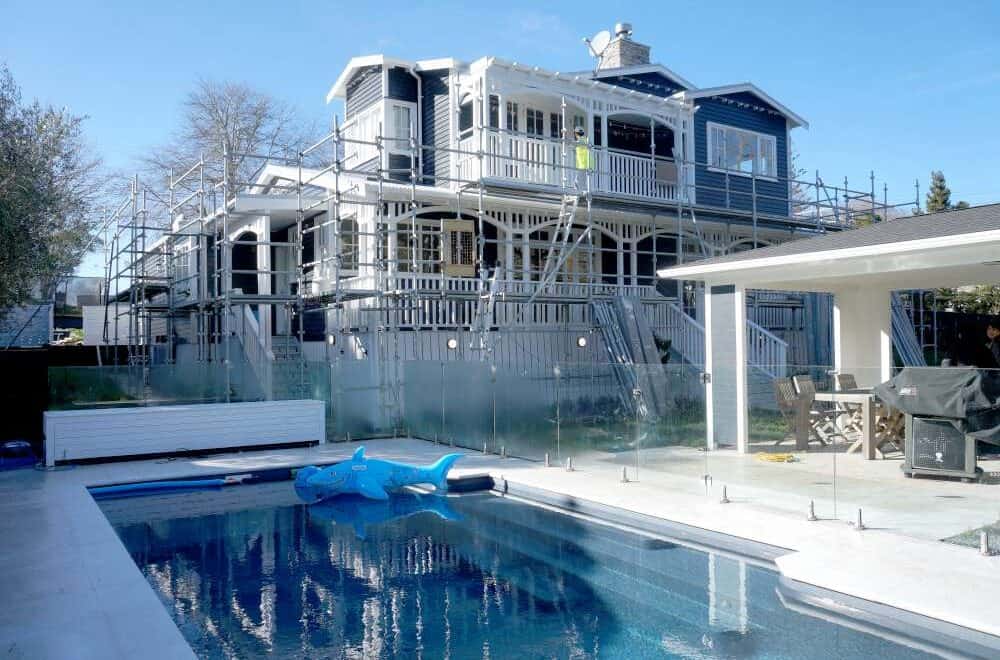
                    Screenshot 2024 11 01 155903 - Superior Renovations
                    House Renovation, Kitchen Renovation

                    Kitchen Planning Measurements NZ | Auckland Designer Guide

                    Standard Kitchen Planning Measurements: An Auckland Designer’s Guide to NZ Standards

                    Quick answer: Standard NZ kitchen planning measurements start with a 900mm benchtop height, 600mm benchtop depth, 1000–1200mm walkways, and AS/NZS 4386 compliant cabinetry. Get these right before cabinetry is ordered and the kitchen will work for the next 20 years — get them wrong and no amount of stone or tile will fix it.


                    kitchen renovation design auckland 2 - Superior Renovations

                    Plan a kitchen reno well and you’ll forget the measurements exist. Plan it badly and you’ll be reminded every morning — the dishwasher door clipping the island, the bench just slightly too low for your back, two people trying to pass each other in front of the fridge. Standard kitchen planning measurements aren’t a constraint. They’re what stops the small mistakes that turn an expensive renovation into a daily frustration.

                    The trouble with most measurement guides online: they default to American inches, Australian sizing, or generic global standards that don’t quite line up with how kitchens are actually built in New Zealand. We’ve designed and built over 1,000 Auckland kitchens through our Wairau Valley Design Studio, and the dimensions below are what we use as the baseline — anchored to the AS/NZS 4386 cabinetry standard and MBIE Building Code guidance, then adjusted for the housing stock we work in.


                    Why Standard Kitchen Measurements Actually Matter

                    Standard measurements exist because they work for most people, most of the time. They’re built on ergonomic research, decades of cabinetry industry practice, and the dimensions of every common appliance you might want to install. The Australian/New Zealand cabinetry standard AS/NZS 4386 defines the construction and dimensional baseline most NZ kitchen manufacturers build to.

                    Standards do two jobs. They make sure your kitchen plays nicely with off-the-shelf appliances — a 600mm dishwasher slots into a 600mm cabinet without modification. And they make sure the kitchen is comfortable to use for the broadest range of body types and cooking habits.

                    Where standards stop being useful is the moment your kitchen is unusual — a 1920s Grey Lynn villa with a 2.4m wide room, a Hobsonville townhouse with an island that needs to anchor an open-plan space, or a homeowner who’s 1.9m tall and tired of leaning over a low bench. That’s when the standards become a starting point and a designer earns their fee.

                    💡 Quick tip: Before any cabinet is ordered, stand at your existing bench (or the bench at your friend’s place) and check how it feels for 10 minutes of food prep. If you’re bending or reaching, the standard isn’t your standard — flag it with your designer early.


                    Standard Benchtop Height and Depth in NZ Kitchens

                    The NZ standard kitchen benchtop height is 900mm from the finished floor. Common range sits between 850mm and 950mm depending on the cook. Most Auckland kitchens default to 900mm because it lines up with off-the-shelf base cabinets, appliance heights, and the assumption of an average-height user.

                    Benchtop depth is typically 600mm front-to-back. That gives you a usable prep zone without the bench eating into the walkway behind you. Add a 20–30mm overhang on the front edge and the bench is comfortable to lean against without your toes hitting the cabinet.

                    Diagram showing standard NZ kitchen benchtop height of 900mm and depth of 600mm

                    The 900mm benchtop height is the NZ default — but it isn’t right for every cook.

                    “The 900mm bench is the default, not the answer. We measure our clients during the design consult — taller cooks usually go to 920 or 950mm, and a couple of our clients with back issues have asked for 880mm because they prefer to brace their arms when chopping. The cost difference is nothing. The comfort difference is daily.”
                    — Alison Yu, Designer, Superior Renovations

                    When to deviate from 900mm

                    Two situations call for a non-standard bench height. The first is body type — if you or your partner is taller than 1.85m or shorter than 1.6m, the standard will feel wrong every time you use it. The second is task — a baking-heavy kitchen often benefits from a slightly lower zone (around 850mm) so kneading and rolling doesn’t strain shoulders, while a coffee or cocktail bench can sit higher to keep the work surface at hand height.

                    If you’re planning to age in place, BRANZ’s Universal Design guidance recommends a height-adjustable bench in the 620–900mm range — worth a conversation with your designer if accessibility is on the horizon.

                    💡 Quick tip: Bench height should be measured from the finished floor — not the subfloor. New flooring (tile, engineered timber, vinyl plank) all add 8–20mm of height, which is why villa renovations in Mt Eden and Ponsonby sometimes end up with a 920mm bench when the spec said 900mm. Get the flooring spec locked before cabinet manufacture.


                    Base Cabinet Dimensions and Modular Widths

                    Base cabinets carry the weight of the kitchen — drawers, pots, the appliances that sit underneath, and the benchtop above. Their dimensions decide what fits where, and they’re built to a standardised module so the cabinetry industry can manufacture efficiently.

                    • Cabinet height (without bench): 870mm typical (with 100–150mm kickboard underneath)
                    • Cabinet depth: 560–570mm carcass plus the benchtop overhang gives the 600mm total
                    • Common cabinet widths (NZ modular): 300mm, 400mm, 450mm, 600mm, 800mm, 900mm, 1000mm, 1200mm
                    • Kickboard (toe-kick) height: 90–150mm — most NZ builders use 100mm
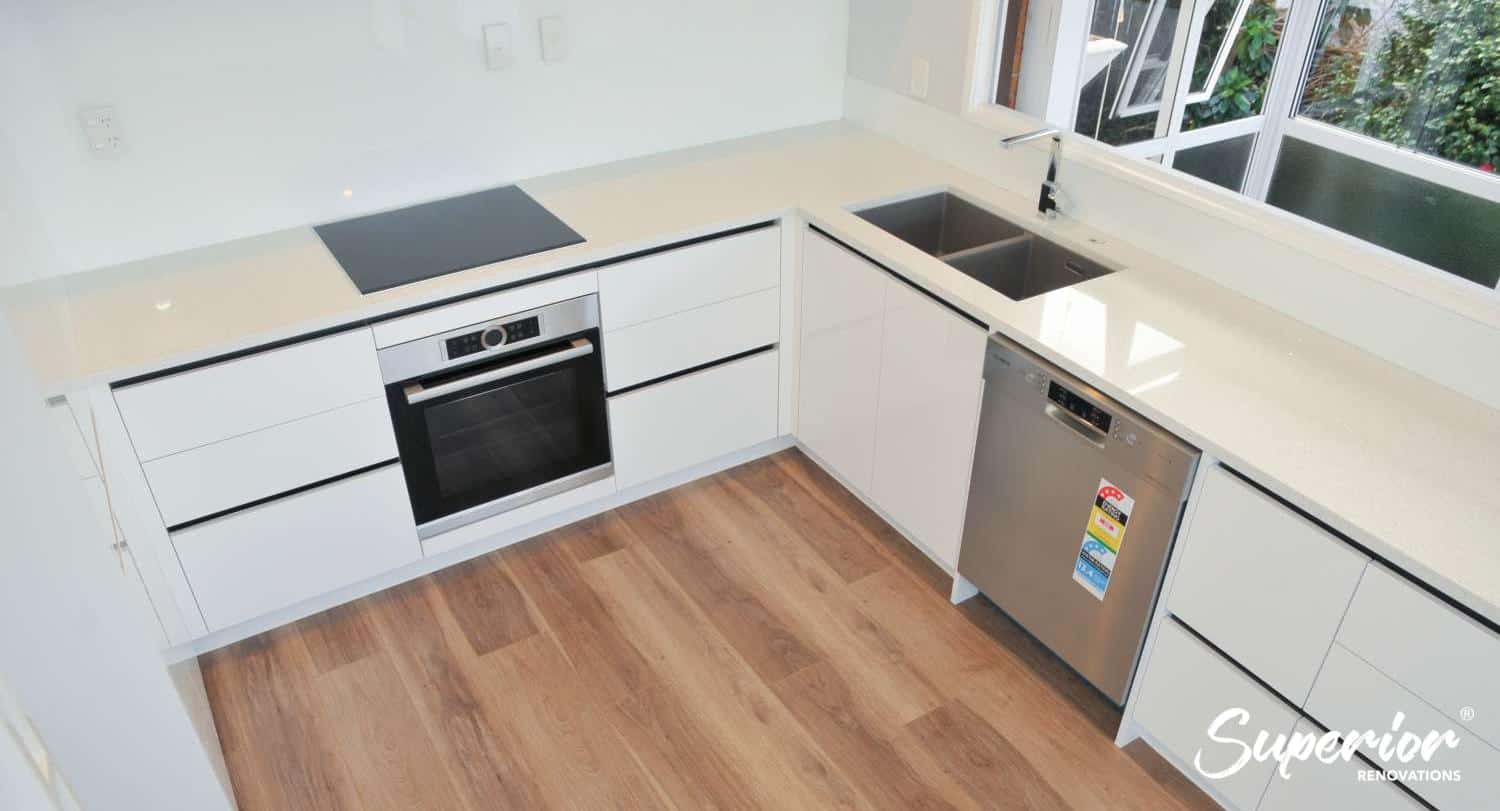
                    The 600mm module is doing the most work in your kitchen. It fits the standard dishwasher, the standard under-bench oven, most freestanding cookers, and the most common drawer bank size. When a designer is laying out your kitchen, the 600mm anchor points usually go in first — sink, dishwasher, cooker — and everything else stretches between them.

                    💡 Quick tip: NZ-made cabinetry typically allows for 18mm panel thickness on carcasses. If you’re ordering imported flat-pack, double-check — some import lines run at 16mm which can mess with how doors and drawers align against an NZ-spec benchtop edge.


                    Upper Cabinets, Wall Storage and Reach Limits

                    Upper cabinets do storage without taking floor space — useful in the smaller kitchens you’ll find in older Ponsonby villas, character bungalows in Mt Eden, and apartment kitchens across the city.

                    • Height from bench to underside of upper cabinet: 600mm is the working standard (per Bunnings NZ guidance and most NZ cabinetmakers)
                    • Upper cabinet depth: 300–350mm — deeper than that and you start ducking when using the bench
                    • Top of upper cabinets: typically 2100mm from floor for standard 720mm tall uppers, or run to the ceiling (2400mm+) for extra storage

                    The reach limit matters more than the storage volume. Anything above 2000mm needs a step ladder for most people — fine for the Christmas platters, useless for daily use. Plan the contents of each upper cabinet before you finalise the height; the top shelf is for things you touch twice a year, not your everyday glassware.
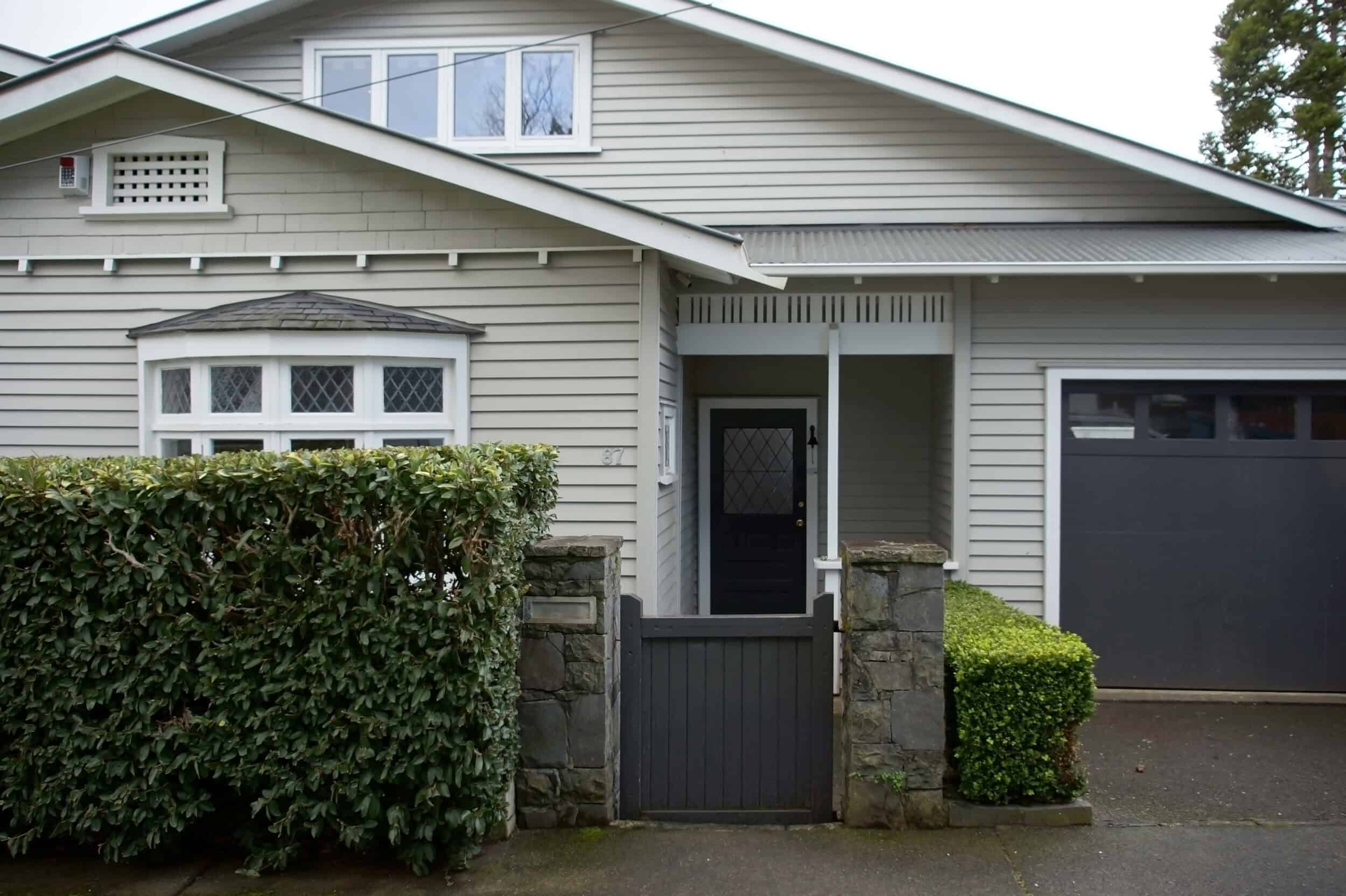

                    Walkway and Clearance Space — The NZ Standard

                    This is where most poorly-planned kitchens fall apart. The layout reads fine on a 2D plan. Then the appliances and the people go in, and suddenly the oven door blocks the fridge and you’re sidestepping every time someone wants the kettle.

                    • Single-cook walkway: 1000–1100mm minimum between bench and wall, bench and island, or bench and bench
                    • Two-cook / busy household walkway: 1200mm minimum — non-negotiable if you regularly cook with another person in the kitchen
                    • Accessible kitchen (MBIE G3/AS1): the NZ Building Code accessibility guidance requires a 1500mm manoeuvring space for wheelchair use
                    • Appliance door clearance: always check the open dimension, not just the closed cabinet width — a 600mm dishwasher needs 600mm of cabinet plus the door projection in front (around 530mm when open)

                    “In open-plan Auckland kitchens — and most of the ones we design now are open-plan — the walkway numbers matter even more than usual. The kitchen isn’t just a kitchen, it’s the corridor between the front door and the lounge. We plan around the traffic flow on a normal Sunday, not a deserted weekday. 1200mm is the minimum we’d set for a family kitchen.”
                    — Eunice Qin, Designer, Superior Renovations

                    💡 Quick tip: Stand in your existing kitchen and have someone open the dishwasher, the oven, and the fridge all at once. If anyone can’t get past, that’s the walkway problem your new design needs to solve. We’ve taken video on consults — it’s the single fastest way to spot a flow issue.


                    Kitchen Island Dimensions for Auckland Homes

                    An island is the best feature in a modern kitchen, or the worst — the difference is almost entirely in the dimensions. Get them right and the island anchors the room. Get them wrong and it’s a 1.5m obstacle eating your floor space.

                    • Minimum island width: 600mm (the smallest a working island can be)
                    • Comfortable working island width: 900–1100mm
                    • Island length: 1800–3000mm depending on room size — anything under 1500mm starts to feel pointless
                    • Bench overhang for stool seating: 300–400mm from the cabinet face (per Houzz NZ’s kitchen island measurement guidance)
                    • Bar stool seat height for a 900mm bench: 600–650mm
                    • Bar stool seat height for a raised 1050–1100mm bench: 750–800mm
                    • Clearance around the island: 1000–1200mm on every side
                    3D kitchen island design showing standard island proportions and overhang for seating

                    Island depth, overhang, and surrounding clearances all need to land together — and the room size dictates which one bends first.

                    How Auckland housing stock affects island sizing

                    The “comfortable” island depends entirely on the room. We’ve worked on Grey Lynn villas with 3m wide kitchens where the right answer was no island at all — a peninsula instead, because the 1200mm clearance just wasn’t possible. We’ve also done Hobsonville townhouses with open-plan ground floors that easily took a 1100 × 2400mm island with seating along one side and a sink along the other. Same family, same budget — completely different island.

                    💡 Quick tip: If you want stools on the island, decide whether you want elbows up or down. A flat 900mm island works for breakfast bowls and laptops. A raised 1050–1100mm section works better for drinks, casual chat, and hiding the working bench from the lounge view. Pick before the cabinetry quote — adding a raised section after the fact gets ugly.

                    For inspiration on how these proportions play out in completed Auckland projects, browse our Kitchen Design Gallery.


                    Appliance Placement and Space Requirements

                    Every appliance has its own measurement rules. Get them wrong and you’ll either block the workflow, hit a ventilation problem, or — most painfully — find out at install that the brand-new range doesn’t quite fit the cabinet you’ve already paid for.

                    Kitchen appliance placement and clearance diagram for fridge, oven, dishwasher and rangehood

                    Appliance clearances stack on top of each other — the fridge door, the oven swing, the dishwasher drop-down all need their own space.

                    Fridge

                    • Standard freestanding fridge width: 600mm (slim), 700mm (mid), 800–900mm (French door / side-by-side)
                    • Cabinet alcove width: add 25–50mm to the fridge width for ventilation
                    • Clearance above the fridge: 50mm minimum for heat dissipation
                    • Door swing clearance in front: 900mm minimum to open and unload

                    Oven and cooktop

                    • Standard oven widths: 600mm (most common), 750mm, 900mm
                    • Bench either side of the cooktop: 300mm minimum, 450mm preferred — for landing hot pans and prep
                    • Cooktop to range hood clearance (electric / induction): 600mm minimum
                    • Cooktop to range hood clearance (gas): 650–750mm depending on the hood manufacturer’s spec

                    Dishwasher

                    • Standard dishwasher width: 600mm (most homes), 450mm (slim/apartment)
                    • Distance from sink: within 900mm — keeps the plumbing run sensible and stops dripping plates being walked across the room
                    • Door-down clearance in front: 530mm projection — needs walkway space accounted for

                    💡 Quick tip: Pick your appliances before the cabinet drawings are finalised, not after. Even within “600mm dishwasher” there’s variation — a Bosch and a Miele can differ by 5mm in height once installed, and that’s enough to leave a visible gap under the benchtop. Send actual model numbers to your designer.


                    Sink and Tapware Measurements

                    The sink area is the busiest square metre of the kitchen. Position and sizing decide whether the kitchen works for one person rinsing wine glasses or two people prepping dinner.

                    • Single bowl sink: 500–600mm wide × 400–500mm deep is the NZ standard
                    • Double bowl / 1.5 bowl sink: 800mm wide × 480mm deep is typical
                    • Sink depth (bowl): 180–220mm — deeper bowls handle pots without splashing
                    • Bench clearance on prep side: 600mm minimum, 900mm preferred
                    • Bench clearance on landing side: 450mm minimum
                    • Mixer tap spout height above the bench: 250–350mm depending on the tap and your sink depth — taller mixers suit pot filling, shorter ones look cleaner against a window

                    If your sink sits in front of a window — and a lot of Auckland kitchens do, especially in character homes facing the back garden — check the mixer doesn’t hit the window frame when the spout swivels. We’ve measured this on consults and found a few clients’ existing taps already bashing the architrave.


                    Lighting Heights — Pendants, Downlights, Under-Cabinet

                    Bad kitchen lighting is one of those things you don’t notice until you’re trying to chop something at 6pm in winter and squinting at the bench. Three lighting layers do the work in a properly designed kitchen — overhead general light, task light on the working surfaces, and feature pendants over the island or dining bench.

                    • Pendant lights over an island: 750–900mm above the bench surface — high enough not to block the view across the kitchen, low enough to cast usable light on the bench
                    • Recessed ceiling downlights: 800–1000mm apart, 600mm from any wall, positioned over the front of the bench (not behind it — otherwise you cast a shadow over your own hands while working)
                    • Under-cabinet LED strip: mounted at the front edge of the underside of the upper cabinet, aimed across the bench
                    • Pendant cord length over a fixed dining bench: 700–800mm above the bench
                    Modern kitchen with layered lighting including recessed downlights and under-cabinet LED strip

                    Layered lighting — recessed downlights for general light, under-cabinet LED for the bench, and pendant lights as features.

                    Kitchen island with pendant lighting hung at standard 750mm above the benchtop

                    Pendant lights positioned low over the island — both functional task lighting and a design feature in their own right.

                    For more on getting kitchen lighting right, our previous guide on the importance of lighting in achieving a beautiful kitchen design goes deeper.


                    Splashback Heights and Wall Coverings

                    The splashback is the wall between the bench and the upper cabinets. Two jobs — protect the wall from water, steam, and oil, and add a finish that suits the rest of the kitchen.

                    • Standard splashback height: 600mm — matches the standard bench-to-upper-cabinet gap
                    • Behind the cooktop: the splashback should extend the full bench-to-rangehood height with no joins — usually 700–900mm depending on hood placement
                    • Full-height splashbacks (bench to ceiling): increasingly common in Auckland renos, particularly with engineered stone or large-format tile — easier to clean, fewer grout lines, more contemporary
                    • Window-as-splashback: a feature in a lot of villa kitchens — the bench abuts the windowsill, no splashback, which works as long as the trim is waterproof-finished

                    Adjusting Standards for Auckland Housing Stock

                    The standards above are the starting point. Auckland’s housing mix means most kitchens need at least one adjustment off-standard, and the older the home, the bigger the gap between “what the textbook says” and “what fits”. Here’s what we see across the suburbs.

                    Pre-1940s villas (Grey Lynn, Ponsonby, Mt Eden, Herne Bay)

                    Original kitchens were often the smallest room in the house — sometimes 2.5 × 3m with a chimney intruding into one wall. Walkway standards still apply, but island ambitions usually need to give way to a peninsula. Ceiling heights are generous (often 3m+), which lets you run tall pantry cabinets up to 2700mm without the room feeling crammed.

                    Leaky-era plaster homes (mid-1990s to mid-2000s, widespread)

                    Standard sizing usually applies, but recladding work in adjacent walls can change the kitchen footprint mid-project. We’ve had situations where new framing post-reclad shifted the wall position by 40mm and forced a recut on the benchtop. Worth factoring in if you’re combining a kitchen reno with weathertightness work.

                    1970s–80s brick-and-tile (South and West Auckland, North Shore)

                    Generally a kind house for kitchen renos — generous floor footprints, square rooms, easy access for delivery and trades. Standard measurements apply cleanly. The constraint is usually ceiling height (2.4m) which limits how tall the uppers can run.

                    Hobsonville, Flat Bush, Millwater townhouses (post-2010)

                    Open-plan ground floors, often with an L-shape kitchen running into a dining-living combined space. Walkway and island standards matter even more here because the kitchen is a circulation space, not just a cooking room. Most of these homes were built with 900mm benches and modular cabinetry already in place — refresh kitchens (replacing doors, benchtop, splashback while keeping the carcasses) often make more financial sense than a full tear-out.

                    Apartments (CBD, Takapuna, Newmarket)

                    Galley kitchens with 800–900mm walkways are the norm, and body corporate rules often prevent moving plumbing or extraction. Compact appliances (450mm dishwashers, 600mm cooktops) get used heavily here. Pay particular attention to ventilation — many apartment kitchens vent through a shared duct that may need consent before any change.


                    How a Designer Catches Measurement Errors Before They Cost You

                    Standard measurements give you the language. Catching the errors specific to your house is where a designer earns their keep. We use a three-stage check on every kitchen renovation through the Design Studio — and most of the errors get caught well before any cabinetry is ordered.

                    • Site measure: we measure the existing room in person, not just from your drawings. Wall lines in older Auckland homes are rarely square, and a 20mm taper across a 3m run will show up in the finished cabinetry unless it’s planned around.
                    • 3D rendered walk-through: a 3D kitchen render lets you see the proportions before manufacture. Walking the camera around the rendered space catches sightline issues (the rangehood looming over the dining table, the pendant lights in the way of the window view) that 2D plans hide.
                    • Shop drawings sign-off: the final cabinetmaker drawings list every dimension to the millimetre, every appliance model number, every hinge type. This is the last stop before anything is cut.

                    “Measurements are the boring part of design, which is exactly why they’re where renovations go wrong. We’ve inherited kitchens where the previous designer signed off on drawings that listed a 600mm dishwasher cabinet next to a 650mm appliance. By the time it’s at install, you’re spending money to fix what should have been caught at drawings stage. The check is half an hour. The fix is thousands.”
                    — Dorothy Li, Design Manager, Superior Renovations

                    If you’d like a sense of what the design process looks like end-to-end, our Design Studio page walks through it — or check out our previous guide on top kitchen design ideas for a small kitchen renovation for layout examples that put these measurements to work.

                    The measurements above are the baseline most Auckland kitchens are built to, but they’re the start of the conversation — not the end. A 900mm bench is right for most people. A 1200mm walkway works for most households. Where the standards stop being useful is also where the design work properly begins.

                    Book your free in-home consultation with Superior Renovations
                    Use our kitchen renovation cost calculator
                    Request a free feasibility report for your project


                    What is the standard kitchen bench height in NZ?

                    The NZ standard kitchen bench height is 900mm from the finished floor, with a common range of 850-950mm depending on the cook's height. The AS/NZS 4386 cabinetry standard is built around this 900mm baseline. Taller cooks (over 1.85m) often go to 920-950mm for back comfort, and homeowners planning for accessibility can spec a height-adjustable bench in the 620-900mm range per BRANZ Universal Design guidance.

                    How much walkway clearance do I need in an Auckland kitchen?

                    Single-cook kitchens need a minimum walkway clearance of 1000-1100mm between bench and wall, bench and island, or bench and bench. Two-cook or family kitchens need 1200mm minimum. Accessible kitchens require 1500mm manoeuvring space per the NZ Building Code G3/AS1 guidance from MBIE. In open-plan Auckland homes where the kitchen is also a corridor, 1200mm is the practical minimum.

                    What is the standard benchtop depth in a NZ kitchen?

                    The standard NZ kitchen benchtop depth is 600mm front-to-back. This is made up of a 560-570mm cabinet carcass plus a 20-30mm overhang on the front edge. The 600mm depth comfortably fits a standard 600mm appliance like a dishwasher or under-bench oven while leaving a usable prep zone on top. Islands often run deeper at 900-1100mm to accommodate seating overhangs.

                    How big should a kitchen island be in a typical Auckland home?

                    A working kitchen island should be at least 600mm wide and 1500mm long, with 1800-3000mm length being more common in Auckland homes. For seating overhangs, plan 300-400mm of overhang from the cabinet face and 600-650mm seat height stools for a 900mm island. Allow 1000-1200mm of clearance on every side of the island for walkway flow.

                    What is the minimum distance between cooktop and range hood in NZ?

                    For electric and induction cooktops, the minimum cooktop-to-rangehood clearance is 600mm. For gas cooktops, the clearance increases to 650-750mm depending on the rangehood manufacturer's specifications. Always check the appliance manual — some high-output gas cooktops require larger clearances, and some sealed gas/induction hybrids have their own specific requirements.

                    How high should upper kitchen cabinets be installed above the bench?

                    The standard NZ height from benchtop to the underside of upper cabinets is 600mm. This gives enough clearance for benchtop appliances (kettles, mixers, coffee machines) while keeping the upper cabinet contents within reach. Upper cabinets typically run from 1500mm height up to 2100mm for standard 720mm tall units, or up to ceiling height (2400-2700mm) for full-height storage.

                    What kitchen cabinet widths are standard in New Zealand?

                    Common NZ kitchen cabinet widths follow a modular system: 300mm, 400mm, 450mm, 600mm, 800mm, 900mm, 1000mm and 1200mm. The 600mm module is the most common because it fits standard NZ appliances — dishwashers, single ovens, freestanding cookers. Most NZ-made cabinetry uses 18mm panel thickness on carcasses, which affects how doors and drawers align in the final installation.

                    What clearance does a fridge need in an Auckland kitchen?

                    A freestanding fridge needs 25-50mm of width clearance in its cabinet alcove for ventilation, 50mm minimum above for heat dissipation, and 900mm of clear floor space in front for the door to swing open and allow loading. French door and side-by-side fridges (800-900mm wide) need extra planning because the doors swing wider than standard hinged fridge doors.

                    What is the standard kitchen sink size in NZ?

                    NZ standard kitchen sink sizes are 500-600mm wide x 400-500mm deep for a single bowl, or 800mm wide x 480mm deep for a double or 1.5 bowl sink. Bowl depth is typically 180-220mm. Plan for 600mm minimum (900mm preferred) of bench clearance on the prep side of the sink, and 450mm minimum on the landing side. Mixer tap spouts typically project 250-350mm above the bench.

                    How high should pendant lights hang above a kitchen island?

                    Pendant lights above a kitchen island should hang 750-900mm above the bench surface. This gives enough room not to block sightlines across the kitchen, while casting useful task light onto the bench. For pendants over a fixed dining bench or raised breakfast bar, hang slightly higher at 700-800mm above the bench. The cord or rod can usually be shortened on site to fine-tune the final hang height.

                    Do I need to follow the AS/NZS 4386 standard for my kitchen?

                    AS/NZS 4386 is the Australian/New Zealand standard for domestic kitchen assemblies and is the baseline most NZ kitchen manufacturers build to. While it isn't a legally enforced building code requirement for a residential kitchen renovation, building to this standard means your kitchen will be compatible with off-the-shelf appliances, will use sensible ergonomic dimensions, and will be easier to repair or refresh in future. Any reputable NZ cabinetmaker will be building to this standard by default.

                    Can a designer change the standard measurements to suit my body type?

                    Yes — and they should. Standard NZ kitchen measurements are designed for average body types, but a good designer will measure you during the consult and adjust bench heights, cabinet positions, and reach distances to suit. Common adjustments include 920-950mm benches for taller cooks, 850-880mm zones for baking-heavy use, lower upper cabinets for shorter cooks, and full Universal Design specs for ageing-in-place planning. Adjustments are easy at design stage and expensive after manufacture.


                    Further Resources for Your Kitchen Renovation

                    1. Featured projects and Client stories to see specifications on some of the projects.
                    2. Real client stories from Auckland

                    Need more information?

                    Take advantage of our FREE Complete Home Renovation Guide (48 pages), whether you’re already renovating or in the process of deciding to renovate, it’s not an easy process, this guide which includes a free 100+ point check list – will help you avoid costly mistakes.

                    Download Free Renovation Guide (PDF)


                    finance - Superior Renovations

                    Have you been putting off getting renovations done?

                    We have partnered with Q Mastercard ® to provide you an 18 Month Interest-Free Payment Option, you can enjoy your new home now and stress less.

                    Learn More about Interest-Free Payment Options*

                    *Lending criteria, fees, terms and conditions apply. Mastercard is a registered trademark and the circles design is a trademark of Mastercard International Incorporated.


                    Still have questions unanswered?

                    Book a no-obligation consultation with the team at Superior Renovations,
                    we’d love to meet you to discuss your renovation ideas!

                      Services

                      Home RenovationKitchen RenovationBathroom RenovationOutdoor RenovationHouse ExtensionCommercialDesign ServicesOther

                      By submitting this form, you agree to receive communications from us via email or text regarding our services, you can unsubscribe at any time.

                      This site is protected by reCAPTCHA and the Google

                      Privacy Policy and Terms of Service apply.


                      References

                      1. Standards New Zealand — AS/NZS 4386.1:1996 Domestic kitchen assemblies (Kitchen units)
                      2. Building Performance (MBIE) — Building Code accessibility guidance: Kitchens
                      3. BRANZ Build Magazine — Universal Design Supplement: Kitchens (Issue 168)
                      4. Bunnings New Zealand — How to measure up for a new kitchen
                      5. Houzz New Zealand — Key measurements for designing the perfect kitchen island
                      In early June, I hired Superior Renovation company to thoroughly renovate our two bathrooms. The project has now been completed and we are very satisfied. Thank you sincerely, and we highly recommend it.
                      Despite some delays, Eunice, Neil and the team at Little Giants have done a really good job on out kitchen renovation. Great finishing and very responsive to fixing up any little thing we weren't happy with.

                      Good work team!
                      ​From the very first consultation, our experience with this team has been nothing short of stellar.

                      ​Working with Eunice, our sales consultant, set a high bar for the rest of the project.
                      Eunice is truly exceptional at what she does. When we first began our kitchen project, we went through several versions of our floor plan, and she was with us every step of the way—from the initial planning stages right through to the final concept. Her patience and dedication during the design process were remarkable.
                      Throughout the project, Eunice provided:
                      * **Invaluable Suggestions:** She has a keen eye for both aesthetics and functionality, pointing out details we never would have considered on our own.
                      * **Seamless Adjustments:** No matter how many tweaks we requested, she handled every change with professionalism and a "can-do" attitude.
                      * **Expert Guidance:** She transformed our vague ideas into a cohesive, stunning reality.

                      ​Once the planning was complete, Neil, our project manager, took the reins and truly blew us away. Neil is a consummate professional who balances technical expertise with fantastic communication.
                      ​ He kept us informed at every stage, ensuring we knew exactly what to expect and when.
                      Whenever a minor pivot was needed, Neil handled it with grace and efficiency, keeping the timeline on track.
                      His standards for the renovation work were incredibly high, ensuring the final result was polished and beautiful.

                      ​The transition from Eunice’s initial planning to Neil’s execution was flawless. If you are looking for a team that combines design expertise with top-tier project management, look no further. We are absolutely thrilled with our new kitchen and new flooring !
                      Superior Renovations has just finished a complete remodel of my bathroom. I can see, why the company has such a high reputation. At every stage, from sales, design, project management, and execution, the company excelled at every point. I am just so happy with the work that they have done and they have exceeded my expectations at every point.
                      Used Superior for a kitchen and bathroom renovation last year. They did an excellent job updating both rooms, communication was excellent ongoing tjrough the project, they coordinated all the tradies, synchronized so there was little downtime, and it all worked exactly as planned and on budget. Was really glad we chose Superior Renovations and plan to use again for our entrance way at some stage.
                      As I said to my work colleagues ‘I have just had the most pleasant experience’. When they realised it was with renovations at home they were shocked - ‘unheard of’ I was told.
                      Everything went to plan - timing, project management, costs, etc, etc. Neil communicated with me daily and made my whole bathroom renovation a pleasure.
                      The best decision I made was choosing Superior Renovations.
                      Thank you Kevin for our initial connection and for passing me on to Neil to manage the whole process.
                      We just finished a bathroom renovation and couldn’t be happier with the results. The craftsmanship is top-notch, and the attention to detail in the tiling and finishing is impressive. The team was professional, kept the workspace clean, and delivered exactly what we envisioned. Highly recommend them for anyone looking for a high-quality transformation.
                      Superior did an excellent job of renovating our ensuite. Project manager Jacob was easy to work with and communications were good.
                      This is our second review for Superior Renovations. They have done two projects earlier this year and we were so impressed by the work they have finished. After discussing and very careful consideration, we decided to go with more projects with them. So far, they have now completed stage 1 renovation of our house. We still amazed for their knowledge and services; they really listen to us and discuss anything with us if they feel/think could be better…
                      From the first day we work with them, we have no issue with them at all, from communication, discussing, designing to the teams working on the site.
                      Especially we are highly recommended to those who are considering doing the house renovation, please contact them and you will know why we are so pleased to have them to do our house renovation.
                      We are thanking Cici, Neil and the teams so much….
                      We are looking forward to seeing what the outcome will be.

                      David and Emily
                      We recently had our bathroom renovated by Superior Renovations and couldn’t be happier with the experience. Dorothy and Neil were an absolute pleasure to work with. They guided us through every step of the process, making what can be a stressful experience feel smooth and straightforward.
                      The quoting process was transparent and detailed, with no hidden fees or surprises. Neil was incredibly responsive and always available whenever we had questions or requests, which gave us real peace of mind throughout the project. We really love the end result and enjoy our new bathroom!
                      We’ll definitely be returning to the Superior Reno team for our next project. Highly recommended!
                      Our bathroom reno has just been completed & I am so happy. The whole process was easy & hassle free. Alison designed our bathroom & was very patient with our changes/then changes back again. Jacob our project manager was a delight to deal with. He always kept us informed of the scheduling & any other information we may have needed. All the tradies worked hard & the job was completed & signed off within 3 weeks. That's demo, full tiling, installation of new everything & delivery & pick up of the skip down a very tricky driveway. We absolutely love the new bathroom & would recommend Superior Renovations everyday. Future jobs I will definitely be contacting them again. Thank so much for your excellent work
                      Having explored our reno options, it was an easy decision to select Superior Renovations for our work. As first timers at anything like this we had to trust the system with grand old 100year old bungalow. We were so pleased to have Cici, Sonny and Kai working with us the whole way through. Be shout out to all the team, builders, plumbers, electricians, tilers and painters. A superb job delivered on budget and ahead of time. The communication from Cici and Sonny was first class. Would highly recommend working with Superior Renovations in fact, we already have more worked booked in. Thanks Superior you made Millie and Monty's parents very happy. 🐾
                      I am very happy with the recent renovation for my new kitchen.
                      The team worked really hard to get it done within the time frame.
                      The manager, Jacob, was very helpful and communicated well and always sorts out any issue immediately.
                      Thank you Irene
                      We couldn’t be happier with our new pergola! From start to finish, the team was professional, punctual, and easy to work with. They took the time to listen to what we wanted and offered great suggestions to make the design even better. The quality of the materials and workmanship is outstanding — everything feels solid, well-built, and beautifully finished. Kudos to Sinan Sun as she has been an amazing contact with the company.
                      We are very pleased with our bathroom reno by Superior Renovations! Jacob, Cici and the team always kept us up to date, were always friendly to deal with and finished ahead of schedule. Most importantly we are very happy with the quality of the work.
                      We have been working with Superior Renovations as a supplier now for over three years. In that time we have found the team to be very professional and well organised. Which is a welcome relief in this industry! Just recently we have become their sole supplier for portaloos, which recognises the collaboration we have forged over these three years.

                      In particular, Leanne and Elaine set a very high standard of communication and flexibility. This is of vital importance when scheduling deliveries and pickups with us, however, they understand not everything can be done at once and are willing to work with us for the best (supplier/contractor/client) outcome.

                      I would imagine this ethos would flow directly through to all their contracted renovation work. A pleasure to work with!
                      A very reliable supplier – we’ve been working with them for three years now, and they have never let us down. Well done to the team.
                      We have been working with these guys for the past 4 years and find them an awesome company to work with, very efficient and organised. I highly recommend!
                      Finding someone reliable for renovations has always been the most stressful thing for us. In the past, we had several painful renovation experiences—money was spent but the problems were never truly solved, and things often ended up worse than before. We really didn’t know where to find a trustworthy renovation company.

                      For more than ten years, our wish had been to renovate our bathroom, laundry, and toilet, so that we could finally enjoy a comfortable and functional living environment. Just when we were about to give up, we came across Superior Renovations online. We quickly made an appointment with Cici, who designed and provided us with a quote.

                      Throughout the whole process, I was deeply impressed by the professionalism of Superior Renovations. What stood out most was that they always delivered on their promises—everything agreed upon was completed on time. This built a relationship of trust and reliability. Up until completion, I was completely satisfied with their dedication and the quality of their workmanship.

                      During the renovation, we encountered some of the challenges that often come with older houses, but Cici and her team helped us resolve the discomforts we had been living with for years. We are truly grateful to the construction team.

                      Some say renovations are easy if you just have money, but I believe the most important thing is finding a trustworthy team that keeps their word, values quality, and cares about the customer’s experience.

                      Because of this renovation experience, we can now confidently plan our next project—the kitchen—and Superior Renovations will definitely be our first choice. We strongly recommend them.

                      Finally, I want to thank Cici and the team for helping us fulfill our dream.

                      Mark & Kate
                      Sinan is a very good consultant. She helps a lot during renovation. Very satisfied with their job.
                      It was great to have Alison's recommendations and input on how & what would look best for our kitchen and bathroom reno. Jacob, our project manager, has been a star too; ensuring that the project was delivered as planned, AND giving us great ideas & suggestions along the way.

                      We will definitely be calling on you guys again for our next home reno. Thanks team!
                      Very impressed with Superior Renovations.Building our pergola with blinds for a fair price .First thank you Sinan for quoting the job and your flexabilty and knowledge..Secondly the job was done well within the time frame, thanks to Jeff for supervising the job ( eventhough he wasn't too well) and keeping us up to date throughout the process. Payment was fair and easy as well .
                      Thoroughly recommend Superior Renovations for your reno job 👍
                      Very efficient team of workers and high quality finish.
                      Very happy with our renovated bathroom.
                      We will use this company again.
                      We’re very happy with the renovation work done by the team. It’s rare for renovation projects to finish on time, but they committed to completing ours before the Easter holiday—and they delivered! Our project manager, Jacob, worked incredibly hard (even physically! 😄) to make it happen.

                      I admit I might not have been the easiest client—I was particular about details like colours, tile placement, and exactly where the hand basin bowl should sit on the bench. But they listened, took it all on board, and got it done. Thank you, Jacob!
                      I’ll definitely bring you another challenge in the future. 😉
                      Thanks Superior Renovations for doing our house, it definitely looks a lot better now! Special thanks goes to Alison and Jacob for their excellent effort and good manners in handling the construction process, it wasn't easy but with them around it definitely became easier to handle. Cheers🥂